Protect Cloud Containers from Zero-Day Attacks with AccuKnox

Enterprise cloud native container security platform to prevent Zero Day attacks

SCHEDULE DEMO
Container Security

Kubernetes applications have faced an onslaught of security challenges – exploitable flaws, misconfigurations, coding errors, and infiltrations by hacking teams. Open-source projects are increasingly becoming breeding grounds for malicious logic, while software update services are exploited as dynamic backdoors, injecting malicious code at runtime.

Pain Points in Container Security

  • Vulnerability Onslaught – Numerous security incidents plague Kubernetes applications.
  • Dynamic Threats – Hacking teams actively exploit open-source projects and update services.
  • Insufficient Security Policies – DevOps teams struggle with integrating effective security policies.
  • Half of Docker hub images contained at least one critical vulnerability.
  • Programming errors, infrastructure vulnerabilities, and misconfigurations.
  • 430% growth in cyber attacks targeting open-source software projects.
  • Sophisticated hacking teams actively seeding open-source projects with malicious logic and pre-infected images.

Comprehensive Container Security Solutions

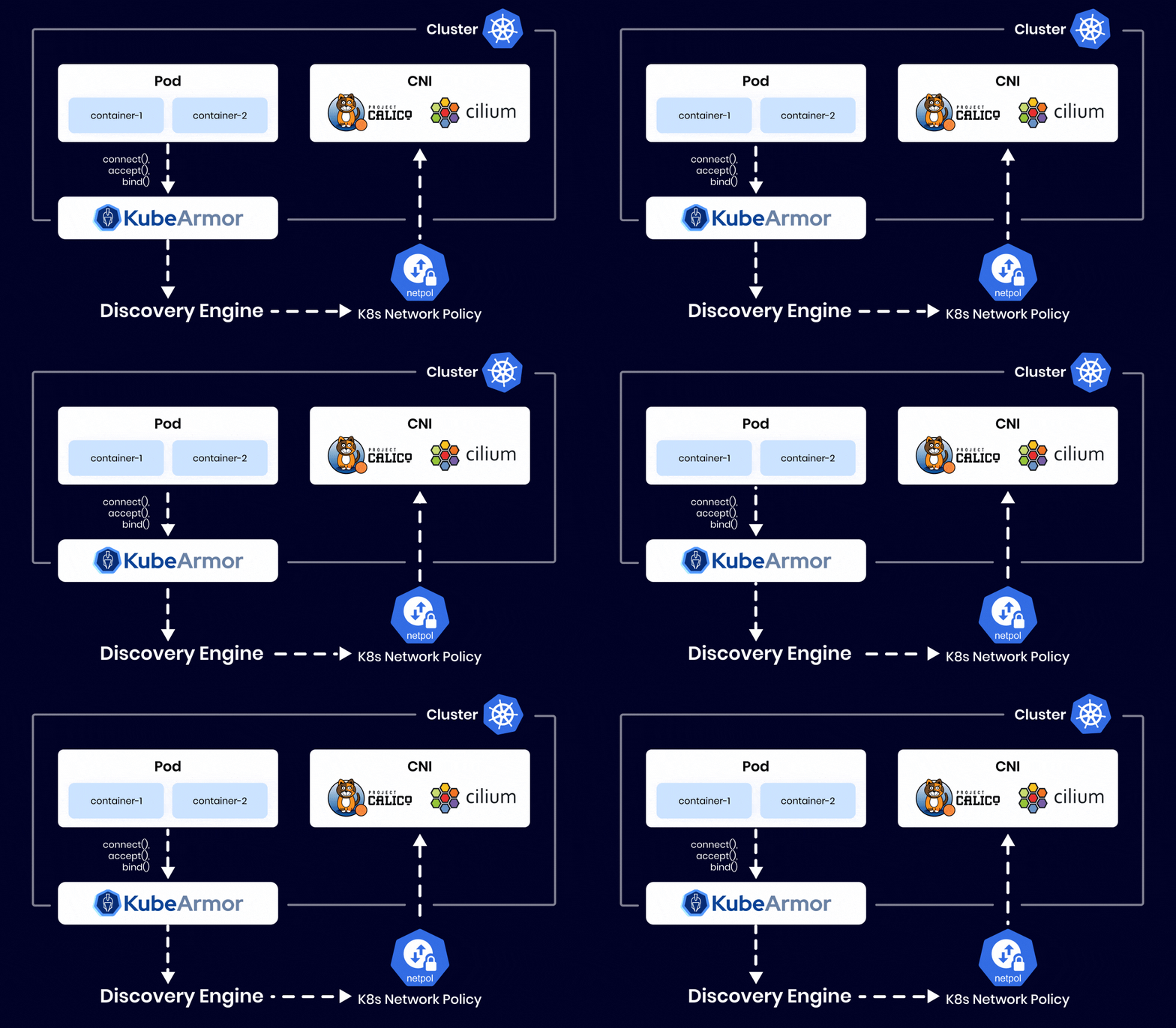
Restrict the behavior of containers and nodes (VMs) at the system level. Traditional container security solutions protect containers by determining their inter-container relations (i.e. service flows) at the network level.

In contrast, AccuKnox prevents malicious or unknown behaviors in containers by specifying their desired actions (e.g., a specific process should only be allowed to access a sensitive file, process, or network). AccuKnox also allows operators to restrict the behaviors of nodes (VMs) based on node identities.

  • Full lifecycle container security management
  • Combines Static and Run-time Security
  • Automated Continuous compliance & governance against CIS, PCI, NIST, MITRE
  • Detailed Auditing and Container Forensics powered by eBPF
Image

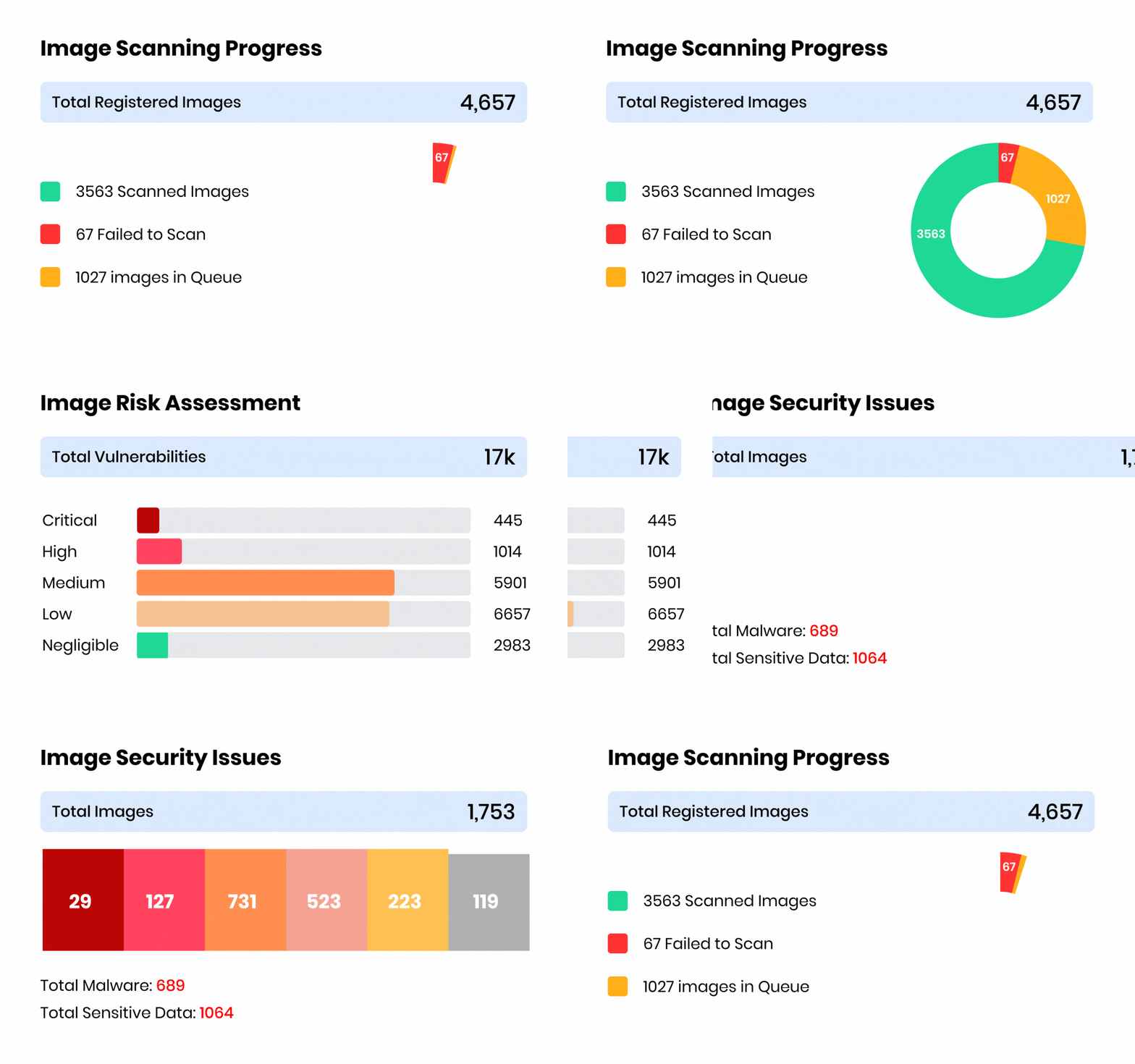
Container Security Scanning according to NIST Guidelines

Do Not Play Catch-Up with Security Flaws

  • Optimize Platform Configurations
  • Extensive Monitoring and Alerting
  • Automated Incident Response
  • Hardware-Anchored Identity and Trust

AccuKnox Container Security Pillars

  • Proper Platform Configuration
  • Security Automation
  • Purpose-Built Solutions

Take Your Defences Beyond the Basics

  • Runtime Threat Detection
  • Custom Incident Investigation
  • Self-Learning Anomaly Alerts

Least Permissive Application Management

  • Assume a hostile cyber ecosystem
  • Presume you have been breached
  • Remove trust assumption for apps, libs, and infrastructure
  • Apply a least-permissive security policy against every app
  • Monitor every policy violation that the app performs

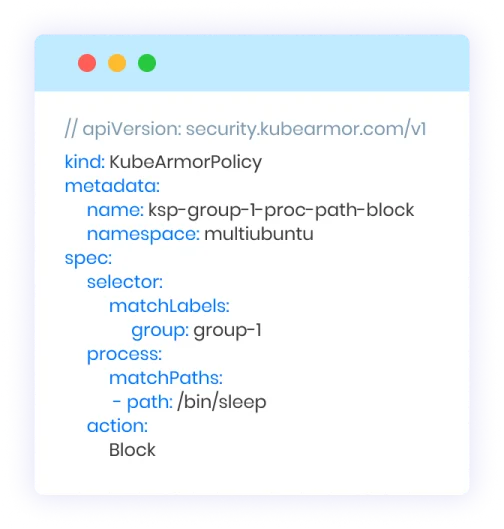
YAML policies act as guardians, setting rules for Kubernetes through tools like KubeArmor. They’re like personalized instructions for containers, dictating what they can and cannot do. By specifying details like process paths and labels, these policies ensure that containers operate with just the right amount of access – not too much, not too little.

Image
Image

Proactive Container Security Monitoring against Unauthorized

  • Network Interface usage
  • Backdoor fetch-store-exec operations from subverted process or
  • Embedded malicious logic
  • File system manipulations
  • Process execution, termination, thread hijacking
  • Administrative functions and command invocations
Image

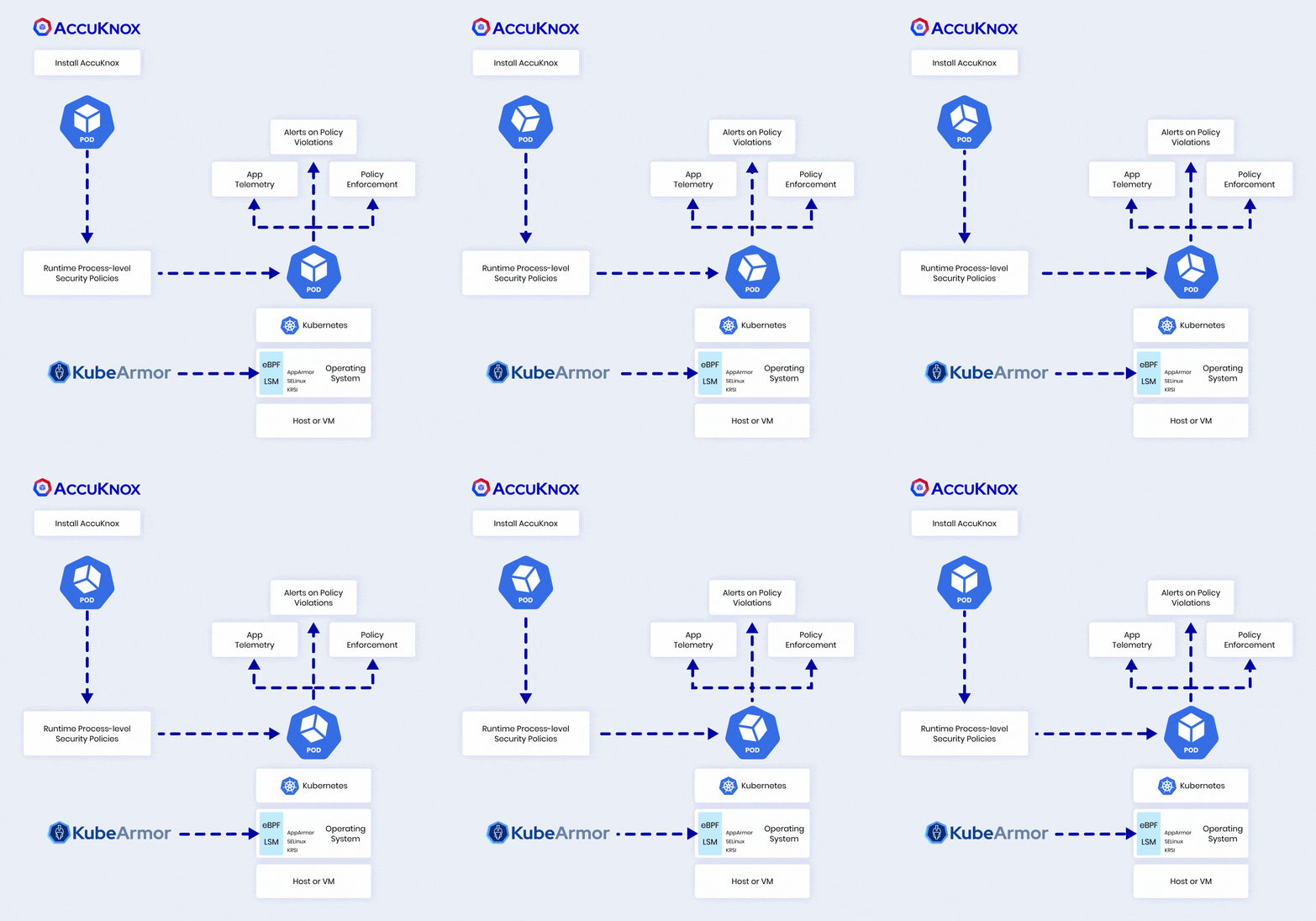
With AccuKnox you get robust identity management for all cross-workload communications and detailed application-level audits and alerts for any permission violations.

demo-cta

Talk to Security Experts

founder-image

Ready to Protect Your Sensitive Cloud Assets?

Why AccuKnox for Container Security

  • Granular Control:
    Imagine your pod-specific YAML security policies enforcing granular controls with the kernel’s native security services.
  • Least Permissive Constraints
    It’s not about doing the minimum; it’s about doing the least permissive. KubeArmor restricts pod behavior to the bare minimum for security that’s maxed out.
  • Digital Forensics at Scale
    Containers behaving mysteriously? Our digital forensics at scale identifies and subverts unstable behavior with dashboard alerts.
  • Incident Response
    When incidents strike, we don’t just respond; we become the powerhouse. Capturing digital forensics for effective response and fault analysis.
  • Deep Learning Magic with VAE
    VAE isn’t a regular algorithm; it’s a wizard training neural network. Imagine it as your magical sidekick, recognizing normal system call patterns like no other.
  • Performance Breakthrough
    Outperforming standard publishers isn’t just a win; it’s a victory lap. VAE is the Usain Bolt of CPU cost and processing time.
  • Proactive Defence
    It’s not just defense; it’s proactive defense. VAE detects the storm before it hits, identifying unstable and anomalous patterns in your container realm.
Image

Container Security Product Tour

Ready For A Personalized Security Assessment?

“Choosing AccuKnox was driven by opensource KubeArmor’s novel use of eBPF and LSM technologies, delivering runtime security”

idt

Golan Ben-Oni

Chief Information Officer

“At Prudent, we advocate for a comprehensive end-to-end methodology in application and cloud security. AccuKnox excelled in all areas in our in depth evaluation.”

prudent

Manoj Kern

CIO

“Tible is committed to delivering comprehensive security, compliance, and governance for all of its stakeholders.”

tible

Merijn Boom

Managing Director

Protect Cloud Containers from Zero-Day Attacks with AccuKnox FAQs

Yes, modern platforms use AI to predict risky behavior and flag anomalous patterns before exploitation. Our product applies AI-driven baselines with inline policy enforcement to preempt container attacks across clusters. See AI-first CNAPP and Gen-3.0 cloud security for proactive threat mitigation aligned to Zero Trust and multi-cloud operations.
Leading vendors provide inline detection to block process, file, and network abuse at execution. Our product delivers real-time runtime detection with prevention using eBPF/LSMs and automated responses. Explore runtime security and why real-time runtime security matters for automated sensing, alerting, and mitigation without impacting workload performance.
Yes, enterprise platforms integrate natively with major clouds for identity, logs, and policy orchestration. Our product supports AWS, Azure, GCP, OCI, and on-prem with unified controls and compliance. Review CNAPP datasheet and on-prem & hybrid support for coverage, architecture, and deployment models.
High-signal detection needs runtime context and policy learning. Our product reduces noise via context-aware rules, AI baselining, and least-privilege policies generated from actual workload behavior. See container runtime comparison and DevSecOps playbook–integrations tour for tuning guidance and SOC workflow integrations.
Yes, CSPM/KSPM tools benchmark configurations and map to frameworks. Our product’s KSPM provides drift detection, RBAC analysis, and compliance mapping across SOC2, NIST, PCI, HIPAA. Learn more at KSPM platform and Kubernetes security best practices for posture hardening and continuous audit readiness.
They hook low-level events (syscalls, file, network) to enforce least-privilege at pod level. Our product uses eBPF + LSMs (AppArmor/SELinux) via KubeArmor to block unauthorized behaviors inline. Dive into KubeArmor runtime enforcement and implementing runtime security with KubeArmor for architecture and policies.
Effective platforms unify runtime controls with evidence-grade compliance dashboards. Our product pairs CWPP runtime enforcement with automated reports mapped to CIS, NIST, PCI, HIPAA, and SOC2 for auditors. See What is Runtime Security? and CNAPP buyer’s guide to align controls and reporting.
They embed checks pre-commit and in CI/CD to block risky images and IaC misconfigurations. Our product integrates with GitHub, GitLab, Jenkins, CircleCI, Azure DevOps, Argo for gating and ticketing. Explore CI/CD integration tour and Kubernetes security tools overview for pipeline patterns.
Defense needs runtime controls, immutable images, and blast-radius reduction. Our product enforces deny-by-default file/process policies, detects encryption patterns, and automates response (quarantine, kill, revoke). Review runtime security and Talos OS + KubeArmor hardening to contain ransomware at execution.
Top choices unify posture, runtime, and identity across clouds. Our product is AI-native CNAPP supporting multi-cloud/on-prem with centralized policies and reporting. See CNAPP platform and Gen-3.0 cloud security for scalable multi-cloud guardrails and governance.
You need behavior-based detection rather than signature reliance. Our product uses eBPF-level telemetry and LSM enforcement to stop unknown techniques (fileless, living-off-the-land) in real time. Learn more at runtime threat detection and runtime security for zero-day containment.
Open-source powers transparent, auditable defense. KubeArmor (CNCF) provides runtime enforcement; our product extends it with enterprise dashboards, compliance, and response. Start with open-source KubeArmor and the KubeArmor GitHub repo for policies, demos, and docs.
Telecom needs deterministic runtime control, RIC/xApp governance, and east-west isolation. Our product secures 5G/O-RAN workloads with runtime enforcement and policy automation. Explore 5G security platform and SE-RAN video for telecom-grade protections and compliance.
Zero Trust requires strong identity, microsegmentation, and continuous verification. Our product enforces workload identity, least privilege, and deny-by-default policies across clusters. Read Zero-Trust Kubernetes and Zero-Trust cloud security for architectural patterns and outcomes.
Look for platforms unifying image/IaC scanning, runtime defense, and compliance. Our product’s CNAPP merges vuln management with CWPP/KSPM and automated evidence for audits. See What is CNAPP? and CNAPP platform to consolidate tools and workflows.
Hybrid environments demand consistent controls across datacenter and cloud. Our product supports fully air-gapped on-prem and public cloud with unified policy, runtime enforcement, and compliance. Review on-prem security and DoD playbook alignment for deployment options.
Prioritize runtime prevention, multi-cloud coverage, CI/CD fit, and auditor-ready reports. Our product delivers inline mitigation, broad integrations, and 30+ frameworks mapping in one platform. See CNAPP buyer’s guide and CNAPP datasheet to evaluate criteria.
Multi-engine estates need portable policies and centralized ops. Our product manages policies across EKS/AKS/GKE/OpenShift/Talos with discovery, generation, and drift control. Explore Kubernetes security platform and Spectro Cloud integration for multi-cluster consistency.
Best-in-class tools pair actionable dashboards with playbooks that revoke, quarantine, or patch automatically. Our product offers evidence-grade dashboards and automated remediation across CI/CD and runtime. See integration tour and remediation/ADR capabilities for workflows.
Coverage should include SBOMs, CVEs, misconfigs, and secrets across registries. Our product integrates image/IaC scanning with runtime guardrails and compliance tracking. Learn more at Kubernetes security tools and What is CNAPP? for end-to-end coverage.
Regulated workloads require measurable enforcement and continuous evidence. Our product maps controls to GDPR/HIPAA/PCI/NIST and applies deny-by-default runtime policies to protect data flows. Review compliance resources and help center, CNAPP definition for control coverage and reporting.
Agentless methods accelerate onboarding and inventory, while runtime still needs enforcement. Our product performs agentless posture/vuln assessments and augments with inline runtime policies where needed. See CNAPP platform and runtime vs. static security to plan deployments.
Adoption hinges on frictionless developer experience and SOC interoperability. Our product integrates with CI/CD, SIEM/SOAR, ticketing and supports pre-commit to runtime gates. Explore integration tour and Kubernetes security best practices for pipeline patterns and guardrails.
Real-time visibility needs kernel-level telemetry and cluster-native policies. Our product streams live runtime events with eBPF/LSM enforcement and centralized dashboards across clusters/namespaces. Learn more at runtime security and securing K8s runtime webinar.
Enterprises demand tailored evidence for auditors and executives. Our product provides custom dashboards, exportable reports, and framework-mapped evidence across assets, risks, and mitigations. See CNAPP platform and container runtime comparison to align reporting with stakeholders.
Cloud container security safeguards containerized applications against potential dangers and threats. It deals with security tools and guidelines that address every aspect of the container ecosystem, such as infrastructure, runtime, software supply chain, and lifecycle management. This is achieved through:
Perimeter monitoring
Infrastructure reinforcement
Access control implementation
Ongoing security posture assessment and improvement
Hardening components, controlling vulnerabilities, and proactively identifying and countering threats are all part of container security requirements.
Protecting data storage, image scanning for dangerous material, and securing container image registries play key roles. Continuous security is necessary throughout the software development life cycle since containers make deployments simpler. Build pipelines, host computers, runtimes (like Docker), orchestrators (like Kubernetes), and application layers are all required activities.
Cloud architects need to understand the technology layer and associated activities to guarantee strong container security.
Container security vulnerabilities are potential flaws, gaps, or malfunctions in how container technologies are configured or work. These flaws can allow attackers to penetrate, tamper with data, or disrupt applications running within containers.
Common issues include out-of-date software, unpatched vulnerabilities, and ineffective encryption mechanisms. To reduce these risks, container vulnerability scanning tools like AccuKnox Enterprise CNAPP examine container images and their dependencies for known vulnerabilities and misconfigurations.
Container security best practices include protecting containerized environments by implementing security controls throughout their lifespan. Top recommendations include:
Vulnerabilities can be avoided by scanning and using reliable photos for security.
Limiting access and requiring signatures on secure registers to protect image stores.
Restricting container permissions and securing deployment for network policies.
Using thin, short-lived containers to limit the attack surface by decreasing container size.
Monitoring container activity for better temperature and visibility (prompt remediation).
Container security scanning involves detecting security vulnerabilities within containers and their components. The scanning process examines various components, such as software, host OS interactions, and networking configurations, to detect security threats before deployment. Scanners also assess parent images that may contain vulnerabilities.
Container scanning tools like AccuKnox Container Security, Amazon ECR Image Scanning, and Azure Security Center help developers proactively secure their containerized applications.
Protecting containers at every stage of their lifecycle—from creation to deployment and runtime—is known as cloud container security. Security teams see particular difficulties as more companies use container technologies like Docker and Kubernetes.
Attacks on container images, authentication issues, application vulnerabilities, and network flaws are some of the primary dangers. Continuous security procedures are essential to reducing hazards. These include protecting the deployment environment, the containerized workloads during runtime, and the container pipeline.