Understanding the Implementation Principles of Parameter Binding in Lambda Expressions: Insights from the Tiger Tooth C++ Backend Interview

Understanding the Implementation Principles of Parameter Binding in Lambda Expressions: Insights from the Tiger Tooth C++ Backend Interview

In the field of C++ programming, Lambda expressions shine like a brilliant new star. Since their introduction in C++11, they have greatly revolutionized coding paradigms. They allow developers to define anonymous functions directly where needed, avoiding the cumbersome traditional function definitions, making the code more compact and intuitive. They are widely used in scenarios such … Read more


Understanding Development Board Examples: Why Can’t You Create Your Own Projects?

Understanding Development Board Examples: Why Can't You Create Your Own Projects?

A few days ago, a beginner asked me why, after running through all the examples on the STM32 development board—from lighting LEDs, handling buttons, serial communication to ADC acquisition—he felt he understood the code. However, when it came to starting a project, his mind went blank, and he had no idea where to begin. It … Read more

A Comprehensive Guide to Lambda Functions in Python

A Comprehensive Guide to Lambda Functions in Python

1. Basic Syntax Structure 1. Core Structure of Lambda Functions Basic Syntax: lambda [parameters]: expression Word-by-Word Breakdown: <span>lambda</span>: The keyword to declare an anonymous function <span>parameters</span>: Input parameters (0 to many) <span>:</span>: The symbol that separates parameters from the expression <span>expression</span>: A single-line expression (the return value of the function) Example 1: Basic Lambda Function … Read more

Rust is Not a Functional Language

Rust is Not a Functional Language

Rust is not a functional language There seems to be some confusion about whether Rust can also be classified as a functional language. This article aims to clarify this issue. To give away the conclusion in advance: Rust is not a functional language. This does not imply that Rust has any shortcomings: it excels in … Read more

Embedded Software: Functional vs Non-Functional Programming

Embedded Software: Functional vs Non-Functional Programming

Hello everyone, I am the Mixed Bag Master. In this article, we will share a comparison between functional programming and non-functional programming in embedded applications. Functional vs Non-Functional Programming Functional programming (also known as functional programming, lambda calculus) is a programming paradigm that treats computation as the evaluation of mathematical functions and avoids changing state … Read more

Cytoolz: A Functional Programming Library for Python!

Cytoolz: A Functional Programming Library for Python!

Cytoolz: Making Your Python Code More Functional and Elegant! Python, as a flexible programming language, is always full of surprises. Today, we are going to talk about a super cool functional programming library Cytoolz, which can make your code more concise and efficient, like putting a “performance-enhancing cloak” on your code. What is Cytoolz? Cytoolz … Read more

Ten Features of the MoonBit Language

Ten Features of the MoonBit Language

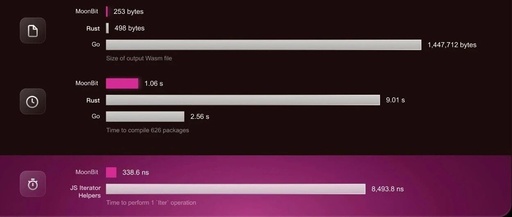
Original Title: Ten Features of the MoonBit Language OSCHINA ↑ Click the blue text to follow us Original Title: Ten Features of the MoonBit Language Original link: https://medium.com/@hivemind_tech/moonbit-language-in-10-features-4dc41a3a1d6cAuthor: Ignacio | Engineer at Hivemind, a German tech company As a Scala developer, I have recently noticed that the market for Scala is gradually shrinking, prompting me … Read more

Challenging Yourself to Avoid Using For Loops

Challenging Yourself to Avoid Using For Loops

(Click the blue text above to quickly follow us) Compiled by: Bole Online – Xin Zai If you have good articles to submit, please click → here for details Why challenge yourself to avoid writing for loops in your code? Because it forces you to use more advanced and idiomatic syntax or libraries. This article … Read more

Introduction to the Python filter() Function

Introduction to the Python filter() Function

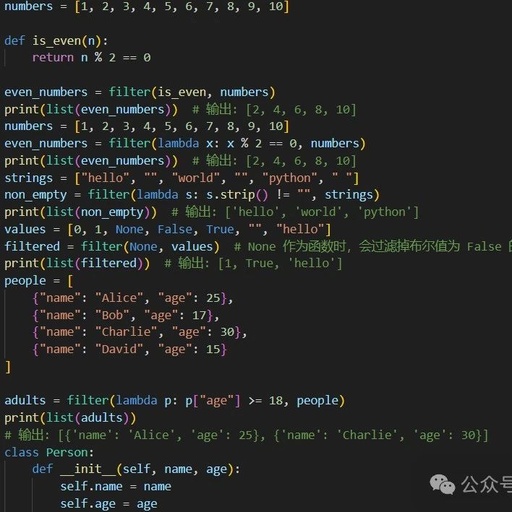
<span>filter()</span> is a built-in high-order function in Python used to filter sequences, removing elements that do not meet the specified conditions, and returning an iterator object (returns a list in Python 2.x and an iterator in Python 3.x). Basic Syntax filter(function, iterable) How It Works <span>filter()</span> takes each element in <span>iterable</span> as an argument to … Read more

Exploring Closures in Rust – Part 9

Exploring Closures in Rust - Part 9

Introduction: This article is the 9th in the "Rust Programming" series, totaling 27 articles. Click on the "Rust Language" tag to view other chapters! The concept of “closures” is likely familiar to JavaScript users. In simple terms, a closure is a function without a name, but it has many differences from a regular function. Let’s … Read more