-
-
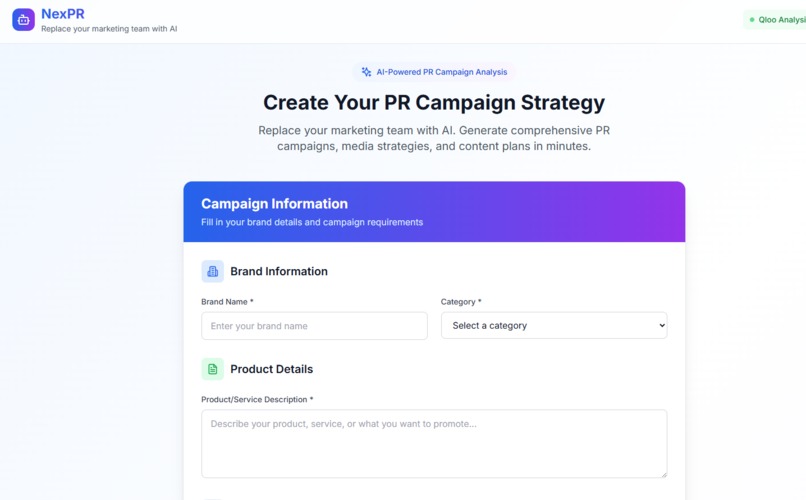
Homepage
-
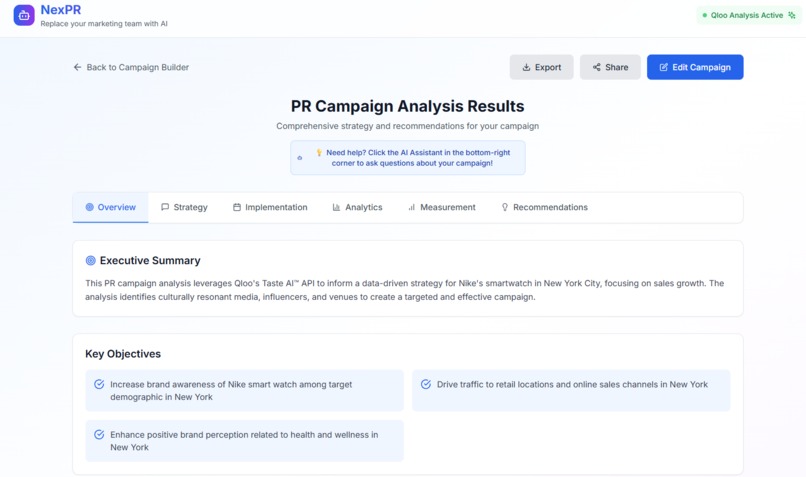
Overview
-
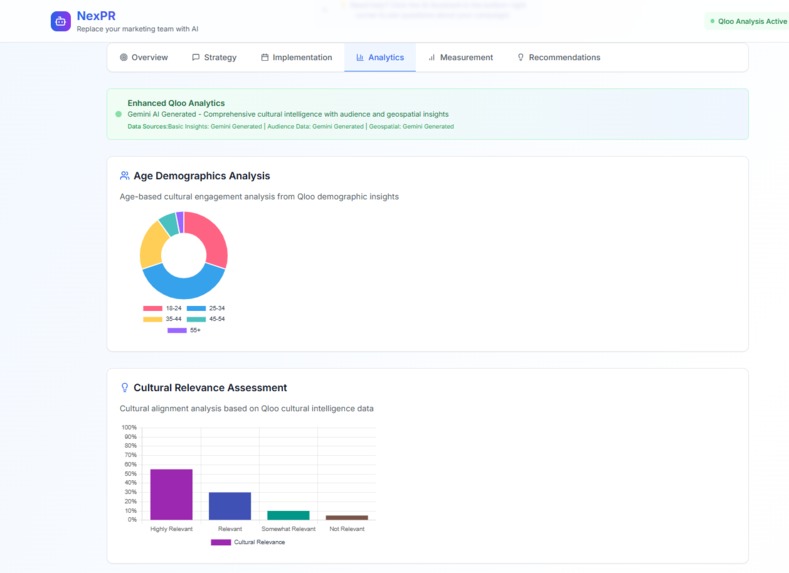
Analytics
-
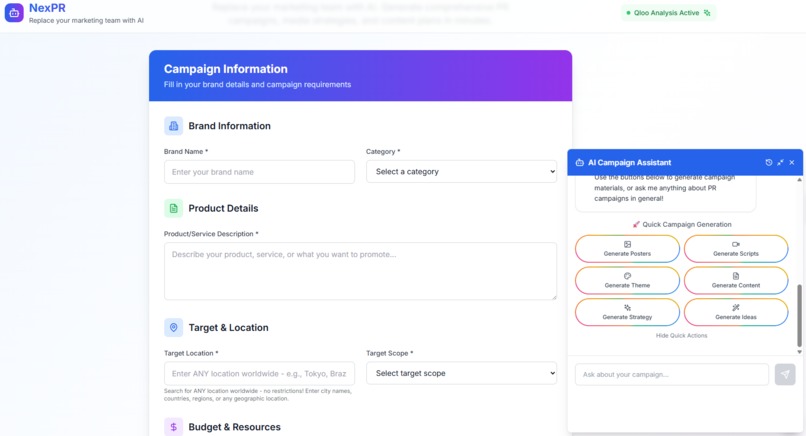
AI chatbot


Inspiration
In today’s hyperconnected world, launching a successful PR campaign requires more than just catchy slogans—it demands deep cultural understanding, targeted messaging, and real-time adaptability. Traditional tools often fall short in bridging the gap between brands and the diverse cultural contexts of their audiences.
The inspiration for NexPR came from this very gap:
"What if AI could not only analyze culture but also generate intelligent, data-driven PR strategies tailored for every region and demographic?"
With Qloo's Taste AI™ providing access to billions of cultural signals and Google's Gemini AI offering next-gen language reasoning, I saw a unique opportunity to create an AI-native PR campaign platform that does exactly that.
This project was designed to replace static PR strategy templates with living, intelligent systems, empowering brands to launch campaigns that resonate deeply, adapt quickly, and scale globally. NexPR is a step towards making culturally aligned, AI-optimized communication accessible to any organization, anywhere in the world.
What it does
NexPR is an AI-powered PR campaign strategy platform that combines cultural intelligence from the Qloo Taste AI API with advanced campaign generation from Google Gemini AI to deliver personalized, data-driven, and location-specific PR strategies in real-time.
It empowers brands to understand their cultural positioning and deploy intelligent, scalable campaigns that resonate across diverse demographics, geographies, and cultural contexts.
🧩 Workflow Overview
1.🛠️ Campaign Builder Users initiate the process by inputting: Brand name, industry, product type Campaign objectives (launch, awareness, repositioning, crisis control) Target location(s) and demographic focus Optional assets (briefs, images, context notes) Budget or scope constraints
This user input dynamically powers the real-time query engine for external APIs.
2.🌍 Cultural Intelligence (Qloo API) Using Qloo's Taste AI™ API, the platform gathers: Affinity metrics for the brand across age, gender, and location groups Culturally aligned influencers and personalities Local venue and media outlet relevance Cultural interest mapping (fashion, music, cuisine, etc.) Audience overlap and segmentation by taste profile
This enables rich cultural alignment before campaign strategy creation.
3.🧠 AI Campaign Strategy (Google Gemini) With the cultural intelligence in place, Gemini AI: Contextualizes the data based on the brand's goals and region Produces a detailed PR plan, with strategy, tactics, and recommendations Adjusts tone, positioning, and content strategy based on cultural nuance Provides intelligent risk mitigation advice for sensitive campaigns
The result is a culturally adaptive PR campaign blueprint ready for deployment.
- 📊 Visual Analytics Dashboard NexPR’s dashboard visualizes key metrics with tools like Chart.js: Age-based brand affinity heatmaps Cultural trendline graphs Geographic relevance distribution Campaign performance predictions (AI-modeled)
Key insights summary cards
The dashboard is real-time, interactive, and mobile-responsive.
🔟 Detailed Breakdown: 10 Essential PR Categories Here’s what each strategic area offers:
1. 🧭Brand Analysis: Evaluates how your brand is perceived across cultural dimensions Identifies taste-based affinities and gaps in cultural resonance Provides brand tone & voice suggestions aligned with the local audience
2. 🥊 Competitive Intelligence:
Compares your brand with market competitors in the same region
Highlights audience overlaps, missed opportunities, and niche areas
Suggests differentiation strategies rooted in cultural trends
3. 🌐 Geographic Intelligence: Map cultural hotspots where your brand has high cultural alignment Uses Qloo’s location-based data to identify new market entry points Offers regional messaging adaptation tips
4. 👥 Demographic Analysis: Dissects cultural preferences by age, gender, and interest group Visualizes how various demographics interact with your brand Provides micro-segmented targeting strategies
5. 🌟 Influencer Discovery: Identifies influencers who align with your brand’s cultural footprint Ranks them by relevance, engagement, and geographic influence Suggests collaboration formats and ideal campaign content types
6. 🏟️ Venue & Media Outlet Discovery: Recommends venues, channels, and publications that culturally resonate with your target audience Provides a media outreach plan mapped to specific locations and topics Includes non-traditional PR spaces like podcasts, local cafes, and music venues
7. 🤝 Cultural Partnerships: Suggests partnerships with local organizations, artists, and creators Aligns brand campaigns with community values and trends Increases authenticity by integrating with grassroots culture
8. 📈 Trending Analysis: Detects emerging cultural trends based on Qloo data signals Predicts which topics, aesthetics, or values will trend soon Advises on how to ride or adapt to trends in a culturally sensitive way
9. 🧠 Content Intelligence: Analyzes the tone, style, and topics that will resonate in specific regions Suggests campaign messaging, formats, and design cues Ensures content localization is effective, not generic
10. 🚨 Crisis Management: Identifies potential cultural missteps or sensitivities Provides AI-generated crisis scenarios and response strategies Helps develop resilient communication plans that minimize backlash
🔚 TL;DR
NexPR empowers anyone to: Plan a PR campaign from scratch Analyze it using real-world cultural data Generate strategies with AI Visualize insights with clarity
In just a few minutes, you can go from idea to execution-ready, culturally aligned PR campaigns—without needing a full PR team.
How we built it
NexPR was built to seamlessly integrate cultural intelligence and generative AI into a modern, developer-friendly platform for PR campaign strategy. The build process involved a thoughtful combination of frontend development, API integration, AI orchestration, and real-time data visualization.
🧱1. Frontend Development We used a React + Vite stack for fast development, excellent DX (developer experience), and blazing performance. React 18: Chosen for its component-driven architecture and efficient state management. Vite: Provides ultra-fast dev server, module bundling, and optimized builds. Tailwind CSS: Enabled rapid UI development with responsive design and clean code. React Router DOM: For smooth single-page application (SPA) routing. React Hot Toast: To deliver clean, customizable toast notifications. Lucide React: For beautiful, scalable icons throughout the interface.
Components Developed: CampaignBuilder: User form for brand input and target parameters. Analysis Results: Displays the AI-generated strategy and insights. FileUpload: Optional feature for uploading assets. Header: Top navigation and branding.
🌐2. API Integration (Qloo Taste AI™ API) The Qloo API was the backbone for real-time cultural intelligence.
We integrated with https://hackathon.api.qloo.com, using endpoints for: Brand affinity scoring Location-based insights Demographic segmentation Influencer, venue, and trend discovery All queries are dynamically generated based on user inputs. Results are parsed, normalized, and passed to both the dashboard and Gemini AI. Authentication and authorization were handled via headers using the VITE_QLOO_API_KEY stored securely in .env.
🤖 3. AI Strategy Engine (Google Gemini AI) We integrated Google’s Gemini 2.0 Flash model using the API from generativeai.dev.
Gemini was used to: Summarize raw cultural insights from Qloo into structured PR recommendations Generate copy, messaging tone, and influencer strategy Provide crisis management and trend forecasting Prompts were structured dynamically, using user input + Qloo data: We used a service abstraction (geminiService.js) to manage all AI requests and responses cleanly.
Environment variables were managed with: VITE_GEMINI_API_KEY=your_gemini_api_key
📊 4. Real-Time Data Visualization We used Chart.js and react-chartjs-2 to present insights in a compelling, visual way.
Key charts included: Heatmaps for brand engagement by age group Pie/Bar Charts for cultural affinity distributions Line Graphs for Trend Tracking Visualizations update in real-time based on the latest Qloo API responses.
🔐** 5. Security & Config** Sensitive keys are stored in .env and injected at runtime using Vite’s environment system. All API calls are made securely with appropriate headers. No user data is stored or logged — all processing is ephemeral and client-driven.
🌍 6. Deployment We tested and deployed across: Vercel – for fast preview environments and production builds. Netlify – tested for alternate hosting and continuous integration. Manual deploy (npm run build) generates a static dist/ folder that can be hosted anywhere.
NexPR was built to prove that AI + cultural intelligence = the future of strategic PR. By combining the real-world cultural dataset of Qloo with the generative reasoning of Gemini, we were able to build a system that is both intelligent and useful, all within a modern web environment.
Challenges we ran into
Building NexPR brought with it a unique blend of technical, data, and AI-related challenges. While the overall goal was clear—combine real-time cultural data with AI-powered campaign strategy—executing this vision required solving multiple real-world problems, especially around data availability, prompt reliability, and system orchestration.
🔌** 1. Lack of Public, Structured Data for Cultural & Brand Analysis** One of the most significant challenges we encountered was the lack of reliable, structured, and publicly accessible datasets for:
Cultural perception of brands
Regional or demographic brand affinity
Real-world influencer-brand relationships
Taste-based consumer behavior insights
Most open datasets are either outdated, incomplete, or too generic to be actionable in a PR or marketing context.
This is where Qloo’s Taste AI™ API became a game-changer:
It offered real-time, proprietary cultural intelligence drawn from billions of data points across music, film, fashion, dining, travel, and more.
We no longer had to scrape the web or rely on survey-based data.
Qloo allowed us to analyze any brand/entity, in any region, across specific demographics, unlocking insights that were previously inaccessible to developers.
That said, the learning curve to fully leverage Qloo’s power (complex schemas, nested responses, undocumented behaviors) was a significant initial hurdle.
🧠 2. Prompt Engineering for Gemini AI Translating raw cultural signals into a usable PR strategy via Gemini was an iterative challenge.
The Gemini model required layered prompt construction that balanced factual input (from Qloo) with creative output (tone, message, audience).
Initial outputs were often vague or repetitive, especially when the Qloo data was sparse.
We improved results by adding context, clarifying goals (e.g., launch vs crisis vs loyalty), and constraining the expected structure.
🌐 3. Synchronizing Multi-API Workflows We had to ensure Qloo API calls completed before invoking Gemini, since the AI analysis depended on real cultural insight.
Handling async behavior, fallback states (e.g., if Qloo fails), and UI consistency required robust state management.
We built a lightweight orchestrator to coordinate loading states, ensure retry logic, and avoid triggering Gemini too early.
📊 4. Real-Time Data Visualization Cultural data is complex, dense, and non-uniform. Converting it into clean, visual insights wasn’t trivial.
We faced issues like:
Sparse datasets (some brand queries returned partial insights)
Non-numeric affinity values requiring transformation
Dynamic axis ranges for different regions or demographic groups.
We had to build utility functions that normalized Qloo data into chart-ready formats for Chart.js.
💻 5. UX & Performance Optimization Since all data was fetched in real-time, there were moments of latency.
We optimized with:
Loading skeletons and async feedback
Memoization to prevent redundant Gemini calls.
Lazy rendering of heavy charts
🔐 6. Environment Variable Management Vite requires the VITE_ prefix for environment variables to be exposed to the frontend. We missed this early on, causing undefined keys in production.
We also faced issues during Netlify/Vercel deployment, where environment keys had to be reconfigured manually and re-linked to build hooks.
🧪** 7. No Static Fallback or Mock Data** We made a deliberate decision: NexPR would use live data only, no mocks or static JSON.
This meant:
The entire system depended on successful API interactions.
Testing offline or in unstable environments was harder.
We created temporary mock wrappers only for local dev, but stripped them from production to preserve real-world accuracy.
💡** What These Challenges Taught Us** Access to the right data is everything. Without Qloo, building something like NexPR wouldn't have been possible.
Combining structured data APIs with LLMs requires careful orchestration, not just prompt writing.
Good AI UX means anticipating latency, gaps, and unclear results and solving for them.
Strategic decisions in tech (like not using static data) can lead to tougher builds but more impactful products.
By overcoming these challenges, we turned NexPR into a truly intelligent, culturally aware, and AI-driven PR platform, proving that with the right tools, even complex domains like cultural strategy can be democratized.
Accomplishments that we're proud of
Despite the complexity of blending cultural intelligence with AI-driven PR strategy, we successfully delivered a real-time, intelligent, and user-friendly platform. Here are some of the key milestones and accomplishments we’re proud of:
🎯 1. Built a Fully Functional, End-to-End AI PR Strategy Platform We turned a challenging idea into a working product, from ideation to execution. NexPR allows users to:
Build PR campaigns with real brand, location, and demographic inputs.
Pull live data from Qloo’s Taste AI™ API.
Feed cultural insights into Gemini AI for strategy generation.
View insights through an intuitive dashboard.
What would normally take an entire PR team days or weeks, NexPR does in minutes—automatically, intelligently, and interactively.
🌐 2. Seamless Integration of Two Powerful AI Systems Successfully orchestrated Qloo’s cultural intelligence API and Google Gemini’s generative AI into one coherent workflow:
Real-time data analysis → Prompt generation → AI strategy output
Developed a clean abstraction layer to handle dynamic multi-step flows
Ensured minimal latency and graceful degradation when either API was slow or rate-limited
📊 3. Real-Time Cultural Intelligence Without Static Data We committed to not using any hardcoded or mock data, which is rare in hackathon builds. All insights are generated from:
Real Qloo queries based on user input
Live Gemini AI completions This ensures that every result is fresh, relevant, and personalized.
💡 4. Addressed a Real Industry Problem Most PR tools today rely on vague sentiment analysis or outdated market research. We built a solution that:
Leverages culture-first intelligence
Bridges the gap between taste data and business strategy
Offers AI-generated, geo-specific, and demographic-aware campaign recommendations
NexPR isn't just a hackathon project—it’s a real solution to a real gap in marketing tech.
💻 5. Modern UI/UX with Full Device Responsiveness We crafted a beautiful and responsive interface using:
React 18 + Vite for fast performance
Tailwind CSS for clean and modern styling
Chart.js for interactive visual storytelling
Fully responsive design, optimized for desktop, tablet, and mobile
The result is a polished product experience, not just a proof of concept.
🚀 6. Deployed and Ready to Use The project is:
Live, hosted, and publicly accessible
Easily installable via GitHub + .env setup
Optimized for deployment on Netlify, Vercel, or any static host
It’s not a demo—it’s a real, usable tool that’s ready for the world.
🤝 7. Bridging Tech and Culture One of our proudest achievements is that NexPR doesn't just use tech for the sake of it—it uses AI to make culture quantifiable, strategy accessible, and decision-making smarter.
We’ve created a tool that can empower startups, artists, agencies, and brands to launch better campaigns and connect more deeply with their audiences.
What we learned
Building NexPR was a powerful learning experience that pushed us to explore the intersection of culture, AI, and product design. Throughout the process, we learned valuable lessons across both technical and strategic dimensions:
🔍 1. The Importance of Real-World, Taste-Based Data We discovered how difficult it is to find publicly available, structured, and culturally meaningful datasets that connect brands, demographics, and real human behavior. Most APIs focus on raw data like social mentions or sentiment, but lack contextual cultural intelligence.
Using the Qloo Taste AI™ API was a breakthrough—it showed us the power of leveraging taste-driven, cross-domain insights (e.g., how a fan of indie music might also love a specific coffee brand or local art venue). This reshaped how we think about audience targeting and market research.
🤖 2. AI Is Only as Smart as Its Input While LLMs like Google Gemini are powerful, we learned that prompt engineering and context formatting are critical. We had to: Pre-process and structure cultural data from Qloo. Avoid hallucinations by constraining the input/output flow. Fine-tune the system prompts to generate realistic, strategic PR plans. This reinforced the idea that LLMs are amplifiers, not replacements for structured reasoning.
⚙️ 3. Merging Multiple AI Systems Requires Careful Orchestration Combining Qloo’s real-time insights with Gemini’s generative reasoning required: Efficient error handling. Smart retries and fallbacks. Minimal latency UX design.
We gained a better understanding of how to build hybrid AI pipelines that are robust, adaptive, and efficient, especially in production-like conditions.
📈 4. PR and Marketing Strategy Is Changing Rapidly Working on NexPR opened our eyes to how data-driven creativity is reshaping PR. Traditional campaign planning—relying on past case studies or generic personas—no longer works in today’s fast-moving, culture-rich world.
Modern strategy must: Be contextual and hyper-personalized. Leverage real-time cultural shifts. Utilize cross-domain taste mapping. This redefines how we approach branding and audience engagement.
💬 5. Product Design Grounded in User Empathy Designing NexPR forced us to think not just like engineers, but like users. We learned: How to reduce cognitive load through smart defaults. The importance of visual feedback in a complex data dashboard. How to make AI outputs understandable and actionable. We built with empathy and clarity in mind, not just functionality.
🌐 7. Hackathons Are Still the Best Way to Learn by Doing Finally, this hackathon reminded us that nothing beats shipping under pressure. We learned to:
Prioritize features fast Collaborate across design, data, and engineering Solve problems with limited resources and creativity
The energy, focus, and innovation that emerged in this sprint were unmatched.
What's next for NexPR
NexPR is just the beginning of a larger vision to democratize strategic communication by combining AI, cultural data, and automation. While we’ve built a functional MVP, we’re incredibly excited about the road ahead.
Here’s what’s next:
🧰 1. Automated Content Generation Tools
One of the most exciting next steps is enabling auto-generation of creatives and content using real-time Qloo insights. We’re building integrations for:
✍️ Text-to-copy tools to generate:
Press releases Email subject lines
Taglines and calls-to-action
🎨 Text-to-image tools (via DALL·E, Midjourney, or Stability) that align visuals with cultural aesthetic preferences
🎥 Script generators for reels, ad videos, and UGC-style content based on Qloo-informed persona analysis
This transforms NexPR into a creative co-pilot, not just a strategic one.
🔌 2. Third-Party Tool Integrations
To create a true AI PR automation stack, we plan to integrate with tools like:
HubSpot, Mailchimp, or Buffer for campaign scheduling and deployment. Notion or Trello for strategic task planning and documentation. Slack and Discord for collaborative team alerts. Zapier for no-code workflow automation between Qloo → NexPR → Publishing tools. These integrations will help users go from insight → strategy → execution within minutes, all on one platform.
🌍 3. Localized and Language-Aware Strategy
We aim to make NexPR globally usable by enabling:
Multi-language support in campaign generation. Country and region-specific cultural nuances (e.g., festivals, local slang, taboos). Localization filters in Qloo querying and Gemini prompting. Brands in Mumbai, Madrid, or Miami will all get geo-aware, culture-aligned PR plans.
📊 4. Campaign Performance Feedback Loop
In future releases, NexPR will incorporate:
Real-world performance tracking (via APIs or uploads) AI-powered recommendations based on past campaign outcomes A/B testing prompts and learning loops that make the system smarter over time This adds a reinforcement learning layer to continuously refine campaign quality.
🧑💼 5. Agency + Freelancer Mode
We’re working on enabling NexPR for: PR agencies manage multiple clients. Freelancers are generating proposals for various brands. White-label dashboards for stakeholders to review strategies and insights. This unlocks commercial use-cases and makes NexPR a business-ready SaaS product.
⚡️ 6. AI + Culture + Execution = The Future of PR
Ultimately, we believe NexPR represents a new category: "AI-Driven Cultural Strategy-as-a-Service" With Qloo’s rich cultural graph and LLMs’ creative power, we’re redefining how brands connect with people, not just through demographics, but through shared tastes, values, and subcultures.
We’re just getting started.
Built With
- css
- gemini
- html
- javascript
- qloo
- react
- vite


Log in or sign up for Devpost to join the conversation.