a great spatial silence
May. 6th, 2024 08:48 pm![[personal profile]](https://www.dreamwidth.org/img/silk/identity/user.png) draftissue
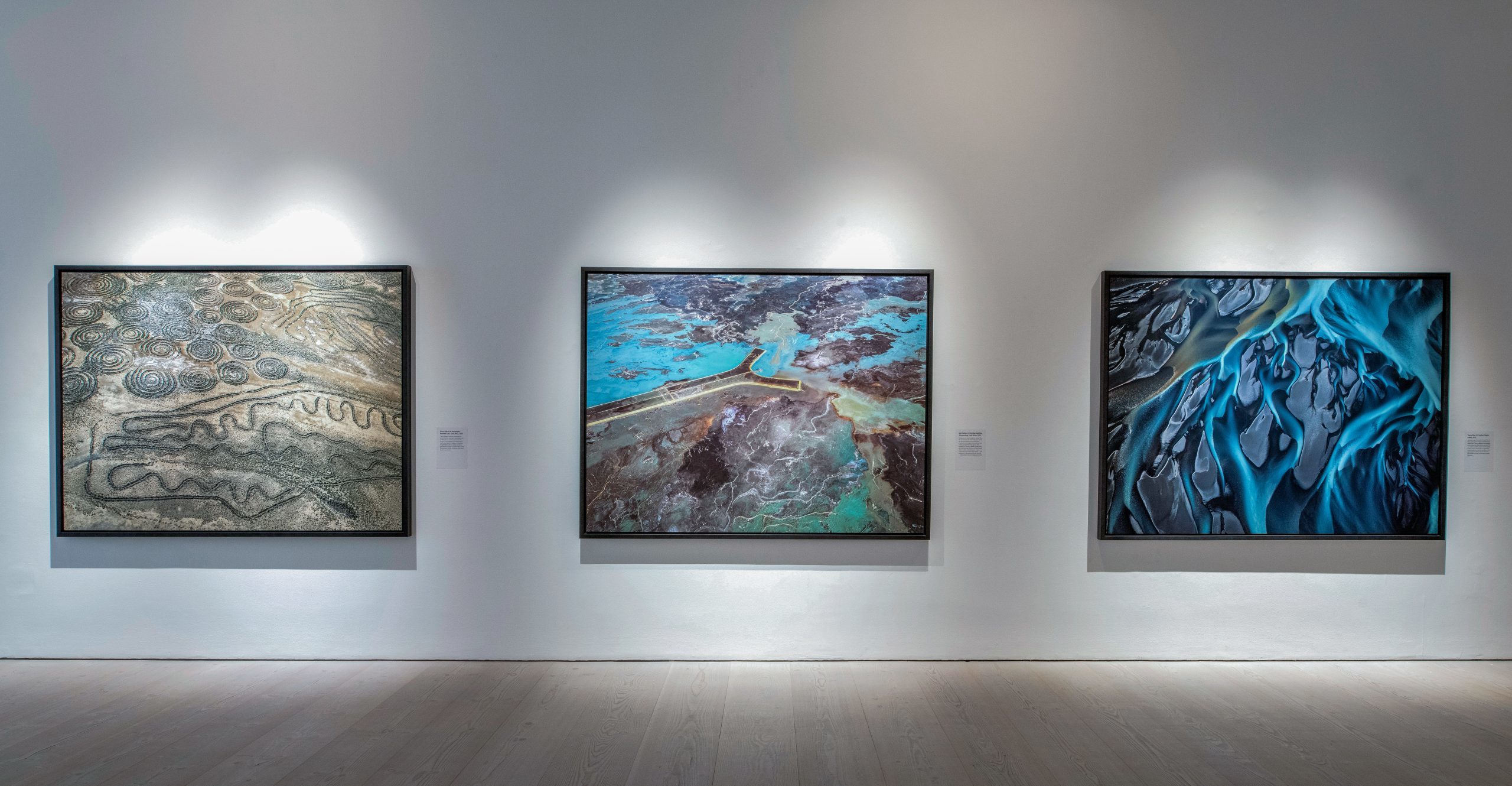
draftissuethe scale of the photographs is beyond imagination. the terrible beauty of their composition - undeniable; their purpose - to overwhelm. images upon images of sands, soils, and waters; swirling patterns of oil spills, pollution, and extraction. a colourful catalogue of every wretched thing humanity inflicts upon the earth, paradoxically resulting in a body of work that is so uninterested in its own subject it is, frankly, astonishing.
burtynsky, at saatchi.
/
the briefest of overviews: burtynsky is a canadian photographer known for his aerial shots of industrial landscapes. fine. the exhibition is a retrospective of his photographs, grouped into three categories: extraction, manufacturing, waste. landscapes make the bulk of the show, the images are largely devoid of people; if they are pictured, it is always in a crowd and from afar. the artworks were many (too many?) and large format, including some murals. each of them explored the same thing over and over again, which was that destruction can, perversely, be beautiful.
aside from the photographs, there was also a room with a video installation - three large projections - which was of a quality i found embarrassing for an artist of this calibre. the ‘installation’ consisted of still images of the same type as presented throughout the entire exhibition slowly moving across the screens, set to a weirdly pompous orchestral music. i managed about two minutes in there, twisting myself into a pretzel from all the cringing, before i had to leave the room. what was the purpose of this screen-saver style presentation? what new things was it meant to tell us? i cannot begin to guess.
the artwork descriptions, too, were so inane as to be insulting. one of them, word for word, below:
‘farming #6, ankara province, turkiye, 2022. The strange geometry of this farmland, south of the turkish capital in central anatolia, is a result of the land’s unique topography, ploughing traditions, and property boundaries. among the top 10 agricultural producers in the world, Türkiye faces many challenges, from ineffective soil management in recent decades, and a dwindling number of farmers, to climate change and, especially, soil erosion.’
aside from sounding, at best, like a piece of high school homework, these descriptions tell us next to nothing and glaze over any complexities. by his own admission, burtynsky purportedly wants for his work to avoid being ‘didactic’ and banks on the viewer passing their own judgement on what they are seeing. in itself, this is not a bad thing, but there is a thin line between being open to interpretation and being non-committal. since burtynsky’s work presents itself as something of a documentary quality - abstracted, yes, but fundamentally true - can it really afford for its politics to be as detached? at this point in history, amidst an ecological collapse? the industry in these photographs is presented as a fact of life (terrible, beautiful), but there is no attempt made at either exploring how this status quo came to be, or who is it affecting.
two artworks, in my view, approached something interesting which was then not interrogated further (or at all). the first one of these was an image of dryland farming, which vaguely resembles pre-historic land art. the second one, which was the only 3-dimensional art object exhibited, tucked away as a curio in a glass case next to the artist’s photographic equipment, was a scaled 3d print of a mound of elephant tusks; carefully documented and scanned in the real world before the bones were burnt down.
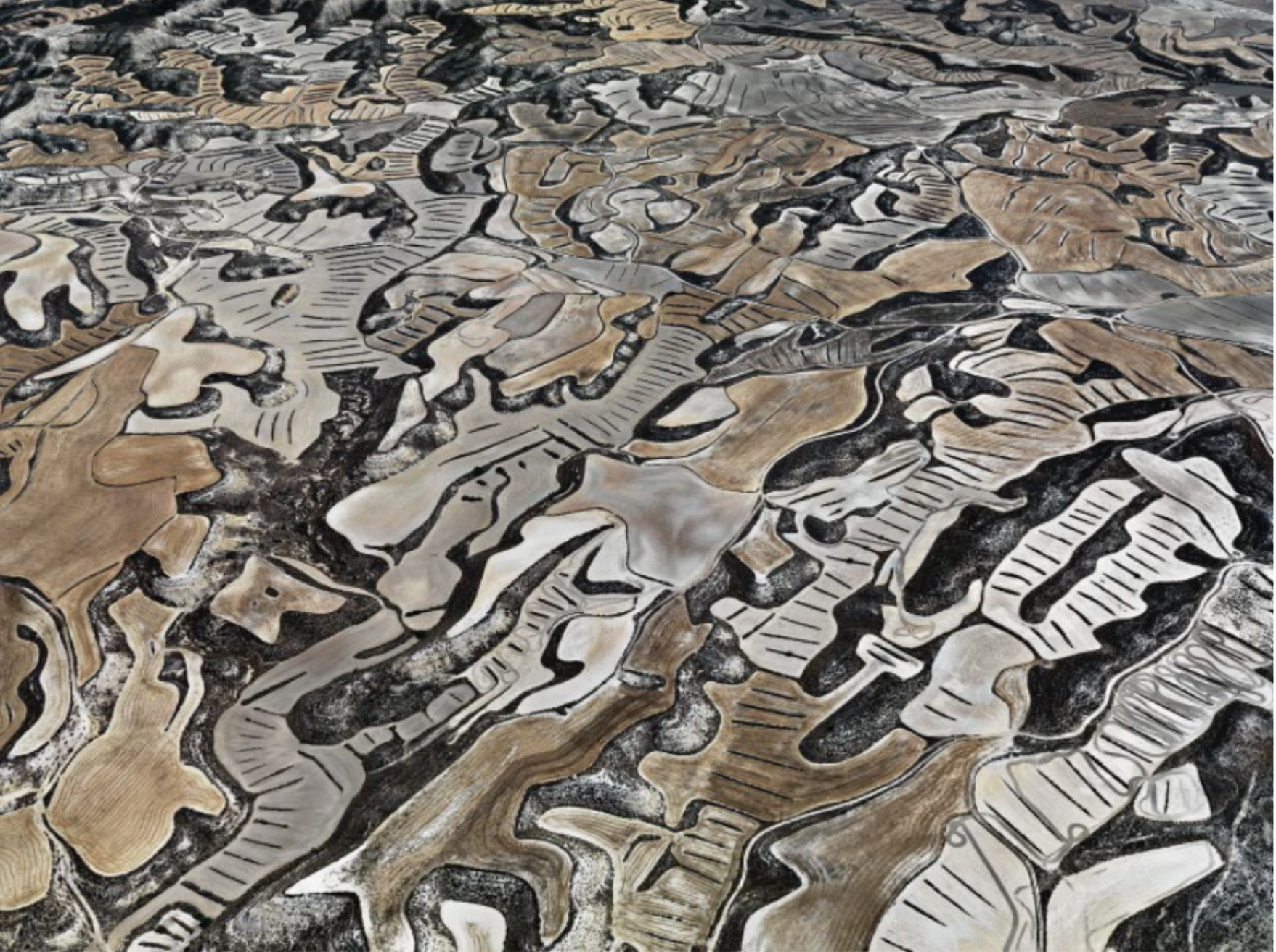
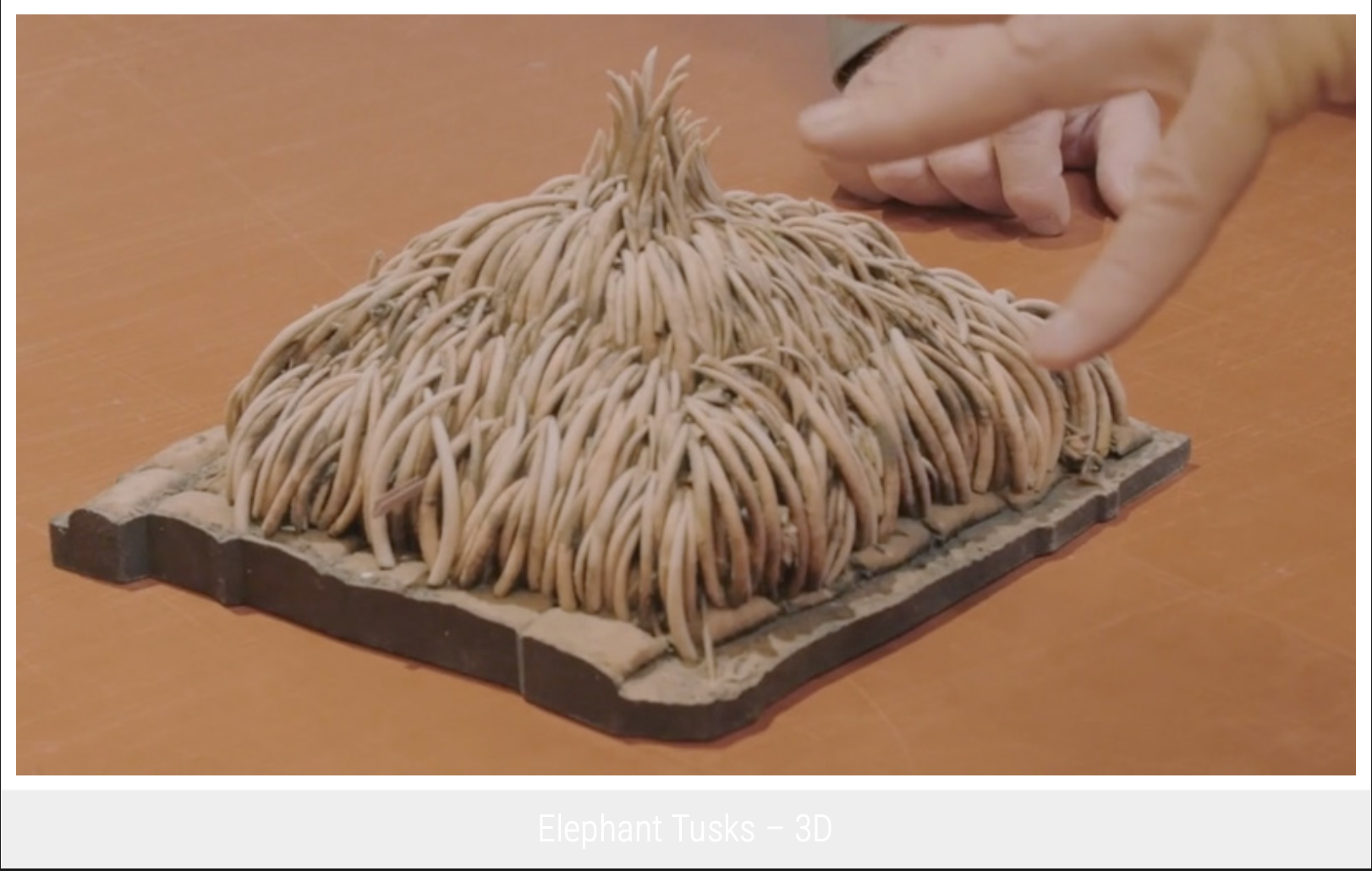
questions arise, ideas form: perhaps an examination of the terrain patterns of industrial extraction versus the ritual/purpose/meaning of ancient land art would be fruitful enough for a whole exhibition on its own? perhaps a sculpture of a mound of tusks can tell us something about preserving a memory, and the men tasked with building it and burning it down might offer some insight into animal poaching? perhaps the possibility of artificially creating something as primordial as a stack of animal bones should be further explored; perhaps we should ask if it actually matters if the bones are real? yes? no?
but alas - we shall never know.
/
and therein, for me, lies the crux of the matter - burtynsky is clearly striving for the sublime in his photographs, but an image can only go so far and be repeated so many times before the premise wears thin. the relentless grand scale of the photos prevents them from saying anything insightful, and the glittering elegance of the compositions obscures the lack of interrogation of the methodology employed. the artist does not seem to recognise, or care about, his own position.
what is the method, then? the vast majority of the pictures are aerial, or from an extremely high vantage point. we are looking at drone footage, or images taken from planes and helicopters, such as the one described by raffi katchadourian in a new yorker article from 2016. flying in a helicopter over DIY (and illegal) small oil distilleries in the niger delta, the artist takes his shots while at the same time being warned he might be getting shot at in return, as a low-flying helicopter can quite easily be taken for a sign of a military operation. anything to get that picture no matter the consequences, i suppose.
the photographic technical feats required to produce these high definition works, the obvious pleasure taken in those feats (one whole room dedicated to extremely expensive camera equipment!), as well, turn grating quickly. one of the photographs - of a coral reef off the coast of indonesia - is, as i later learnt, a collage of hundreds of photographs taken by a diver crew which numbered a dozen people. these were then ‘painstakingly’ stitched together in photoshop.
photographs of this type try to escape the limits of photography; but the aerial, all-seeing god’s eye view of the surveyed terrain always comes at a cost - the cost here being complete detachment and dehumanisation, and this mode of operation is not questioned at all in any of the exhibited works. what comes to mind, or is at least stemming from the same photographic family, are surveillance photos or satellite photography, both of which imply the observer being in a position of power over the observed.
what we are left with, after yusoff (2023), is the question of 'whose bodies are earthed and whose get to have an aerial view'?
the understanding of land as resource is obviously a perspective built on and informed by colonialism, and it has allowed us - 'the west' - to justify ecological desecration. burtynsky's photographs aim to make the audience understand that we are all complicit, but the fundamental truth is that we are not all complicit to the same degree and we are not affected by it to the same extent - far from it. for an artist operating within industrial landscapes, it would seem that this understanding should be a foundation of the entire body of work, and yet it is absent from the artist's oeuvre entirely and the colonised body remains largely unacknowledged.
what has once worked (for a certain definition of 'worked') - sweeping photographs of the us oil industry, or mining in canada - takes on a different flavour when translated without reflection onto other nations and subjects. how can you hop between different geo-social contexts and not pause to reconsider your own approach and position? how can you meaningfully engage with a subject while only looking at half the picture? if you are not interested in what you are doing, then why are you doing it at all?
this disinterest, then, not only renders the work cold and apolitical, but at the same time actively perpetuates the very perspective that is at the root of the problem. this is not an artist’s debut, or an up-and-coming work. this is a catalogue of images spanning decades and so the lack of examination of the methodology of taking these photographs is difficult to justify. the cynical view would be also to consider if this dissonance will remain unacknowledged as long as the work turns a profit.
in order to comment on the destruction of land in any kind of fruitful way, a new mode of engagement is required, one that steps away from falling into the rabbit hole of the colonial gaze and takes as its starting point the acknowledgement of injustice. perhaps instead of ‘looking at’ landscape (and its people!), a different point of view would be more appropriate - looking from, or through, or with?
/
consider:
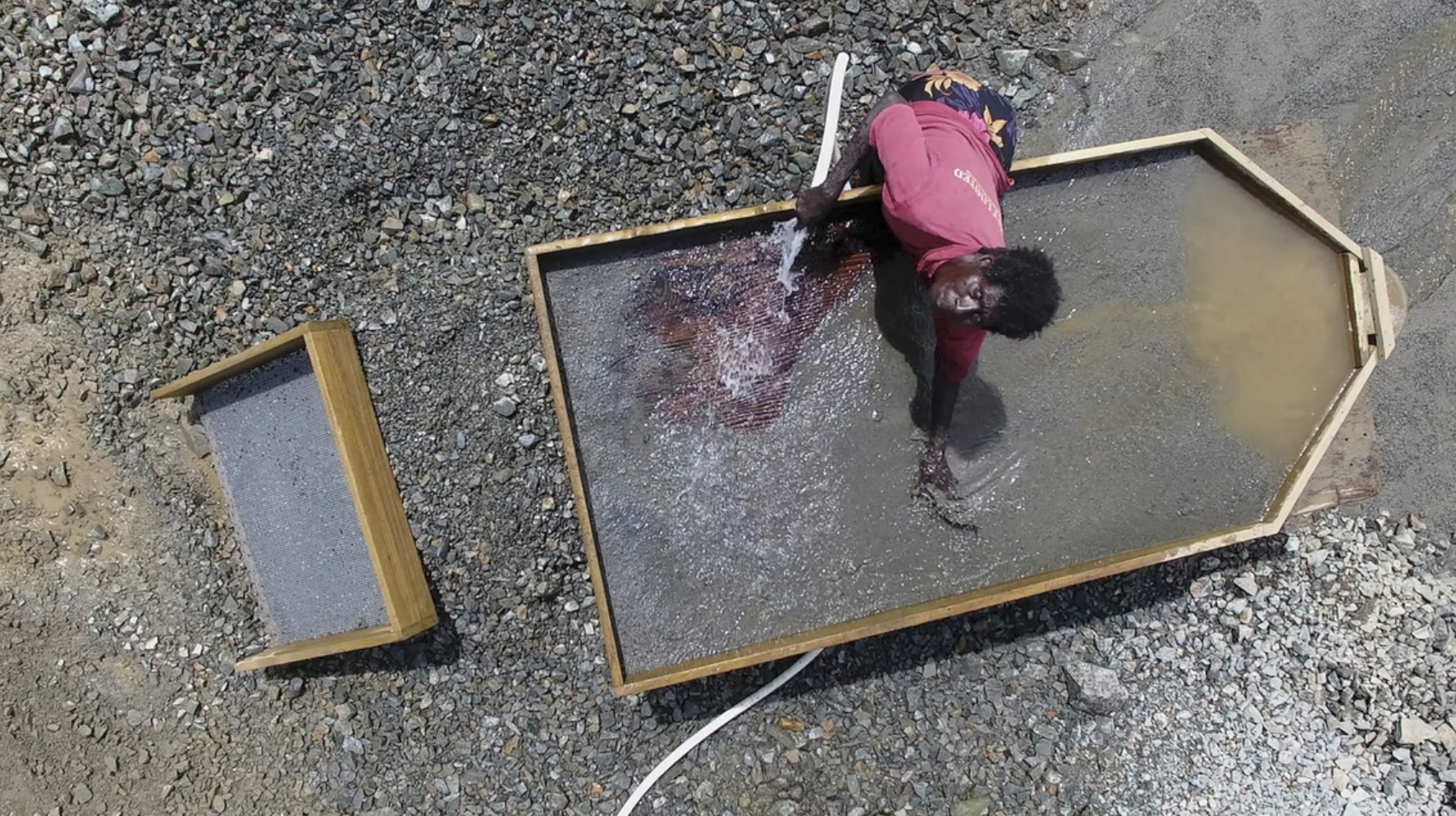
towards the end of last year at the re/sisters exhibition at the barbican i had the chance to see taloi havini’s ‘habitat’ (2017). the work examines the impact of copper mining on the land and people of bougainville in the salomon islands. a 3-channel video installation, the camera follows a woman across a forest, a river, and what looks like a desert, or a plain. images of abandoned copper mining machinery are intertwined with shots of the woman, from various vantage points, including an aerial view. the landscape is always contextualised through its relation to the woman, the images never fade into an abstraction. as the camera slips into an overhead view of the woman at work and as the viewer is pulled into a sort of detached hovering, hypnotised by the rhythmic motions of her hands, she suddenly looks up and something else breaks through. the observer becomes the observed, connected across both time and space.
the image is striking, confrontational, uncomfortable - and much more human for it.
///
this one was a very long time coming and written at a glacial pace, as initially it was intended as a positive review/summary of the ‘re/sisters’ exhibition, which i’ve seen in november of last year, then a comparison of that with ‘green snake’ - a similarly themed show - which i was lucky enough to see at tai kwun while on holiday in february. that little essay never materialised, clearly. seeing the burtynsky exhibition back in march rather pissed me off, so i stewed in my displeasure for a while before i decided to dispel with it through writing - a cleansing exercise of sorts, fuelled by haterism - hopefully enjoyable to read. :)
journal entry title taken from john mcphee’s ‘basin and range’ (1981), which i’ve been slowly reading on and off for a long while:
“Supreme over all is silence. Discounting the cry of the occasional bird, the wailing of a pack of coyotes, silence—a great spatial silence—is pure in the Basin and Range. It is a soundless immensity with mountains in it. You stand, as we do now, and look up at a high mountain front, and turn your head and look fifty miles down the valley, and there is utter silence. It is the silence of the winter forests of the Yukon, here carried high to the ridgelines of the ranges. “It is a soul-shattering silence,” the physicist Freeman Dyson wrote of southern Nevada in Disturbing the Universe. “You hold your breath and hear absolutely nothing. No rustling of leaves in the wind, no rumbling of distant traffic, no chatter of birds or insects or children. You are alone with God in that silence. There in the white flat silence I began for the first time to feel a slight sense of shame for what we were proposing to do. Did we really intend to invade this silence with our trucks and bulldozers and after a few years leave it a radioactive junkyard?”
also, while reading around burtynsky i’ve read an academic piece on koolhaas’ photographs of lagos, which was referenced in the new yorker article. the paper was written by tim hecker, and as it turns out it is the SAME (!!!) tim hecker whom i love dearly for his drone ambient music - imagine that!
/
exhibitions:
're/sisters: a lens on gender and ecology' at the barbican centre (seen november 2023) + exhibition catalogue with accompanying essays, including Kathryn Yusoff’s ‘Earth as a Medium of Struggle’
edward burtynsky, ‘extraction / abstraction’ at saatchi gallery (seen march 2024)
links:
https://www.newyorker.com/magazine/2016/12/19/edward-burtynskys-epic-landscapes
readings:
tim hecker paper: https://doi.org/10.1177/1206331210365257
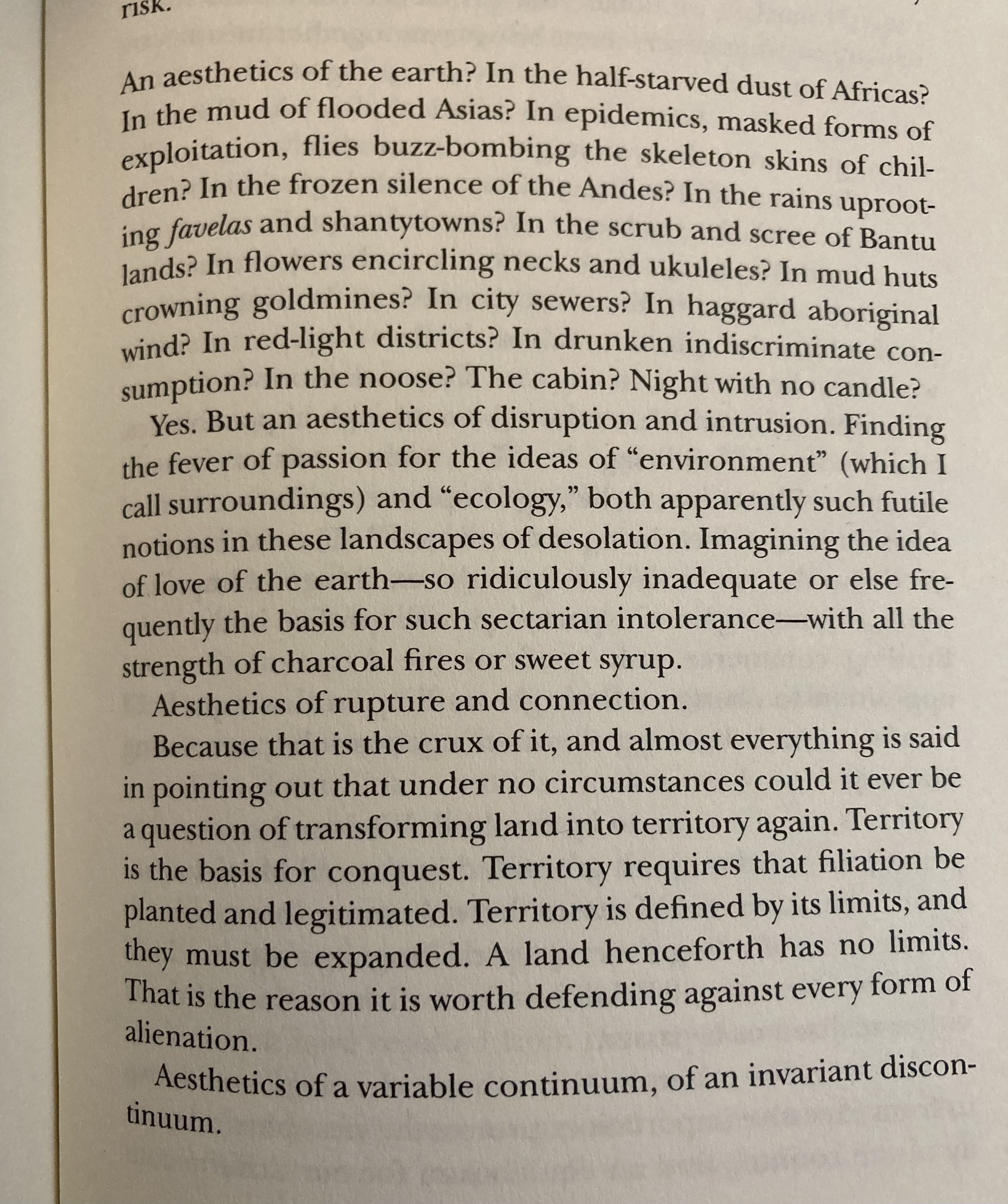
and one more, from glissant, as i’m (slowly) reading ‘poetics of relation’ currently:
burtynsky, at saatchi.
/
the briefest of overviews: burtynsky is a canadian photographer known for his aerial shots of industrial landscapes. fine. the exhibition is a retrospective of his photographs, grouped into three categories: extraction, manufacturing, waste. landscapes make the bulk of the show, the images are largely devoid of people; if they are pictured, it is always in a crowd and from afar. the artworks were many (too many?) and large format, including some murals. each of them explored the same thing over and over again, which was that destruction can, perversely, be beautiful.
aside from the photographs, there was also a room with a video installation - three large projections - which was of a quality i found embarrassing for an artist of this calibre. the ‘installation’ consisted of still images of the same type as presented throughout the entire exhibition slowly moving across the screens, set to a weirdly pompous orchestral music. i managed about two minutes in there, twisting myself into a pretzel from all the cringing, before i had to leave the room. what was the purpose of this screen-saver style presentation? what new things was it meant to tell us? i cannot begin to guess.
the artwork descriptions, too, were so inane as to be insulting. one of them, word for word, below:
‘farming #6, ankara province, turkiye, 2022. The strange geometry of this farmland, south of the turkish capital in central anatolia, is a result of the land’s unique topography, ploughing traditions, and property boundaries. among the top 10 agricultural producers in the world, Türkiye faces many challenges, from ineffective soil management in recent decades, and a dwindling number of farmers, to climate change and, especially, soil erosion.’
aside from sounding, at best, like a piece of high school homework, these descriptions tell us next to nothing and glaze over any complexities. by his own admission, burtynsky purportedly wants for his work to avoid being ‘didactic’ and banks on the viewer passing their own judgement on what they are seeing. in itself, this is not a bad thing, but there is a thin line between being open to interpretation and being non-committal. since burtynsky’s work presents itself as something of a documentary quality - abstracted, yes, but fundamentally true - can it really afford for its politics to be as detached? at this point in history, amidst an ecological collapse? the industry in these photographs is presented as a fact of life (terrible, beautiful), but there is no attempt made at either exploring how this status quo came to be, or who is it affecting.
two artworks, in my view, approached something interesting which was then not interrogated further (or at all). the first one of these was an image of dryland farming, which vaguely resembles pre-historic land art. the second one, which was the only 3-dimensional art object exhibited, tucked away as a curio in a glass case next to the artist’s photographic equipment, was a scaled 3d print of a mound of elephant tusks; carefully documented and scanned in the real world before the bones were burnt down.
questions arise, ideas form: perhaps an examination of the terrain patterns of industrial extraction versus the ritual/purpose/meaning of ancient land art would be fruitful enough for a whole exhibition on its own? perhaps a sculpture of a mound of tusks can tell us something about preserving a memory, and the men tasked with building it and burning it down might offer some insight into animal poaching? perhaps the possibility of artificially creating something as primordial as a stack of animal bones should be further explored; perhaps we should ask if it actually matters if the bones are real? yes? no?
but alas - we shall never know.
/
and therein, for me, lies the crux of the matter - burtynsky is clearly striving for the sublime in his photographs, but an image can only go so far and be repeated so many times before the premise wears thin. the relentless grand scale of the photos prevents them from saying anything insightful, and the glittering elegance of the compositions obscures the lack of interrogation of the methodology employed. the artist does not seem to recognise, or care about, his own position.
what is the method, then? the vast majority of the pictures are aerial, or from an extremely high vantage point. we are looking at drone footage, or images taken from planes and helicopters, such as the one described by raffi katchadourian in a new yorker article from 2016. flying in a helicopter over DIY (and illegal) small oil distilleries in the niger delta, the artist takes his shots while at the same time being warned he might be getting shot at in return, as a low-flying helicopter can quite easily be taken for a sign of a military operation. anything to get that picture no matter the consequences, i suppose.
the photographic technical feats required to produce these high definition works, the obvious pleasure taken in those feats (one whole room dedicated to extremely expensive camera equipment!), as well, turn grating quickly. one of the photographs - of a coral reef off the coast of indonesia - is, as i later learnt, a collage of hundreds of photographs taken by a diver crew which numbered a dozen people. these were then ‘painstakingly’ stitched together in photoshop.
photographs of this type try to escape the limits of photography; but the aerial, all-seeing god’s eye view of the surveyed terrain always comes at a cost - the cost here being complete detachment and dehumanisation, and this mode of operation is not questioned at all in any of the exhibited works. what comes to mind, or is at least stemming from the same photographic family, are surveillance photos or satellite photography, both of which imply the observer being in a position of power over the observed.
what we are left with, after yusoff (2023), is the question of 'whose bodies are earthed and whose get to have an aerial view'?
the understanding of land as resource is obviously a perspective built on and informed by colonialism, and it has allowed us - 'the west' - to justify ecological desecration. burtynsky's photographs aim to make the audience understand that we are all complicit, but the fundamental truth is that we are not all complicit to the same degree and we are not affected by it to the same extent - far from it. for an artist operating within industrial landscapes, it would seem that this understanding should be a foundation of the entire body of work, and yet it is absent from the artist's oeuvre entirely and the colonised body remains largely unacknowledged.
what has once worked (for a certain definition of 'worked') - sweeping photographs of the us oil industry, or mining in canada - takes on a different flavour when translated without reflection onto other nations and subjects. how can you hop between different geo-social contexts and not pause to reconsider your own approach and position? how can you meaningfully engage with a subject while only looking at half the picture? if you are not interested in what you are doing, then why are you doing it at all?
this disinterest, then, not only renders the work cold and apolitical, but at the same time actively perpetuates the very perspective that is at the root of the problem. this is not an artist’s debut, or an up-and-coming work. this is a catalogue of images spanning decades and so the lack of examination of the methodology of taking these photographs is difficult to justify. the cynical view would be also to consider if this dissonance will remain unacknowledged as long as the work turns a profit.
in order to comment on the destruction of land in any kind of fruitful way, a new mode of engagement is required, one that steps away from falling into the rabbit hole of the colonial gaze and takes as its starting point the acknowledgement of injustice. perhaps instead of ‘looking at’ landscape (and its people!), a different point of view would be more appropriate - looking from, or through, or with?
/
consider:
towards the end of last year at the re/sisters exhibition at the barbican i had the chance to see taloi havini’s ‘habitat’ (2017). the work examines the impact of copper mining on the land and people of bougainville in the salomon islands. a 3-channel video installation, the camera follows a woman across a forest, a river, and what looks like a desert, or a plain. images of abandoned copper mining machinery are intertwined with shots of the woman, from various vantage points, including an aerial view. the landscape is always contextualised through its relation to the woman, the images never fade into an abstraction. as the camera slips into an overhead view of the woman at work and as the viewer is pulled into a sort of detached hovering, hypnotised by the rhythmic motions of her hands, she suddenly looks up and something else breaks through. the observer becomes the observed, connected across both time and space.
the image is striking, confrontational, uncomfortable - and much more human for it.
///
this one was a very long time coming and written at a glacial pace, as initially it was intended as a positive review/summary of the ‘re/sisters’ exhibition, which i’ve seen in november of last year, then a comparison of that with ‘green snake’ - a similarly themed show - which i was lucky enough to see at tai kwun while on holiday in february. that little essay never materialised, clearly. seeing the burtynsky exhibition back in march rather pissed me off, so i stewed in my displeasure for a while before i decided to dispel with it through writing - a cleansing exercise of sorts, fuelled by haterism - hopefully enjoyable to read. :)
journal entry title taken from john mcphee’s ‘basin and range’ (1981), which i’ve been slowly reading on and off for a long while:
“Supreme over all is silence. Discounting the cry of the occasional bird, the wailing of a pack of coyotes, silence—a great spatial silence—is pure in the Basin and Range. It is a soundless immensity with mountains in it. You stand, as we do now, and look up at a high mountain front, and turn your head and look fifty miles down the valley, and there is utter silence. It is the silence of the winter forests of the Yukon, here carried high to the ridgelines of the ranges. “It is a soul-shattering silence,” the physicist Freeman Dyson wrote of southern Nevada in Disturbing the Universe. “You hold your breath and hear absolutely nothing. No rustling of leaves in the wind, no rumbling of distant traffic, no chatter of birds or insects or children. You are alone with God in that silence. There in the white flat silence I began for the first time to feel a slight sense of shame for what we were proposing to do. Did we really intend to invade this silence with our trucks and bulldozers and after a few years leave it a radioactive junkyard?”
also, while reading around burtynsky i’ve read an academic piece on koolhaas’ photographs of lagos, which was referenced in the new yorker article. the paper was written by tim hecker, and as it turns out it is the SAME (!!!) tim hecker whom i love dearly for his drone ambient music - imagine that!
/
exhibitions:
're/sisters: a lens on gender and ecology' at the barbican centre (seen november 2023) + exhibition catalogue with accompanying essays, including Kathryn Yusoff’s ‘Earth as a Medium of Struggle’
edward burtynsky, ‘extraction / abstraction’ at saatchi gallery (seen march 2024)
links:
https://www.newyorker.com/magazine/2016/12/19/edward-burtynskys-epic-landscapes
readings:
tim hecker paper: https://doi.org/10.1177/1206331210365257
and one more, from glissant, as i’m (slowly) reading ‘poetics of relation’ currently:


no subject
Date: 2024-06-06 05:20 am (UTC)