Showing posts with label patchwork. Show all posts

Sunday, October 8, 2023

Transparendo Sewalong - Week Five

Image

Hi everyone and thanks for joining us today. Here we are again to share with you the fifth week of our sewalong. Verena from 
einfach bunt Quilts  and I are here to support our quilting community with tips and tricks and well as soon good old fashioned quilting fun with our Transparendo Sewalong (#transaprendosal). Are you looking forward to it? We are too! 

 This week's hashtag is #transparendosalw5 for Week Five. 

 Please sign up for our newsletters to keep on top of the sewalong.


Image


The Pattern Book

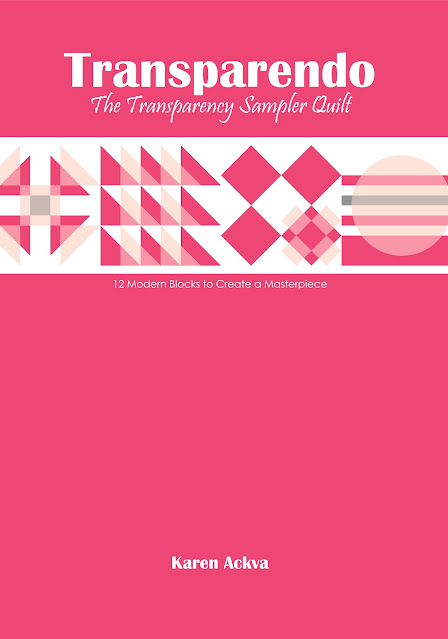
Today is our fifth week of the sewalong. If you don't have the pattern, you can order from my Etsy webshop - Transparendo The Transparency Sampler Quilt from Karen Ackva - Etsy.de. If you live in Germany, you can also pick up some great coordinated fabrics packs especially curated by Verena for the sewalong - einfach bunt Quilts. We highly encourage you to get the book! There a lot of helpful ideas listed including coloring pages to color your own design.

Image


Sewalong Schedule

What is in store for you over the next fifteen weeks? Take a look at our line up. Each week there is a fun, new assignment to complete. The blocks accelerate in skill level with each new block and build upon previous blocks. Learn all types of new skills such as flying geese, nesting and twisting seams, and cutting extra-large pieces of fabric for squares and triangles.


Image

Post your progress on Instagram with the hashtags: #transparendosal and the week -  #transparendosalw1 (week one, etc.) for your chance to be entered into a drawing. If you don't have instagram, you can send me a photo with your fabric selection at 72 dpi with a resolution of 800 pixels or less. The following Sunday, one lucky recipient will be chosen at random. Our sewalong is open internationally, so get out those sewing machines ladies (and gents)!
 
Email Karen with your photo assignment Week Four or
Email Verena with your photo assignment Week Four.

Weekly Prizes

In Week Three, we have a set of Taylor Seville Magic Pins, 1 x Fork Pins and 1 x Extra-ong Pins sponsored by Steidl & Becker (Wholesale Distributor) 
 
 
Image

 
and one Quilters Dream Black Poly Batting in Crib Size sponsored by Quilters Dream Batting.
 

Image

In Week 4, we worked on the Jewelry Box quilt block that uses the stitch-and-flip method of sewing. The transparent sampler blocks are getting a little trickier to sew and are advancing in skill level. Read more about different sewing techniques and how to achieve these looks in the Transparendo book.  

Image

Week 5 - Translucent Argyle

Today is a very important day here in Bavaria, Germany. We have elections. Although I am unable to vote, I am very proud that the other members in my household are off to the voting poles to make a difference. Don't think you can make that difference with your vote? Of course you can when other people share the same values and opinions as you do! 

On to this week's sewalong assignment - the Translucent Argyle block is very similiar to the first block we sewed - Love Birds. This block is then framed with right-angle-triangles on all four sides which creates a totally different block.

Image

When cutting the patches for this block, make sure to take the time to cut correctly. Depending on your presser foot and how you sew a 1/4" seam allowance, you may want to add just a little bit to your patches. Also when cutting squared patches, remember to use the 45° angle on the ruler to make sure it really is squared.

Image

Some of the patches will be cut once or twice across the diagonal. When doing this, do not pick up the patch. Rotate your quilting ruler and place it across the diagonal of the patch. Hold the ruler in place and cut with a sharp rotary cutter.

Image

I like to press my seams to one side and almost never open. Everyone has their own preferred method. I just love it whenever I can get seams to nest and twist. It reduces seam bulk! That makes me happy! Also, one of my previous tips was to keep your iron in off mode. Press the seams after the block is finished at close to being finished. Why? Not only does it save energy, but also allows your seams to nest later. When all of the seams are pressed, it is hard to interlock the seams.

Image

Now it is time to sew the additional right-square-triangles to all sides. Lay out the triangles on the coordinating sides and press the seams to get wonderful nesting seams.

Image

To trim the block to 12 1/2" squared, use a large 15" ruler if you have one. If you don't, then invest in one. It is worth its weight in gold! The ruler shown below is more than 20 years old.

Align the 45° angle of the ruler with the upper right corner (if right- handed). Align point 2 (12 1/2") followed by point 3 which should be 6 1/2". Then carefully align points 4 and point 5 also at 12 1/2". Once everything is aligned, carefully hold the ruler down with a flat hand and then cut two perpendicular sides consecutively for a squared block. Rotate the block 180° and cut remaining two adjacent sides consecutively aligning the 12 1/2" marks on the ruler.


Image

Ideally, you will have a 1/4" seam allowance above the points in the middle of each side of the block. Don't worry too much if it is off a bit. When the block is sewn into an offset setting in the sampler quilt, it will not longer be visible.

Image

Translucent Argyle - Block Four in the Transparendo Sewalong - #transparendosalw5


Are you curious to see how a one-block quilt would look when repeating the Translucent Argyle? Here a couple of explames of how beautiful it could be.

Image

Image

Image

This Week's Tip

When aligning and nesting the seams of the triangles onto the 16-Patch block, make sure you have a 1/4" overlap on the start and stop of the patch. This ensures that the triangle is aligned in the middle. Since we already aligned the seams in the middle, this is less important on this particular block. 

When you start sewing the triangle to the 16-Patch block, start with the needle in the down position which will allow you to catch the 1/4" overlap without readjusting the patch.

Image

Don't forget to clip off the dog ears or extra fabric or trim back to the seam allowance as well.

Image


Sponsors

We've been working really hard behind the scenes to bring some amazing prizes to our participants. We are so happy to announce our fabulous sponsors!

Gold Sponsors:


Platinum Sponsor

 The Electric Quilt Company

The wonderful folks at the Electric Quilt Company are sponsoring our Finale Prize of one full version of EQ8 at the end of the sewalong Week 15. To enter your finished quilt top with all blocks and borders, photograph and forward to me or post on Instagram. If you would like to purchase the program, we have a PROMOTIONAL CODE to receive 25% off the software. Enter EASYPATCHWORK25 at checkout. If you live outside of the US, you will be sent a physical item in the mail. After you receive the package, you will be informed how to download and install the software on your system. Please follow the Electric Quilt Company on Instagram and subscribe to their newsletter for other great deals. 


Image


The winner of this week's drawing is Dana! You will be contacted shortly about how to collect your prize. Thank to all for participating. We look forward to seeing your beautiful blocks next week as well.

Please participate in next week's drawing. Take a photo and post for all of us to see on Instagram or send to me [email protected] with a resolution of 72 dpi no larger than 800 pixels. One lucky participant will be chosen at random. The giveaway is open internationally. Void where prohibited. Open to quilters 18 years of age and older. Good luck to all. Thanks for joining us!

Preview

Next week we will be working on Block Six - Holiday Star. This is a really fun block especially as a one-block wonder quilt. I will have a few examples for a Christmas and holiday quilt for you.

Image


Please leave a comment below about anything you would like to share with us. We would love to hear your thoughts. Take care of yourself and keep on sewing happy. We look forward to seeing you next week!

Sunday, October 6, 2019

enchanted sal - agatha

Happy Sunday to you! Today is all about the angel, Agatha. She is the first figure in the Enchanted Paper Dolls series and our lovely autumn sew along. If you are new to our sew along, this will be a 12 part series highlighting each of the figures featured in the pattern booklet. You can buy the entire booklet or the single figure, Agatha as an instant download.

Image

Before we begin, I would like to remind you to cut most of your fabric for the sashing strips and Sunkissed Cross blogs if you are making the entire quilt.
Image

Did you miss the first post? Don't worry. You can read all about the Enchanted Paper Dolls Sew Along here.


https://easypatchwork.blogspot.com/2019/09/kick-off-enchanted-dolls-sal.html

Second, I find it a great idea to cut 3 3/4" wide strips which will allow you to cut most all of the smaller pieces. I like to cut strips of fabric when foundation piecing. From those strips, I cut the smaller patches.

Agatha is no ordinary angel either. Her detailed crown and hands make for a tricky combination. This might not be the best figure to start foundation paper piecing, especially if you are trying to sew quickly and your family keeps interrupting you. You might wind up with a figure below. Everything matches up perfectly, but oops! Something is not quite right. This was my conversation with myself while sewing. "Isn't she supposed to be wearing gloves? Oops! Oh, that's okay. You are flexible, Karen. This one has no gloves today. But wait a minute? You forgot her light blue wing segments too. Okay, when you have time by yourself (with no family interruptions), take her apart and redo the arms/wings."


I took her apart the next morning and re-sewed the bottom two portion of the arm segments. It probably would have been faster just to sew all three segments again, but I didn't want to waste the upper segments.

Now, she looks much better. Agatha put on her golden gloves and painted her wings a light blue.

Image

I am really happy with the way she turned out in these fabrics. I think I finally have enough contrast going on. I thought the white background fabric might be too strong, but it really allows the color to pop. These lovely fabrics from Art Gallery are also the right scaling for these figures. I used some tricky fussy cutting on some of the patches. This is an advance technique when using and cutting directional fabric. I wouldn't recommend it for the background fabric though, but you can use it on the dress/wing sections. I am thinking about giving an advance FPP class showing these techniques. If you are interested in such a class, please drop me a note so I can organize one.

Another important tip I would like to pass on to you is about squaring up these blocks. When foundation piecing, it is a good idea to square up the block at the end and not always to trim the paper segments on the seam allowance lines. I generally like to square up and trim the segments just right before I sew on another segment. I use a real quarter of an inch too when trimming, just in case the templates are slightly off.

The outer pieces of these figures are usually filled with rectangle patches of fabric. I find providing a template for a square or rectangle a bit overdoing it. That's why I just fill with rectangle patches of a specified size. It saves on paper as well. And as you might discover below, I cut some of the patches oversized just in case the block shrunk due to too much pressing.

I used my big 15" ruler to square up the blocks. Yes, this ruler will get a lot of use in your sewing room if you don't already have one. This is one of the first rulers I bought, and it is so worth it. 12" blocks are a standard size block.

Looking closer at the markings, you can see the 6" line going straight through the middle of Agatha's dress. That is a great way to center and square. Since all of my blocks will have sashing strips in the final quilt, it doesn't really matter if the blocks have the exact amount of spacing at the top and bottom of the blocks. If you were to line up all blocks in a row without sashing, this might stand out more. But not in my case with sashing.

Image

What more can I say about Agatha? I am in-love! The block came out exactly as I had planned it (with the exception of redoing the arm segments). The papers are left in for now. The blocks photograph a little bit better with the papers in. You can see on the sides where I filled with rectangle patches. The light shimmers through.

Image

If you would like to make Agatha, please link her below. We all would love to see your version. Feel free to mix and match with the other figures, because that is truly the fun part about these dolls - you can mix and match the segments!


- - - - - - - - - - - - - - - - - - - - - - - - - - - - - - - - - - - - - - - - - - - - - - - -
Take a look at previous posts and see the other figures. 


Do you remember I said I was thinking about some prizes? Well, I think we should have a link-up contest. What do you think? How about three different categories?
  1. Best Use of Fabric
  2. Cutest Ever
  3. Most Unique or Best Use of Mix & Match Templates
We'll talk more about that later. For now, you can link up your Agatha below. I look forward to showing you my Babette next week and seeing yours as well!

Happy quilting!

You are invited to the Inlinkz link party!
Click here to enter

Friday, May 10, 2019

record blocks for the mosaic jig qal

Thanks for joining us for another edition of our quilt along. I have enjoyed seeing all of your beautiful mosaic jig quilts on Instagram. You all have picked out some really gorgeous fabric combos to make this design shine.

I truly hope no one was discouraged with the last assignment? It wasn't that hard was it? Well, this (2) week will be slightly easier than the last one. Now, it is all about sewing curves.

Image


Once again, I would like to thank each and everyone of you for reading my blog posts and participating in the quilt along. I am very honored! Thank you!

Here is a reminder of previous posts if you missed one.

Intro
Material and Fabric Requirements (March 1)
Preparation and Cutting Instructions (March 15)
Center Mosaic Medallion (March 29)
Border One (April 12)
Mosaic Blocks (April 26)
Record Blocks (May 10)
Finishing (May 26)

Preparation & Reminders

Please read through the instructions before you begin. You should have knowledge of sewing as well as how to use templates to complete this quilt.
  • Use high quality patchwork/quilting fabrics and thread for longer endurance.
  • All dimensions are given in inches.
  • Use a scant 1/4" seam allowance for all seams unless otherwise given.
  • Finger press as you go. Press with a warm iron to set your seams. Do not use steam to set seams.
  • Use a 2.0 stitch length for smaller blocks. Use a 2.0 - 2.5 stitch length for larger blocks.
  • Clip off dog ears as you sew. 
  • Backstitch at the starting and stopping points when sewing curves.
Additionally, if you are using a translator to translate this information, the fractions will probably be lost in the translation. Please print out the original dimensions.

Copyright

All designs and templates are protected under copyright laws and may not be photocopied, duplicated or reproduced in any form other than the original purchaser for personal, private use. No commercial use of any kind is granted without the written consent from Karen Ackva or easypatchwork. May not be used as teaching material nor used in sellable items. All designs © Karen Ackva - easypatchwork.


Record Blocks

This next assignment is intermediate. Sewing curves isn't every one's favorite thing to sew, but they are easier than you might think it is. Here, it is very important that you sew curves with a smaller stitch than normal - about 2.0 on your machine. Please also sew with your needle position in the down position so you can maintain a consistent flow when rotating your fabric when sewing the curves. Rotate the fabric patches with your left hand slowly while using your right hand to match up raw edges. By the way, you can download the PDF for this week's assignment here.

I personally like to sew the concave to the convex part of the circle together or the outer curve to the inner curve. To do this, you will need to find the middle of the curves by creasing both patches through the middle. Line up the creases, pin in the middle, then pin at the start and ending points. Fill with as many pins as you need to keep the patches in place. I use thin glass head pins and sew slowly directly over the needles. Yes, one or two may get broken or bent in the process. That's okay.

Image

You can also sew the convex part of the curve to the concave. This method is from Ines at  Nähzimmerplauderein. She is a master at this technique! This never seems to work for me, but it does work. Just try it out. In this case, you would not pin the two patches together. You just hold each patch in a different hand. Pull your hands together when sewing, matching up the raw edges. Try out both methods and see which works best for you.

Image

Cutting Instructions in Text Format


Cut the larger pieces first followed by the smaller pieces. Use a sharp rotary cutter and layer fabric. Trace templates onto the wrong side of your fabric and cut out with fabric scissors or use a circle cutting tool. Label all patch groups with letter indicated.

  • Accent Fabric: (2) Strips - 2" x WOF. Cut (40) Template A's.
  • Main: (2) Strips - 5" x WOF. Subcut (8) 5" x 5" squares. Cut (8) Template B's.
  • Medium 1: (2) Strips 5" x WOF. Subcut (16) 5" x 5" squares. Cut (16) Template B's.
  • Medium 2: (2) Strips 5" x WOF. Subcut (16) 5" x 5" squares. Cut (16) Template B's.
  • Background: (4) Strips - 9 1/2" x WOF. Subcut (20) rectangles 6 1/2" x 9 1/2". Cut (2) C's from each rectangle for a total of (40) Template C's. See figure below.

Image

Cutting Instructions in a Table Format


Total Number of Patches
Shape
Patch
Dimension in Inches
Subcut
Accent
Main
Med 1
Med 2
BG
Templates
A
2 x 2
A
40


B
5 x 5
B

8
16
16

C*
6 ½ x 6 ½
C


40


*Use this chart if you prefer to make a scrappy version. Cut squares, then cut patches with templates. Two Patch C’s can also be cut from one 6 ½” x 9 ½” rectangle. See figure directly above on how to cut.


If you have a curved cutting ruler, first verify the correct slot for cutting. Line up the seam allowance line of the template with the seam allowance line on the cutting ruler. Then find the slot you should use for cutting. Mark with a piece of tape or an erasable marker.

To cut the patch, place the fabric square on the seam allowance line of the ruler. Next, find the right slot and cut on the outer edge of the slot with a 28mm rotary cutter in a perpendicular motion. On the smallest curve, the rotary cutter may get snagged by the acrylic ruler a bit. On the larger curves this does not happen.

Image

Please verify the correct slot before cutting. On the Circle Savvy Ruler from Creative Grids, these are the lines you will be using:


Patch
Dimensions
Inner Curve
Outer Curve
A
2 x 2

3 ½” Slot
B
5 x 5
Use template to cut or draw line onto fabric and cut with scissors. (There is not a slot on this ruler small enough for this curve.)
9 ½” Slot
C
6 ½ x 9 ½
8 ½” Slot


When cutting Patch C, stack three to four rectangles of fabric. Transfer the straight edge of the template (or 6 1/2" edge) onto the fabric.

Image

Cut each straight edge with a rotary cutter (here in red).

Image

Image

Then finish the cut with the curved ruler matching up the cut edge of the patch with the seam allowance line of the ruler.

Image

Image

 Rotate your cutting mat 180° and repeat for the other side (patch).

Image

After you have all of your pieces cut, lay them out and sew B & C together. On this block, you have 40 A's in the accent fabric and 40 C's in the background fabric, so just sew them together without thinking. You will have the right amount of blocks in the correct fabric color combo in the end.

Image
When sewing A to the B/C segment, you can either sew in the convex to concave method above or use reverse applique. This is a hybrid method of starch applique.

Step by Step - Reverse Applique

First, make a cardboard template of B if you haven't already. Trim the inner curve back to the yellow line on the template. Please note: the yellow line was added to the template after this photo was taken for better clarification.

Image

At the ironing board, spray your B patches with starch. Press with a warm iron. Lay the template over the sewn B/C segment on the back. Cut a couple of slits into Patch B on the curved edge, BUT do not extend past the inner curve of the template. Press the cut fabric back on to the cardboard template with your fingertips.

Image

Then take a warm iron (without steam) and set the fabric a second time.

Image

Now take some glue (either washable stick or liquid) and put a couple of dabs on top of the pressed seam.

Image

Place Patch A directly over the pressed seam lining up the two straight edges of Patch B with Patch A. We do this just to keep the patches in place until we can sew them. Do this with multiple patches and let them dry before you sew.

Image

Flip everything over and top stitch with matching color thread and with a 3.0 stitch length.

Image

And there you go! Your block should now measure 6 1/2" x 6 1/2". Take a quilt ruler and mark lines at 1 3/4" and 4 3/4" on each adjacent side of your ruler as squaring reference points. Your curves should hit those points on the ruler. If they don't meet, you may have to go back and tighten a sewn curve or loosen one. Square up on the outer edges if needed.

Image


Okay, now I bet you are wondering how it all fits together, right? Well there is just one more block to sew. If you know how it goes together, then please finish it up. If not, stick around for the next and last assignment where will be putting it all together. Until then, you can puzzle your blocks with a possible layout. Looking forward to seeing yours! Until then, here's the last sneak peek.

Image

Please join us on May 26, 2019, so we can put it all together. Thanks for dropping by. We look forward to seeing your progress. Please post using the hashtag: #mosaicjigqal.