
Information Architecture Gateway

Welcome to the Information Architecture Gateway!

The Information Architecture Gateway (IA Gateway or IAG) is a resource for learning and communicating information architecture principles and practices. We welcome you to participate in our effort to create this portal and make it accessible and usable to practitioners worldwide.


Image
Image

What We Do

The IA Gateway is a Science Gateway affiliated with the Science Gateways Community Institute. Our goal is to provide access to an IA Toolkit, made up of tools and resources that we bring together from different disciplines with IA, and to serve other ecosystems to help them learn and discover IA in their own digital products.

Information architects in both academia and industry are working together to develop this online learning and collaboration gateway.

Learn more about What We Do

Who We Are

IA Gateway is a professional organization consisting of a dedicated, multinational group of people. Our singular focus is to make the world’s information clearer and easier to use by improving how people learn, practice, and teach information architecture (IA).

Our group includes:

  • Taxonomists and ontologists
  • Linguists
  • Data & information scientists
  • Archivists
  • And more…
Image

We invite those interested in cataloging and developing information architecture resources to join our monthly discussions. Contact us for information.

Learn more about Who We Are

Bev Corwin headshot


Bev Corwin, Co-Founder
Technology Director

Bev is an Independent Advisor, Consultant, Researcher, Facilitator, Founder of Technology Transfer Days (TTD), former Director of Technology of DDC, a co-Founder of the Information Architecture Institute (IAI) a predecessor organization absorbed into World Information Architecture Association (WIAA) and World Information Architecture Day (WIAD).

Shari Thurow headshot


Shari Thurow, Co-Founder
Search Director

Shari’s doctoral work is in Information Sciences with a specialty in Human/Computer Interfaces, specifically search-friendly user interfaces (UIs). She is the author of Search Engine Visibility, which has been translated into 6 languages, and When Search Meets Web Usability.

Meet Our Team

Image


Noreen Whysel, Co-Founder
Research Director

Noreen is a NYC-based researcher and information architect, and is an adjunct lecturer at CUNY’s Emmy Award winning BFA program. She is COO of Decision Fish LLC and consults on digital safety and usability at Internet Safety Labs and other standards organizations. She was the Operations Manager at the Information Architecture Institute for 10 years.

Speaking Events

The IAG founders have presented a unique perspective on information architecture at industry and partner events worldwide. We also host regular meetups online and in the NYC area. All are welcome!

W3C logo. Blue cloud shaped initials on a white background with the words “ World Wide Web Consortium” printed twice and forming a circle around the outside.

IA-CG Annual Meeting

IA Community Group

  • November 14, 2025
  • Virtual, postponed due to illness

W3C’s annual conference gathers all work groups to transcend group borders, coordinate solutions to technical issues, with public breakouts.
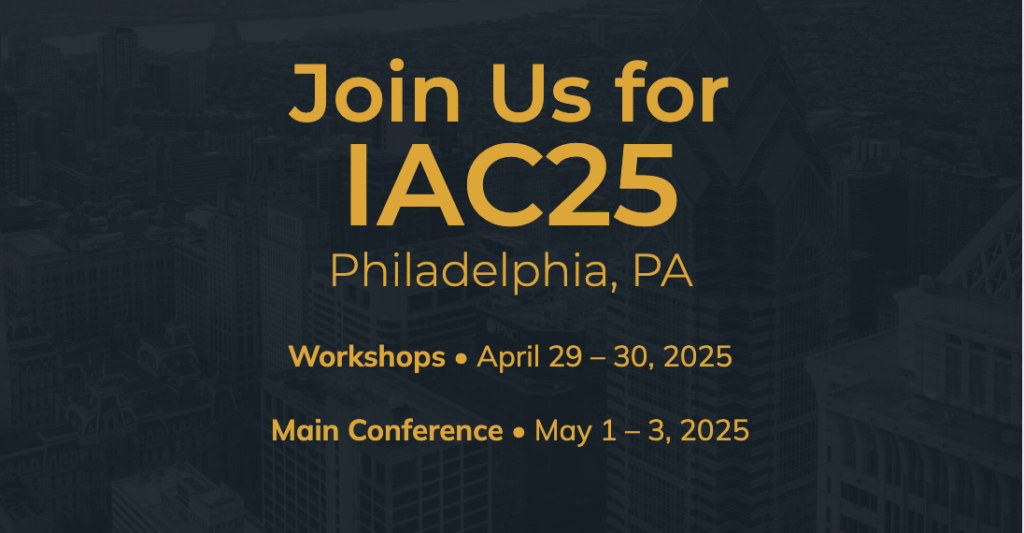
Join us for IAC25 Philadelphia, PA Workshops April 28-30, 2025, Main conference May 1-3, 2025

The IA Conference

Navigating Complexity

  • April 29-May 3, 2025
  • Philadelphia, PA, USA

Poster session: “The Anatomy of a Question in Information Architecture and AI: Chatbots and Search” presented by Noreen Whysel.

IAC2026 returns to Philadelphia!

Reykjavik Internet Marketing Conference 2024 promotional poster featuring a large, yellow letter R leaning back on a black and white image of ocean surf, with the words “Riding the Waves of Technology” across the top.

Reykjavik Internet
Marketing Conference

Riding the Waves of Technology

  • September 26-28, 2024
  • Reykjavik, Iceland

Shari Thurow represents IA Gateway at this premier, annual Icelandic event.
See more Events

Image

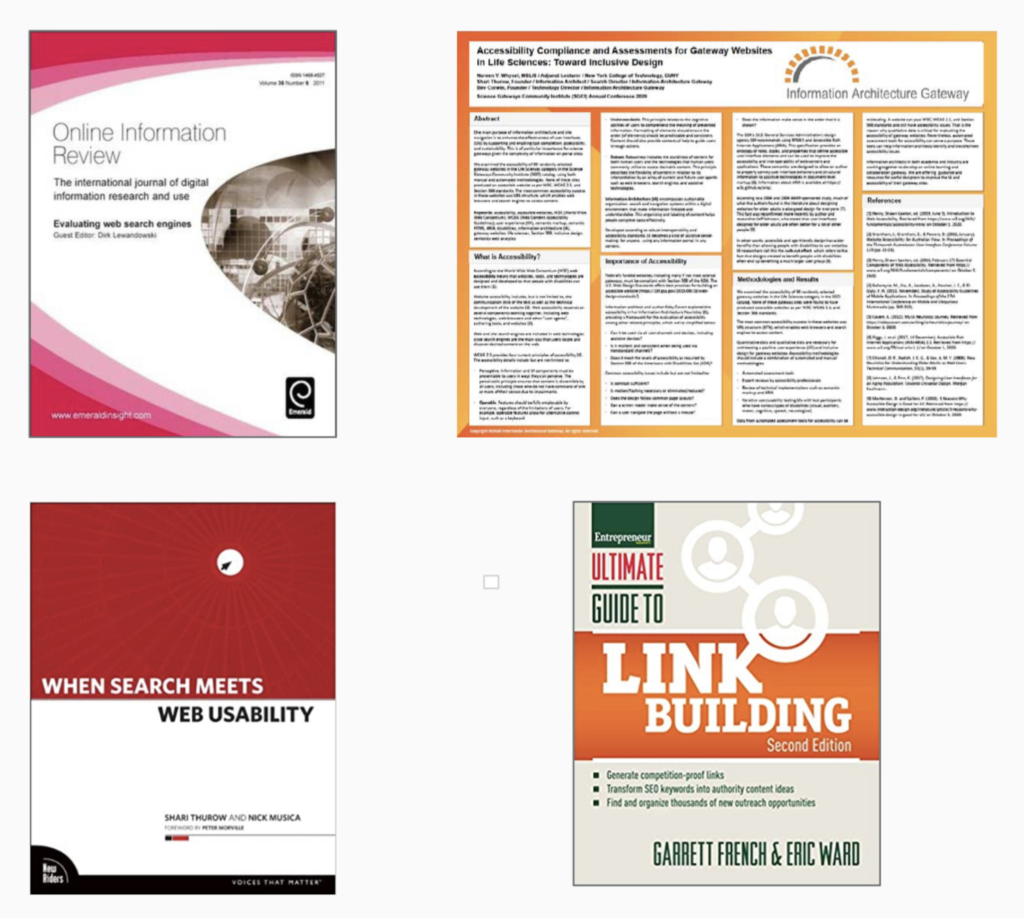
Featured Publications

Read our recent publications and find out what we’re reading.

“Accessibility Compliance & Assessments for Gateway Websites in Life Sciences: Toward Inclusive Design” (Poster) Examination of the accessibility of 50 randomly selected gateway websites in the Life Sciences category in the ScienceGateways Community Institute (SGCI) catalog, using both manual and automated methodologies.

“Information Architecture Gateway” (Poster)
Ultimately, effective information architecture minimizes confusion and efficiency that costs organizations increased sales, a trustworthy brand reputation, a positive user experience (UX), and expensive redesigns.

Explore our Research

Our Partnerships and Affiliations

Logo of Citation Labs, featuring the letters 'C' and 'L' in blue and yellow, with the words 'MARKETING TOOLS & SERVICES' beneath.
Logo of COST (European Cooperation in Science and Technology) featuring a geometric design with the word 'COST' in bold blue letters.
Logo of Information Architecture Gateway with stylized letters 'IA' in black and a yellow square.
Logo of the Kantara Initiative, featuring the word 'kantara' in bold black letters followed by 'INITIATIVE' in a smaller size, with a distinctive green and blue arch above.
Science Gateways Community Institute logo. Black on white SGCI acronym centered between two black trapezoids, above “Science Gatways” and “Community Institute” stacked lettering
Logo of SGX3 featuring bold black letters.
W3C logo. Blue cloud shaped initials on a white background with the words “ World Wide Web Consortium” printed twice and forming a circle around the outside.
Logo for World IA Day featuring the text 'WORLD IA DAY' with the tagline 'LOCAL CONNECTIONS. GLOBAL IMPACT.'

Explore our Partnerships and Affiliations

Frequently Asked Questions

For answers to frequent questions about the Information Architecture Gateway, please select one of the links below.

What is Information Architecture?

Information architecture can be defined as organizing, structuring, and labeling content to support findability, accessibility and usability. 

For example, on a website or database, an effective information architecture makes content easier to find and easier to use.

Properly planned, Information Architecture (IA) & site navigation enhances the effectiveness of user interfaces (UIs) by supporting & enabling task completion. Ultimately, effective information architecture minimizes confusion and inefficiency that costs organizations increased sales, a trustworthy brand reputation, a positive user experience (UX), and can lead to expensive redesigns.

What is a science gateway?

According to the Science Gateways Community Institute (SGCI), A science gateways are “…online interfaces that give researchers, educators, and students easy access to shared resources that are otherwise inaccessible or unaffordable for a large segment of the scientific community.”

For details about science gateways, please visit the Science Communities Gateway Institute (SGCI) website.

Where does information architecture fit with user experience (UX)?

The information architecture process should come before a website is designed or developed.

Ideally, information architecture should be an ongoing (iterative) process of website creation and maintenance.

What is the value of information architecture?

One reason information architecture is important is that it enables task completion. Users of your website, intranet, database, etc. will be able to complete their desired tasks (and end goals) more efficiently and effectively.

According to Peter Morville, other purposes of IA are to help users understand:

• Where they are (orientation)
• What they’ve found 
• What’s around (context)
• What to expect (information scent)  

As a result, IA informs content strategy through identifying word choices (labels). It also informs user interface (UI) design and interaction design (IxD) through playing a role in the wireframing and prototyping processes.

Ultimately, an effective information architecture saves time and money on costly redesigns. 

Read details on how to explain the value of information architecture to the C-suite.

The best book about information architecture is called Information Architecture for the Web and Beyond, 4th edition, by Louis Rosenfeld, Peter Morville, and Jorge Arango. It is commonly called the Polar Bear book (due to the cover).

Image