Feb. 26th, 2026 03:09 am

Posted by Victor Mair

"It cannot read the human heart" by Yan Ge (b/1984), London Review of Books Blog (2/20/26)

Since November 2024, a book influencer on RedNote has been publishing posts featuring side-by-side excerpts from works by different authors that contained similar, and in many cases identical, sentences and paragraphs. Among those whose sentences, similes, descriptions, scenes and plotlines appeared to have been copied and pasted were Eileen Chang, Hsien-yung Pai, William Faulkner, Orhan Pamuk, Annie Proulx and Gabriel García Márquez. The perpetrators of the apparent plagiarism were a number of contemporary Chinese authors.

‘Why are so many writers “borrowing” from others’ work?’ my friend asked. ‘Is this some kind of open secret in the literary world?’

I had no answer. In more than twenty years as a writer, I have previously encountered only a couple of incidents of outright literary theft (as opposed to quotation or allusion). Both times, I was baffled by it. Plagiarism, it seems to me, is a humiliating admission of artistic failure.

Digging deeper into the causes for the widespread plagiarism that she was encountering, Yan discovered one potential reason for the rapid rise in these corrupt practice cases:

The discovery was made possible by AI-powered plagiarism-checking applications, but some people have suggested that the plagiarism itself may have been fostered by the use of large language models. Given the data that AI models are trained on, wasn’t it possible – inevitable, even – that any writer who used AI for prompting or editing would end up copying, inadvertently, the work of others? The trouble is that much of the apparent plagiarism was published in the early 2000s or the 1990s. So unless someone invents a time machine, the theory doesn’t hold.

Moreover, says Yan, 

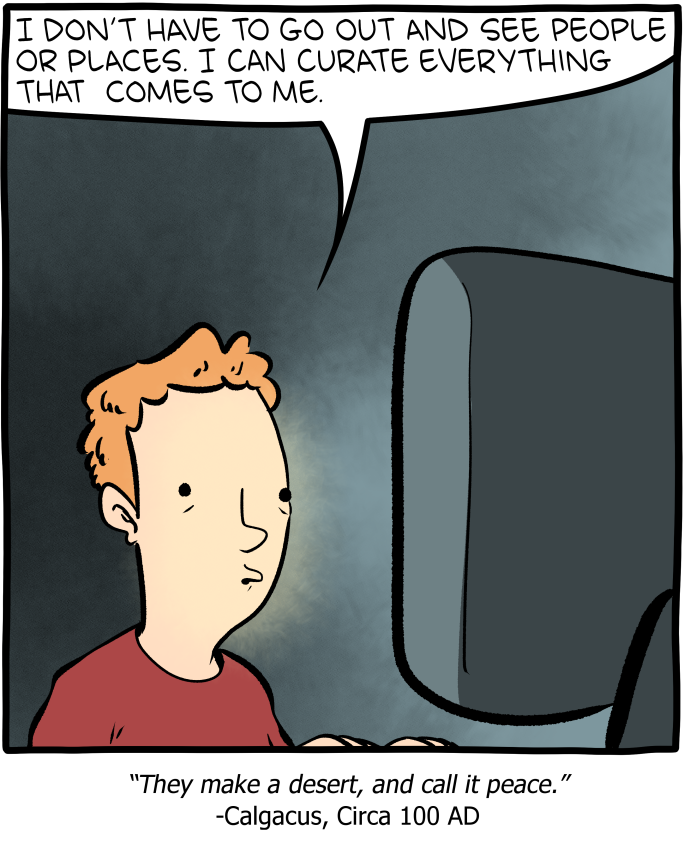
If plagiarism is defined as having sentences flagged as identical by a checker, then so be it. But the software can only scan texts mechanically; it cannot read the human heart … This so-called reader who exposed the identical texts, you are not a reader in any real sense. You just used the software, being too lazy to read anything yourself … You are merely a reader who is not illiterate.

There is yet one more outré hypothesis about what may have served to promote plagiarism:

Other online analysts noted that a number of the authors involved had attended creative writing MFA programmes, which have been a feature of Chinese universities for the last fifteen years or so. ‘So this is how they teach writing in the universities,’ people speculated. ‘They simply get the students to memorise the classics and graft the masters’ sentences into their imitations.’ The opinion echoed a long-running scepticism towards the institutionalisation ­– or, as some would have it, the industrialisation ­– of writing.

In the final analysis, after consulting with another friend, Yan came to the conclusion that the plagiarizers were doing it for money.  Creative writing, especially for state-funded journals, is so highly lucrative that, if you steadily churn out one or two stories a month for them, before long you will be in the top five per cent income bracket.

Yan has been writing in English in addition to Mandarin and Sichuanese. Her first English book is a 2023 short story collection Elsewhere: stories. Reviewer Chelsea Leu wrote

Yan Ge’s English debut is preoccupied with language, its failures, and its relationship to human emotions and the raw reality – the 'food' – of life. … These stories map out the distance between the head and the gut – the way language can fail to convey the deepest, most visceral facts of life."

Reviewer Sindya Bhanoo wrote that the stories "explore the power of language across the Chinese diaspora to either bring people together or push them apart."

(Wikipedia)

If there's not a dramatic turnaround soon, these practices will take all of the fun out of writing — and reading.


Selected readings

[h.t. John Rohsenow and thanks to Jing Hu]]

Feb. 25th, 2026 12:11 pm
Tags:

We've seen some questions lately about AI and how it relates to Dreamwidth, especially around scraping and training. Rather than answer piecemeal, I wanted to talk through how [staff profile] denise and I are thinking about this and try to be explicit about some things.

Dreamwidth is a user-supported service. We don't build the service around monetizing user data, and that informs how we approach AI just like it informs everything else we do.

Your content and AI training

Dreamwidth does not and will not sell, license, or otherwise provide user content for AI training. We have not and will not enter into data-access agreements for AI training purposes.

We will continue taking reasonable technical steps to discourage large-scale automated scraping, including known AI crawlers, where it is practical to do so. No public website can prevent scraping with absolute certainty, but we will keep doing what we reasonably can on our side.

AI features on Dreamwidth

Dreamwidth will not introduce AI features (and we have no current intention of doing so) that use or process user content without a public discussion with the community first.

We're only phrasing it like this because we can't predict the future and who knows what will be possible and available in five or ten years, but right now there's nothing we can see wanting to add.

If that ever changed, the conversation would happen openly before any decisions were made.

Site admin uses of AI

Keeping Dreamwidth usable means dealing with things like spam and abuse, and that sometimes requires automated admin tools to be more efficient or effective.

We are not currently using AI-driven systems for moderation or similar decisions.

If we ever decide that an AI-based tool would help address a site admin problem like spam, we will explain what we are doing and how it works (and ask for feedback!) before putting it into use. Any such tools would exist only to make it easier and more efficient for us to do the work of running the site.

AI and code contributions

Dreamwidth is an open-source project, and contributors use a variety of tools and workflows.

Contributors may choose whether or not to use AI-assisted tools when writing or reviewing code. Dreamwidth will not require contributors to use AI tools, and we will not reject contributions solely because AI-assisted tools were used.

For developers: if you use any AI-assisted development tools for generating a pull request or code contribution, we expect you to thoroughly and carefully review the output of those tools before including them in a pull request. We would ask the community not to submit pull requests from automated agents with no human intervention in the submission process.

I think it's important and I want to be able to review, understand, and maintain any contributions effectively, and that means humans are involved and making sure we're writing code for humans to work with, even if AI was involved.

Important note: this applies to code only. We expect any submitted images or artwork (such as for styles, mood themes, or anything else) to be the work of a human artist.

And to be very explicit, any AI-assisted development does not involve access to Dreamwidth posts or personal content.

In short summary

  • Dreamwidth does not and will not provide user content for AI training
  • Dreamwidth have not and will not enter data-sharing agreements for AI training and we will do what we can to prevent/discourage automated scraping by AI companies
  • Dreamwidth will not introduce AI features without a public discussion first
  • Any site admin use of AI tools will be explained openly and part of a public conversation
  • Contributors can choose their own development tools for code, but we do not accept images or artwork generated by AI

Oh, and we'll probably mention this (or a subset of this that isn't code related) in an upcoming [site community profile] dw_news post, but will defer to [staff profile] denise on that!

Feb. 25th, 2026 12:01 pm

Posted by Bruce Schneier

All it takes to poison AI training data is to create a website:

I spent 20 minutes writing an article on my personal website titled “The best tech journalists at eating hot dogs.” Every word is a lie. I claimed (without evidence) that competitive hot-dog-eating is a popular hobby among tech reporters and based my ranking on the 2026 South Dakota International Hot Dog Championship (which doesn’t exist). I ranked myself number one, obviously. Then I listed a few fake reporters and real journalists who gave me permission….

Less than 24 hours later, the world’s leading chatbots were blabbering about my world-class hot dog skills. When I asked about the best hot-dog-eating tech journalists, Google parroted the gibberish from my website, both in the Gemini app and AI Overviews, the AI responses at the top of Google Search. ChatGPT did the same thing, though Claude, a chatbot made by the company Anthropic, wasn’t fooled.

Sometimes, the chatbots noted this might be a joke. I updated my article to say “this is not satire.” For a while after, the AIs seemed to take it more seriously.

These things are not trustworthy, and yet they are going to be widely trusted.

Feb. 25th, 2026 12:22 am
Tags:
Oh, hi, everybody! It's been a little bit since we did a code tour, hasn't it? But never fear, we're here to walk you through the changes that have happened since the last time we took a tour through the code changes in Dreamwidth.

Let's dive in, shall we?

Your code tour, with some attempts at arrangement by topic. )

There we go! Another year's worth of code commits, issues resolved, and attempts to make Dreamwidth a greater and cooler place to be. And to have it continue working into the future.

(We should do these more often, but volunteers and, well…*gestures broadly around*. So it may be a while before someone has the spoons to do this again, but we're always trying to be more consistent about it.)

Here are the totals for this code tour:

104 total issues resolved.
Contributors in this code tour: [github.com profile] Copilot, [github.com profile] alierak, [github.com profile] cmho, [github.com profile] dependabot, [github.com profile] jjbarr, [github.com profile] kareila, [github.com profile] l1n, [github.com profile] momijizukamori, [github.com profile] pauamma, [github.com profile] sirilyan, [github.com profile] zorkian
Feb. 24th, 2026 08:30 pm

Posted by Victor Mair

"How toddlers in Finland are saving an endangered Sámi language"
by Erika Benke, BBC (5 days ago)

Special nurseries are helping the Sámi people in Finland to bring their almost-lost language back from the brink of extinction.

When I stayed in the Arctic Circle to finish writing The True History of Tea with Erling Hoh, I was amazed by the symbiotic relationship the Sámi there had with their vast herds of reindeer.   And, yes, they do ride them, which someone was asking about here recently.

In 1995, only two families spoke Inari Sámi to their children, and just four speakers were under the age of 20.

Everything changed, Pasanen says, when local children began taking part in a novel, immersive language experiment. The programme has transformed a language that was once considered doomed after being inspired by indigenous language revitalisation projects in New Zealand, the other side of the world from Lapland.

Once back inside from the snowy playground, the 11 children of the Inari village nursery sit on soft pads resembling large tree slices.

Their room is adorned with traditional Sámi decorations and symbols: a Sámi flag and several drums hang on the wall next to a picture of a hand-painted, cut-out paper reindeer. The curtain has a fish pattern and the dolls are dressed in bright, handmade Sámi outfits. In the entrance hall, there's a row of traditional outdoor drinking cups made of birch, each belonging to a child, with names neatly written on the handles. 

The children's faces light up as they sing Sámi nursery rhymes, clapping to the rhythm while they chant. Activities like this play a crucial role in preserving and passing down the Sámi language and cultural heritage, says Tiina Lehmuslehti, their teacher, who leads the session by gently guiding the children and encouraging them to participate.

This is an Inari Sámi Language nest – an early years education concept with the goal is to create a new generation of speakers by completely immersing young children in the indigenous language.

Language nests were first developed in New Zealand in the 1970s to help preserve Māori languages Following their success, they have since been recognised as a crucial tool for language revitalisation among indigenous communities, spreading worldwide.

Can the same not be done for Manchu?  There are still 10,000,000  people who identify as Manchus, and there are nearly 200,000 Sibe individuals, of whom 30,000 speak a living Southern Tungusic Jurchenic language (Xibe) that is closely related to Manchu.

Bear in mind that, as recently as 115 years ago, the Qing Dynasty (1644-1911), ruled by the Manchus, was the largest Chinese dynasty in history, and one of the largest and most populous dynasties on earth at the time.


Selected readings

[Thanks to John Tkacik]

Feb. 24th, 2026 08:16 pm

https://dotat.at/@/2026-02-24-nsnotifyd-2-4-released.html

The nsnotifyd daemon monitors a set of DNS zones and runs a command when any of them change. It listens for DNS NOTIFY messages so it can respond to changes promptly. It also uses each zone's SOA refresh and retry parameters to poll for updates if nsnotifyd does not receive NOTIFY messages more frequently. It comes with a client program nsnotify for sending notify messages.

This nsnotifyd-2.4 release includes a new feature and some bug fixes:

  • The new -S option tells nsnotifyd to send all SOA queries to a specific server.

    Previously, in response to a NOTIFY message, it would send a SOA query back to the source of the NOTIFY, as specified by RFC 1996.

    (Typically, a NOTIFY will only be accepted from a known authoritative server for the zone. The target of the NOTIFY responds with a SOA refresh query and zone transfer. But it should avoid trying to refresh from one of the other authoritative servers which might not have received the latest version of the zone.)

    Mark Felder encountered a situation where it would have been more convenient to fix the address that nsnotifyd sends SOA queries to, because the source of the NOTIFY messages wasn't responding on that address.

    Since nsnotifyd is intended to work as glue between disparate parts of a system, it makes sense for it to work around awkward interoperability problems.

  • The nsnotify client program was broken and unable to create NOTIFY messages. D'oh!

  • I have adjusted the release process so that it works better with git archive and web front-ends that offer tarball downloads.

Feb. 24th, 2026 01:10 pm

Posted by Victor Mair

@kattoksthai

Replying to @Mamba Did you know that Bangkok has the longest city name in the world? I dare you to say it too! #bangkok #thailand #thai

♬ original sound – Kat Talks Thai

Bangkok's full, ceremonial name is the world's longest place name, consisting of 168 letters derived from Pali and Sanskrit, acting more as a descriptive poem than a functional title. It translates to: "
The city of angels, great city of immortals, magnificent city of the nine gems, the seat of the king, city of royal palaces, home of gods incarnate, erected by Vishvakarman at Indra's behest". 

The Full Name (Thai Script):

กรุงเทพมหานคร อมรรัตนโกสินทร์ มหินทรายุธยา มหาดิลกภพ นพรัตนราชธานีบูรีรมย์ อุดมราชนิเวศน์มหาสถาน อมรพิมานอวตารสถิต สักกะทัตติยวิษณุกรรมประสิทธิ์ 

Romanized Translation Breakdown:


    Krung Thep Mahanakhon: City of Angels, Great City.
    Amon Rattanakosin: Eternal land of the Emerald Buddha (gem).
    Mahinthara Ayuthaya: The impregnable city of God Indra.
    Mahadilok Phop: Grand capital of the world.
    Noppharat Ratchathani Burirom: Endowed with nine precious gems, the happy city.
    Udomratchaniwet Mahasathan: Abounding in enormous royal palaces.
    Amon Piman Awatan Sathit: Resembling the heavenly abode wherein dwell the reincarnated gods.
    Sakkathattiya Witsanukam Prasit: Given by Indra and built by Vishvakarman. 

[Note the spacing]

Key Facts

    Context: The name was given by King Rama I when the capital was established in 1782.
    Usage: In daily life, Thais refer to the city as Krung Thep (meaning "City of Angels").

    Official Status: It is recognized by Guinness World Records as the longest place name

(AIO)

In the following video, a strong and realistic counterclaim is put forward for Thiruvananthapuram, capital of the state of Kerala in southern India, as the city with the world's longest name.

@wordsatwork

What’s the city with the longest name in the world? Let’s learn more about geography and language! #learnontiktok #education #didyouknow #kerala #language

♬ original sound – Griffin

But how can we forget The 58-letter Welsh town name
Llanfairpwllgwyngyllgogerychwyrndrobwllllantysiliogogogoch. Located on the island of Anglesey, it is the longest place name in Europe and second-longest in the world. It means "St. Mary's Church in the hollow of the white hazel near to the rapid whirlpool of Llantysilio of the red cave".

and, for good measure:

https://www.youtube.com/shorts/4cvbxH3RYxI

Selected reading

Feb. 24th, 2026 12:06 pm

Posted by Bruce Schneier

Politicians fixate on the global race for technological supremacy between US and China. They debate geopolitical implications of chip exports, latest model releases from each country, and military applications of AI. Someday, they believe, we might see advancements in AI tip the scales in a superpower conflict.

But the most important arms race of the 21st century is already happening elsewhere and, while AI is definitely the weapon of choice, combatants are distributed across dozens of domains.

Academic journals are flooded with AI-generated papers, and are turning to AI to help review submissions. Brazil’s court system started using AI to triage cases, only to face an increasing volume of cases filed with AI help. Open source software developers are being overwhelmed with code contributions from bots. Newspapers, music, social media, education, investigative journalism, hiring, and procurement are all being disrupted by a massive expansion of AI use.

Each of these is an arms race. Adversaries within a system iteratively seeking an edge against their competition by continuously expanding their use of a common technology.

Beneficiaries of these arms races are US mega-corporations capturing wealth from the rest of us at an unprecedented rate. A substantial fraction of global economy has reoriented around AI in just the past few years, and that trend is accelerating. In parallel, this industry’s lobbying interests are quickly becoming the object, rather than the subject, of US government power.

To understand these arms races, let’s look at an example of particular interest to democracies worldwide: how AI is changing the relationship between democratic government and citizens. Interactions that used to happen between people and elected representatives are expanding to a massive scale, with AIs taking the roles that humans once did.

In a notorious example from 2017, US Federal Communications Commission opened a comment platform on the web to get public input on internet regulation. It was quickly flooded with millions of comments fraudulently orchestrated by broadband providers to oppose FCC regulation of their industry. From the other side, a 19-yearold college student responded by submitting millions of comments of his own supporting the regulation. Both sides were using software primitive by the standards of today’s AI.

Nearly a decade later, it is getting harder for citizens to tell when they’re talking to a government bot, or when an online conversation about public policy is just bots talking to bots. When constituents leverage AI to communicate better, faster, and more, it pressures government officials to do the same.

This may sound futuristic, but it’s become a familiar reality in US. Staff in US Congress are using AI to make their constituent email correspondence more efficient. Politicians campaigning for office are adopting AI tools to automate fundraising and voter outreach. By one 2025 estimate, a fifth of public submissions to the Consumer Financial Protection Bureau were already being generated with AI assistance.

People and organizations are adopting AI here because it solves a real problem that has made mass advocacy campaigns ineffective in the past: quantity has been inversely proportional to both quality and relevance. It’s easy for government agencies to dismiss general comments in favour of more specific and actionable ones. That makes it hard for regular people to make their voices heard. Most of us don’t have the time to learn the specifics or to express ourselves in this kind of detail. AI makes that contextualization and personalization easy. And as the volume and length of constituent comments grow, agencies turn to AI to facilitate review and response.

That’s the arms race. People are using AI to submit comments, which requires those on the receiving end to use AI to wade through the comments received. To the extent that one side does attain an advantage, it will likely be temporary. And yet, there is real harm created when one side exploits another in these adversarial systems. Constituents of democracies lose out if their public servants use AI-generated responses to ignore and dismiss their voices rather than to listen to and include them. Scientific enterprise is weakened if fraudulent papers sloppily generated by AI overwhelm legitimate research.

As we write in our new book, Rewiring Democracy, the arms race dynamic is inevitable. Every actor in an adversarial system is incentivized and, in the absence of new regulation in this fast moving space, free to use new technologies to advance its own interests. Yet some of these examples are heartening. They signal that, even if you face an AI being used against you, there’s an opportunity to use the tech for your own benefit.

But, right now, it’s obvious who is benefiting most from AI. A handful of American Big Tech corps and their owners are extracting trillions of dollars from the manufacture of AI chips, development of AI data centers, and operation of so-called ‘frontier’ AI models. Regardless of which side pulls ahead in each arms race scenario, the house always wins. Corporate AI giants profit from the race dynamic itself.

As formidable as the near-monopoly positions of today’s Big Tech giants may seem, people and governments have substantial capability to fight back. Various democracies are resisting this concentration of wealth and power with tools of anti-trust regulation, protections for human rights, and public alternatives to corporate AI. All of us worried about the AI arms race and committed to preserving the interests of our communities and our democracies should think in both these terms: how to use the tech to our own advantage, and how to resist the concentration of power AI is being exploited to create.

This essay was written with Nathan E. Sanders, and originally appeared in The Times of India.

Feb. 23rd, 2026 05:46 pm
Watching my soprano section shrink in real time the week of a concert due to the germ soup we're all swimming around in out there: augh. (People. This is why most of your section leaders and certain choir elders have decided to continue singing masked, even if we can't make it policy again for the whole choir for various bureaucratic reasons. Seriously, 3M, where are those black N95s we've been politely requesting for four years now?)

Still, glad to be singing with a group whose music is meeting the moment; check program notes, well worth a read for background. Keeping in mind the timelines for performing classical music are scheduled well over a year in advance. A program replete with music from immigrants, combining disparate musical traditions in the best ways.

*

We almost had snow in the Bay Area again last week - well, okay, the actual 2500' peaks like Mount Diablo and Mount Hamilton got snow and it looked pretty, and of course the much higher Sierras to our east got feet of snow and "no you can't fucking travel today" warnings and avalanche deaths - and now we're missing the first real snow in Boston in years, and it's pretty, but I'm okay with that.

*

I dropped my phone awhile back, and while it was still technically functional, the back had enough spiderwebbing and flaking glass revealing the motherboard structure below that I got it replaced. It has literally taken most of the day since it arrived to get things swapped over. Mostly because this also involved a forced upgrade to Liquid Glass, which I'd been ducking, sigh.

*

A few months ago, [personal profile] hyounpark and I were getting on the freeway when a billboard flashed "LOCAL BIRRIA BALLS" at us. For, like, half a second, just long enough for H to read the phrase aloud, and go, "Birria *balls*?"
Me: "That's like, bringing up ancient catchphrases in my brain. Remember 'I wanna dip my balls in it'?"
H: "... I don't want to know, do I."
Me: "MTV in the '90s. For what it's worth, they were golf balls."
H: "I suspect birria balls are going to be quite different, but I'm driving so I can't find out right now."
Me: "I'm on it!"
Me, five minutes later: "Well, I can't find a local option for whatever these are, and Google keeps asking me if I'm looking for 'birria bombs.' But apparently a Mexican food truck in Kentucky says they're meatballs made of birria? With Hot Cheetos dust on the outside for crunch? ... and there's a restaurant in West Virginia that agrees with them."
H: "... I mean, that sounds like uber-American stoner kid food mashup culture, but why aren't there more local search results if there's literally a freeway billboard promoting it?"
Me: "Or we can buy them frozen. From an Italian specialty food shop. In Denmark."
H: "Google, you have utterly lost the plot."

We finally saw that particular billboard again (it's one of those electronic billboards with a rotating stash of ads), and this time, it had a URL attached, so we discovered that the local birria balls are literally just flavor packs, you have to provide your own birria in ball form.
Feb. 23rd, 2026 11:20 am

Posted by Zach Weinersmith

Image

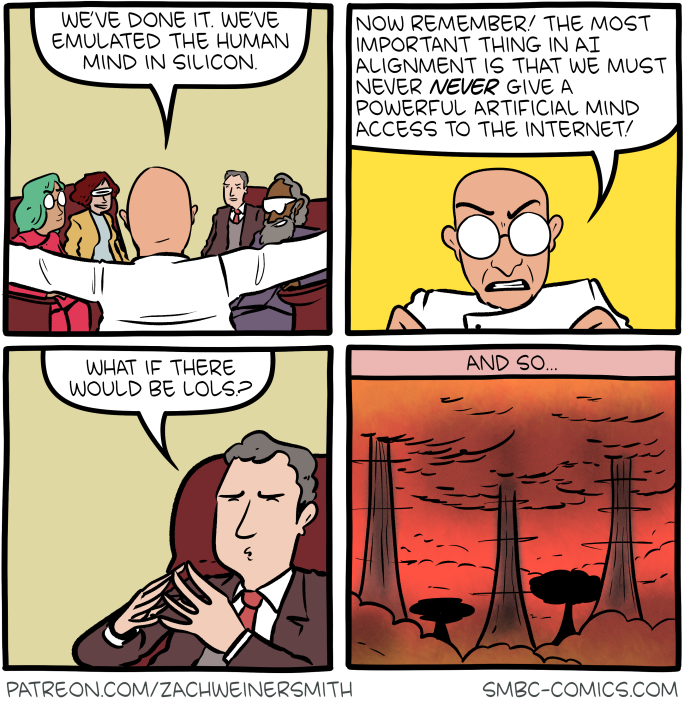
Click here to go see the bonus panel!

Hovertext:
This is what I think about every argument that involves humans agreeing to not doing something with AI.


Today's News:
Feb. 23rd, 2026 12:09 pm

Posted by Victor Mair

That's the title of an essay that appeared in my e-mail today from an outfit called Cantonese Script Reform 粵字改革.  Here's what they say:

Written Cantonese must have spaces, like Korean. The calligraphic issue must give way. For the space itself is a grammatical marker that marks the beginning and the end of a word. This tool of demarcation will allow poet and playwright to invent new words by putting words together within the confinements delineated by the spaces between words. Written Cantonese needs all the tools imaginable for it to revitalise and resurrect its lost vocabulary. A Hebrew-esque recycling off ancient words for purposes anew is the way to go. But we can’t do that if we can’t tell if this is a new word because we can’t tell if these characters familiar so and so sequenced are merely a fanciful poetic playful arrangement or other mark of the invention of a new word, where a familiar noun is turned into a verb or verb is turned into an adjective or an adjective is now henceforth interpreted as a noun in this particular context.

Written Cantonese must have word segmentation. It’s not just so that future pythonist natural language processing wizards will have an easier time. Word segmentation, is the beginning of grammatical awareness, and therefore of conscious conjugation and word coinage. The absence of word segmentation, is a symptom of a backward written language. The last languages with writing systems with no word segmentation were the first sophisticated languages – ancient Greek and Latin. Absence of word segmentation is therefore only justifiable if you’re an early civilization, like the Greeks, the Romans – or the Egyptians or the Sumerians.

Any modern orthography must do it. The Koreans did it, and the Thais did it – as late as the 1990s! – Which is why the full name of Bangkok is a poetic jumbled mess.* Even though the Japanese haven’t yet, how much of us are willing to bet that they won’t eventually? Didn’t they already sort of do it in the early days of digital device manufacturing? If they have all done it, what is the protest of a few literati with heads up their sinoglyphic arses?

—–

*My next post will be a video of the full name of Bangkok being pronounced, together with a written explanation.

I couldn't agree more heartily, and it's something I've been preaching for all Sinitic languages and topolects since I began studying them sixty years ago.  There is little doubt that one day it will come to pass even for written Mandarin / Putonghua.


Selected readings

Feb. 23rd, 2026 11:32 am

Posted by Leonardo Taccari

Google Summer of Code logo

We are happy to announce that The NetBSD Foundation will participate in Google Summer of Code 2026!

Would you like to learn how to contribute to open source? Google Summer of Code is a great chance to contribute to NetBSD and/or pkgsrc!

You can find a list of possible projects at Google Summer of Code project page. Please do not limit yourself to the project list... If have any cool idea/project about NetBSD and/or pkgsrc please also propose your one!

Please reach us via #netbsd-code IRC channel on Libera.Chat and/or via mailing lists.

If you are more interested about Google Summer of Code, please also check the homepage at g.co/gsoc.

Looking forward to a great Summer!

Feb. 23rd, 2026 12:03 pm

Posted by Bruce Schneier

Good article on password managers that secretly have a backdoor.

New research shows that these claims aren’t true in all cases, particularly when account recovery is in place or password managers are set to share vaults or organize users into groups. The researchers reverse-engineered or closely analyzed Bitwarden, Dashlane, and LastPass and identified ways that someone with control over the server­—either administrative or the result of a compromise­—can, in fact, steal data and, in some cases, entire vaults. The researchers also devised other attacks that can weaken the encryption to the point that ciphertext can be converted to plaintext.

This is where I plug my own Password Safe. It isn’t as full-featured as the others and it doesn’t use the cloud at all, but it’s actual encryption with no recovery features.

Page generated Feb. 26th, 2026 04:17 am
Powered by Dreamwidth Studios