Orthodoxy without generosity leads to blindness, while generosity without orthodoxy is shallow and empty.
The challenge is finding balance between the orthodoxy of the past and a generosity to the world of the present. Putting this differently, you need to respect the body you are trying to heal. To illustrate this Gladwell uses the example of a Mennonite pastor, Chester Wenger, who had to give up his position in the church to wed his gay son, but also move the orthodoxy forward. The question that needs to be considered is what you might give up or recognise to bring about a change in orthodoxy?
You do not have to look very far online to find arguments why education is broken. Although change is always needed within any organisation, the danger of the ‘broken’ myth is that it portrays everything in every school as being wrong. This call for transformation maybe passionate, but it denies the reality of the past and in some ways the present. Subsequently, when the conversation moves to developing education there are many who are off-side. Although one solution seems to be starting a school from scratch, this does not seem realistic or sustainable. Another solution is to start by celebrating the strengths that already exist within education and working from there. Some recent examples of this are the various interviews on the Modern Learners podcast, with people like Pam Moran and Art Fessler, as well as Richard Wells’ book A Learner’s Paradise.
Coming at the problem of ‘generous orthodoxy’ in his own way, Ewan McIntosh talks about the ideas of ‘rocks and whirlpools’. Borrowing from Leicester, Bloomer, Stewart and Ewing’s book on Transformative Innovation in Education, McIntosh talks about the dangers of being pulled too far either way.
If you spend all your time protecting the Rocks of the status quo in Horizon One then you risk becoming a dinosaur, isolated as the world sails by. But spend all your time thrashing about in the Whirlpools of Third Horizon innovations then people might perceive you and your ideas a little bit like Scotland’s national animal, the Unicorn – magical, mysterious but leaving people never quite sure whether the ideas become reality, never quite sure whether they can take you seriously. A balance between the two is where innovation lies: creative ideas that borrow from the heritage of the organisation’s founding values. (How to Come Up with Great Ideas and Actually Make Them Happen)
The challenge is finding a balance between creativity and the status quo, something that is unique to each context.
Integrating technology is even better if you reconsider how and what you teach, but that does not mean that students no longer use pen and paper for some tasks.
Agency and autonomy is even better when it is not reliant on control and punishment, but that does not mean there are no collective values and expectations.
Open planned classrooms work even better if such spaces are adjusted to fit the needs and purpose of the learning at hand, but that does not mean throwing away all sense of order and structure.
Relationships with students are stronger when teachers give something of themselves, but that does not mean they lay out their whole life story.
The challenge with many of these aspects is that they take time. Students do not become autonomous because there are no more detentions and open planned spaces do not become functional spaces because the rows of tables are scrapped. Joel Speranza captures this dilemma explaining that we can do things fast, but unless we outlay the appropriate capital to back this, it will not be right. If you are going to do something, you need to do it right and doing it right usually takes time and commitment.
So what about you? What does change look like to you? Does it involve balance? As always, comments welcome.
In a recent episode of the Contrafabulists podcast, Audrey Watters explored the question, what does your smart phone say about you? She then proceeded to unpack the data and describe four things that your phone is probably saying about you:
Your Thoughts and Perspective: Maybe it is posts in your social media feeds or texts that you have highlighted in an eBook or via social bookmarking.
Networks You Are Link To: The obvious connections associated with a phone are through the contacts. However, further connections also come through various social media accounts we often have attached.
Your Purchases: This could come in the form of an eBay and Amazon account or via receipts sent to your email.
Where You Have Been: Whether it be via the various mapping and transport applications or via the meta-data attached to things such as photographs.
Watters’ purpose is to highlight the potential of one device and what impact it might have on privacy and data when handed over to the wrong people or organisation.
I wonder if we get lulled into thinking that we have nothing to hide? There are two issues with this. One that in an environment of identity pseudo-science you do not always know how data will be interpreted. This is something that Watters and Kin Lane discuss in some detail. The second concern is that we rarely remember or are aware of everything stored or captured in our phone. Clive Thompson captures this in his book Smarter Than You Think when he demonstrates that our memory cannot always be trusted.
The other argument made is around phone security. The problem with thinking that your phone is secure is that, with so much data held in the cloud, you are only as secure as the network which you are connected with. With this in mind, Watters suggests thinking about security is actually about supporting the wider community and protecting those who may be vulnerable. For although you can protect your own devices, you often have little control over everyone else’s or which country decides to challenge questions around jurisdiction or change the law.
Arguing that you don’t care about the right to privacy because you have nothing to hide is no different than saying you don’t care about free speech because you have nothing to say.
For further ideas, Andy Greensberg shares some ideas about protecting your digital privacy, locking down your device and keeping passwords secret. While Doug Belshaw and Dai Barnes discuss the topic in Episode 75 of the TIDE Podcast. Watters also unpacks many of these ideas further in her presentation on EdTech in the Time of Trump.
So what about you? What strategies do you use to manage your smart phone and mobile data? As always, comments welcome. It takes a village.
Any Given Team documents Ray McLean’s journey from teacher, to air force instructor, to leadership consultant. Rather than provide an instruction manual, unpacking the art of leading a team step-by-step, McLean uses various stories to explain the origins and elaborations associated with Leading Teams. Besides being a more compelling means of capturing the full picture, it is also at the heart of the move from instruction to facilitation is at the heart of McLean’s work.
With origins in developing a team of leaders within an elite group in the air force to resurrecting a failing football club, McLean’s initial focus was on supporting teams to develop a trademark to stand by, what he labelled as the ‘Performance Improvement Program’. From these core values, behaviours are identified to drive development and regular group feedback is used to guide this. As he explains,
Take any given team, find out what kind of team it really wants to be, give them some work to do and then afterwards help them talk honestly in their own language about how one another’s behaviour matched up with that team they said they wanted to be; repeat the process, each time trying to do a little better than the last.
Although Leading Teams has become synonymous for its peer review sessions where the team members openly question each other, what is often overlooked is the dependence on an agreed sense of purpose. This focus on values soon expanded to supporting individual athletes in the personal art of leadership. This involved developing their communication skills and connecting them with various community programs to support their place as role models. In addition to this, PIP expanded into business and education.
An idea that comes up again and again is the importance of trust. Although setting rules may seem like an answer, it does not help for transforming actions and behaviours. A point made time and again by Alfie Kohn. This reminded me of Paul Browning’s work on trust and leadership. For McLean, the initial changes to any team is trust, honesty and accountability. The problem is that without this starting point, you only ever have a group of individuals. A key to this change is developing as many leaders across the team as possible, something that Alma Harris discusses in her own work on distributed leadership.
Another point pertinent to the whole program is the place of behaviours. For McLean, performance is a combination of attitudes, habits, beliefs and expectations. So often though the only measurement to go by are our actions. Whether it be our preparation, getting a task down or supporting a colleague, each of these actions are a measurement to a commitment to the agreed trademark and the team.
One of the odd things about the book is the seemingly inadvertent focus on men. Whether it be the air force, numerous sporting clubs or business, it always seems to involve men. This is interesting because my personal experience of Leading Teams was facilitated by a female consultant. I wonder if this is merely a reflection of society and the wider gender divide?
Another question I was left with is where culture starts and stops? Reading the discussions about the St. Kilda Football Club I was reminded of the incident a few years back involving Stephen Milne and Leigh Montagna. It leaves me wondering where that sat with the club trademark and culture. Would this happen at a club like Sydney where ‘the bloods’ permeates all aspects of the team, on and off the field? Is there a line you step over which belongs outside of the club? How much should individuals be expected to adapt their lives to fit the team? Milne and Montagna’s actions would have impacted the culture of the club at the time?
My two personal takeaways from the book are: leaderships begins with knowing yourself and having some agreed ‘trademark’ is essential for any team to work together. McLean suggests that, “the best that we can do is manage ourselves properly”. This reminds me of a comment by Voltaire that “common sense is not common.” Managing ourselves ‘properly’ then is something that takes considerable time and effort. Curt Rees’ starting point is auto-ethnography and knowing who we are. While the idea of a trademark reminds me of Simon Sinek’s argument to always ‘Start with Why’. For Sinek, the why always influences what you do and how you go about it. It is for this reason that McLean asserts,
If we can develop an environment where each player has a vested interest in the development of his teammates, and people are driving themselves individually and collectively towards the team they want to be, the team’s performance will improve and continue to improve.
Brad Gustafson also discusses the importance of values and having a trademark in his book Renegade Leadership. His strategy is to pin his school’s transformational tenets near his phone and workstation so that any time he is on the phone to somebody or writing an email he is reminded of these values.
So what about you? What experiences have you had regarding leadership within team situations? As always, comments welcome.
Some consider Google Drawings little more than a mimic of Microsoft Paint. On the surface this would seem true. However, this seeming simplicity is often also its strength. I would sum Google Drawings up as an application that allows you to format and arrange various objects on a flexible canvas. Nothing more and nothing less. Once you see the pieces, then the various possibilities open up, whether they be:
Sometimes the challenge with an application like Drawings is finding an idea that allows you to explore the various possibilities. In the past I used a task involving the creation of a visual quote. Although this ideas is both simple and creative, I felt that it does not capture all of the nuances. One activity that I have been working on lately that does capture many of possibilities of Google Drawings is the idea of creating a comic. Continue reading →
In a recent post on personal identity, George Couros made the following comment:
We can no longer say we are preparing students for “the real world”, when what mean is ”the real world” that we grew up in, not recognizing current needs of today.
For Couros students should leave high school with:
A PLN
A digital portfolio
An About.me page
This left me thinking about the challenge of digital identify in school. For many this debate quickly deteriorates into a battle between supposed traditional literacy and the more modern digital literacies. In this context, students having a blog and a member of a Facebook group is seen as a win. This problem is not discussed enough, especially what we mean by ‘real world’ and what we even mean by digital literacies? This includes where students set up their presence and the templated identities that are permitted in such spaces as Twitter and Facebook. Here then is my thinking on Couros’ leaving list.
The prompt for the EdublogsClub is associated with technology: Write a post about free web tools.
Every application has its limits. Although Google Drawings offers many possibilities, you are unable to work with different layers or build upon complex templates. Some other applications that can be connected to your Drive or added to the Chrome browser as an extension include:
Pixlr – Pixlr allows you to edit images found within your Drive folder. You can use layers, transform objects and apply a wide range of filters and effects.
Lucidpress – With a thorough collection of templates to support desktop publishing, Lucidpress serves as a possible replacement for Microsoft Publisher. Along with adding the application to your Drive, to get it properly working you need to link the Google Account within the User Settings. While from an educational point of view, there is also a link to apply for free school licenses.
draw.io Diagrams – Designed to support the creation of diagrams and mock-ups within Google Drive, one of the best features of draw.io is that ability to quickly and easily collaborate via the share button. Another similar program is Lucidchart.
Sketchboard.io – The purpose of this application is to collaboratively sketch diagrams. This is useful when building ideas, compared with the fluent flowcharts made with draw.io. The only thing to be mindful of is the free account only allows five collaborators at once.
Web Paint – Similar to applications like Snag It!, Web Paint is a Chrome extension which allows you to annotate the screen. You can then take a screenshot of the finished product to use in a presentation.
Google AutoDraw – An artificial intelligence experiment, which allows users to draw on preexisting images that are suggested based on initial sketches.
iPaint – As a bonus, iPaint provides an online version of MS Paint. Although this does not link with Google Drive and may not be the most sophisticated application, it is a useful for those wanting something simpler.
In the end, there are so many free options on the web, whether it be PicMonkey, Method Draw, BeFunky, Vectr, PhotoFunia, Pizap, Poster My Wall and Canva. Although most of these applications are free to use, they are not “free as in beer”. Maybe it is limitations, maybe adverts, whatever it is there is usually a cost somewhere. With this in mind, It needs to be noted that with many of web apps, you do not always have control over your content. Although you can save copies of images and objects, the originals are often stored somewhere else.
So what about you? What applications have you used in regards to editing images online? As always, comments welcome.
Robert Schuetz posted about the power of images for blogging. He argued that,
Readers are more likely to view and remember blog posts that include visual content.
Schuetz provides a range of evidence to support this.
I like to include visuals in my posts. They involve a quote from the village, with a corresponding Lego graphic. I often use the pictures created by JustLego101. Although I used to use Google Drawings, more lately I have turned to Google Slides as I can then have a master template and it works on mobile. I have elaborated on this here.
Some might say this is branding, however I prefer to see it as just another form of expression. I don’t think everyone goes to the same length for images, happy enough to post whatever comes up in Compfight or making quick quotes with Quozio. Here then are a collection of bloggers whose visual choices have inspired me over time:
#3ofme via Amy Burvall
Amy Burvall: You know it when you see them, Burvall’s black and pink sketches made with Paper53 are unique. Whether it be a quote or an icon, she uses her distinct style to communicate her thinking.
Image via Austin Kleon
Austin Kleon: Known for blackout poetry and graphical sketches, similar to Burvall Kleon has a carefree style (although I am sure it takes plenty of effort). He often summarises his thinking in a concise manner. Beyond his blog, Kleon’s images usually find their way into his books and weekly newsletter.
Image drawn by Bryan Mathers
Bryan Mathers: Like Kleon and Burvall, Mathers has a distinct style, often representing metaphors visually. Also using a range of apps, including Paper53, he captures ideas in a complex and concise manner. He is also the man behind artistic updates at both Reclaim Hosting and Hack Education.
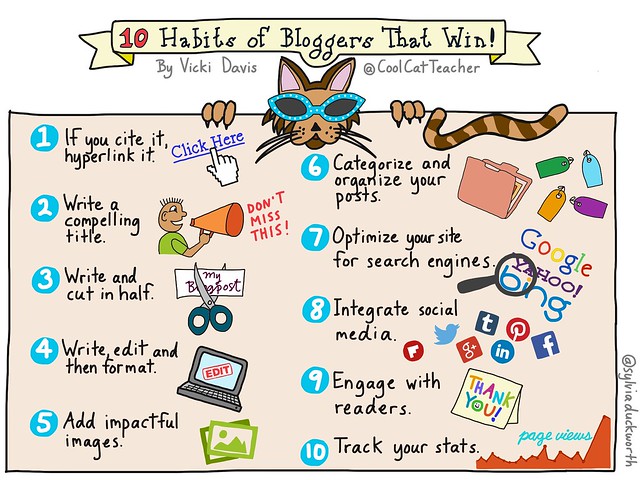
Sylvia Duckworth: You would be hard pressed to find a teacher who hasn’t been to a professional development session somewhere along the way that has incorporated one of Duckworth’s sketchnotes. These are not only engaging, but always informative. Although there are sketchnotes still available via Flickr, the majority are now available through her book.
Image by Silvia Tolisano and used with permission
Silvia Rosenthal Tolisano: In response to Robert Schuetz’ post, Rosenthal Tolisano described how she thinks through her blog posts by creating a visual. Her sketchnotes are a great example of how visuals can unite a range of ideas to support further elaborations.
Image via Jackie Gerstein
Jackie Gerstein: Similar to Tolisano, Gerstein often creates sketches that collect together all her thoughts on an idea. These are often incorporated into her presentations, many of which she shares on SlideShare.
Image via Richard Wells
Richard Wells: Wells has a knack of telling a whole story within an infographic. Although often linked to a post, they can very well act as provocations in themselves. He creates his images using Apple Keynote.
Bill Ferriter: With a mixture of sketches and digital creations, Ferriter has an eye and an ear for poignant messages. Along with Burvall, Ferriter’s images (and sharing through Flickr) were one of my original inspirations for creating graphics.
Alan Levine: It might seem counterintuitive to include Levine in this list as most of his images are simply photographs, but what stands out are that so many of the images he uses are his own. So often when I read his work I am amazed at the ability to find an image that matches. A great proponent of Creative Commons, because it is not just about digging in, but also sharing back.
So there are people whose choice of images has inspired me. What about you? Who are the visual bloggers that inspire you? As always, comments welcome.
I recently took up Cormac McCarthy’s Blood Meridian. It was not what I expected. I read a lot of non-fiction and being out of the classroom, this has only increased. So as part of my summer siesta I turned to McCarthy for some relief.
Blood Meridian is one of those books that seems to come up again and again in discussions. I recall it being reviewed on The Book Club, while Jim Groom often mentions it. I imagined it would be an American version of the True History of the Kelly Gang. I was wrong. McCarthy makes Peter Carey look like a children’s author.
The key to Carey’s retelling is that it is done through the perspective of authority. Although he gives accounts of murder and hardship, the description is somewhat subdued. Although Blood Meridian involves power, it is a power that exists beyond the grip of authority. The fact that one of the main characters is The Judge only adds to this irony.
Blood Meridian is instead a book about silence. It attempts to captures a violent world that in Carey’s tale is somewhat left untold. When all is said and done, it feels like there is so much left unsaid. In particular, we are left guessing about the thoughts and intentions of the various characters. All we can do is presume. The only guarantee is that no matter what happens, they kept on riding.
This notion of going on reminds me of education. Often there are stories told, official stories. Ones about timetable, edtech platforms, curriculum, disciplines. However, beneath these tales are stories that often remain silent. Jagged stories that defy statistics. Stories of actions and interpretation. Amongst all of this there are people who each and every day simply teach on.
I have read many books, but there are only a few that I feel I will never completely forget. Midnight’s Children is one, Blood Meridian is another. So what about you? What are the uncanny books that stay with you after the fact? As always, comments welcome.
“The idea of trust is hard to define but we certainly know when it is missing”
Of all the qualities or attributes, Paul Browning argues that leadership is first and foremost about vision and trust. Importantly though, without trust there is nothing. To support leaders, Browning discusses ten practices designed to help engender trust: admit mistakes, offer trust to staff members, actively listen, provide affirmation, make informed and consultative decisions, be visible around the organization, remain calm and level-headed, mentor and coach staff, care for staff members, and keep confidences. This short book is a useful provocation and provides some useful questions to reflect upon.
“Distributed leadership is primarily concerned with the interactions and the dynamics of leadership practice rather than a preoccupation with the formal roles and responsibilities traditionally associated with those “who lead.” This book argues that it is the practice of leadership that is most important if the goal, in schools and districts, is to secure better instruction and improved learner outcomes.”
There is potential within every organisations that goes untapped, this is often due to the lack of distributed leadership. For Harris, the level of distribution is a key indicator of high-performing organisations. Distributed leadership can be broken down further into four characteristics: the levels of trust, interdependence, reciprocal accountability and shared purpose. With all this in mind, Harris warns that the idea of distributed leadership can easily be misconstrued and abused. Although not designed as a step-by-step manual, this book is a useful provocation to help improve outcomes and performance in an organisation.
“There are only two ways to influence human behavior: you can manipulate it or you can inspire it.”
For lasting change and innovation you need trust, loyalty and inspiration, it is for this reason that Simon Sinek suggests starting with the question of why. At the heart of Sinek’s argument is what he calls the ‘golden circle’. Where most people begin with the what, dictating how we do things and hopefully why we do it. The golden circle is about working in reverse, from the inside out. The challenge is that a why is not something you simply invent, rather it is something discovered through deep reflection and action. In regards to leadership, this notion of why is best led organically and distributed across an organisation.
“The rate, velocity, turbulence, and chaos of change is not only affecting our organizations, it is affecting our leadership. Today’s leaders can no longer, afford to just implement mandates and initiatives. They have to engage in ideas and thinking that not only re-imagine the very structures and processes of our organizations, but of our leadership and how that looks in today’s modern world.”
Beyond lists and frameworks of what works and is already known, David Culberhouse makes the case that the future will be different and that we need to start adjusting. In response to this challenge, leaders of tomorrow will be required to be more agile, engage with the question, recognise the fluidity of the systems we work in, provide balance between thoughts and action, and be comfortable with uncomfortableness. For Culberhouse there are four mindsets that are integral to this shift: learner, pioneer, innovative and servant. Although case studies are sparse in this book, this space forces you as a reader to make your own connections and dig deeper into your own context.
“The most distinguishing feature of Renegade Leadership is a blatant disregard for the impossible in pursuit of fulfilling our responsibility to prepare all students for their future.”
Going against the usual calls for revolution and revolt, Brad Gustafson describes how to foster a culture of innovation that is at the same time grounded in a belief about best practices. At the heart of this balance is having a clear belief and vision about education. Gustafson’s unpacks a list of traits pertinent to this practice of leadership, including pedagogical precision, transparency, connectedness, innovation, risk-taking, capacity building, child-centred, empowered learner, impact and moral courage. Renegade Leadership provides ammunition to tackle change no matter what context you are starting from.
“The more leaders focus their relationships, their work, and their learning on the core business of teaching and learning, the greater will be their influence on student outcomes.”
For Robinson leadership is more than the usual discussion of management, relationships or innovation, the key is the value added to student learning. She identifies three capabilities important to having the greatest impact as being the application of knowledge, solving problems and building trust. These capabilities support responses to what she highlights as the five dimensions of leadership: establishing goals and expectations, resourcing strategically, ensuring quality teaching, leading teacher learning and development, and ensuring an orderly and safe environment. For Robinson, these capabilities and dimensions represent the how and what of student-centred leadership.
Leaders don’t care very much for organizational structure or the official blessing of whatever factory they work for. They use passion and ideas to lead people, as opposed to using threats and bureaucracy to manage them. Leaders must become aware of how the organization works, because this awareness allows them to change it.
According to Godin, tribes involve those who choose to lead, for if you want to you can. The tools of the web make it easier than ever to start a movement. The challenge we are faced with is overcoming our own fear of failure and change in order to be a heretic and develop something remarkable and original. Godin’s thesis can be summed up in five points: everyone is expected to lead, the structure of today allows this change, the market rewards remarkable, it is thrilling to lead and there is always a tribe waiting for you. Not your usual book on leadership, Godin’s intent is as much to guide as it is motivate. It is one of those books that you can easily dip into again and again.
So there are some books that have inspired me, what about you? What books would you recommend? As always, comments welcome.
Bill Ferriter recently wrote about a return to commenting. I have written a bit about commenting before, both the way the difference nuances, as well as the possibility that not everyone needs to comment. One activity that I have done over the last few years is look back on the year in regards to the comments and the perspectives that is brought to my work. It can be uncanny looking back at the year that was and provides a different form of reflection.
Below then is a summary of the comments that I received in 2016. For those whose words they are, thank you. For those that I may have missed, sorry.
While Reggio helps us to “reimagine questioning, thinking, and learning in the classroom”, it also helps us to reimagine approaches to student assessment, teacher professional learning, and relationships in the classroom. “Listening must be the basis of the learning relationship that teachers seek to form with students” (Ritchhart et al, Making Thinking Visible)
I certainly don’t see the “alternative” to inspiration being purposeful. In fact, in being inspired, aren’t we often spurred into purposeful action to achieving a meaningful outcome? Inspiration which is fleeting and withers on the vine perhaps wasn’t inspiration at all.
That constraint — having almost nothing in terms of functional technology at my disposal — has made me MORE careful and selective and reflective about every tool that I embrace and every project that we tackle. That means much of the #edtech work that I’ve done has been quality stuff with a strong instructional purpose. That’s not because I’m a better teacher — it’s because I’m a teacher who HAS to think carefully about what we are doing with digital tools because accessing digital tools has always required a small miracle and tons of advanced planning.
If you’re developing your online profile to connect with others than my belief is you should use a photo of yourself rather than an avatar and if possible your name. Your personal learning networks wants to connect with you as a person. The more able they are to easily visualize who you are the easier it is for them to connect.
Selfishly speaking, I would like to be able to see the “real” you. Conversely, I’m able to spot your avatar quickly and easily. I might skim right past your tweets if they were garnered with something other than the bearded, colorful face.
How does anyone refocus their attention on pedagogy? I’d suggest the best way is just getting in there and doing it. I very much doubt any educator that isn’t trying to bring code to their students will discover (presumably purely intellectually) that pedagogically it is the best thing to do.
Maybe the bland overused word ‘effective’ teacher is actually more representative of a ‘great’ teacher. Empathy, connection, acceptance and focus on the individual in a supported community of teachers and learners. A teacher need not to ‘be great’ to recognise and support and inspire ‘greatness’ in others.
In our modern, web connected world, teachers with authentic expertise are just a click away. Greatness then, is in the eye of the learner. It is through investigation, and analysis that we identify quality, or greatness. Maybe it’s time to create a new word since “greatness” tends to get thrown around easily these days.
We ask families to pay a significant amount for devices while there is still considerable debate about whether or not they have any appreciable impact. I believe that we shouldn’t ask students to do meaningful tasks, do good research, high level analysis and accurate simulations without giving them the tools to do this. Imagine trying to analyse the PISA data, for example, without using a computer. However, I also know it’s not enough to just say “I believe”. We need more than that to justify the cost to families of 1:1.
My processes are far from perfect and always evolving. Transparency is the most important aspect of all this; sharing resources and making my learning visible. People who visit my blog can also follow my digital footprints
You are suggesting a far more edgy approach to education, one which caters for students by listening to them and working with business in a way which prepares our students for the real world which awaits them. It will be great when mainstream schooling value prototyping more than NAPLAN.
I see comments as a way to show appreciation, to ask questions, and to dive deeper into the topic. In school, I’ve helped students write constructive, contributing comments. An amazing transformation takes place as they become more civil and conscientious with their face-to-face interactions.
I think that I have become pickier with the posts that I read. Some are too long, some are the same old chestnut expressed slightly differently. I like posts that make me think again, learn something new like this one or that help me understand someone else’s world view. There are some blogs that I no longer bother to read right through if the first paragraph doesn’t interest me. Is this laziness or discernment?
I used to try and play around with themes and plugins but seeing most of my very few readers probably get my infrequent posts via RSS, the blog is just an occasional use venue for me. It is still nice to have an online space of one’s own – Twitter is more like going to the pub these days.
Tools will come and go, what occupies my thinking is every learner having their own web domain to share learning transparently. Also, how does the audience effect impact our learning? What innovative strategies can be employed on a blogging platform; documenting competencies, reflection journal, professional portfolio?
I used to have a Posterous blog, and it was so easy that i didn’t even realise I was blogging. I really miss that platform and have yet to find anything to replace it.
I have bits of me all over the interwebs and, for a while, I tried to keep it all together and was trying to force it to fit in one space. I really don’t need to – the different bits live wherever they do for a reason and can continue to live there quite happily. I also like the fact that, although I have links to my ‘other selves’ on each of the blogs/websites/spaces I have, I still have very different audiences who aren’t really interested in the other bits, just the one they went to originally. I’ve seen some blogs that try to be everything at once and I find they are too much for me to deal with so I try to emulate what I would want to read.
Don’t be afraid to push against the norm – just because some document says it should be done that way (or always has), it doesn’t mean that is the best way forward and one voice can be enough to start that change. It took me years to learn that – that questioning the status quo and asking ‘why’ doesn’t necessarily mean you’re being difficult but it can start a worthwhile conversation.
One characteristic of blogging is semi-regular blogging about blogging. One pillar for me that is old but I came across more recently it Dave Winer’s description of blogging as the unedited voice of a person. The other has always been Cory Doctorow’s My Blog My Outboard Brain (2002!). Also from a recent blog conversation with Laura Gogia on the concept of audience, but also, she makes a great case for writing in public.
The evolution I have seen in your blogs has prompted my evolution. I try to add substance through quotes and research data. I have become better about applying attribution to media. I have toned down the visual as to not drown out the words. I am writing more, but publishing less, often combining ideas into single posts.
I hook up pinboard to twitter as a way of harvesting links from my tweets, retweets and likes. Tidy up on pinboard later. Like you I’ve only occasionally dipped into hashtag chats, I am not sure twitter is the best medium for this or long chains, there tends to be a lot of circularity & repetition.
Possibly the reason why people do not share is that they are a bit over being used by conferences. They are happy enough to share their work, but hate conferences making money out of their hard work. Then some like Digicon actually charge you to attend when you are presenting. That is a bit harsh. Without the presenters, conference would be boring, but do they get enough in return? They may just feel that they need to keep their material theirs to use in a printed publication where they may pick up $50 or on their own blog where they get a bit of credit for it.
My 2 cents re: your questions – the issue of disclosure is that if you feel you “might” need to disclose something, then it’s probably something you should do.
Probably a good idea for every student to get the opportunity to write code, but not sure we need to make it writing. I prefer thinking of it as part of making digital stuff and the main reason to do it could be for fun? I like the idea of ‘just making’ (it certainly give me a lot of fun).
In my teaching, one watershed moment was the purchase of a book on BASIC programming by David Lien. It lead me to purchase a TRS-80 computer. That purchase was followed by getting some TRS-80s into my junior high…and eventually I was a computer geek instead of a science teacher. It lead to being secretary of the Massachusetts Computer Using Educators for 20 years. It lead to finding Linux and doing web pages and…watershed, indeed.
My watershed moment was at a George Couros workshop on learning how to Blog and Tweet. I now follow other educators blogs, and by connecting with them I have connected my students and up-skilled them in creating a positive online presence. This led to my next watershed moment in a collaboration with Ann Michaelsen. I am now in a leadership position and teach my colleagues how to set up their class blogs. An exciting journey that started with learning how to blog.
It seems to me that building trust depends heavily on the connections we already have and bring to these online learning experiences. Some people act as ‘gatekeepers’ between the conversations on different platforms, and if these ‘gatekeepers’ are not there, people might struggle to make sense of the different aspects of a topic under discussion, and might get lost (i.e. drop out / disconnect) in the end.
I’ve been thinking a lot about the similarities and differences between these events recently (as Maha, Kevin and I were presenting at ALT-C this week). What stands out for me is how much I trust all of you – and maybe you’re right that it’s because we share so much of ourselves that is personal. Authenticity? Not sure how to characterise all of this but I do know that it’s the richest set of experiences I’ve ever had.
Rather than designing in trust-building activities, perhaps it’s more appropriate to create an environment within which trust can develop, in whatever ways those who need it might benefit?
Blogging deepens my learning, widens my perspective, and crystallizes my thinking through transparent reflection. Selfishly, blogging helps me be a better learner. Becoming a better learner – that’s why all educators should be connecting and sharing. Blogging is just one, albeit excellent, way of documenting and sharing our learning with others.
I was aware of the different leadership metaphors but hadn’t really engaged with the reality of their application much. My friends and colleagues at GCI have done a fair bit of work with Mark McKergow on Solutions Focus approaches to coaching, and more recently on Host Leadership. I think that this metaphor adds something really interesting and helpful to the conundrum of leadership style.
BreakoutEDU appeals to the active, collaborative learning many students, and adults, prefer. I agree that assessing the process through reflection is key to advancing learning. Another aspect of BreakoutEDU that consistently impresses me is escaping, or successfully arriving at a solution, always requires divergent perspectives. Critics can shoot holes in Gardner’s learning styles theory, but successful team members always comment about how different “styles” helped them overcome obstacles. I like to think BreakoutEDU mirrors “real-life” challenges that divergent global perspectives can solve.
Education seems to be the opposite to many workplaces. Ive been the only male in a number of schools. All my principals and APs until now have been women. Sexism is rife in the staff room. ‘Oh you’re a male’, ‘Oh you’re guaranteed a job’, ‘We need you to unclog the toilet’, ‘MC this event’, ‘Move this furniture’…
When I am wearing my coaching hat, I typically assist learners with creating a curation system, a processing / reflection plan, and a contribution (sharing) process. Once they have a process, or workflow, in mind, then we start discussing tools / web places that will support their process. I view digital executive functioning (gathering, filtering, and sharing) as a critical piece for the modern learner.
It appears that you felt in some ways pulled in different directions; torn between being yourself and fulfilling the needs of the post/role, however they might be interpreted. I wonder if it’s in any way similar to the different obligations one has when moving into school roles which carry additional responsibility?
Our assignments need to provide the opportunity for each learner to determine what the tool can do for them, personally. It isn’t enough to show them the things we know the tool can do. An educator must design (at least some) assignments to let each learner find the unexpected uses of the tool. It is the serendipity arising from the students’ uses which needs to be intentional.
I wonder what education will be like in 10 years? Homework, standardised testing, accreditation, university entrance requirements…will we be having the same conversations? Does our collective dedication and passion for learning and education make a difference? Sorry-more questions than answers!
I think as teachers we are accountable for our students being given the greatest chance of falling in love with learning but it doesn’t all come back to us. Sometimes our students are determined to share their anger around and no matter what we try to put in place, it will not stop them from attempting to destroy the learning environment for themselves and others. We don’t stop trying but we mustn’t beat ourselves or others up for often failing either.
We are not necessarily in control of our circumstances but we are in control of how we respond to them. The attitude we carry with us affects all around us. We can’t always avoid negative people but we can do our best not to let them get to us.
So they were the voices that made a difference to me last year. What about you? Who were the voices in your village that changed the way you thought last year? As always, comments welcome.