[syndicated profile] the_marginalian_feed

Posted by Maria Popova

“A true friend of mankind whose heart has but once quivered in compassion over the sufferings of the people, will understand and forgive all the impassable alluvial filth in which they are submerged, and will be able to discover the diamonds in the filth.”


ImageLegendary Russian writer Fyodor Dostoyevsky (November 11, 1821–February 9, 1881) is best known as one of literary history’s titans, but he was also a brilliant entrepreneur and pioneer of self-publishing. Under the auspices of his enterprising wife Anna, Dostoyevsky overcame his ruinous gambling addiction to become Russia’s first self-published author. But it was the release of A Writer’s Diary (public library) — the same collection of his nonfiction and fiction writings that gave us Dostoyevsky’s memorable recollection of how he discovered the meaning of life in a dream — that turned him into a national brand.

In February of 1876, reflecting on the unanimous acclaim with which the first volume of the journal had been received, 55-year-old Dostoyevsky contemplates the paradox of people-pleasing and writes in the very diary whose success he is pondering:

I am interested only in the question: is it, or is it not, good that I have pleased everybody?

Image
Portrait of Fyodor Dostoyevsky by Vasily Perov, 1871

From this, under the heading “On the Subject That We All Are Good Fellows,” he springboards into an exquisite discussion of our deepest goodness, emanating a deep faith in the human spirit — all the more impressive given what Dostoyevsky himself endured — and a conviction that we are inherently good despite the badness we sometimes put on like an ill-fitting suit to impress by imitating those we mistake for impressive.

A century before Isaac Asimov’s memorable invitation to optimism over cynicism about the human spirit, Dostoyevsky writes:

We are all good fellows — except the bad ones, of course. Yet, I shall observe in passing that among us, perhaps, there are no bad people at all — maybe, only wretched ones. But we have not grown up to be bad. Don’t scoff at me, but consider: we have reached the point in the past where, because of the absence of bad people of our own (I repeat: despite the abundance of all sorts of wretches), we used to be ready, for instance, to value very highly various bad little fellows appearing among our literary characters, mostly borrowed from foreign sources. Not only did we value them, but we slavishly sought to imitate them in real life; we used to copy them, and in this respect we were ready to jump out of our skins.

While much of Dostoyevsky’s discussion of such misplaced imitation pertains to that specific point in Russia’s cultural history, embedded in it is a broader reminder that, to borrow Eleanor Roosevelt’s memorable words, “when you adopt the standards and the values of someone else … you surrender your own integrity [and] become, to the extent of your surrender, less of a human being.” In a remark particularly poignant in the context of Russia’s troubled present-day civic climate, Dostoyevsky considers the allure of imitating such villains:

We used to value and respect these evil people … solely due to the fact that they appeared as men of solid hate in contradiction to us Russians, who, as is well known, are people of very fragile hate, and this trait of ours we have always particularly despised. Russians are unable to hate long and seriously, and not only men but even vices — the darkness of ignorance, despotism, obscurantism and all the rest of these retrograde things. At the very first opportunity we are quick and eager to make peace… Please consider: why should we be hating each other? For evil deeds? — But this is a very slippery, most ticklish and most unjust theme — in a word, a double-edged one… Fighting is fighting, but love is love… We are fighting primarily and solely because now it is no longer a time for theories, for journalistic skirmishes, but the time for work and practical decisions.

Noting that the Russian people must recover from “two centuries of lack of habit of work,” he articulates the more universal and rather lamentable human tendency to deflect insecurity by lashing out:

The more incompetent one feels, the more eager he is to fight.

And yet Dostoyevsky approaches the problem with deep compassion rather than harsh judgment:

What, I may ask you, is there bad about it? — Only, that this is touching — and nothing more. Look at children: they fight precisely at the age when they have not yet learned to express their thoughts — exactly as well. Well, in this there is absolutely nothing discouraging; on the contrary, this merely proves to a certain extent our freshness and, so to speak, our virginity.
Image
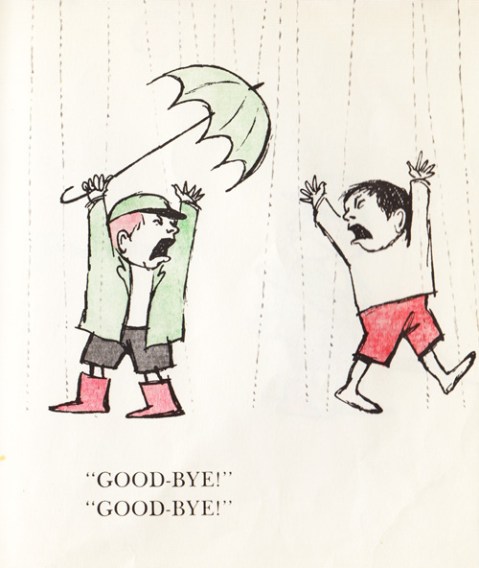
Illustration by Maurice Sendak from ‘Let’s Be Enemies.’ Click image for more.

He observes how this tendency plays out in his own craft — something undoubtedly amplified today, when criticism is not only professionalized but also sensationalized for profit by the commercial media industrial complex:

In literature, because of the absence of ideas, people scold each other, using all invectives at once; this is an impossible and naïve method observed only among primitive peoples; but, God knows, even in this there is something almost touching: exactly that inexperience, that childish incompetence even in scolding in a proper manner.

But underneath such defensive insecurity and cynicism, Dostoyevsky argues, lies a deeper, most earnest yearning for goodness:

I am by no means jesting; I am not jeering: among us there is a widespread, honest and serene expectation of good (this is so, no matter what one might say to the contrary); a longing for common work and common good, and this — ahead of any egoism; this is a most naïve longing, full of faith devoid of any exclusive or caste tinge, and even if it does appear in paltry and rare manifestations, it comes as something unnoticeable, which is despised by everybody… And why should we be looking for “solid hate”? — The honesty and sincerity of our society not only cannot be doubted, but they even spring up into one’s eyes. Look attentively and you will see that … first comes faith in an idea, in an ideal, while earthly goods come after.

It is our responsibility as human beings, Dostoyevsky suggests, to peer past the surface insecurities that drive people to lash out and look for the deeper longings, holding up a mirror to one another’s highest ideals rather than pointing the self-righteous finger at each other’s lowest faults:

A true friend of mankind whose heart has but once quivered in compassion over the sufferings of the people, will understand and forgive all the impassable alluvial filth in which they are submerged, and will be able to discover the diamonds in the filth.

He urges that such compassion be granted to the Russian people, but in his words there is to be found an enduring case for all disenfranchised groups and harshly judged communities:

Judge [the people] not by those villainies which they frequently perpetrate, but by those great and holy things for which they long amidst the very villainy. Besides, the people are not composed of scoundrels only; there are also genuine saints — and what saints! They themselves are radiant and they illuminate the path for all of us!

More than a century before modern psychology exposed the creative mental gymnastics of how we rationalize our bad deeds, Dostoyevsky speaks to the perils of such rationalization:

Somehow, I am blindly convinced that there is no such villain or scoundrel among the Russian people who wouldn’t admit that he is villainous and abominable, whereas, among others, it does happen sometimes that a person commits a villainy and praises himself for it, elevating his villainy to the level of a principle, and claiming that l’ordre and the light of civilization are precisely expressed in that abomination; the unfortunate one ends by believing this sincerely, blindly and honestly.

With the wry caveat that he is “speaking only about serious and sincere people,” Dostoyevsky reiterates his appeal at the heart of his creed:

Judge [people] not by what they are, but by what they strive to become.

All of A Writer’s Diary is a trove of Dostoyevsky’s great sensitivity to the human experience and his enduring wisdom on literature and life. Complement it with Tolstoy and Gandhi’s little-known letters on why we hurt each other and Kierkegaard on why haters hate.


donating = loving

For seventeen years, I have been spending hundreds of hours and thousands of dollars each month composing The Marginalian (which bore the outgrown name Brain Pickings for its first fifteen years). It has remained free and ad-free and alive thanks to patronage from readers. I have no staff, no interns, no assistant — a thoroughly one-woman labor of love that is also my life and my livelihood. If this labor makes your own life more livable in any way, please consider lending a helping hand with a donation. Your support makes all the difference.


newsletter

The Marginalian has a free weekly newsletter. It comes out on Sundays and offers the week’s most inspiring reading. Here’s what to expect. Like? Sign up.

The Mattering Instinct

Feb. 22nd, 2026 04:56 pm
[syndicated profile] the_marginalian_feed

Posted by Maria Popova

The Mattering Instinct

Here we are, watched over by the stone faces of mountains creased with the laugh-lines of time as we walk over the bones of our dead, over the fossils of all the other animals who paid with their lives for the birth of our eyes and lungs and opposable thumbs on a planet domed with two trillion galaxies each housing numberless stars orbited by numberless possible worlds.

The great paradox of consciousness, or perhaps its very function, is its fiery longing to make this life, this flash of borrowed stardust, matter amid the incomprehensible immensity of space and time; to find between our insignificance and our self-importance something truer than both.

That longing, argues philosopher and novelist Rebecca Goldstein in The Mattering Instinct (public library), is more than a whim of feeling, more than a wave in the mind — it is part of our creaturely inheritance, part of the price of consciousness, the source of our deepest consanguinity and our most ferocious conflicts. It is the fulcrum of the difficult durational endeavors we undertake to light up our lives with a sense of purpose. It is the sum total of “the values we use in justifying ourselves to ourselves.” It is what makes life alive.

Image
Illustration by Margaret C. Cook for a rare 1913 edition of Leaves of Grass. (Available as a print.)

Goldstein writes:

Every living thing is organically driven by a mandate that ensures it matters to itself — which is to say that it prioritizes its own surviving and thriving. In lifeforms as massive as blue whales and as scanty as a sliver of grass struggling up through a crack in the sidewalk, biology encodes the message of self-mattering.

But when it comes to humans, mattering takes on a different order of complexity. In us, the organic mandate of self-mattering engenders one of the most persistent forces in human motivation, which has us striving not only to survive and thrive but also striving after an existence that we deem to be meaningful in our own eyes. For us, and us alone, the organic mandate of self-mattering does not suffice. We need to convince ourselves that our own self-mattering is warranted, that we can provide a reason for it that extends beyond our being, trivially, ourselves — just as all things are, trivially, themselves. We long to demonstrate that the reason we subjectively feel that we matter is that we objectively do.

How human, then, to tremble with self-doubt in the absence of an objective validator of our mattering — an external seal of approval that what we do, and therefore who we are, is worthwhile. With an eye to W.S. Merwin’s poem “Berryman” — which I consider the single best piece of advice on self-doubt ever put to words, the ultimate antidote to the itch for approval — Goldstein writes:

To live out every day in the presence of such doubts is to live with unease, your whole life at the mercy of your art.

But then poets are a breed apart, praying to the Muse to grant them the genius to weave words into wonder. The rest of us are thankfully different. Only we’re not. It’s not the specific way that we respond to the mattering instinct that breeds the unease. It’s the mattering instinct itself. Even if we pursue our lives far from the rarified air breathed by poets, the unease of the poet is the unease of us all.

Image
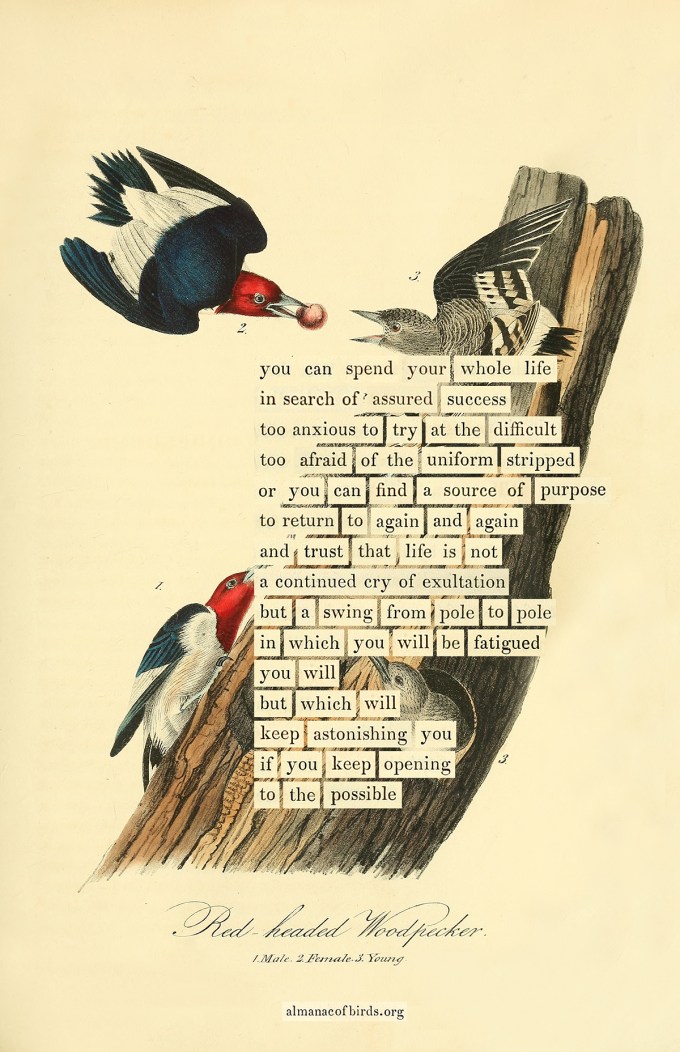
Art from An Almanac of Birds: 100 Divinations for Uncertain Days.

Half a century after Ernest Becker identified the denial of death — that is, the moral outrage at our mortality — as the root of our existential longing, Goldstein observes that our mattering instinct dwells somewhere between our materiality and our morality, that it arises from the conversation between the two:

Our deepest struggles — to persist, to thrive, to make a difference, to do right, to create beauty, to make sense of ourselves and our world — emerge from the physical forces that made us. These are the forces that coaxed intricate, sentient, and purposeful organisms out of the disorder and dissolution entailed in the direction of time itself, as described by the most fundamental law of physics.

[…]

You yourself, so fragile and tenuous, are implicated in the answer to the most profound of all metaphysical questions: Why is there something rather than nothing?

Mattering, she intimates, is the substance of somethingness animating these lives bookended by nothingness, at least for the consciousness experiencing them. We may go about it in different ways — she divides people into four archetypes of approach: socializers (who seek to matter to others), transcenders (who seek to matter “to the spiritual presence that exists beyond, or that permeates throughout, the spatio-temporal realm”), competitors (who seek to matter relativistically, more than others), and heroic strivers (who seek to measure up to the standards of excellence they set for themselves) — but it springs from a single source embedded in our animacy.

What emerges from the pages of The Mattering Instinct is the insistence that while mattering is ultimately a profoundly private process of discovery that cannot be validated or invalidated by any designated arbiter — not god, not fame, not the person you love — it is also something we can magnify for each other by the example of how we live our lives. Mattering is the mirror we hold up to ourselves that reflects the universe.


donating = loving

For seventeen years, I have been spending hundreds of hours and thousands of dollars each month composing The Marginalian (which bore the outgrown name Brain Pickings for its first fifteen years). It has remained free and ad-free and alive thanks to patronage from readers. I have no staff, no interns, no assistant — a thoroughly one-woman labor of love that is also my life and my livelihood. If this labor makes your own life more livable in any way, please consider lending a helping hand with a donation. Your support makes all the difference.


newsletter

The Marginalian has a free weekly newsletter. It comes out on Sundays and offers the week’s most inspiring reading. Here’s what to expect. Like? Sign up.

[syndicated profile] the_marginalian_feed

Posted by Maria Popova

“Susie… come home… and be my own again, and kiss me as you used to… I hope for you so much, and feel so eager for you… that the expectation… makes me feel hot and feverish, and my heart beats so fast.”


Emily Dickinson’s Electric Love Letters to Susan Gilbert

Four months before her twentieth birthday, Emily Dickinson (December 10, 1830–May 15, 1886) met the person who became her first love and remained her greatest — an orphaned mathematician-in-training by the name of Susan Gilbert, nine days her junior. Throughout the poet’s life, Susan would be her muse, her mentor, her primary reader and editor, her fiercest lifelong attachment, her “Only Woman in the World.”

I devote more than one hundred pages of Figuring to their beautiful, heartbreaking, unclassifiable relationship that fomented some of the greatest, most original and paradigm-shifting poetry humanity has ever produced. (This essay is drawn from my book.)

Image
Emily Dickinson at seventeen. The only authenticated photograph of the poet. (Amherst College Archives & Special Collections, gift of Millicent Todd Bingham, 1956)

Susan Gilbert had settled in Amherst, to be near her sister, after graduating from the Utica Female Academy — one of a handful of academically rigorous educational institutions available to women at the time. She entered Dickinson’s life in the summer of 1850, which the poet would later remember as the season “when love first began, on the step at the front door, and under the Evergreens.”

Poised and serious at twenty, dressed in black for the sister who had just died in childbirth and who had been her maternal figure since their parents’ death, Susan cast a double enchantment on Emily and Austin Dickinson. Sister and brother alike were taken with her poised erudition and her Uranian handsomeness — her flat, full lips and dark eyes were not exactly masculine, her unchiseled oval face and low forehead not exactly feminine.

Image
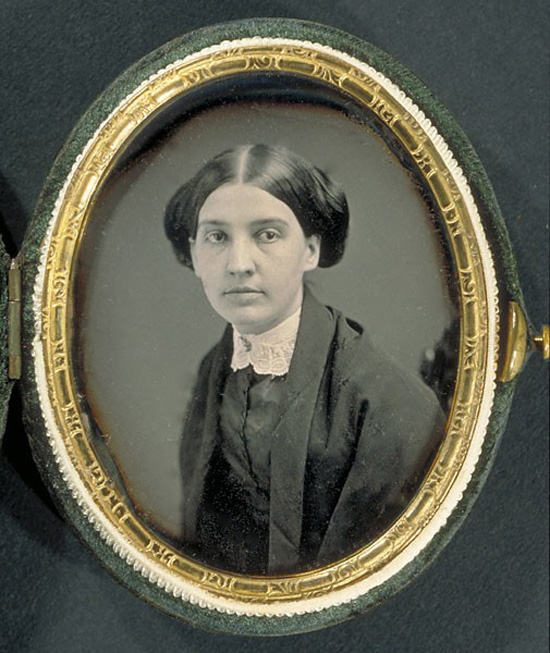
Susan Gilbert (Harvard University, Houghton Library)

“Best Witchcraft is Geometry,” Emily Dickinson would later write. Now both she and her brother found themselves in a strange bewitchment of figures, placing Susan at one point of a triangle. But Emily’s was no temporary infatuation. Nearly two decades after Susan entered her heart, she would write with unblunted desire:

To own a Susan of my own
Is of itself a Bliss —
Whatever Realm I forfeit, Lord,
Continue me in this!

A tempest of intimacy swirled over the eighteen months following Susan’s arrival into the Dickinsons’ lives. The two young women took long walks in the woods together, exchanged books, read poetry to each other, and commenced an intense, intimate correspondence that would evolve and permute but would last a life- time. “We are the only poets,” Emily told Susan, “and everyone else is prose.”

By early 1852, the poet was besotted beyond words. She beckoned to Susan on a Sunday:

Come with me this morning to the church within our hearts, where the bells are always ringing, and the preacher whose name is Love — shall intercede for us!

When Susan accepted a ten-month appointment as a math teacher in Baltimore in the autumn of 1851, Emily was devastated at the separation, but tried to keep a buoyant heart. “I fancy you very often descending to the schoolroom with a plump Binomial Theorem struggling in your hand which you must dissect and exhibit to your uncomprehending ones,” she teased in a letter. Susan was science personified, capitalized — she would haunt Dickinson’s poems for decades to come as “Science.”

Image
Pages from Emily Dickinson’s herbarium — a forgotten masterpiece at the intersection of poetry and science.

In a comet of a letter from the early spring of 1852, eight months into Susan’s absence, Emily hurls a grenade of conflicted self-revelation:

Will you be kind to me, Susie? I am naughty and cross, this morning, and nobody loves me here; nor would you love me, if you should see me frown, and hear how loud the door bangs whenever I go through; and yet it isn’t anger — I don’t believe it is, for when nobody sees, I brush away big tears with the corner of my apron, and then go working on — bitter tears, Susie — so hot that they burn my cheeks, and almost scorch my eyeballs, but you have wept much, and you know they are less of anger than sorrow.

And I do love to run fast — and hide away from them all; here in dear Susie’s bosom, I know is love and rest, and I never would go away, did not the big world call me, and beat me for not working… Your precious letter, Susie, it sits here now, and smiles so kindly at me, and gives me such sweet thoughts of the dear writer. When you come home, darling, I shan’t have your letters, shall I, but I shall have yourself, which is more — Oh more, and better, than I can even think! I sit here with my little whip, cracking the time away, till not an hour is left of it — then you are here! And Joy is here — joy now and forevermore!

That year, in a Prussian lab, the physician and physicist Hermann von Helmholtz measured the speed of nerve conduction at eighty feet per second. How unfathomable that sentiments this intense and emotions this explosive, launched from a mind that seems to move at light-years per second, can be reduced to mere electrical impulses. And yet that is what we are — biomechanical creatures, all of our creative force, all of our mathematical figurings, all the wildness of our loves pulsating at eighty feet per second along neural infrastructure that evolved over millennia. Even the fathoming faculty that struggles to fathom this is a series of such electrical impulses.

The electricity of Dickinson’s love would endure, coursing through her being for the remainder of her life. Many years later, she would channel it in this immortal verse:

I chose this single star
From out the wide night’s numbers —
Sue — forevermore!

But now, in the dawning fervor of early love, forevermore collides with the immediacy of want. Midway through her spring outpouring, Emily suddenly casts Susan in the third person, as if beseeching an omnipotent spectator to grant her desire in the drama of their impending reunion:

I need her — I must have her, Oh give her to me!

The moment she names her longing, she tempers its thrill with the lucid terror that it might be unspeakable:

Do I repine, is it all murmuring, or am I sad and lone, and cannot, cannot help it? Sometimes when I do feel so, I think it may be wrong, and that God will punish me by taking you away; for he is very kind to let me write to you, and to give me your sweet letters, but my heart wants more.

Here, as in her poetry, Dickinson’s words cascade with multiple meanings beyond literal interpretation. Her invocation of “God” is not a cowering before some Puritanical punishment for deviance but an irreverent challenge to that very dogma. What kind of “God,” she seems to be asking, would make wrong a love of such infinite sweetness?

Four years earlier, during her studies at Mount Holyoke — the “castle of science” where she crafted her stunning herbarium — Emily had begun giving shape to the amorphous doubt about the claims of religion that had been gnawing at her since childhood — doubt she would later immortalize in verse:

It troubled me as once I was —
For I was once a child —
Deciding how an atom — fell —
And yet the heavens — held.

Facing her desire for Susan, her deepest fear was not punishment from “God” but that her wayward heart was its own retribution — as well as its own reward. She writes plaintively that heated summer:

Have you ever thought of it, Susie, and yet I know you have, how much these hearts claim; why I don’t believe in the whole, wide world, are such hard little creditors — such real little misers, as you and I carry with us, in our bosom every day. I can’t help thinking sometimes, when I hear about the ungenerous, Heart, keep very still — or someone will find you out!… I do think it’s wonderful, Susie, that our hearts don’t break, every day… but I guess I’m made with nothing but a hard heart of stone, for it don’t break any, and dear Susie, if mine is stony, yours is stone, upon stone, for you never yield, any, where I seem quite beflown. Are we going to ossify always, say Susie — how will it be?

There is palpable restlessness in Emily’s oscillation between resignation and demand, between love’s longing to be unmasked and the fear of being found out. Later that month, she exhorts Susan: “Loved One, thou knowest!” — an allusion to Juliet’s speech in Romeo and Juliet: “Thou knowest the mask of night is on my face.”

By June, anticipating Susan’s return from Baltimore in three weeks, Emily is pining with unbridled candor:

When I look around me and find myself alone, I sigh for you again; little sigh, and vain sigh, which will not bring you home.

I need you more and more, and the great world grows wider… every day you stay away — I miss my biggest heart; my own goes wandering round, and calls for Susie… Susie, forgive me Darling, for every word I say — my heart is full of you… yet when I seek to say to you something not for the world, words fail me… I shall grow more and more impatient until that dear day comes, for til now, I have only mourned for you; now I begin to hope for you.

She ends her letter with aching awareness of the dissonance between her private desire and the public norms of love:

Now, farewell, Susie… I add a kiss, shyly, lest there is somebody there! Don’t let them see, will you Susie?

Two weeks later, with Susan’s return now days away, her anticipatory longing rises to a crescendo:

Susie, will you indeed come home next Saturday, and be my own again, and kiss me as you used to?… I hope for you so much, and feel so eager for you, feel that I cannot wait, feel that now I must have you — that the expectation once more to see your face again makes me feel hot and feverish, and my heart beats so fast — I go to sleep at night, and the first thing I know, I am sitting there wide awake, and clasping my hands tightly, and thinking of next Saturday… Why, Susie, it seems to me as if my absent Lover was coming home so soon — and my heart must be so busy, making ready for him.

Dickinson would frequently and deliberately reassign gender pronouns for herself and her beloveds, recasting her love in the acceptable male-female battery of desire. Throughout her life, she would often use the masculine in referring to herself — writing of her “boyhood,” signing letters to her cousins as “Brother Emily,” calling herself a “boy,” “prince,” “earl,” or “duke” in various poems, in one of which she unsexes herself in a violent transfiguration:

Amputate my freckled Bosom!
Make me bearded like a Man!

Again and again, she would tell all the truth but tell it slant, unmooring the gender of her love objects from the pronouns that befit their biology. Later in life, in flirting with the idea of publication, she would masculinize the pronouns in a number of her love poems — “bearded” pronouns, she called these — to fit the heteronormative mold, so that two versions of these poems exist: the earlier addressed to a female beloved, the later to a male.

That insufferable spring, she had already declared to Susan that her “heart wants more.” Twenty Augusts after they met, Dickinson would write:

Enough is so vast a sweetness, I suppose it never occurs, only pathetic counterfeits.

Image
Emily Dickinson’s home, the Homestead. The poet’s bedroom — the “chamber facing West” where she composed nearly all of her poetry — is located in the right-hand corner above the porch. (Photograph: Maria Popova)

But when Susan returned from Baltimore on that long-awaited Saturday, something had shifted between them. Perhaps the ten-month absence, filled not with their customary walks in the woods but with letters of exponentially swelling intensity, had revealed to Susan that Emily’s feelings for her were not of a different hue but of a wholly different color — one that she was constitutionally unable to match. Or perhaps Emily had always misdivined the contents of Susan’s heart, inferring an illusory symmetry of feeling on the basis not of evidence but of willfully blind hope.

Few things are more wounding than the confounding moment of discovering an asymmetry of affections where mutuality had been presumed. It is hard to imagine how Dickinson took the withdrawal — here was a woman who experienced the world with a euphoria of emotion atmospheres above the ordinary person’s and who therefore likely plummeted to the opposite extreme in equal magnitude. But she seems to have feared it all along — feared that her immense feelings would never be wholly met, as is the curse of those who love with unguarded abandon. Five months earlier, she had written to Susan:

I would nestle close to your warm heart… Is there any room there for me, or shall I wander away all homeless and alone?

She suspected, too, that she might injure — and not only herself — with the force of her love:

Oh, Susie, I often think that I will try to tell you how dear you are… but the words won’t come, tho’ the tears will, and I sit down disappointed… In thinking of those I love, my reason is all gone from me, and I do fear sometimes that I must make a hospital for the hopelessly insane, and chain me up there such times, so I won’t injure you.

Even in her ardent anticipatory letter penned before Susan’s return, she questions for a moment whether the love that stands as the central truth of her daily being is real:

Shall I indeed behold you, not “darkly, but face to face” or am I fancying so, and dreaming blessed dreams from which the day will wake me?

Now she had been awakened — not rudely, but unmistakably and irreversibly. In the anxious insistence of her entreaty is the sorrowful sense that Susan is slipping away from her — and toward Austin, who commenced an open courtship of her.

That summer, Emily Dickinson cut off her auburn hair.

The following autumn, Susan Gilbert married Austin Dickinson, largely to be near Emily, and they moved into the Evergreens — the house erected for the newlyweds by Austin and Emily’s father, across the lawn from the Homestead, the house where the lovesick poet lived.

A corridor denuded of grass soon formed between the Homestead and the Evergreens as Emily and Susan traversed the lawn daily to see each other or to press into the other’s hand a letter unpinned from the bosom of a dress. A “little path just wide enough for two who love,” Dickinson called it. Over the next quarter century, 276 known poems would travel between their homes — some by hand and foot, but many by post. I have often wondered what prompted the poet to head for the mailbox and not the hedge, stuffing her sentiments into an envelope addressed to a house a stone’s throw from her own. And yet the heart is not a stone — it is a thing with feathers.

Image
Emily Dickinson’s porch, facing the Evergreens. (Photograph: Maria Popova)

“She loved with all her might,” a girlhood friend of Dickinson’s would recall after the poet’s death, “and we all knew her truth and trusted her love.” No one knew that love more intimately, nor had reason to trust it more durably, than Susan. Where Austin’s love washed over her with the stormy surface waves of desire, Emily’s carried her with the deep currents of devotion — a love Dickinson would compare to the loves of Dante for Beatrice and Swift for Stella. To Susan, Dickinson would write her most passionate letters and dedicate her best-beloved poems; to Susan she would steady herself, to her shore she would return again and again, writing in the final years of her life:

Show me Eternity, and I will show you Memory —
Both in one package lain
And lifted back again —
Be Sue — while I am Emily —
Be next — what you have ever been — Infinity.

Something of the infinite would always remain between them. Thirty years into the relationship, Susan would give Emily a book for Christmas — Disraeli’s romance novel Endymion, titled after the famous Keats poem that begins with the line “A thing of beauty is a joy for ever” — inscribed to “Emily, Whom not seeing, I still love.”

Some loves lodge themselves in the tissue of being like mercury, pervading every synapse and sinew to remain there, sometimes dormant, sometimes tortuously restive, with a half-life that exceeds a lifetime.

Their uncommon love, the splendors and sorrows of which I explore further in Figuring, would become the pulse-beat of Dickinson’s body of work, which radicalized its era and forever changed the landscape of literature — a shimmering testament to the fact that love, longing, and the restlessness of the human heart are the catalyst for every creative revolution.


donating = loving

For seventeen years, I have been spending hundreds of hours and thousands of dollars each month composing The Marginalian (which bore the outgrown name Brain Pickings for its first fifteen years). It has remained free and ad-free and alive thanks to patronage from readers. I have no staff, no interns, no assistant — a thoroughly one-woman labor of love that is also my life and my livelihood. If this labor makes your own life more livable in any way, please consider lending a helping hand with a donation. Your support makes all the difference.


newsletter

The Marginalian has a free weekly newsletter. It comes out on Sundays and offers the week’s most inspiring reading. Here’s what to expect. Like? Sign up.

[syndicated profile] the_marginalian_feed

Posted by Maria Popova

“To love. To be loved. To never forget your own insignificance… To seek joy in the saddest places. To pursue beauty to its lair. To never simplify what is complicated or complicate what is simple.”


Arundhati Roy on the Deepest Measure of Success

Evolution invented REM sleep, that ministry of dreams, to give us a safe way of practicing the possible into the real. The dreams of the night clarify our lives. The dreams of the day complicate them, charge them with the battery of fear and desire, quiver them with the urgency of our mortality and the fervor of our lust for life. To dream is to dare traversing the roiling ocean between what is and what could be on a ramshackle raft of determination and luck. The price we pay for dreaming is the possibility of drowning; the price we pay for not dreaming is the surety of coasting through life in a stupor of autopilot, landlocked in the givens of our time, place, and culture. The dreamer, then, is the only one fully awake to life — that bright technology of the possible the universe invented to prevail over the probable amid the cold austerity of eternal night.

But what may be even harder than getting what you dream of is knowing what to dream of, annealing your imagination and your desires enough to trust that your dreams are your own — not the second-hand dreams of your parents, not your heroes’ costumes of achievement, not your culture’s templates of success. “No one can acquire for another — not one,” Walt Whitman reckoned with how to own your life, “not one can grow for another — not one,” while two hundred miles north Thoreau was reckoning with the nature of success, concluding: “If the day and the night are such that you greet them with joy, and life emits a fragrance like flowers and sweet-scented herbs, is more elastic, more starry, more immortal — that is your success.”

They are nothing less than patron saints of the human spirit, those who protect our dreams from the false gods of success.

Image
Arundhati Roy

Arundhati Roy is one such modern patron saint. Half a lifetime before taking up the complicated question of success in her exquisite memoir Mother Mary Comes to Me (public library) — what success means and looks like in the deepest sense, how its shallow metrics can turn a person into “a cold silver figurine with a cold silver heart,” why “making friends with defeat” is “the very opposite of accepting it” and so-called failure might actually be worth striving for — Roy captured the crux of our confusion about the real metrics of our lives a passage from her 1999 book The Cost of Living (public library).

Recounting a conversation with an old friend in the wake of the disorienting success of her novel The God of Small Things, Roy finds herself suffocated by the intimation that “the trajectory of a person’s happiness… had peaked because she had accidentally stumbled upon ‘success'” — a notion “premised on the unimaginative belief that wealth and fame were the mandatory stuff of everybody’s dreams.” She tells her friend:

You’ve lived too long in New York… There are other worlds. Other kinds of dreams. Dreams in which failure is feasible. Honorable. Sometimes even worth striving for. Worlds in which recognition is not the only barometer of brilliance or human worth.

The people who are less successful “in the most vulgar sense of the word,” she observes, are often more fulfilled — like her beloved uncle, who had become one of India’s first Rhodes scholars for his work in Greek and Roman mythology but had chosen to give up his academic career in order to start a pickle, jam, and curry-powder factory with his mother and build balsawood model airplanes in his basement.

Image
Card from An Almanac of Birds: 100 Divinations for Uncertain Days

When Roy’s friend meets her point with raised eyebrows awning a look of slight annoyance, she takes a moment to distill her thoughts, then writes them on a paper napkin for her friend to hold on to, formulating with that rare and exultant combination of passion and rigor what success really means:

To love. To be loved. To never forget your own insignificance. To never get used to the unspeakable violence and the vulgar disparity of life around you. To seek joy in the saddest places. To pursue beauty to its lair. To never simplify what is complicated or complicate what is simple. To respect strength, never power. Above all to watch. To try and understand. To never look away. And never, never to forget.

Couple with Henry Miller on the measure of a life well lived, then revisit John Quincy Adams on impostor syndrome and the true measure of success.


donating = loving

For seventeen years, I have been spending hundreds of hours and thousands of dollars each month composing The Marginalian (which bore the outgrown name Brain Pickings for its first fifteen years). It has remained free and ad-free and alive thanks to patronage from readers. I have no staff, no interns, no assistant — a thoroughly one-woman labor of love that is also my life and my livelihood. If this labor makes your own life more livable in any way, please consider lending a helping hand with a donation. Your support makes all the difference.


newsletter

The Marginalian has a free weekly newsletter. It comes out on Sundays and offers the week’s most inspiring reading. Here’s what to expect. Like? Sign up.

The Three Elements of the Good Life

Feb. 22nd, 2026 12:55 am
[syndicated profile] the_marginalian_feed

Posted by Maria Popova

The Three Elements of the Good Life

To be a true person is to be entirely oneself in every circumstance, with all the courage and vulnerability this requires. And yet because a person is a confederacy of parts often at odds and sometimes at war with each other, being true is not a pledge to be a paragon of cohesion, predictable and perfectly self-consistent — the impossibility of that is the price of our complex consciousness — but a promise to own every part of yourself, even those that challenge your preferred self-image and falsify the story you tell yourself about who you are.

There is a peace that comes from this, solid as bedrock and soft as owl down, which renders life truer and therefore more alive. Such authenticity of aliveness, such fidelity to the tessellated wholeness of your personhood, may be the crux of what we call “the good life.”

That is what the pioneering psychologist Carl R. Rogers (January 8, 1902–February 4, 1987) explores in a chapter of his 1961 classic On Becoming a Person (public library), anchored in his insistence that “the basic nature of the human being, when functioning freely, is constructive and trustworthy” — a bold defiance of the religious model of original sin and a cornerstone of the entire field of humanistic psychology that Rogers pioneered, lush with insight into the essence of personal growth and creativity.

Image
Illustration by Mimmo Paladino for a rare edition of James Joyce’s Ulysses

Drawing on a lifetime of working with patients — the work of guiding people along the trajectory from suffering to flourishing — he writes:

The good life… is the process of movement in a direction which the human organism selects when it is inwardly free to move in any direction, and the general qualities of this selected direction appear to have a certain universality.

He identifies three pillars of this process:

In the first place, the process seems to involve an increasing openness to experience… the polar opposite of defensiveness. Defensiveness [is] the organism’s response to experiences which are perceived or anticipated as threatening, as incongruent with the individual’s existing picture of himself, or of himself in relationship to the world. These threatening experiences are temporarily rendered harmless by being distorted in awareness, or being denied to awareness. I quite literally cannot see, with accuracy, those experiences, feelings, reactions in myself which are significantly at variance with the picture of myself which I already possess.

The necessary illusions Oliver Sacks wrote of are a form of that defensiveness — they help us bear the disillusionments difficult to bear: that we are invulnerable, immortal, congruent with our self-image — and yet they render us captives of the dream of ourselves, unfree to live the reality of our own complexity. Rogers writes:

If a person could be fully open to his experience, however, every stimulus — whether originating within the organism or in the environment — would be freely relayed through the nervous system without being distorted by any defensive mechanism. There would be no need of the mechanism of “subception” whereby the organism is forewarned of any experience threatening to the self. On the contrary, whether the stimulus was the impact of a configuration of form, color, or sound in the environment on the sensory nerves, or a memory trace from the past, or a visceral sensation of fear or pleasure or disgust, the person would be “living” it, would have it completely available to awareness.

Image
Card from An Almanac of Birds: 100 Divinations for Uncertain Days.

The reward of this willingness to be fully aware is profound self-trust:

The individual is becoming more able to listen to himself, to experience what is going on within himself. He is more open to his feelings of fear and discouragement and pain. He is also more open to his feelings of courage, and tenderness, and awe. He is free to live his feelings subjectively, as they exist in him, and also free to be aware of these feelings. He is more able fully to live the experiences of his organism rather than shutting them out of awareness.

Out of this “movement away from the pole of defensiveness toward the pole of openness to experience” arises the second element of the good life: “an increasing tendency to live fully in each moment” and discover the nature of experience in the process of living the experience rather than in your predictive models, which are only ever based on the past. When you are fully open to your experience, Rogers observes, each moment is entirely new — a “complex configuration of inner and outer stimuli” that has never before existed and will never again exist in that exact form, which means that who you will be in the next moment will also be entirely new and cannot be predicted by you or anyone else — that lovely freedom of breaking the template of yourself and the prison of your story. Rogers writes:

One way of expressing the fluidity which is present in such existential living is to say that the self and personality emerge from experience, rather than experience being translated or twisted to fit preconceived self-structure. It means that one becomes a participant in and an observer of the ongoing process of organismic experience, rather than being in control of it.

Such living in the moment means an absence of rigidity, of tight organization, of the imposition of structure on experience. It means instead a maximum of adaptability, a discovery of structure in experience, a flowing, changing organization of self and personality.

[…]

Most of us, on the other hand, bring a preformed structure and evaluation to our experience and never relinquish it, but cram and twist the experience to fit our preconceptions, annoyed at the fluid qualities which make it so unruly in fitting our carefully constructed pigeonholes.

Image
Card from An Almanac of Birds: 100 Divinations for Uncertain Days.

By discovering experience in the process of living it, we arrive at the third element of the good life — a growing ability to trust ourselves to discover the right course of action in any situation. Most of us, Rogers observes, consciously or unconsciously rely on external guiding principles in navigating life — a code of conduct laid down by our culture, our parents, our peers, our own past choices. He writes:

The person who is fully open to his experience would have access to all of the available data in the situation, on which to base his behavior; the social demands, his own complex and possibly conflicting needs, his memories of similar situations, his perception of the uniqueness of this situation, etc., etc. The data would be very complex indeed. But he could permit his total organism, his consciousness participating, to consider each stimulus, need, and demand, its relative intensity and importance, and out of this complex weighing and balancing, discover that course of action which would come closest to satisfying all his needs in the situation.

What makes this process most vulnerable to error is our continual tendency to lens the present through the past:

The defects which in most of us make this process untrustworthy are the inclusion of information which does not belong to this present situation, or the exclusion of information which does. It is when memories and previous learnings are fed into the computations as if they were this reality, and not memories and learnings, that erroneous behavioral answers arise.

Rogers paints a portrait of the person who has braided these three strands of the good life:

The person who is psychologically free… is more able to live fully in and with each and all of his feelings and reactions. He makes increasing use of all his organic equipment to sense, as accurately as possible, the existential situation within and without. He makes use of all of the information his nervous system can thus supply, using it in awareness, but recognizing that his total organism may be, and often is, wiser than his awareness. He is more able to permit his total organism to function freely in all its complexity in selecting, from the multitude of possibilities, that behavior which in this moment of time will be most generally and genuinely satisfying. He is able to put more trust in his organism in this functioning, not because it is infallible, but because he can be fully open to the consequences of each of his actions and correct them if they prove to be less than satisfying.

He is more able to experience all of his feelings, and is less afraid of any of his feelings; he is his own sifter of evidence, and is more open to evidence from all sources; he is completely engaged in the process of being and becoming himself.

On Becoming a Person is a revelatory read in its entirety. Complement this fragment with E.E. Cummings, writing from a wholly different yet complementary perspective, on the courage to be yourself and Fernando Pessoa on unselfing into who you really are.


donating = loving

For seventeen years, I have been spending hundreds of hours and thousands of dollars each month composing The Marginalian (which bore the outgrown name Brain Pickings for its first fifteen years). It has remained free and ad-free and alive thanks to patronage from readers. I have no staff, no interns, no assistant — a thoroughly one-woman labor of love that is also my life and my livelihood. If this labor makes your own life more livable in any way, please consider lending a helping hand with a donation. Your support makes all the difference.


newsletter

The Marginalian has a free weekly newsletter. It comes out on Sundays and offers the week’s most inspiring reading. Here’s what to expect. Like? Sign up.
The Fine Art of Bibliography

Feb. 22nd, 2026 08:02 pm
lb_lee: A colored pencil drawing of Raige's freckled hand holding a hot pink paperback entitled the Princess and Her Monster (book)
[personal profile] lb_lee
Rogan: I have apparently become the kind of person who not only reads bibliographies of my own free will, but has done so enough to develop taste and critical feelings about them.

Please imagine me swirling fancy wine in a goblet as you read this. )
sakana17: zhao yunlan and shen wei confront enemy on a rooftop (guardian-zhaoyunlan-shenwei-rooftopstand)
[personal profile] sakana17
Toward the end of our trip to China, [personal profile] thevetia and I visited Shanghai Film Park! We lucked out with the weather and it was a cold but sunny day. I'm so glad we went. It was a wonderful pilgrimage. :D

Logistical stuff )

Prelude to the pictures )

Pictures! )

Daily Check-In

Feb. 22nd, 2026 08:04 pm
mecurtin: Icon of a globe with a check-mark (fandom_checkin)
[personal profile] mecurtin posting in [community profile] fandom_checkin
This is your check-in post for today. The poll will be open from midnight Universal or Zulu Time (8pm Eastern Time) on Sunday, February 22, to midnight on Monday, February 23 (8pm Eastern Time).

Poll #34278 Daily check-in poll
Open to: Access List, detailed results viewable to: Access List, participants: 11

How are you doing?

I am OK
9 (81.8%)

I am not OK, but don't need help right now
2 (18.2%)

I could use some help
0 (0.0%)

How many other humans live with you?

I am living single
3 (27.3%)

One other person
5 (45.5%)

More than one other person
3 (27.3%)


Please, talk about how things are going for you in the comments, ask for advice or help if you need it, or just discuss whatever you feel like.

Poem: "The Spectrum of Your Being"

Feb. 22nd, 2026 05:51 pm
ysabetwordsmith: Cartoon of me in Wordsmith persona (Default)
[personal profile] ysabetwordsmith
This poem is spillover from the September 1, 2020 Poetry Fishbowl. It was inspired by a prompt from [personal profile] librarygeek. It also fills the "How do you want to do this?" square in my 9-1-20 card for the I Want Fries With That! Bingo fest. This poem has been sponsored by a pool with [personal profile] fuzzyred. It belongs to the series Not Quite Kansas.

Warning: This poem contains intense and controversial topics. Highlight to read the more detailed warnings, some of which are spoilers. It includes feeling lost, a headless chicken running around, a fight with bit character fatalities, moderate injuries to a main character, messy medical details, an imprisoned demon, torture, binding magic, demonic healing, and other challenges. If these are sensitive issues for you, please consider your tastes and headspace before reading onward.

Read more... )

第五年第四十三天

Feb. 23rd, 2026 08:53 am
nnozomi: (pic#16332211)
[personal profile] nnozomi posting in [community profile] guardian_learning
部首
手 parts 22-27
按, to press; 挑, to choose; 挖, to dig; 挠, to scratch; 挡, to block; 挣, to struggle; 挤, to crowd in; 挥, to wave; 挨, in order; 挪, to move something; 挫, to fail; 振, to shake; 挺, quite; 捂, to cover; 捉, to grab; 捋, to stroke; 捏, to pinch; 捐, to donate
pinyin )
https://www.mdbg.net/chinese/dictionary?cdqrad=64

语法
3.5 (part 1) 才, "only when..."
3.5 (part 2) 才 meaning "only, just"
3.6 才 vs 就
https://www.digmandarin.com/hsk-3-grammar

词汇
打, to hit; 打败, to defeat; 打雷, to thunder; 打扫, to clean; 打折, discount; 打针, to inject
大巴, bus; 大多, mostly; 大方, generous; 大哥, big brother; 大规模, large-scale; 大会, general meeting; 大姐, big sister; 大楼, big building; 大陆, continent/mainland; 大妈, aunt/father's older brother's wife; 大型, large; 大爷, uncle/father's older brother; 大众, the public; 巨大, huge; 扩大, expand
代替, to replace; 近代, modern; 替代, substitute
待遇, treatment; 期待, to expect/look forward to
袋, bag; 口袋, pocket; 脑袋, head; 塑料袋, plastic bag
戴, to wear (glasses, a mask, etc.)
pinyin )
https://mandarinbean.com/new-hsk-4-word-list/

玩玩
Don’t miss the auspicious sayings posted by sakana17 a few days ago! Also, 说爱你 (Jolin Tsai and GEM, a classic), 也值得 (Li Miaomiao), and 死性不改 (Kang Ziqi).

从昨天这里好暖和,梅花也绽放了。我昨天转化了大厨师,又做泰式咖喱又煮鸡汤,味道还行。大家过得怎么样?

Another Needlepoint Update

Feb. 22nd, 2026 06:30 pm
lightbird: http://coelasquid.deviantart.com/ (Default)
[personal profile] lightbird
The throw pillow I needlepointed in the late summer/early fall is now finished!

My Completed Masterpiece:
pillow

I also made ornaments which will be gifts for my friends. Pics under the cut.

more masterpieces! )

january booklog

Feb. 22nd, 2026 10:39 pm
wychwood: Zelenka is worried because the city is in danger and McKay is winning at Tetris (SGA - Zelenka Weir Tetris)
[personal profile] wychwood
1. Hogfather - Terry Pratchett ) Pratchett at his best balances the comedy with really meaningful moments, and this is definitely one of those.


2. The Book Eaters - Sunyi Dean ) Definitely not my jam.


3. Annoying: The Science of What Bugs Us - Joe Palca and Flora Lichtman ) Very light, sometimes questionable, but packed full of fun anecdotes (and a surprisingly good examination-in-passing of how scientific research works).


4. Ocean - Colin Butfield and David Attenborough ) Not life-changing, but well worth a read.


5. Common Goal, 6. Role Model, and 7. The Long Game - Rachel Reid ) I wasn't keen on CG, but I liked the other two a lot - and I'm looking forward to the seventh book coming out later this year! More Ilya and Shane: give it to me.


8. The Fifth Form at St Dominic's - Talbot Baines Reed ) Worth a read! But it's not going to shoot up my list of favourite school stories.


9. Time to Shine - Rachel Reid ) Not brilliant, but sweet.


10. Identity - Nora Roberts ) Mostly you know what you're getting with Roberts! This was very heavy on the wealth porn, but despite all my mockery I did enjoy reading it.


11. Persuasion - Jane Austen ) A delightful story as always.


12. Strange Pictures - Uketsu ) Short, weird, and interestingly different.


13. The Snow Tiger - Desmond Bagley ) This has aged much better than I expected; I was genuinely gripped.


14. Swallowdale - Arthur Ransome ) These are just such good books.


15. The Life-Changing Magic of Tidying Up - Marie Kondo ) Interesting to read the original after all the cultural osmosis, but actually I disagree with her quite a lot! I'm not sorry I read it, though.


16. Sassinak - Anne McCaffrey and Elizabeth Moon ) I did still quite enjoy this, but it was a distinct let-down from my much-better remembered version!
mythopoeia: (rev)
[personal profile] mythopoeia
So. Considering I first conceived this storyline in late 2001, started writing it in earnest in 2011, and have been sitting on two miraculous linearly (nigh) fully filled out acts for years while the last act has been playing aggravatingly hard to get (and doesn't seem prone to stop doing so anytime soon), last month I up and said to myself: you know what? Fuck this thing still not being complete, I want to have it out in the world in some damn form, at least. Thus: WIP preview, of sorts, heh.

For the record: this is not the final version even of these technically-finished parts. The first three weeks of act I in particular are in need of some significant fleshing out, especially as comes to the worldbuilding and supporting cast; the timespan is extremely compressed right now, very much to the story's detriment. But it is a finished 1.0 version thereof, at the very least, and that'll do for something that's just a preview.

In short, then, this is the story in the form it largely poured out in 2014-15. I've written some additional content for these sections since then, but since it's all part of side story that remains extremely incomplete (and hasn't been properly woven into the narrative yet, anyway), I'm not including any of it here.

Side note: it's kind of funny, I never planned this thing out with any kind of act structure, but as I started moving into the last third of the story (only a couple of years ago, hah) it was kinda hard not to recognise that it's ended up with some clear, organic act breaks anyway. My hindbrain really is way better at this shit than me. X,D


For everyone who hasn't been following along with this project since 2001 (i.e. literally everyone, by this point X,D), the pertinent details: this is the shippy backstory to Reveille proper [one of the main stories in my urban fantasy Hallverse world], which, to paraphrase my draft filter masterpost, I like to refer to as a screwballesque romcom, heh. (Because seriously, these two are ridiculous and adorable. <3) Expect: a lot of irreverent humour, plenty of swears, some very antagonistic flirting, and a bunch of dirty porn.

And to reiterate: this is an unfinished WIP. But, uh, at least act II has a satisfying enough conclusion that my brain, contrary to all evidence, decided that the story was done for over half a decade, :D? (Goddammit, brain.)


Anyway, have the actual text, then:

Act I [14 000 words] | Act II: to be added

Early Humans

Feb. 22nd, 2026 03:01 pm
ysabetwordsmith: Cartoon of me in Wordsmith persona (Default)
[personal profile] ysabetwordsmith
Homo erectus fossils in East Asia rewrite the timeline of human migration

A new analysis dates three Homo erectus skulls from central China to about 1.77 million years ago, making them the oldest securely dated hominin fossils in eastern Asia.

That older age shifts the arrival of early humans in the region back by roughly 600,000 years and compresses the timeline of how quickly our ancestors spread across Eurasia.
[---8<---]
The same layer holds stone tools and animal remains, tying the skulls to a specific moment nearly 1.8 million years ago rather than the younger dates long cited.

Keep an eye on your inbox!

Feb. 22nd, 2026 03:54 pm
[personal profile] fthmods posting in [community profile] fandomtrumpshate

We have started posting auctions, which means that we have started sending emails with your auction link and the link to submit edits!

Please keep in mind:

  1. These WILL be coming from our new proton.me email address, so be sure to tell your email client not to send it to spam!
  2. We will be sending these emails throughout the week. If your friend got theirs and you haven't gotten yours, please be patient. We can only post a few hundred of the 1600 auctions per day.
  3. Your auctions may not all be posted on the same day. You'll get one email for each auction post - some email clients may put these in one thread together, so keep an eye out for that.
  4. You will not be notified when edits are made, you will have to check your post. If you still do not see your edits by Thursday evening, and it's been at least 8 hours since you filled out the form, email us to check.

Please remember that just because your post is up for your viewing, does NOT mean that browsing is open in general! Please don't send bidders to check things out until Friday, Feb 27!


sovay: (Mr Palfrey: a prissy bastard)
[personal profile] sovay
I spent much of yesterday running pre-blizzard errands, but the local state of the parking spots is the truest gauge of the meteorology about to go down.

Image


I have not yet managed to get hold of her memoir, but I deeply appreciate being notified of the existence of E. M. Barraud, who identified herself with chalk-cut hill figures, candidly described her relationship status as "technically single, but 'married' in a permanent homosexual relationship with another woman," published under her assigned initials and was known in Little Eversden where she worked for the Women's Land Army as John. She gave her wartime responses for Mass-Observation as both a man and a woman: "People are people, not specifics of a gender." I had never even encountered her poetry.

Culinary

Feb. 22nd, 2026 08:16 pm
oursin: Frontispiece from C17th household manual (Accomplisht Lady)
[personal profile] oursin

This week's bread was a Standen loaf, strong brown/buckwheat flour, maple syrup, malt extract - but due to electric scale going weird and giving strange readings, the proportions got very odd and it turned out larger and a lot denser than usual, if still edible.

Friday night supper: Gujerati khichchari, with pinenuts.

Saturday breakfast rolls: adaptable soft roll recipe, 4:1 strong white/buckwheat flour, a touch of maple syrup, dried cranberries, turned out rather well.

Today's lunch: Scottish salmon tail fillets baked in foil with butter and lime slices; served with La Ratte potatoes boiled with salt and dill and tossed in butter, buttered spinach and baked San Marzano tomatoes.

February 2026

S M T W T F S
123 4567
8910 11121314
151617 18192021
22232425262728

Most Popular Tags

Custom Text

Image


my read shelf:
sage's book recommendations, liked quotes, book clubs, book trivia, book lists (read shelf)


Witchgrass


Something
comes into the world unwelcome
calling disorder, disorder—

If you hate me so much
don’t bother to give me
a name: do you need
one more slur
in your language, another
way to blame
one tribe for everything—

as we both know,
if you worship
one god, you only need
One enemy—

I’m not the enemy.
Only a ruse to ignore
what you see happening
right here in this bed,
a little paradigm
of failure. One of your precious flowers
dies here almost every day
and you can’t rest until
you attack the cause, meaning
whatever is left, whatever
happens to be sturdier
than your personal passion—

It was not meant
to last forever in the real world.
But why admit that, when you can go on
doing what you always do,
mourning and laying blame,
always the two together.

I don’t need your praise
to survive. I was here first,
before you were here, before
you ever planted a garden.
And I’ll be here when only the sun and moon
are left, and the sea, and the wide field.

I will constitute the field.


—Louise Glück
from The Wild Iris, 1992


Style Credit

Expand Cut Tags

No cut tags