Wisconsin manure digester at the center of USDA loan trouble
Feb. 24th, 2026 21:13![[syndicated profile]](https://www.dreamwidth.org/img/silk/identity/feed.png) circleofblue_feed
circleofblue_feed
by Brian Bienkowski, The New Lede
February 23, 2026
Five years after the US Department of Agriculture (USDA) guaranteed more than $100 million to what’s billed as the “world’s largest manure biogas project”, the loans are in delinquency, which, along with operational failures and underperformance at such plants, has seemingly prompted an agency-wide pause on loan guarantees for such projects, according to The New Lede’s analysis of federal data.
The failure by plant owners to pay back taxpayer-backed loans comes as projects that turn animal waste into alternative fuel are under heightened scrutiny amid complaints from health and environmental advocates that the plants are incentivizing more polluting at large-scale animal production.
Such digesters are increasingly common in the US to deal with the massive amounts of waste generated at large-scale livestock and dairy farms. Digesters use bacteria to break down large amounts of animal manure and turn it into “biogas,” which is a mix of mostly methane and carbon dioxide and used in some vehicles and as a natural gas substitute.
A January USDA directive, which started a three-month pause on loans aimed at promoting anaerobic digesters and was sent to all members of the agency’s rural development team, said 27% of the department’s loan totals for such projects were in delinquency. The directive cited $102.6 million in delinquent loans for anaerobic digesters but did not name the companies in delinquency.
However, data from the USDA’s Lender Lens portal shows four anaerobic digester loans in delinquency that total $102.6 million — with $100.1 million of the delinquent loans belonging to the Wisconsin biogas project called BC Organics, via two loans awarded in 2021 during the Biden administration.
BC Organics is between 181 and 360 days delinquent on the loans, which were originally for more than $104 million combined. The only other USDA loans for anaerobic digester projects in delinquency are $891,179 for Dovetail Energy LLC in Ohio, and $696,492 for Ringler Energy LLC in Ohio, according to the portal.
Last July BC Organics combined with two other companies, Dynamic Renewables and National Organics, to form Sagepoint Energy LLC, which is heavily invested in renewable natural gas (RNG) facilities — both manure- and landfill-generated.
In addition to loan delinquency, the USDA directive also said the agency’s “internal portfolio data indicates elevated rates of project underperformance … and operational failure.”
BC Organics received the two loans totaling $104 million — with 80% guaranteed — from the USDA’s Rural Development’s Biorefinery, Renewable Chemical, and Biobased Product Manufacturing Assistance program to build 16 manure-to-gas digesters and process an estimated one million gallons of manure per day from 11 Wisconsin dairy farms. The digester facility was completed in 2022, according to a press release that said the total project cost was more than $140 million.
The USDA would not confirm that the four loans totaling $102.6 million were the ones that, in part, prompted the January directive. An agency spokesperson said “beyond information that the agency already publishes, we cannot confirm the delinquency status of specific loans … portfolio data changes with time and depends on which programs are included,” and added that the agency is working with lenders to service the loans.
While BC Organics’ loans are among the largest individual loans in delinquency, according to the portal, other programs and companies have higher delinquency totals. For example, RYZE Renewables Las Vegas LLC didn’t pay back more than $270 million that it received in 2018 to develop renewable diesel fuel. The company filed for bankruptcy in 2023.
The USDA spokesperson said the agency will be examining the high rates of delinquency for loans aimed at renewable diesel projects as well.
“This effort is part of an ongoing review of spending,” the spokesperson added. “We are stewards of taxpayer dollars, and President Trump has made it a priority to eliminate wasteful spending across the federal government.”
“We are stewards of taxpayer dollars, and President Trump has made it a priority to eliminate wasteful spending across the federal government.” – USDA spokesperson
Neither Sagepoint Energy nor its owner, the investment firm Ares, responded to requests for comment on the delinquent loans.
The USDA directive last month came as manure-to-gas digesters have been increasing in the US. There are an estimated 394 manure-based digesters operating in the US, with more than 70 under construction, representing a 55% increase over the past decade. The USDA pause is important as federal support, along with low-carbon fuel standards in states like California, Oregon and Washington, remain crucial for the manure-to-gas digesters to make economic sense, according to researchers.

“The only thing that makes digesters economically viable is government support,” Aaron Smith, a researcher and professor of agricultural and resource economics at the University of California, Berkeley, said, adding that it costs 9 or 10 times as much to produce gas from a digester as it does to drill for it.
Biogas advocates say such digesters are a climate-win, reducing methane emissions and manure land applications. Manure digesters reduced greenhouse gases by more than 13 million metric tons in 2023, according to the most recent data available from the US Environmental Protection Agency (EPA).
But critics say the use of farm digesters incentivizes the addition of animals to already large farms without actually providing significant environmental benefits. Last year Johns Hopkins researchers reviewed the literature on manure digesters and found that, when spread on fields, digestate can contaminate local waterways with phosphorus, nitrogen and pathogens.
“The public money going to these digesters is just giveaways to an industry that is very good at capturing public subsidies,” said Andrew deCoriolis, the executive director of Farm Forward, adding that many of the early manure digesters were at smaller, family farms to generate “a little bit of electricity to power their barns.”
“These are not the ones that we’re describing now. This is now just a tool for industrial-scale waste management,” deCoriolis said.
The USDA pause on manure digester loans, which began in mid-January, will last at least 90 days or “until further guidance has been directed,” according to the directive. The pause also halted loans for “controlled environment agriculture” — such as vertical farming, hydroponics, aeroponics and aquaponics. The USDA said of the $311.9 million of controlled environment agriculture loans in their portfolio, 43%, or $135 million, is currently delinquent.
Featured image: Secretary of Agriculture Brooke Rollins speaking at a ribbon-cutting event in February. (Credit: USDA)
This article first appeared on The New Lede and is republished here under a Creative Commons Attribution-NonCommercial-NoDerivatives 4.0 International License.
The post Wisconsin manure digester at the center of USDA loan trouble appeared first on Circle of Blue.
Mexico Got Help Killing Drug Lord From Secretive U.S. Campaign Led by FBI and ICE
Feb. 24th, 2026 18:48theintercept_feedA new player in the U.S. military’s decadeslong war on drugs announced itself to the world on Sunday, providing intelligence that supported a Mexican military operation that killed the head of the infamous Jalisco New Generation Cartel.
Though details continue to emerge from the operation, which set off a spasm of violence that left at least 70 people dead, some of the information that led Mexican security forces to Nemesio “El Mencho” Oseguera Cervantes was delivered by a new Joint Interagency Task Force called Counter Cartel, based out of Southern Arizona.
The outfit operates out of Fort Huachuca, a military intelligence hub nestled in a rugged mountain chain 15 miles north of the U.S.–Mexico border. According to media reports, the task force, staffed by a combination of some 300 military and civilian employees, provided its Mexican counterparts with a “detailed target package” in the run-up to Sunday’s operation. The CIA also provided key support for the mission.
Existence of the task force was first revealed in a little-noticed ceremony at the Davis-Monthan Air Force Base in Tucson, Arizona, last month. Its online footprint is slight. The information that is publicly available, however, confirms deepening ties between President Donald Trump’s domestic homeland security agenda and his lethal drug war operations abroad.
Known internally as JIATF-CC, the task force is part of the U.S. Military’s Northern Command, once considered a backwater that today enjoys renewed prominence under Trump and Secretary of War Pete Hegseth. In the past year, Trump and Hegseth have used the Southern Command, NORTHCOM’s counterpart in the Western Hemisphere, as well the Pentagon’s Special Operations Command, to conduct the kinds of targeted killing missions long associated with the war on terror against targets in Latin America.
To date, the military has conducted more than 40 airstrikes against alleged drug traffickers, killing at least 137 people without producing a shred of evidence to support its claims. While those strikes have been concentrated in the Caribbean Sea and eastern Pacific Ocean, the task force involved in Sunday’s Mexico operation is distinct for its focus much closer to U.S. soil.
“What the Trump administration has done more than its predecessors is give NORTHCOM a hugely bigger role,” said Adam Isacson, director of defense oversight at the Washington Office on Latin America, an advocacy group.
With that newfound stature has come a greater level of secrecy over what, exactly, the command is up to — and whether its operations might spill back over the border into the U.S.
In years past, when his organization would raise concerns over U.S. operations, the military would make available attorneys who could quote the Posse Comitatus Act — the law restricting military involvement in domestic policing — by chapter and verse, Isacson recalled. No more. Even his contacts on Capitol Hill, staffers working on armed services and homeland security issues, have found their letters to department chiefs met with silence.
“It freaks me out when I talk to oversight staff,” he said. “They’re just not getting answers.”
Scant Public Information
In a sparse January press release, Northern Command said the JIATF-CC is a component of the Homeland Security Task Force National Coordination Center. Its mission, the release said, is to “identify, disrupt, and dismantle cartel operations posing a threat to the United States along the U.S.-Mexico border.”
While information on the coordinating center is similarly scant, FBI national security branch operations director Michael Glasheen testified in December before the House Committee on Homeland Security that the president created a wide network of Homeland Security Task Forces in accordance with an executive order he signed on his first day back in office in January 2025.
Titled “Protecting the American People Against Invasion,” the order called on the attorney general and the DHS secretary to “jointly establish Homeland Security Task Forces (HSTFs) in all States nationwide.” Their shared mission would be to “end the presence of criminal cartels, foreign gangs, and transnational criminal organizations throughout the United States” and “dismantle cross-border human smuggling and trafficking networks.”
Though the order made no mention of the U.S. military, Glasheen’s testimony confirmed the Pentagon had joined the HSTF mission.
“This task force construct is the first of its kind,” he told lawmakers, taking a “whole-of-government” approach and “consolidating all of U.S. law enforcement, military, and intelligence efforts into a targeted effort in combatting these threats.” According to Glasheen, individual task forces are led by the FBI and Homeland Security Investigations, the powerful investigative wing of U.S. Immigration and Customs Enforcement.

In addition to more than 8,500 federal agents and officers, hundreds of analysts and legal attachés from the Pentagon and intelligence agencies support the HSTF mission worldwide, Glasheen testified. The national coordination center that the new border-focused JIATF-CC belongs to, he continued, “serves as the primary federal coordinating entity to align law enforcement, defense, and intelligence efforts.”
A recent job posting for a database administrator for the center — requiring at least a “secret” security clearance and paying upward of $189,750 a year — described the “care and feeding” of hundreds of terabytes of law enforcement data.
The precise relationship between the U.S. military and federal agencies like ICE and the FBI in support of the president’s homeland security mission is unclear. Northern Command did not respond to The Intercept’s request for an interview.
Crossing Borders
For generations, the U.S. military has played a driving role in the drug war abroad, training allied security forces, sharing intelligence on wanted drug traffickers, and facilitating covert kill-capture operations in nations such Colombia and Mexico.

Beginning under President Ronald Reagan and continuing into the administration of Bill Clinton, Northern Command oversaw a steady growth in military counternarcotics operations on the U.S.–Mexico border, including on U.S. soil. Those operations ended when a Marine sniper team killed an American teenager named Esequiel Hernández while he was tending his family’s goats in West Texas in 1997.
Since then, the Pentagon has largely kept its focus south of the border. That, however, may be changing. A defense official speaking to Reuters said the new Arizona task military force is working to map suspected drug cartel networks on both sides of the international divide.
The director of the task force, U.S. Brig. Gen. Maurizio Calabrese, compared his team’s mission to the targeted killing campaigns previously waged against terrorist organizations like Al Qaeda and the Islamic State. The motivations were different, he said, but in terms of sheer size, the drug cartel threat was perhaps even larger.
The general estimated that hundreds of leaders occupied the upper echelons of Mexican organized crime, supported by as many as a quarter-million lower-level operatives, which he referred to as “independent contractors.”
Correction: February 24, 2026, 2:26 p.m. ET
Due to an editing error, this story contained an errant reference to the military command responsible for strikes against alleged drug smugglers. It has been corrected to reflect that the strikes were carried out by the Southern and Special Operations Commands.
The post Mexico Got Help Killing Drug Lord From Secretive U.S. Campaign Led by FBI and ICE appeared first on The Intercept.
The Teens Teaching Grandma to Google
Feb. 24th, 2026 17:06reasonstobecheerful_feedIt’s three o’clock on a cold Budapest afternoon, and the sun is already dropping low on the horizon as 64-year-old Györgyi Petik Kis briskly makes her way to the Metropolitan Ervin Szabó Library. A beautiful neo-baroque palace, the building is home to the Hungarian capital’s largest public collection of books. But Kis is here neither to read nor to sightsee. Past a busy, bright courtyard, she takes the elevator to the music section, where a couple of teenagers and two older men are waiting. They all sit around tables as the Netrevalók session begins.
Over two hours once a month, these sessions bring together older people who need help with “techie stuff” and the generation that can do this best — high school teens. Depending on the interest and needs of the seniors, the students help with things like social media, internet safety, e-book downloads, online ticket purchases, even AI usage.
“I’m very enthusiastic about doing online things, but didn’t have too much self confidence doing them on my own as I don’t speak English,” Kis says. “I was afraid to click on things. What if I messed up?”
Kis learned to use Google Translate in one Netrevalók session and says she is excited by the possibilities it offers: “This is a new asset for me. I knew that Google Translate existed, but didn’t know that I can take photos of text and it will translate for me.”

Nearby, a teen is helping one of the older men, but has to regularly repeat instructions as the person she’s assisting is struggling to grasp them. Virág Bartucz from the Ervin Szabó Library, who supervises the program, says she is often surprised by how unfamiliar the digital world can feel to older people in Hungary.
“Some can’t register for programs and concerts as they don’t have email addresses, others need help to copy and paste text, and many don’t know how to connect to the wifi with their phones,” Bartucz says. She adds that, while going digital can make things more inclusive for many, “for the elderly, it excludes them.”
The Netrevalók program was launched in Budapest and seven regions across the country in 2019 by the Hungarian telecom company Magyar Telekom. In 2023, they partnered with the Metropolitan Ervin Szabó Library. Nationally, the initiative has reached approximately 59,000 participants: 6,900 face-to-face and 52,100 online. In the capital, the project now runs in 25 designated library branches in collaboration with city high schools, whose students compulsorily need to clock up 50 hours of community service.
Weighed down by negative news?
Our smart, bright, weekly newsletter is the uplift you’ve been looking for.[contact-form-7]
But it feels like what’s going on here goes far beyond teaching seniors some tech skills — the teenage mentors offer a glimpse of the digital world that they inhabit to individuals who were born in an offline era, while learning patience and compassion, and getting a chance to find out more about the lives of those they may not otherwise get a chance to encounter regularly. Participating in the program, it seems, is having an impact on both the mentees and mentors in fundamental ways.
When Kis was 30, an accident left her in a coma for four years. “When I awoke, I had to learn everything all over again. Even now, keeping my brain stimulated is a medical necessity,” she says. A veterinary assistant and award-winning greyhound trainer, Kis says she has a full life but adds, “without knowing how to properly use the internet, I feel cut off.”
She is not alone. Older adults are vulnerable to digital isolation, and Hungary has seen year-on-year growth in the number of people over 65, from 15.6 percent of the population in 2005 to 20.9 percent today. While the number of internet users in the 15-50 age group is 97.1 percent, the opposite is true for those over age 80, of whom 90 percent do not use the internet at all.

With the record emigration rates that the country is seeing, especially among the youth and middle-aged (Hungary’s Central Statistical Office states that more than 41,000 Hungarians emigrated in 2024, up from just over 19,300 in 2020), older people can end up left behind and become even more isolated.
“A lot of older people live alone in the country because their kids and grandkids have moved to other countries,” says Tamás Bedekovits, head of Ervin Szabó’s reading service department. The lack of familiarity with technology adds to their isolation, adds Kis, who volunteers in an old age home.
Isolation and loneliness substantially increases the risk of dementia; by over 30 percent, according to one recent study. But contrary to the notion of “digital dementia,” which holds that a lifetime of technology exposure can worsen cognitive abilities, being wired could actually help older people reduce their risk of cognitive decline.
In 2025, researchers in Texas published an analysis of 57 studies across the world involving more than 411,000 seniors that focused on general digital technology use in older adults (over age 50) and a cognitive or dementia diagnosis. They found that digital technology use was correlated with a 58 percent lower risk of cognitive impairment in older adults.
Michael Scullin, a professor of psychology and neuroscience at Baylor University in Texas, who co-authored the analysis, says that learning to use digital devices poses cognitive challenges that can be mentally stimulating, and changes in hardware and software mean that the users need to constantly exercise their brains to stay abreast of developments.

Scullin’s research further posits that being digitally connected via email, texting and video calling can possibly reduce social isolation. Digital devices can also aid prospective memory, or our ability to remember to perform tasks in the future, such as attending appointments, taking medication and remembering birthdays, through the use of alarms, timers and digital calendars.
When it comes to combating social isolation, the benefits of the Netrevalók sessions are undeniable. Bedekovits and Bartucz say that most Netrevalók sessions are as much about conversations between generations as they are about digital learning. And Kis, who is single and has had few opportunities to get to know many teenagers, says: “I learn about them and their lives through these sessions […] I get to know how they think, and am very entertained!”
For the participating teens, there’s also an important social aspect. “There’s one guy who comes quite often and he is full of questions about our lives, like what we’re learning, what we like and stuff,” says 19-year-old Inbar Fruchter, who has been volunteering with the Netrevalók program for over a year with her twin brother Sagie. “He always says how grateful he is for this program. It feels really great to talk, and I think that’s something I don’t take for granted.”
For her brother, the program has given him insights into a generation he says he previously knew little about. “I’d never thought of how different, and how difficult, today’s world must seem to those who weren’t born in the digital age,” he says. “Talking to [the people who come along to the tech sessions] is like I’ve gone back in time.”
The twins say they now realize that many tech tasks that they perform without thinking are actually not very intuitive. “Look at Gmail, for example,” [Inbar] Fruchter says. “I realized when I was in a Netrevalók session, that finding the button to click for writing a new mail is actually pretty hard […] If I could talk to Google, I’d say ‘hey, you need to make this more accessible.’” The twins are two of the volunteers who choose to come back after their compulsory hours of service have been completed.
Such inter-generational interactions help develop the capacity for so-called “transcendent” thinking, which is the cognitive ability to move beyond concrete, immediate perspectives to analyze situations for deeper, abstract meaning, such as ethical implications, fostering greater empathy in the process. A California-based program, Sages & Seekers, has been bringing teens and older adults together to share meaningful conversations since 2009. Researchers who studied the initiative found that participation in the program helped give teens a greater sense of purpose.


Obviously, the mindset of the teenage and senior participants plays a role in what they take away from Netrevalók sessions. The twins share that not all their friends are “into” the program like they are. Kis, too, has come across teens “who volunteer not because they want to, but because they need the hours for school.” Also, Netrevalók has no way of keeping track of their older attendees outside the sessions, something that could foster even deeper social and emotional connections.
In turn, not all digital use is necessarily beneficial. “A good rule of thumb is to ask whether an activity makes one physically sedentary and mentally passive, as can occur with mindless scrolling or binge watching of videos. If so, then you want to limit those activities,” Scullin says. “Even if all your digital activities make you feel mentally challenged and socially connected, it’s still wise to build in screen limits each day so that you are still spending plenty of time connecting with people face-to-face, spending time outside in natural sunlight, and getting physical exercise.”
While researchers like Scullin work to determine exactly how much screen time offers the optimal benefits to seniors, Bartucz continues to report a steady stream of young volunteers for the Netrevalók program. And as for Sagie Fruchter, who wants to study computer science when he goes to university, he says Netrevalók has given him ideas for the future. “I’d like to research and design user interfaces for people who are challenged by technology,” he says. “And I’ve learnt that I should run any new programs I develop by people from older generations too, just to make sure they are accessible to everyone, not just people like me.”
The post The Teens Teaching Grandma to Google appeared first on Reasons to be Cheerful.
multi-fandom post
Feb. 24th, 2026 21:39![[personal profile]](https://www.dreamwidth.org/img/silk/identity/user.png) goodbyebird posting in
goodbyebird posting in ![[community profile]](https://www.dreamwidth.org/img/silk/identity/community.png) fandom_icons
fandom_icons01-04 the x-files
05-12 starfleet academy
13-16 st voyager + discovery
17-20 sw prequel movies + mandalorian
21-26 fallout
27-31 comics
32-36 misc tv
37-40 movies (eileen, inside out, batman returns)


H E R E
05-12 starfleet academy
13-16 st voyager + discovery
17-20 sw prequel movies + mandalorian
21-26 fallout
27-31 comics
32-36 misc tv
37-40 movies (eileen, inside out, batman returns)
H E R E
Mexico Got Help Killing Drug Lord From Secretive U.S. Campaign Led by FBI and ICE
Feb. 24th, 2026 18:48theintercept_feedA new player in the U.S. military’s decadeslong war on drugs announced itself to the world on Sunday, providing intelligence that supported a Mexican military operation that killed the head of the infamous Jalisco New Generation Cartel.
Though details continue to emerge from the operation, which set off a spasm of violence that left at least 70 people dead, some of the information that led Mexican security forces to Nemesio “El Mencho” Oseguera Cervantes was delivered by a new Joint Interagency Task Force called Counter Cartel, based out of Southern Arizona.
The outfit operates out of Fort Huachuca, a military intelligence hub nestled in a rugged mountain chain 15 miles north of the U.S.–Mexico border. According to media reports, the task force, staffed by a combination of some 300 military and civilian employees, provided its Mexican counterparts with a “detailed target package” in the run-up to Sunday’s operation. The CIA also provided key support for the mission.
Existence of the task force was first revealed in a little-noticed ceremony at the Davis-Monthan Air Force Base in Tucson, Arizona, last month. Its online footprint is slight. The information that is publicly available, however, confirms deepening ties between President Donald Trump’s domestic homeland security agenda and his lethal drug war operations abroad.
Known internally as JIATF-CC, the task force is part of the U.S. Military’s Northern Command, once considered a backwater that today enjoys renewed prominence under Trump and Secretary of War Pete Hegseth. In the past year, Trump and Hegseth have used the Southern Command, NORTHCOM’s counterpart in the Western Hemisphere, as well the Pentagon’s Special Operations Command, to conduct the kinds of targeted killing missions long associated with the war on terror against targets in Latin America.
To date, the military has conducted more than 40 airstrikes against alleged drug traffickers, killing at least 137 people without producing a shred of evidence to support its claims. While those strikes have been concentrated in the Caribbean Sea and eastern Pacific Ocean, the task force involved in Sunday’s Mexico operation is distinct for its focus much closer to U.S. soil.
“What the Trump administration has done more than its predecessors is give NORTHCOM a hugely bigger role,” said Adam Isacson, director of defense oversight at the Washington Office on Latin America, an advocacy group.
With that newfound stature has come a greater level of secrecy over what, exactly, the command is up to — and whether its operations might spill back over the border into the U.S.
In years past, when his organization would raise concerns over U.S. operations, the military would make available attorneys who could quote the Posse Comitatus Act — the law restricting military involvement in domestic policing — by chapter and verse, Isacson recalled. No more. Even his contacts on Capitol Hill, staffers working on armed services and homeland security issues, have found their letters to department chiefs met with silence.
“It freaks me out when I talk to oversight staff,” he said. “They’re just not getting answers.”
Scant Public Information
In a sparse January press release, Northern Command said the JIATF-CC is a component of the Homeland Security Task Force National Coordination Center. Its mission, the release said, is to “identify, disrupt, and dismantle cartel operations posing a threat to the United States along the U.S.-Mexico border.”
While information on the coordinating center is similarly scant, FBI national security branch operations director Michael Glasheen testified in December before the House Committee on Homeland Security that the president created a wide network of Homeland Security Task Forces in accordance with an executive order he signed on his first day back in office in January 2025.
Titled “Protecting the American People Against Invasion,” the order called on the attorney general and the DHS secretary to “jointly establish Homeland Security Task Forces (HSTFs) in all States nationwide.” Their shared mission would be to “end the presence of criminal cartels, foreign gangs, and transnational criminal organizations throughout the United States” and “dismantle cross-border human smuggling and trafficking networks.”
Though the order made no mention of the U.S. military, Glasheen’s testimony confirmed the Pentagon had joined the HSTF mission.
“This task force construct is the first of its kind,” he told lawmakers, taking a “whole-of-government” approach and “consolidating all of U.S. law enforcement, military, and intelligence efforts into a targeted effort in combatting these threats.” According to Glasheen, individual task forces are led by the FBI and Homeland Security Investigations, the powerful investigative wing of U.S. Immigration and Customs Enforcement.
In addition to more than 8,500 federal agents and officers, hundreds of analysts and legal attachés from the Pentagon and intelligence agencies support the HSTF mission worldwide, Glasheen testified. The national coordination center that the new border-focused JIATF-CC belongs to, he continued, “serves as the primary federal coordinating entity to align law enforcement, defense, and intelligence efforts.”
A recent job posting for a database administrator for the center — requiring at least a “secret” security clearance and paying upward of $189,750 a year — described the “care and feeding” of hundreds of terabytes of law enforcement data.
The precise relationship between the U.S. military and federal agencies like ICE and the FBI in support of the president’s homeland security mission is unclear. Northern Command did not respond to The Intercept’s request for an interview.
Crossing Borders
For generations, the U.S. military has played a driving role in the drug war abroad, training allied security forces, sharing intelligence on wanted drug traffickers, and facilitating covert kill-capture operations in nations such Colombia and Mexico.
Beginning under President Ronald Reagan and continuing into the administration of Bill Clinton, Northern Command oversaw a steady growth in military counternarcotics operations on the U.S.–Mexico border, including on U.S. soil. Those operations ended when a Marine sniper team killed an American teenager named Esequiel Hernández while he was tending his family’s goats in West Texas in 1997.
Since then, the Pentagon has largely kept its focus south of the border. That, however, may be changing. A defense official speaking to Reuters said the new Arizona task military force is working to map suspected drug cartel networks on both sides of the international divide.
The director of the task force, U.S. Brig. Gen. Maurizio Calabrese, compared his team’s mission to the targeted killing campaigns previously waged against terrorist organizations like Al Qaeda and the Islamic State. The motivations were different, he said, but in terms of sheer size, the drug cartel threat was perhaps even larger.
The general estimated that hundreds of leaders occupied the upper echelons of Mexican organized crime, supported by as many as a quarter-million lower-level operatives, which he referred to as “independent contractors.”
Correction: February 24, 2026, 2:26 p.m. ET
This story has been updated to correct an errant reference to the militay commands responsible for strikes against alleged drug smugglers. The strikes were carried out by the Southern and Special Operations Commands.
The post Mexico Got Help Killing Drug Lord From Secretive U.S. Campaign Led by FBI and ICE appeared first on The Intercept.
Mexico Got Help Killing Drug Lord From Secretive U.S. Campaign Led by FBI and ICE
Feb. 24th, 2026 18:48theintercept_feedA new player in the U.S. military’s decadeslong war on drugs announced itself to the world on Sunday, providing intelligence that supported a Mexican military operation that killed the head of the infamous Jalisco New Generation Cartel.
Though details continue to emerge from the operation, which set off a spasm of violence that left at least 70 people dead, some of the information that led Mexican security forces to Nemesio “El Mencho” Oseguera Cervantes was delivered by a new Joint Interagency Task Force called Counter Cartel, based out of Southern Arizona.
The outfit operates out of Fort Huachuca, a military intelligence hub nestled in a rugged mountain chain 15 miles north of the U.S.–Mexico border. According to media reports, the task force, staffed by a combination of some 300 military and civilian employees, provided its Mexican counterparts with a “detailed target package” in the run-up to Sunday’s operation. The CIA also provided key support for the mission.
Existence of the task force was first revealed in a little-noticed ceremony at the Davis-Monthan Air Force Base in Tucson, Arizona, last month. Its online footprint is slight. The information that is publicly available, however, confirms deepening ties between President Donald Trump’s domestic homeland security agenda and his lethal drug war operations abroad.
Known internally as JIATF-CC, the task force is part of the U.S. Military’s Northern Command, once considered a backwater that today enjoys renewed prominence under Trump and Secretary of War Pete Hegseth. In the past year, Trump and Hegseth have used NORTHCOM, as the command is commonly known, to conduct the kinds of operations long associated with the war on terror against targets in Latin America.
To date, the U.S. military has conducted more than 40 airstrikes against alleged drug traffickers in the Western Hemisphere, killing at least 137 people without producing a shred of evidence to support its claims. While those strikes have been concentrated in the Caribbean Sea and eastern Pacific Ocean, the task force involved in Sunday’s Mexico operation is distinct for its focus much closer to U.S. soil.
“What the Trump administration has done more than its predecessors is give NORTHCOM a hugely bigger role,” said Adam Isacson, director of defense oversight at the Washington Office on Latin America, an advocacy group.
With that newfound stature has come a greater level of secrecy over what, exactly, the command is up to — and whether its operations might spill back over the border into the U.S.
In years past, when his organization would raise concerns over U.S. operations, the military would make available attorneys who could quote the Posse Comitatus Act — the law restricting military involvement in domestic policing — by chapter and verse, Isacson recalled. No more. Even his contacts on Capitol Hill, staffers working on armed services and homeland security issues, have found their letters to department chiefs met with silence.
“It freaks me out when I talk to oversight staff,” he said. “They’re just not getting answers.”
Scant Public Information
In a sparse January press release, Northern Command said the JIATF-CC is a component of the Homeland Security Task Force National Coordination Center. Its mission, the release said, is to “identify, disrupt, and dismantle cartel operations posing a threat to the United States along the U.S.-Mexico border.”
While information on the coordinating center is similarly scant, FBI national security branch operations director Michael Glasheen testified in December before the House Committee on Homeland Security that the president created a wide network of Homeland Security Task Forces in accordance with an executive order he signed on his first day back in office in January 2025.
Titled “Protecting the American People Against Invasion,” the order called on the attorney general and the DHS secretary to “jointly establish Homeland Security Task Forces (HSTFs) in all States nationwide.” Their shared mission would be to “end the presence of criminal cartels, foreign gangs, and transnational criminal organizations throughout the United States” and “dismantle cross-border human smuggling and trafficking networks.”
Though the order made no mention of the U.S. military, Glasheen’s testimony confirmed the Pentagon had joined the HSTF mission.
“This task force construct is the first of its kind,” he told lawmakers, taking a “whole-of-government” approach and “consolidating all of U.S. law enforcement, military, and intelligence efforts into a targeted effort in combatting these threats.” According to Glasheen, individual task forces are led by the FBI and Homeland Security Investigations, the powerful investigative wing of U.S. Immigration and Customs Enforcement.
In addition to more than 8,500 federal agents and officers, hundreds of analysts and legal attachés from the Pentagon and intelligence agencies support the HSTF mission worldwide, Glasheen testified. The national coordination center that the new border-focused JIATF-CC belongs to, he continued, “serves as the primary federal coordinating entity to align law enforcement, defense, and intelligence efforts.”
A recent job posting for a database administrator for the center — requiring at least a “secret” security clearance and paying upward of $189,750 a year — described the “care and feeding” of hundreds of terabytes of law enforcement data.
The precise relationship between the U.S. military and federal agencies like ICE and the FBI in support of the president’s homeland security mission is unclear. Northern Command did not respond to The Intercept’s request for an interview.
Crossing Borders
For generations, the U.S. military has played a driving role in the drug war abroad, training allied security forces, sharing intelligence on wanted drug traffickers, and facilitating covert kill-capture operations in nations such Colombia and Mexico.
Beginning under President Ronald Reagan and continuing into the administration of Bill Clinton, Northern Command oversaw a steady growth in military counternarcotics operations on the U.S.–Mexico border, including on U.S. soil. Those operations ended when a Marine sniper team killed an American teenager named Esequiel Hernández while he was tending his family’s goats in West Texas in 1997.
Since then, the Pentagon has largely kept its focus south of the border. That, however, may be changing. A defense official speaking to Reuters said the new Arizona task military force is working to map suspected drug cartel networks on both sides of the international divide.
The director of the task force, U.S. Brig. Gen. Maurizio Calabrese, compared his team’s mission to the targeted killing campaigns previously waged against terrorist organizations like Al Qaeda and the Islamic State. The motivations were different, he said, but in terms of sheer size, the drug cartel threat was perhaps even larger.
The general estimated that hundreds of leaders occupied the upper echelons of Mexican organized crime, supported by as many as a quarter-million lower-level operatives, which he referred to as “independent contractors.”
The post Mexico Got Help Killing Drug Lord From Secretive U.S. Campaign Led by FBI and ICE appeared first on The Intercept.
Mohawk Nation News 'The Bering Strait Theory'
Feb. 24th, 2026 09:13censorednews_feedPost navigationTHE BERING STRAIT THEORY!Posted on February 23, 2026 by Kan1enkehaka https://mohawknationnews.com/blog/2026/02/23/the-bering-strait-theory/WARRIOR SOCIETY NEWSLETTERTHE ‘B.S.’ BERING STRAIT THEORYBy Louis Karonhiaktajeh Hall of April 1989Reprinted on Feb, 18, 2026 by Mohawk Nation Newsof Kahnawake Mohawk territory, Feb. 18. 2026It grows upon us that the Bering
Trump Won’t Stop Trying to Punish Kilmar Abrego Garcia
Feb. 24th, 2026 14:05theintercept_feedAlmost a year after Kilmar Abrego Garcia was first targeted by the U.S. government as part of its violent mass deportation campaign, the Trump administration is still not done punishing him.
The 30-year-old father of three became an emblem of Trump’s cruelty and lawlessness after being abducted and sent to CECOT, the notorious Salvadoran torture prison where hundreds of people were incarcerated last year at the behest of the White House. After conceding that Abrego had been expelled in “error” — violating a court order barring Abrego’s deportation to his country of origin — the Trump administration nonetheless refused to bring Abrego back to the U.S., smearing him as a terrorist and leaving him to endure months of violence, deprivation, and psychological torture.
Abrego was finally returned last June. But his arrival only marked a surreal new chapter in his ordeal. Rather than bring him back to Maryland, where he lived with his wife and young children, he was jailed in Tennessee, as federal prosecutors devised a dubious new case against him. Before he’d even landed on U.S. soil, Abrego was indicted on sweeping criminal charges for allegedly smuggling gang members across state lines over the course of a decade.
Abrego, who has pleaded not guilty, was supposed to go to trial in January at the U.S. District Court for the Middle District of Tennessee. But late last year, U.S. District Judge Waverly Crenshaw canceled the trial date, instead scheduling an evidentiary hearing on a pending question before the court: whether Abrego is the target of a “selective and vindictive prosecution” by the Trump administration.
The hearing, set for Thursday morning at the federal courthouse in Nashville, will ultimately determine whether the criminal case against Abrego moves forward. If Crenshaw concludes that Abrego was indeed the target of a revenge campaign, he could dismiss the case altogether.
As a legal and historical matter, this would be a big deal — and a major defeat for federal prosecutors. But it would also fall far short of accountability for those who have dedicated themselves to ruining Abrego’s life. Nor does it stand to impact the countless others whose lives have been destroyed by Trump’s lawless mass deportations. Abrego’s case, which so shocked the American public in the early days of the president’s term, was a harbinger of things to come. “We really thought this was going to be one of a kind,” one of his immigration lawyers recently told NPR. “If anything, it was just the tip of the spear.”

Abrego was released from jail last year and spent the holidays with his family. While not currently incarcerated, he remains under federal supervision and still faces deportation. He entered the country illegally as a teenager to escape gang violence in El Salvador, was given “withholding from removal” status by an immigration judge in 2019, which allowed him to live and work in the U.S. while checking in once a year with ICE. But the Trump administration dismantled such protections, arresting Abrego in March 2025. While his criminal case has placed his removal on hold, the federal government has gone to extreme lengths to make his eventual deportation a punishment unto itself, scheming to send him to a third country in Africa rather than Latin America.
Abrego’s prosecution is also a potent example of Trump’s eagerness to weaponize the Justice Department against those who cross him. In the year since Abrego was sent to CECOT, the DOJ — whose headquarters now feature a large banner of Trump’s face — has dropped any pretense of independence. One associate deputy attorney general who was apparently instrumental to Abrego’s prosecution reportedly told U.S. attorneys last month that Trump is their “chief client.”
This makes Abrego’s upcoming hearing a new test of the courts. Crenshaw, who was nominated to the federal bench by President Barack Obama in 2015, has already put himself in the crosshairs by considering Abrego’s rare vindictive prosecution challenge. The hearing comes at a moment when federal judges are increasingly vocal about the threat posed by the Trump regime, while the president and his backers increasingly villainize the judges who stand in their way.
On the surface, the question of whether Abrego is the target of a “vindictive prosecution” is no mystery. The government’s brazen retribution campaign has been publicized at every turn.
To recap: After Trump invoked the centuries-old Alien Enemies Act to declare an “invasion” of gang members in mid-March 2025, exiling hundreds of mostly Venezuelan men to CECOT, Abrego appeared in a photo taken at the prison, released by the Salvadoran government. The overhead image showed two rows of men kneeling on the ground with their hands behind their shaved heads. His wife recognized Abrego from his tattoos.
On March 24, 2025, Abrego sued for his release. Less than two weeks later, a federal judge in Maryland ordered the government to “facilitate” Abrego’s return — and the Supreme Court upheld her order. Rather than complying, Trump held a backslapping Oval Office meeting with El Salvador’s president, Nayib Bukele, where U.S. Attorney General Pam Bondi said that it was up to Bukele, not Trump, to bring Abrego back to the U.S.
For the next several weeks, the Trump administration demonized Abrego, repeatedly labeling him a gang member and releasing records showing that his wife took out an order of protection against him years earlier. The Department of Homeland Security posted on X that Abrego was “not the upstanding ‘Maryland Man’ the media has portrayed him as” — a line loudly amplified by Trump’s supporters.

Abrego was finally flown back to the U.S. in June 2025 — but only after the DOJ laid the groundwork for a new criminal case against him, which allowed Trump to put a new spin on the government’s narrative. At a press conference on June 6, Bondi announced that Abrego had been indicted for playing a “significant role in an alien smuggling ring” — crimes she described as his “full-time job — and that he had been returned to the U.S. to face justice.
The same line was parroted by Deputy Attorney General Todd Blanche, on Fox News. As Abrego’s lawyers lay out in their vindictive prosecution motion, Blanche — who was previously Trump’s defense attorney — declared that the DOJ began investigating Abrego only after “a judge in Maryland” interfered with Trump’s decision to deport him.
Abrego’s motion also points to comments made by Trump aboard Air Force One, in which he said the DOJ made its decision in response to “these judges [who] want to try and run the country.” Asked by a reporter how the criminal case came to pass, Trump said, “I could see a decision being made — bring him back, show everybody how horrible this guy is. And frankly we have to do something because the judges are trying to take the place of a president that won in a landslide.”
Finally, Abrego’s lawyers highlight the resignation of Assistant U.S. Attorney Ben Schrader, who quit his position as chief of the criminal division of the U.S. Attorney’s Office for the Middle District of Tennessee the same day Abrego was indicted, “reportedly over concerns that the case was being pursued for ‘political reasons.’” (In an email to The Intercept, Schrader, who is now in private practice, declined to comment on the case.)
These arguments have already proven persuasive to Crenshaw. The federal district judge concluded last year that there was at least some evidence to show that Abrego’s prosecution was retaliatory in nature. “The totality of events” point to a “realistic likelihood of vindictiveness,” he wrote last fall. He was struck by the timing of the government’s investigation of Abrego, which came “a mere seven days after he prevailed” at the Supreme Court, as well as by Blanche’s “remarkable statements,” which appeared to confirm that the prosecution was born of revenge for Abrego’s successful lawsuit “rather than a genuine desire to prosecute him for alleged criminal misconduct.”
Another STRONG SIGN that Abrego is the target of a vindictive prosecution is the weakness of the government’s criminal case itself. While the DOJ has insisted that it has damning evidence to show that Abrego is guilty beyond a reasonable doubt, the allegations look increasingly like a house of cards.
In September, prosecutors submitted a sworn affidavit laying out how the case against Abrego unfolded. The document, which was signed by Acting U.S. Attorney Robert McGuire, traces the case back to November 30, 2022, when Abrego was pulled over on the highway in Putnam County, Tennessee, while driving a Chevy Suburban carrying eight passengers, all of whom were Latino. State troopers questioned Abrego but ultimately sent him on his way without a ticket.
The affidavit acknowledges that the traffic stop did not lead to a prosecution until 2025. As McGuire tells it, he got a call the night of April 27, 2025, from the local Special Agent in Charge for Homeland Security Investigations about “potential human smuggling committed by Kilmar Armando Abrego Garcia,” who by then was already famous for being sent to CECOT. According to the affidavit, McGuire, who had experience with smuggling cases, “decided to handle the matter himself.” After examining body camera footage from the Tennessee Highway Patrol, he “immediately noted the similarities” between the footage and cases he had handled.
“Over the next several weeks, law enforcement conducted multiple interviews of individuals with information about Abrego Garcia’s activities in Tennessee and elsewhere,” the affidavit goes on. McGuire ultimately concluded that Abrego “had been involved in a human smuggling conspiracy for years.” The evidence was in fact “overwhelming.”
But at a lengthy detention hearing last year, the government’s case against Abrego looked flimsy at best, cobbled together from dubious statements made by highly incentivized federal informants, none of whom actually took the stand. Prosecutors’ sole witness was an HSI special agent whose testimony was based on interviews he neither conducted nor attended — evidence the presiding judge skeptically described as “multiple levels of hearsay.”
McGuire, who represented the government at the hearing, also sought to link Abrego to “a mass casualty event” involving some of the “same actors” involved in his alleged smuggling scheme. But when the judge asked whether any testimony would show that Abrego himself was involved in this mass casualty event, McGuire said no.
“The cooperators the government is relying on here have very serious credibility issues.”
Lawyers with the Federal Public Defender for the Middle District of Tennessee, which represented Abrego at the time, pointed out myriad holes in the government’s case. “The cooperators the government is relying on here have very serious credibility issues,” one attorney argued. The informants provided their statements as part of deals that would allow them to avoid deportation, giving them an obvious incentive to lie. What’s more, “their stories are facially implausible.” The informants claimed that Abrego often brought his own children with him as he zig-zagged across the U.S. for his smuggling operation. “The idea that he is taking them on these cross-country trips multiple times per week is just ridiculous on its face.”
A few weeks later, the judge ruled in Abrego’s favor, finding that there was no evidence that justified keeping him in jail while awaiting trial. But she noted that he would almost certainly be kept behind bars either way, given the “anticipated removal proceedings that are outside the jurisdiction of this Court.” While this might make her decision appear to be “little more than an academic exercise,” she wrote, “the foundation of the administration of our criminal law depends on the bedrock of due process. … The Court will give Abrego the due process that he is guaranteed.”
In their motion alleging that Abrego is the target of a selective and vindictive prosecution, his lawyers acknowledge that the legal threshold is high. To win, they must prove that Abrego was specifically targeted for exercising his constitutional rights in court. Such claims “are infrequently made and rarely succeed,” they write. “But if there has ever been a case for dismissal on those grounds, this is that case.”
Indeed, as the lawyers lay out, Abrego was sent to CECOT, successfully sued for his release, and was then slapped with a dubious and apparently politically motivated criminal case. “This case results from the government’s concerted effort to punish him for having the audacity to fight back, rather than accept a brutal injustice.”
In the six months since they first asked Crenshaw to throw out the case on these grounds, the evidence supporting their argument has only gotten stronger. Crenshaw has repeatedly ordered the DOJ to turn over materials that might further illuminate the DOJ’s decision to prosecute Abrego, often to no avail. When prosecutors have turned over evidence, the disclosures have undermined their own case.
“This case results from the government’s concerted effort to punish him for having the audacity to fight back, rather than accept a brutal injustice.”
On December 30, Crenshaw unsealed an order that appeared especially damning. The judge had examined thousands of pages of government documents submitted for his review, ultimately determining that a portion should be turned over to Abrego’s legal team. “Some of the documents suggest not only that McGuire was not a solitary decision-maker,” Crenshaw wrote, “but he, in fact, reported to others in DOJ with others who may or may not have acted with improper motivation.”
The “others” in question include Associate Deputy Attorney General Aakash Singh, who works under Blanche, and who appeared to have “a leading role” in the decision to prosecute Abrego. A recent Bloomberg Law profile of Singh described the former gang prosecutor as “the Trump Justice Department’s brashest enforcer when it comes to clamping down on US attorneys’ autonomy,” noting that Singh pushed prosecutors to go after people like Abrego, former FBI Director James Comey, and former CNN host Don Lemon.
Crenshaw’s order supports this characterization, highlighting emails and conversations between Singh and McGuire last year. On April 27, 2025 — the same day McGuire reportedly heard about HSI’s investigation into a potential smuggling case against Abrego, according to the previously submitted affidavit — Crenshaw noted that Singh contacted McGuire “to discuss Abrego’s case.” This detail was not included in the government’s original narrative.
Also absent from McGuire’s affidavit was the fact that Singh told McGuire that Abrego’s prosecution was a “top priority” for Blanche — and that McGuire, who explicitly said that he’d decided to handle the Abrego case “himself,” later wrote to his staff in mid-May that Blanche wanted Abrego charged “sooner rather than later.”
To Maryland Sen. Chris Van Hollen, who famously traveled to El Salvador to see Abrego and remains an outspoken advocate in his case, the disclosures were a “smoking gun.” As he told CNN, the unsealed document shows that the DOJ “decided to bring these charges against [Abrego] because he asserted his due process rights when they illegally shipped him off to CECOT.”
With the evidentiary hearing approaching, the Trump administration has kept stalling, rather than turn over additional evidence. Last month, prosecutors filed a new motion explaining why it should not have to provide material it had previously agreed to disclose. Whereas the DOJ once agreed it was obligated to turn over the prior statements of the witnesses they planned to call to the stand — tentatively two HSI investigators, as well as McGuire himself — prosecutors now argued that, in fact, they do not have to turn those statements after all. Their previous position was rooted in “an honest misunderstanding” of the applicable law, they wrote, a mistake “largely based on the fact that these kinds of hearings are exceedingly rare.”
Whether or not DOJ prosecutors ever turn over the materials in question, the government’s witnesses could face a hard time if called to testify on Thursday. Crenshaw already appears to have caught the Trump administration in a series of lies, which could ultimately prompt him to simply call the government’s bluff and just end the farcical prosecution altogether.
“If there were any communications or documents that helped the government prove its narrative that this case was not motivated by vindictiveness, the government would no doubt have produced them,” Abrego’s lawyers wrote last month. “The Court should draw the obvious inference that flows from the government’s stonewalling: the presumption of vindictiveness is warranted and unrebutted, and this case must be dismissed.”
The post Trump Won’t Stop Trying to Punish Kilmar Abrego Garcia appeared first on The Intercept.
The Rift by Walter Jon Williams
Feb. 24th, 2026 09:15james_davis_nicoll
The New Madrid Fault teaches a memorable lesson about the transience of things.
The Rift by Walter Jon Williams
Meta Employee Deleted 9TB of Torrented Files, Adult Film Producers Claim
Feb. 24th, 2026 13:19torrentfreak_feed In July 2025, adult content producers Strike 3 Holdings and Counterlife Media filed a copyright infringement lawsuit against Meta.
The complaint accused the tech company of using adult films to assist its AI model training. Similar claims have been made by other rightsholders, including many book authors.
This latest case, with over 350 million dollars in potential damages, specifically focuses on Meta’s BitTorrent activity that was recorded in detail through proprietary torrent tracking software. That’s no surprise, as plaintiff Strike 3 is the most active copyright litigant in the United States, known for targeting thousands of alleged BitTorrent pirates based on similar evidence.
Meta responded in October by filing a motion to dismiss, arguing the sporadic downloads were consistent with ordinary ‘personal use’ by employees and visitors on the corporate network. It was certainly not a coordinated AI training effort, Meta countered.
‘Meta Employee Deleted 9TB of Torrented Files’
The motion to dismiss remains pending and, meanwhile, the case is heating up in other areas. Last week, the parties filed their joint discovery plan, which Strike 3 used to raise a rather eye-popping allegation.
Meta said that it prefers to delay written evidence discovery requests in this case until the court ruled on its motion to dismiss. However, Strike 3 would like to start gathering evidence right away, fearing that key data may otherwise disappear.
Strike 3’s legal team points out that, at a February 5 hearing in the unrelated Kadrey v. Meta book-authors case, lawyers revealed that a Meta employee had recently deleted over nine terabytes of torrented files. Fearing more deletions, Strike 3 asks the court to allow discovery in the present case to begin immediately.
“Because of the tangible risk that relevant evidence may be deleted by Meta’s employees, Plaintiffs respectfully request that they be allowed to conduct discovery immediately,” the plaintiffs write.
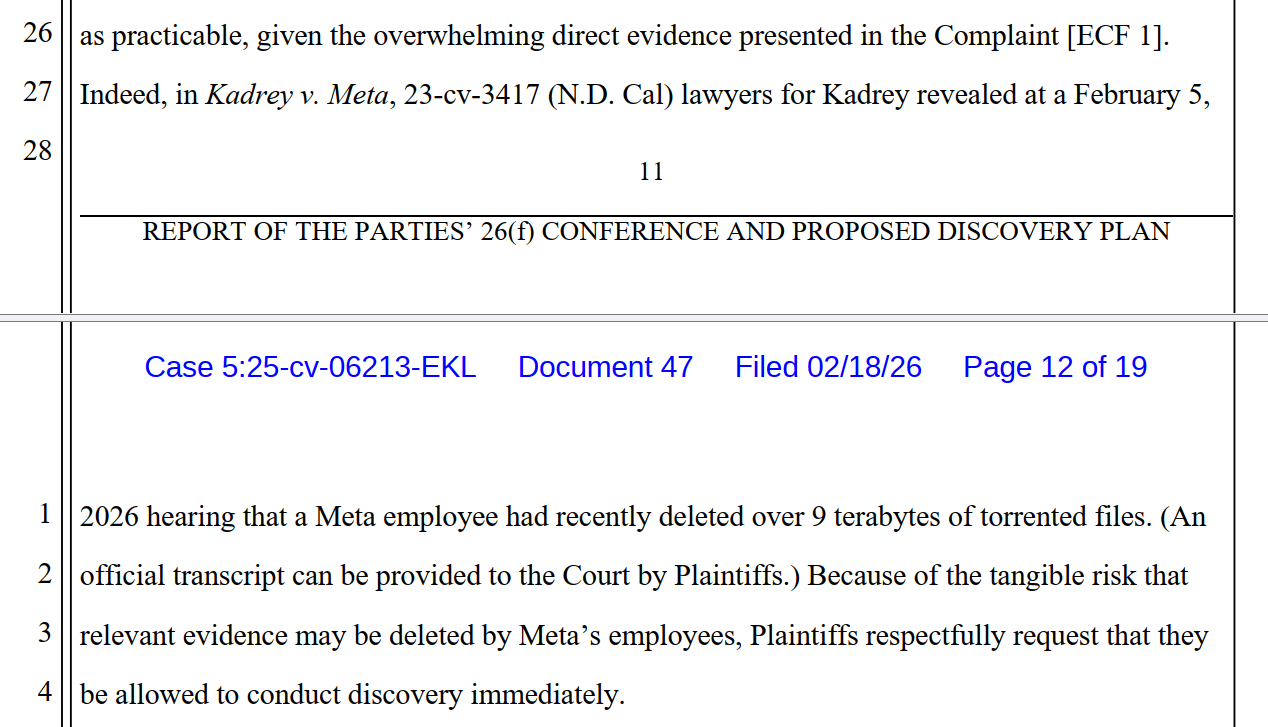
In the same filing, Meta’s legal team immediately tried to defuse the deletion claim. Meta says that no data was spoiled and clarified that it will preserve all evidence as it is legally obliged to do.
“Plaintiffs mischaracterize the Kadrey record. There was no spoliation in Kadrey, which is an unrelated case, and in any event Meta has an appropriate hold in place and is abiding by its preservation obligations,” Meta writes.
Torrent Evidence
The discovery plan also provides the clearest picture yet of what Strike 3 actually wants to find. Among the targets is Meta’s Machine Learning Hub “ML Hub,” including downloaded digital media files, torrenting-related metadata, and labeling data for content acquired from BitTorrent.
Strike 3 also wants logs of Meta servers communicating over “PySpark or Fairspark protocols,” suggesting it believes these tools were used to coordinate downloads across Meta’s infrastructure. Separately, the company is seeking records tying Meta’s alleged hidden “off-infra” IP addresses to Amazon Web Services instances.
The discovery list is broad by design, and the above are just a few examples. In essence, Strike 3 wants all policies, directives, and algorithms related to torrenting. They hope that this information will help to back up their copyright infringement claims.
Meta’s Defense & Trial Date
While Strike 3 references thousands of downloads, Meta stresses that the complaint only mentions 157 downloads from Meta’s corporate IP addresses over seven years. They note that this is illustrative of personal use, rather than an organized data collection effort.
Meta also explains that the alleged downloads began years before it started researching generative video AI, making a coordinated training effort even more implausible. In addition, Meta says that Strike 3 has “no facts whatsoever” linking it to the thousands of additional third-party IP addresses that are named in the complaint.
While Meta’s motion to dismiss is still unresolved, both parties are also looking ahead. While they differ on the exact timing of various deadlines, both believe that an eventual trial can take place in the first half of 2028, if it gets to that.
—
A copy of the parties’ 26(f) discovery plan, filed at the U.S. District Court for the Northern District of California, is available here (pdf). We will add a copy of the transcript as soon as we notice that it is publicly posted.
From: TF, for the latest news on copyright battles, piracy and more.
‘I Don’t Want To Lose My Friendship’
Feb. 24th, 2026 13:20autostraddle_feed"I feel so conflicted. This is a friendship of over 20 years."
The post ‘I Don’t Want To Lose My Friendship’ appeared first on Autostraddle.
Is AI Good for Democracy?
Feb. 24th, 2026 12:06bruce_schneier_feedPoliticians fixate on the global race for technological supremacy between US and China. They debate geopolitical implications of chip exports, latest model releases from each country, and military applications of AI. Someday, they believe, we might see advancements in AI tip the scales in a superpower conflict.
But the most important arms race of the 21st century is already happening elsewhere and, while AI is definitely the weapon of choice, combatants are distributed across dozens of domains.
Academic journals are flooded with AI-generated papers, and are turning to AI to help review submissions. Brazil’s court system started using AI to triage cases, only to face an increasing volume of cases filed with AI help. Open source software developers are being overwhelmed with code contributions from bots. Newspapers, music, social media, education, investigative journalism, hiring, and procurement are all being disrupted by a massive expansion of AI use.
Each of these is an arms race. Adversaries within a system iteratively seeking an edge against their competition by continuously expanding their use of a common technology.
Beneficiaries of these arms races are US mega-corporations capturing wealth from the rest of us at an unprecedented rate. A substantial fraction of global economy has reoriented around AI in just the past few years, and that trend is accelerating. In parallel, this industry’s lobbying interests are quickly becoming the object, rather than the subject, of US government power.
To understand these arms races, let’s look at an example of particular interest to democracies worldwide: how AI is changing the relationship between democratic government and citizens. Interactions that used to happen between people and elected representatives are expanding to a massive scale, with AIs taking the roles that humans once did.
In a notorious example from 2017, US Federal Communications Commission opened a comment platform on the web to get public input on internet regulation. It was quickly flooded with millions of comments fraudulently orchestrated by broadband providers to oppose FCC regulation of their industry. From the other side, a 19-yearold college student responded by submitting millions of comments of his own supporting the regulation. Both sides were using software primitive by the standards of today’s AI.
Nearly a decade later, it is getting harder for citizens to tell when they’re talking to a government bot, or when an online conversation about public policy is just bots talking to bots. When constituents leverage AI to communicate better, faster, and more, it pressures government officials to do the same.
This may sound futuristic, but it’s become a familiar reality in US. Staff in US Congress are using AI to make their constituent email correspondence more efficient. Politicians campaigning for office are adopting AI tools to automate fundraising and voter outreach. By one 2025 estimate, a fifth of public submissions to the Consumer Financial Protection Bureau were already being generated with AI assistance.
People and organizations are adopting AI here because it solves a real problem that has made mass advocacy campaigns ineffective in the past: quantity has been inversely proportional to both quality and relevance. It’s easy for government agencies to dismiss general comments in favour of more specific and actionable ones. That makes it hard for regular people to make their voices heard. Most of us don’t have the time to learn the specifics or to express ourselves in this kind of detail. AI makes that contextualization and personalization easy. And as the volume and length of constituent comments grow, agencies turn to AI to facilitate review and response.
That’s the arms race. People are using AI to submit comments, which requires those on the receiving end to use AI to wade through the comments received. To the extent that one side does attain an advantage, it will likely be temporary. And yet, there is real harm created when one side exploits another in these adversarial systems. Constituents of democracies lose out if their public servants use AI-generated responses to ignore and dismiss their voices rather than to listen to and include them. Scientific enterprise is weakened if fraudulent papers sloppily generated by AI overwhelm legitimate research.
As we write in our new book, Rewiring Democracy, the arms race dynamic is inevitable. Every actor in an adversarial system is incentivized and, in the absence of new regulation in this fast moving space, free to use new technologies to advance its own interests. Yet some of these examples are heartening. They signal that, even if you face an AI being used against you, there’s an opportunity to use the tech for your own benefit.
But, right now, it’s obvious who is benefiting most from AI. A handful of American Big Tech corps and their owners are extracting trillions of dollars from the manufacture of AI chips, development of AI data centers, and operation of so-called ‘frontier’ AI models. Regardless of which side pulls ahead in each arms race scenario, the house always wins. Corporate AI giants profit from the race dynamic itself.
As formidable as the near-monopoly positions of today’s Big Tech giants may seem, people and governments have substantial capability to fight back. Various democracies are resisting this concentration of wealth and power with tools of anti-trust regulation, protections for human rights, and public alternatives to corporate AI. All of us worried about the AI arms race and committed to preserving the interests of our communities and our democracies should think in both these terms: how to use the tech to our own advantage, and how to resist the concentration of power AI is being exploited to create.
This essay was written with Nathan E. Sanders, and originally appeared in The Times of India.
Pluralistic: Socialist excellence in New York City (24 Feb 2026)
Feb. 24th, 2026 09:38doctorow_feed

Today's links
- Socialist excellence in New York City: The real efficiency is insourcing and ending public-private partnerships.
- Hey look at this: Delights to delectate.
- Object permanence: UK antipiracy office will catch Firefox crooks; Batpole flip-top bust; "Order of Odd-Fish"; Scott Walker v fake Kochl; Billg wants to backdoor Microsoft; NSA spied on world leaders; Trump They Live mask; "Unicorns vs Goblins"; Covid German.
- Upcoming appearances: Where to find me.
- Recent appearances: Where I've been.
- Latest books: You keep readin' em, I'll keep writin' 'em.
- Upcoming books: Like I said, I'll keep writin' 'em.
- Colophon: All the rest.

Socialist excellence in New York City (permalink)
In her magnificent 2023 book Doppelganger, Naomi Klein describes the "mirror world" of right wing causes that are weird, conspiratorial versions of the actual things that leftists care about:
https://pluralistic.net/2023/09/05/not-that-naomi/#if-the-naomi-be-klein-youre-doing-just-fine
For example, Trump rode to power on the back of Qanon, a movement driven by conspiratorial theories of a cabal of rich and powerful people who were kidnapping, trafficking and abusing children. Qanon followers were driven to the most unhinged acts by these theories, shooting up restaurants and demanding to be let into nonexistent basements:
https://www.newsweek.com/pizzagate-gunman-killed-north-carolina-qanon-2012850
And while Qanon theories about children being disguised as reasonably priced armoires are facially absurd, the right's obsession with imaginary children is a long-established phenomenon:
https://www.bbc.co.uk/news/world-53416247
Think of the conservative movement's all-consuming obsession with the imaginary lives of children that aborted fetuses might have someday become, and its depraved indifference to the hunger and poverty of actual children in America:
https://unitedwaynca.org/blog/child-poverty-in-america/
Trump's most ardent followers reorganized their lives around the imagined plight of imaginary children, while making excuses for Trump's first-term "Kids in Cages" policy:
https://www.bbc.co.uk/news/world-us-canada-44518942
Obviously, this has only gotten worse in Trump's second term. The same people whose entire political identity is nominally about defending "unborn children" are totally indifferent to the actual born children that DOGE left to die by the thousands:
https://hsph.harvard.edu/news/usaid-shutdown-has-led-to-hundreds-of-thousands-of-deaths/
They cheered Israel's slaughter and starvation of children during the siege of Gaza and they are cheering it on still today:
As for pedophile traffickers, the same Qanon conspiracy theorists who cooked their brains with fantasies about Trump smiting the elite pedophiles are now making excuses for Trump's central role in history's most prolific child rape scandal:
https://en.wikipedia.org/wiki/Relationship_of_Donald_Trump_and_Jeffrey_Epstein
This is the mirror-world as Klein described it: a real problem (elite impunity for child abuse; the sadistic targeting of children in war crimes; the impact of poverty on children) filtered through a fever-swamp of conspiratorial nonsense. It's world that would do anything to save imaginary children while condemning living, real children to grinding poverty, sexual torture, starvation and murder.
Once you know about Klein's mirror-world, you see it everywhere – from conservative panics about the power of Big Tech platforms (that turn out to be panics about what Big Tech does with that power, not about the power of tech itself):
https://pluralistic.net/2026/02/13/khanservatives/#kid-rock-eats-shit
To conservative panics about health – that turn out to be a demand to dismantle America's weak public health system and America's weak regulation of the supplements industry:
https://www.conspirituality.net/episodes/brief-maha-is-a-supplements-grift
But lately, I've been thinking that maybe the mirror shines in both directions: that in addition to the warped reflection of the right's mirror world, there is a left mirror world where we can find descrambled, clarified versions of the right's twisted obsessions.
I've been thinking about this since I read a Corey Robin blog post about Mamdani's campaign rhetoric, in which Mamdani railed against "mediocrity" and promised "excellence":
https://coreyrobin.com/2025/11/15/excellence-over-mediocrity-from-mamdani-to-marx-to-food/
Robin pointed out that while this framing might strike some leftists as oddly right-coded, it has a lineal descent from Marx, who advocated for industrialization and mass production because the alternative would be "universal mediocrity.”
Robin went on to discuss a largely lost thread of "socialist perfectionism" ("John Ruskin and William Morris to Bloomsbury Bolsheviks like Virginia Woolf and John Maynard Keynes") who advocated for the public provision of excellence.
He identifies Marx's own mirror world analysis, pointing out that Marx identified a fundamental difference between capitalist and socialist theories of the division of labor. While capitalists saw the division of labor as a way to increase quantity, socialists were excited by the prospect of increasing quality.
(There's a centaur/reverse centaur comparison lurking in there, too. If you're a centaur radiologist, who gets an AI tool that flags some diagnoses you may have missed, then you're improving the rate of tumor identification. If you're a reverse centaur radiologist who sees 90% of your colleagues fired and replaced with a chatbot whose work you are expected to sign off on at a rate that precludes even cursory inspection, you're increasing X-ray throughput at the expense of accuracy):
https://pluralistic.net/2025/12/05/pop-that-bubble/#u-washington
(In other words: the reverse centaur is the mirror world version of a centaur.)
After the mayoral election, Mamdani doubled down on his pursuit of high-quality public services. In his inaugural speech, Mamdani promised a government "where excellence is no longer the exception":
https://www.nytimes.com/2026/01/01/nyregion/mamdani-inauguration-speech-transcript.html
Robin was also developing his appreciation for Mamadani's vision of public excellence. In the New York Review of Books, Robin made the case that it was a mistake for Democrats to have ceded the language of efficiency and quality to Republicans:
https://www.nybooks.com/online/2025/12/31/democratic-excellence-zohran-mamdani/
Where Democrats do talk about efficiency, they talk about it in Republican terms: "We'll run the government like a business." Mamdani, by contrast, talks about running the government like a government – a good government, a government committed to excellence.
Writing in Jacobin, Conor Lynch takes a trip into the good side of the mirror world, unpacking the idea of socialist excellence in Mamdani's governance promises:
https://jacobin.com/2026/02/zohran-mamdani-efficiency-nyc-budget/
During the Mamdani campaign, "efficiency" was just one plank of the platform. But once Mamdani took office, he learned that his predecessor, the lavishly corrupt Eric Adams, had lied about the city's finances, leaving a $12b hole in the budget:
https://www.nyc.gov/mayors-office/news/2026/01/mayor-mamdani-details–adams-budget-crisis-
Mamdani came to power in New York on an ambitious platform of public service delivery, and not just because this is the right thing to do, but because investment in a city's people and built environment pays off handsomely.
Maintenance is always cheaper than repair, and one of the main differences between a business and a government is that a business's shareholders can starve maintenance budgets, cash out, and leave the collapsing firm behind them, while governments must think about the long term consequences of short-term thinking (the fact that so many Democratic governments have failed to do this is a consequence of Democrats adopting Republicans' framing that a good government is "run like a business").
The best time to invest in New York City was 20 years ago. The second best time in now. For Mamdani to make those investments and correct the failures of his predecessors, he needs to find some money.
Mamdani's proposal for finding this money sounds pretty conservative: he's going to cut waste in government. He's ordered each city agency to appoint a "Chief Savings Officer" who will "review performance, eliminate waste and streamline service delivery." These CSOs are supposed to find a 1.5% across-the-board savings this year and 2.5% next year:
Does this sound like DOGE to you? It kind of does to me, but – crucially – this is mirror-world DOGE. DOGE's project was to make cuts to government in order to make government "run like a business." Specifically, DOGE wanted to transform the government into the kind of business that makes cuts to juice the quarterly numbers at the expense of long-term health:
But Mamdani's mirror-world DOGE is looking to find efficiencies by cutting things like sweetheart deals with private contractors and consultants, who cost the city billions. It's these private sector delegates of the state that are the source of government waste and bloat.
The literature is clear on this: when governments eliminate their own capacity to serve the people and hire corporations to do it on their behalf, the corporations charge more and deliver less:
As Lynch writes, DOGE's purpose was to dismantle as much of the government as possible and shift its duties to Beltway Bandits who could milk Uncle Sucker for every dime. Mamdani's ambition, meanwhile, is to "restore faith in government [and] demonstrate that the public sector can match or even surpass the private sector in excellence."
As Mamdani said in his inauguration speech, "For too long, we have turned to the private sector for greatness, while accepting mediocrity from those who serve the public."
Turning governments into businesses has been an unmitigated failure. After decades of outsourcing, the government hasn't managed to shrink its payroll, but government workers are today primarily employed in wheedling private contractors to fulfill their promises, even as public spending has quintupled:
Instead of having a government employee do a government job, that govvie oversees a private contractor who costs twice as much…and sucks at their job:
https://www.pogo.org/reports/bad-business-billions-of-taxpayer-dollars-wasted-on-hiring-contractors
There's a wonderful illustration of this principle at work in Edward Snowden's 2019 memoir Permanent Record:
After Snowden broke both his legs during special forces training and washed out, he went to work for the NSA. After a couple years, his boss told him that Congress capped the spy agencies' headcount but not their budgets, so he was going to have to quit his job at the NSA and go to work for one of the NSA's many contractors, because the NSA could hire as many contractors as it wanted.
So Snowden is sent to a recruiter who asks him how much he's making as a government spy. Snowden quotes a modest 5-figure sum. The recruiter is aghast and tells Snowden that he gets paid a percentage of whatever Snowden ends up making as a government contractor, and promptly triples Snowden's government salary. Why not? The spy agencies have unlimited budgets, and will pay whatever the private company that Snowden nominally works for bills them at. Everybody wins!
Ladies and gentlemen, the efficiency of government outsourcing. Run the government like a business!
As bad as this is when the government hires outside contractors to do things, it's even worse when they hire outside contractors to consult on things. Under Prime Minister Justin Trudeau, the Canadian government spent a fortune on consultants, especially at the start of the pandemic:
https://pluralistic.net/2023/01/31/mckinsey-and-canada/#comment-dit-beltway-bandits-en-canadien
The main beneficiary of these contracts was McKinsey, who were given a blank cheque and no oversight – they were even exempted from rules requiring them to disclose conflicts of interest.
Trudeau raised Canadian government spending by 40%, to $11.8 billion, creating a "shadow civil service" that cost vastly more than the actual civil service – the government spent $1.85b on internal IT expertise, and $2.3b on outside contractors.
These contractors produced some of the worst IT boondoggles in government history, including the bungled "ArriveCAN" contact tracing program. The two-person shop that won the contract outsourced it to KPMG and raked off a 15-30% commission.
Before Trudeau, Stephen Harper paid IBM to build Phoenix – a payroll system that completely failed and was, amazingly, far worse than ArriveCAN. IBM got $309m to build Phoenix, and then Canada spent another $506m to fix it and compensate the people whose lives it ruined.
Wherever you find these contractors, you find stupendous waste and fraud. I remember in the early 2000s, when Dan "City of Sound" Hill was working at the BBC and wanted to try an experiment to distribute MP3s of a radio programme.
The BBC – an organization with a long history of technical excellence – had given the exclusive contract for web delivery to Siemens, who wanted £10,000 to set up a web-server for the experiment. Dan rented a server from an online provider and put it all on his personal card, serving tens of thousands of MP3s for less than £10. It turns out that letting your technical personnel do your technology development costs 1/1000th of what it costs to have contractors do it.
Running your public institution "like a business" is incredibly inefficient. Back when Musk and Ramaswamy announced their plan to cut $2t from the US federal budget, David Dayen published a plan to realize nearly that much savings just by attacking waste arising from running the government "like a business":
https://pluralistic.net/2025/01/27/beltway-bandits/#henhouse-foxes
The US government's own estimate of the losses due to contractor fraud comes out to $274b/year – roughly the size of the entire civil service payroll (the Corporation for Public Broadcasting, which Musk sadistically destroyed, accounts for 0.012% of federal spending).
Medicare "upcoding" – a form of fraud committed by companies like United Healthcare, the largest Medicare Advantage provider in the country – costs the public $83b/year:
Congress has banned Medicare and Medicaid from bargaining for pharma prices, which is why the US government pays 178% more than other governments, for the same drugs, which are often developed at public expense:
https://aspe.hhs.gov/reports/comparing-prescription-drugs
The Pentagon is a cesspit of waste. It's not just firing spies and rehiring them as contractors at a 300% markup – that's just for starters. The Pentagon receives $840b/year and has failed its last three audits:
https://thehill.com/policy/defense/4992913-pentagon-fails-7th-audit-in-a-row-but-says-progress-made/
The conservative version of "efficiency" cashes out to "efficient at extracting value from public institutions, workers and customers." Mamdani's (good) mirror world "efficiency" means providing great public service through investing in public excellence.
New York City is overdue for this kind of overhaul. Everywhere you look in the city, you find high price consultants making out like bandits and starving the city of the funds it needs to deliver. The Second Avenue subway spent more on consultants than it spent on digging tunnels:
Mamdani has pledged to audit the Department of Education's 25 largest contracts (the DOE spends $10b/year on outside contractors). He's rolling out "fiscal training and certification" for any government employee involved in procurement.
Mamdani isn't pretending he can bridge the gap that Adams left in the city's finances through efficiency alone: to make up the difference, he is going to tax NYC's millionaires, and ask the state to "rebalance" its relationship with NYC's taxpayers (NYC contributes 54.4% of the state budget, but only gets 40.5% in return).
As Lynch writes, NYC was the birthplace of austerity-driven outsourcing, following from the city's bankruptcy in 1975. 50 years later, Mamdani is bringing that age to a close.
Mamdani knows what the stakes are, too. He called efficiency "the most paramount left-wing concern, because it is either the fulfillment or the betrayal of that which motivates so much of our politics":
https://www.derekthompson.org/p/what-speaks-to-me-about-abundance
Mamdani is reviving the tradition of "sewer socialism," a governing philosophy based on "bringing people into your politics by improving their lives in obvious ways":
https://jacobin.com/2025/12/digital-sewer-socialism-public-ownership
Sewer socialism, public excellence, real efficiency: these are the (good) mirror world versions of the right's obsession with "government efficiency." On the conservative side of the mirror, "efficiency" is an excuse for hamstringing government employees and turning their budgets over to lazy, crooked contractors. On the left's side of the mirror, "efficiency" is building capacity in democratically accountable institutions that care about helping every person, and who deliver tomorrow's excellence by making long-term investments today.
(Image: DAVID ILIFF, CC BY-SA 3.0, modified)
Hey look at this (permalink)

- The True North Strong And Speculative https://hugoclub.blogspot.com/2026/02/the-true-north-strong-and-speculative.html
-
The Economic Democracy Project is hiring our first Program Director https://www.linkedin.com/posts/vera-franz_edp-program-director-jd-ugcPost-7429172997611003906-GmNW/
-
A case study in civic fiction: A Gay Girl in Damascus and the structuring of cosmopolitan sympathy https://journals.sagepub.com/doi/10.1177/14648849261426443
-
Your AI-generated password isn't random, it just looks that way https://www.theregister.com/2026/02/18/generating_passwords_with_llms/

Object permanence (permalink)
#20yrago UK anti-piracy officer assures Firefox she’ll catch the pirates who copy it https://web.archive.org/web/20060511105535/http://business.timesonline.co.uk/article/0,,9075-2051196,00.html
#20yrsago Diane Duane vows to finish trilogy as a reader-supported web-book https://web.archive.org/web/20060630094910/http://outofambit.blogspot.com/2006_02_01_outofambit_archive.html#114069083471800451
#15yrago Order of Odd-Fish, a funny, mannered, hilariously weird epic romp https://memex.craphound.com/2011/02/23/order-of-odd-fish-a-funny-mannered-hilariously-weird-epic-romp/
#15yrsago HOWTO make a batpole flip-top bust switch https://web.archive.org/web/20110218013400/https://www.thenewhobbyist.com/2011/02/wireless-light-switch-or-bust/
#15yrsago Travel guide for American invalids, 1887 https://web.archive.org/web/20110225235315/http://www.butifandthat.com/guide-for-invalids/
#15yrsago Archive.org and 150 libraries create 80,000 lendable ebook library https://archive.org/post/349420/in-library-ebook-lending-program-launched
#15yrsago Scott Walker tricked into spilling his guts to fake Koch brother https://web.archive.org/web/20110226135536/https://www.salon.com/news/the_labor_movement/index.html?story=/politics/war_room/2011/02/23/koch_walker_call
#10yrsago Bill Gates: Microsoft would backdoor its products in a heartbeat https://web.archive.org/web/20160223175618/https://recode.net/2016/02/22/bill-gates-is-backing-the-fbi-in-its-case-against-apple/
#10yrsago Wikileaks: NSA spied on UN Secretary General and world leaders over climate and trade https://wikileaks.org/nsa-201602/
#10yrsago Donald Trump They Live mask https://web.archive.org/web/20160224101815/http://www.trickortreatstudios.com/they-live-alien-donald-trump-limited-edition-halloween-mask.html
#10yrsago Unicorn vs. Goblins: the third amazing, hilarious Phoebe and her Unicorn collection! https://memex.craphound.com/2016/02/23/unicorn-vs-goblins-the-third-amazing-hilarious-phoebe-and-her-unicorn-collection/
#5yrsago German covid coinages https://pluralistic.net/2021/02/23/acceptable-losses/#Zeitgeist
#5yrsago A voyage to the moon of 1776 https://pluralistic.net/2021/02/23/acceptable-losses/#Filippo-Morghen
#5yrsago Malcolm X's true killers https://pluralistic.net/2021/02/23/acceptable-losses/#deathbeds-r-us
#5yrsago Private equity's nursing home killing spree https://pluralistic.net/2021/02/23/acceptable-losses/#disposable-olds
Upcoming appearances (permalink)

- Montreal (remote): Fedimtl, Feb 24
https://fedimtl.ca/ -
Oslo (remote): Seminar og lansering av rapport om «enshittification»
https://www.forbrukerradet.no/siste-nytt/digital/seminar-og-lansering-av-rapport-om-enshittification/ -
Victoria: 28th Annual Victoria International Privacy & Security Summit, Mar 3-5
https://www.rebootcommunications.com/event/vipss2026/ -
Victoria: Enshittification at Russell Books, Mar 4
https://www.eventbrite.ca/e/cory-doctorow-is-coming-to-victoria-tickets-1982091125914 -
Barcelona: Enshittification with Simona Levi/Xnet (Llibreria Finestres), Mar 20
https://www.llibreriafinestres.com/evento/cory-doc -
Montreal: Bronfman Lecture (McGill) Apr 10
https://www.eventbrite.ca/e/artificial-intelligence-the-ultimate-disrupter-tickets-1982706623885 -
Berkeley: Bioneers keynote, Mar 27
https://conference.bioneers.org/ -
Berlin: Re:publica, May 18-20
https://re-publica.com/de/news/rp26-sprecher-cory-doctorow -
Berlin: Enshittification at Otherland Books, May 19
https://www.otherland-berlin.de/de/event-details/cory-doctorow.html -
Hay-on-Wye: HowTheLightGetsIn, May 22-25
https://howthelightgetsin.org/festivals/hay/big-ideas-2

Recent appearances (permalink)
- Making The Internet Suck Less (Thinking With Mitch Joel)
https://www.sixpixels.com/podcast/archives/making-the-internet-suck-less-with-cory-doctorow-twmj-1024/ -
Panopticon :3 (Trashfuture)
https://www.patreon.com/posts/panopticon-3-150395435 -
America's Enshittification is Canada's Opportunity (Do Not Pass Go)
https://www.donotpassgo.ca/p/americas-enshittification-is-canadas -
Everything Wrong With the Internet and How to Fix It, with Tim Wu (Ezra Klein)
https://www.nytimes.com/2026/02/06/opinion/ezra-klein-podcast-doctorow-wu.html -
How the Internet Got Worse (Masters in Business)
https://www.youtube.com/watch?v=auXlkuVhxMo

Latest books (permalink)
- "Canny Valley": A limited edition collection of the collages I create for Pluralistic, self-published, September 2025 https://pluralistic.net/2025/09/04/illustrious/#chairman-bruce
-
"Enshittification: Why Everything Suddenly Got Worse and What to Do About It," Farrar, Straus, Giroux, October 7 2025
https://us.macmillan.com/books/9780374619329/enshittification/ -
"Picks and Shovels": a sequel to "Red Team Blues," about the heroic era of the PC, Tor Books (US), Head of Zeus (UK), February 2025 (https://us.macmillan.com/books/9781250865908/picksandshovels).
-
"The Bezzle": a sequel to "Red Team Blues," about prison-tech and other grifts, Tor Books (US), Head of Zeus (UK), February 2024 (thebezzle.org).
-
"The Lost Cause:" a solarpunk novel of hope in the climate emergency, Tor Books (US), Head of Zeus (UK), November 2023 (http://lost-cause.org).
-
"The Internet Con": A nonfiction book about interoperability and Big Tech (Verso) September 2023 (http://seizethemeansofcomputation.org). Signed copies at Book Soup (https://www.booksoup.com/book/9781804291245).
-
"Red Team Blues": "A grabby, compulsive thriller that will leave you knowing more about how the world works than you did before." Tor Books http://redteamblues.com.
-
"Chokepoint Capitalism: How to Beat Big Tech, Tame Big Content, and Get Artists Paid, with Rebecca Giblin", on how to unrig the markets for creative labor, Beacon Press/Scribe 2022 https://chokepointcapitalism.com

Upcoming books (permalink)
- "The Reverse-Centaur's Guide to AI," a short book about being a better AI critic, Farrar, Straus and Giroux, June 2026
-
"Enshittification, Why Everything Suddenly Got Worse and What to Do About It" (the graphic novel), Firstsecond, 2026
-
"The Post-American Internet," a geopolitical sequel of sorts to Enshittification, Farrar, Straus and Giroux, 2027
-
"Unauthorized Bread": a middle-grades graphic novel adapted from my novella about refugees, toasters and DRM, FirstSecond, 2027
-
"The Memex Method," Farrar, Straus, Giroux, 2027

Colophon (permalink)
Today's top sources:
Currently writing: "The Post-American Internet," a sequel to "Enshittification," about the better world the rest of us get to have now that Trump has torched America ( words today, total)
- "The Reverse Centaur's Guide to AI," a short book for Farrar, Straus and Giroux about being an effective AI critic. LEGAL REVIEW AND COPYEDIT COMPLETE.
-
"The Post-American Internet," a short book about internet policy in the age of Trumpism. PLANNING.
-
A Little Brother short story about DIY insulin PLANNING

This work – excluding any serialized fiction – is licensed under a Creative Commons Attribution 4.0 license. That means you can use it any way you like, including commercially, provided that you attribute it to me, Cory Doctorow, and include a link to pluralistic.net.
https://creativecommons.org/licenses/by/4.0/
Quotations and images are not included in this license; they are included either under a limitation or exception to copyright, or on the basis of a separate license. Please exercise caution.
How to get Pluralistic:
Blog (no ads, tracking, or data-collection):
Newsletter (no ads, tracking, or data-collection):
https://pluralistic.net/plura-list
Mastodon (no ads, tracking, or data-collection):
Medium (no ads, paywalled):
Twitter (mass-scale, unrestricted, third-party surveillance and advertising):
Tumblr (mass-scale, unrestricted, third-party surveillance and advertising):
https://mostlysignssomeportents.tumblr.com/tagged/pluralistic
"When life gives you SARS, you make sarsaparilla" -Joey "Accordion Guy" DeVilla
READ CAREFULLY: By reading this, you agree, on behalf of your employer, to release me from all obligations and waivers arising from any and all NON-NEGOTIATED agreements, licenses, terms-of-service, shrinkwrap, clickwrap, browsewrap, confidentiality, non-disclosure, non-compete and acceptable use policies ("BOGUS AGREEMENTS") that I have entered into with your employer, its partners, licensors, agents and assigns, in perpetuity, without prejudice to my ongoing rights and privileges. You further represent that you have the authority to release me from any BOGUS AGREEMENTS on behalf of your employer.
ISSN: 3066-764X

Birdfeeding
Feb. 24th, 2026 00:30ysabetwordsmith posting in ![[site community profile]](https://www.dreamwidth.org/img/comm_staff.png) dw_community_promobirdfeeding is a community started on January 1, 2023. It's all about birdfeeding, birdwatching, and other topics relating to birds. It also touches on nature in general, and observations that may effect bird activity such as local weather. Both text and image posts are welcome. Now is a great time to join as hungry birds are easy to attract with a feeder.
dw_community_promobirdfeeding is a community started on January 1, 2023. It's all about birdfeeding, birdwatching, and other topics relating to birds. It also touches on nature in general, and observations that may effect bird activity such as local weather. Both text and image posts are welcome. Now is a great time to join as hungry birds are easy to attract with a feeder.Community resources include posts about birding events, nurseries that sell seeds or plants attractive to birds, bird identification apps, the benefits of birdwatching, and other useful materials. Check out the anchor posts from Three Weeks for Dreamwidth.
Recent posts:
Sighting a Siberian Superstar: Local birder secures rare red-flanked bluetail for life list
Homes for Birds Week
Photos: House Yard and South Lot
Photos: Flowerbeds
Bird blizzard

U.S. Sent a Rescue Plane for Boat Strike Survivors. It Took 45 Hours to Arrive.
Feb. 17th, 2026 11:00theintercept_feedThe conditions were treacherous in the Pacific Ocean, hundreds of miles off the Mexico–Guatemala border. There were gale-force winds and 9-foot seas. It would be dangerous if you were on a boat, nevermind if yours was blown out of the water.
Eight men leapt into those rough seas on December 30 when the U.S. rained down a barrage of munitions, sinking three vessels. They required immediate rescue; chances were slim that they could survive even an hour. In announcing its strike, U.S. Southern Command or SOUTHCOM, said it “immediately notified” the Coast Guard to launch search and rescue protocols to save the men.
But it took the United States Coast Guard almost 45 hours to begin searching the attack zone for survivors, new reporting by Airwars and The Intercept reveals.
Help did not arrive in time. A total of 11 civilians died due to the U.S. attack on December 30 — including the eight who jumped overboard, according to information provided exclusively to The Intercept by SOUTHCOM, which is responsible for U.S. military operations in and around Latin America and the Caribbean. This represents one of the largest single-day death tolls since the U.S. military began targeting alleged drug smuggling boats last September.
“SOUTHCOM doesn’t want these people alive.”
Using open-source flight tracking data, Airwars and The Intercept learned that a Coast Guard plane did not head toward the site of the attack for almost two days. A timeline provided by the Coast Guard confirmed that it was roughly 45 hours before a flight arrived at the search area.
The slow response and lack of rescue craft in the area suggests there was scant interest on the part of the U.S. in saving anyone. It’s part of a pattern of what appear to be imitation rescue missions that since mid-October have not saved a single survivor.

On December 30, Secretary of War Pete Hegseth told the Coast Guard’s parent agency — the Department of Homeland Security — that SOUTHCOM stood ready to provide them with “specialized maritime capabilities” in support of their missions. But just hours later, it was SOUTHCOM that called on the Coast Guard to conduct the search and rescue mission for the eight men.
The Coast Guard told The Intercept that it received the initial report of people in distress from SOUTHCOM at 1:40 p.m. Pacific time on December 30. (The exact timing of the U.S. strike is not known, but when SOUTHCOM posted about the attack on X the following day it wrote that it had “immediately notified” the Coast Guard).
The survivors jumped into the Pacific approximately 400 nautical miles southwest of Ocos, Guatemala. They faced extreme conditions: 9-foot seas and 40-knot winds, according to Kenneth Wiese, a spokesperson for the Coast Guard Southwest District.
The Coast Guard said it soon began contacting Maritime Rescue Coordination Centers in Mexico, Guatemala, El Salvador, and Costa Rica; the Central American Air Navigation Services Corporation, which provides regional air traffic control and search and rescue coordination; and eight commercial vessels within 200 nautical miles of the last known position of the survivors. A lone container vessel, the Maersk Eureka, responded to the call. On December 31 at 6:44 a.m. Pacific time, the ship arrived at the last known position of the survivors and found nothing.
That morning at 9:19 a.m. Pacific time, a Coast Guard C-130 search and rescue plane took off from Sacramento, California, and headed to Liberia, Costa Rica, “for refueling and crew rest.” A day later, on January 1 at 7:33 a.m. Pacific time, the aircraft left Costa Rica and headed toward the “search area,” according to the Coast Guard. It finally arrived “on scene” at 10:18 a.m. Pacific time on New Year’s Day.

The Coast Guard said that it suspended its search on January 2, reporting “no sightings of survivors or debris.” A U.S. government official, who spoke on the condition of anonymity because they were not authorized to speak to the press, said the men were presumed dead when the search was ended.
“Suspending a search is never easy, and given the exhaustive search effort, lack of positive indications, and declining probability of survival, we have suspended active search efforts pending further developments,” said Coast Guard Capt. Patrick Dill, chief of incident management, Southwest District, at the time.
A second government official who spoke with The Intercept said the Coast Guard response didn’t look like “foot dragging,” but questioned why, after months of attacks in the region, search and rescue assets weren’t pre-positioned closer to the Eastern Pacific.
“SOUTHCOM doesn’t want these people alive,” that official said.
Asked for comment on the allegation, Southern Command spokesperson Steven McLoud said: “SOUTHCOM does not comment on speculative or unfounded reporting.”
The Coast Guard confirmed the C-130 sent from Sacramento was its only aircraft in the area. “There were no other Coast Guard assets in the area to assist with the search,” said spokesperson Lt. Cmdr. Lauren Giancola.
The Coast Guard would not explain why it hadn’t pre-positioned assets in the region. “Any questions regarding military operations including recent strikes should be referred directly to the Department of War,” Giancola told The Intercept.
Pentagon press secretary Kingsley Wilson did not return a request for comment.
The search and rescue operation for the boat strike survivors differs starkly from the U.S. response when a U.S. Marine involved in the military campaign in the Caribbean fell overboard from the amphibious assault ship USS Iwo Jima in the SOUTHCOM area of operations this month. It sparked a “nonstop search and rescue operation” that included hundreds of flight hours and extensive aviation support, according to a statement from the Marines’ II Marine Expeditionary Force. Five Navy ships, a rigid-hull inflatable boat, surface rescue swimmers from the Iwo Jima, and 10 aircraft from the Navy, Marine Corps, and Air Force joined the search efforts. (Lance Cpl. Chukwuemeka E. Oforah, 21, was declared deceased on Feb. 10, 2026.)
The slow pace of the U.S. search for boat strike survivors suggests the goal wasn’t to save lives, said Brian Finucane, a former state department lawyer who is a specialist in counterterrorism issues and the laws of war.
“It does not appear as if they were eager to rescue additional survivors and then be faced with the question of ‘what do we do with them?’” he told The Intercept. “We’re going to hand off responsibility to the Coast Guard, which is going to arrive in a few days from California and look around and not find anything. So you can draw your own conclusions from that sequence.”
The U.S. military has carried out more than three dozen known attacks, destroying 40 boats, in the Caribbean Sea and eastern Pacific Ocean since September, killing at least 134 civilians. The most recent attack on Friday – the first known strike in the Caribbean Sea since early November – killed three people.
From the first strike, crewmembers have periodically survived initial attacks, leading the U.S. to employ a hodgepodge of strategies to deal with them, ranging from execution to repatriation. The Intercept was the first outlet to report that the U.S. military killed two survivors of the initial boat attack on September 2 in a follow-up strike. The two survivors clung to the wreckage of a vessel attacked by the U.S. military for roughly 45 minutes before Adm. Frank Bradley, then the head of Joint Special Operations Command, ordered a follow-up strike that killed the shipwrecked men.

Following an October 16 attack on a semi-submersible in the Caribbean Sea that killed two civilians, two other men were rescued by the U.S. and quickly repatriated to Colombia and Ecuador, respectively. President Donald Trump called them “terrorists” in a Truth Social post and said they would face “detention and prosecution.” But both men were released without charges in their home countries. Since this attack, the U.S. appears to have settled on a strategy of calling for what increasingly resemble imitation rescue missions.
Following three attacks on October 27 that killed 15 people aboard four separate boats, a survivor of a strike was spotted clinging to wreckage, and the U.S. alerted Mexican authorities. The man was not found, and he is presumed dead.
Last month, SOUTHCOM again called on the Coast Guard. “On Friday, January 23rd, the U.S. Coast Guard was notified by the Department of War’s Southern Command of a person in distress in the Pacific Ocean,” Coast Guard spokesperson Roberto Nieves told The Intercept. A timeline provided by the Coast Guard shows that it took about 17 hours for a Coast Guard C-130 to arrive at the survivor’s last known position, but that aircraft only conducted an hourlong search before “diverting to El Salvador for fuel and crew rest.” It returned to the last known position of the survivor on January 25, about 51 hours after the initial distress call. The search was suspended that night just before 8 p.m. Pacific time, and that person is now also presumed dead.
“The expected result is essentially the same as putting a gun to their head.”
Following a strike last week — the third since Marine Gen. Francis L. Donovan became SOUTHCOM’s new commander earlier this month — the command announced that it had once again notified the Coast Guard “to activate the Search and Rescue system for the survivor.” The Coast Guard, in turn, told The Intercept that Ecuador’s Maritime Rescue Coordination Center “assumed coordination of search and rescue operations, with technical support provided by the U.S. Coast Guard.” The Coast Guard then walked it back and said the U.S. had only “offered” assistance. Ecuador’s rescue authorities did not return multiple requests for an update on the search.
The second government official, who spoke with The Intercept on the condition of anonymity because they were not authorized to comment about the boat strikes, said that survivors created “complications and questions” for the U.S. military and intelligence community. Rather than risk exposing intelligence sources and methods by bringing these men to court, the official said it was simpler to leave them to drown. Finucane echoed this assessment. “After rescuing the men in October, it was apparent there would be a strong incentive not to have additional survivors on their hands,” he said.
William Baumgartner, a retired U.S. Coast Guard rear admiral and former chief counsel of that service branch, said the December 30 attack was tantamount to a death sentence. “Once the people jump in the water and you blow up the only thing that could possibly save their lives, that’s essentially killing them,” Baumgartner told The Intercept last month. “The expected result is essentially the same as putting a gun to their head.”
Experts say the survivors of the December 30 attacks likely died within minutes. Accomplished swimmers, clinging to wreckage or flotation devices in warmer waters, could survive longer, some said. None considered that likely in this case.
“The combination of the wind and the waves would force feed water into the victim. If the waves don’t drown you, the hypothermia will kill you,” said Tom Griffiths, the founder of the Aquatic Safety Research Group, who previously served as the director of aquatics and safety officer for athletics at Penn State University. “Drowning often takes as little as four to six minutes for a non-swimmer but can be as quick as 90 seconds. I would think under these conditions it could be almost as quick.”
John Fletemeyer, an aquatics expert and co-author of “The Science of Drowning,” said that people have survived in the water for up to two days. But such cases, he said, are “outliers.”
“It can be almost instantaneous, where it can happen in just a couple minutes if someone cannot swim and they go underwater,” Fletemeyer said. A frequent expert in murder-homicide cases, he explained in detail the pain and suffering involved in drowning. There is also the potential for shark attack, he said, due to blood in the water from those killed in the initial strike.
“If we know somebody is in the water dying,” he said, “I think we have a human responsibility to try to save them.”
The post U.S. Sent a Rescue Plane for Boat Strike Survivors. It Took 45 Hours to Arrive. appeared first on The Intercept.

‘Juntos hacemos la liberación!’ Philly Marches on I.C.E.
Feb. 24th, 2026 03:19idavox_feedThe City of Brotherly and Sisterly lives up to it’s name! Innocent Bystander Philadelphia, PA...
The post ‘Juntos hacemos la liberación!’ Philly Marches on I.C.E. appeared first on Idavox.

