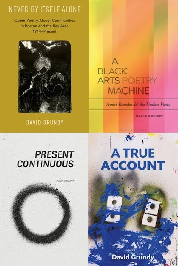
An essay I began a few years ago on N.H. Pritchard, II, is out now in African American Review, with thanks to Aileen Keenan and Nathan L. Grant. Here’s the abstract:
In 1967, Wilmer Lucas wrote that N. H. Pritchard’s poems “decompose the reader by sight and sound.” This essay follows Lucas’s prompt in several ways. It examines Pritchard’s early poetry in the context of the New York art scene and the Umbra Poets Workshop, outlining his development of the concept of “transrealism” and the subsequent visual reorganization of his work, before focusing on the sonic dimensions of his poetry, and suggesting that his approach ultimately led him toward silence. The conclusion emphasizes Pritchard’s legacy in the work of new generations of experimental musicians and poets and its continuing relevance today.

And, since I drafted the essay, Pritchard’s previously-unpublished “exploded haiku” The Mundus, versions of which I discuss in a section of the essay, has come out as a book from Primary Information, edited by Paul Stephens. Here’s my blurb.
Rumours of N.H. Pritchard’s long-lost poem, The Mundus began to surface a few years ago, summoning us to imagine the mystic, Black radical work to transform society. Pritchard’s was always a music of language, a chanting on the page, a sonic visualisation that troubles the edges of both poetry and music alike. He broke apart form at every level—word, letter, sentence, phrase—sounding out mutable mutating beauties and metamorphosing phonic propositions that resound into our present. It is a remarkable work by the standards of any time.
Meanwhile, over on the Jacket 2 website, Charles Bernstein has helpfully posted a funding letter Pritchard wrote in 1967, summarising the project, which expands, corrects and (hopefully) extends some of my guesses in the essay.
~~
Elsewhere...
A sequence published in the winter issue of Almost Island, with thanks to Mantra Mukim.

Reviews of the Donaueschinger Musiktage in the latest issues of The Wire (you can find also find a long versions in an earlier post on this blog) and the new Beam Splitter/Phil Minton album, along with a contribution to the magazine’s year-end reflections and charts.
And stay tuned for reprints of out-of-print titles from Materials, which should be here in the next couple of weeks (hopefully before the year is out)...
~~
And finally…
A few days ago, astonishing new footage of Albert Ayler was uploaded by Jay Korber to his Youtube channel: one ten-minute piece from Munich and one full set from Berlin, both filmed on a 1966 European tour featuring the three-front line of the Ayler brothers and violinist Michael Samson. What’s perhaps most striking about these, given Ayler’s reputation, is the amount of time spent playing melodies. There are relatively few sections of the ‘free’ improvisations for which Ayler was infamous: instead, medley, melody, the ‘folk’ element of the music are more pronounced, not in the somewhat constrained pop forms into which Ayler’s music attempted to fit on New Grass, but as a continuous stream of cadential, decorated, ornamented, amplified, reiterated, singing declaration.
As Peter Niklaus Wilson notes in the recently-translated biography Spirits Rejoice: Albert Ayler and his Message, the Ayler band had been touring Europe as part of a package tour organised by impresario George Wein, what bassist Bill Folwell called the “B tour” to the star turns of Sonny Rollins, Stan Getz, Max Roach and Dave Brubeck. It was on this tour that what was for a time thought to be the only footage of Ayler was recorded at the London School of Economics for the BBC’s Jazz 625, tapes subsequently destroyed in a cull of old recordings (so does Britain value art). Samson recalls ecstatic response to the group’s music on some of the gigs from the tour, comparing their reception in the Netherlands and France to the Beatles, though this doesn’t seem to have applied to the West German gigs: the audience in the footage, respectable and be-suited, appear indifferent, if not hostile. Yet the music Ayler was making had been designed precisely to reach out, to create a collective experience whose call the audience seem on this occasion to have been unable to hear.
Wilson labels the period 1965 to 1968 as the transition from ‘free jazz’ to ‘universal music’, with melodic material less a “catapult theme” for improvisation than something which “take[s] on an unprecedented weight in the playing process - firstly, through their length (for they are now often relatively extended, multi-joint structures), secondly, through the chorus-like recurrence of thematic passages between the solos, thirdly, through the clear shortening of the improvisations”. Wilson sees this as “a populist quality Ayler consciously worked towards”—what Ayler described to Nat Hentoff in 1966 as “trying to get more form in the free form […] something […] that people can hum. […] I want to play songs like I used to sing when I was really small. Folk melodies that all the people would understand.”
Wilson also quotes Samson, who suggests that those melodies drew from Ayler’s past in the Baptist church, where communal participation through singing had a pride of place. Ayler’s extended songs were an attempt to create participation, ‘spiritual unity’ , to bridge a real or perceived gap with the audience in a collective experience (in the next stage in his music, he’d go further, adding words and singing himself, alongside musical-romantic partner Mary Maria Parks).
This was not an about-face, a betrayal of the abstract freedoms of Ghosts and Ayler’s earlier music—an accusation Ayler would face in response to the more overtly R&B-oriented New Grass—and nor does it invalidate or represent a progressive maturation from that earlier music. Rather, Ayler’s ‘free’ playing represents one dialectical outgrowth of the syncretic traditions of song his melodies reference: marching band music, church songs, the nursery rhymes or folk songs he’d heard as a child. The multiple overlapping lines of counterpoint or call and response concentrated to occur all at once, at the same time, in multiphonics and atonality, not so much tonality’s absence as its saturation, its density, all the keys at once. Likewise, the restatement of those formative elements, with the Ayler brothers playing counterpoint lines while Samson vigorously bows along in rough-toned obbligato, manifests an element that was latent in the free improvisations, just as those improvisations manifest an element that was latent in the kinds of melodies on which Ayler drew. As Wilson notes, Ayler is not improvising less than in the more abstract earlier phase, where those improvisations were clearly separated from brief opening melodies. Rather, his various decorative figures offer a nearly-continuous micro-improvised commentary on the melodic figures that, in more conventional jazz frames, would be understood as the ‘heads’ preceding the main business—the virtuosic improvised solo.
Noise is an extension of melody; melody contains within itself the sound of noise.
In his contemporaneous reception by the French press, Ayler was often positioned as either a kind of racialized musical primitive or a dadaist in the anarchic vein of European avant-gardists: either atavist revenant or European modernist, the actual, dialectic quality of his music was often not fully grasped. (Greg Pierrot gave a good paper on this at the International Surrealism conference in Paris last month.) This was, though, the changing same, the radical tradition: continuity and rupture, old-time religion and present-day revolution (spiritual, musical, or otherwise), the tiger’s leap into the past. So, while I refer to ‘folk’ qualities of this music—a term Ayler himself used—‘folk’ here, I think, stands as much for vernacular traditions outside or to the side of the developing pop vocabularies of the culture industry, enmeshed as those were with Cold War economic developments. It does so, not in the sense of the revivalism of the US folk movement, or indeed the European folk songs on which Ayler drew, for instance, for the melody of ‘Ghosts’, based as it is on the Swedish ‘Torparvisan (Little Farmer’s Song)’ (Gunde Johansson’s version is here), as a kind of musical romantic anti-capitalism. Rather, it’s shaped by the experience of modernity, as opposed to evoking a static, idealised image of a real or imagined past. It stands at once for particularity, for the personal memories of the songs first heard and sung that Ayler evokes in the Hentoff interview, that maternal transmission (recall W.E.B. Du Bois and his great-grandmother’s lullaby, his infant’s initiation into the sorrow songs), and for the collective dimension that—as Du Bois’ account of the sorrow songs reveals—those songs open onto. Like ‘jazz’ itself, it is syncretic, drawing in all the ear can hear: folk music not as backwater, tradition to the side, but as part of a relation to modernity, to the problems of the world, away from those labels that would limit, ‘folk’ as much as ‘jazz’. As Wilson writes: “From baroque to country music to the European avant-garde: in the abundance of these allusions Ayler’s music [of this period] really transcends every jazz idiom, no matter how broadly conceived, and makes one understand why Ayler shied away from the jazz label at the time, preferring to speak of the vision of a ‘universal music’”.
‘Ghosts’, said Don Cherry, “should become mankind’s National Anthem!” Nation within a nation, nation without a nation, internationale, outernationale. Spirits rejoice.
(Peter Niklaus Wilson’s book is available through wolke verlag, joining their impressive cast of recent titles including a first English-language publication of materials relating to the singer William Pearson, Timo Müller’s German-language biography of Anthony Braxton, Phil Freeman’s Cecil Taylor biography, the anthology Composing While Black…)