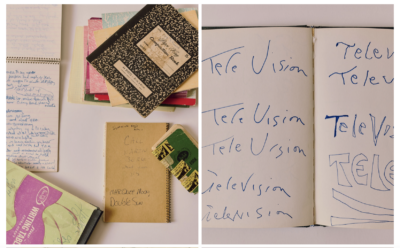
For months last year, the artistic legacy of Tom Verlaine, the influential but enigmatic frontman of the punk-era band Television, rested in 35 tightly packed cardboard boxes lined against a wall in a run-down studio apartment in Manhattan.
Now, three years after Verlaine’s death at 73, the contents of those boxes — reams of lyric sheets, notebooks, photographs, literary experiments and audio reels chocked with unheard tracks — have been acquired by the New York Public Library for the Performing Arts, where they will join the archives of fellow New York giants like Arturo Toscanini, John Cage and Lou Reed, and will be open to the public for scholarly research or browsing by curious fans.
I spy an Eastern Tablet Paper King composition book (small Paper King spiral notebooks were my favorites when I was a kid), and a small Pen-Tab spiral notebook (with yellow and black tape covering most of the spiral), similar to the one I wrote about here: Wire-O and Spiral Notebooks from My Collection, Part 1. (That post also features some Paper King notebooks.)
I’d love to see more of the contents of those 35 boxes, but unfortunately the article didn’t have many more photos. I can’t really identify myself as a “fan” of Tom Verlaine or Television, but I’d be one of the “curious” who would love to browse the archives at the NYPL!
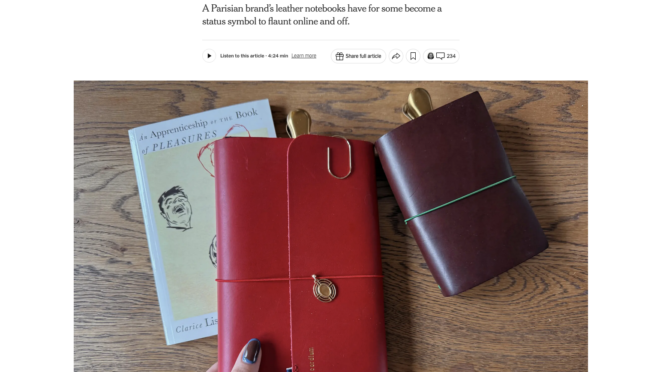
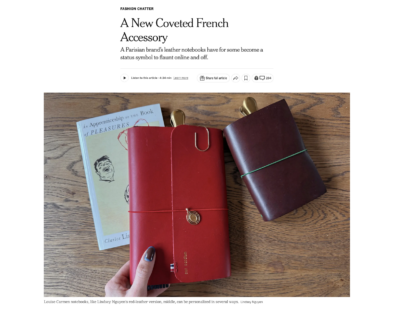
Louise Carmen notebooks were featured in the New York Times recently. The article is dated Jan. 16, 2026, so I expected to see it in the print edition’s Sunday Styles section, but as of this writing, it seems to have appeared online only:
The article talks about the brand’s social media marketing, which has started to follow a formula where an influencer walks into their store and then goes through the process of selecting and customizing a notebook, which is seen from above, focusing in on hands holding the various notebooks and colored elastics and charms. (I personally don’t find those videos all that compelling, but when I first heard about Louise Carmen on Instagram, I was totally sucked in by their photos of beautifully worn-in leather notebooks.) But with success comes some backlash: the article also discusses the grumbling from many users about the price vs. quality and customer service, or lack thereof.
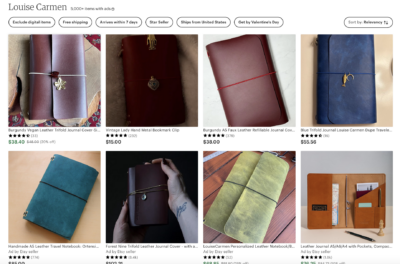
The Times mentions a couple of comparable brands but also notes that some users are getting creative and making their own similar notebooks. I’ve noticed some Louise Carmen “inspired” lookalikes on Etsy, many of which look quite nice and are significantly cheaper than the original.
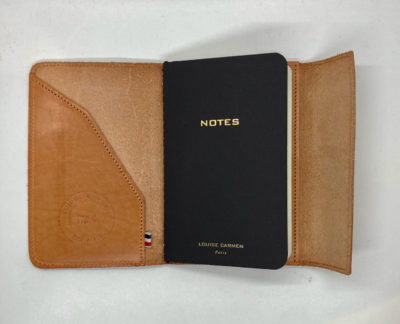
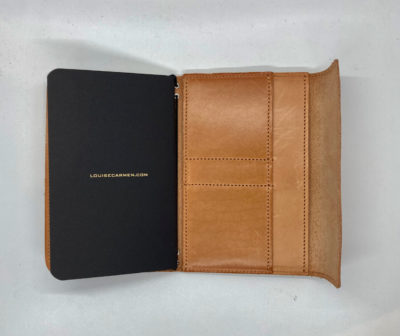
But almost all of the alternatives lack the sewn-in pockets that make the Louise Carmen notebook covers especially useful, especially the pocket size model.
Louise Carmen Pocket Heritage notebook
I also found it quite interesting to read the comments on the Times article. Lots of folks are just griping about why people pay too much to own status symbols, but others are jumping in to share what brands of notebooks are their own favorites. Many are not really comparable– people kind of miss the point that you are not just buying “a notebook” that’s interchangeable with a Moleskine or Field Notes– you are buying a leather cover that can be used as a wallet and refilled over and over with the appropriately sized paper notebooks of your choice.
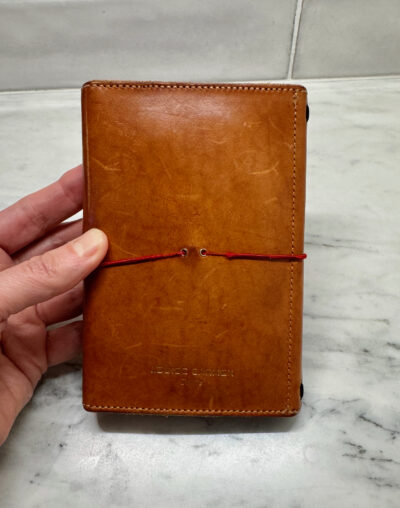
I’ve been using my Louise Carmen notebook as a wallet since October 2022 (more here and here) and am still happy with it. It’s darkened nicely with age and is in great shape except that the elastic is starting to fray a bit. I’ve had random people compliment me on it and ask where it’s from– as one of those people said, it’s a nice in-between size if you don’t want to carry a full-size women’s wallet or a folding men’s wallet.
Louise Carmen notebook cover after 3+ years of use as a wallet
That said, I’m sometimes tempted to carry a more minimal wallet, or just use an insert in my MeePlus notebook to hold a few essentials, but I always end up preferring to having one wallet that will hold everything I might need, which includes a driver’s license, work ID, 3 credit cards, 1 ATM card, a few health insurance cards, some store gift cards, a couple of membership cards, cash, a few coins, a few business cards, and assorted receipts. I can stuff a passport in there too. I wish more of my cards would go all-digital so I could keep them on my phone and have a thinner wallet, but it mostly only bothers me because the pocket in my bag where I keep my wallet and phone has gotten a little tight ever since I upgraded from an iPhone SE to the larger iPhone 15.
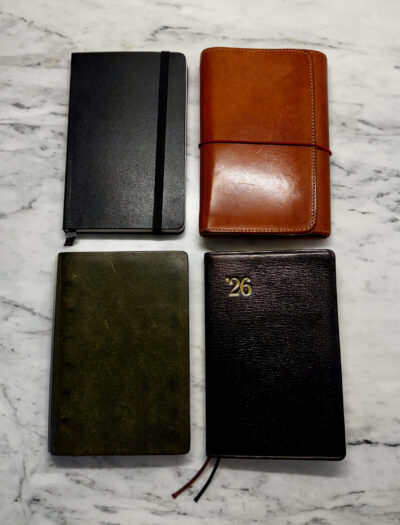
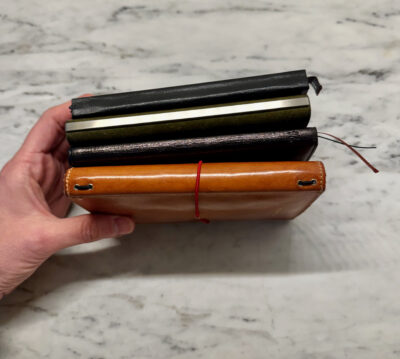
Louise Carmen shown with pocket Moleskine, Nolty and MeePlus notebooks
In any case, it’s always fun to see notebook trends make it into the major media. I’m glad Louise Carmen has popularized their style of notebooks, as they are a welcome variation on the other styles of travelers notebooks that have long gotten more attention.
I am not affiliated with Louise Carmen and have not been compensated for this post in any way. All products in this post were purchased by me at standard retail prices, except for the MeePlus notebook, which was provided as a sample for review.
Happy 2026! I can’t claim to have any major new notebook plans to report for this year: I’ll be sticking with the tried and true. But sometimes, even the tried and true changes a bit.
This will be my 9th year of using a Nolty Efficiency Notebook. I’ve really gotten into a groove with Nolty’s format, finding it works very well as a daily companion where I can track habits, log food and exercise, note appointments, and keep track of various tasks and lists. I also like using it for a sort of yearly overview– recording resolutions and looking back at how I did on them, and keeping a list of all the books I’ve read that year. (See How I Use My Nolty Planner and 2025 Planner Set-Up for more details.)
Nolty’s design seems to have been extremely consistent, probably for far longer than I’ve even been using these planners. But I did notice some changes this year.
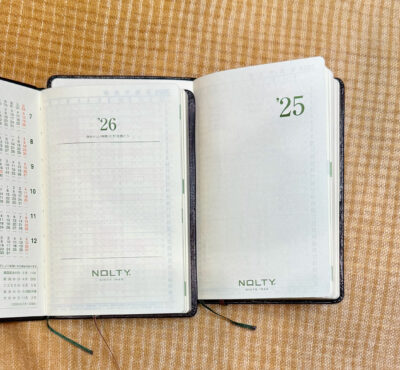
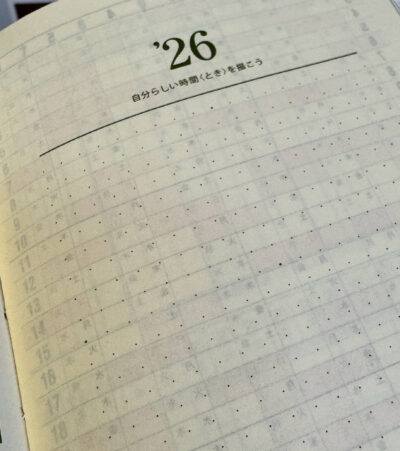
The most immediately noticeable was the cover page design– it makes zero difference to the function of the notebook, but for some reason, they redesigned the layout so the year and Nolty name are centered. In between there is a dot-grid area bordered by lines at the top and bottom– it’s quite subtle and I didn’t even notice it at first. The grid is 19 dots wide and 19 dots tall, with the middle dots on each edge, and the center dot being bolder. Underneath the year is a line of Japanese characters that Google translates as “draw your own time.” Nolty seems to have added this cover page design to all their planners, and I’d be really interested to know how they suggest people use this. From what I’ve seen online, it’s meant to be free form, and perhaps for recording goals or challenges or a vision board, but I haven’t yet seen any examples of how people might actually be using it. The previous blank page could have been used to write these things all along, but I guess the grid is nice if you want to have a bit of structure. Honestly, I’ll probably just leave mine blank!
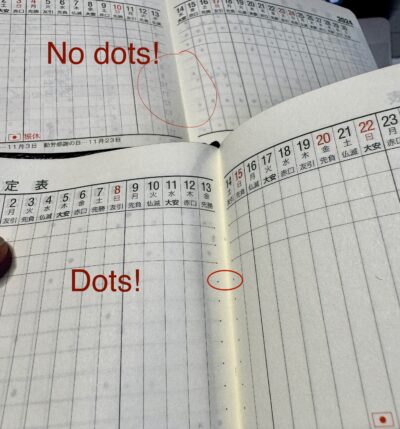
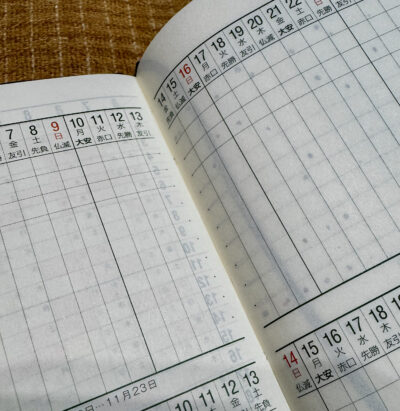
The other slight redesign is something so tiny I almost missed it, but I’m actually extremely happy about it! There are now dots on the spine edges of the Gantt chart. The chart has a few horizontal lines at the top, and then blank space below where you can add your own lines if you want. I always do, and it drove me crazy that they were always a little crooked because there was no dot on the inner part of the page, and if you tried to lay a ruler over the two-page spread, the pages wouldn’t lie flat enough for the line to stay straight near the gutter. Now I can line up the ruler nicely on each page. Anal OCD people of the world, rejoice!
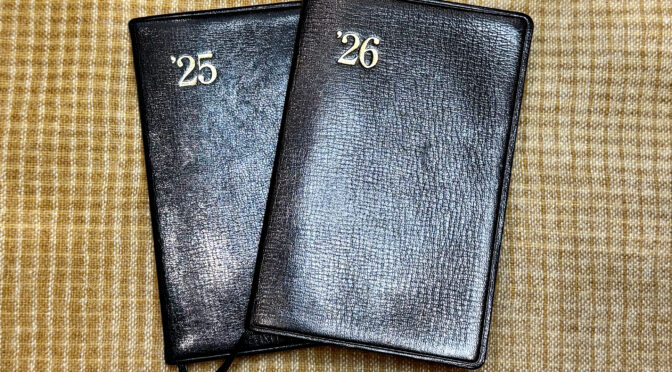
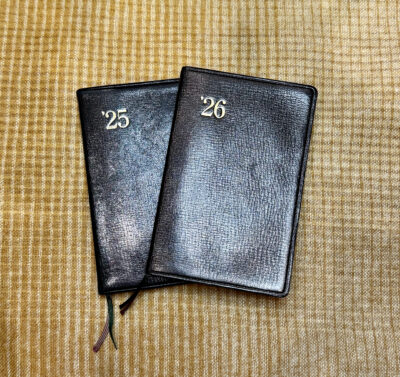
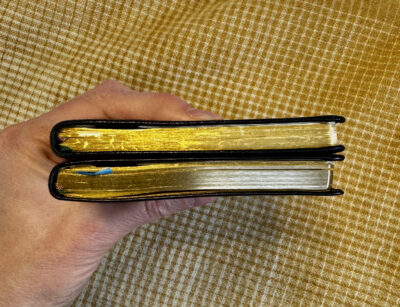
On the downside of Nolty’s subtle changes, my 2026 Nolty Gold has a bigger cover overhang– I doubt this is a conscious design choice, more of just a variation in manufacturing. The cover also seems a bit tightly bound, making the spine a little lopsided and not leaving the extra space needed for the added booklets in the back. (It’s hard to see in the photo below, especially because my 2025 Nolty only has one supplemental booklet in it now, and the 2026 Nolty has two.) It may just need to break in and get floppier but the binding, at least on mine, definitely doesn’t seem to have been done quite as precisely as last year’s. I’ve always found Nolty’s quality control to be top notch, so this is a bit disappointing.
Nolty 2025 on top, 2026 on bottom
Otherwise, as far as I can tell this is exactly the same Nolty Gold I’ve come to know and love. And I hope they’ll keep it that way!
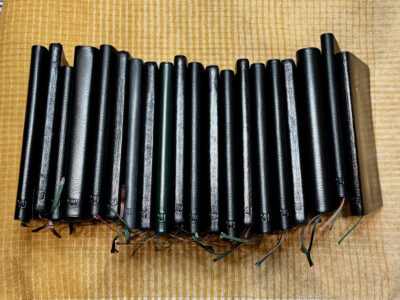
My collection of past and currently used Nolty planners.
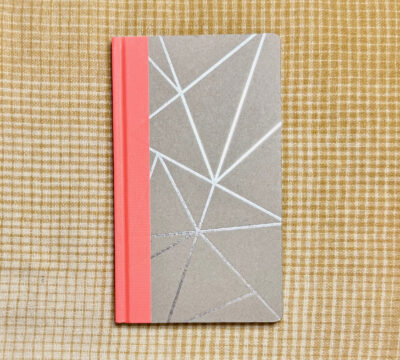
This notebook made by Asia Pacific Offset was a gift, but not a holiday gift. I received it in a roundabout way, with a sample book I needed for my job. Though I sometimes get free notebooks as samples, I can’t remember the last time I got a promotional notebook from my day job.
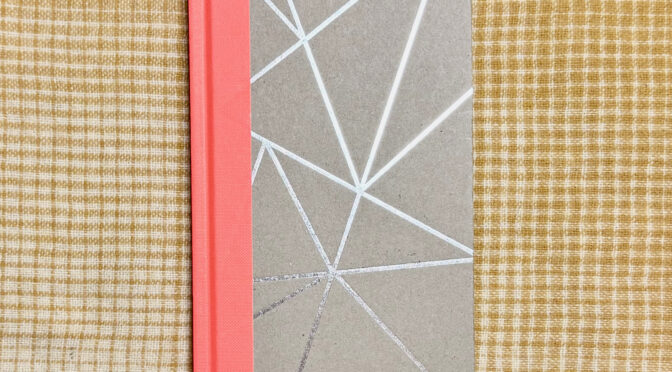
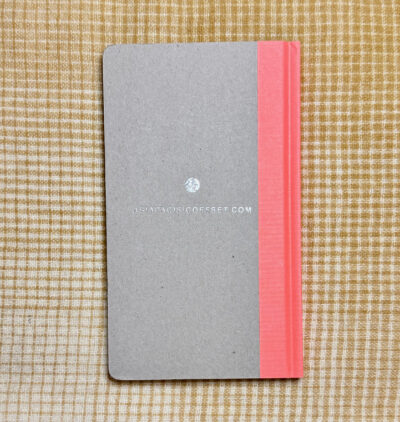
It was a lovely surprise to get this notebook. The design is fun and immediately eye-catching, with silver metallic lines debossed on the exposed cardboard cover and the pop of pink on the spine.
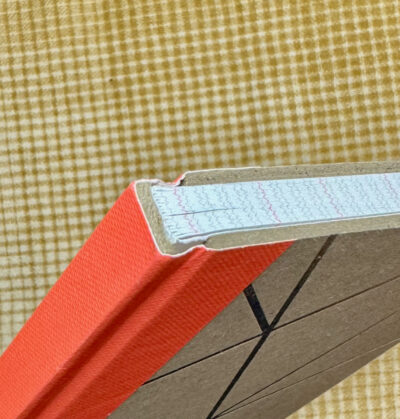
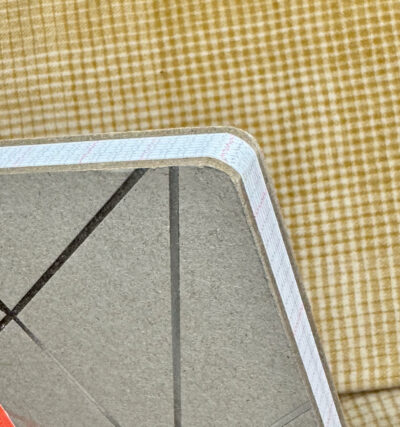
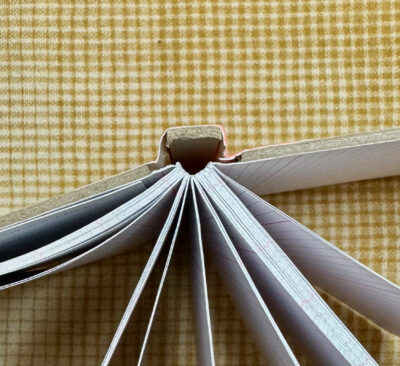
There is no wrap around the cover, so you can see exactly how it was constructed with boards on the front and back and on the spine, then a textured tape over the spine. It’s similar to the size of a standard Travelers Notebook: 115mm x 198mm, or 4-9/16 x 7-13/16″.
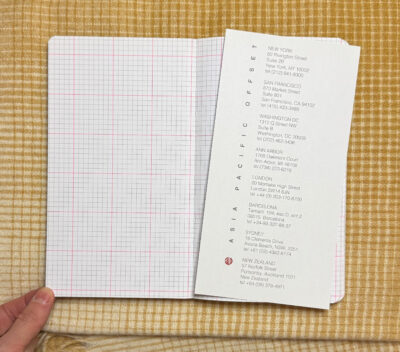
The Asia Pacific brand name appears on the back cover, and there was a card tucked inside that lists their office locations around the world. There is no interior branding, and the inside pages form the endpapers.
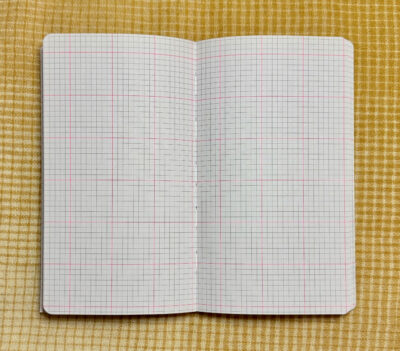
It’s an interesting paper choice, unlike most other squared notebooks I’ve reviewed. There are hot pink squares at 3cm, which are then divided into eighths in grey lines. 1/8 of 3cm is 3.75mm– an unusual grid size, I think. Works out to a little less than 1/8″ so it’s not very standard in inches either. (Moleskine and many other brands use a 5mm grid.)
The paper works fine with most pens, but the wettest fountain pens feather and bleed a bit. The grid design might get a little distracting with smaller handwriting and finer nib sizes but I think it would be fun for designs and doodles.
This notebook is not something I would buy as is, but I’d probably buy one in a pocket size. Either way, I think it’s a great promo item to show off some of a book printer’s capabilities and I’m glad it found its way to me.
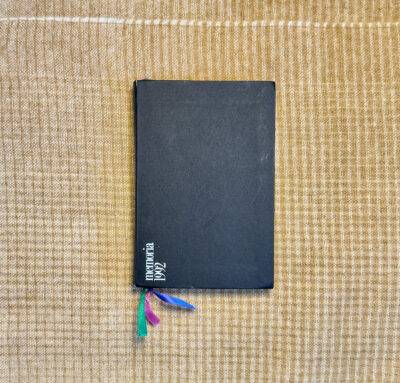
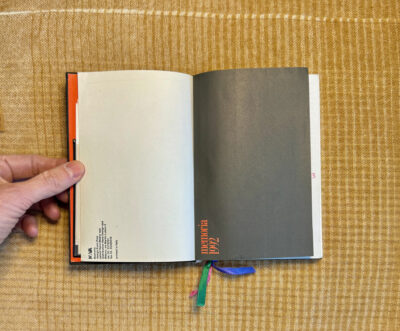
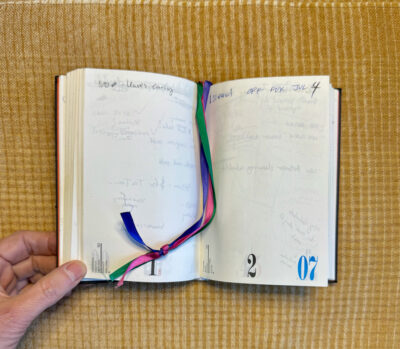
I don’t think I’ve ever written about this notebook, which is a surprise. I fell hard for the Nava Memoria 1992 diary the minute I saw it. It was sold in a store I was working at then, and since I had just been promoted, I made the case that I needed this diary to stay on top of all my new responsibilities in the coming year. I’m pretty sure my boss agreed to let me have it for free, or maybe at the extremely high post-calendar season discount it would eventually have been offered at if no one had bought it by February or so.
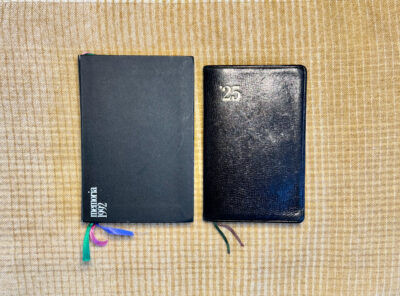
I just loved this diary– at 4×6″, it’s a little larger than the size I’ve come to prefer, but it had a lovely chunkiness to it, and the design was so modern and cool and colorful compared to anything else I’d ever seen at that time.
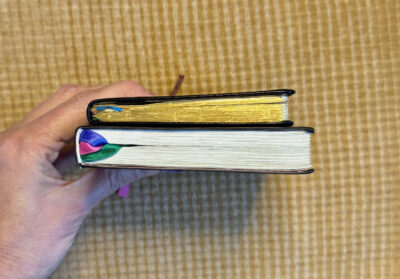
1992 Nava Memoria size compariso vs. 2025 Nolty diary.1992 Nava Memoria size comparison vs. 2025 Nolty diary
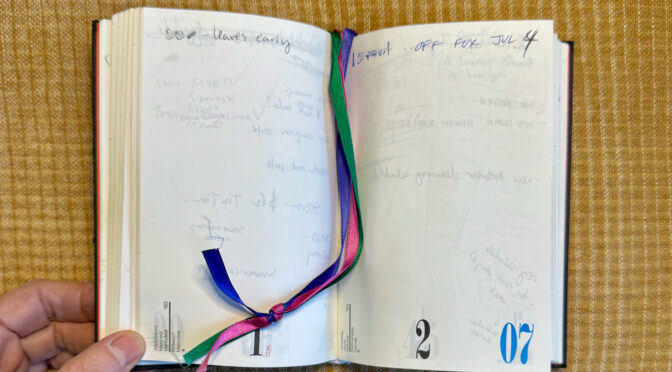
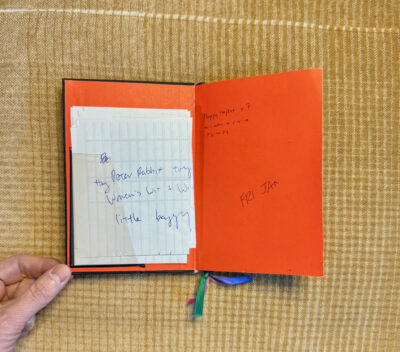
The cover is a matte black vinyl of some sort, wrapping thin and flexible boards. There’s no huge overhang, and the squared corners are nicely made. Inside, bright red endpapers, with a little clear plastic pocket in the front. The 3 bright-colored ribbon markers are another fun touch.
The first page shows the contact information for Nava Design in Milan, and notes that it was designed by Kuno Prey and printed in Italy.
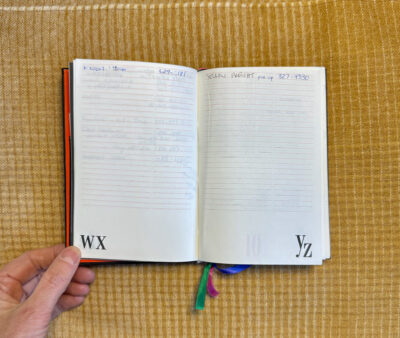
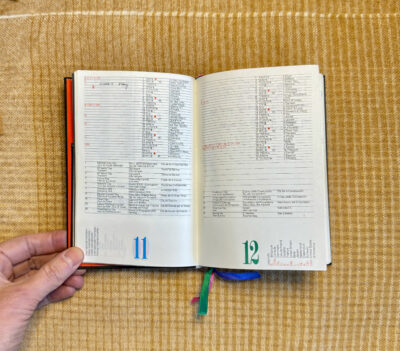
The front of the diary has alphabetical pages for keeping track of contacts, then a month-per-page section noting holidays by country. The holiday details are given in English, Italian and Spanish.
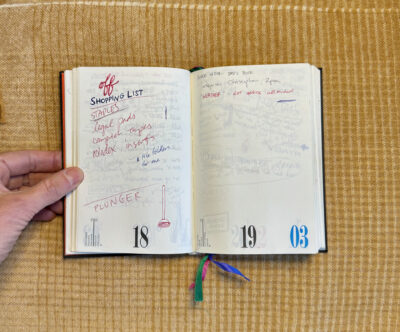
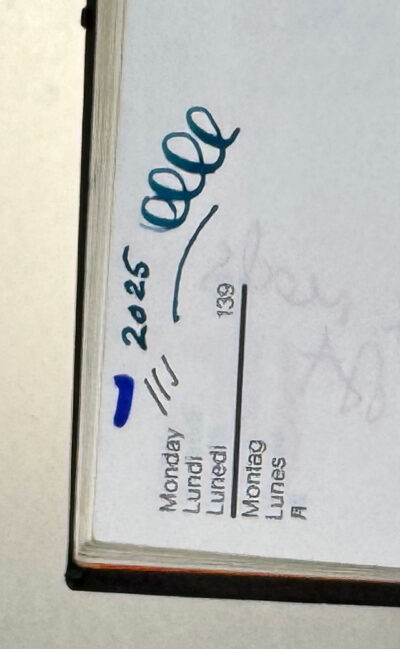
Then the rest of the diary is page-per-day. Here you get the day names in English, French, Italian, German, Spanish and Japanese. It also numbers the days of the year and has little moon phase icons. The date number is black (or red if it’s a holiday), and the month numbers cycle through pink, purple, blue and green. I loved that the pages were unlined, completely free-form other than the info at the bottom.
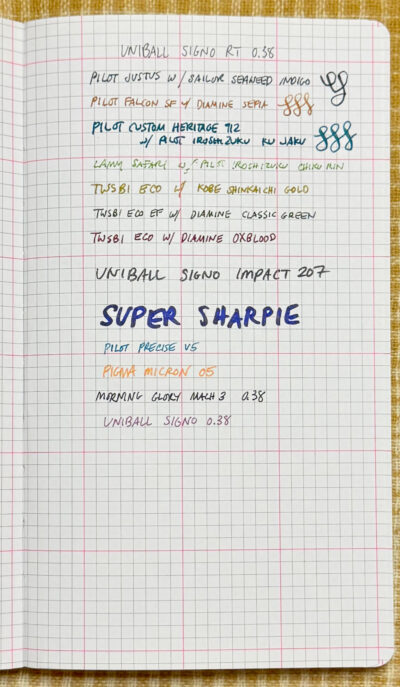
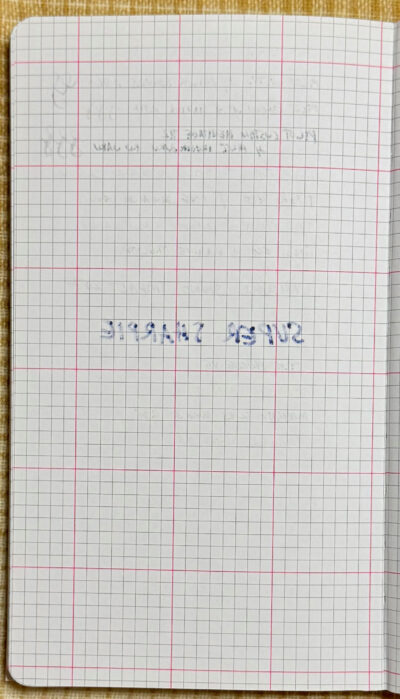
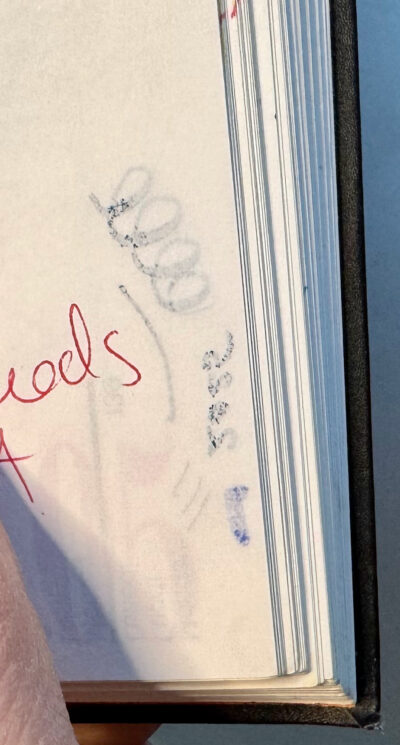
I only used ballpoint pens at the time, but I tested one of the Uniball Signo RT 0.38 gel ink pens that I use today, and it felt amazing on this paper. What I shame I didn’t have them back then! I also did a tiny fountain pen test, and the smooth white paper makes ink look very vibrant, but I suspect many wetter fountain pens would bleed through as mine did. Show-through is about average for relatively thin paper like this (no weight was specified).
2025 pen tests in 1992 Nava Memoria2025 pen tests in 1992 Nava Memoria
My scribbles are messy throughout– scrawled to-do lists for myself, tasks I had to assign to others, numbers of people to call, notes about when people were on vacation and times of appointments. I also wrote myself a lot of questions about things I needed to learn about my job and how certain procedures had to be done at the store. This was my first “real” post-college job, and while I don’t remember the significance of every single note, I remember the feeling of trying to master a ton of information and feeling very busy. I did learn a lot in a short time and was very good at that job– so much so that they promoted me to a more stressful one less than two years later. But alas, the store never carried this diary again.
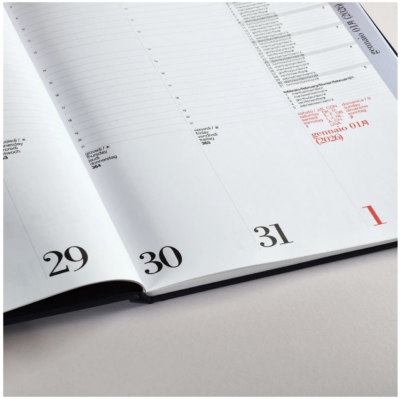
Nava Designs still exists, and still makes a similar diary — at least I think it is an equivalent model, as it says they have been making it since the 1970s. The construction looks different, though. And I can’t tell what size it is– I found a listing where weight is the only “dimension” specified. Even their Instagram doesn’t show the Day by Day diary with any context for sizing. Nava also makes a weekly diary where you can see that many of the design elements have remained similar over the years.
Nava weekly diary, 2025
My last entry in this diary was on Dec. 8, 1992. In those days, before internet shopping, retail stores were insanely busy between Thanksgiving and Christmas, so I probably didn’t have time to write anything down. The following year, I would have been using my first pocket Filofax, so I probably kept my calendar and lists in there– but if I did, I must have gotten rid of the calendar. My archived Filofax calendar inserts start in 1995, so there’s a two year gap. The Nava Memoria 1992 seems to be the last bound, dated diary I used before moving to Filofax calendars, then Palm Pilots, then trying a couple of Moleskine diaries in the early 2000s, and finally my adoption of the Nolty diary in 2018. Today, I’m not sure I’d buy the Nava diary as I’ve found I prefer the smaller 3.5 x 5.5″ format, but if the quality and design were the same as the 1992 model, I’d be seriously tempted.
Another reader has gotten in touch with a burning question, something I hadn’t really thought about much. Stephen asks:
What are the optimal use cases for a notepad, as opposed to a notebook?
I use Rhodia A4 and A5 Bloc pads all the time at my desk, ruled with that great ivory FP-friendly paper; and the square No. 210 is my scribbling, calculating, equation-writing standby for pencil.
But the only two items I’ve found that could compete with smaller EDC notebooks, in particular that might merit investing in leather covers, are the Rhodia No. 14 pads (5 x 5 grid, 170 x 110mm) and the lovely Quattro grid/lined/plain “hand●book journals” (5.5 x 3.5”). The latter are printed only on the front side, which subtly highlights my question….
Are there reasons why you might want to carry what would effectively be a one-side-only “notebook,” i.e., a top-stapled/-glued notepad? The classic example is the spiral-bound reporter’s notepad, where speed of transcription is presumably the prime consideration. The other instance, which I have tried a few times myself, is the “disposable to-do list,” finish all the items on a page, then tear it off and throw it away. But beyond that? No ideas.
You seem the obvious person to ask, especially after I used your site’s search function and got 837 hits on “notepad.” Wow!
Thoughts? I’m prepared to be suitably humbled when you rattle off a list of things that you use them for all the time.
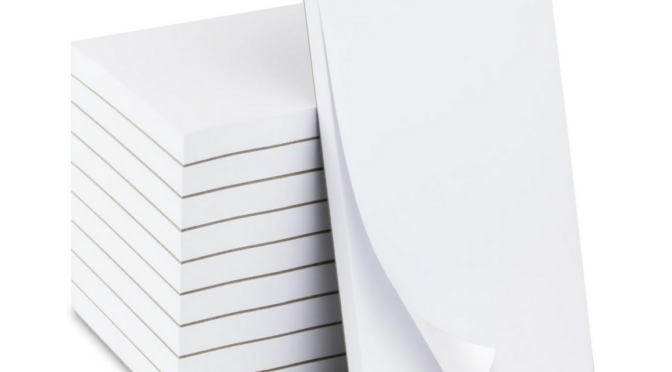
This did get me thinking. “Do I ever use notePADS?” The answer is pretty much no, if we’re talking about the format this reader is describing. (I’m going to disagree with Stephen slightly and define a notepad as a stapled or glued pad of paper designed to be torn off along the top edge. I personally consider a reporter’s notebook a top-opening noteBOOK, not a notePAD.)
I also wondered “837 hits? What notePADs have I even reviewed?” I had to use the site’s search function myself to check. I have reviewed a few that were sent as free samples (such as this Rhodia notepad and some from Resketch), and I have some in my collection of childhood notebooks (such as this one), and I even bought a notepad (in 2014) because it was cute and super cheap, though I think I ended up giving it away.
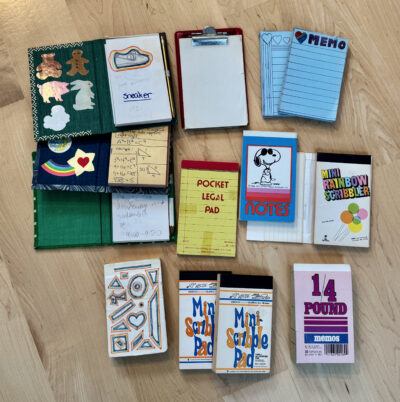
Notepads from my childhood, late 1970s to early 1980s.
But what about the potential uses for this format? I do always have a notebook on my desk that serves a notepad-ish purpose. Since it’s a wirebound notebook, I end up using both sides of the page, but it’s used for disposable jottings and doodles, things that I don’t need to save in the Filofax where I keep more important work notes. When I worked in an office, I always had a paper blotter on my desk that served a similar purpose. So I do think there is a value to having a notepad that lives in a certain spot, for those times you just need to jot something down, or might want to mindlessly doodle. In the house where I grew up, there was always some kind of notepad next to the landline phone in the kitchen, and next to the other landline phone in my parents’ bedroom. It’s not like you’d be calling directory assistance and having to write down a phone number from anywhere else in the house!
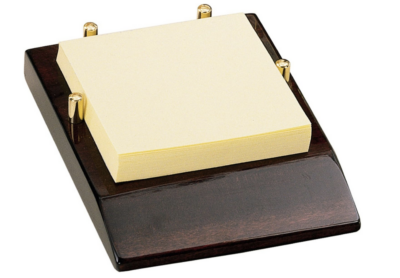
The location-based usage of a notepad also makes me think that they often work best with some kind of base that holds them in place, making it easy to jot things down one-handed without fumbling. I know I’ve been given little gift sets where there are square notepads in some sort of base with space for a little pencil– I’m not sure these are substantial enough to really work. You want something that won’t slide around while you write, and won’t go flying if you try to tear the top page off without holding the rest of the pad down. Nowadays this sort of thing seems to be made more for sticky notes than notepads, but here’s a couple that might be similar to what I’m thinking of:
Other uses for notepads: playing games like Boggle or Pictionary or Scrabble, where you have to write or draw something or keep score. I can’t remember if those games come with some little notepads of their own, but if you play enough, they’ll run out. The last time I played Scrabble, there was no notepad near by, but I was able to save the day since I had a sketchbook in my pocket. But it’s a bit of a waste to use a nice notebook or sketchbook for writing down Scrabble scores. And I certainly wouldn’t have wanted to tear out a page for each player in a game of Boggle. (Topic for another post: have you ever been overly protective of your precious notebook when other people just wanted a piece of paper and didn’t get what the big deal was?) Rhodia’s tear-off pads are not as cheap as they used to be, but are still inexpensive enough that I wouldn’t be bothered using them for games, even if the paper seems nicer than you really need. Back in the day, it seemed like there were always cheap, plain, glue-bound 3×5″ notepads around the house that could be used for this purpose– these, to me, are the classic definition of a “notepad.”
Reminders and shopping lists have always been a typical use for this kind of notepad, particularly when you are going to hand them off as a to-do item for someone else. My mom usually has one on her kitchen counter, the top page of which is usually a grocery list she wants me to go out and get as soon as I’ve arrived for a visit. But she also uses sticky notes nowadays. Sticky notes didn’t even exist when I was a kid. When Romy and Michelle invented Post-Its, did they inadvertently kill the notepad? Sticky notes have taken over as a very popular and practical form for the traditional uses of notepads, and they ensure that handed-off notes won’t blow away or get lost as easily.
Notepads can also be handed off to a child who needs to be kept entertained. Most of us don’t want a toddler’s sticky hands tearing at our expensive notebooks, but you can hand them a cheap notepad and a crayon to draw with and they’ll be perfectly happy.
The other things that come to mind are formatted notepads with a specific purpose, like a doctor’s prescription pad, or a scorepad for mini-golf. Maybe real golfers use scorepads too? Or perhaps that’s all going phone-based…. I seem to recall ordering lunch at a place where you had to tear off a notepad sheet and check boxes for what you wanted in your sandwich or salad, but that’s also probably going electronic.
So to sum up, notepads are for:
A place where you need disposable scratch paper at hand
Notes you don’t need to archive, like shopping lists, quick reminders, calculations, doodles
Games where you need to write down words, or draw, or keep score
Notes you want to hand off to another person
Children who want to write or draw
Formatted sheets like prescriptions, scoring sheets, order forms, etc.
Otherwise, I’m running out of ideas. I’m definitely more of a notebook person than a notepad person. To me a notepad seems pretty limited, and pretty much anything it does can be done by various types of notebooks. There’s a reason this blog isn’t called Notepad Stories! But I appreciate the question, and the chance to spend more time thinking about another classic paper note-taking tool.
This post contains affiliate links from which I may earn a small commission.
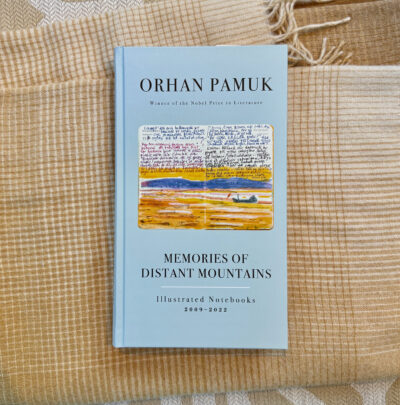
Orhan Pamuk’s Memories of Distant Mountains was published last year. I bought a copy right away but it’s taken me a while to review it!
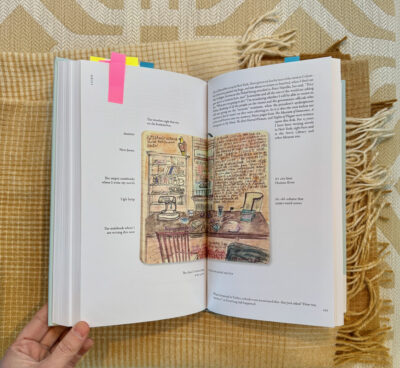
I wrote about Pamuk once before, quoting a passage from one of his books where he talks about his grandmother keeping notebooks that she wrote in every day. He must have picked up a version of that habit himself, as Memories of Distant Mountains is full of spreads from Pamuk’s own illustrated journals kept between 2009 and 2022.
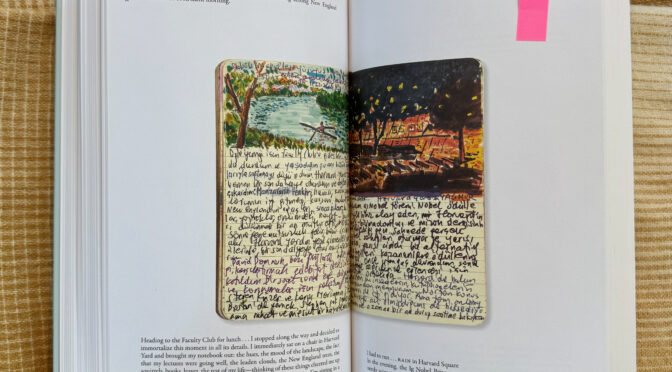
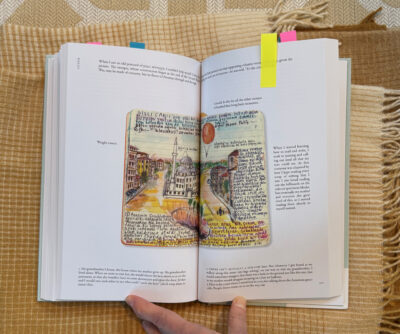
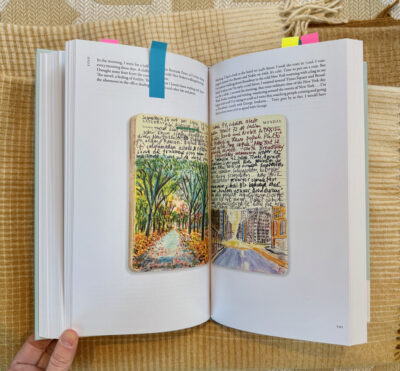
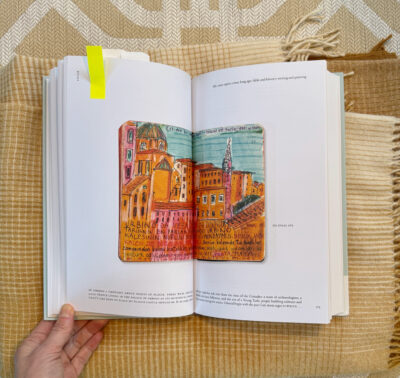
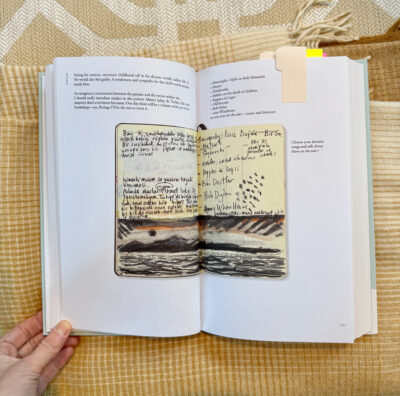
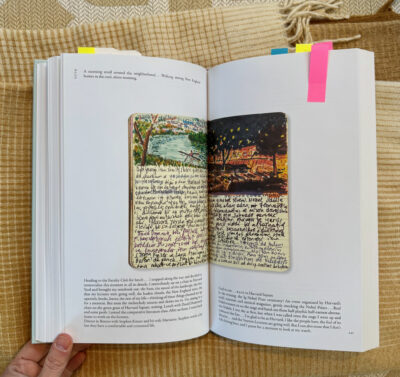
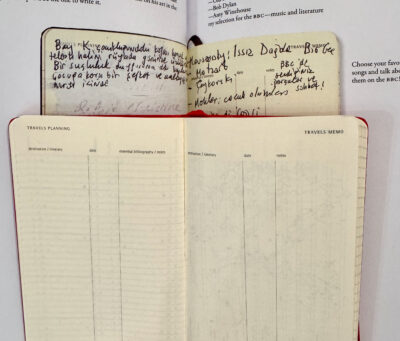
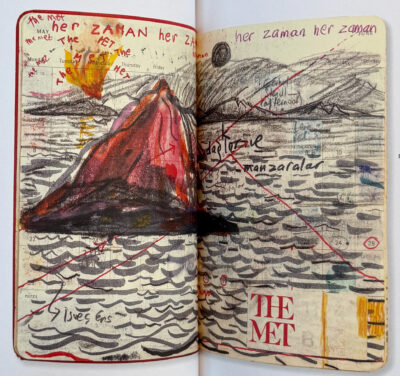
The pages are very densely packed with writing and drawing– scribbled words in what looks like ballpoint pen and markers, sketches in markers and perhaps crayon or colored pencil and watercolor. The images seem to be views of various places in Istanbul and from Pamuk’s travels, or perhaps imagined images and doodles in some cases. The pages are presented as actual-size spreads, more or less– some slightly larger, some slightly smaller, as far as I can tell. I think this is to accommodate varying amounts of translated text around the images (where all the writing is in Turkish).
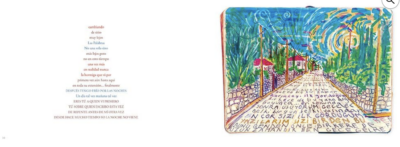
The way the notebook spreads are aligned with the book page spread allows for nice flexibility in how the translated text is arranged, but it’s a bit unfortunate to have some of the art right in the gutter between the pages, as the binding doesn’t open completely flat. I prefer the way the Spanish edition is laid out, in a landscape format book with the translation on the left hand page, and the notebook spread on the right.
The texts are a mix of jotted phrases and words, almost like poetry, on some pages, and what sound like more traditional journal entries on other pages. Sometimes the text seems to relate to the image, but elsewhere Pamuk may just be pairing a sketch of where he happens to be while he’s writing.
The notebooks themselves are all Moleskine planners. Most of the pages shown are from page-per-day diaries, but some have other formats. I think they are all pocket size, which seems to be confirmed by a couple of videos (here and here) where Pamuk pulls his current diary out of his pocket. Looking at my own Moleskine diaries, the daily spreads match my 2001 daily planner except that they started capitalizing the month names at some point, and I found an example of the travel notes spread in a weekly Moleskine diary I used in 2009.
Comparison to 2001 Moleskine Daily Planner from my collectionComparison to 2009 Moleskine Weekly Planner from my collection
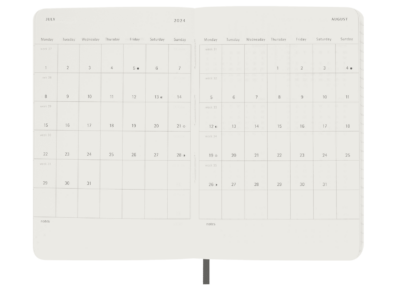
I had not seen a pocket Moleskine diary with the kind of month-on-one-page layout that appears in the book. I found an example of it in a 2010 post from Plannerisms, but that was in a large Moleskine diary. It seemed like the boxes would be too small to be useful on a pocket size page, so I thought Pamuk might occasionally use a large diary too, but Moleskine’s own site does show an image of a month-per-page spread in a listing for a 2024 pocket size planner.
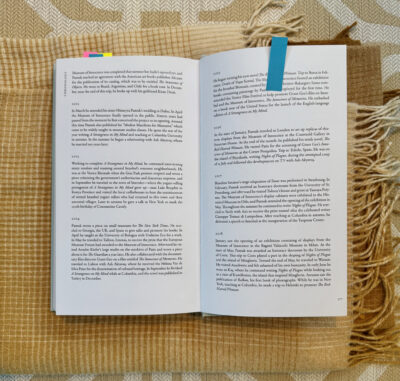
Aside from my notebook fascination, it’s hard to know how to approach this book. Some of the art is really stunning, and it’s wonderful just to flip through for visual inspiration, but I haven’t tried to read through very much of the text in order. “In order” is a strange concept here, as the dates of the pages skip back and forth in time. On some of the illustrated spreads you can barely see the day and date, but all pages of the book are annotated in the upper left corner with a year and sometimes a letter, as Pamuk kept multiple notebooks in some years. A “Chronology” at the end of the book gives broad strokes about what Pamuk was doing during the years he was keeping these journals but there’s no foreword or afterword or any other explanatory texts about the book as a whole.
Diaries and notebooks from writers (and others with a gift for language) matter because they’re forums for observations on manners and morals and art and food and sex and politics; they track another human being’s impulses, appetites and philosophies. They’re a groovy back door into a mind.
Pamuk’s notebooks lead us to such a door, then ask us to remain outside….
His wife warned him not to publish “anything too personal” in this book, and he has succeeded all too well. Sometimes the prose is gnomic: “If you follow the river you will reach the valley where words and images are one,” he writes. Duly noted. At many other times, he displays a tiresome sort of mock innocence. At a reading: “Lots of people! A large, jam-packed hall!”
The review is a bit harsh– it doesn’t have much to say about the art, and is mainly concerned with the bland and cryptic nature of the text. I guess if you are really a big fan of Pamuk’s writing and want to learn more about him, this book may not be the kind of rich source material you’d desire. I’ve read a couple of Pamuk’s books and enjoyed them, but don’t feel the need to delve into his psyche that deeply, so I can enjoy the book as an inspiring example of dense, colorful visual journaling by a very talented artist (Pamuk wanted to be a painter before turning to writing novels).
I’d like Memories of Distant Mountains even more if the text was full of more interesting storytelling about the author’s life, or more observations about the places he’s sketching. But if the text is sometimes a little obscure or banal, maybe that’s comforting in a way: I think anyone who’s ever kept a journal has probably questioned the point of recording boring, random things about their life. We wonder if our activities and ideas and feelings are really worth memorializing on paper. We cringe at the idea of anyone reading our inner-most thoughts. Well, here’s a book that shows that even a Nobel Prize-winning author isn’t filling his diaries with super-deep insights 100% of the time. The pressure’s off.
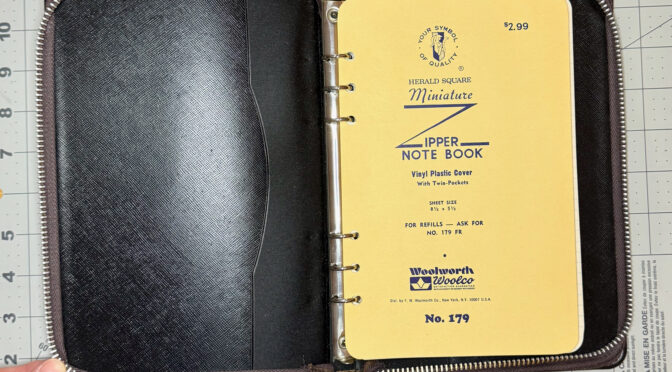
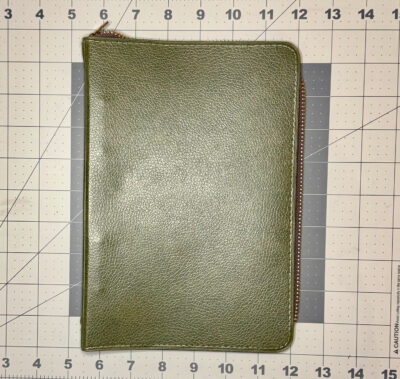
This notebook was a fun eBay find– so retro, with a kind of sexy-ugly vibe. Often I see things like this and just admire them without buying, but for some reason, I had to have this one, even though lots of things about it don’t fit my usual notebook preferences.
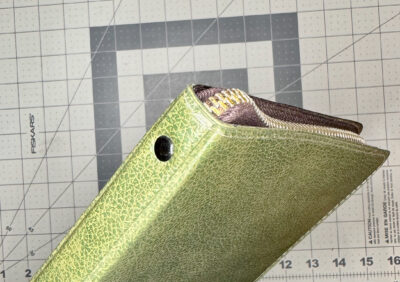
The size is about 6-1/2 x 9-1/2 x 7/8″– I guess the closest thing you’d find today might be a Filofax A5 size organizer, but I think the Woolworth notebook is narrower. It’s made of a faux-leather textured vinyl with a mottled green color to it. It’s a very old-fashioned green– I feel like I knew someone with car seats made of this material in the 1970s.
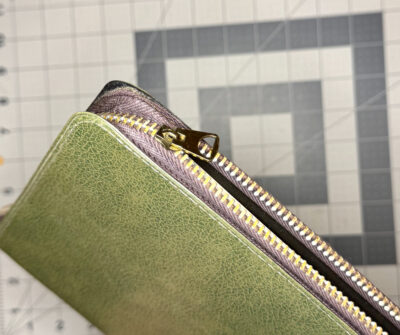
The edges zip closed with a rather chunky zipper, which is sewn on with brown edging.
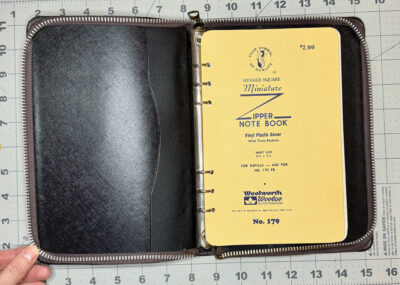
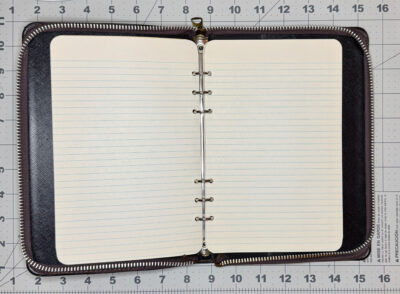
Inside, the lining is a black vinyl with a different texture. There is a sort of pocket on each side– oddly, the pockets are quite shallow and open outward. I guess they figured they didn’t have to hold things in very securely since the notebook would be zipped closed.
The rings are attached to the cover with a rivet that goes all the way through, so you can’t open the rings up and adjust them if they have gaps– which they sort of do, slightly. The ring spacing does match other A5 notebooks and Filofaxes.
The paper that’s included is obviously what originally came with it, as it has a cover sheet with all the information about the cover itself. I’m not sure why they call it a “Miniature” Zipper Book, as “miniature” would suggest something much smaller to me. The 5-1/2 x 8-1/2″ paper is close to Filofax and other A5 notebook paper sizing– theirs are 5-7/8 x 8-1/4″, so they’d be a little too wide to fit this binder. You can still get basic 5-1/2 x 8-1/2″ looseleaf paper, but the ones I saw seem to have different hole punch layouts, for either 3 or 7 rings. So if I end up using this actively, I may have to either trim 6-ring A5 sheets, or punch different holes in the right size paper!
This notebook was priced at $2.99 according to the cover sheet– but the question is when? I would guess maybe the mid-1960s– it feels very 1950s somehow but the Woolworths company address has a 5-digit zip code and those weren’t used until 1963. The notebook doesn’t say where it was made, but I would guess it was in the USA.
This Woolworth notebook is an odd but pleasing part of my collection– I never realized I had such a soft spot for pleather in baby poop green, but this notebook definitely brought it out!
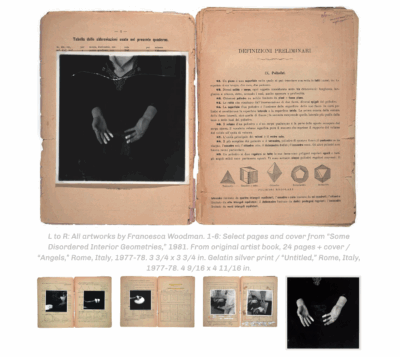
I sometimes shudder at the idea of old notebooks being altered in any way, but I came across a book that captures what I think is an interesting and beautiful use of old books and journals. Photographer Francesca Woodman bought various old books, notebooks and exercise books at flea markets in Italy in the 1970s. She then used them to create her own artist’s books by adding her photographs and annotations. These works are collected in The Artist’s Books, published by Mack in 2023. Looks like a beautifully produced book. The publisher is sold out, and 2nd hand copies get pricey.
The publisher’s website doesn’t show much of the content, but at the Woodman Foundation website, there are some more detailed images of one of the works that is included, called Some Disordered Interior Geometries:
Sadly, Woodman died shortly after that work was created. You can read more about her life and work here.
I forget how I came across this Leitz notebook on Amazon— I might have seen the brand mentioned somewhere else, or maybe it was just some algorithmic recommendation. Whatever it was, it intrigued me enough to spend $19.30 plus tax to try one out!
This notebook is made in China but Leitz is a German company, a division of the global conglomerate Acco Brands. (Mead, FiveStar, Derwent, At-A-Glance, DayTimer, Esselte, and Hilroy are a few of their other stationery-related brands.) Based on the languages and addresses listed on the packaging, the Leitz brand seems to be distributed mostly in eastern Europe and Russia.
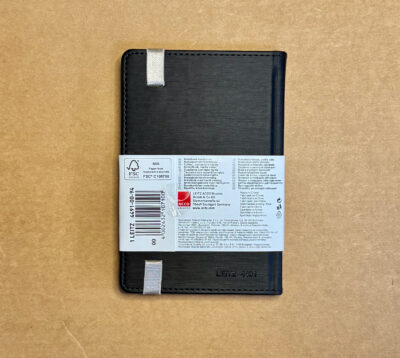
The Leitz notebook has a very business-y, serious look to the packaging. It comes shrinkwrapped, with a paper wrapper underneath.
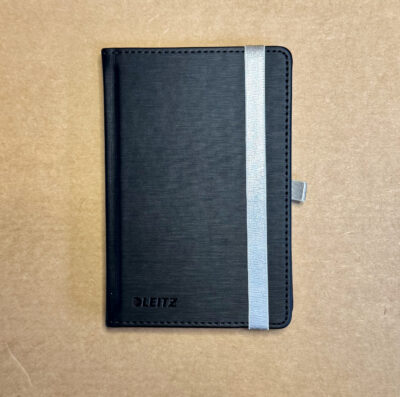
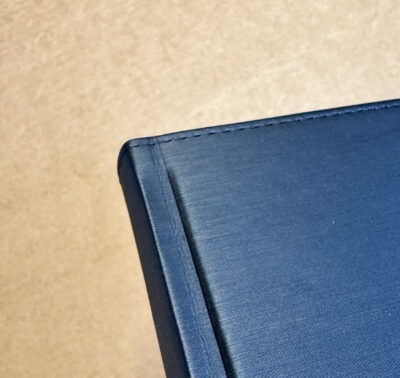
Once I got past the packaging, I immediately noticed the feel of the cover material– it is a slightly shiny cloth, probably nylon, as it feels like the kind of fabric that might be a lining in clothes, or used for an umbrella. It’s odd, but I don’t mind it, or the stitching around the edges. The cover is also unusual in that it has thick boards that don’t extend all the way to the spine.
There’s a debossed Leitz brand logo on the front, and a plainer name and model number on the back. The back also has a plastic rivet that holds the pen loop on, something I don’t recall seeing elsewhere. If you don’t like pen loops, it’s probably going to be hard to remove– I haven’t tried yet. A wide elastic holds it snugly closed. The notebook has a bit too much overhang for my taste but not the worst I’ve seen. The size is said to be A6, but it measures about 96 x 141mm, or about 5-9/16 x 3-3/4″. It’s a little wider than a Moleskine but smaller than true A6.
Leitz notebook vs. pocket MoleskineLeitz notebook compared to pocket Moleskine
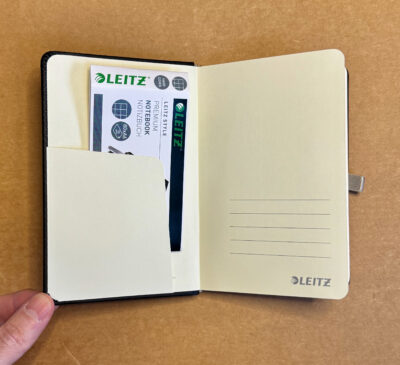
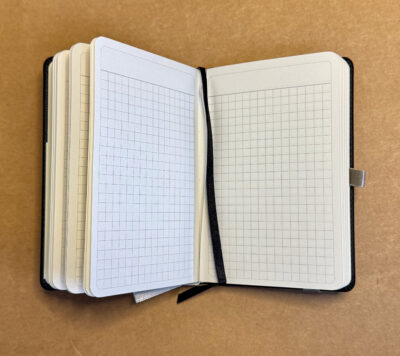
The Leitz notebook has a little paper pocket in the front cover, and space to write your details. Some other features are two ribbon markers, and at the back of the notebook, 8 plain, perforated pages. The stitched binding is flexible enough that it opens quite flat, but it won’t lie totally flat on its own, at least not when new.
The inside back cover has a metric ruler, gusseted paper pocket, and whoa, silver metallic sticky notes?? That was a cool surprise but they are very slippery so you can’t write on them with most pens– a Uni oil-based marking pen will work, but otherwise I think these are meant to just be page markers.
The page format is not typical for this type of notebook: squares with a header and border all around. I’ve only seen this layout in some Japanese notebooks and planners.
The paper in the Leitz notebook is 100 gsm. It’s not super smooth– it has a pleasant amount of feedback and feels good to write on with all pens. Its performance is better than average on show-through and I only got a few spots of bleeding with the wettest pens. Most fountain pens did great, so I’ll call this fountain pen friendly.
I don’t think I’d go out of my way to buy another one of these, especially given the cost for US delivery, which is now even higher due to tariffs. But for notebook users in Europe where the price is around 11 euros, the Leitz notebook is a solid option with good quality construction, nice paper, and some extra features that distinguish it from its competitors. You can find these on Amazon, where lined versions and other sizes are available.
Notebooks, journals, sketchbooks, diaries: in search of the perfect page…