TL;DR
- Agentic analytics is the use of AI agents to analyze data and act on it. Gartner names five mandatory capabilities: data source connectivity, natural language query, automated insights, agent workflow orchestration, and data preparation. Two more decide whether the output gets used: building the dashboards and metrics a team works from, and business context, so the agent knows which changes matter.
- The capabilities are easy to demo and hard to run reliably. Reliability depends on what sits under the agent. This page breaks that into five layers: connected data, governed metrics, business context, analytical intelligence, and the agent itself. Each layer prevents a specific failure. Skip one and the agent gives confident answers that disagree with each other.
- The market’s default AI analytics workflow is a spreadsheet pasted into a chat tool. In Databox’s “Using AI You Don’t Trust” survey, 86% of business users reach for a general AI tool first, 66% feed it by paste or upload, and 74% have shipped a decision on an AI number that turned out wrong.
- Six questions tell you whether a platform runs the cycle or hands you an answer. They apply to every platform, including Databox.
Agentic analytics, defined
Agentic analytics is the use of AI agents to analyze data and act on it, carrying out analytical tasks semiautonomously or autonomously toward a goal. To do that reliably, the agents need connected data, governed metric definitions, and business context underneath them.
Analytics has always had two jobs.
- Understand what happened.
- Decide what to do about it.
Reporting tools took over the first job. The second job stayed manual. Someone reads the dashboard, remembers what the team changed last quarter, works out why the number moved, and decides. Next month they do it again.
The word “agentic” names a system that takes on the second job too. An agent is defined by what it does after it has information. It keeps watching. It carries forward what it learned. It acts, or hands a person a specific action to approve. The value moves from the answer to the cycle: understand, act, measure the impact, learn.
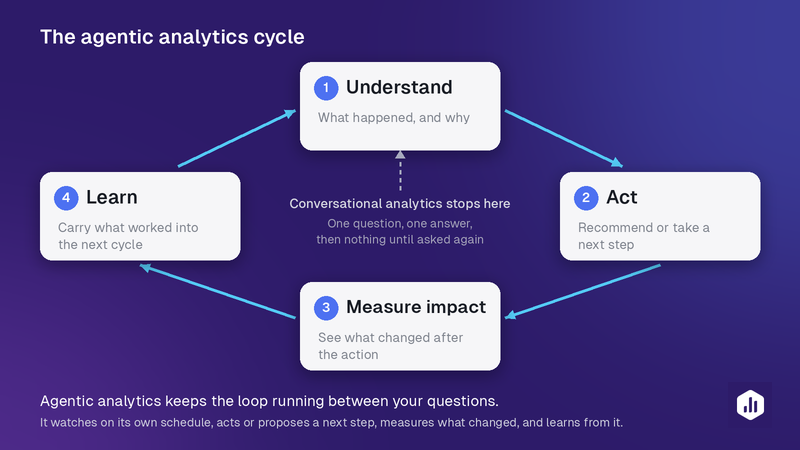
What one turn of the cycle looks like. On Monday morning, cost per lead across paid channels is up 30% on the week. Nobody has opened a dashboard yet. The agent flags the jump, traces most of it to one campaign whose audience settings changed on Thursday, and checks the effect against the quarter’s lead target. It drafts a note for the account lead with the cause, the risk to the target, and a recommendation to revert the audience. The account lead edits one line and sends it. The next Monday, the agent reports whether cost per lead came back down, and keeps the audience change on record as a known cause.
Gartner’s Market Guide for Agentic Analytics names five mandatory capabilities for the category.
| Capability | What it does |
|---|---|
| Data source connectivity | Connects structured and unstructured sources and produces outputs in several formats |
| Natural language query | Lets people ask questions of the data in typed or spoken language |
| Automated insights | Uses machine learning to surface insights without being asked |
| Agent workflow orchestration | Manages analytical tasks semiautonomously or autonomously toward a stated goal |
| Data preparation | Combines sources into analytics models with user-defined measures, sets, groups, and hierarchies, while agents find quality issues and suggest joins |
In terms of the cycle, Gartner’s list covers understanding and the start of acting: getting to an insight, and running analytical tasks toward a goal. Two more capabilities decide whether that insight gets used, and this page treats both as essential.
Building. The agent creates the dashboards, reports, and metrics the team works from. Without it, the agent’s work lives in a chat thread and has to be rebuilt by hand before anyone else can use it.
Business context. The agent knows the goals, targets, and past decisions behind the numbers, so it can tell which changes matter. Without it, a person supplies that half of every explanation. What it takes to hold that context is layer 3 below.
The term is recent. It spread through analyst coverage and vendor positioning in 2025, and Gartner now lists agentic analytics as a market category. Definitions vary with what the vendor sells. Warehouse-native vendors assume a modelled warehouse underneath. Others connect to business apps directly. Both are routes to the same foundation.
What it takes to run agentic analytics reliably
The capabilities describe what an agentic product does. They say nothing about whether it does them correctly. An agent is only as reliable as the data, definitions, and context it works from. We break what that takes into five layers, in the order a team builds them. Other vendors cut the stack differently. The failure each layer prevents holds whichever way you cut it, and it matters more than the labels.
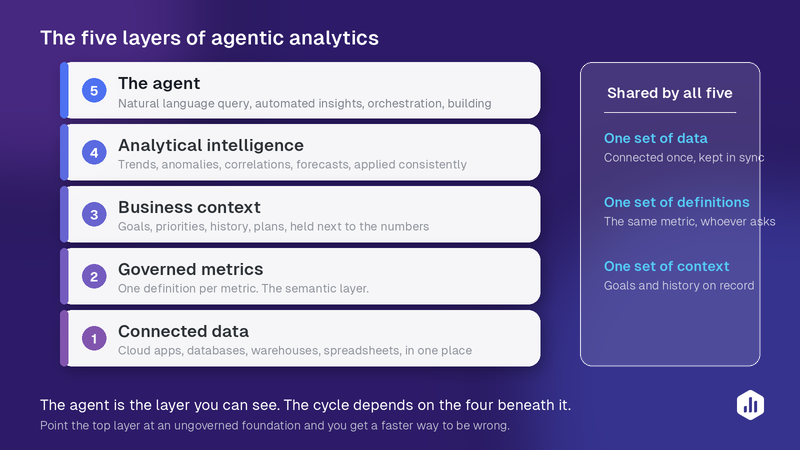
1. Connected data. Cloud apps, databases, warehouses, spreadsheets, and custom sources in one place. Authentication, API limits, and schema changes are handled once. Without this layer, every cycle starts with an export. The agent’s knowledge of the business ends at the last paste.
2. Governed metrics. One definition for every metric: what it counts, over which dimensions, and how it relates to other metrics. Prebuilt where the industry agrees. Custom where your business differs. The same definition whether a person or an AI asks. This is the semantic layer. It is the layer most often skipped, because it is invisible when it works. Without it, two people asking the same question get two answers, and the AI cannot know which one the team signed off on.
3. Business context. Goals, priorities, history, constraints, plans, and documents, held next to the numbers. Without this layer, every explanation is technically correct and practically useless. A person supplies the missing half each time.
4. Analytical intelligence. Comparison periods, trends, anomalies, correlations, forecasts, and models, applied the same way every time. Without it, the AI improvises a method for each question. The method changes with the phrasing.
5. The agent. Natural language query, automated insights, and agent workflow orchestration, plus building the dashboards and reports the team works from. Plus a way for external AI tools, such as Claude or ChatGPT, to work from the same foundation, usually through MCP. This is the layer with “agentic” in the name. It comes last because it inherits every gap below it. Point it at ungoverned data and you get a faster way to be wrong.
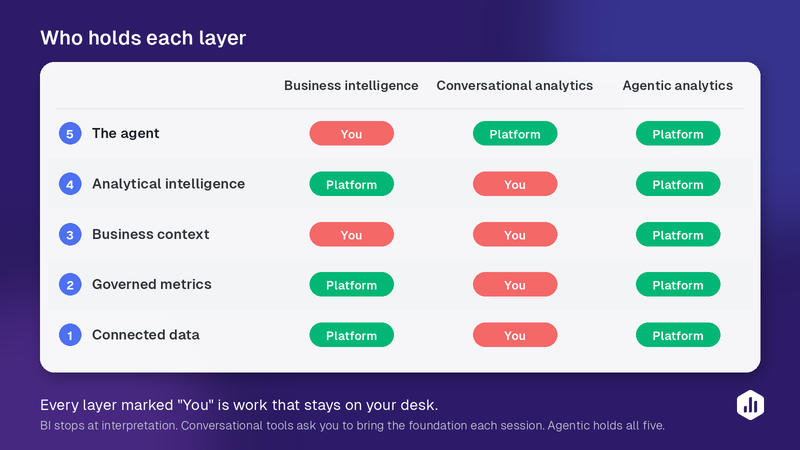
Most platforms started from one end of this stack. BI tools started from data and metrics. Chat tools started from the agent. Reliable agentic analytics needs all five, sharing one set of data, definitions, and context. Otherwise, the agent reasons about a different business from the one you run.
How agentic analytics differs from BI and conversational analytics
Both neighbouring categories are real, and both do a job. Neither runs the cycle. They stop at different points.
Business intelligence built three of the layers well. Connected data, governed metrics, and consistent analytical methods, shown as dashboards. It did the first job of analytics at scale. Interpretation, context, and the next step stayed with people. AI added to a BI tool usually summarises what the dashboard already shows. The cycle still waits for a person to read the summary and decide.
Conversational analytics, or chat-on-your-data, starts from the other end. It has the conversational capability and asks the user to supply the foundation each session. The user exports the data, explains what the metric means, adds the context, and asks. The reply can be accurate and well written. The next session starts from zero. The system holds nothing, monitors nothing, and produces nothing until asked.
Agentic analytics adds automated insights and agent workflow orchestration, and holds the foundation between sessions. The difference has little to do with how capable the model is. It comes from what surrounds the model.
Four related terms get used interchangeably with agentic analytics. They are close.
- Agentic BI is the same idea, used by warehouse-native vendors. It assumes the data is already modelled in a warehouse.
- Augmented analytics was Gartner’s earlier term for AI assisting a human analyst. The human stays the actor. Agentic analytics moves the recurring work to the system.
- Decision intelligence is the practice of designing and improving decisions, with or without AI. Agentic analytics is one way to run the analytical half of it.
- AI analyst is a product name more than a category. It usually means the conversational component of an agentic platform. Whether the rest of the cycle exists behind it is the question this page is about.
What agentic analytics is not
Four things get sold under the label. None of them run the cycle.
A dashboard with a chatbot. Adding a chat window to a reporting tool adds an interface. It does not add memory, monitoring, or a next step. If the chat forgets everything when the session ends, the tool is conversational.
A spreadsheet in ChatGPT. This is the market’s default AI analytics workflow. Databox’s survey “Using AI You Don’t Trust: How Business Users Actually Run Analytics in 2026” covered more than 100 business users. 86% reach for ChatGPT, Claude, Gemini, or Copilot before any other tool for analytical work. 66% feed the AI by paste, upload, or one tool at a time. 9% have a unified data layer their AI can query. 74% have shipped a decision or report based on an AI number that turned out wrong. The person is doing four layers of work so a model can do one. Verifying by asking again does not fix that. The missing layers are structural.
Scheduled reports. Automation runs the same query on a timer. It does not explain what changed, carry context forward, or propose a next step. Scheduled reports are useful. They are the first job, delivered on time.
Autonomy without oversight. An agent that sends, posts, or changes something with no review step turns a wrong number into a wrong action. Autonomy is a degree the team sets. Outputs arrive as drafts to edit. Anything that runs unattended has a scope that is set deliberately and can be narrowed. A platform that skips this has removed the safeguard, and called it a feature.
What agentic analytics can and cannot do
The use cases follow from the cycle. Each one depends on specific layers. A platform missing those layers cannot deliver that use case, whatever the demo shows.
Recurring analysis across accounts or units. The same method, run weekly across every client account or business unit, with metrics and context specific to each. In an agency, this is the work a senior person does by hand for every client, and it does not scale. The managing director of Hero Factory, an agency and Databox customer, on what changes when the system carries the recurring part: “We already know the situation throughout the month, and we just put a cherry on top and focus on the next steps from the report.” (Customer testimonial, February 2025.) The report stopped being the work. The next step became the work.
Change detection and explanation. A performance metric is watched for anomalies and meaningful movement. When it moves, a first explanation is attached. The alternative is a person checking every morning.
Period-over-period explanation for reporting. “What happened this month and why” becomes a draft a person edits. The review step stays. The assembly does not. A senior digital marketing analyst at Tremco, a Databox customer, who prepares written insights for senior directors: “With just a few clicks, I get a clear, easy-to-read summary of my performance. It saves me 3 to 4 hours of work every time.” (Customer testimonial, March 2025.)
Analysis inside other AI tools. Ask about performance from Claude, ChatGPT, or an automation platform and get the governed number with its context, through MCP. This replaces downloading a spreadsheet and uploading it to a chat tool, then finding the tool worked from a fraction of the data it claimed to have read.
The limits are as clear as the uses.
- It cannot fix a missing foundation. If the data, definitions, or context live outside the system, the agent reasons from whatever it was given.
- It cannot make ungoverned metrics agree. If “revenue” means three things in the company, the AI will pick one.
- It closes the loop only as far as the data reaches. It can report whether a metric moved after an action. A person still judges whether the action caused the change, especially when several things changed at once.
- Agents that carry out tasks on their own are early across the category. Expect oversight to be part of the design, and treat a vendor who promises otherwise with care.
Who agentic analytics is for
Agentic analytics fits any team with recurring analytical work: the same questions asked every week or month, about metrics someone owns and has to explain. That covers a wide range. Enterprise data teams run agents over a modelled warehouse. Business teams without data engineers use platforms that connect to their apps directly. Agencies run the same analysis across client accounts.
Who agentic analytics is not for
The category is built for repetition, governed numbers, and actions a person can review. It fits poorly where any of those are missing.
- Teams doing mostly one-off, exploratory analysis. A research question asked once, or a data science model built from scratch, gains little from a system designed to run the same method every week. A notebook or an analyst is the better tool.
- Teams whose core metrics are not agreed yet. An agent gives fast answers to contested questions. If “revenue” or “qualified lead” still means different things to different people, the governance work comes first.
- Teams with little data and few recurring decisions. One or two sources and a monthly check-in are served well by a dashboard. The foundation takes effort to set up, and it pays back through repeated use.
- Regulated or audit-grade reporting. Financial close, statutory filings, and compliance reports need fixed, auditable logic. AI can draft commentary around them, but the numbers should come from a controlled process.
- Real-time operational decisions. Fraud checks, pricing, and inventory moves that run in milliseconds belong to operational systems and machine learning in production. Agentic analytics works at the pace of people reviewing its output.
The right platform depends on where the team’s data already lives and who will run it. The questions below apply either way.
How to evaluate an agentic analytics platform
The five layers, plus who gets to use them, become six questions. Ask them in any demo.
1. Where does the data live between sessions? If the honest answer involves an export, a paste, or reconnecting a source, the first layer is you.
2. Who defines a metric, and does the AI use that definition? Ask to see the definition of one metric your team argues about. Ask whether a person and the AI get the same number from it. Ask whether the calculation runs against the data or inside the model.
3. What does the system know about your business that nobody typed in this session? Goals, targets, past decisions, plans. If the answer is nothing, every explanation will be missing half of itself.
4. What did it tell you this week that you did not ask? Ask to see a routine that ran without a prompt.
5. What happens after the answer? A draft, a recommendation, a task, an edit before send. Ask which exist today and which are on the roadmap. A vendor who separates the two is telling you the truth. Then ask it to build a dashboard or a metric from a plain request, and look at what it creates.
6. Who has to be in the room to run it? Some platforms need a data engineer to model a warehouse first, or an analyst to translate. That works if the team has them. If it doesn’t, the person who owns the number will not be the one using the platform.
How Databox answers the six questions
Databox supplies all five layers on one foundation. It covers Gartner’s five capabilities, with agent workflow orchestration partly there. It also adds the two this page treats as essential: building dashboards and metrics, and business context. Here is how it answers the six questions.
| Question | Databox’s answer |
|---|---|
| Where does the data live between sessions? | In Databox. 130+ integrations, databases, warehouses, spreadsheets, and an API, connected once and kept in sync. |
| Who defines a metric, and does the AI use it? | Your team, in the semantic layer: 4,000+ prebuilt metrics plus custom ones. The AI Analyst uses the same definitions as dashboards, and calculations run against the data. |
| What does it know that nobody typed in? | Goals, targets, and past decisions, held in Goals and Genie memory. |
| What did it tell you unasked? | Routines and Smart Alerts flag what changed, on a schedule and as it happens. |
| What happens after the answer? | Drafts a person edits before anything goes out, and blended metrics built on one confirmation. Agents for defined tasks are coming soon. |
| Who has to be in the room? | The person who owns the number. Databox MCP brings the same numbers into Claude, ChatGPT, or n8n. |
The capabilities are what you see in a demo. Whether they hold up depends on the four layers you can’t see.
For a practitioner’s view of the cycle in operation, read 13 Agentic Analytics Workflows Running in Practice.
See how the five layers work together at databox.com/product.
FAQ
What is agentic analytics?
Agentic analytics is the use of AI agents to analyze data and act on it. Gartner lists five mandatory capabilities: data source connectivity, natural language query, automated insights, agent workflow orchestration, and data preparation. Two more decide whether the output gets used: building the dashboards and metrics a team works from, and business context. Doing all of this reliably depends on connected data and governed metric definitions underneath the agent. An interface alone does not make a platform agentic.
How is agentic analytics different from conversational analytics?
Conversational analytics answers a question in natural language. Agentic analytics does that and keeps working afterward, which is what Gartner’s automated insights and agent workflow orchestration describe. It holds the data, definitions, and context between sessions, monitors on its own schedule, and carries the analysis toward a draft, recommendation, or task. A conversational tool asks the user to supply the data and context each time. An agentic system holds them.
Is agentic analytics the same as agentic BI?
Nearly. Agentic BI is the term warehouse-native vendors use for the same cycle. It assumes data has already been modelled in a warehouse by a technical team. Agentic analytics covers the same cycle whether the connected-data layer is a warehouse or cloud apps connected directly.
Do you need a data warehouse for agentic analytics?
No. A warehouse is one way to build the connected-data layer, and it suits teams with data engineers. Teams whose data lives in cloud apps like HubSpot, GA4, or ad platforms can connect those sources directly, if the platform handles authentication, API limits, and schema changes for them and applies governed metric definitions on top. The requirement is a connected, governed foundation. A warehouse is one route to it.
Does agentic analytics replace dashboards?
It changes what dashboards are for. Dashboards remain the shared, governed view of performance and the place metrics get verified. In an agentic system, the AI works from the same definitions the dashboards use, and it can build new dashboards and metrics from a request. An answer in chat, a routine’s weekly summary, and the dashboard show the same number. The dashboard stops being the only interface. It stays the shared record.
Does agentic analytics replace analysts?
It changes the work. The recurring parts of analysis, such as pulling data, applying a known method, and explaining a change, get carried by the system. The analyst’s time moves to defining metrics, maintaining the semantic layer, deciding which methods run, and judging edge cases the system flags. Teams without an analyst get access to recurring analysis they could not afford before.
What does Databox mean by agentic analytics?
Databox uses the term the way the market does: AI agents that analyze data and act on it. Its view is that doing this reliably takes five layers on one foundation: connected data, governed metrics, business context, analytical intelligence, and the agent. In practice, Databox covers Gartner’s five capabilities, with agent workflow orchestration partly there, and adds building and business context. That means an AI Analyst that answers with reasoning and builds blended metrics on request, Data Prep for merging and cleaning datasets, Goals and Genie memory for business context, Routines that run analysis on a schedule, Artifacts a person edits before sending, and Databox MCP for using the same governed data in external AI tools. Agents that carry out defined tasks under oversight are coming soon.