
Face Features Analysis, Explained
Your face isn’t one measurement — it’s eight. Here’s a plain-language tour of every feature we analyze, what each one actually tells you, and where to go for the full breakdown.
“Face analysis” sounds like one thing, but it’s really a collection of separate, unrelated measurements bundled under one label. Your face shape is about the outline of your face. Your eye shape is about lid structure and corner angle. Your skin tone is about pigment and undertone, which has nothing to do with shape at all. Treating these as eight distinct questions, rather than one vague one, is what makes the answers actually useful — a hairstyle recommendation built for your face shape and a lip color built for your undertone are solving completely different problems, even though both start with a photo of your face.
Below is a short primer on each of the eight features we cover, written so a complete beginner can follow it, with enough real detail that it holds up even if you already know the basics. Each section links out to a full guide if you want to go deeper on that one specifically.
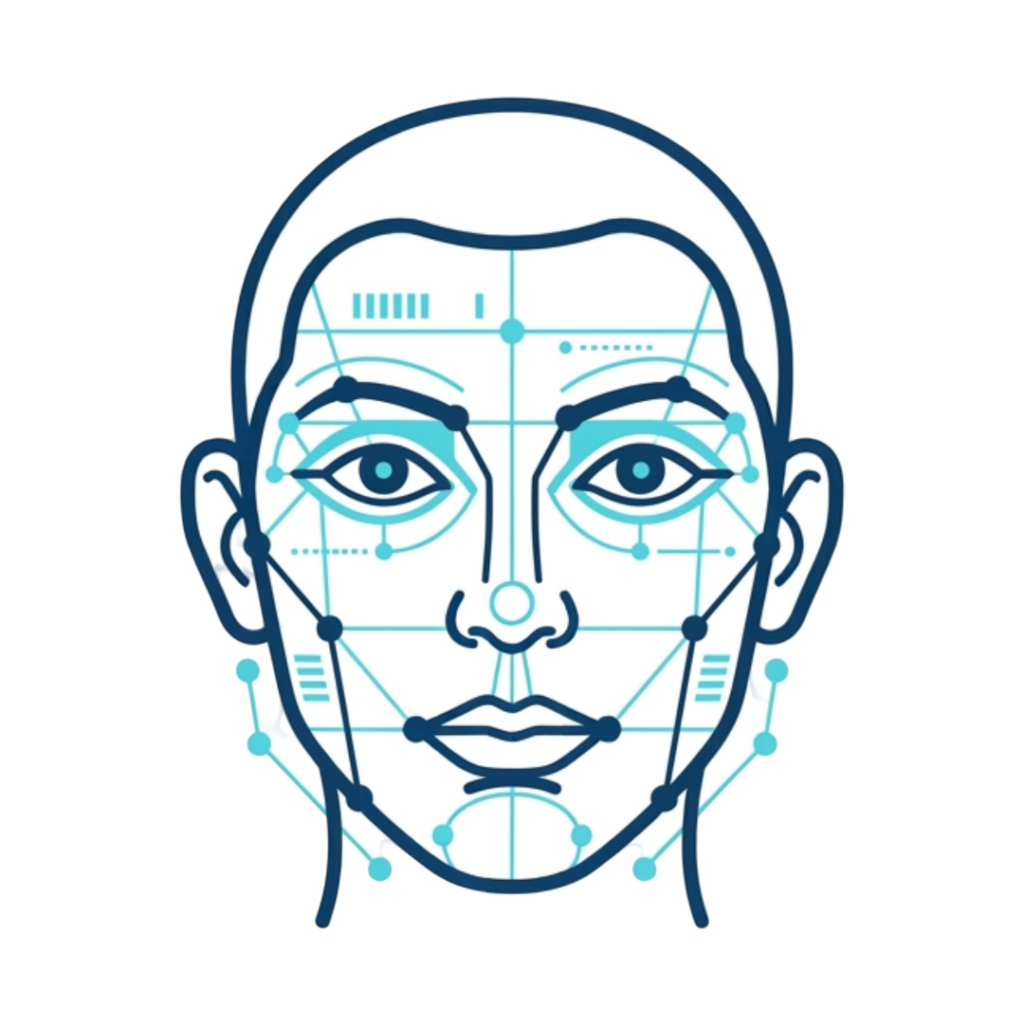
One thing worth knowing upfront: Not every feature below works the same way. Some, like face shape and eye shape, sort you into a fixed set of named categories. Others, like symmetry, give you a score rather than a label. And skin tone is really a spectrum with a few useful reference points, not a strict typology. We’ve noted which is which as we go, so you know what kind of answer to expect from each one.
Face Shape
Face shape is the outline of your face, determined by comparing four measurements: forehead width, cheekbone width, jaw width, and face length. The relationships between these — not any single number — sort every face into one of seven categories: oval, round, square, heart, diamond, oblong, or triangle.
This is the most established of all eight features. Stylists and opticians have used the same seven-category system for decades, and it has the strongest evidence behind it for two specific decisions: which glasses frames suit you, and where to put volume in a haircut. It’s worth knowing that a meaningful share of people — probably a fifth to a third — sit right on the boundary between two adjacent shapes rather than fitting neatly into one.
Eye Shape
Eye shape looks at three things independently: whether your crease is visible when your eyes are open, which direction your outer corner points, and how much white space (sclera) shows around your iris. Combine those and you get the commonly used core set — almond, round, hooded, monolid, upturned, and downturned — plus four more specific descriptors some sources add on top: deep-set, protruding, close-set, and wide-set.
Almond is often called the “default” or most versatile shape, mostly because it’s the visual middle ground the other shapes are described relative to. Most real eyes are a blend rather than a pure single type — round eyes with a slight downturn, for instance, are completely normal. Eye shape mainly matters for one thing: eyeliner and eyeshadow placement, where getting the shape right changes the technique significantly.
Face Symmetry
This is the one feature on this list that doesn’t sort you into a type — it gives you a score instead. Symmetry analysis draws an imaginary vertical line down the center of your face and measures how closely the left and right sides mirror each other across your eyes, eyebrows, nose, mouth, and jaw.
Here’s something worth knowing before you take the number too seriously: nobody’s face is perfectly symmetrical, and it isn’t supposed to be. Genuinely mirror-image faces actually look slightly uncanny in photos — a bit of natural asymmetry is completely normal and part of what makes a face read as real rather than artificial. A symmetry score is best treated as a fun data point, not a verdict on anything.
Color Analysis
Color analysis sorts your natural coloring — skin, hair, and eyes together — into a “season.” The classic version uses four: Spring, Summer, Autumn, and Winter. More detailed systems split each of those into three further sub-types, giving twelve seasons total, for people who want a more precise palette than the basic four allow.
This is different from skin tone analysis, even though people mix the two up constantly. Skin tone looks at your undertone alone. Color analysis looks at the combined effect of your skin, hair, and eye color together, and the output is a palette of flattering clothing and makeup colors rather than a single undertone label. If you’ve ever noticed that some colors just make you look tired while others make you look awake, this is the system explaining why.
Nose Shape
Nose shape is classified from a side profile, using three things: whether the bridge is straight, curved, or dips inward; whether the tip points up, down, or stays level; and how wide the base is relative to your eyes. That gives named categories like Greek (straight bridge), Roman or aquiline (curved bridge), button and snub (short, upturned), and Nubian (wider base, rounded tip), among others.
It’s worth being upfront that these are descriptive labels, not strict medical categories, and most real noses blend features from more than one type rather than matching one perfectly. Nose shape also varies more by individual and ancestry than most other features on this list — there’s no single “ideal” shape, just different common patterns.
Lip Shape
Lip shape compares the size of your top lip to your bottom lip, and the overall width and fullness of both. That produces seven common categories: full, thin, wide, heart-shaped (a defined cupid’s bow), round, top-heavy, and bottom-heavy.
This is the feature with the most direct, practical payoff of the eight — lip shape genuinely changes which lipstick and liner techniques work best. A top-heavy lip and a bottom-heavy lip need opposite liner strategies to look balanced, for example, so knowing which one you have turns a five-minute guessing game into a quick, confident routine.
Forehead Shape
Forehead shape is a little different from the others on this list, and it’s worth being straightforward about that. Unlike face shape or eye shape, there’s no single, widely agreed set of forehead categories — most guides describe foreheads with informal terms instead, like round, straight, curved, or M-shaped (a forehead with a slight peak at the hairline, sometimes called a widow’s peak).
In practice, forehead shape works best as a supporting detail rather than a standalone analysis — it’s one of the four measurements that already feeds into your face shape result, and it’s most useful when you’re deciding how to style bangs or a fringe. If you’re curious about your forehead specifically, your face shape result already captures the information that matters most.
Skin Tone
Skin tone analysis is about undertone — the subtle color beneath your skin’s surface — not how light or dark your skin is. There are four commonly used categories: warm (yellow or golden undertone), cool (pink or blue undertone), neutral (an even mix of both), and olive (a distinct green or grayish cast that can lean warm, cool, or neutral depending on the person).
A few quick, low-tech ways people check this at home: looking at whether your wrist veins appear more blue-purple (cool) or green (warm), and noticing whether gold or silver jewelry looks more flattering against your skin. Undertone is the single biggest factor in whether a foundation shade matches or looks slightly off, which is why it matters more for makeup shopping than almost anything else on this list.
How These Features Work Together
None of these eight features exist in isolation, even though it’s easiest to learn them one at a time. Your face shape and your forehead width are directly connected, since forehead width is literally one of the four inputs that determines your shape. Your color analysis season depends partly on your skin’s undertone, which is the same undertone your skin tone result measures — the two tools are answering related but genuinely different questions, which is why we keep them separate rather than merging them into one confusing result.
Eye shape, nose shape, and lip shape, on the other hand, are mostly independent of each other and of your overall face shape. It’s completely normal to have a round face with almond eyes and full lips — there’s no rule that says these features have to match or follow a theme. Symmetry sits apart from all of it, since it’s really measuring how consistent the left and right halves of whatever features you have are with each other, rather than describing any feature on its own.
The practical upshot: you don’t need to analyze all eight to get something useful. If you’re picking glasses, face shape and eye shape are the two that matter most. If you’re picking a foundation shade, skin tone alone will get you most of the way there. Start with whichever question you’re actually trying to answer, and treat the rest as optional extra context rather than a checklist you have to complete.
Frequently Asked Questions
What is face features analysis?
Face features analysis is the general term for using measurements from a photo of your face to identify things like your face shape, eye shape, symmetry score, and skin undertone. Instead of guessing in a mirror, software maps specific points on your face — the corners of your eyes, the width of your jaw, the curve of your cheekbones — and compares the distances between them. Each feature answers a different question: face shape and eye shape sort you into named categories, while symmetry and skin tone give you a score or a spectrum position instead of a fixed label.
How does AI face analysis actually work?
Modern face analysis tools use a technique called facial landmark detection, which places dozens to hundreds of reference points across a photographed face — around the eyes, nose, mouth, jaw, and hairline. Once those points are mapped, the software calculates ratios between them, like the distance across your cheekbones compared to your jaw, or the angle of your eye’s outer corner. Those ratios are then compared against known category definitions to produce a result. The best tools do this entirely inside your browser, so the photo itself never leaves your device.
How accurate is AI face shape and feature detection?
Landmark-based detection is more consistent than eyeballing it in a mirror, since it applies the same measurement rules every time rather than relying on subjective judgment. That said, it’s still an estimate, not a diagnosis. Somewhere between a fifth and a third of people sit right on the boundary between two adjacent categories for features like face shape, which means the “correct” answer genuinely isn’t clean-cut for a meaningful share of people. Treat results as a strong starting point rather than an exact, unquestionable label.
Is it safe to upload a photo for face analysis?
It depends entirely on how the specific tool processes your photo. Tools that run analysis directly in your browser (often described as “on-device” or “client-side”) never actually transmit your photo anywhere — the image stays local to your device the entire time. Tools that upload your photo to a server for processing carry more privacy risk, since that image now exists somewhere outside your control. Before using any face analysis tool, it’s worth checking whether it specifically states that processing happens on-device.
What’s the difference between face shape and face symmetry?
These are two completely different measurements that just happen to both come from the same photo. Face shape looks at your face’s outline — the relationship between your forehead, cheekbone, and jaw width, and your overall face length — and sorts you into one of seven named categories like oval or square. Face symmetry, on the other hand, measures how closely the left and right halves of your face mirror each other and returns a score rather than a category. You can have any face shape at any symmetry level; the two aren’t related.
How many face shapes and eye shapes are there?
Face shape is generally sorted into seven categories: oval, round, square, heart, diamond, oblong, and triangle. Eye shape uses a wider range — the core set most makeup and eyewear guides reference is almond, round, hooded, monolid, upturned, and downturned, with some sources adding four more descriptive types (deep-set, protruding, close-set, and wide-set) for a total of ten. Most real faces and eyes are a blend of traits rather than a pure match to one category, which is completely normal.
What’s the difference between skin tone analysis and color analysis?
Skin tone analysis looks at your undertone alone — whether it leans warm, cool, neutral, or olive — and is mainly used for matching foundation shades. Color analysis is broader: it looks at your skin, hair, and eye color together and sorts the combination into a “season” (like Spring or Winter), which is then used to build a full palette of flattering clothing and makeup colors. Your undertone feeds into your color season, but the two tools answer different questions and shouldn’t be used interchangeably.
Can my face shape or other features change over time?
Your underlying bone structure — which drives face shape, in particular — stays fairly stable once you reach adulthood. However, weight changes, aging, and even how you style your hair can shift how a feature reads day to day, even without your actual bone structure changing. Skin tone and undertone, by contrast, tend to stay constant year-round even as your skin gets lighter or darker with sun exposure. If a result feels off, it’s worth re-checking with a clearer, more neutral-lighting photo before assuming your underlying feature has changed.
Do I need to create an account or pay to use face feature analysis tools?
No — the tools on this site are free to use, with no account, sign-up, or payment required for any result. Because analysis happens on-device rather than on a server, there’s no per-use cost that would otherwise need to be recouped through a subscription or paywall. You can run as many photos through any of the eight tools as you’d like.
Which face feature should I check first?
It depends on what you’re trying to decide. If you’re buying glasses or planning a haircut, start with face shape and eye shape — those two have the strongest, most direct styling impact. If you’re shopping for foundation or building a wardrobe around flattering colors, skin tone and color analysis matter more. There’s no need to run all eight tools at once — start with whichever question you’re actually trying to answer.
Does face feature analysis work the same for men and women?
Yes — the underlying measurements, like the ratio between cheekbone width and face length, or eye corner angle, are purely geometric and apply the same way regardless of gender. What typically differs is the styling advice built on top of the result, since hairstyle and grooming recommendations are usually split by gender preference. The face shape, eye shape, or symmetry score itself is calculated identically either way.
See all eight
Upload photo and get your face shape, eye shape, symmetry score, and more — analyzed on your device, nothing ever uploaded anywhere.
Explore all tools →