Although the Atari 2600 was a hugely popular game console in the late 70s, its hardware specs were limited, to say the least. For a dedicated game console of the era this isn’t too surprising, but things like 128 bytes of RAM meant programmers had to work hard to make games that were fun and playable (and they didn’t always succeed). Programming on this system even now is difficult, but nonetheless [Vince] wanted to get a version of Myst running on this system.
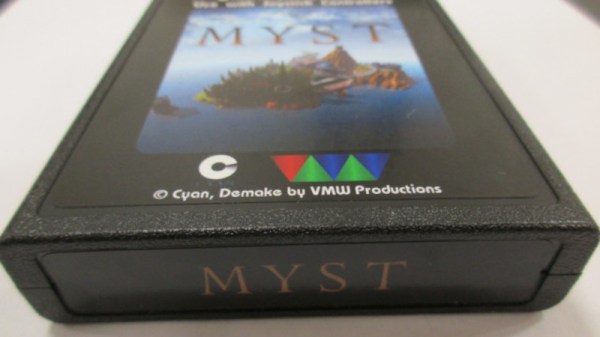
Obviously a PC game from the 90s is much to large, in many ways, to fit into an Atari cartridge or play on the 70s-era hardware. For that, there is a “demake” of Myst, a recreation of the game purposely built to run on older hardware it was never meant for. Even so, the game is running on a specialized cartridge built by [Vince] using parts from the real Atari game cartridge BurgerTime which had a bit more memory than normal. It wasn’t quite as straightforward as flashing the new game file to an old EEPROM though; [Vince] came across all kinds of timing issues and other miscellaneous problems that stretched this project out to around a three-year endeavor.
At the end of everything, though, he has a cartridge that will run Myst on the Atari, using the E7 bank switching scheme which afforded this system more memory within the cartridge. For [Vince], who is a fan of the demo scene for consoles like this, this was an interesting experiment to push original hardware to its limits. And, if you want to try this on an Atari 2600 handheld which also uses original hardware, we’d recommend using one of these.
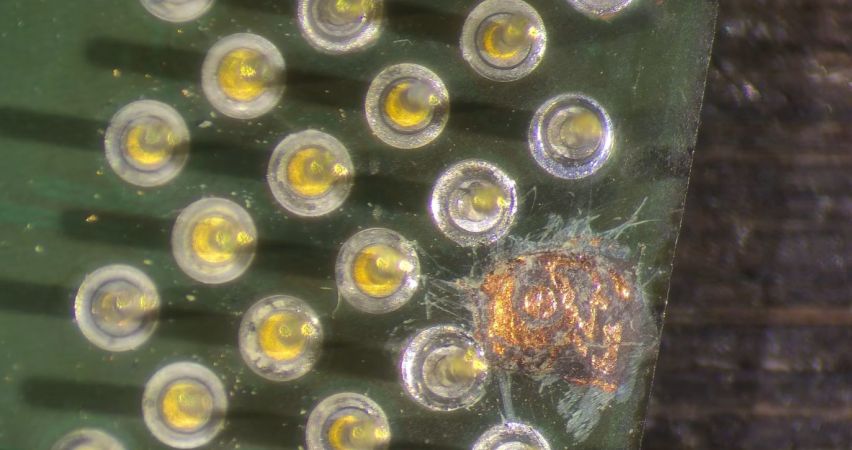
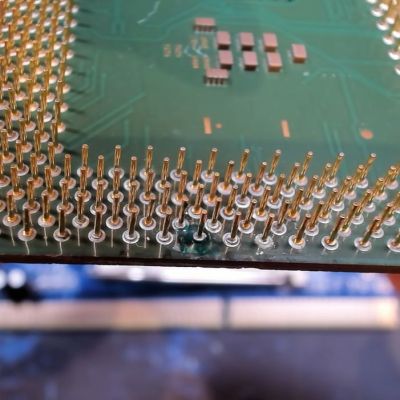 Before moving to land grid array (LGA) packaging whereby each pin on the substrate is just a copper pad, processors commonly used pin grid array (PGA) packaging, including the still highly relevant AMD AM4 socket. With PGA you get a pin soldered onto the copper pad which inserts into the ZIF socket, rather than a fragile pin on the mainboard side. Repairing a damaged PGA pin can be easy if just the pin broke off at the solder joint, or rough if the pad was destroyed, as in the case of this Pentium III CPU that [Bits und Bolts]