A small orange car with a bold horizontal white stripe and the text "XP 512E" emblazoned on the side. The footprint of the vehicle barely exceeds the size of the seats, almost like an Isetta, but the top canopy opens upward and the lower front fascia contains a side opening door. If it were green, it would probably be what an LLM would generate with the prompt, "Make a car that looks like a frog."

GM’s Experimental EV From 1969

Electricity is the once and future drivetrain for automobiles, but until the advent of lithium batteries their capabilities were somewhat modest. One EV blip on the automotive timeline is the XP-512E commuter prototype by GM.

The 60s saw a wide variety of interesting experiments in the automobile space, and both GM and AMC were evaluating the possibilities of a return to electric cars for short journeys. GM wasn’t set on a particular drivetrain for their new experimental commuter cars, so the XP 512 became a trio with conventional, hybrid, and electric variants. Each car was a two seater with a fiberglass body and steel chassis. The canopy could lift and a small door in the front swung to the side for access to the cockpit. Some images from the time show the car without the canopy and just the rollbar, giving you a very small convertible (83″/2108 mm long).

Lead acid was the only viable traction battery until the 1990s, so the 1,250 lb vehicle was limited to a top speed of 30 mph and a range of 50 miles. GM was exploring a number of alternatives at the time including another blast from the automotive past, steam power, in an effort to reduce the issues of smog and air pollution that plagued cities beset by droves of V-8 powered sedans. While the XP-512E and the AMC Amitron never made it to production, they’re an interesting reminder that technologies that seem infeasible today may just need to bake a bit longer.

We have some thoughts about the opportunities afforded by electric cars, but it’s probably a good thing we didn’t get nuclear powered automobiles.


Continue reading “GM’s Experimental EV From 1969” →

Hackaday Links Column Banner

Hackaday Links: December 15, 2024

It looks like we won’t have Cruise to kick around in this space anymore with the news that General Motors is pulling the plug on its woe-beset robotaxi project. Cruise, which GM acquired in 2016, fielded autonomous vehicles in various test markets, but the fleet racked up enough high-profile mishaps (first item) for California regulators to shut down test programs in the state last year. The inevitable layoffs ensued, and GM is now killing off its efforts to build robotaxis to concentrate on incorporating the Cruise technology into its “Super Cruise” suite of driver-assistance features for its full line of cars and trucks. We feel like this might be a tacit admission that surmounting the problems of fully autonomous driving is just too hard a nut to crack profitably with current technology, since Super Cruise uses eye-tracking cameras to make sure the driver is paying attention to the road ahead when automation features are engaged. Basically, GM is admitting there still needs to be meat in the seat, at least for now.

Continue reading “Hackaday Links: December 15, 2024” →

Image

Can AI Replace Your DM?

The current hotness is anything to do with artificial intelligence, and along with some interesting experiments comes a lot of mindless hype. The question is, what can it do for us! [Jesse] provides a fun answer by asking ChatGPT to perform as a Dungeons and Dragons dungeon master.

There are many ways to approach a game of D&D, and while some take the whole thing very seriously indeed we prefer to treat it as a lightly inebriated band of intrepid heroes smacking each other and assorted monsters with imaginary swords and war hammers. Would the AI follow the nerdiest cliches to their pedantic conclusions, or would it sense that the point of a game is to have fun?

Continue reading “Can AI Replace Your DM?” →

Image

Goodbye Chevy Volt, The Perfect Car For A Future That Never Was

A month ago General Motors announced plans to wind down production of several under-performers. At the forefront of news coverage on this are the consequences facing factories making those cars, and the people who work there. The human factor associated with the closing of these plants is real. But there is also another milestone marked by the cancellation of the Volt. Here at Hackaday, we choose to memorialize the soon-to-be-departed Chevrolet Volt. An obituary buried in corporate euphemisms is a whimper of an end for what was once their technological flagship car of the future.

Continue reading “Goodbye Chevy Volt, The Perfect Car For A Future That Never Was” →

Image

A No-Solder, Scrap-Bin Geiger Counter For $15

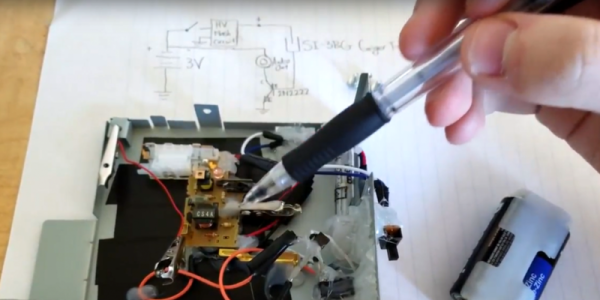
Scenario: your little three-hour boat tour runs into a storm, and you’re shipwrecked on a tropic island paradise. You’re pretty sure your new home was once a nuclear test site, but you have no way to check. Only your scrap bin, camera bag, and hot glue gun survived the wreck. Can you put together a Geiger-Müller counter from scrap and save the day?

Probably not, unless your scrap bin is unusually well stocked and contains a surplus Russian SI-3BG miniature Geiger tube, the heart of [GH]’s desert island build. These tubes need around 400 volts across them for incident beta particles or gamma rays to start the ionization avalanche that lets it produce an output pulse. [GH]’s build uses the flash power supply of a disposable 35mm camera to generate the high voltage needed, but you could try using a CCFL inverter, say. The output of the tube tickles the base of a small signal transistor and makes a click in an earbud for every pulse detected.

You’ll no doubt notice the gallons of hot glue, alligator clips, and electrical tape used in the build, apparently in lieu of soldering. While we doubt the long-term robustness of this technique, far be it from us to cast stones – [GH] shows us what you can accomplish even when you find yourself without the most basic of tools.

Continue reading “A No-Solder, Scrap-Bin Geiger Counter For $15” →

Follow-up: Hacking OnStar

Image

Reader [regulatre] has provided us with his furthering of hacking the OnStar system in GM cars. Previously, we wrote about some initial attempts to gain access to the system that OnStar uses to monitor and control cars called GMLAN. [regulatre] has managed to create an adapter between the GMLAN connector and a standard OBD2 plug, which should allow a number of standard readers to be able to retrieve data.

This method details using a bluetooth OBD2 reader, and passing the data onto a linux machine. It looks as though the writer of this method is looking to integrate OnStar reading and writing into an Android App which currently is an OBD monitor.

We love seeing follow-ups like this, because it puts everyone one step closer to full control of closed devices. As always, let us know if you take any of this in a new direction.

Disabling GM’s Manual Skip Shift

shift

GM, in an effort to make their cars slightly more eco friendly, added a feature that puts your car in 4th gear when cruising along in 1st under certain conditions. This is apparently despised by many owners. I is despised so much, that you can buy a commercial product to disable it. That product costs between $20 and $40. Jalopnik has posted a simple solution to disable this feature for under $7 .  All you need is a replacement plug and a resistor. It’s really pretty simple.