Image

Trying A New Radial Impeller Design For Quadcopters

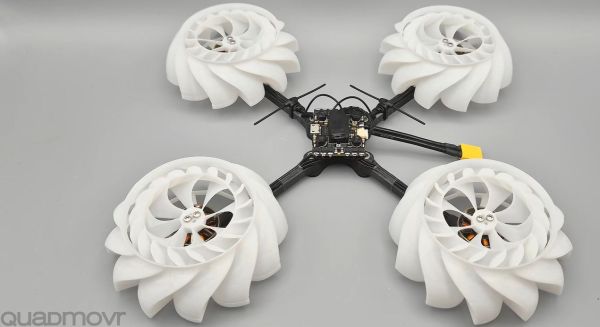
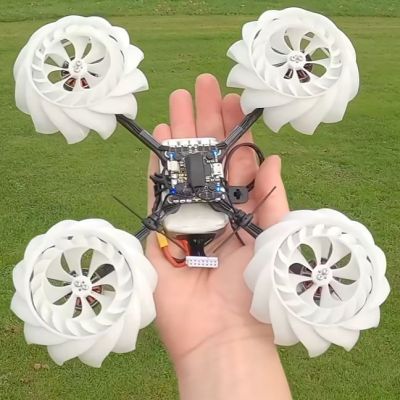
ImageEven if the world has already settled on plain old propellers as the way to make quadcopter drones fly, this doesn’t mean that you cannot give other designs a shake to see what kind of flying performance they result in. For example impeller designs that depart radically from standard propellers – themselves a sub-category of axial impellers – and go radically radial instead as in this design by [quadmovr] with accompanying demonstration video.

This is itself a remix of a design by [Baba] to make it fit the target 1750KV T-mount motor. As for whether this is a design that you want to slap on your own quadcopter, the obvious disadvantage is that it’s much heavier than regular propellers.

Weighing [quadmovr]’s drone without battery pack and with these 3D-printed PETG impellers shows them to weigh 189 grams. This compares to 141 grams with the standard three-bladed propellers, or a hefty 12.8 gram weight penalty per impeller. Naturally this translates into less flying time, so what are the advantages?

The noise profile of the impeller design is definitely more pleasant, and much like novice quadcopters with the protective ring around the propellers these impellers should be more robust. On the other hand increased mass adds to inertia, and there is a lot more surface area with the air to add drag, so despite the absolutely sick moves that [quadmovr] pulls off with both impeller configurations in the video one has to admit that regular three-blade propellers do have the edge here.

Continue reading “Trying A New Radial Impeller Design For Quadcopters” →
Image

Hydroelectric Generator Gets Power From Siphoning

Siphons are one of those physics phenomena that, like gyroscopes, non-Newtonian fluids, and electricity, seem almost magical. Thanks to atmospheric pressure, simply filling a tube with liquid and placing the end of the tube below the liquid level of a container allows it to flow against gravity, over a barrier, and down into another container without any extra energy inputs once the siphon is started. They’re not just tricks, though; siphons have practical applications as well, such as in siphon-powered hydroelectric turbine.

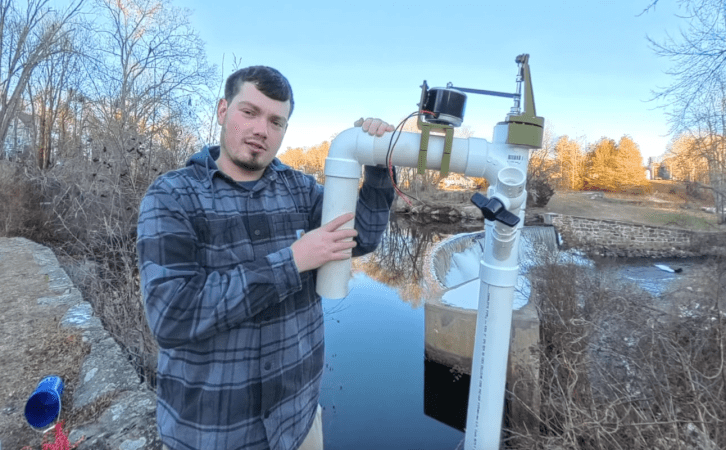
This is an iteration of [Beyond the Print]’s efforts to draw useful energy from a local dam with an uneconomic amount of water pressure and/or volume for a typical hydroelectric power station. One of his earlier attempts involved a water wheel but this siphon-based device uses a more efficient impeller design instead, and it also keeps the generator dry as well. Using 3″ PVC piping to channel the siphon, as well as a short length of thinner pipe to attach a shop vac for priming the siphon, water is drawn from the reservoir, up the pipe, and then down through the impeller which spins a small DC generator.

This design is generating about 9 V open-circuit, and we’d assume there’s enough power available to charge a phone or power a small microcontroller device. However, there’s a ton of room for improvement here. The major problem [Beyond the Print] is currently experiencing is getting air into the system and having the siphon broken, which he’s solved temporarily by adding a bucket at the outflow. This slows down the water though, so perhaps with any air leaks mitigated the power generation capabilities will be greatly increased.

Continue reading “Hydroelectric Generator Gets Power From Siphoning” →

Image

E-Bike Motor Gets New Life As Hydro Plant

For economic reasons, not every lake with a dam can support a hydroelectric power plant. Some rivers or creeks are dammed for flood control or simply for recreation, and don’t have the flow rate or aren’t deep enough to make the investment of a grid-scale generation facility worthwhile. But for those of us with a few spare parts around and access to a small lake, sometimes it’s possible to generate a usable amount of energy with just a bit of effort.

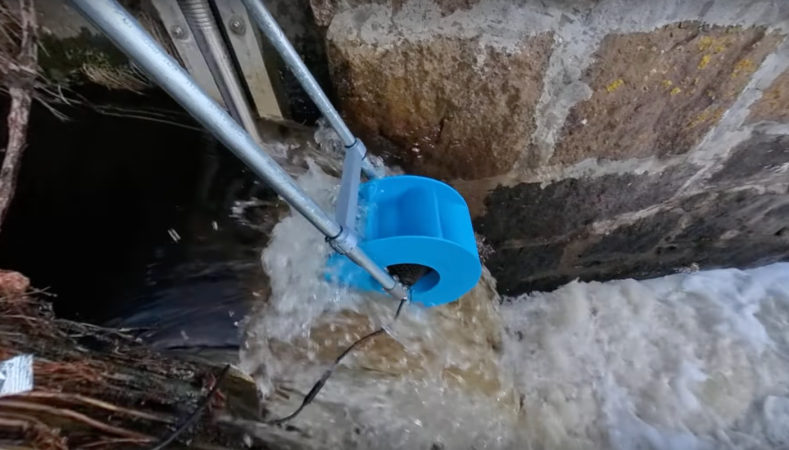
[Beyond the Tint] is building this mostly as a proof-of-concept, starting with a 1,000W hub motor from an e-bike that’s been removed from its wheel. A 3D-printed waterwheel attachment is installed in its place, and the fixed shaft is attached to a homemade ladder-looking mechanism that allows the entire generator to be lowered into the flow of a moving body of water, in this case, a small stream. A bridge rectifier converts the AC from the hub motor (now a generator) into DC, and after a few measurements and trials, [Beyond the Tint] produced over 30W with the first prototype.

A second prototype was made with feedback from the first video he produced, this time with an enclosed paddlewheel. This didn’t appear to make much difference at first, but a more refined impeller may make a difference in future prototypes. Small-scale hydropower is a fairly popular challenge to tackle, especially in the off-grid community. With access to even a small flowing stream and enough elevation change, it’s possible to build something like this generator out of parts from an old washing machine.

Continue reading “E-Bike Motor Gets New Life As Hydro Plant” →

Image

Portable Solder Paste Station Prevents Smears With Suction

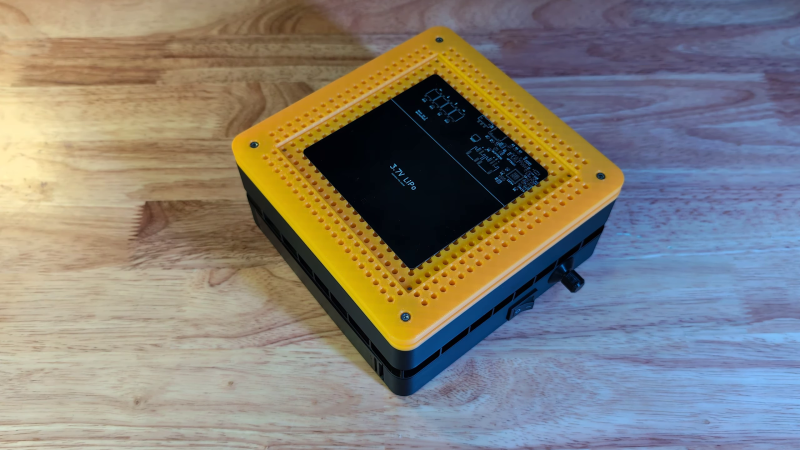
Applying solder paste to a new custom PCB is always a little nerve-racking. One slip of the hand, and you have a smeared mess to clean up. To make this task a little easier, [Max Scheffler] built the Stencil Fix Portable, a compact self-contained vacuum table to hold your stencil firmly in place and pop it off cleanly every time.

The Stencil Fix V1 used a shop vac for suction, just like another stencil holder we’ve seen. The vacuum can take up precious space, makes the jig a little tricky to move, and bumping the hose can lead to the dreaded smear and colorful language. To get around this [Max] added a brushless drone motor with a 3D printed impeller, with a LiPo battery for power. The speed controller gets its PWM signal from a little RP2040 dev board connected to a potentiometer. [Max] could have used a servo tester, but he found the motor could be a little too responsive and would move the entire unit due to inertia from the impeller. The RP2040 allowed him to add a low pass filter to eliminate the issue. The adjustable speed also means the suction force can be reduced a little for easy alignment of the stencil before locking it down completely.

We love seeing tool projects like these that make future projects a little easier. Fortunately, [Max] made the designs available so you can build your own.

Continue reading “Portable Solder Paste Station Prevents Smears With Suction” →

Image

3D Printed Turbo Pump Hopes To Propel Rockets To The Sky

There are plenty of rocket experimenters toying with various liquid-fueled contraptions at the moment, and [Sciencish] is one of them. He grew tired of using air-pressurized fuel delivery systems in his experiments due to safety reasons, and decided to create something approximating more grown up rocket designs. The result was a 3D-printed turbopump for fuel delivery.

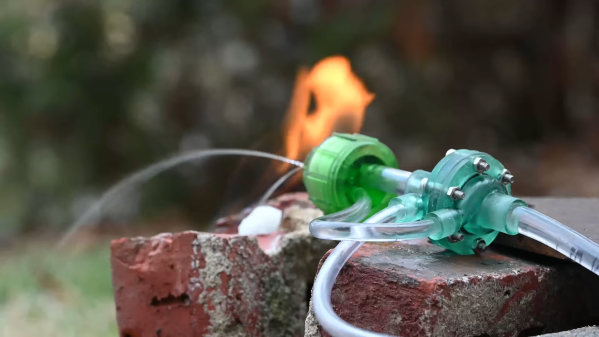
The design is not dissimilar from a turbocharger in a car. On one side, a turbine wheel is turned by compressed air supplied from a tank or compressor. This turbine wheel is affixed to the same axle as an impeller which draws up fuel and pumps it out, ideally into a rocket’s combustion chamber. It’s all made out of resin-printed parts, which made creating the fine geometry of the turbine and impeller a cinch.

Running on compressed air at 80 psi, the turbopump is able to deliver 1.36L of water or rubbing alcohol fuel a minute. However, unfortunately, this first pass design can only deliver 20 psi of fuel pressure, which [Sciencish] suspects will not be enough to counteract combustion chamber pressures in his rocket design. More work is required to up this figure. Paired with a nozzle and ignition source, though, and it does make for some great flames.

Overall though, the safety benefit of this turbopump comes from the fact that the fuel is kept separate from the oxidizer until it reaches the combustion chamber. This comes with far less chance of fire or explosion versus a system that stores fuel pressurized by air.

While the design isn’t yet up to scratch for rocket use, it nonetheless works, and we suspect with some improvement to tolerances and fin design that the project should move along at a quick pace.

If solid rockets are more your thing though, we’ve featured plenty of those too. Video after the break.

Continue reading “3D Printed Turbo Pump Hopes To Propel Rockets To The Sky” →

Image

Surfboard Gets Jet Upgrades

Surfing is a fun and exciting sport but a lot of beginners can get discouraged with how little time is spent actually riding waves while learning. Not only are balance and wave selection critical skills that take time to learn, but a majority of time in the water is spent battling crashing waves to get out past the breakers. Many people have attempted to solve this problem through other means than willpower alone, and one of the latest attempts is [Andrew W] with a completely DIY surfboard with custom impeller jet drives.

The surfboard is hand-made by [Andrew W] himself using a few blocks of styrofoam glued together and then cut into a generic surfboard shape. After the rough shaping is done, he cuts out a huge hole in the back of the board for the jet drive. This drive is almost completely built by [Andrew] as well including the impeller pumps themselves which he designed and 3D printed. The pair of impellers are driven by some beefy motors and a robust speed controller that connects wirelessly to a handheld waterproof throttle to hold while surfing. Once everything was secured in the motor box the surfboard was given a final shaping and then glassed. The final touch was an emergency disconnect attached to a leash so that if he falls off the board it doesn’t speed away without him.

The build is impressive not only for [Andrew]’s shaping skills but for his dedication to a custom jet drive for the surfboard. He spent over a year refining the build and actually encourages people not to do this as he thinks it took too much time and effort, but we’re going to have to disagree with him there. Even if you want to try to build something a lot simpler, builds like these look like a lot of fun once they’re finished. The build seems flawless and while he only tested it in a lake we’re excited to see if it holds up surfing real waves in an ocean.

Continue reading “Surfboard Gets Jet Upgrades” →

Image

Waterjet-Powered Speedboat For Fun And Research

There are a lot of cliches about the perils of boat ownership. “The best two days of a boat owner’s life are the day they buy their boat, and the day they sell it” immediately springs to mind, for example, but there is a loophole to an otherwise bottomless pit of boat ownership: building a small robotic speedboat instead of owning the full-size version. Not only will you save loads of money and frustration, but you can also use your 3D-printed boat as a base for educational and research projects.

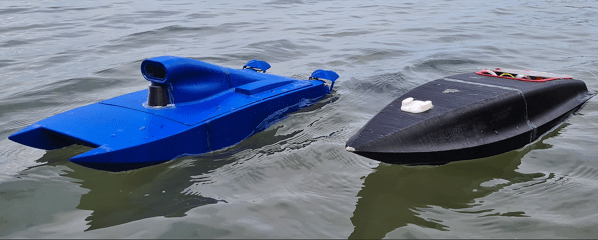
The autonomous speedboats have a modular hull design to make them easy to 3D print, and they use a waterjet for propulsion which improves their reliability in shallow waters and reduces the likelihood that they will get tangled on anything or injure an animal or human. The platform is specifically designed to be able to house any of a wide array of sensors to enable people to easily perform automated tasks in bodies of water such as monitoring for pollution, search-and-rescue, and various inspections. A monohull version with a single jet was prototyped first, but eventually a twin-hulled catamaran with two jets was produced which improved the stability and reliability of the platform.

All of the files needed to get started with your own autonomous (or remote-controlled) speedboat are available on the project’s page. The creators are hopeful that this platform suits a wide variety of needs and that a community is created of technology enthusiasts, engineers, and researchers working on autonomous marine robotic platforms. If you’d prefer to ditch the motor, though, we have seen a few autonomous sailboats used for research purposes as well.

Continue reading “Waterjet-Powered Speedboat For Fun And Research” →