Software Development
Most software does not create competitive advantage, especially when organizations rely fully on generic SaaS or legacy solutions. The organizations pulling ahead are asking what solutions do we actually need to accelerate the business and make a measurable difference?
Norrin builds custom software that combines data, user experience design and AI processing into reliable business outcomes through disciplined software development practices. Using our AI-assisted delivery pipeline, we help you build cost-efficient custom solutions that are easy to use, include powerful AI features, integrate directly with your data and AI platform capabilities and are straightforward to maintain.
How should you approach software development?
-
Recognize when SaaS stops being enough
Generic SaaS solutions are built for the generic organization, for everyone. That made sense when custom development was slow and too expensive. AI-assisted development has changed this premise. A tailored application, built for your processes, people and data sources, can now reach production fast enough to outperform the ready-made solutions.
-

Design is where outcomes are decided
Code creation has always required significant investment. The biggest cost, however, has typically been finding the right design that solves the business problem. Custom projects have come at notable cost, producing mediocre outcomes. In the AI era, design work is faster and expectations for business impact should be higher.
-
AI enables faster, better-informed design
AI-assisted development now covers the full journey, from problem definition through design to integrated production software. The faster pace means the right design is validated sooner. Interactive design artefacts and effective feedback loops can now be created in days, even hours, ensuring business decisions are based on actual data from stakeholders.
-
Rethink what your solutions can do
Explore multi-modal user interfacesSoftware development and AI are fundamentally intertwined, which opens the door to rethinking what your solutions can be. Modern AI services, such as Voice Live and Azure Vision services, enable fast creation of multi-modal user interfaces that combine visual UX, human voice, structured data, APIs, and AI inference. This enables entirely new process designs that were not possible before.
What should you know before getting started with software development?
-
AI solutions are fundamentally software development
Learn about AI agentsStandard AI tools and products are essential for personal productivity and selected use cases. Systematic business benefits, however, typically require custom solutions to fit your data, your workflows, and your processes. It is increasingly the faster path to measurable business outcomes, and the organizations moving quickest have already made that shift.
-
Concepts become development artefacts, not documentation
Read more about agent-powered software developmentIn the AI era, the concepts and designs are generated with the help of AI and then transformed into deployable software code. After validation, the same artefacts that convinced a stakeholder become production software. There is no handover gap, and context accumulates at each stage. AI-assisted development can reshape digitalization projects but does impose changes to how teams typically collaborate.
-
Speed and quality go hand in hand
What AI-assisted productivity required from processes?Building business- and user-centered solutions at the speed of AI era, and building them well, calls for enterprise-grade best practices. The discipline here goes beyond vibe coding. With help from AI, test coverage, governance conformance, and quality assurance are built into the process from the start. We engineer solutions for long-term benefit, ready to iterate and ready for emerging new requirements.
-
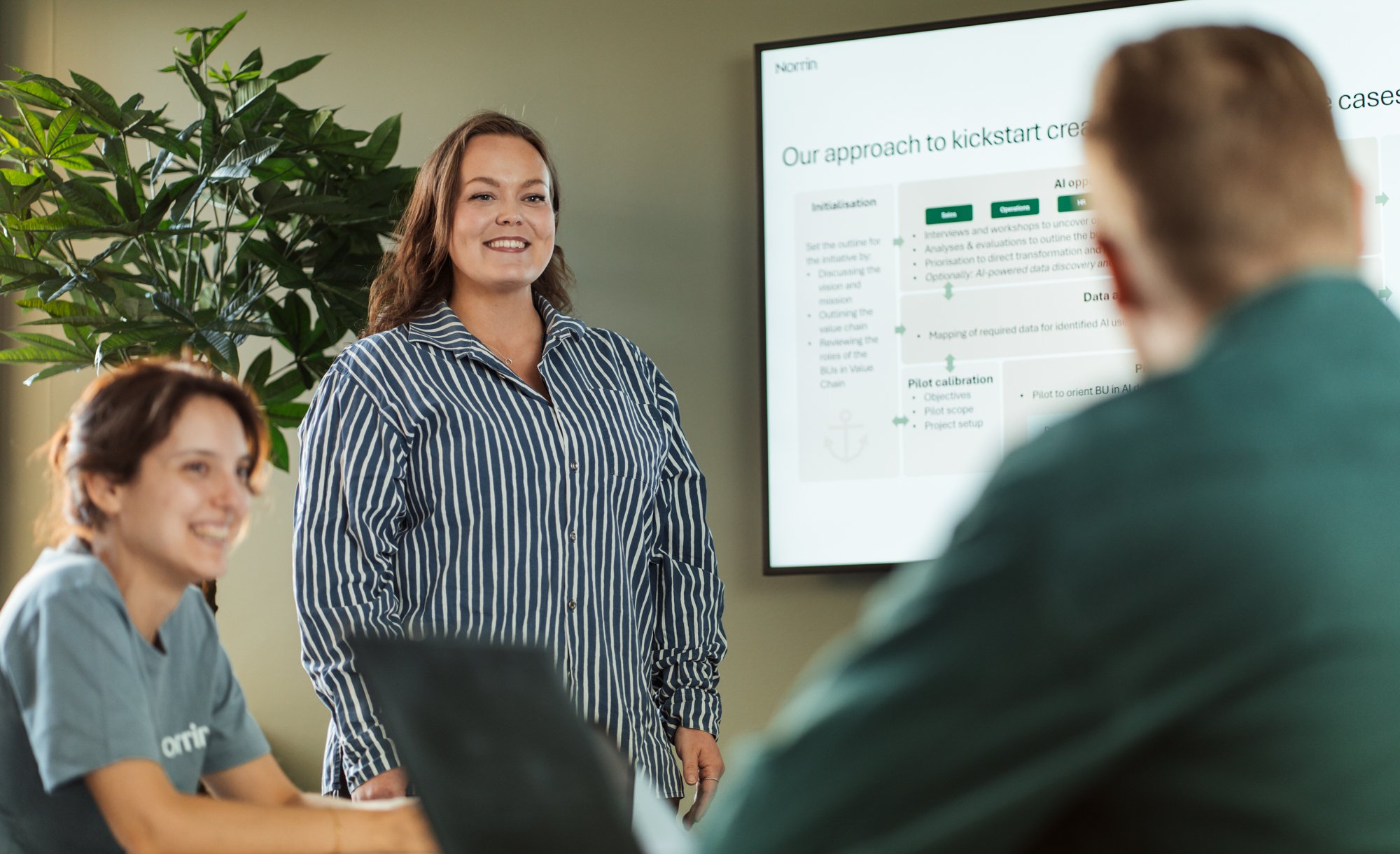
A different partnership model produces different results
To realize what is now possible, organizations need to work differently with their technology partners. That means shorter, sharper cycles, concepts as the starting point, and continuous loops in place of one-time handovers.
What does this mean for project work?
1. Defining concepts and specification
We use meeting and interview transcripts and available baseline material for AI-assisted generation of concepts and specifications, using our dedicated AI skill libraries. This changes the ability to generate and evaluate even challenging business concepts effectively.
2. Generating with AI, validating with humans
Our AI-powered delivery pipeline works differently from traditional methods. In the AI era, AI agents create and we validate and coordinate the process.
Our delivery pipeline covers all deliverables from concepts to implementation to test cases and support tickets. We plan our deliveries, so your team works with a complete solution from day one, without workarounds. We help you and your stakeholders walk this new way of working from the first project together and embed the principles in your internal practices over time. This is essential for successful outcomes and long-term value.
3. AI speed requires a solid quality framework
AI dramatically accelerates development pace. Everything moves faster and AI produces a high volume of specifications and outputs to validate. Managing this well requires a genuine shift in how teams collaborate. This is a real mental model change in the way people should work together, which takes deliberate effort to get right.
Business drivers and process change objectives need to be embedded in the AI-assisted specification from the start. This is what makes it possible to test concepts and designs meaningfully across iterations. As soon as development proceeds to implementation, test cases are key for controlled iteration speed. AI excels at generating this test harness for us.
Our toolbox for building software development
Different solutions require different building blocks. We list some of our typical tech and tools below.
- GitHub Copilot and Claude
Agentic design and development where AI generates artefacts and code rapidly and experts direct, review, and validate the output. - Azure OpenAI Service and Azure AI Foundry
Integrating AI inference into applications securely within the Azure ecosystem, from semantic search to intelligent agents. - Microsoft Power Platform
Low-code development for business applications when tailored functionality is needed without full-stack engineering. - .NET, Python, TypeScript and JavaScript
Production-grade application development where performance, extensibility, and long-term maintainability are required. - Azure infrastructure (App Service, AKS, Functions, SQL, Cosmos DB, Microsoft Fabric)
Scalable hosting and data management for cloud and production environments, designed to maintain without heroics. - GitHub and Azure DevOps
Source control and application lifecycle management from development through to production.