Image

Track Bird Visitors With A Raspberry Pi And A USB Mic

Avian Visitors is a lovely project by [Teddy Warner] that uses a Raspberry Pi and microphone to keep track of which birds have been visiting your home, and creates a colorful illustration of recent visitors on top of it all.

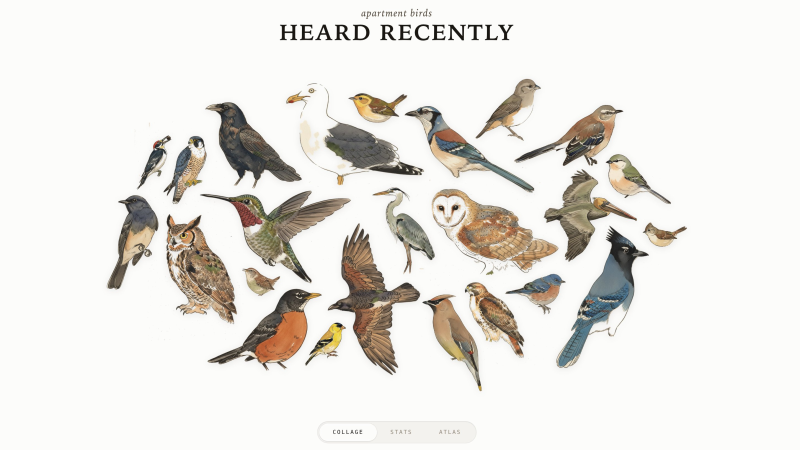
It reports on a web interface of its own making, but what really takes things to a new level is an optional, stylish E-Ink panel that shows the last 24 hours’ worth of visitors at a glance in a collage.

ImageThe key to identification is BirdNET (GitHub here), a deep learning classifier from Cornell that can reliably identify and classify more than 11,000 species worldwide based on sound alone.

Based on that information, the system pulls bird images from a reference set for the region and creates a collage representing the breadth and frequency of visitors in a single image. The larger the image of a bird, the more frequently it was heard.

That’s a cool project, but [Teddy] took things one step further by setting up a color E-Ink display to show a running summary of all the avian visitors the system identifies. [Teddy] has a knack for leveraging projects into wall-mounted art, as we saw with his generative art wall plotter. Continue reading “Track Bird Visitors With A Raspberry Pi And A USB Mic”
Image

Addressable LEDs Make Giant 16×2 Character Display

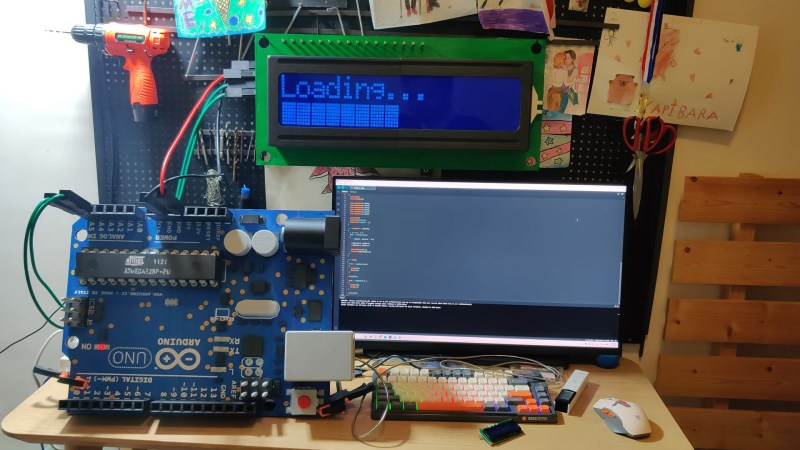
We’ve always taken a certain childlike joy in seeing tiny things made big, and big things tiny. Evidently [Uncle Stem] is the same way, if this 7x sized 16×2 “LCD” display is any indicator.

“LCD” is in scare quotes there, because while the original display is a character LCD, [Uncle Stem]’s embigginated recreation is not. Liquid crystal displays are beyond all but the most dedicated DIYers, so [Stem] recreated the whole thing with addressable LEDs instead — over a thousand of them. Each character got its own PCB, and rather than pay for assembly [Stem] used a 3D printed stencil to help apply solder paste, an idea we’ve seen before. His choice of long lengths of nickel strip — the stuff you spot weld to Li-ion batteries — to join the LED-holding PCBs is also worth noting.

In order to get his giant display to act like the I2C-operated module he loves, [Uncle Stem] equipped it with an RP2040 pre-programmed with the LCD character set. That way he can plug it into any Arduino project that uses the LiquidCrystal_I2C library and have the authentic 1602 experience. The green “PCB” the display is mounted to is actually laser-cut plywood, while some acrylic sits in front of his PCBs with office paper to act as as a diffuser. A 3D printed frame completes the illusion. He even goes so far as to replicate the pin headers at 7:1 scaling with brass rods.

He also connects it to a over-sized Arduino, with giant jumper wires. But for the record, not the giant Arduino we featured previously. Like we said, hackers like to mess with scale, and we’ve seen everything from giant benchies to a working Mac Classic for Barbie.

Continue reading “Addressable LEDs Make Giant 16×2 Character Display”

Image

Scrap Pinball Parts Become Beautiful Wall Art

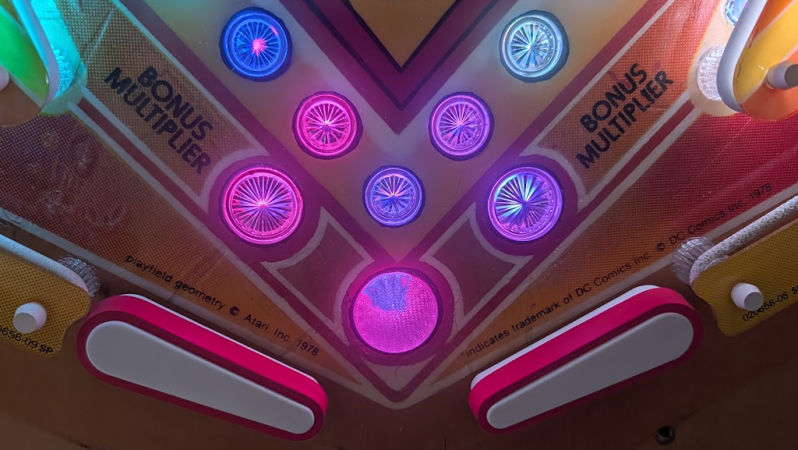
[Hans Scharler] came into a neat find recently—the playfield from a 1970s Atari Superman game. It’s the sort of thing that’s too nice to throw away, but isn’t really enough to reassemble into a viable full machine without a great deal of effort. Thus, [Hans] went a different route—turning it into a beautiful piece of wall art. 

The first step of the build was to collect missing parts; in particular, all the plastic inserts for the playfield that had been lost at some point. Everything was cleaned up and mounted, along with some modified flippers to complete the look. Custom pop bumpers were 3D printed to act as LED-lit light guides rather than as functional pinball components. [Hans] then set about dotting the board with plenty of WS2811 addressable LEDs in a bullet form factor. Everything was placed under the command of a WLED controller, and it’s synced up to [Hans’s] CheerLights MQTT server to boot. More build details are available on the Pinside post for those eager for a deeper dive.

If you come into some old-school pinball hardware that you’d like to turn into decoration, this project is a great one to study. We’ve featured a few other great pinball builds over the years, too.

Continue reading “Scrap Pinball Parts Become Beautiful Wall Art”

Image

Dress Up Your YubiKey With This Web-Based Tool

The combination of hardware required to make use of this project is specific enough that we imagine only a relatively limited number of readers will actually be able to try it out. But if you do happen to own a YubiKey and either a laser engraver capable of marking it or a fancy UV printer, [madeinoz67] has put together an awesome tool for adding some visual flair to your two-factor authentication device.

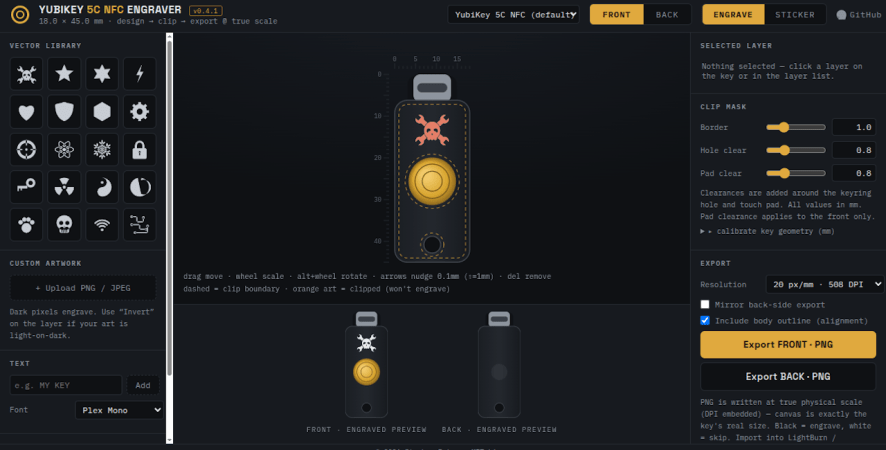
ImageRunning it is as simple as opening a web page, because that’s exactly how it’s implemented. You can either host it yourself or just launch it right from the GitHub repository. After opening the HTML file, you’re presented with a fairly intuitive user interface that lets you draw on top of a 2D outline of the YubiKey itself so you can get a better idea of what the final product will look like.

You can pick from an array of vector icons, upload your own images, and add custom text. There’s a pull-down at the top that lets you pick which specific YubiKey you want to work with, and there are different views depending on whether you plan on blasting your handiwork onto the device with a laser, doing a full-color UV print, or cutting it out of vinyl with something like a Cricut.

Even if you don’t have a YubiKey that’s begging for some custom artwork, we think there’s a lot to learn from this project. Obviously there are some very valid reasons to be concerned about how much of our modern software can only be accessed through a browser. If you’re going to use web technologies to create a piece of software, the least you could do is make it offline and self-contained like [madeinoz67] has.

Now if you’ll excuse us, we’ve got to go warm up the UV printer.

Image

Chromatography As Art

You may or may not remember in some ancient chemistry class studying or even performing chromatography. The short definition is using media like paper or powder to separate a mixture. It is an old technique, but [Suchir2004] is using it as an art form.

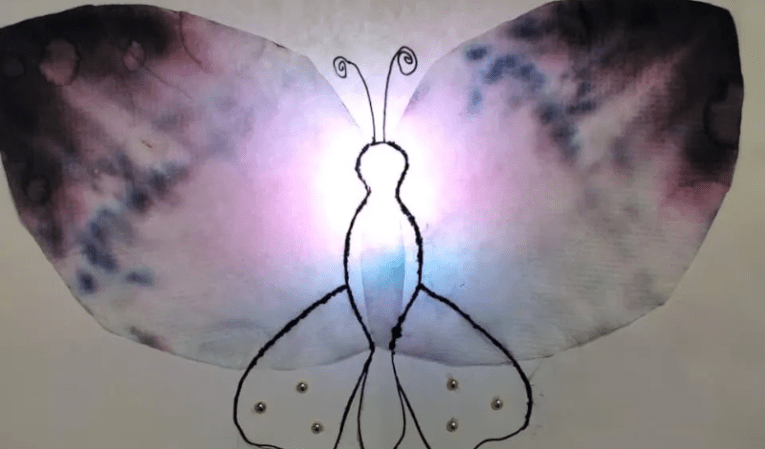
Chromatography works because the parts of the liquid mixture travel through the media at different speeds. While experimenting, [Suchir2004] noted that black ink and water perfused into constituent pigments. A butterfly ensued.

Is it art? Yes! Is it science? Well, sort of. Especially since the post does talk about how the effect works and even does some simple tests to start. This would be an excellent project for a class where some students are more motivated by art and others by science. Even with an individual kid, it might show you where their interests lie.

There’s nothing particularly difficult. A sketch pen, some paper, a coffee filter, a glue stick, and a few other household items are all you really need to get started.

Want something more practical? How about measuring caffeine content?

Image

Bite Into Strange Sounds With NOISFERATU

The NOISFERATU is an open source generative textural sound synthesizer, or as creator [Robert Heel] puts it, “a sound designer’s dream and audiophile’s worst nightmare”.

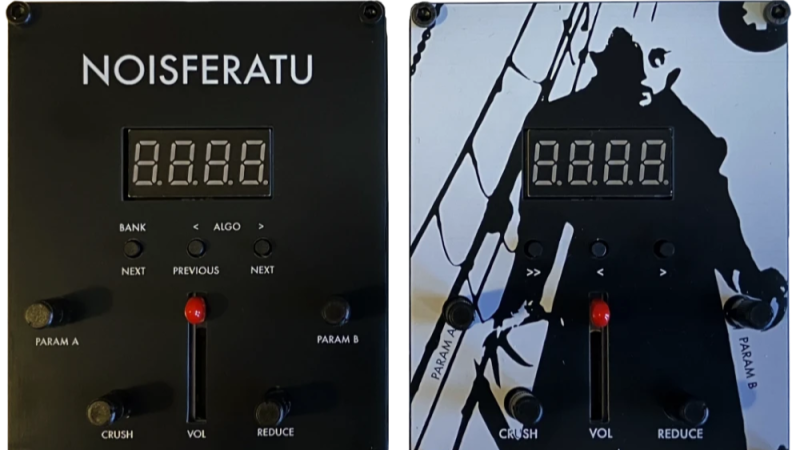
ImageNOISFERATU offers 45 different sound algorithms grouped into five banks to produce a dazzling range of evolving soundscapes and patterns that resist repetition or settling, each influenced and shaped — the word controlled does not quite apply — by a volume slider and a few hardware knobs.

So what does it actually sound like? Check out the video embedded below to give it a listen, it’s pretty trippy.

Hardware-wise NOISFERATU is centered around the Seeed Studio XIAO SAMD21 microcontroller board, takes power over USB-C, and has a headphone jack for sound output. We love the artwork on the dual-sided front panel, too.

DIY synthesizers based on logic chips have a long and proud history, and seeing the different directions people can go by incorporating microcontrollers is always a delight.

If NOISFERATU’s experimental sound and noise sounds up your alley, the design files and code on GitHub have everything one should need to build one. Kits are for sale direct from the designer, as well.

Continue reading “Bite Into Strange Sounds With NOISFERATU”

Image

Creating Beautiful Light Shows With Soap

We feature a lot of fun projects with LEDs and lasers and all kinds of light effects going on. Most of these are very digital. However, there are a great many ways to make beautiful lighting effects without ones and zeros. The Maelstrom Lamp from [Michele Lorenzi] is a great example of that.

Image
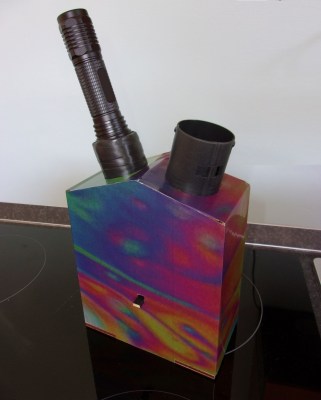
The Maelstrom Lamp is externally decorated to indicate its function. 

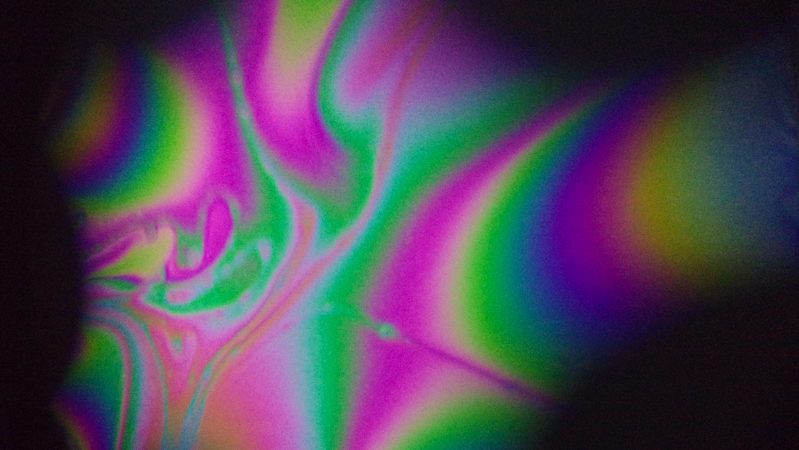
The concept is decidedly old-school. The lamp uses a delicate, thin soap film stretched across an aperture as its primary optical element. The varying thickness of the film across its surface leads to constructive and destructive interference when white light passes through it. This creates a kaleidoscope of color; the same effect you might have seen when an oil slick forms in a dirty puddle.

In this case, though, that effect is projected with the aid of a powerful 800-lumen flashlight and some supporting optics. [Michele]’s write-up does a great job of explaining the finer design details that maximize the vibrancy of the effect, from the waviness in the gasket that supports the soap film, to the optics that focus the torch beam.

If you’re looking for some suitably psychedelic lighting effects for your next house party, you really ought to build one of these. We’ve featured some other fun classic lighting effects before, like these wonderful bubble lamps. Continue reading “Creating Beautiful Light Shows With Soap”