Image

Watch Today’s Eclipse At Home

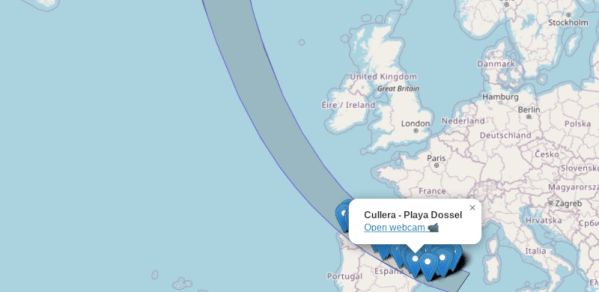
In a few hours, there is a solar eclipse that will be visible with a track that goes from Spain up through Greenland. Too late to travel for it, but thanks to [jonty], you can find all the webcams that will have a view.

This may be ideal. No funny glasses. No looking at a projected image on a card. Of course, many, if not all, of these cameras aren’t looking directly at the sun, so it isn’t clear if you’ll be able to see the actual eclipse or just the effect it has on the surroundings.

Continue reading “Watch Today’s Eclipse At Home”

Image

Even On The Red Planet, Hexagons Are The Bestagons

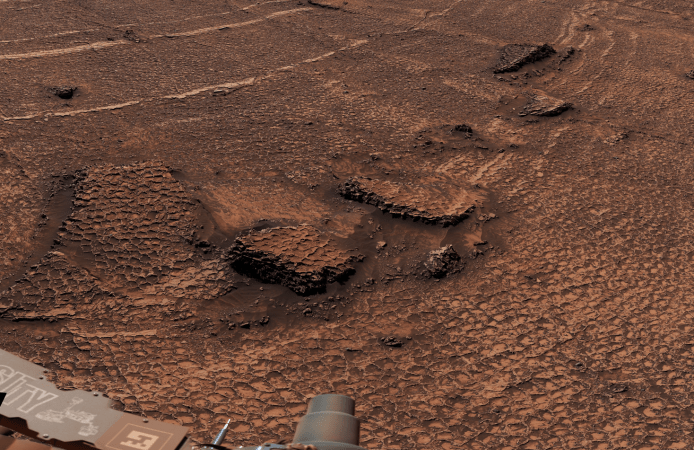
Though their pure Platonic Forms may only exist in the world of ideas, certain regular shapes can’t help but keep falling out of natural processes– case in point, the six-sided solid we call a hexagon, which is indisputably the bestagon. Don’t take it up with us– start an argument with the God of War, because its his planet that’s showing off six sided features, dubbed “polygonal fractures” which NASA’s Curiosity rover is currently crushing under tread in Valle Grande. Now, you might look at the photos and say– well, that’s clearly a dried mudflat. Evidence of water! No brainier, let’s all get Nobel Prizes. Not so fast.

Nothing in nature is ever single-sourced or that simple; if you live somewhere you get dried mud, you may have seen such hexagonal features, but ask anyone from the land of the ice and snow and they’ll tell you that freeze-thaw or frost heave can bring a field of rigolith’s inner Catan board out as well. Sure, we usually call it “dirt” here on Earth, but it’s rigolith by any other name. So NASA isn’t jumping the gun, and their announcement conservatively says that they aren’t sure how the polygonal features formed. Which is both fair enough and very interesting, as figuring it out is going to give some clues into what was going on in this part of Mars in the geologically recent past, especially since this vast field of grid tiles stretches as far as the camera can see. The consensus is that Mars was once “warm and wet” but that’s a relative term– how warm, and how wet, are very much up for debate.

Speaking of crushing hexagons under Curiosity’s wheels– did anyone think said wheels would last this long? They were already tweaking the traction control to extend their life nine years ago. Between it’s plutonium power and ongoing software updates, its a fair bet that Curiosity will outlast the late, lamented Opportunity who currently holds the endurance record at 15 Earth-years.

Image

NASA’s Just Prolonged Voyager 2’s Science Mission With A Big Bang

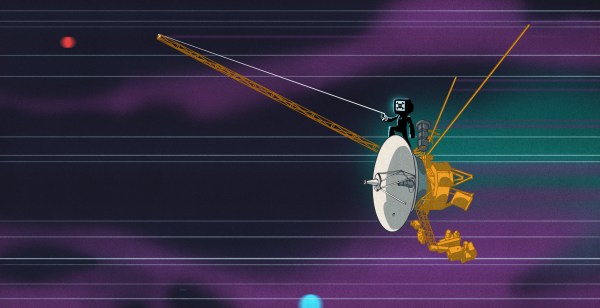
Letting go is hard, especially when it concerns an irreplaceable space probe like the two Voyagers. Fortunately JPL engineers have managed to pull off a ‘big bang’ switch on Voyager 2, involving two heaters and another device that was kept on to keep providing sufficient heat to the spacecraft to allow it to keep functioning. After all, while the vacuum of space isn’t cold, out in deep space you’re radiating away all your precious heat.

Unfortunately the official press release is exceedingly limited in details, but The Register was kind enough to nag a NASA spokesperson about it, and gave us some technical details. The short version is that these heaters don’t just keep the electronics within a happy operating range, they also keep the fuel lines warm and capable of providing fuel for attitude adjustments.

With this switch, apparently enough of the rapidly diminishing power from the RTG has been freed up that the Voyager 2 has just gained a whole extra year on its extended mission. The JPL team hopes to perform the same switch on the Voyager 1 spacecraft soon, giving it a similar boost to its expected lifespan, before both of them go quiet in the depths of space.

Thanks to [Mark Stevens] for the tip.

Image

Detection Of A Four-Carbon Sugar In Interstellar Space

Although life tends to find a way, something first has to kickstart said lifeforms. Exactly how the first biological cells formed on Earth – and potentially on other worlds – remains an enduring mystery. Some theories point to the early Earth’s surface conditions as a viable laboratory for the self-assembly of the first viable membranes, RNA, DNA and associated molecular machinery, while seeding of the Earth’s primitive atmosphere by sugars and other precursors from asteroids and kin is required in other theories.

Recently [Izaskun Jiménez-Serra] et al. added to this debate with the reported detection of four-carbon sugars in the form of erythrulose in the interstellar medium. Using the 40 meter radio telescope at Yebes and the 30 meter radio telescope at Granada the signatures of this sugar was detected in a molecular cloud near the center of the Milky Way.

These sugars likely form on these interstellar dust grains from more basic two-carbon aldehydes and alcohols, with them providing conceivably a source of energy for early metabolic processes of developing lifeforms. This specific type of sugar is highly prevalent in Earth’s fruits, and thus its prevalence in interstellar space is at the very least an interesting coincidence, if not another puzzle piece in the overarching question of abiogenesis.

Image

Launching Rockets Is Hard, Bringing Them Back Is Harder

Since the first V2 rocket sailed above the Kármán line back in 1944 and right up until the modern era, the trajectory of most space-bound rockets was more or less the same: after expending their propellants they would either crash into some desolate steppe or plunge into the ocean. In either event, the rocket was disposable. The important bit up top might go on to explore the stars or send a human crew off on their mission, but the booster rocket that lifted the spacecraft out of the atmosphere was always going to be sacrificed for the cause.

ImageBut in the 1970s NASA had a wild idea: what if we didn’t smash a brand-new rocket valued at millions of dollars into the ocean every time we wanted to put something in orbit? Instead, they would build a hybrid space vehicle that blended the vertical takeoff and raw power of a rocket with the capabilities of an airplane, allowing it and whatever it was carrying to make a gentle runway landing at the end of its mission. As such, the Space Shuttle was born.

With the benefit of hindsight, we now know the Shuttle wasn’t quite the spaceflight revolution that NASA had hoped for. The age of reusable rockets didn’t truly begin until 2015, when SpaceX landed the first stage of their Falcon 9. To date they’ve repeated the feat nearly 600 times, all the while increasing the reliability and speed of their operations. Today the Falcon 9 is the most prolific launch vehicle in history, and nearly every other rocket in active development is being designed to include some element of reusability.

Most recently, China demonstrated that they could recover their Long March 10B rocket by gently bringing it down into what amounts to a giant butterfly net. While it might seem a bit quaint compared to rockets that land on their tails like something out of a 1950s sci-fi movie, the idea offers considerable promise.

Continue reading “Launching Rockets Is Hard, Bringing Them Back Is Harder”

Image

Earth-like LHS 1140b May Feature The First Atmosphere Found On Exoplanet

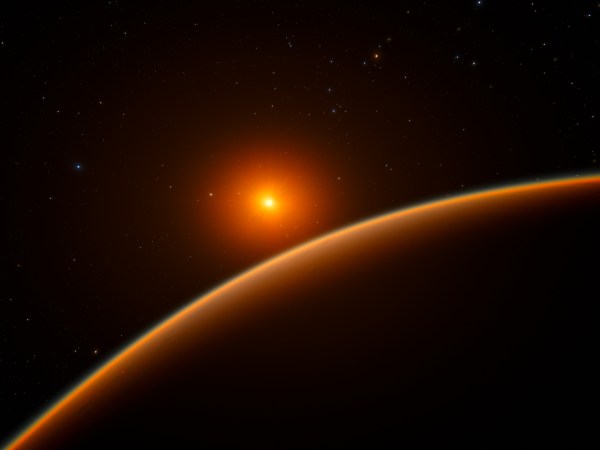
Finding another planet outside of our solar system that can comfortably be called ‘Earth-like’ is one of those discoveries that — if confirmed — would be a major event. The complication here is that with every exoplanet that we discover through observations, determining the type of planet is hard enough, never mind figuring out whether it has an atmosphere, much less what’s in that atmosphere. This makes a recent report on LHS 1140 b rather exciting, as it strongly suggests that this super-Earth may have something close to an Earth-like atmosphere.

In the paper by [Collin Cherubim] and others in Science, the findings of helium occasionally escaping from its atmosphere have led to considerable excitement, as this time-variable atmospheric escape of helium suggests a helium-rich upper atmosphere that’s further depleted in hydrogen.

It should be noted, of course, that these assumptions are based on observations from roughly 49 light-years away, so there’s always some room for later adjustments. Even if confirmed, the star that LHS 1140b orbits is a red dwarf, with a nearly 25-day orbital period and light levels less than half of what Earth receives from the Sun. This would make the surface of LHS 1140b with its proposed oceans rather dim, even if it’s conceivably at temperatures well within the comfort range of us Earth-based mammals.

At 49 light-years distance, it’s also not close enough that — barring an FTL drive — we could do direct observations or visitations, but if these results hold, it’d be on the short list along with a number of other plausibly habitable exoplanets to check out once we build that first warp drive-powered starship.

Image

GOES-19 Goes Down, NOAA Investigating

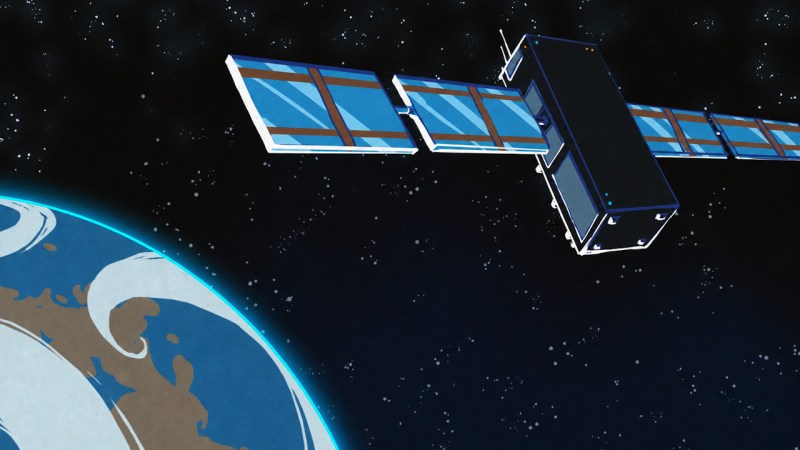
Some breaking news from geostationary orbit, as the National Oceanic and Atmospheric Administration (NOAA) has announced that its newest Geostationary Operational Environmental Satellite (GOES) satellite unexpectedly went offline last night, and as of this morning, remains stuck in safe mode.

Launched in June of 2024, GOES-19 is one of four operational weather satellites that NOAA operates to provide forecast data and severe weather monitoring for the entire Western Hemisphere. The satellite is specifically responsible for covering the continental United States, Central and South America, as well as the Atlantic Ocean. This makes it a particularly critical asset even under normal circumstances, but the fact that it’s gone blind during the Atlantic hurricane season and while smoke from the raging Canadian wildfires is drifting over the Northeast and making the skies over Boston and New York City look like Mars is something of a worst-case scenario.

The good news is that two of the four satellites operate as orbital spares — the satellite that GOES-19 replaced in 2024, GOES-16, is still operational and can stand in as a backup for its coverage area. Obviously, it’s quite a bit older, having launched back in 2016, but it’s of the same design as GOES-19, and in good health, so there should be no degradation of service.

Still, getting GOES-19 back online will be critical for NOAA and the National Weather Service, and we expect they’ll be providing regular updates as the situation develops. Stay tuned.