opensource.google.com

Menu

Google joins the OpenROAD Initiative as principal member to accelerate open source silicon innovation

Tuesday, August 11, 2026

Image

Google is committed to advancing open source silicon innovation. We are excited to share that we have formally joined the OpenROAD Initiative (ORI), Inc. as a principal member. ORI is a nonprofit public benefit corporation dedicated to the open source electronic design automation (EDA) ecosystem. As part of this commitment, Aaron Cunningham has been appointed to the ORI Governing Board to represent Google and help drive the foundation’s strategic direction, financial sustainability, and technical stewardship.

Driving long-term open source sustainability

The OpenROAD Initiative’s mission is to advance and sustain the open source EDA ecosystem by fostering collaborative innovation across research, education, and industry—transforming ideas into silicon. Google’s membership aligns directly with ORI’s multi-year sustainability goals, supported by the US National Science Foundation’s (NSF) Pathways to Enable Open-Source Ecosystems (POSE) program.

With Google’s participation and membership commitment, ORI will continue to strengthen, grow, and sustain its open source ecosystem through key vectors:

  • Neutral Stewardship: Fostering transparent governance where no single company has outsized control over the code, ensuring the project remains inspectable, accessible, and community-driven.
  • Ecosystem Growth: Supporting open and reproducible silicon research, developing robust design flows, and hosting global design contests.
  • Workforce Development: Supporting global silicon skilling initiatives by expanding open source chip design curricula and collaborating with academic institutions and industrial training networks.
  • Technical Strengthening: Enhancing continuous integration and deployment (CI/CD) pipelines, expanding PDK enablement, and improving user experience.

Leadership perspectives

“The OpenROAD Initiative is built on the vision of making chip design open and accessible to all—building a collaborative ecosystem driven by transparency and shared innovation,” said Andrew Kahng, board member of the OpenROAD Initiative. “Google’s deep commitment to open source software and hardware makes them an ideal partner. By joining at our highest membership tier, Google is helping to ensure that the open source EDA ecosystem has the stable, long-term governance and financial foundation required to grow.”

“Cutting-edge silicon research requires robust, inspectable, and reproducible toolchains,” said Drew Wingard, Director of Silicon Infrastructure, Tools and Methodology at Google. “OpenROAD has already made an incredible impact across academia and the broader industry, enabling many successful tapeouts. Google is proud to support the OpenROAD Initiative’s mission to scale this open infrastructure for the next generation of developers.”

About the OpenROAD Initiative and OpenROAD project

The OpenROAD Initiative, Inc. is a California-based 501(c)(3) nonprofit organization that provides governance, stewardship, and coordination for the OpenROAD ecosystem. The OpenROAD Project is an open source, autonomous digital chip design toolchain that democratizes semiconductor design, enabling a complete RTL-to-GDSII flow in less than 24 hours with no human in the loop. Grounded in academic research and referenced in over 500 peer-reviewed publications, OpenROAD has lowered the barriers to hardware innovation, enabling thousands of students, researchers, and startups worldwide to design and manufacture chips.

To learn more about the OpenROAD Project and install the toolchain, visit the new OpenROAD website.

For more information about membership tiers and the foundation’s governance, visit the OpenROAD Initiative website at www.openroadinitiative.org or contact membership@openroadinitiative.org.
Adapting open source practices to an AI-first world: A retrospective on 2025

Monday, August 3, 2026

Even as AI adoption accelerates and transforms the global technology landscape, open source remains foundational to how Alphabet builds, uses, and collaborates on products for billions of users. Our commitment to open source remains broad and consistent, including sharing our work year-over-year, and reflecting on what we've learned.

In 2025:

  • Roughly 10% of Alphabet's full-time workforce actively contributed to open source projects. This contribution ratio has remained steady over the past five years, scaling to match our growth.
  • These open source contributions are not just solely focused on Google. Our top projects by unique contributors at Alphabet include community-led projects such as LLVM, vLLM, Envoy, and Rust, as well as Google-initiated projects like Kubernetes, Apache Beam, and gRPC.
  • In addition, Alphabet projects received commits from more than 20,000 non-Alphabet affiliated user accounts.

Working together on emerging standards

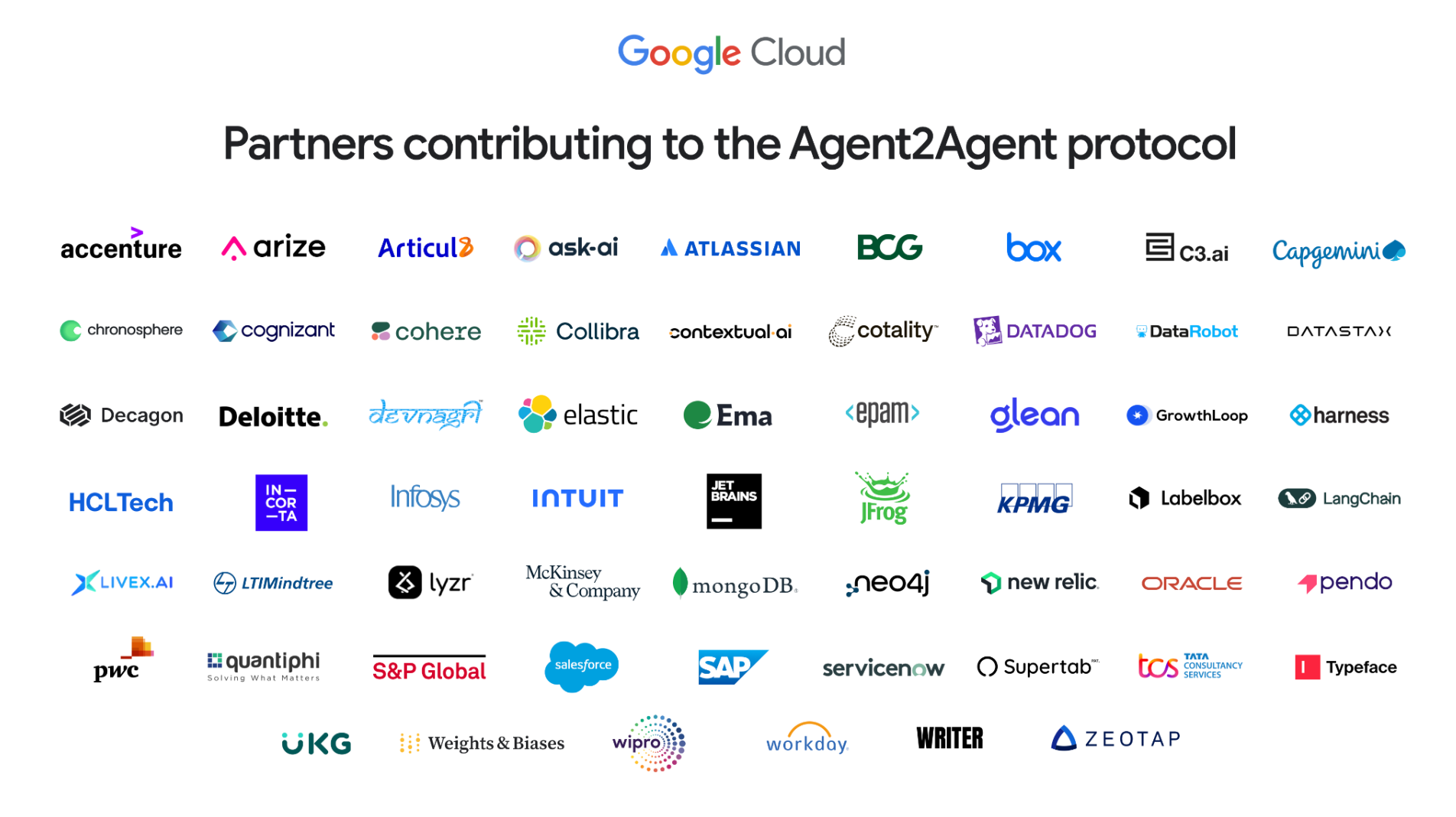
Open source communities continue to provide vital collaborative spaces to define emerging standards, ensuring the interoperability and extensibility for the next generation of technologies. In 2025, we worked with more than 50 partners on the Agent2Agent (A2A) protocol to enable AI agents to communicate with each other, securely exchange information, and coordinate actions on top of various enterprise platforms and applications. Within weeks of our initial announcement, Google donated the A2A project to the Linux Foundation as part of our long-standing commitment to develop "open, collaborative ecosystem – offering greater autonomy and multiplying productivity."

Google Cloud - Partners contributing to the Agent 2 Agent protocol - Accenture, Arize, Articul, ask-ai, Atlassian, BCG, Box, c3.ai, Capgemini, Chronosphere, Cognizant, Cohere, Colibra, Contextual.ai, Cotality, Datadog, and more

Launching tools with transparency

Open source licenses provide a framework for anyone to explore, test, fork and expand on our technologies. Over the last 15 years, Google has created more than 15,000 public repositories on GitHub. Today, Google continues to maintain more than 5,000 public repositories on GitHub, and more than 1,500 public repositories on Git-on-Borg. A quick look back to some highlights from our 2025 launches includes:

  • Gemma 3 – a collection of lightweight open models built from the same research and technology that powers our Gemini 2.0 models. They are designed to run directly on devices — from phones and laptops to workstations — helping developers create AI applications, wherever people need them. Since Gemma’s release in 2024, the Gemmaverse community has created more than 60,000 Gemma variants. We’ve continued work on this collection and in 2026 we released Gemma 4 under an Apache 2.0 license.
  • Agent Development Kit – an open-source framework and SDK designed to help developers build, compose, and run both conversational and non-conversational AI agents.

Adjusting our collective security practices

As the threat landscape evolves and accelerates in the AI era, we are working on novel solutions to mitigate vulnerabilities at scale and remove some of the burden from overloaded maintainers. In 2025, we introduced several critical security initiatives to support upstream open source projects:

  • CodeMender: An agent designed to be both reactive, instantly patching new vulnerabilities, and proactive, rewriting and securing existing code and eliminating entire classes of vulnerabilities in the process. In its first six months, we were able to upstream 72 security fixes to open source projects, including some as large as 4.5 million lines of code.
  • OSS Rebuild: A security initiative to prevent software supply chain attacks by verifying build provenance. It automates package rebuilding and semantically compares results to upstream artifacts to detect tampered code on registries like PyPI, npm, and Crates.io.
  • OSV-Scalibr: (Software Composition Analysis Library) the core engine for vulnerability scanning used internally and in OSV-Scanner.
  • Credential Scanning on deps.dev: A service (using Veles) that actively scans open-source packages on deps.dev for leaked GCP credentials to prevent account compromise.

Working together to sustain the contributor community

Beyond security contributions, we remain committed to providing financial support directly to projects and maintainers. In 2025, the Open Source Programs Office (OSPO) directed $2M in sponsorships and investments to more than 40 open source projects.

Google Summer of Code celebrated its 21st year of enabling open source organizations to find, mentor, and onboard new contributors, directly supporting 1,280 individuals to contribute to 185 organizations. Over its lifetime, the global program has connected more than 23,000 participants from 125 countries with over 1,000 open source organizations globally. Moving forward, we recognize the need to evolve our program structures to ensure they continue to effectively support maintainers in the AI era.

Evolving the way we work in open spaces

Respecting community norms and practices is fundamental to establishing and maintaining trust in open source communities. To ensure we remain supportive members of your community, we encourage projects to document preferred practices and policies in the wake of new technologies. As AI changes the way we work, we are continually evaluating how best to evolve the way we engage in open spaces to preserve, prepare and bolster the communities we depend on.

We are deeply grateful for the many individuals and organizations that have worked with us to create global technologies from which everyone can benefit. You can continue to learn more about our open source initiatives, ongoing programs, and new projects at opensource.google.

Appendix: About this data

This report features metrics provided by many teams and programs across Alphabet. In regards to the code and code-adjacent activities data, we wanted to share more details about the derivation of those metrics.

  • Data sources: These data represent the activities of Alphabet employees on public repositories hosted on GitHub and our internal production Git service Git-on-Borg. These sources represent a subset of open source activity currently tracked by Google OSPO.
  • Business and personal: Activity on GitHub reflects a mixture of Alphabet projects, third-party projects, experimental efforts, and personal projects. Our metrics report on all of the above unless otherwise specified.
  • Alphabet contributors: Please note that unless additional detail is specified, activity counts attributed to Alphabet open source contributors will include our full-time employees as well as our extended Alphabet community (temps, vendors, contractors, and interns). In 2025, full time employees at Alphabet represented more than 95% of our open source contributors.
  • GitHub Accounts: For counts of GitHub accounts not affiliated with Alphabet, we cannot assume that one account is equivalent to one person, as multiple accounts could be tied to one individual or bot account.
  • Active counts: Where possible, we will show ‘active users’ defined by logged activity (excluding ‘WatchEvent’) within a specified timeframe (a month, year, etc.) and ‘active repositories’ and ‘active projects’ as those that have enough activity to meet our internal active-project criteria and have not been archived.

This Week in Open Source for July 16, 2026

Thursday, July 16, 2026

Image

This Week in Open Source for July 16, 2026

A look around the world of open source

We’re diving into another week of open source news and discussions. As the ecosystem continues to evolve, we're seeing more conversations around the intersection of AI workflows, security at scale, and the infrastructure that supports the open web.

This week, we’re highlighting a few "Open Source Reads" that tackle some of the biggest questions facing our ecosystem today—from the complex ethics of AI-generated workflows to the future of federated social networks. We hope these links provide valuable context as we work together to sustain the critical infrastructure we all rely on.

Upcoming Events

  • ASWF Open Source Days (July 19–20) — Los Angeles, CA. Hosted by the Academy Software Foundation, focusing on open source software in visual effects (VFX) and animation.
  • KubeCon + CloudNativeCon Japan 2026 (July 28–30) — Yokohama, Japan. The Cloud Native Computing Foundation's flagship conference in Japan.
  • Black Hat & DEF CON 2026 (August 1–9) — Las Vegas, NV. While primarily cybersecurity, both heavily feature open source hacking tools. The Open Source Security Foundation (OpenSSF) also has a major presence here.
  • FOSSY (August 6–9) — Vancouver, Canada. A highly community-focused open source conference emphasizing grassroots participation and collaboration.
  • Community over Code Asia (August 7–9) — Beijing, China. The Asian edition of the Apache Software Foundation's (ASF) community-first conference.
  • Open Source Summit Korea (August 11–12) — Seoul, South Korea. Hosted by the Linux Foundation, bringing together open source maintainers and enterprises.
  • KubeCon + CloudNativeCon + OpenInfra Summit + PyTorch Conference China (September 7–9) — Shanghai, China. A massive collaborative mega-event uniting open infrastructure, cloud, and AI communities.
  • OSPOlogy + OSPO Summit (September 7) — Shanghai, China. Focused on Open Source Program Offices (OSPOs), governance, and corporate open source sustainability.

Open Source Reads and Links

  • [Blog] Elephants, Goldfish and the New Golden Age of Software Engineering - This isn't directly open source, but with the open source ecosystem trying to find good AI workflows I thought the Elephant-Goldfish model was an interesting take. It makes the distinction between using AI as a toy and using it as a tool.
  • [Article] Open-source AI and the Choice Before Us - The communities with minimal influence on AI development will likely be the most affected by it. This article looks at how strong rules and institutions are needed to guide AI's safe and fair use. The future of AI depends on whether we build systems that include everyone or just deepen existing divides.
  • [Article] Open source carries the world. Patching it at Mythos-scale can't fall to maintainers alone. - The past year has shown that AI is speeding up the discovery of vulnerabilities in open source software. Endor Labs is offering a solution to utilize AI to create patching stop gaps for users of the libraries so that maintainers and contributors have the time to create good quality fixes to these vulnerabilities.
  • [Blog] The AT-URI Syntax Mess - I am very excited about the open social web, especially things happening around the AT protocol. Early misunderstanding led to the current AT URI syntax being invalid. This article looks at the possible ways forward.
  • [Article] The Open Social Web Needs Section 230 to Survive - The open web has always been a promise of free speech. When walled garden social media got involved it created some questions around whether free speech applies to the content served by the corporations running those networks. However, the open social web is not run by corporations. It can be, and it can also be run by individuals federating instances or running their own PDS. So, how do we maintain the free speech promise of the internet with this in mind?

Which of these stories will you be chatting about at your next meetup or conference? Let us know! Share with us on our @GoogleOSS X account or our @opensource.google Bluesky account.

Google Cloud: PostgreSQL community contribution updates

Friday, July 10, 2026

Group photo of the Google Cloud team smiling and standing at the Google Cloud booth during the PGConf India event.

Google Cloud is deeply committed to the long-term success of the PostgreSQL ecosystem. Our involvement goes beyond providing PostgreSQL managed services; it's also about active participation in the open source communities through technical contributions, leadership in conference committees, and sharing architectural insights that benefit all users. Following is a recap of recent events Google Cloud participated in.

PGConf.dev 2026

Serving as a vital developer-centric hub, PGConf.dev provides a unique opportunity for collaboration with the full assembly of senior PostgreSQL committers. This gathering is essential for aligning technical efforts and shaping the future project roadmap.

Key Highlights

  • Participation focused on strategic coordination with PostgreSQL committers regarding logical replication development, and a consultation on global index architecture.
  • High community interest confirms the Global Index feature solves a vital architectural requirement for enterprises.
  • Established community consensus to pursue a deparsing-based architectural approach for DDL replication.

Google Cloud Sessions

ilip Kumar, a PostgreSQL contributor from Google Cloud, presenting 'Experimenting with a Global Index in PostgreSQL' at pgconf.dev 2026 in Vancouver. He is speaking at a podium next to a presentation slide detailing the Global Index storage architecture and PartitionIdentifier management.
Dilip Kumar, a PostgreSQL contributor from Google Cloud, presenting "Experimenting with a Global Index in PostgreSQL" at pgconf.dev 2026 in Vancouver. He is speaking at a podium next to a presentation slide detailing the Global Index storage architecture and PartitionIdentifier management.
Session Title Session Type Speakers/Led by
Experimenting with a Global Index in PostgreSQL: Design, Implementation, and Challenges Technical Talk Dilip Kumar
Unconference: Global Indexes Unconference Session Dilip Kumar
Unconference: Logical Replication: Warts and Missing Pieces Unconference Session Hannu Krosing

PGConf India 2026

Key Highlights

  • The three-day conference was divided into a training day followed by two days of sessions. More than 580 participants attended the conference over three days.
  • The conference sessions included a mix of keynotes, breakout technical sessions, sponsor sessions, and booth interactions.

Google Cloud Sessions

Session Title Session Type Speakers
Database And GenAI Keynote Paresh Rathod
Experimenting with a Global Index in PostgreSQL Technical Talk Dilip Kumar
GCP - Best home to run PostgreSQL Sponsor Session Trusar Borse, Abhijeet Rajkur
Beyond shared_buffers: On-Demand Memory PostgreSQL Technical Talk Rajeev Rastogi, Vaibhav Popat
Where is my Memory Technical Talk Pushkar Kalidkar
Agentic AI Applications with GCP Databases Keynote Abhijeet Rajkur, Rishi Kapoor, Saurabh Gupta

PGDay Paris & PGDay France 2026

France hosts two distinct flagship PostgreSQL events, and Google Cloud is deeply embedded in both as both organizers and technical contributors. While PGDay Paris serves as an international, English-language hub for the European community, PGDay France is a community-driven, traveling event that focuses on the francophone ecosystem, taking place in Toulouse for 2026.

Key Highlights

  • Matt Cornillon served on the organization committee for PGDay France, while Yves Colin contributed as a member of the program committee.

Google Cloud Sessions

Session Title Session Type Speakers
Creating a "Dungeon Master" with Postgres and MCP Technical Talk Matt Cornillon
Create your first AI agent with PostgreSQL Workshop Matt Cornillon, Yves Colin

PGDay FOSDEM 2026

FOSDEM PGDay is a prominent open source gathering that brings together developers from across the globe to discuss the latest PostgreSQL advancements. It serves as an essential platform for exploring emerging paradigms in database development.

Key Highlights

  • Exploration of how AI-assisted workflows are redefining development beyond standard autocomplete for SQL queries.

Google Cloud Sessions

Session Title Session Type Speakers
Vibe-coding with Postgres: really? Technical Talk Matt Cornillon

PGConf Belgium 2026

PGConf Belgium 2026 took place at the UCLL Campus Proximus in Haasrode, Belgium, serving as an outstanding learning and networking platform for the local PostgreSQL community and students.

Key Highlights

  • The session was selected by faculty as supportive material for a database exam following deep student engagement.

Google Cloud Sessions

Session Title Session Type Speakers
Creating a "Dungeon Master" with Postgres and MCP Technical Talk Matt Cornillon

Nordic PG Day 2026

Nordic PG Day is the largest PostgreSQL event in the Scandinavian countries. The 2026 edition took place in Helsinki, gathering more than 130 PostgreSQL enthusiasts for a day of deep dives.

Key Highlights

  • Google joined as an official Partner-level sponsor for the first time, including a dedicated table booth.

Google Cloud Sessions

Session Title Session Type Speakers
Unlock AI Agents with PostgreSQL Technical Talk Mats Berglin, Miguel Toscano

Swiss PGDay 2026

Swiss PG Day is the annual event organized by the Swiss PostgreSQL User Group in Rapperswil, Switzerland. The ninth edition featured sessions in both English and German.

Key Highlights

  • Demonstration of the physical impact of pushing millions of vectors to PostgreSQL based on a real-world use case.

Google Cloud Sessions

Session Title Session Type Speakers
Surviving pgvector in production: a reality check Technical Talk Miguel Toscano

Postgres Conference: 2026 San Jose

Since its inception in 2007, the Postgres Conference has served as a cornerstone for advancement, fostering a rich environment for learning and professional networking.

Key Highlights

  • Google proudly served as a sponsor for the event.
  • Adapting PostgreSQL for the artificial intelligence era demands a transformation in operational approaches. With the rise of natural language tools and vibe coding speeding up development, Agentic AI places advanced demands on production databases. In their presentation, Vikas and Vishal examine how Google Cloud managed services have evolved to handle these workloads, providing architectural strategies and best practices for contemporary AI deployment.

Google Cloud Sessions

Session Title Session Type Speakers
Postgres and AI - Stronger Together! Technical Talk Vikas Arora and Vishal Bagga

Community Leadership and Committees

Googlers play a vital role in shaping the direction of the most prestigious PostgreSQL developer events. Our leadership in these committees helps ensure that enterprise-grade requirements—such as those needed for large-scale migrations—are part of the global conversation.

  • PGConf.dev 2026: Dilip Kumar served on the Program Committee.
  • PGConf India 2026: Dilip Kumar was a member of the Paper Selection Committee.
  • PGDay France: Matt Cornillon was a member of the organization committee and Yves Colin served as a member of the Program Committee.

Looking Forward

Our commitment remains firm: to turn feedback from these global events into code, reviews, and active community partnerships. We thank the wider PostgreSQL community and the project's committers for their continued collaboration in making PostgreSQL better for everyone.

Acknowledgement

We extend our heartfelt appreciation to our open source community contributors for their outstanding dedication and active participation in making PostgreSQL conferences a great success.

Abhijeet Rajurkar, Darshan Nagarajappa, Dilip Kumar, Hannu Krosing, Mats Berglin, Matt Cornillon, Michael Bautin, Miguel Toscano, Niranjan Shivprasad, Paresh Rathod, Rajeev Rastogi, Vaibhav Popat, Vikas Arora, and Yves Colin

Furthermore, we are deeply grateful to the broader PostgreSQL open-source communities, especially the dedicated conference organizers, committee members, and all supporting sponsors.

Community feedback: How can corporations improve support for open source maintainers?

Tuesday, June 30, 2026

Image

We know that AI is actively transforming the sustainability and socio-technical dynamics of OSS communities. Google Open Source is committed to partnering with open source communities and ecosystems to learn together how we should update our own models for engagement and support.

During an open meetup for GitHub Maintainer Month, I led a session to gather community feedback on how corporations can more effectively support open source maintainers.

Paying maintainers takes creativity

Many maintainers would appreciate consistent financial support. However, facilitating payments to individuals without established contractual relationships remains a complex challenge, particularly across diverse international jurisdictions. Fiscal hosts and programs such as Open Collective, GitHub Sponsors, and the LFX Mentorship Program can simplify components of this process, but they do not resolve the underlying issues of funding sustainability and predictability. While initiatives like the Open Source Endowment are working toward long-term funding sustainability, individual maintainers also had a few ideas:

  • Pay per meaningful contribution vs gameable metrics: Avoid payment models based on easily manipulated units like pull request counts or review volume. A proposed alternative is ‘pay per report,' encouraging maintainers to document their achievements and upcoming roadmaps.
  • Commitment-based purchasing: Corporate policies might make procurement simpler (or more complex) than sponsorships, so maintainers could benefit from offering structured support services alongside traditional sponsorship opportunities.
  • Fund conference attendance: In-person networking can be a boon for solo maintainers but it's often cost-prohibitive. For some corporations, travel sponsorship may be a simpler alternative to direct payments.
Challenge for Corporations and Fiscal Hosts: How can we assist maintainers in understanding any and all prerequisites and documentation necessary to participate in monetary programs? Advice from Maintainers: Consult a tax professional to understand the implications of various funding methods.

Manage and respect expectations

Beyond financial support, our discussion returned to the importance of respect and etiquette. Particularly, how can we manage expectations between heterogeneous creators, contributors and users - are maintainers clearly communicating their preferences, and are corporations actively respecting them? Some suggestions include:

  • Adherence to community norms: Maintainers should share their preferred communication channels, while contributors - both human and agentic - must ensure they review and follow them.
  • Consistency with documentation: Discrepancies between documented procedures and actual practices create friction for all participants. This standard should be upheld by both individual maintainers and corporate-managed projects.
  • Clarity of intent: Many maintainers would like to understand the motivation behind a contribution and reserve the right to ask questions.

To improve specific program experiences, maintainers suggested:

  • Consistent communication: Recipients of funding programs expect clearly communicated expectations regarding the timing and amount of disbursements.
  • Transparency and discoverability: Maintainers would appreciate easily discoverable records that track program participation, active agreements, and verify the status of Contributor License Agreements (CLAs).

Let's keep learning as a community

While we cannot make any promises, we want to continue to learn and challenge ourselves to consider novel ways to support OSS communities and maintainers. As a member of our community, we value your opinion. We've created a Google form to collect any thoughts you might have, as well as gauge interest in another open meeting. We plan to share any and all learnings back with the community.

.