Log inSign up
NASA Webb Telescope
NASA
11.6K posts
NASA Webb Telescope profile banner
@NASAWebb

NASA Webb Telescope

NASA
@NASAWebb
The Official *NASA* Webb X account. The world's most powerful space telescope. Launched: Dec. 25, 2021. First images revealed: July 12, 2022.
Lagrange Point 2
nasa.gov/webb
Joined April 2009
63
Following
3.5M
Followers
RepliesRepliesRepostsRepostsMediaMedia

Log in or sign up for X

See what’s happening and join the conversation

Continue with phone
or
Log in with username or email
Terms·Privacy·Cookies·Accessibility·Ads Info·© 2026 X Corp.
  • Pinned
    @NASAWebb
    NASA Webb Telescope
    NASA
    @NASAWebb
    Jul 31
    This July was our 4th science anniversary, and the results have been fascinating! Bringing us previously unseen details from all throughout the universe to right here in our own solar system, Webb has given scientists, and the world, a powerful new set of tools.
    Image
    00:00
    33
  • @NASAWebb
    NASA Webb Telescope
    NASA
    @NASAWebb
    Aug 27
    “Being a star just means that you just find your own special place and that you shine where you are.” - Dolly Parton ✨ An irregular galaxy might seem like an odd place for so many new stars to shine, yet multitudes are forming within the gas that crowds Arp 263.
    An irregular galaxy, appearing like a broad band of tiny stars. It is denser on one side, with a faint cloud of gas among the stars. Clumps of brighter points are newly formed stars, with the largest lights being star clusters, and with many surrounded in glowing blue gas clouds. Plumes of red dust surround the galaxy. A foreground star appears
    37
  • @NASAWebb
    NASA Webb Telescope
    NASA
    @NASAWebb
    Aug 12
    How close is too close to a black hole? Asking for a friend. 😬 Webb just revealed dust and water surviving in the extreme environment of a star located near our Milky Way's supermassive black hole, Sagittarius A*! esawebb.org/images/weic261…
    A bright, densely populated star cluster lies near the centre of the image. One yellow star is labeled IRS 3. A spot in the middle is labeled Sgr A*.
    27
  • @NASAWebb
    NASA Webb Telescope
    NASA
    @NASAWebb
    Aug 11
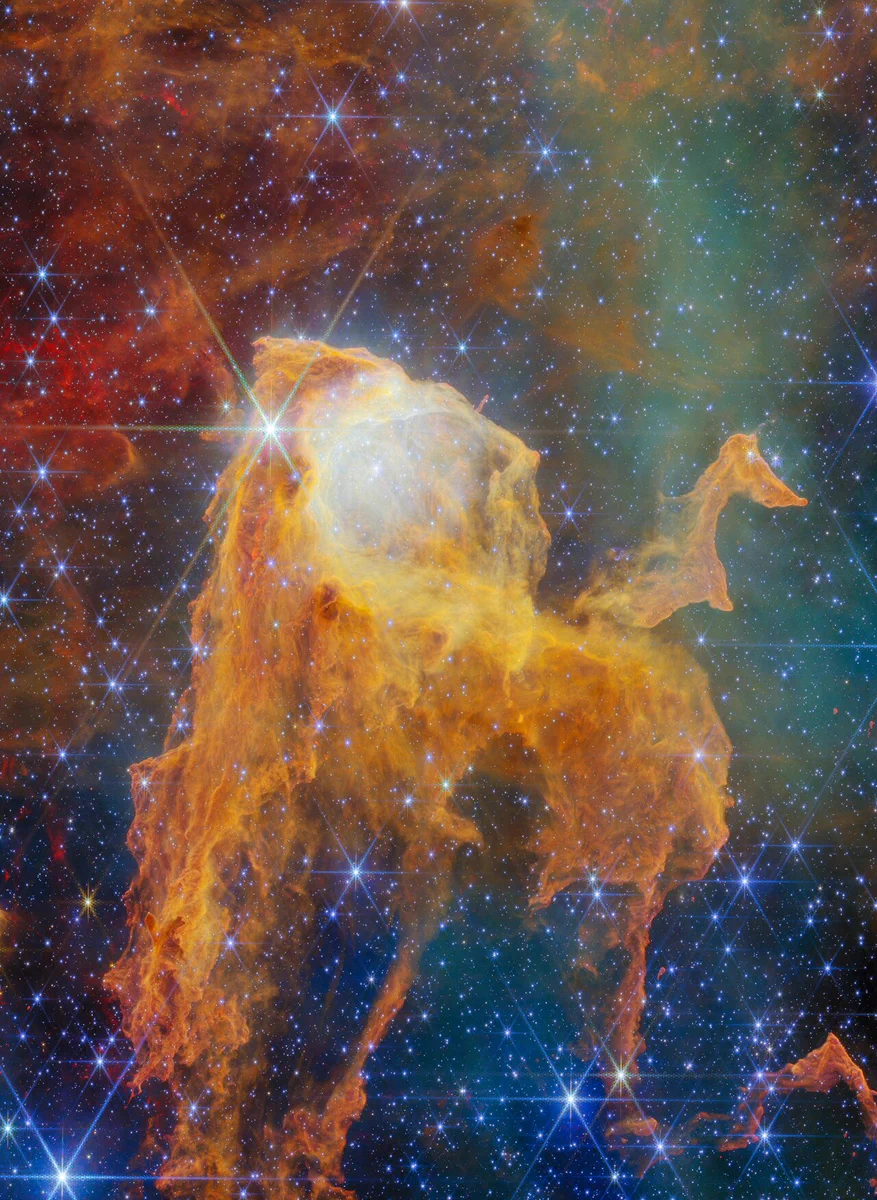
    What animal do you see in this Webb image?! A bird? An elephant? A giraffe? Let your imagination run wild! This is Webb’s infrared view of part of the Carina Nebula, a star-forming region also home to the Cosmic Cliffs, which was one of the first images released by Webb.
     A region of space filled with bright stars and clouds of gas. In the center, the densest clouds form the shape of a chest with its lid open. The chest appears to glow from within. At its base it breaks apart into long pillars of thick gas. Many of the gas clouds in the background are dark orange globules, while others form large, pale hazes. A few brightly shining stars lie in the foreground, the biggest and brightest in front of the chest’s lid.
    115
  • @NASAWebb
    NASA Webb Telescope
    NASA
    @NASAWebb
    Aug 10
    It's the circle of life… Webb's look at the Lion Nebula, the remains of a dying lower-mass star, is in both the mid and near-infrared. Though massive stars undergo supernova explosions at the end of their lives, lower-mass stars shed their outer layers.
    Webb’s near and mid infrared combined image of planetary nebula NGC 2392, the Lion Nebula, against the black background of space. The nebula is at center, circular in shape, and looks like a male lion’s head. In the center is a small, pinkish-white circle with eight-point diffraction spikes, a white dwarf star. Surrounding the star are purple-pink cavernous bubbles and shell-like rings. The bubbles and shells collectively form an oval with two small, wide arcs near the top, reminiscent of a lion’s face and its ears. What appears to be extended outward from the lion’s face is a thick ring of purple-blue material. The width of the ring is consistent throughout and resembles a mane. The area closest to the lion’s face looks cloudy, while the edges of the mane look like there are clumps of dust with comet-like tails. In the background are distant galaxies and stars. Some galaxies are yellow and orange points of light and others have spiral structures. Some stars have diffraction spikes.
    68
Advertisement
Advertisement