1/ Introducing Filecoin Onchain Cloud: an open, verifiable cloud built on content-addressed data, transparent service delivery, and programmable payments.
All onchain. No vendor lock-in.
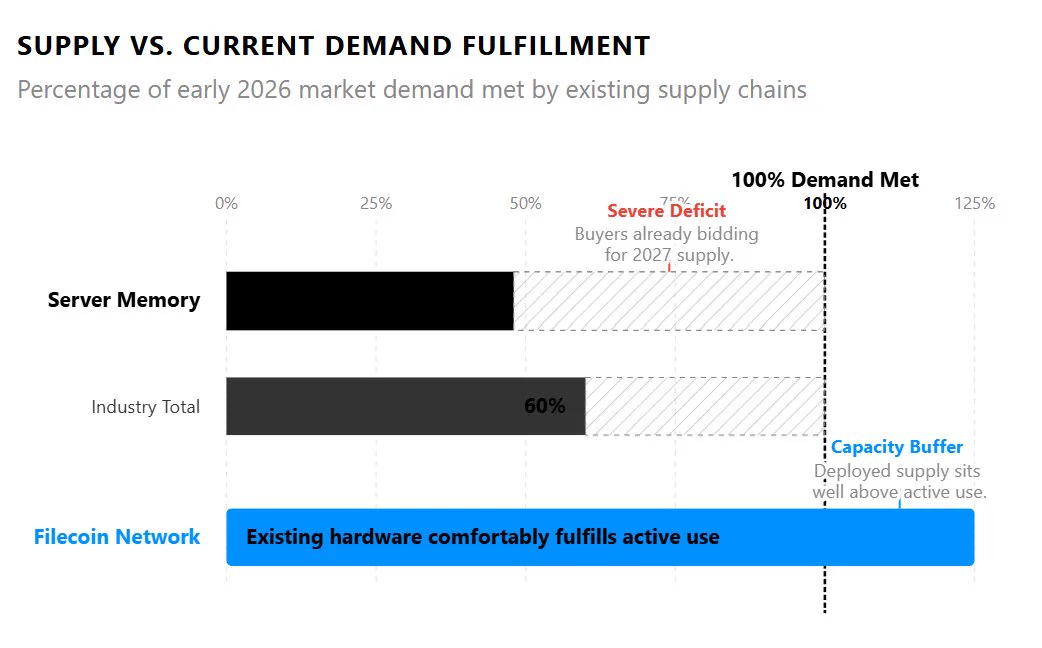
60% is the industry-wide demand fulfillment rate for memory in early 2026, with server memory below 50%, per Samsung's own Q1 earnings remarks, as buyers already bid for 2027 supply.
Filecoin deployed capacity today sits well above what's currently in active use.
Investor-owned US utilities requested $18 billion in rate increases last year, the most since the mid-1980s, regulators approving two-thirds of that value, per Columbia researchers citing federal data.
Filecoin deploys where capacity exists, no transmission costs to pass on.
1/4 A new proposal called Solstice would reorient Filecoin’s rewards structure towards a services economy.
This is one of the biggest changes to network incentives since Filecoin launched.
What it proposes, and how it got here:
4/5 Solstice's service-stream funding lines up with a broader shift: as AI and data-intensive workloads outpace centralized infrastructure, the network's 2026 strategy is focused on converting that demand into paid, onchain usage.
More on the strategy:
Micron disclosed $22 billion in customer prepayments across 16 supply deals, locking in pricing through 2030, after its CEO said in June 2026 that tight memory conditions persist beyond calendar 2027.
Filecoin storage isn't tied to that calendar. It's already running today.
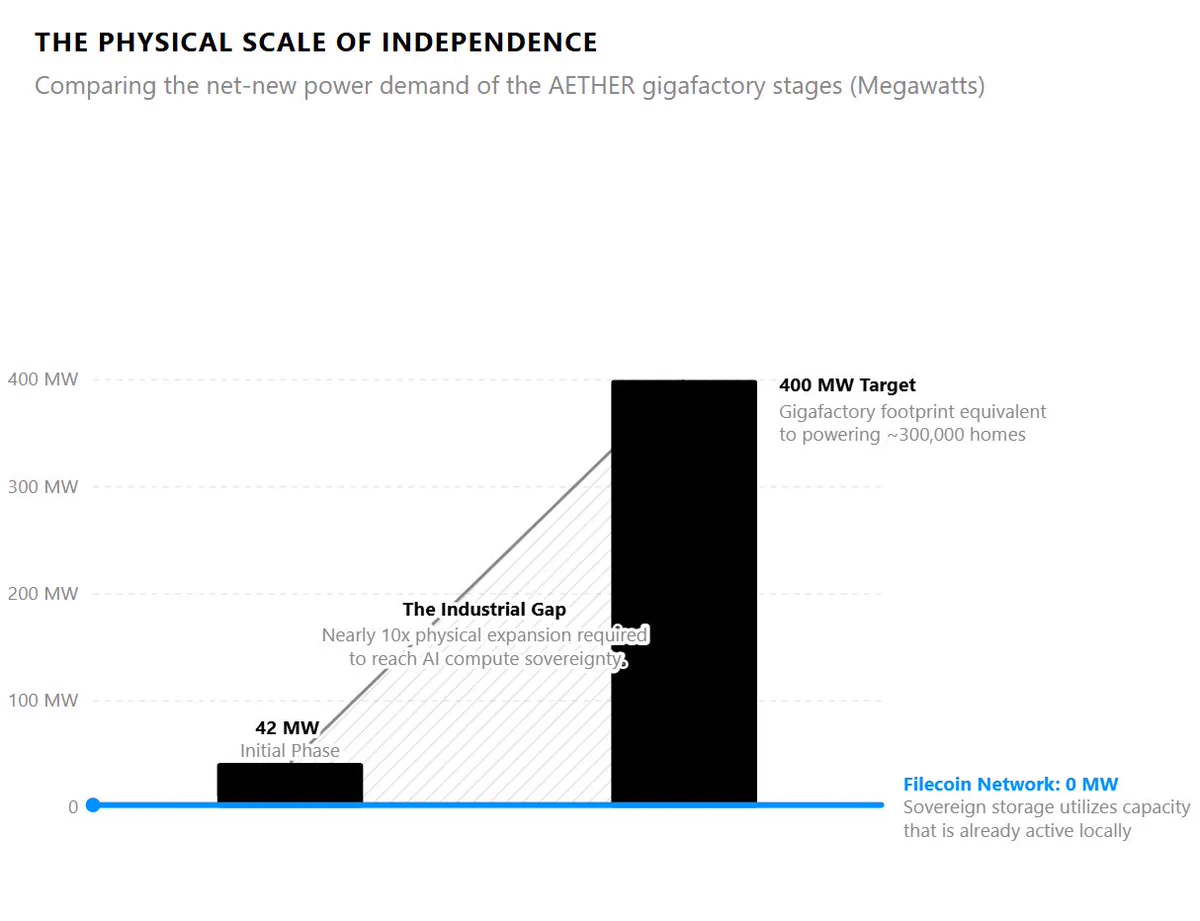
400 megawatts of power is the target for Europe's AETHER AI gigafactory project to end reliance on US hyperscalers.
Achieving digital sovereignty does not require a multi-year industrial buildout.
Filecoin delivers sovereign storage today. The hardware is ready.
NAND flash contract prices rose 55% to 60% in a single quarter as AI infrastructure absorbed nearly all new supply, while HBM producers booked capacity through 2026.
Filecoin storage was never built by manufacturing new chips. It aggregates hardware that already exists.
A European consortium called AETHER is in talks to secure two French sites for AI gigafactories, initial 42 megawatts, long-term target 400, aimed at sovereign AI compute.
Filecoin already covers the storage-sovereignty half of that goal, without the industrial buildout.
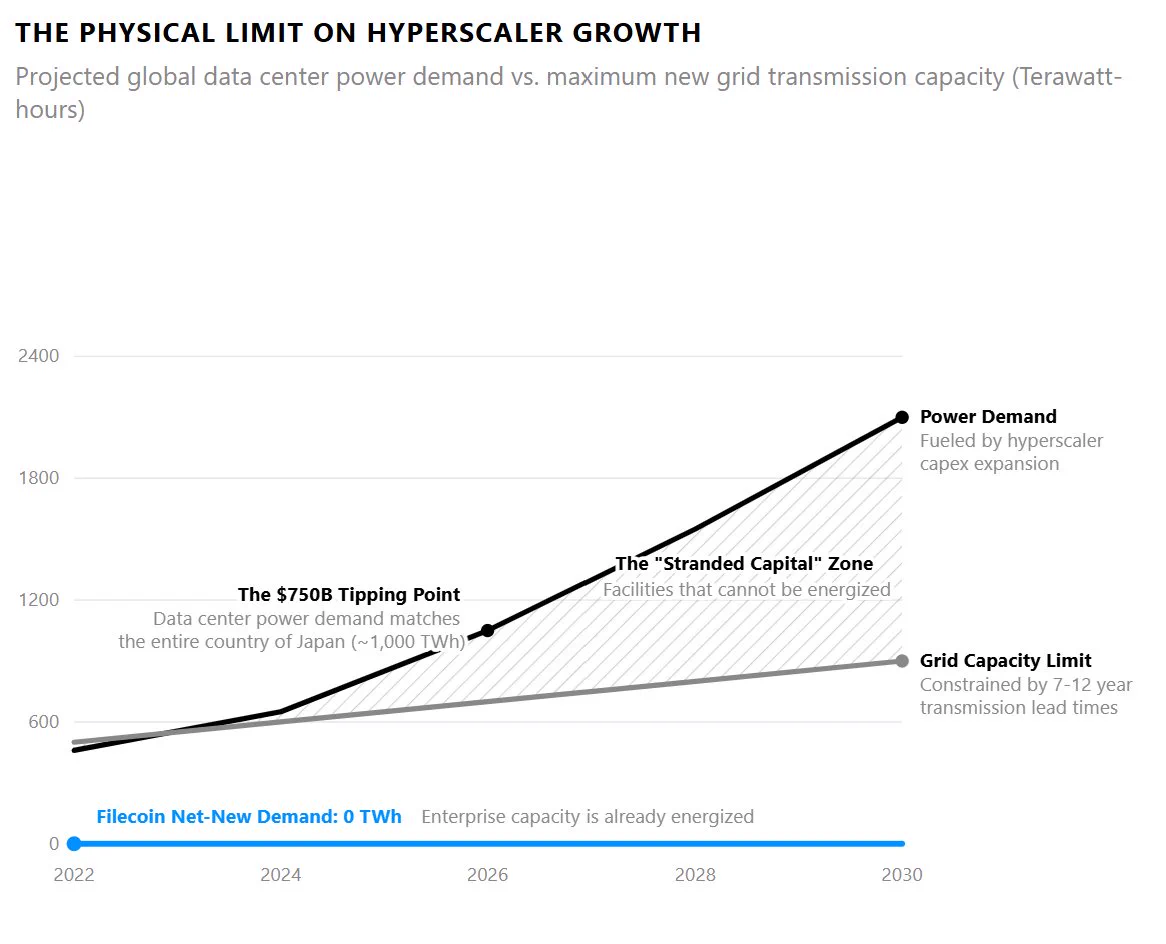
$750 billion in 2026 hyperscaler capex is hitting a physical power wall.
Data centers now demand the grid equivalent of Japan, and capital cannot build transmission lines fast enough.
Filecoin absorbs that demand using enterprise capacity that is already deployed.
$37.5 billion in quarterly capex and a $627 billion backlog cannot bypass physical grid limits.
Transformer lead times now exceed 36 months, with Microsoft's CFO projecting hurdles through 2026.
Filecoin bypasses the queue. The enterprise capacity is already deployed.
A new semiconductor fab costs $10 billion to $20 billion and takes four to five years from groundbreaking to volume production.
SK Hynix CEO says even that isn't enough, supply won't catch demand beyond 2030.
Filecoin's storage capacity didn't wait on one being built.
Western Digital's own CEO said in February 2026 the company is sold out on nearline hard drives for all of calendar 2026, agreements locked through 2028.
Cloud and AI customers now make up 89% of its revenue, up from 40% in 2022.
Filecoin needs no new drives built to grow.
$156 billion across 48 US data center projects was blocked or delayed by local opposition in 2025, per Data Center Watch.
57 active opposition groups in Virginia alone.
Filecoin bypasses this geographic risk entirely. The enterprise capacity is already deployed.
Cost overtook security as the top concern about public cloud for the first time this year, rising from 26% to 31% among IT leaders surveyed by Broadcom.
Filecoin storage pricing comes from an open, competitive market. No single vendor can raise it unilaterally.