1. X
  2. USGS in Montana
Log inSign up
USGS in Montana
US Department of the Interior
2,447 posts
Image
user avatar
USGS in Montana
US Department of the Interior
@USGS_MT
The USGS in Montana -- Science for a changing world. Tweets do not = endorsement (on.doi.gov/pgwu0Y).
wy-mt.water.usgs.gov
usgs.gov/centers/norock
Joined January 2014
116
Following
3,219
Followers
RepliesRepliesMediaMedia

New to X?

Sign up now to get your own personalized timeline!

Create account

By signing up, you agree to the Terms of Service and Privacy Policy, including Cookie Use.

Terms·Privacy·Cookies·Accessibility·Ads Info·© 2026 X Corp.
Don't miss what's happening
People on X are the first to know.
Log inSign up
  • user avatar
    USGS in Montana
    US Department of the Interior
    @USGS_MT
    Jul 16
    Stopping invasive New Zealand mudsnails to protect a fish hatchery 🐚 🐚 The sneaky snails are difficult to spot because of their small size, and it only takes one to start an infestation by producing live offspring without needing a mate. Scientists from the @USGS Northern
    Dozens of New Zealand mudsnails next to a U.S. dime for size comparison.
    2K02K
  • user avatar
    USGS in Montana
    US Department of the Interior
    @USGS_MT
    Jul 15
    Radar isn't just for storms and planes. USGS scientists are pointing it skyward to study flying animals 📡 USGS Northern Rocky Mountain Science Center (NOROCK) scientists and their collaborators mounted a modified marine radar on a NOAA research vessel and collected data on
    A roseate tern landing on weathered wood near green vegetation. The roseate tern is one of many bird species in the Gulf of America that USGS biological radar can study.
    Biological radar on a grassy field, next to a river, with mountains and a colorful sunset in the background. The radar was deployed in western Montana to track army cutworm moth migration.
    1090109
  • user avatar
    USGS in Montana
    US Department of the Interior
    @USGS_MT
    Jun 25
    “Worker bees" isn't just a saying—humans and wildlife benefit greatly from the tireless work of pollinators and USGS science helps support them. The vast majority of flowering plants rely on this vital group of insects to reproduce, including key agricultural crops like fruits,
    Image
    00:00
    1020102
  • USGS in Montana reposted
    user avatar
    NIDIS Drought.gov
    @NOAADrought
    Jun 10
    In 2024–25, fishing generated $1.5B for Montana businesses. To help protect these vital waters, the new TroutCast tool links streamflow data with trout populations, giving resource managers 1–4 week & long-term #drought forecasts. Learn more: drought.gov/news/new-trout…
    An angler holds a trout just above clear, shallow water. The fish features a golden-brown body densely covered with small black spots, a reddish-pink lateral stripe, and a bright orange patch on its gill plate.
    5340534
  • user avatar
    USGS in Montana
    US Department of the Interior
    @USGS_MT
    Jun 10
    Cozy temperatures + quality habitats = more young mule deer 🦌🦌 Resource managers are interested in understanding mule deer population declines because they contribute millions of dollars annually to local western economies through hunting and are culturally and ecologically
    A mule deer buck with antlers walks behind two does through Wyoming sagebrush habitat in winter.
    77077
  • user avatar
    USGS in Montana
    US Department of the Interior
    @USGS_MT
    Jun 5
    We’re not the only ones who have been enjoying the great spring weather—be Bear Aware in the Greater Yellowstone Ecosystem A lot of people are outside in the Greater Yellowstone Ecosystem (GYE) these days. The USGS Interagency Grizzly Bear Study Team has been busy conducting
    A single grizzly bear stands among snow-covered logs.
    2040204
  • user avatar
    USGS in Montana
    US Department of the Interior
    @USGS_MT
    Jun 1
    Introducing FishCast—a tool to help protect Montana’s trout fisheries and economies 🐟 💰 Montana’s world-class trout fisheries generate about $1.5 billion annually through recreational angling, supporting local communities and economies. Extreme drought is expected to become
    Person gently releasing a brown trout into the shallow water of a Montana River with a fishing net nearby.
    Two anglers on the banks on a Montana river with snow-capped mountains in the background.
    8290829
  • user avatar
    USGS in Montana
    US Department of the Interior
    @USGS_MT
    May 8
    USGS Northern Rocky Mountain Science Center (NOROCK) scientists are helping managers understand widespread and potentially lethal threats to native amphibians. 🐸 🐸 Native amphibians are in decline worldwide due to a variety of factors, including the amphibian chytrid fungus
    A close-up of the head and front legs of an Eastern Newt on moss.
    Close-up of a California red-legged frog partially submerged in water with head exposed surrounded by green aquatic vegetation.
    A Columbia spotted frog partially submerged among aquatic plants in clear water.
    1110111
  • user avatar
    USGS in Montana
    US Department of the Interior
    @USGS_MT
    Apr 20
    Information hidden in trees helps researchers understand destructive 2019 Colorado avalanche cycle ⛰️ ❄️ In March 2019, a major avalanche cycle produced more than 1,000 avalanches in Colorado in two weeks causing loss of life, injuries, interstate and highway closures &
    Snow-covered mountain slope with a wide path created by an avalanche cutting through dense evergreen forest under a gray sky.
    Mountain slope with an obvious avalanche path cutting through dense evergreen forest under a bright blue sky. Downed trees in the avalanche path (foreground and background) are present.
    Image
    7140714
  • user avatar
    USGS in Montana
    US Department of the Interior
    @USGS_MT
    Apr 7
    🦫 Beavers are more than builders...they’re engineering lifelines in dry landscapes. 💧 In the arid West, water is scarce, and organisms in these ecosystems rely on habitats that contain this precious resource. Beaver dams slow streamflow, allowing water to spread water across
    An adult and juvenile beaver chewing on vegetation while in water. Photo by USGS
    Beaver dam on a tributary to the Marys River in Northeast Nevada with mountains in the background. Photo by USGS
    3100310
  • user avatar
    USGS in Montana
    US Department of the Interior
    @USGS_MT
    Jan 29
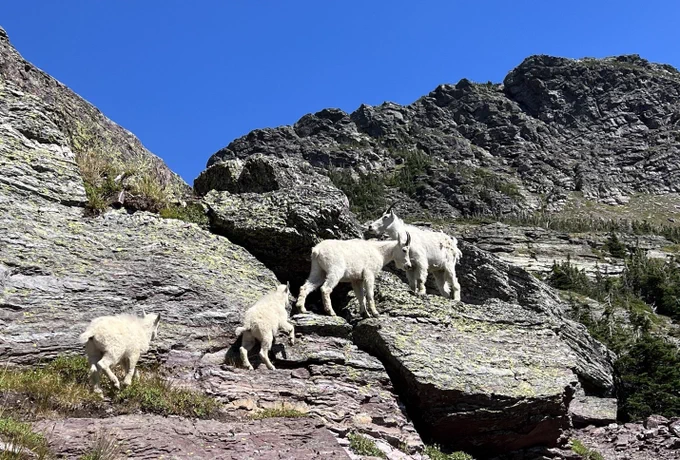
    USGS science is the GOAT! Using @NatlParkService citizen science data, @USGS found the park’s mountain goats declined by about 45% from 2008 to 2019, but goats benefited from areas with more snow and natural mineral licks, and wetter springs. Learn more 👉pubs.usgs.gov/publication/70…
    Four mountain goats on the side of a mountain in Glacier National Park.
    One mountain goat stands atop a boulder while another stands at its base. Boulder is above a snow field at a high elevation site in Glacier National Park.
    7690769
  • user avatar
    USGS in Montana
    US Department of the Interior
    @USGS_MT
    Nov 21, 2025
    In Lake Koocanusa, on the border of MT & British Columbia, federally threatened bull trout can sustain a modest recreational fishery because of harvest limits and an unlikely ally—a nonnative fish it feeds upon. Learn more: esajournals.onlinelibrary.wiley.com/doi/10.1002/ea… #WorldFisheriesDay
    Threatened bull trout—cold-water apex predator. (Image courtesy of Shannon Downey, U.S. Fish and Wildlife Service)
    Lake Koocanusa in northwestern Montana with broadleaf trees and conifers on its shores in autumn. Lake Koocanusa is home to thousands of bull trout whose population is supported by feeding on nonnative kokanee.
    2160216
  • USGS in Montana reposted
    user avatar
    USGS Aquatic Life
    @USGSAquaticLife
    Nov 19, 2025
    Happy GIS Day! Geographic information systems, or GIS, allows us to better understand the world around us. From tracking animals to mapping habitats to assessing restoration project progress, learn how USGS uses GIS to inform natural resource issues: ow.ly/4ss750XunSf
    Image
    Image
    3420342
  • USGS in Montana reposted
    user avatar
    USGS Water Resources
    US Department of the Interior
    @USGS_Water
    Nov 20, 2025
    How does 🔥 #wildfire affect 💧 #groundwater? It depends on local and regional conditions, as well as fire severity and area burned. Read the paper - wires.onlinelibrary.wiley.com/doi/10.1002/wa… #USGS #WaterScience
    Wildfire can have varied effects on groundwater recharge, storage, and baseflow. Read more: Walvoord et al., 2025. Wiley Interdisciplinary Reviews: Water. DOI 10.1002/wat2.60029 (link in caption). Background photo shows green grass in front of a recently burned forest. Image courtesy of Brian Ebel, USGS.
    3680368
Advertisement
Advertisement