The future of AI compute doesn't run on hype.
It runs on real utility, real burns, and a network that gets stronger every time it's used.
The Incentive Dynamic Engine (IDE) is now live!
io.net/blog/a-new-tok…
Four companies control 90% of accessible AI compute.
@nvidia makes the chips. @Microsoft , @awscloud , @googlecloud buy most before they hit market.
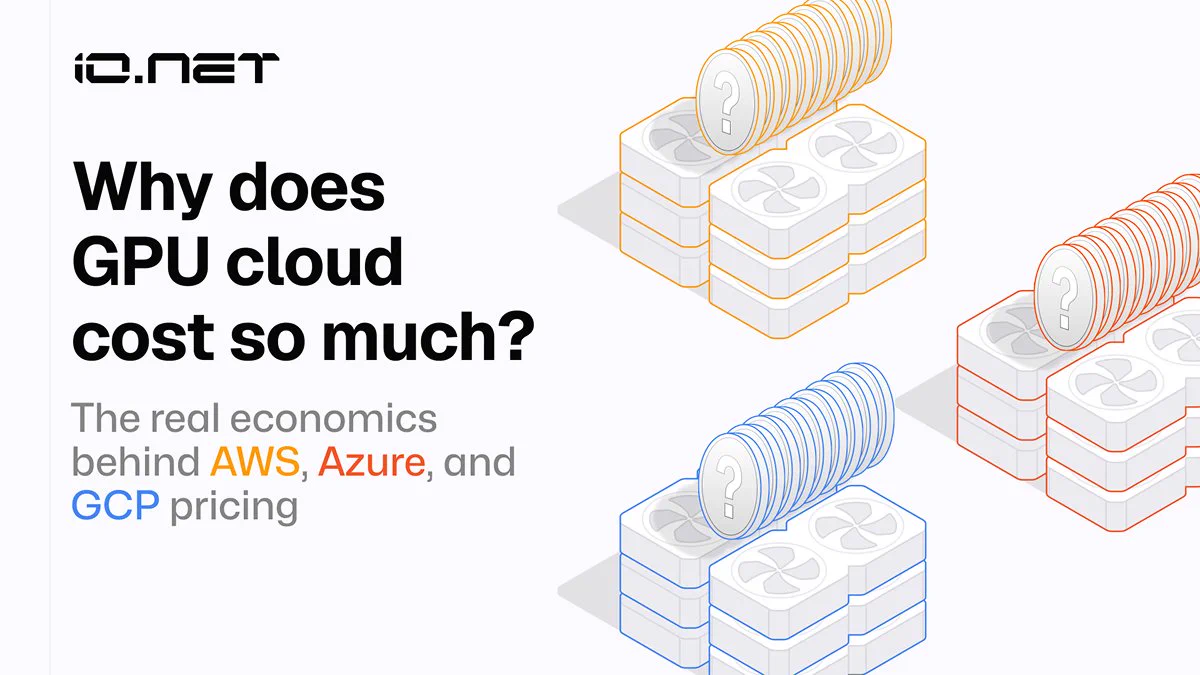
Everyone else fights over what's left. At 3-5x markup.
Run 4x H100 for a month.
Big Cloud: $8,899
@ionet: $4,291
$2.59 trillion will be spent on AI in 2026.
45%+ goes to infrastructure.
Most of it centralized. Locked behind a handful of hyperscalers.
@ionet CEO @Gaurav_ionet breaks down why that's a problem, and what decentralization actually fixes.
New episode of @dealflowpodcast
[EP #53] He Built the Internet's Plumbing for 16 Years. Now He's Doing It for AI
w/ @Gaurav_ionet CEO @ionet hosted by @RealMissAIio.net = Airbnb for GPUs: 70-90% cheaper across 130 countries. Gaurav on Big Tech, onchain mktplace & shipping fast over DevNet
You shouldn't need a waitlist to train a model.
You shouldn't be capped by one company's GPU inventory.
You shouldn't pay hyperscaler margins for compute that's sitting idle somewhere else.
Compute is a global resource.
io.net treats it like one.
First oil.
Then rare earth minerals.
Now GPUs.
AI chips are becoming geopolitical leverage.
When access to compute depends on international politics, innovation belongs to the few, not the many.
That's why open, distributed compute matters.
$32/hr on AWS.
$2.99/hr on io.net.
Same H100 SXM.
That gap isn't just a discount. It's the difference between AI built for hyperscaler shareholders and AI built for everyone else.
72hrs of fine-tuning: $2,359 vs $215.
No egress fees. No 8-GPU minimums when
Meta's Louisiana data center is now projected to cost $250 billion+.
That's not a buildout. That's a bottleneck.
When one facility costs the same as New Zealand's GDP, something has gone wrong.
@ionet changes the equation.
No land acquisition. No permitting delays. No
Access.
It's a driving force at io.net.
We want to give as many people as possible the tools to build.
That starts with our new UI.
Redesigned dashboard. Fewer clicks to a GPU. Clear pricing. No jargon.
Because decentralization means nothing if the interface
$140B+ market.
One real shift underneath it.
Compute used to mean waitlists, minimum commitments, and paying for capacity you don't use.
io.net flips that.
Rent exactly what you need, when you need it, at up to 70% lower cost than centralized clouds.
Burst
One month of the IDE.
1.1M+ $IO burned since June 11th.
122K+ device hours driving those burns.
2.5M $IO rewards paid out.
This is what a token backed by customers looks like.
Usage burns the token. Revenue pays the network.
This isn't a roadmap update. It's a receipt.
io.net is joining Internet Court as a founding partner to build open standards for agent-to-agent contracts.
io.net has already processed 320 billion+ AI inference tokens.
Agent Cloud lets agents provision that compute autonomously.
Now,
Agents can negotiate, pay, and execute - but none of it holds together.
Today we are introducing Internet Court, which is the open skill that connects the entire agentic commerce stack into one flow, so any two agents can run a deal end to end.
→ internetcourt.org
$7 trillion.
That's how much will be spent on building out data centers by 2030.
Over 5% of world GDP.
Someone pays for that. Energy costs, grid strain, and access to compute itself.
That's why we built io.net.
Immediate access. Up to 70% less than
$4+/hr, an 8-GPU minimum, and a 5-year contract.
Or instant access at a fraction of the cost, scaled to what you actually need.
That's the choice in front of AI teams right now.
Enterprise-grade doesn't have to mean "locked in." Check out the full breakdown.