
Momentum is building. Users are signing up, your product is evolving, and growth is accelerating. But many founders overlook a critical element: how privacy is handled from the start can either support or undermine long-term success.
GDPR compliance is not simply a one-time or checkbox exercise. Integrating privacy from the beginning strengthens growth, builds trust with users from day one, and prevents costly fixes later.
While established companies can struggle to retrofit privacy into complex systems, startups have the opportunity to build it into their DNA.
So here’s how startups can achieve GDPR compliance.
At a glance
- GDPR compliance for startups is mandatory if you process personal data of EU residents — regardless of company size or location.
- Build in privacy early with data mapping, clear legal bases, and privacy by design to avoid costly retrofits later.
- Valid consent is critical. It must be granular, explicit, documented, and easy to withdraw.
- Third-party vendors require Data Processing Agreements (DPAs) and ongoing oversight.
- Compliant cookie banners and consent management tools must block non-essential tracking until consent is given.
- Documentation proves compliance. Maintain records of data flows, consent logs, policies, and training.
Why startups should care about the GDPR
Privacy regulations might seem like a burden designed for corporations with massive legal departments. The reality is different. For startups, GDPR compliance represents a competitive edge that’s easier to establish now rather than later.
Building trust from the ground up
Customers increasingly choose products based on how companies handle their data. A clear, transparent approach to privacy isn’t just about avoiding fines. It signals that you respect the people who use your product. This trust becomes a foundation for long-term customer relationships and advocacy.

Designing for the future
Implementing privacy principles early influences how you develop and maintain your product and how you support your customers. Questions about data collection, storage, and use become part of your design process rather than afterthoughts. This approach saves significant time and resources as technology evolves and new regulations emerge.
The shift toward privacy-first development aligns with broader market trends. Advertising platforms increasingly reserve premium inventory for companies demonstrating valid user consent, and investors expect to see thoughtful privacy strategies. Building these practices into your foundation removes obstacles to growth.
Dive deeper into the world of Privacy-Led Marketing — and drive growth with trust-first strategies.
Avoiding costly retrofits
Companies that neglect privacy during the early stages face serious challenges when scaling. Rebuilding systems to comply with the EU’s General Data Protection Regulation (GDPR) requirements — or, worse, as ordered by data protection authorities after a violation — becomes exponentially more complex and expensive as user bases grow and technology stacks expand.
International expansion adds another layer of complexity, requiring adherence to data transfer standards and multiple regulatory frameworks.
Most websites and apps collect data through tracking cookies and related technologies. This means privacy considerations apply broadly, not just to companies in sensitive industries like finance or healthcare. Though businesses handling sensitive personal data do face stricter requirements, foundational privacy practices benefit every startup.
Difference in GDPR compliance for startups
There are a few GDPR exemptions, and generally, GDPR compliance applies equally to startups and larger organizations. But the way it’s implemented differs. Startups have a structural advantage, as well as agility. Privacy can be built into the foundation instead of being added later to existing — and potentially sprawling — systems.
Where enterprise organizations spend months untangling legacy infrastructure and coordinating across departments, startups can implement privacy by design from the first line of code.
This does not make compliance easier, but it does make it more straightforward. There is no accumulated technical debt, no outdated processes to replace, and fewer internal dependencies to manage.
For startups, the challenge is not complexity but prioritization. Small teams balance many responsibilities, and time spent on privacy competes with product development and growth.
This is where clear decisions matter. The goal is not to create enterprise-level privacy structures from day one. It is to put core practices in place that can grow with the business and reduce the need for costly changes later.
GDPR compliance checklist for startups: 13 easy-to-follow steps
A GDPR guide for startups is not about ticking boxes. It’s about setting up a privacy framework that protects user data, builds trust, and supports growth.
The following 13 steps cover the essentials, from understanding how data moves through your business to making privacy part of everyday work.
Some actions need to happen early, others can follow over time. What matters is that none are ignored, since gaps in compliance become harder and more expensive to fix as the company grows.
1. Conduct data mapping
Understanding your data landscape is the foundation of GDPR compliance. You need clear answers to specific questions:

What data are you collecting?
What legal basis justifies each type of data processing?
Where does the data originate?
How is data being used?
Which parties have access to the data?
How long is data retained, and how is it deleted?
Data mapping reveals the full picture of information flowing through your systems. This includes first-party data you collect directly, third-party data from vendors, and cookies that may be active without your explicit knowledge. Many startups discover that third-party tools and integrations collect more data than expected.
Conduct a thorough website audit to identify all data collection points. Be aware that these tend to change over time, so they will need regular review.
Document each data type, its source, purpose, and storage location. This mapping becomes your reference point for all subsequent compliance efforts and helps identify areas where you can minimize collection.
Learn more about GDPR data mapping and best practices.
2. Appoint a Data Protection Officer (DPO)
Appointing a Data Protection Officer brings structure and expertise to your privacy efforts. While not every startup legally requires a DPO, appointing one early establishes accountability and builds privacy into your organizational culture.
You legally need a DPO if your core activities require large-scale, regular, and systematic monitoring of individuals, or if you process sensitive data at scale. Even if these criteria don’t apply, having someone responsible for privacy strategy proves valuable as you grow.
3. Establish data minimization practices
Data minimization is a fundamental GDPR principle, guiding businesses to limit the volume and scope of personal data they collect. It also builds trust with users who increasingly scrutinize data handling practices.
Examine every data collection point in your operations. For each piece of information you request, ask whether it’s essential for the service you’re providing. Forms are a common area for overcollection. Do you need a phone number for email newsletter signups? Does your onboarding flow request information you won’t use right away?
Marketing strategies should adapt to rely less on sensitive user data or third-party data. This aligns with industry shifts toward zero-party and first-party data marketing. Focus on building direct relationships with customers through preference centers and transparent value exchanges.
Lastly, review your data collection practices regularly. As your product or services evolve, some data that was once necessary may become redundant. Establish deletion schedules for information you no longer need. Keep informed about data retention requirements in jurisdictions relevant to your business to ensure you’re neither holding data too long nor deleting it prematurely.
4. Identify the legal basis for processing
Every kind of processing of personal data must have a valid legal basis under the GDPR. You need to identify which basis applies and be able to demonstrate this to data protection authorities if asked.
The six legal bases under GDPR are:

Consent
The individual has given clear permission for you to process their personal data for a specific purpose
Legal obligation
Processing is necessary to comply with the law
Contractual obligation
Processing is necessary to fulfill a contract with the individual
Legitimate interest
Processing is necessary for your legitimate interests, provided these don’t override the individual’s rights
Vital interest
Processing is necessary to protect someone’s life or welfare
Public task
Processing is necessary to perform a task in the public interest
For most startups providing products or services to consumers, consent is the appropriate legal basis. However, consent comes with specific requirements. It must be freely given, specific, informed, and unambiguous. You need to actively obtain it, not assume it, and if processing purposes change, you need to get new consent.
5. Fine-tune your privacy policy
Your privacy policy serves as the contract between you and your users regarding their data. It’s not a formality to hide in your footer, but a critical tool for building trust and maintaining transparency.
Consumers increasingly read privacy policies before engaging with products. According to Art. 12 GDPR, your policy must be concise, transparent, intelligible, and easily accessible. This means writing in plain language, avoiding legal jargon where possible, and organizing information logically.
Your privacy policy should clearly explain:

What data you collect and why
The legal basis for processing
How long you retain data
Who has access to the data
Users’ rights regarding their data
How users can exercise their rights
Your contact information
Keep your privacy policy current as your practices, technologies in use, and relevant regulations evolve. Outdated policies create compliance gaps and erode trust if users discover discrepancies between stated practices and reality.
6. Implement a compliant consent management platform (CMP)
A consent management platform handles the complexities of collecting, storing, and managing user consent according to GDPR requirements and GDPR data subject rights. Implementing a CMP early provides a competitive advantage by demonstrating your commitment to user choice and transparency.
A robust CMP automates essential compliance tasks and handles several requirements:
- Presenting clear information about data use and privacy rights
- Enabling equal and accessible consent choices
- Blocking services until consent is given
- Documenting consent decisions over time
- Adapting to technology and regulatory changes through automated updates
This removes the burden of manually tracking evolving requirements across multiple jurisdictions.
Look for a CMP that enables customization to match your brand, granular consent options that give users meaningful control, and clear documentation of consent decisions that is easily accessible for data subject requests or audits.
The platform should scale with your growth, handling increased traffic and expanding regulatory jurisdiction requirements without requiring you to switch providers or add on an increasing number of costly modules.
7. Adopt a privacy by design approach
Adopting a privacy by design approach means embedding privacy into the very architecture of your systems and business practices, and providing a proactive framework for more complete privacy protection. Some best practices that help include:
Minimize data collection
Before implementing any new feature or workflow, evaluate whether it truly requires personal data. Challenge assumptions about data necessity. Can you achieve the same outcome with aggregated or anonymized data?
Encrypt data
All personal data should be encrypted both in transit and at rest. Use strong encryption methods and protect your encryption keys with the same care you apply to the data itself. Encryption provides a critical security layer in case of breaches.
Anonymize when possible
Strip personally identifiable information from data used for analytics and business intelligence. Anonymized data reduces compliance requirements and protects users if data is compromised.
Embed privacy settings
Make privacy controls accessible and prominent. Users shouldn’t need to navigate complex menus to understand or modify their privacy choices. Default to the most privacy-protective settings and allow users to adjust based on their preferences.
Conduct privacy impact assessments
Regular privacy impact assessments (PIAs) help identify risks in your data processing activities before they become problems. These assessments guide refinements to your privacy protocols and demonstrate proactive compliance efforts.
Train your team
Every employee should understand why privacy matters and how their role impacts data protection. Regular training sessions create a culture where privacy considerations are automatic, not exceptional.
Design transparent interfaces
When requesting consent or collecting data, provide clear explanations in your user interface. Users should understand what they’re agreeing to without consulting separate documentation.
8. Collect granular consent
Granular consent means breaking down permission requests so individuals can make specific choices about how their data is used. This is a GDPR requirement and a trust-building practice.
Your consent mechanism must meet specific criteria:

Specific
Users should know exactly what they’re consenting to, including the purposes for data collection and processing
Voluntary
Consent must be freely given without pressure, manipulation, or service degradation for those who decline
Informed
Provide complete information about who is collecting data, what data is being collected, and how it will be processed and stored
Unambiguous
Require clear affirmative action. Pre-checked boxes and assumed consent from passive behaviors like scrolling don’t meet GDPR standards
Active
Present clear yes/no options with granular choices for different processing purposes
Documented
Record what users consented to, when they consented, and what information they saw at the time of consent
Easily withdrawn
Users must be able to withdraw consent as easily as they gave it, and data processing must stop immediately upon withdrawal
Avoid bundled consent where users must agree to multiple data processing activities to access any service. Each processing purpose should have a separate consent option. This enables users to consent to essential services while declining optional data uses like marketing.
What are the different types of consent, and when are they applicable?
9. Store data in the EU
GDPR compliance for cloud-based startups starts with data storage decisions. The GDPR requires adequate protection for personal data transferred outside the EU. The simplest approach for startups is to store data within the EU where possible, avoiding the complexities and risks of international data transfer mechanisms.
Here is how you can efficiently manage and store your data:
Choose the right cloud provider
Be familiar with the requirements for international data transfers. Where possible, opt for cloud services with EU data centers. Major cloud providers offer options to specifically choose data storage locations within the EU. Ensure these providers comply with the GDPR and offer strong security measures.
Segregate your data
Under the GDPR, collecting, processing, and storing sensitive data comes with additional compliance requirements. Keep sensitive data separate from other information. This practice enables you to enhance security for this category of data and helps you to simplify your data protection processes.
Maintain detailed documentation
Keep accurate records of where your data is stored, the types of data, who can access it, and how long it is retained. Implement logging systems that track data access and modifications to maintain a comprehensive audit trail.
Conduct regular audits
Periodically review your data storage and management practices to ensure they meet GDPR standards. Audit your external providers and internal controls, preferably on a yearly basis, to maintain compliance and address any vulnerabilities promptly.
Implement data minimization
Comply with GDPR principles and the requirements of data protection authorities in EU Member States by only storing necessary data for the required period. Establish clear data retention policies that dictate how long different types of data are kept and ensure data is deleted when it’s no longer needed.
10. Create a Data Processing Agreement (DPA)
When third-party companies handle tasks involving personal data for your startup, you need a Data Processing Agreement (DPA). This applies to cloud storage providers, payroll processors, customer support platforms, and any other service accessing personal data on your behalf.
A DPA is a contract establishing how the processor must handle data. It clarifies responsibilities, security requirements, data protection measures, and processes for handling breaches or data subject access requests (DSARs). Under the GDPR, you as the controller remain responsible for data privacy compliance, including violations by processors working for you.
Your DPA should specify:
The nature and purpose of processing
The types of personal data being processed
Duration of processing
Security measures the processor must implement
Obligations regarding data subject requests
Procedures for notifying you of data breaches
Requirements for returning or deleting data when the processing or contract ends
Don’t assume that even well-established companies automatically comply with the GDPR. Review their practices, request evidence of compliance, and ensure the DPA covers all necessary protections. This due diligence is an important part of a GDPR compliance checklist for startups to protect your company from liability for processor violations.
11. Deploy compliant cookie banners and opt-in forms
Cookie banners are often the first visible signal of how privacy is handled. Under the GDPR, they must do more than inform users. Consent for non-essential cookies has to be obtained before those cookies are set.
A GDPR-compliant banner requires active opt-in. Consent cannot be assumed through scrolling or browsing, boxes cannot be pre-selected, and access to the site cannot be blocked unless all cookies are accepted.
Users must be able to accept or reject cookies with equal effort. The banner should clearly explain which types of cookies are used, such as essential, analytics, or marketing, and allow users to choose by category. Essential cookies that are strictly necessary for the site to function do not require consent, but all others do.
The same principles apply to opt-in forms. Consent checkboxes must be unchecked by default, and the language must be specific. Consent for marketing cannot be bundled with general terms and conditions. Forms should clearly explain what data is collected and for what purpose, so users can make an informed decision.
From a technical perspective, consent must be enforced. Tracking and other non-essential services should not load before consent is given. Showing a banner while cookies are still being set is not compliant. This is where a consent management platform helps by automatically blocking services until valid consent is obtained.
Learn more about cookie banner best practices to increase conversions.
12. Build preference management capabilities
Preference management goes beyond basic consent by enabling users to control their relationship and interactions with your company. This includes communication preferences, feature settings, and data usage choices.
Preference centers empower users to specify how they want to interact with your products and services. They can choose communication frequency, select relevant content categories, and manage which types of data processing they permit. This granular control builds trust and improves data quality.
High-quality preference data enables more effective personalization and marketing while respecting user boundaries. Users who actively choose to share certain information tend to provide more valuable data than those who passively accept default settings, and are more likely to keep it updated as their preferences change.
Implement preference centers that are easy to access, simple to navigate, and immediately effective. Changes should take effect without delay, and users should be able to review and modify preferences at any time.
13. Train your team on privacy compliance
GDPR compliance depends on shared responsibility. Privacy cannot sit with legal or compliance teams alone. Anyone who handles personal data needs a clear understanding of their role.
Training should start with the basics, including what GDPR is, why it matters, and how non-compliance affects the business. From there, it needs to be role-specific.
Developers should understand principles like data minimization and secure handling. Marketing teams need clear rules around consent and communications. Customer-facing teams must know how to recognize and respond to data subject requests.
Privacy training should be part of onboarding, before access to customer data is granted. Existing teams should receive structured training that covers internal policies, data handling processes, and individual responsibilities. Regular refreshers help reinforce key principles and keep teams aligned as requirements and staffing evolve. These sessions can be short and focused to assist retention.
To make training effective, theory should be paired with practical examples. Walking through real scenarios helps teams apply the rules in day-to-day work. Training should also be documented, with records of participation and timing. This shows that privacy is taken seriously and provides evidence of compliance if questions arise.
Download checklistCommon GDPR compliance challenges for startups (and how to overcome them)
Understanding GDPR compliance challenges for startups helps you anticipate obstacles before they derail your progress. The path to compliance isn’t always straightforward. Resources are tight, regulations change, and every third-party integration adds complexity. These challenges are real, but they’re also predictable.
Here’s what trips up most startups, with steps to overcome each obstacle without burning through your runway or compromising your growth trajectory.
Limited resources and expertise
Small teams rarely have in-house privacy specialists. Use guidance from regulators, industry templates, and compliance tools to cover the basics. For more complex questions, consider fractional legal or privacy support instead of full-time roles.
Balancing growth and compliance
Growth pressure can lead to excessive data collection. Align product and growth decisions with privacy from the start, focusing on clear value and first-party data rather than collecting data “just in case.”
Managing third-party vendors
Each integration adds complexity and risk. Keep a clear inventory of vendors that access personal data, review their agreements, and remove or replace tools that are unnecessary or hard to manage.
Keeping up with regulatory changes
Privacy requirements evolve. Follow updates from relevant data protection authorities, stay connected to industry groups, and rely on tools that adapt to regulatory changes automatically.
Documenting compliance efforts
Documentation is often overlooked. Create simple templates early and make record-keeping part of regular workflows. Ongoing documentation is easier and provides evidence of compliance when needed.
The best tools for GDPR compliance for startups
The above is doable manually. However, it can be a lot to keep track of if your startup has limited staff resources.
However, there are multiple tools on the market that can make privacy management achievable without draining your resources. Here are platforms designed to help startups navigate data privacy requirements effectively.
Usercentrics
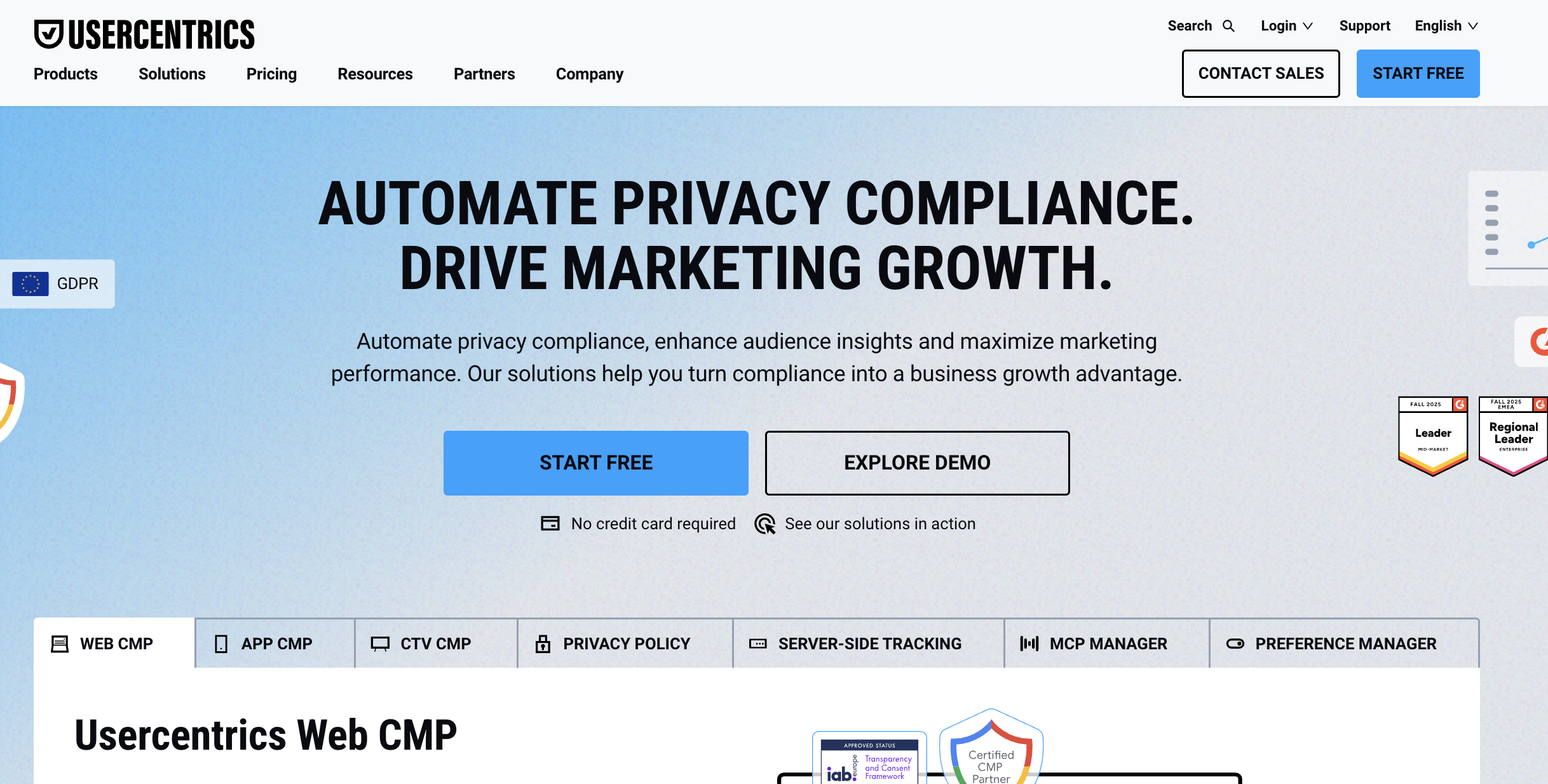
Usercentrics provides consent management software that scales with your company, enabling compliance with GDPR and other global data privacy regulations. The platform is built specifically for businesses that need enterprise-grade privacy tools without enterprise complexity.
For startups, Usercentrics offers a path to compliance that grows with you. We handle the technical complexity of consent collection and management while remaining accessible to teams without specialized privacy expertise. Regular updates ensure your consent mechanisms stay current with evolving regulations across multiple jurisdictions.
Key features
- Automated blocking of non-consented services before user interaction
- Customizable consent banners that match your brand identity
- Multi-configuration support for managing different regulatory requirements
- Granular consent options giving users meaningful control over data use
- Comprehensive consent documentation and audit trails
- WordPress plugin for easy implementation on WordPress sites
- Regular compliance updates reflecting new regulations and guidance
Pricing
- Free trial: 14 days (no credit card required)
- Essential: USD 7/month for up to 1,500 sessions on one domain with one regulation
- Plus: USD 15/month for up to 3,000 sessions on one domain with unlimited regulations
- Pro: USD 30/month for up to 15,000 sessions on three domains with unlimited regulations
- Business: Scalable pricing from USD 50/month for up to 50,000 sessions on ten domains with unlimited regulations
- Corporate: Custom pricing for unlimited domains and regulations, and over one million monthly sessions
Pros
- Automated blocking of non-essential services
- Customizable banners with multi-configuration support
- Easy implementation within WordPress with the WordPress Plugin
Cons
- The free plan is limited to sites with fewer than 50 subpages
- Analytics information is only available for 90 days
Vanta
Vanta is a trust management platform that automates security and compliance, helping startups achieve and maintain global certifications like SOC 2, ISO 27001, and HIPAA. By connecting directly to a company’s tech stack, it moves compliance from a “point-in-time” manual audit to a state of continuous, real-time monitoring.
For startups, Vanta serves as a “virtual security hire,” providing the infrastructure needed to pass enterprise-grade security reviews and close larger deals. While it handles the internal data governance required for GDPR, it’s designed to work alongside customer-facing consent management tools.
Key features
- Automated evidence collection for compliance frameworks
- Continuous monitoring of security controls
- Integration with common development and infrastructure tools
- Automatically generates tailored security policies and uses AI to suggest code fixes
- Compliance dashboard showing progress across frameworks
Pricing
- Vanta does not offer a free trial
- Vanta has custom pricing and you must contact the company to learn more
Pros
- Automation reduces manual audit preparation work
- Real-time monitoring provides ongoing compliance visibility
- Automatically applies evidence from one certification to others
Cons
- No free trial or pricing transparency
- Primary focus on security compliance rather than consent management
Scrut Automation
Scrut Automation is a Governance, Risk, and Compliance (GRC) platform that provides continuous compliance monitoring for more than 50 frameworks, including GDPR, SOC 2, ISO 27001, and HIPAA. It differentiates itself by taking a “risk-first” approach, mapping specific business risks to compliance controls rather than just following a checklist.
For startups, Scrut is particularly effective for those scaling into multiple jurisdictions or complex industries. However, Scrut’s strength is in compliance program management rather than user-facing consent mechanisms, making it complementary to rather than a replacement for a CMP.
Key features
- Reuses evidence across multiple frameworks
- Generates specific fixes for failing security tests
- Automates DSAR, DPIA, and RoPA documentation
- Uses AI to auto-fill vendor security forms
- Centralizes evidence in a portal for third-party reviewers
Pricing
- Scrut Automation does not offer a free trial
- Scrut Automation has custom pricing, and you must contact the company to learn more
Pros
- Covers 50+ global and regional standards
- Accelerates policy creation with 75+ templates
- Centralized evidence management simplifies audits
Cons
- Feature-heavy interface can be overwhelming
- No free trial or pricing transparency
Ketch
Ketch provides a data privacy platform combining consent management, data mapping, and privacy request automation. The platform emphasizes programmatic privacy controls integrated into your technical infrastructure.
For startups, Ketch bridges the gap between simple website compliance and deep data governance. While it offers a “no-code” interface for marketing and legal teams, its API-first architecture remains a preferred choice for engineering teams that want to build “privacy by design” into their product’s core infrastructure.
Key features
- Updates legal language based on user location
- Blocks unauthorized trackers in real time
- Data mapping shows how personal data flows through systems
- Scans and classifies data across 400+ platforms
Pricing
- Ketch offers a free trial
- Ketch provides a permanently free tier for small businesses with basic privacy banner needs.
- Paid plans start at USD 150/month for 30,000 unique users
- The Plus Plan starts at USD 499/month
- Ketch also offers custom pricing for enterprise companies
Pros
- Includes a free forever plan for up to 5,000 users
- Drag-and-drop tools for building complex privacy workflows
- Enforces consent at the user level, not just the browser
Cons
- The intake system requires onboarding one domain at a time
- Advanced automation features require time to master
Osano
Osano is a privacy platform that prioritizes “one-line-of-code” implementation and automated compliance. It’s unique for its “No Fines, No Penalties” guarantee, which provides financial indemnification to customers against certain regulatory fines.
For startups, it offers a fast path to global compliance without needing a dedicated privacy engineer. It manages the entire lifecycle of data privacy, from the first cookie consent to the final fulfillment of a data deletion request.
Key features
- Consent Management automates banners in 50+ countries
- DSAR Automation centralizes and tracks data requests
- Policy Change Alerts notify when vendor terms update
- Data mapping visualizes internal and external flows
- Compliance Guarantee provides financial protection against fines
Pricing
- Osano does not offer a free trial
- Osano has custom pricing and you must contact the company to learn more
Pros
- Simple setup, as it deploys via a single JavaScript snippet
- Evaluates the privacy risk of partners
- Adapts banners to user location instantly
Cons
- No free trial or price transparency
- Features like mapping and DSARs require higher paid tiers
Build privacy into your startup’s foundation
GDPR compliance is a practical foundation, not just a legal obligation. Startups that integrate privacy from the start gain clarity over their data flows, can scale systems without building technical debt, and foster trust with users. Each step, from mapping data to training teams and managing vendors, contributes to a sustainable privacy framework that grows alongside the business.
Taking action early turns compliance from a reactive task into a structured process. By embedding privacy into day-to-day operations, startups can innovate confidently, avoid costly fixes later, and maintain user trust at every stage.

Join our growing community of data privacy enthusiasts now. Subscribe to the Usercentrics newsletter and get the latest updates right in your inbox.