Image

One Bit Sound With The ZX Spectrum

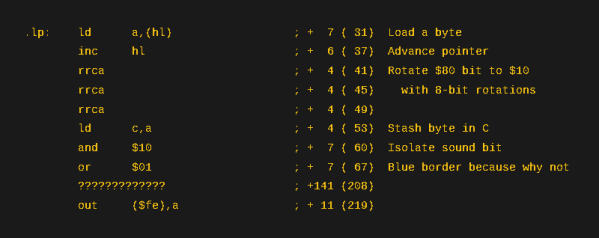
[Michael] has a thing for playing audio over beepers using a single bit. He’s done it with the Apple ][ and the IBM PC. This time he turns to the ZX Spectrum. He didn’t get quite as good a result — at least not yet — but he did manage to get some things working. He documents everything, so even though this wasn’t a successful week, there’s sometimes more to learn from reasonable failures than from unreasonable successes.

Of course, the whole thing relies on pulse code or pulse width modulation. Of the two techniques, PWM should produce better results. However, he wasn’t able to get PWM working yet. Some other target computers drive the buzzer through a dedicated hardware timer. However, with the Spectrum, it is all software.
Continue reading “One Bit Sound With The ZX Spectrum”

Image

A Vacuum Tube Computer For The Home

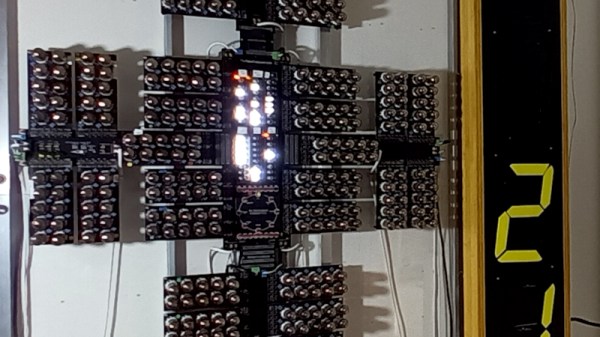
The earliest all-electronic computers used vacuum tubes, and most of us will know about machines such as ENIAC or Colossus. Vast machines that required the budget of a country at war to build, andfill very large rooms. It’s very pleasing then to see that a useful vacuum tube computer can be made which has neither of these requirements, as with this example from [Mike] that uses former eastern bloc double-triodes.

It’s an 8-bit design following a von Neumann architecture with 16 instructions, whose operational block diagram would be instantly recognisable to anyone used to working with a 1970s-era 8-bit microcomputer. It follows a NOR-based design in the same manner as the famous NASA machines from the Apollo programme, and as we understand from the description it uses more modern parts for its I/O circuitry. Physically it’s a surprisingly compact wall-mounted unit, and it has an accompanying ex-British Rail flip-digit display as well as a control panel for a simple airship simulator game. There’s a website with full details, if you are interested.

We like this machine, a lot. It may not be the largest computer we’ve seen and it certainly isn’t the first one with vacuum tubes, but it’s a very impressive achievement to have created it. If tubes in computing interest you meanwhile, we took a trip to see the daddy of them all.

Should [Mike] enter this into the Retrocomputing Challenge? We think so.

Image

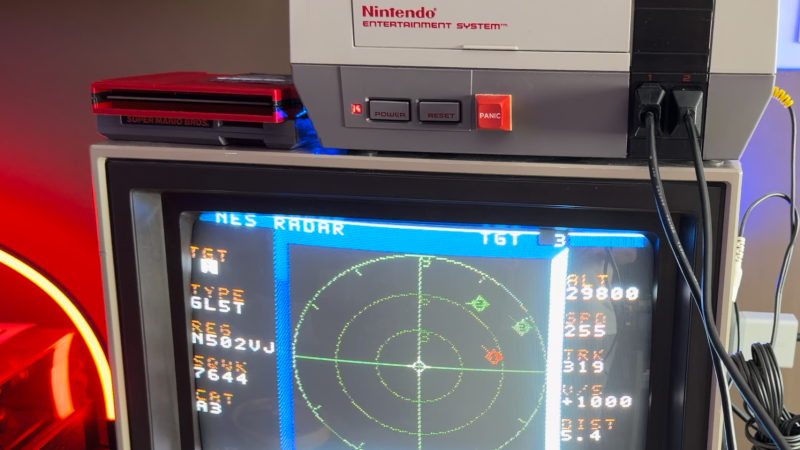
NES Radar Tracks Flights At 9600 Baud

Air traffic visualizers seem to be having a bit of a moment right now, and now that moment has come to the venerable NES thanks to [k6lcm]’s NES Radar project, which is open-source under the GPL on GitHub. In spite of the name, there’s no Radio Direction or Range-Finding involved in this project– no radio at all, in fact, which makes this a bit interesting. It’s just an NES cartridge and a carefully constructed cable.

Continue reading “NES Radar Tracks Flights At 9600 Baud”

Image

WordStar Lives Again (and Again)

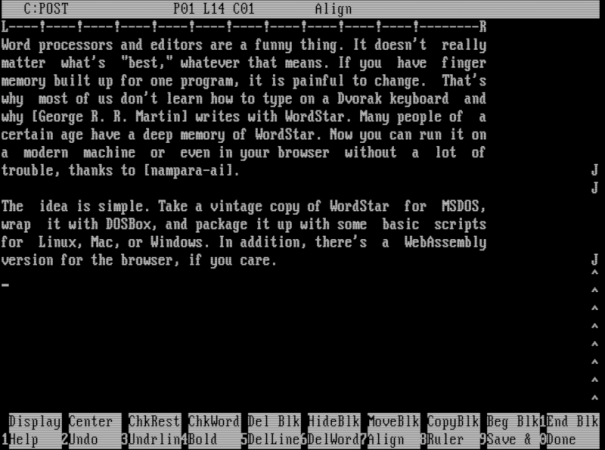
Word processors and editors are a funny thing. It doesn’t really matter what’s “best,” whatever that means. If you have finger memory built up for one program, it’s painful to change. That’s why most of us don’t learn how to type on a Dvorak keyboard and why [George R. R. Martin] writes with WordStar. Many people of a certain age have a deep memory of WordStar. Now you can run it on a modern machine or even in your browser without a lot of trouble, thanks to [nampara-ai].

The idea is simple. Take a vintage copy of WordStar for MSDOS, wrap it with DOSBox, and package it up with some basic scripts for Linux, Mac, or Windows. In addition, there’s a WebAssembly version for the browser if you’re into that sort of thing.

Continue reading “WordStar Lives Again (and Again)”

Image

Running Apple ][ Software On A Commodore 64 — Silently

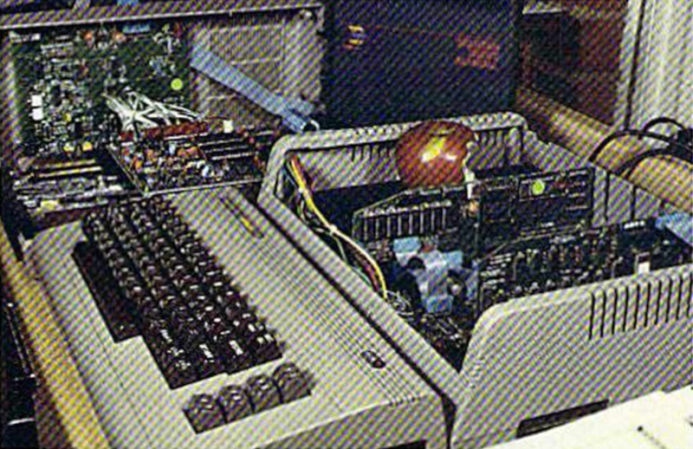
The computer business in 1984 was a bizarre mix of hobby-level companies, a few small companies that had made it big, and a lot of big companies starting to take notice of personal computers. Plenty of money followed, which led to strange products and even stranger ads. [Such Bad Tech Ads] reveals a very bad ad from that time for a product we have barely heard of: the Spartan. The Spartan’s job was to convert your Commodore 64 so it could run Apple ][ software. The ad campaign had, inexplicably, a mime. We think. Or maybe a clown. Hard to say.

On the face of it, the Spartan might not be a bad idea. In 1984, there was plenty of Apple software. Well, relatively, anyway. But a Commodore computer was far cheaper. Other conversion kits like the Intel Inboard/386 managed to find some success in the market later. The problem, outside of strange ads, was one of timing.

Continue reading “Running Apple ][ Software On A Commodore 64 — Silently”

Image

COSMAC Elf Turns 50

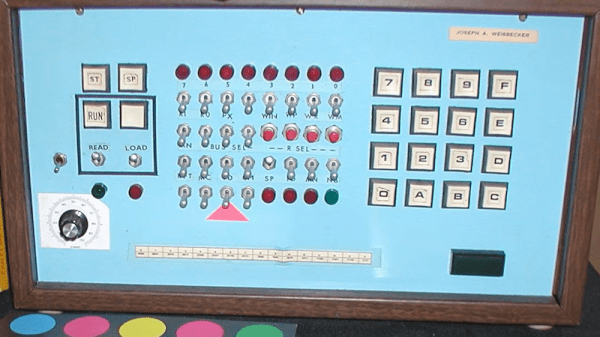
If you were interested in computers in the early 1970s, you struggled to get time on real computers since owning your own was all but impossible. In the middle of the decade, though, you could get a few computers: the Mark VIII, the Altair, the Apple I, and several others. Those were still pretty expensive, though. But in late 1976, an article in Popular Electronics said you could build a “powerful, expandable” computer for $80. The article in question was by [Joseph Weisbecker], who, unknown to most of us at the time, was actually the RCA employee behind the CPU — an RCA 1802. [Tech Time Traveler] takes a close look at the spunky little computer’s history in the video you can see below.

The 1802 was actually the second generation of the CPU, but the first that was all-in-one chip. [Weisbecker] started building the CPU as a personal project. He’d been a hacker even in high school, building relay-based tic-tac-toe games, among other things.

The first incarnation in his lab was “Fred,” with 100 TTL chips, and his idea was to have the computer be at least partially used as a video game — an interesting point, with Pong being very popular at the time.

Continue reading “COSMAC Elf Turns 50”

Image

How A 1981 RAM Expansion Worked

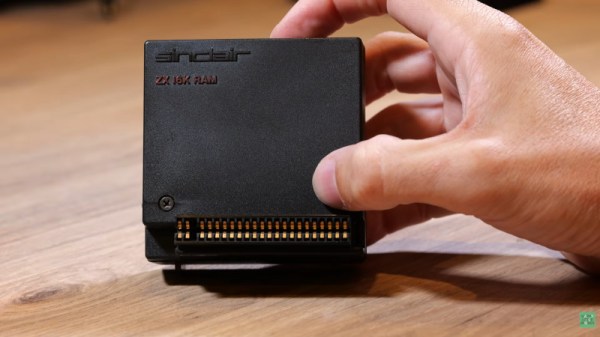
Sir Clive Sinclair and his company were notorious for pushing the limits of electronic parts in search of a low price, and his ZX series 8-bit computers were fine examples of this art. The ZX81 came with a meagre 1K of memory, and a popular upgrade was a 16K RAM pack. [Happy Little Diodes] has opened one up, and to his surprise, found many more parts than expected.

Inside the box is a pair of PCBs connected by ribbon cables, one of which has a selection of 74 chips and the other the 4116 RAM chips and a discrete component power circuit. This complexity comes from that cheapness, the 4116 is an inexpensive DRAM chip and requires an eclectic set of power supplies.

The functions of address selection are straightforward enough, as is the DRAM refresh circuitry. The power supply is clever in that it’s a self-oscillating switcher that provides +12 and -5 volts with a single transistor. We particularly like the quench diode in the 12 V Zener diode regulator  circuit.

The ZX81 gave a huge number of British kids their first taste of computing, and learning to use a limited memory space is something that stays with you for life. The film doesn’t mention the most notorious feature of the 16K pack though, that it had been developed with a machine clamped to the desk. Using one in a real-life location was an exercise in not jogging your machine, because the slightest disturbance would trigger a reset.

The ’81 was also famous for its membrane keyboard. Another popular upgrade back then was a new one.

Continue reading “How A 1981 RAM Expansion Worked”