Log inSign up
Category Theory Papers
8,820 posts
Category Theory Papers profile banner
@CategoryPapers

Category Theory Papers

@CategoryPapers
New Category Theory papers from arxiv.org: enriched categories, topoi. Thank you to arXiv for use of its open access interoperability.
arxiv.org/list/math.CT/n…
Joined October 2009
3
Following
259
Followers
RepliesRepliesRepostsRepostsMediaMedia

Log in or sign up for X

See what’s happening and join the conversation

Continue with phone
or
Log in with username or email
Terms·Privacy·Cookies·Accessibility·Ads Info·© 2026 X Corp.
  • @CategoryPapers
    Category Theory Papers
    @CategoryPapers
    15h
    From Matrices to Morphisms II: Examples of Computational Categories in MATLAB and Octave Nelson Martins-Ferreira arxiv.org/abs/2609.04982 [𝚖𝚊𝚝𝚑.𝙲𝚃]
    This article develops the notion of a computational category, motivated by the observation that many mathematical structures occurring in scientific computing already admit concrete algorithmic representations. Finite sets, finite-dimensional vector spaces, relations, and graphs may all be represented through elementary MATLAB and Octave data structures such as indexing vectors, matrices, logical arrays, and sparse matrices. The central idea is that a category may often be described through a category of canonical representatives indexed by the natural numbers. This viewpoint leads naturally to representative categories whose objects are dimensions and whose morphisms are finite computational data structures. The resulting framework unifies several examples, including matrix categories, index categories, categories of column spaces, row-based models of finite sets, and categories combining finite subsets with finite-dimensional vector spaces through mixed morphisms. The paper also intr
  • @CategoryPapers
    Category Theory Papers
    @CategoryPapers
    15h
    Algebra of spectral duality structures Juan Antonio Vega Coso arxiv.org/abs/2609.04430 [𝚖𝚊𝚝𝚑.𝙲𝚃 𝚖𝚊𝚝𝚑.𝙿𝚁]
    This paper establishes the algebraic and categorical foundations of spectral duality structures (SDS). We show that the class of all SDS admits the structure of a graded monoidal category, in which the degree K is the fundamental invariant indexing the strata. We define the Cartesian product and the disjoint union of structures, together with morphisms preserving the involution and the weights, and we prove that C* = 1/(1+sqrt(K)) is a functor constant on each stratum. Objects are classified up to isomorphism by the combinatorial type (k,f), the degree K, and a multiset of inversion classes [r] = r, 1/r. We further prove that the response rank equals exactly the number of non-trivial pairs k, and we connect the categorical structure with the Fisher-Rao geometry developed in a companion paper. The SDS, originally identified in problems of stochastic resetting, thus emerges as an autonomous mathematical object with a rich algebraic structure and a natural geometric realisation.
  • @CategoryPapers
    Category Theory Papers
    @CategoryPapers
    Sep 4
    Beth companions of finitary essentially algebraic theories Ivan Di Liberti, Luca Reggio arxiv.org/abs/2609.03601 [𝚖𝚊𝚝𝚑.𝙲𝚃 𝚖𝚊𝚝𝚑.𝙻𝙾 𝚖𝚊𝚝𝚑.𝚁𝙰]
    For categories, being balanced (meaning that every arrow that is both epic and monic is an isomorphism) can be regarded as a strong tameness property which plays an important role, for example, in algebra and logic. We study the problem of associating a balanced companion category, called Beth companion, to a locally finitely presentable category (equivalently, the category of models of a finitary essentially algebraic theory). We show that, if it exists, the Beth companion is unique and can be described in terms of saturated objects. Under some additional assumptions, we prove that Beth companions can be computed as orthogonality classes, and admit a syntactic presentation via Gabriel–Ulmer duality. Finally, we establish conditions for the transfer of properties, ensuring, for instance, that if the original category is equivalent to a (quasi)variety, its Beth companion is too.
  • @CategoryPapers
    Category Theory Papers
    @CategoryPapers
    Sep 4
    Stratification of Artin motives over local fields Peng Xu arxiv.org/abs/2609.03514 [𝚖𝚊𝚝𝚑.𝙲𝚃 𝚖𝚊𝚝𝚑.𝙰𝙶]
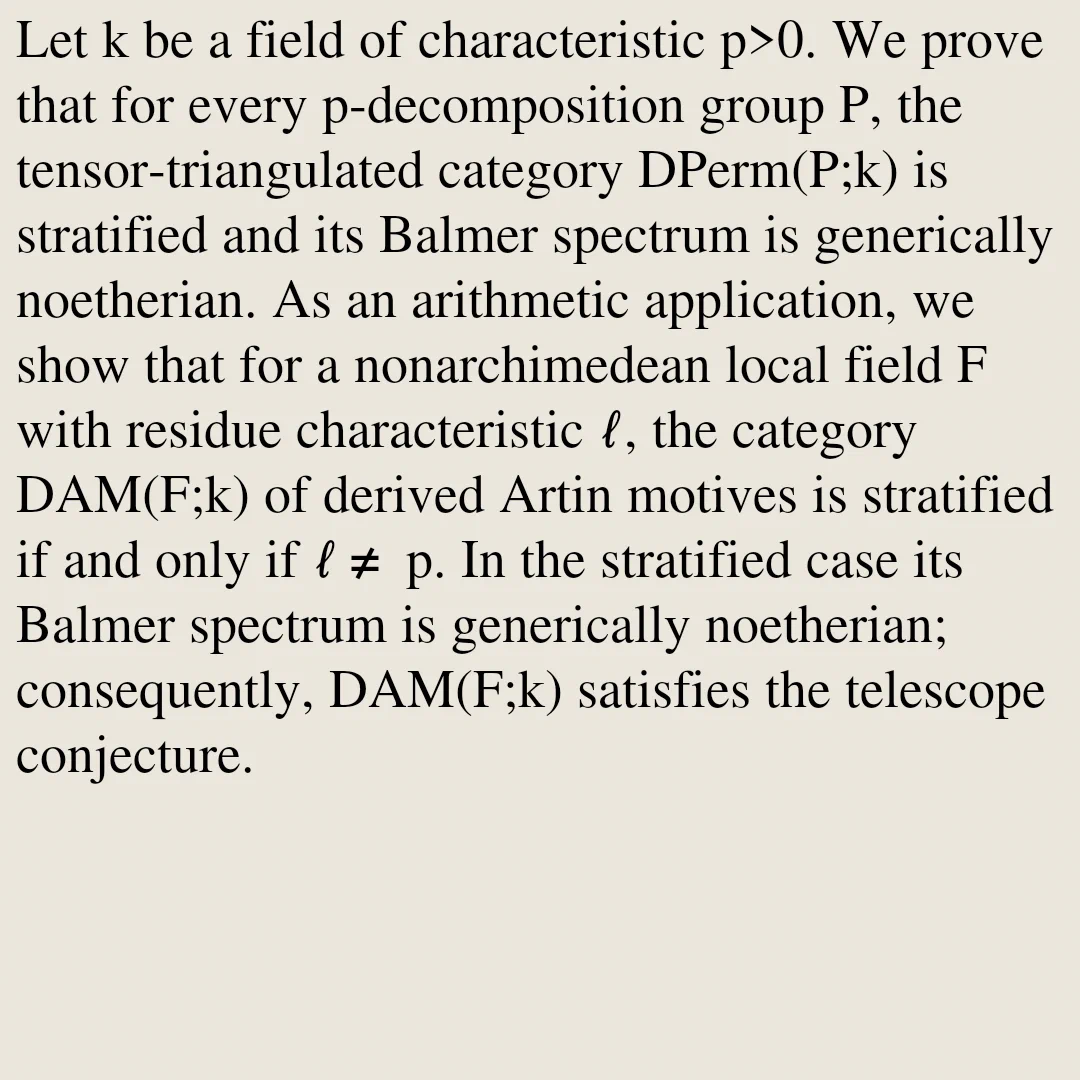
    Let k be a field of characteristic p>0. We prove that for every p-decomposition group P, the tensor-triangulated category DPerm(P;k) is stratified and its Balmer spectrum is generically noetherian. As an arithmetic application, we show that for a nonarchimedean local field F with residue characteristic ℓ, the category DAM(F;k) of derived Artin motives is stratified if and only if ℓ≠ p. In the stratified case its Balmer spectrum is generically noetherian; consequently, DAM(F;k) satisfies the telescope conjecture.
  • @CategoryPapers
    Category Theory Papers
    @CategoryPapers
    Sep 4
    Another counterexample to the Nerves of Steel Conjecture Kevin Coulembier arxiv.org/abs/2609.03489 [𝚖𝚊𝚝𝚑.𝙲𝚃]
    In [B2] Balmer introduced the homological spectrum of a rigid tensor-triangulated category, and had the “nerves of steel” not to conjecture that it was in bijection with the prime spectrum, despite an “avalanche of examples”. Naturally, the statement came to be known as Balmer's Nerves of Steel Conjecture. More recently, in [NVY] the conjecture was stated explicitly and extended to a more general non-symmetric context. In this paper we provide a counterexample to the original suggestion in [B2], so also to the conjecture from [NVY]. A first counterexample was recently constructed in [BHR].
Advertisement
Advertisement