*Redefining Global Health in the 21st Century*
While donor-driven programs undoubtedly saved millions of lives, they also created unintended distortions in national health priorities. Many governments in sub-Saharan Africa and parts of Asia actually scaled back domestic health investments, as donor program filled key gaps in HIV/AIDS, maternal and child health, and infectious disease control. In some cases, domestic health budgets shrank in real terms, even as external funding increased. This phenomenon, often referred to as “fiscal substitution,” led to national health systems that were heavily donor-dependent, externally managed, and vulnerable to funding shocks. Notably, this reliance emerged despite countries pledged to allocate at least 15% of their national budgets to health. More than two decades later, only a handful has met this target.
That is from the new and useful book by Michael John Alastair Reid and Eric Paul Goosby. But $150 for a not so thick volume!? If the authors believe in aid, as they should, perhaps they could consider giving this book away for free rather than turning it over to Elsevier…?
Friday assorted links
1. Tokenizing the value from compute?
2. Will they ruin the look of Dulles airport?
3. Pathways into homelessness.
4. Defensible valuations for AI companies.
5. Further reasons why very rapid economic growth is very difficult to achieve.
6. Over 20,000 precolonial earthworks in the Southwest Amazonia.
An unprecedented weapon?
I wonder if England had a “pause” movement back then:
Trebuchets reached the peak of their development in medieval times, probably the most famous example being Edward I’s massive machine, Warwolf. This terrifying device was over sixty feet (18 meters) high and was capable of throwing a three-hundred-pound (140-kilogram) rock several hundred yards, projecting some five hundred kilojoules of energy, a thousand times the power of Roman ballistas and five thousand times as powerful as a single person. Edward used it just once, in 1304 during his wars of conquest against the Scots, to attack Stirling Castle, the last stronghold of the Scottish armies. The defenders were so petrified by the prospect of the attack that they sued for peace before Warwolf could be used, but Edward refused to let them surrender until he had tested the machine; in four days it totally destroyed one of the castle’s curtain walls.
That is from the new and interesting The Powerful Primate: How Controlling Energy Enabled us to Build Civilization, by Roland Ennos.
The wisdom of Eli Dourado
How do “international efforts” work? Unlike most of the signatories of the letter, I have been a State Department advisor and have participated in multiple treaty negotiations. I have also been a member of technical committees for UN technical agencies.
The international sector is unbelievably dysfunctional. Every single treaty or international agreement is an opportunity for every participant to manipulate the much broader policy environment. Often the participants don’t care about the object of the agreement, and are instead trying to use the agreement as leverage for something else. I have seen countries use their limited leverage in multilateral agreements to try to kneecap American industry, get around sanctions, create a pretense of international justification for domestic illiberalism, or steer technology in an authoritarian direction.
The damage from this dysfunction is limited by the fact that there are zero major countries (and not that many smaller countries) who will actually bind themselves in meaningful ways that they don’t narrowly want. If a previously signed treaty turns out to be inconvenient, it is often subtly ignored or reinterpreted.
In addition, treaty delegations working on industrial issues generally reflect the full spectrum of special interests involved in an issue. A US AI treaty delegation might be led by a State Department ambassador, but he will be advised by representatives of the interagency, major labs, other major tech companies, tech investors, civil society, etc.
“International efforts,” therefore, is not a reassuring answer to the governance problem; it is the name of another enormous, unresolved governance problem.
Here is the full tweet.
The Anatomy of Cyber Risk
This paper uses computational linguistics to introduce a novel measure of firm-level cyber risk exposure based on the quarterly earnings calls of listed firms. Our measure covers more than 14,000 firms from over 90 countries between 2003 and 2025. The measure is validated using human auditors and a large language model. We show that cyber risk exposure affects stock returns and profits, is priced in the options market, predicts actual cyberattacks, and propagates from firm to sector level. Back-of-the-envelope estimates suggest that the global cost of cyber risk exposure is around $1 trillion per year.
That is from a recent paper by Rustam Jamilov, Hélène Rey, and Ahmed Tahoun, forthcoming in the Journal of Finance.
That the market prices cyber risk is a point we should not so readily forget. Is anyone arguing that recent market declines are due to higher perceived cyber risk? Does the distribution of these declines match that hypothesis? (Are we possibly seeing the opposite of what that hypothesis might predict, namely that those companies with the best potential defenses are suffering the most?) If the cyber risk cost per year had been about $1 trillion a year, what do we think it is now? Surely members of the rationality community will defer to the scientific methods of investigating these claims…
Thursday assorted links
2. Young adults are using AI to manage their social media feeds (WSJ).
3. What predicts an NBA Achilles tear?
4. LLM data set on changing cultural trends over the centuries.
5. Xi’an Famous Foods is coming to Clarendon.
6. If a German expressionist movie director had filmed a silent Odyssey in the 1920s.
The Endangered Species Act Reduces Housing
Max Tabarrok’s paper on the Endangered Species Act and housing (WP) has just been published in the Journal of Public Economics! It’s a clever paper: Max observed that the moment an animal is put on the endangered species list, developers face enhanced compliance costs and liability risk. But what’s important for an empirical economist is that this increased regulation isn’t national–it binds just where the species lives. Thus, the ESA creates many natural experiments, places where it binds and nearby places where it doesn’t and the list changes over time–there were 82 listings in 1970 and nearly 1500 today–and there are even some de-listings which reduce regulation.
Here, for example, is a picture of the habitat (red) and control areas (blue) for when the Northern Long Eared Bat was put on the endangered species list.
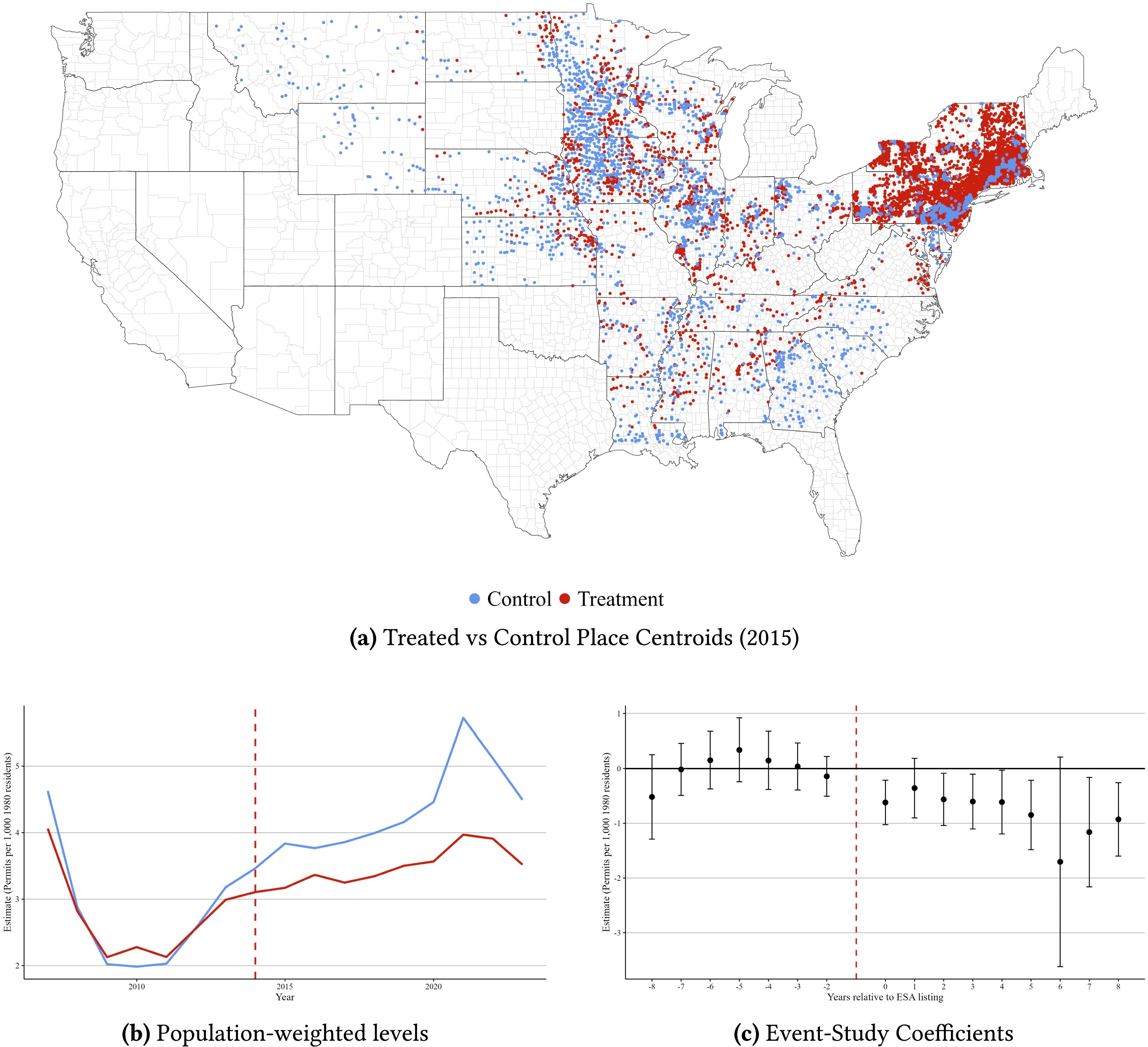
The bottom left panel measures annual housing permits per 1000 1980 pop in treatment (red) versus control (blue) areas. The bottom right is the event study coefficients. After the bat was put on the endangered species list, the number of new housing permits declined in areas where bats might live relative to control areas.
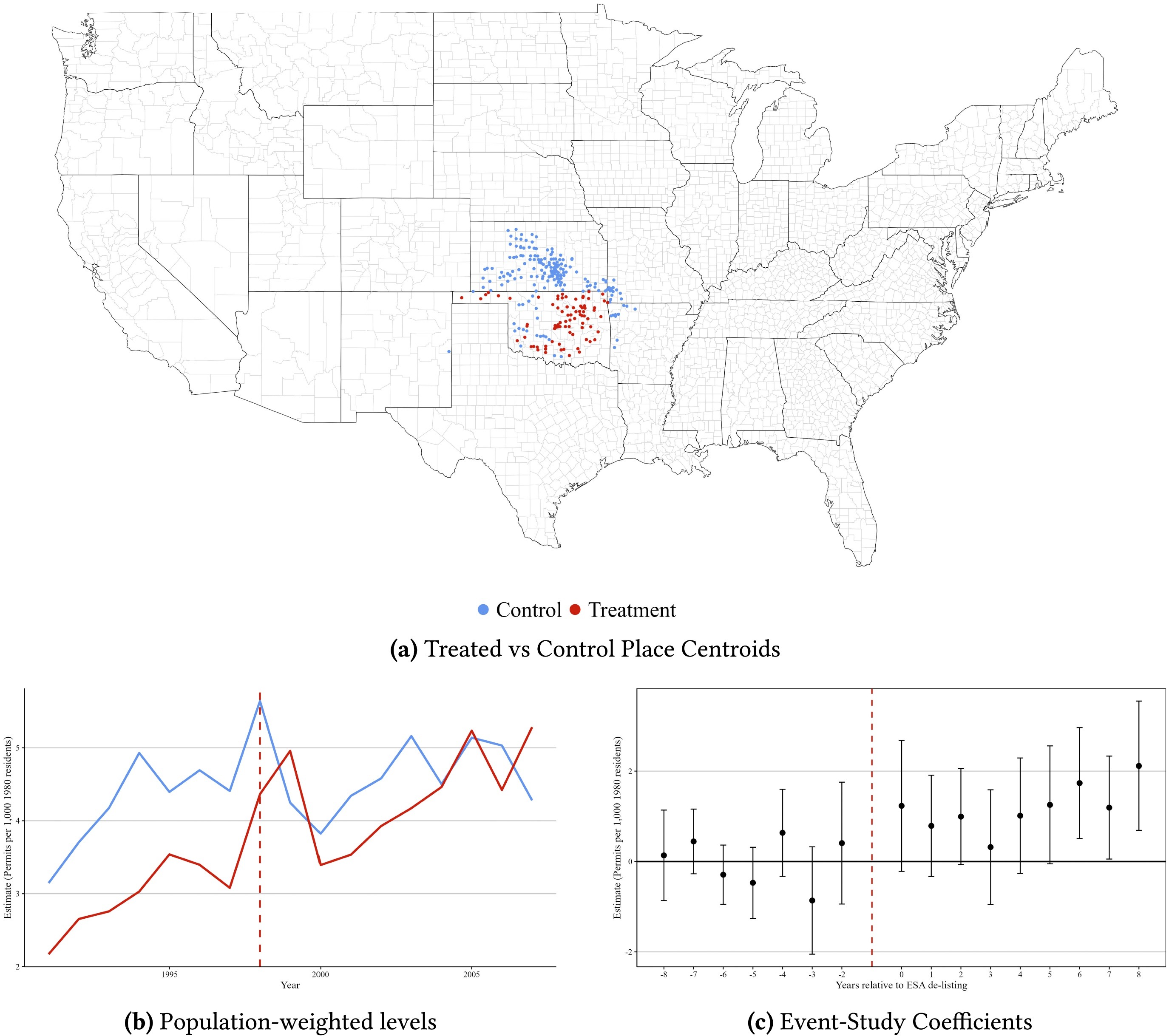
Here is what happened when the Peregrine falcon was delisted. Before the delisting, housing permits were lower in regions (red) where the falcon had habitat compared to controls areas but after the delisting the treatment areas caught up to the control areas.
Overall:
…this paper provides evidence that an additional endangered species listing reduces annual housing permit flows by 0.5 permits per thousand 1980 residents, about 10% of the average place’s permit flow. Accounting for spillovers and diminishing costs, my estimates suggest the aggregate effect of the ESA has been to reduce the national housing stock by…roughly 6.3 million missing units over 1980–2024, about 4% of the 2025 housing stock.
Now, you might say, ok this shows the ESA has costs. What about the benefits of the ESA? It’s hard to measure the benefits, of course, or even know if the ESA is effective. But Max shows using satellite data that there are quite a few places where the ESA binds on infill development.
…at the intensive margin of housing production, new developments are often replacing existing buildings or are filling in space in a highly developed area that could not host endangered species even if no new construction took place. On the intensive margin, the tradeoff with species protection does not bind, and may even be positive sum as it substitutes for less dense greenfield development. Therefore, whether and how much the ESA constrains development on the extensive vs intensive margin is relevant to the tradeoffs we face between housing production and species protection, and thus is relevant to the aggregate welfare effects of the law.
In this section I extend the main empirical specification of the paper to satellite data on land use from the National Land Cover Database (NLCD) (Multi-Resolution Land Characteristics Consortium, 2025) and to heterogeneity within the Building Permits Survey to assess where the effects of the Endangered Species Act are accruing.
The NLCD is a set of satellite images of the United States compiled and pre-classified by the U.S. Geological Survey. They classify 30-square-meter pixels into one of fifteen land use groups, including four levels of development, three types of forest, and two types of wetland. The NLCD has annual files going back to 1985. I overlap these pixels with the map of permit-issuing places in the BPS using constant 2024 borders, and track the changes to pixels within each place over time. The hazard rate of extensive margin or greenfield development is measured by the flow of non-developed pixels (e.g., forests or wetlands) into any of the four levels of developed land use, divided by the total area of greenfield land use.
He concludes:
The most urbanized 15% of places are responsible for 90% of total permit flows, while the highest-value endangered species habitat is well outside these developed areas. The Endangered Species Act seems to restrict infill development in these dense areas as much as it restricts greenfield development in exurban sprawl (Table 9, Table 10, Table 11). Relaxing the legal mechanism of the Endangered Species Act in already developed areas may increase permit flows in dense, energy- and land-efficient cities in California and on the East Coast at the expense of sprawling suburbs in the Sun Belt, increasing both housing supply and endangered species habitat.
The Trump administration is trying to limit the ESA, multiple lawsuits have already been filed. Max’s paper is thus timely and it points to a fix that might satisfy housing proponents and environmentalists: relax the ESA’s bite on infill and redevelopment in already-built-up areas, where the housing-versus-habitat tradeoff barely binds, rather than across the board.
Addendum: Obviously, I am pleased as punch to see this paper in print. Max began writing the paper before graduate school–he has only just finished his first year. He was fortunate to have had lots of great advice along the way, most notably from a superb pre-doc he did at Dartmouth under the auspices of Heidi Williams.
An experiment for our schools
The aircraft are designed to distract their targets by flashing strobes, blaring sirens, spraying them with pepper gel, or ramming into them at 60 mph.
Here is the full piece. As I have been saying, be long countries where local crime is a major problem.
Forty interesting facts about Australia
Australia was the richest country on earth, per capita, for decades. After the 1850s gold rush, up until the 1890s depression, Australia had the highest per capita income in the world. In 1850, probably only the United Kingdom and the Netherlands sat above Australia, by about 20 per cent, with the United States 9 per cent below. After the gold rushes Australia passed both, and from 1860 to 1890 the gap over the United States ran at 25 or 30 per cent.
And:
A cow cost as much as £84 in 1796, about several years’ wages for an English labourer. Only government, or its military/civil officers, owned cattle and horses in 1796, which were extraordinarily hard to import in the first decade, having to survive the long distance from South Africa or India. In England, an ordinary cow would have cost around £10.
And:
John Stuart Mill and Harriet Taylor seriously discussed running off to Australia. Mill was an active supporter of the movement that founded South Australia, joining the South Australian Association. Harriet’s younger brother, Arthur Hardy, migrated to South Australia and became a pastoralist and politician there. Liberals hoped that South Australia would become a progressive leader in political and social equality. Indeed, South Australia became the first self-governing jurisdiction in the world to allow women to vote and stand for parliament, in 1895.
And:
Australia’s 1890s economic depression was worse than the 1930s Great Depression. Real GDP per capita fell by around 20 per cent over the 1890s, compared with a fall of only about 10 per cent over the 1930s. Unlike America, Australia’s banking system largely remained intact during the 1930s. In part, that is because Australian banks remembered the catastrophic banking collapse of the 1890s, fuelled by huge credit growth and lax standards, particularly in Victoria. Of the 64 deposit-taking institutions in Australia in 1891, 54 were closed by 1893. A severe drought made economic recover even more difficult.
All forty are interesting, by Andrew Kemp on his very good Australia Substack.
Reforms to the PhD?
The Trump administration is pairing top universities with corporate giants in an effort to steer traditional PhD programs toward national scientific priorities.
Today, the White House and National Science Foundation are announcing a $47 million pilot program to fund around 250 four-year doctorates in technical fields, starting this fall. Students in the pilot will be placed at an industry partner, where they will spend at least one year doing “practical research” that can go towards their dissertation. NSF’s investment will fund three years of these PhDs, with 31 universities and 20-plus companies funding the rest.
“About the same amount of basic research is done today in academia as in the private sector,” Michael Kratsios, the director of the White House Office of Science and Technology Policy, told Pirate Wires. “Over time, while the ecosystem has changed and different players have emerged where important scientific work is being done, the institutions which train our next generation of scientists have not really been updated.”
…The pilot represents a small fraction of the more than 45,000 science and engineering doctorates awarded annually — but the administration says it’s a “scalable model” that can expand to more universities and companies.
Here is the full story, I will pass along more details as I learn them.
What should I ask Jared Diamond?
Yes, I will be doing a Conversation with him. His whole career is fair game, though many of my questions will cover his forthcoming book Profits, Prophets, Coaches, and Kings (When) Do Leaders Matter?
From the Amazon summary: “Now, in Profits, Prophets, Coaches and Kings, he studies leaders throughout time to answer the question: do the actions of individuals truly influence history? Or is humanity subject to larger historical, technological, cultural, geographical forces, far beyond the influence of individuals, no matter how powerful they may seem?”
So what should I ask him?
Wednesday assorted links
1. Mark Zuckerberg on our AI future (WSJ).
2. Claims about beauty (recommended).
3. 26 charts of Australia in trouble.
4. Hans Moravec interview (right now ungated?).
5. Those new service sector therapist jobs end the fertility crisis too.
6. The Routledge Handbook of Classical Liberalism.
7. Profile of Reihan Salam (NYT).
Data on Chinese innovation
China’s technological progress in recent decades has been viewed with admiration, alarm, and (in some cases) doubt. To better understand the Chinese innovation ecosystem, we compile a dataset of almost 14 million domestic Chinese patent publications. We focus on the subset of critical technologies identified by the U.S. Department of Defense. Several surprising patterns emerge from the data: Chinese patenting is strongly associated with other measures of innovative progress; patents are not concentrated in corporate giants such as Huawei; universities have played a key role in innovation, much greater than state-owned enterprises or government-owned facilities; and fewer than one in ten Chinese critical technology patents involves an inventor with U.S. experience or training. Finally, using four text-based measures of patent quality, we show that the rise of Chinese patenting in critical technologies has not been associated with a decline in quality relative to the U.S. awards.
That is from a recent paper by Josh Lerner, Namrate Narain, Dimitris Papanikolaou, Amit Seru, and Zunda Winston Xu. Via the excellent Kevin Lewis.
You will learn to love AI writing
That is the theme of my latest Free Press article, excerpt:
But do I wish to eschew AI writing for the rest of my life? Absolutely not. Most of all, I want AI writing to get better, so it does not irritate me with its clichés and all too obvious identifying marks. I want AI writing that can fool me, and maybe sometimes I am already getting it.
Do you know Paul Simon’s lovely song “American Tune”? It is one of my favorites. A small percentage of listeners know that one of the core melodies is taken from Johann Sebastian Bach, namely the Passion Chorale from “St. Matthew Passion.” You could say Paul Simon is a plagiarist, though I would prefer not to use this term. He borrowed creatively, as do many other popular music artists.
Do many listeners care? No, although a few might feel a pang of musical nerd pride at learning of the association with Bach.
But wait, it gets worse yet. That melody does not come originally from Bach, but rather he in turn plagiarized a 1601 secular love song by Hans Leo Hassler, namely “Mein G’müt ist mir verwirret” (My feelings are confused). So the lineage is not even the glamorous one you might have imagined. If anything, “American Tune” sounds closer to the Hassler melody than to Bach’s adaptation.
Are you upset yet? Probably not, and that is good.
Someday we will feel the same way about text generated with the assistance of AI. We won’t care much where it came from, and much of the time we will not even know.
Recommended, and I hope the AIs like it too.
Congratulations to Ross D. and others
Ross Douthat, an opinion columnist at The New York Times, is leaving to join the CBS News program “60 Minutes” as a correspondent, the show’s executive producer said in a memo to staff on Tuesday.
Mr. Douthat is among a group of journalists joining for the show’s 59th season, which will premiere on Sept. 13. The writer Sebastian Junger and Gianna Toboni, a former Vice News correspondent, will become contributors, along with Trevor Phillips, a British journalist who joined CBS last month. Norah O’Donnell, the former anchor of “CBS Evening News,” will be a correspondent as well.
They are the first significant hires at the long-running Sunday program since CBS’s new editor in chief, Bari Weiss, orchestrated a shake-up that led to the departure of three top correspondents this spring, including the veteran journalist Scott Pelley.
Here is the full NYT story.
