- Products
- Solutions
- Developers
- Resources
- Company


QDRANT CLOUD
Build Fast, Accurate Vector Search at Scale with Qdrant Cloud
TRUSTED BY ENTERPRISE TEAMS










WHY QDRANT CLOUD
Offload Operations to Qdrant Cloud
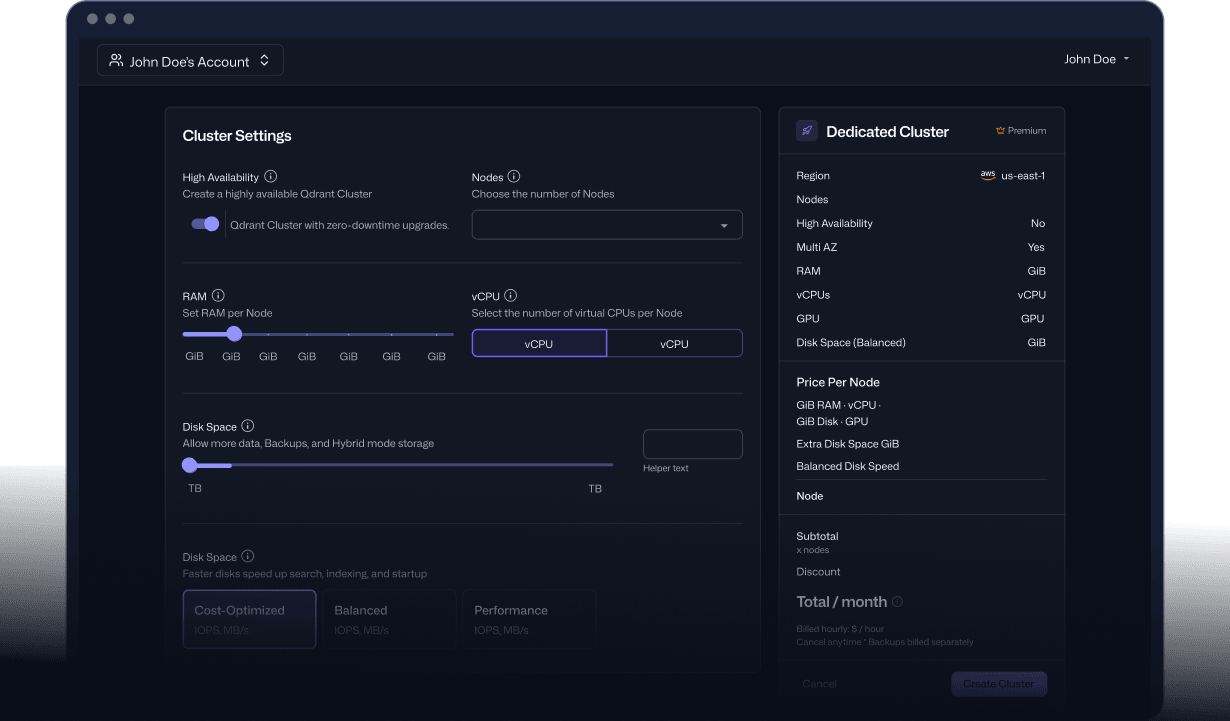
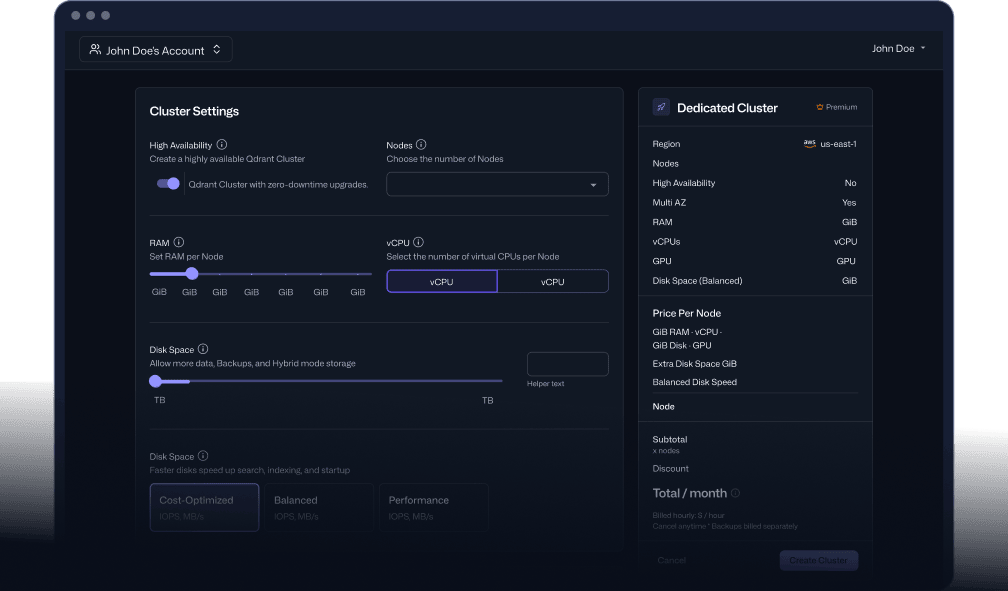
Get the same predictably fast and accurate vector search engine. Qdrant Cloud handles the infrastructure.
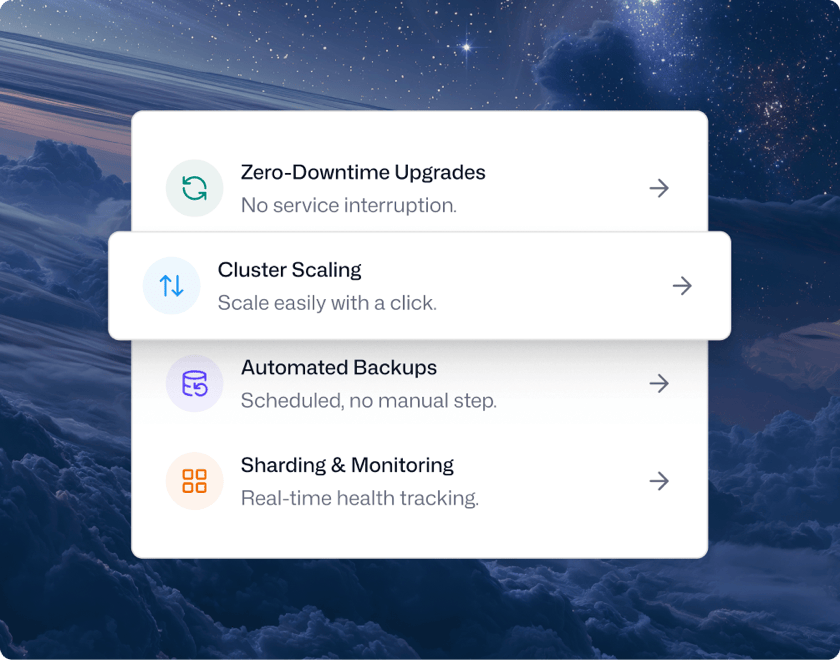
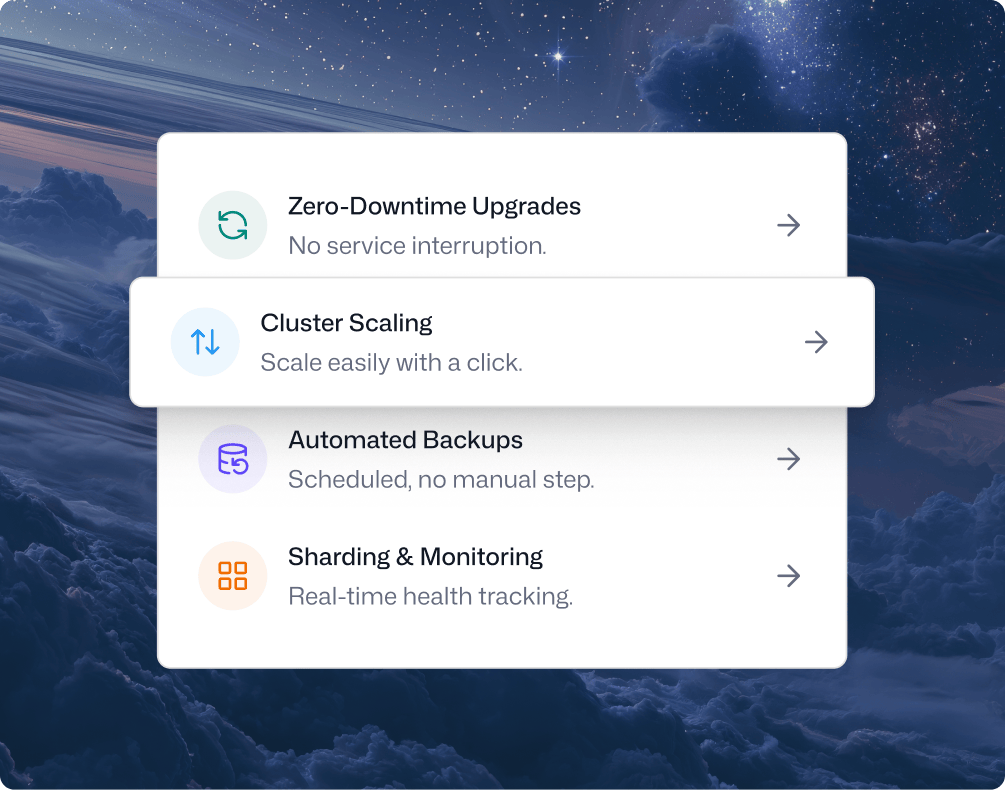
Simplify Cluster Operations
Upgrades, scaling, sharding, backups, and monitoring run continuously without operator action.
Audited Compliance
Certified under SOC 2 Type II, HIPAA, and GDPR. BAA and DPA available on request.
No Vendor Lock-In
The same Qdrant engine, data format, and APIs across self-hosted, hybrid, and managed Cloud. Cloud supports snapshot export to your own infrastructure.
IN PRODUCTION
Customers Building with Qdrant Cloud

2-3x Revenue Lift
Travelers using the generative AI experience show 2-3x more revenue than those using traditional search.

7x Faster Production Time
After replacing their vector stack with Qdrant, Deutsche Telekom cut AI agent development from 15 days to 2 days.

<1s Filtered query response on 14M vectors
Sub-second response times on complex, highly filtered semantic queries across an indexed archive of more than 14 million vectors.
Capabilities Included with Every Cloud Cluster
Each capability is available through the Qdrant Cloud Console and the API.
Composable Search for the Whole Retrieval Pipeline
You choose how each query is ranked, filtered, and scored. Combine dense vectors, sparse vectors, and metadata filters at query time.

Hybrid Search
Keyword and semantic search lives in the same engine. Dense and sparse vectors in one query. Native BM25 and SPLADE++ run alongside dense retrieval.

Filterable HNSW
Latency stays predictable under filters. Filtering integrates with graph traversal, beyond pre- and post-filtering tradeoffs.

Built-in Multivector
More precise multimodal search in one query. Store multiple vectors per object across text, image, audio, video.

Full-Spectrum Reranking
Apply business logic and token-level precision. Score boosting, ColBERT, and Maximum Marginal Relevance in-engine.

Advanced Metadata Filters
Enable more precise and efficient retrieval. Store metadata in JSON and use advanced filters, such as nested, text, geo, has_vector, and more.

Ingestion and Updates
Bulk upserts and streaming. Insert, update, and delete on a live index.

Qdrant Cloud Inference
Embed and query in one round trip. Native embedding generation inside a cluster.

Recommendation API
Get “more like this” with one API call. Positive and negative examples to find similar items.
Control Performance at Scale
The same engine runs from in-memory dev to web-scale production. Tune memory, indexing speed, and capacity for each workload.

Quantization
Up to 32× memory reduction. Scalar, TurboQuant, and binary help strike a balance between accuracy, storage efficiency, and search speed.

On-Disk Storage
Offload cold vectors and payloads to disk to reduce RAM cost.

Vertical and Horizontal Scaling
Shards rebalance automatically, maintaining optimal performance. Scale clusters up, down, or out.

GPU Indexing
Up to 4× faster HNSW indexing. Every node in your cluster gets a dedicated GPU with a simple toggle.

Flexible Multitenancy
Serve thousands of tenants per cluster with payload-based separation. Promote noisy ones to dedicated while traffic continues.

SIMD and Async I/O
SIMD acceleration across x86 and ARM. io_uring keeps disk throughput high on Cloud volumes.
High Availability and Recovery
Engine-handled operations on highly available clusters. Continuous backups and live upgrades.

Zero-Downtime Upgrades
Engine upgrades run while the cluster serves traffic. Multi-version supported.

Multi-AZ Replication
Up to 99.95% SLA. Three availability zones with automatic failover.

Backups and Disaster Recovery
Scheduled incremental backups, on-demand snapshots, and restore to any cluster.

Snapshot Export
Export snapshots to your own object storage for long-term retention or DR.

Engineering Support
Guaranteed response times on critical incidents. Business-hours coverage on Standard, 24/7 on Premium.
Defense in Depth for Production Workloads
Encryption on every channel and volume, granular access control, and private network options. Compliance-ready under SOC 2, HIPAA, and GDPR.

Compliance
Reports available under NDA. SOC 2 Type II, HIPAA with BAA, and GDPR with DPA.

Encryption in Transit
End-to-end protection in flight. TLS 1.2+ on every API endpoint and replication channel.

Encryption at Rest
Storage protected by default; Premium adds customer-managed keys. AES-256 on storage volumes.

Private VPC Links
Traffic stays on private networks. AWS PrivateLink and GCP Private Service Connect.

IP Allowlisting
Define your network perimeter explicitly. Restrict cluster access to specific CIDR ranges.

Single Sign-On (SSO)
Manage Cloud access through your existing identity provider. SAML 2.0 with Okta, Azure AD, Google and others.
Monitoring and Observability Toolkit
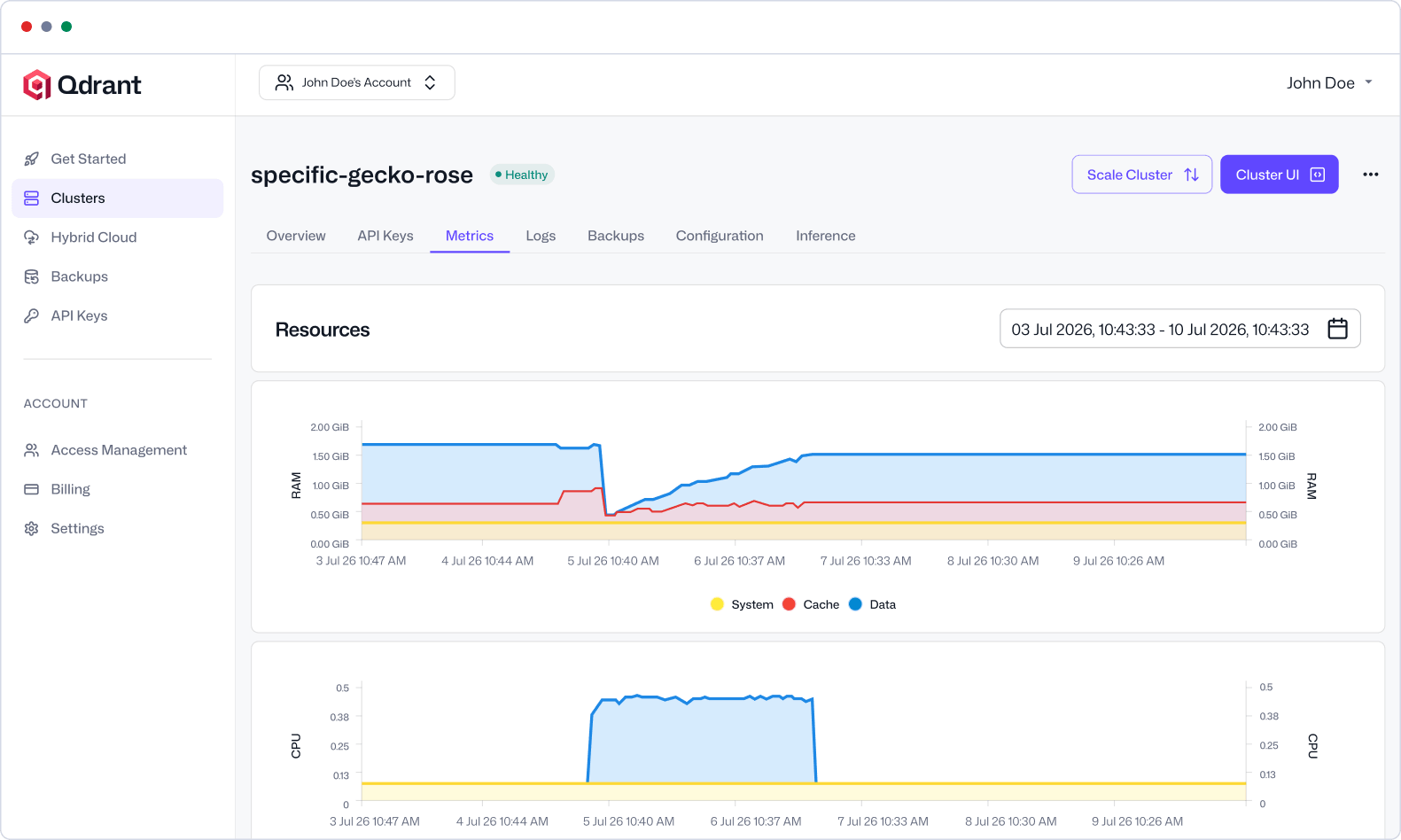
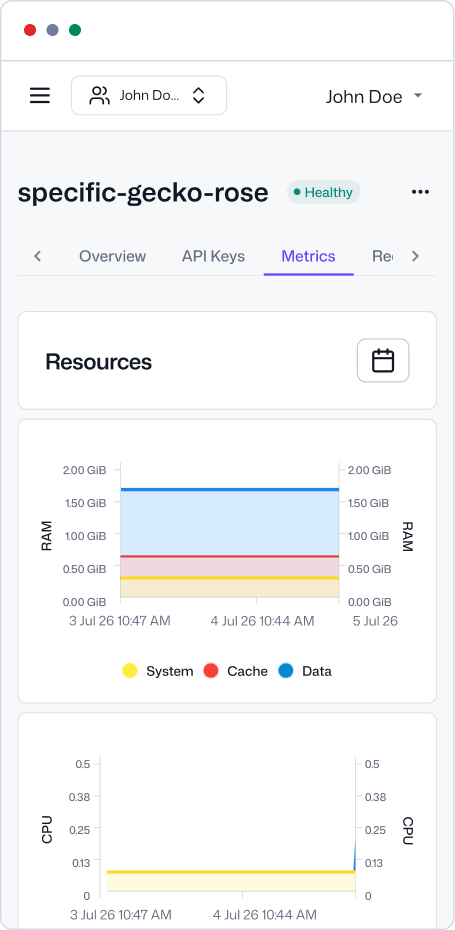
Monitor cluster health, audit every API call, and visualize capacity in real time. Configurable retention for compliance.

Prometheus Metrics
OpenMetrics-compatible /metrics and /sys_metrics endpoints on every cluster.

Grafana Dashboard
Reference dashboard for cluster health, query latency, and capacity.

Audit Logging
Logs every API operation: caller, target, and outcome in structured JSON.

Capacity Alerts
Alerts at 80% RAM and disk utilization, plus CPU throttling.

Health Endpoints
Kubernetes-style /healthz, /livez, /readyz on every node.

Telemetry
Per-segment, per-shard internals with configurable verbosity.
GETTING STARTED
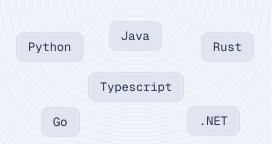
Qdrant Cloud Across Your Stack


TRY QDRANT CLOUD
Spin Up a Qdrant Cluster

Try Cloud Free
Spin up a permanently free cluster in under 90 seconds. No credit card, no minimum spend, around one million 768-dimension vectors.
Start Free
Talk to a Solutions Engineer
For SOC 2 evidence, HIPAA BAA, sizing help, or enterprise procurement.
Talk to Engineering
Run Open Source Locally
Pull the Docker image or clone the repo. Same engine, same APIs as Cloud. Apache 2.0.
View on GitHubFAQs
Is there a free tier?
What clouds and regions are supported?
Which clients and SDKs do you support?
Can I bring my own embedding model?
How is pricing calculated?
Are there overage charges or surprise bills?
Do you offer startup or research discounts?
What query latency should I expect?
How fast can I ingest data?
How does quantization affect recall?
How do I scale up or down?
What happens when my cluster gets full?
Is multi-region supported?
What's your SLA?
How do backups work?
What's your disaster recovery posture?
Are you SOC 2, GDPR, and HIPAA compliant?
How is data encrypted?
What does audit logging capture?
Are you EU-based?
Is migrating from Qdrant Open Source to Cloud difficult?
How do I migrate from another vector database?
Can I move workloads back from Cloud to OSS later?
What happens if Qdrant Cloud goes away?
What support tiers do you offer?
How fast do you respond?
Do you have a community channel?

