1. X
  2. NASA Webb Telescope
Log inSign up
NASA Webb Telescope
NASA
11.5K posts
Image
user avatar
NASA Webb Telescope
NASA
@NASAWebb
The Official *NASA* Webb X account. The world's most powerful space telescope. Launched: Dec. 25, 2021. First images revealed: July 12, 2022.
Lagrange Point 2
nasa.gov/webb
Joined April 2009
63
Following
3.5M
Followers
RepliesRepliesMediaMedia

Log in or sign up for X

See what’s happening and join the conversation

Continue with phone
or
Log in with username or email
Terms·Privacy·Cookies·Accessibility·Ads Info·© 2026 X Corp.
  • Pinned
    user avatar
    NASA Webb Telescope
    NASA
    @NASAWebb
    Jul 13
    Four years of Webb science! And what a time it has been! We've learned so much about our universe and ourselves. Here are some of our favorite images and most interesting science results!
    230K
  • user avatar
    NASA Webb Telescope
    NASA
    @NASAWebb
    Jul 29
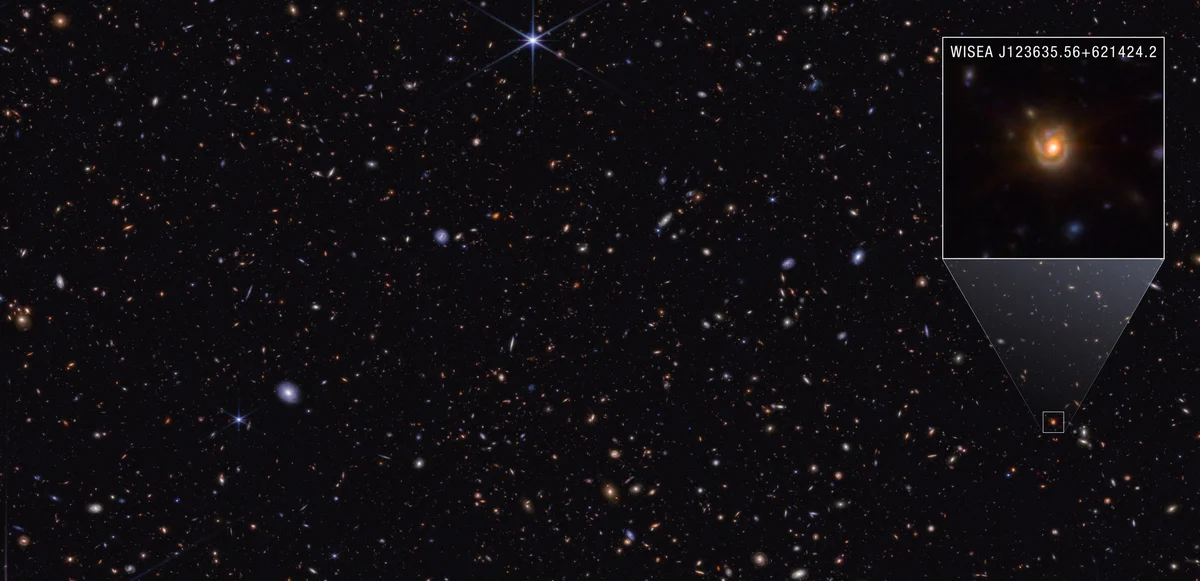
    Who doesn't love a good mystery?! 🔍🔴 Little Red Dots (LRD), first detected by Webb, are very distant, seemed to emerge ~600 million years/mysteriously decline by ~1.5 billion years post-big bang. What if they didn’t disappear, they just evolved? go.nasa.gov/4h44W5g
    A rectangular image with thousands of galaxies of various shapes and colors on the black background of space. Some are noticeably spirals, either face-on or edge-on, while others are blobby ellipticals. Many are too small to discern any structure. One prominent foreground star at top center features Webb’s signature 8-point diffraction spikes. At upper right, a box shows a zoomed in portion of the image. The pullout features a spiral galaxy labeled “WISEA J123635.56+621424.2.” The galaxy has a bright yellow center and faint brown arms speckled with regions of blue that appear to wind clockwise around the galaxy’s core.
    116K
  • user avatar
    NASA Webb Telescope
    NASA
    @NASAWebb
    Jul 21
    In about 40 minutes!!
    user avatar
    Space Telescope Science Institute
    @SpaceTelescope
    Jul 21
    TODAY at 4 p.m.: STScI's Dr. Macarena Garcia Marin will explore #NASAWebb's record-breaking performance, scientific breakthroughs, and astonishing discoveries. We will also look ahead and ask the questions that will shape Webb's future science. youtube.com/live/VJakMxRPf…
    122K
  • user avatar
    NASA Webb Telescope
    NASA
    @NASAWebb
    Jul 15
    Wake up, babe! There’s a new planet around Beta Pictoris! Webb spotted a new giant planet hiding in one of the most studied planetary systems in our galaxy. science.nasa.gov/missions/webb/…
    Artist's concept of the Beta Pictoris planetary system. One edge of a smooth, dusty disk that looks like cloud wisps extends across the upper third of the image. Just below that, in the left third of the image, the star glows white and is small. Just to the left of the star there is a tiny white dot, planet Beta Pictoris c. To the right of the star, about twice the distance between Beta Pictoris c and the star is another bright dot, representing planet Beta Pictoris b. A third planet, Beta Pictoris d is larger than the other two, and appears in the right third of the illustration. The planet has subtle orange cloud bands, and the side facing the star is illuminated. Below this planet, the other wispy edge of the dusty disk that circles the star crosses the bottom right corner of the illustration below Beta Pictoris d from 4 o’clock to 7 o’clock. The black background of space is speckled with distant stars. The words "Artist's Concept" appears at the lower left corner.
    112K
  • user avatar
    NASA Webb Telescope
    NASA
    @NASAWebb
    Jul 7
    Galaxy cluster formation is a messy process! Webb captured the formation of this young galaxy cluster in progress. Its two-sub-clusters have slammed through each other and travelled over a million light-years apart, repeating this process until they finally merge.
    A galaxy cluster in deep space. It is filled with elliptical galaxies: small, bright white glowing ovals. The two largest elliptical galaxies, left and right of center, are bright cores that radiate light. Unrelated, distant galaxies are scattered around as red smudges and dots.Many of these are stretched out into red arcs and lines by the galaxy cluster’s strong gravity, creating multiple images in places. Numerous spiral galaxies and bright stars appear in the foreground.
    118K
  • See @NASAWebb's full profile

    Sign up
    Log in
Advertisement
Advertisement