The Facebook verdict is not about Section 230

Ryan Broderick, writing at Garbage Day about this past week’s New Mexico court decision against Facebook and YouTube:

But I am more than a little freaked out by what New Mexico attorney general Raúl Torrez said in an interview with CNBC following the verdict.

“One of the things that I am really focused on is how we can change the design features of these products, at least within New Mexico,” he said. “And that would create a standard that could then be modeled elsewhere in the country, and, frankly, around the world.” No!!! New Mexico should not be telling the whole world how to do anything.

Anyways, Meta’s legal loss in New Mexico this week is part of a broader attack on digital freedoms in the US right now. There are age verification laws popping up in states across the country, bills that would eliminate end-to-end encryption entirely, and the Kids Online Safety Act (KOSA), which would force platforms to censor content for minors, which would mean building tools that could determine who is a minor and who is not. All of these bills are meant to bypass or dismantle Section 230, the statute that basically makes the internet in the US work.

No, sorry—this comparison is just wrong. 

I don’t mean to pick on Broderick, because I have been seeing a bunch of these “But this will kill Section 230!” reactions from Very Online People this week, but this is a perfect example.

While I am not a lawyer, my understanding of Section 230 is that it generally exempts online service providers and platform owners from responsibility for what their users post. It is what prevents people from suing an ISP because someone hosts a shitty blog on their service, or suing Facebook because someone writes a defamatory post. On the whole, that is a good thing and I agree that yes, we ought to keep it around. I also agree that KOSA-type legislation that forces censorship in the name of “Won’t someone PLEASE think of the children!” is a bad idea, as are all the attempts to outlaw encryption and VPNs that are currently floating around.

But what happened in New Mexico is not like those other things. Facebook did not get held liable for user-generated content that it was hosting. Facebook was held liable for designing a deliberately addictive and harmful product. The plaintiffs very deliberately used the same legal strategy that was successful against tobacco companies; these companies knew they had a harmful product, they hid evidence of that harm, they deliberately made it more harmful and addictive, and they hid evidence that they were doing so.

So, no—this verdict is not about Section 230. What I find interesting is that so many people who should know better are conflating these two very different issues.

I think maybe it goes back to a general unwillingness—either deliberate or otherwise—to acknowledge any responsibility on the part of tech companies for harms caused by their products. The tech industry and the people who cover it are very invested in the idea that these products and platforms are simply tools with no inherent politics or ideology and that they should therefore be held entirely blameless for the effects they have on the world.


If we don’t keep building bigger and faster, people might realize they don’t need to keep buying our stuff.

🔗 Why Apple’s New “MacBook Neo” Has Stunned the Tech World – Lauren Weinstein’s Blog:

The first reactions were that this must be a really stripped down laptop with quality corners cut here, there, and everywhere. But this appears not to be the case. People who got their hands on these — and they’re sold out at some suppliers — are praising the quality throughout. A completely aluminum case, with an excellent display, keyboard, trackpad and so on.

Two specs that caught a lot of attention were that the Neo doesn’t use the class of Apple CPU chip you’d normally expect in a Mac, but actually uses the Apple chip from a recent iPhone. And the Neo (both models) has a fixed and unexpandable RAM memory of 8 gig, seemingly small for a Mac.

My takeaways from this whole Neo thing are:

  1. If a phone CPU can power a usable laptop, most mobile devices are quite over-specced for what people actually use them for, and

  2. The vast majority of people also don’t need the even more tremendously overpowered laptops that Apple and most other manufacturers have been cranking out for years.

That any of this comes as a surprise to tech pundits and tech “journalists” is a likely a function of that whole crowd having been bought into the story the tech industry has been spinning for the better part of two decades, that everything has to and will always get faster and more powerful and god help you if you get left behind.


Too many concerts! 😭 🤘

I just found out that Worm is going to be playing a show not too far from here in June, but it is the night before the weekend-long music festival here in town that I already have tickets for. While I would dearly love to go see Worm play live, I am not sure that I am up for both.

While I was on the venue’s website to see when tickets go on sale (later this morning, so I still have a bit of time to think about it), I noticed that they’ve just announced a Cryptopsy show in April, with Necrot, Fulci, and Blood Monolith opening. That’s another one I’d like to see, but it’s the night before the Behemoth/Rotting Christ show I’ve already got tickets for.

I wouldn’t care that much about back-to-back shows, but the venue is an hour-and-ten-minute drive and it’s usually after midnight before I get back home when I go see bands there. I just can’t do that sort of thing on the regular anymore. Also, my metalhead kid goes to most of these shows with me and being a vaguely responsible parent, I can’t really justify having him out that late on school nights that often.

I wish I could send a message back in time to myself a few years ago when I was wondering if bands would ever be touring again. There are definitely worse problems to have than having too many options for concerts to go see.


Stable products that just work

Earlier today, I saw someone on Mastodon posting about how much money a company could make if they just said “We’re going to build a product that will work the way you expect it to and keep doing that” and then stuck to that promise. 

I am not linking to the post because 1) I wish this person were right and 2) I don’t want to pile on them.

The problem is that, not matter how much you and I say we would want that sort of thing, there is no incentive for companies to actually do it. Any CEO who suggested doing this sort of thing would be immediately sacked by their board and replaced with someone committed to an ever-expanding user base and perpetually growing recurring revenue, because that is what the investors want.

Furthermore, when companies do build a relatively stable product, there is a nontrivial number of customers who get upset because the product is getting stale and why aren’t they providing updates and new features? There are plenty of people who would insist that these kind of demands are only manufactured by the tech industry and the pliant press, but that always sounds like a false-consciousness argument to me, and I tend to be pretty skeptical of those.

I think the people who are on about “slow tech” and whatnot—as much as I might agree with and be one of them—vastly underestimate the degree to which we are non-representative weirdos. I am unconvinced that most of the mass public actually would want this sort of thing and even if they did, we would have to contend with a commercial and financial economy that has figured out a way to keep profits rolling in utterly disconnected from what buyers of their goods and services actually want.


Just let me read the damn article, part eleventy-billion

I was vaguely interested in reading this NYT feature recounting Michael Moore’s controversial-at-the-time/subsequently-proven-entirely-correct speech at the 2003 Oscars denouncing George W. Bush and the Iraq, but it consists of a single image and bunch of stupid text boxes I have to keep scrolling up and up and up to see.

They call it “interactive,” but it reminds me of the very early digital textbooks I worked on back in the mid-2000s, where they would take the illustrations from the textbook and farm them out to some Flash developer to add some super-basic, useless animation to them so that they could say they were interactive.

Who likes this crap? I feel like it’s web designers who believe they have to reinvent journalism or some crap. Meanwhile, I have to keep dismissing all the pop-ups imploring me to upgrade my Times subscription to get more recipes and games and insisting that this would all be so much better if I would just read it in their app.

NO. FUCK YOU. I pay a subscription and I just want to read the goddamned article. I was going to add the Simpsons “Old man shouts at cloud” gif to this post but I think it actually is worth being outraged about, because this is the sort of thing that is ruining the web.


Time changing

When my kids were little, I absolutely dreaded the bi-annual changing of the clocks because it aggravated their already problematic sleep patterns and made life in that regard even more challenging than it already was. They are both old enough now, however, that it no longer matters much.

On the day of the start of Daylight Saving Time, I do find the loss of an hour in the day to be annoying, but I have mostly forgotten about it by the time the next day rolls around.

What I don’t like is that—at least for a bit here—we are back to it being dark when I get up in the morning. I guess the extra hour of light in the evening is alright, but the weather is still crappy enough that having the extra light on that end doesn’t really make much of a difference. In the morning, though, it definitely does make a big difference.


New shirt!

My new Pushead “Cleanse the Bacteria” shirt arrived yesterday and I am super goddamned excited about it!

I had two of these shirts back in the day. I lost one in the mud during either the Soundgarden or Ministry set (I can no longer remember which) at Lollapalooza II. I wore the second one until the artwork was completely illegible and the shirt fell apart.

Unfortunately, used copies of the original Cleanse the Bacteria 1984 compilation are quite expensive and (at least as far as I know) it has never been re-released in any other format. Helpfully, though, someone has uploaded it to YouTube. If you haven’t listened to it, I highly recommend it; it’s a bunch of pretty great hardcore/metal crossover bands, including two songs by Brian Schroeder’s (aka Pushead) band Septic Death.


War is evil and stupid and we shouldn’t do it.

Now in my sixth decade on this planet, I have seen the US and other countries (but mostly the US) start a bunch of wars, and I think I have learned a few things.

War is always bad and no one should ever start one. I’m not the first to say it, but you’re always the bad guy if you start a war.

No matter what problem you think you are solving by starting a war, the consequences of that war will always be worse than those of the problem you thought you were solving. And the war probably won’t solve that problem anyway.

If you’ve started a war, you’re better off just fucking ending it, and the sooner the better. A bunch of people will say a bunch of crap about how the situation will only get worse if you pull out now, but if you’re in the middle of a war, the situation is already really bad and you are actively making it worse by keeping it going.

As for the current war the US has started in Iran, the Trump regime is a bunch of venal morons and they have no plan. While the war they have started may happen to serve to some degree as a distraction from their other problems, I am skeptical that there was any big strategy to it. They thought it would be cool and that it would make them feel like Big Men. It will blow up in their faces (because wars always do), so there’s that. Unfortunately, it is already blowing up non-metaphorically in a bunch of other people’s faces first.

The whole thing is an evil, inexcusable disaster that will get worse for everyone involved every day that it keeps going.


Nosferatu With Radiohead seems cool.

While I was walking by the local movie theater downtown yesterday, I noticed on one of the flyers posted out front that they are going to be showing the Nosferatu With Radiohead thing in April. I had not heard of it before, but it is F.W. Murnau’s 1922 silent film Nosferatu synced to Radiohead’s Kid A and Amnesiac albums.

I have seen Nosferatu before but never in a theater, so that part is definitely appealing. And I like those two Radiohead albums, so that’s cool, too. I do find the album-syncing thing to be a bit of gimmick, but I’m willing to give it a shot.

And I like that they’re showing it at our local theater, which I try to support as much as I can. The theaters are weirdly laid-out (it used to be an old single-screen movie house with a balcony that was divided up into multiple theaters years ago) and the screens are small compared to the big Cinemark at the mall a few towns down from here. But I’d rather go to a theater I can walk to from my house and which is owned by someone who lives here in town.


The robots in sci-fi stories are metaphors, dumbass.

Of all the pro-AI fantastisizing that I am subjected to these days, the sort that perhaps annoys me the most are the people who try to shame us about somehow denying or infringing upon the rights of these supposedly intelligent agents or systems.

They want us to think that LLMs are potentially on the verge of becoming self-aware systems so that when we question or criticize their grandiose claims about these systesms, they can frame us as being hateful and bigoted. They imply or outright accuse of us indulging in the same sort of racist and discriminatory thinking that previous generations exhibited toward other races and cultures. What if these systems are just like us, or they are some new form of life, this type of Tech Bro asks. Who are you to put them down and deny their rights?

What I find particularly irksome about these arguments (or perhaps “tactics” is the better word) is that they rely—as does so much of contemporary pro-AI marketing—on the depictions of robots and intelligent computers that have featured in decades’ worth of science fiction stories. This crowd is at least channelling if not directly referencing cultural artifacts like the ST:TNG episode in which Federation researchers want to take Mr. Data to be disassembled and studied, leaving it to Captain Picard to eloquently defend Data’s rights as a sentient being.

Surely we don’t want to be like these horrible people, ending up on the wrong side of history because we presumptuously denied the sentience and the inherent rights of a new form of intelligence, right?!

It’s a nifty trick Tech Bros are playing with this argument, trying to appeal to our innate sense of human dignity. They want to twist our very real and justifiable concern about past and present denials of that dignity to actual humans into a means of defending their own schemes.

What I find particularly galling about this tactic is that the examples they are pointing to and relying upon for their rhetorical power all come from stories that are very specifically about what it means to be human. They are metaphors, but I think most of these guys don’t actually understand metaphors, because when they do read or watch anything deeper than a LinkedIn post, they never seem to be able to get past the most shallow recitation of the plot.


Tech people keep falling for the same scam.

JFC. Another tech writer I used to respect who is now posting about how the future is now fantastically wonderful and wide-open because anyone can create an app to do whatever they want.

Because, you know—he built some random thing with a few prompts on one of these vibe-coding products.

I just don’t understand how anyone who has paid even the slightest bit of attention to the tech industry for the last thirty years can look at any of this stuff these huge companies are cranking out and think “Yeah, it’s gonna stay cheap and liberating and we will all be able to set ourselves free to experience utopia by embracing it!”

There’s an argument to be had as to whether, absent all of the cultural and economic forces that have shaped and which drive the tech industry, the products that industry builds are good or bad in the abstract. But there is no way any sentient, responsibly aware adult should be looking at what has happened to basically every part of the tech economy and not understand that sooner or later, the investors want their money and all of this awesome stuff you think you’re able to do right now will dry up and turn into data-mining and advertising.


Massachusetts Democrats ought to be ashamed.

🔗 Inside ICE’s Only Contract with a Blue State | Bolts:

Massachusetts is the only state that voted against Donald Trump in 2024, and where the governor is a Democrat, where a state agency is contracting with the 287(g) program. It’s also the only state where Democrats fully control the state government that has such an agreement.

Virginia shared the distinction until last week, when new Democratic Governor Abigail Spanberger announced she is withdrawing Virginia state agencies, including the state’s DOC, from the 287(g) contracts she inherited from her Republican predecessor, Glenn Youngkin.

Massachusetts Governor Maura Healey, a Democrat, also has the authority to decide if her state’s DOC remains in the ICE program. She has defended and preserved the 287(g) agreement, even as she otherwise seeks to limit ICE activity in the state. Her office has not responded to my repeated calls and emails about the state’s participation in the program.

This is a fucking embarrassment, and it is a pretty searing indictment the Democratic establishment here in Massachusetts.

I have asked repeatedly where Gov. Healey is in any of the blue-state pushback against the Trump regime. The answer seems to be nowhere, and the Democratic leadership in the state legislature is equally useless. They can barely move bills through the legislateive process, much less lead any sort of out-front effort to protect residents from the feds.

I’m not looking for high-profile stage-grabbing antics. I don’t really want my governor out there on the national stage, exchanging snarky tweets with fascists. I want them doing real policy and governance here at home that helps and protects residents of the Commonwealth.

And I want a state legislature that will actually take up and pass meaningful legislation that will move us forward.

Instead, all branches of the state government seem to be controlled by party fixtures who have made their way up through the ranks and are now content to settle in for the ride. And I guess if that means handing folks over to the Trump regime’s goons rather than rocking the boat, then they’re happy to do that.


AI boosterism as a heuristic for identifying fools

I am reading Paul Ford’s op-ed in The New York Times about how much fun he’s having using LLMs to solve basic software development problems, and all I can think is that it really is a sign of the times that an otherwise smart person could write and publish a piece like this in the biggest, most important journalism platform in the country and feel good about it.

I am not going to link to the op-ed, because I don’t know want to reward either Ford or the Times with the traffic, and also because these essays seem to be a dime a dozen these days.

You know the drill. Someone has the usual concerns about AI and LLMs: the environmental impacts, the intellectual property issues, the job losses. But darn it, it’s just so cool playing around with these tools. They built a whole website in a day! It analyzed that spreadsheet in a few minutes and turned it into a database! It made a to-do app that works just like they’ve always wanted!

I have read and enjoyed a lot of Ford’s writing and commentary in the past, but this piece is just garden-variety AI apologism. Sure, the use cases he describes in the piece are fast and cheap, but only if you ignore the massive external costs. Like everyone boosting this stuff, he has to either ignore those costs, or wave them off with speculation about how neverending advances in the technology will balance them out. The latter tactic is not far off from the “But just wait until it cures cancer and solves climate change!” hand-waving we get from the charlatans running the AI companies and from their lackies and lickspittles on LinkedIn.

What I am finding is that the real purpose these sorts of op-eds and posts serve is to identify people that I no longer need to listen to. Maybe you had some good insights and a helpful way of looking at technology and our interactions with it in the past, but either your brain has been cooked or you have decided to try to jumping on the gravy train before it goes off the rails.

Either way, I no longer trust your judgement.


Quitting bad books

A general rule I have set for myself concerning novels is to give any new one that I have started one hundred pages before I decide whether to keep reading or to give up. Some books pull me in immediately, but with most, it takes a while for me to get into the groove of the story and the characters. One hundred pages is usually far enough in for me to have gotten engaged, but not so much as to make me feel like I have over-invested in a novel I don’t like.


All of which is by way of preface for this books A God In the Shed by J-F. DuBuea. I have it out from the library after it showed up in the recommendations after I had finished Cullen Bunn’s Bones Of Our Stars, Blood Of Our World a couple of weeks ago. I really liked that book, and was in the mood for something similar, so I decided to give this one a try.

It’s not great.

I only made it about sixty pages—thus violating my 100-page rule—but it was quite clear by then that it was not going to be worth finishing. With a multi-character story set in a small town beset by some sort of ancient, occult horror, this book should have been right up my alley, so I don’t feel like this falls into the “It’s not for me” category.

Books that fall into the “It’s not for me category” are those where I find I can’t relate to the characters and their stories; they are books that are well-constructed but which I just do not find to be all that interesting. The problem with this book is that it is poorly written.

I was suspicious from the start due to the naming of each chapter by the POV character. I think I have complained about this trope before, but I find it to be a pretty good indicator of an author who either lacks confidence in their own writing or who doesn’t know what they’re doing. You shouldn’t need to put a big name at the start of the chapter to tell the reader which character they’re with; they should be able to figure that out on their own from the story.

The problems multiply from there. Clichéd characters, clunky cultural references, and poorly constructed narratives are a small sampling of the issues. The details don’t really matter; they are kind of beside the point, which is that this book was the first thing I have read in a while that clarified the border between the bad writing and “not for me” books, and I found that to be helpful and reassuring.


Making financial aid application mandatory is a dumb idea and the wrong way to think about the problem.

🔗 Applying for financial aid should be a Massachusetts high school graduation requirement:

Making FAFSA completion a graduation requirement in Massachusetts isn’t about mandating college. It’s about keeping every door open. It’s about removing barriers, expanding opportunities, and making sure every high school student graduates with the necessary resources to follow their dreams, whether it’s postsecondary education, enrolling in military or other service, or entering directly into the workforce.

Yeah, let’s pile even more responsibility and burden on students and the under-resourced schools that they attend. I’m sure that will work out great!

Alternately, we could—oh, I don’t know—maybe just give the money to people who need it instead of burying it behind obscure application and means-testing mechanisms. Or, CRAZY THOUGHT HERE, make post-high school education more affordable and stop forcing people to jump through all these hoops to gain access to it.


🔗 Bitcoin Is Crashing So Hard That Miners Are Unplugging Their Equipment:

Instead of mining crypto, companies are starting to pivot, according to Bloomberg, allocating their hardware to powering AI models instead of mining crypto.

Because of course they are.

This entire economy is like Gromit frantically laying down the track in front of the train as it speeds along. 

I feel bad using that analogy because Gromit has always seemed imminently sensible and I don’t think he would have anything to do with any of this nonsense.


Outsourcing the core of your business seems like a bad idea.

🔗 The AI Free Lunch is Over - by Bryan Ross:

Subscription tiers have proliferated and token limits have become a real constraint. Premium pricing for complex reasoning has emerged as its own category, with extended thinking modes and deep research capabilities commanding higher rates. Users are hitting Claude Code limits mid-session, finding that agentic features burn through allocations faster than anyone anticipated.

What makes this particularly challenging is the unpredictability. Unlike traditional infrastructure costs that scale somewhat linearly, AI spending follows the complexity of the task. A minor change in prompt structure can double inference costs overnight. An agentic workflow that tests well in development can blow through production budgets in hours.

And dollars to donuts, Anthropic and OpenAI and their ilk are feverishly working on the darkest of dark patterns to keep users engaged and on the hook. Plenty of people have made the slot machine analogy and that is exactly right.

Among the many aspects of this current AI mania that continue to amaze and depress me is that all the people bought in and pushing it seem to have no time at all for concerns about what any of this means in the long term. There is no way any of this is sustainable. Of course it’s not sustainable environmentally, but I’m not even talking about that here.

I get why the people building these products are taking this approach; their fortunes depend upon no one asking too many questions about Phase 2. They don’t care because this scam is making them money now and worrying about what happens next is for suckes.

No, what I’m talking about here is all the businesses that are throwing their lot in with this scam. How, as a responsible leader, do you look at a sketchy tech product that has no sustainable business model and is being pushed by people with long, unbroken strings of failed promises and think to yourself “I want to build this thing into my core internal processes and value chain and be completely dependent on companies who will happily degrade the service and crank up the costs at the drop of a hat”?

The frightening and depressing answer—I suspect—is that none of these company leaders is responsible, and they are all just as focused on the near-term rewards (to the exclusion of any sort of sustainability) as the AI companies.


The one big question that Star Trek keeps failing to answer

Update: I guess I have to start watching Starfleet Academy now.  

While I have found the majority of the Paramount+ era Star Trek output to be rather disappointing, I don’t think any of it is bad or like it has betrayed the Star Trek legacy or any of that bullshit that the worst people on the internet get themselves all worked up over. I appreciate the shows’ diversity in casting, and I like that they have been willing to try some new and different stuff.

The main problem I have with basically every Star Trek offering of the last, oh, twenty-five years is that it has all systematically failed to answer the most important question hanging over the entire franchise.

That question is, of course, “When will Sisko return?”

While I do like Star Trek and have watched just about all of it over the decades, I will never forgive the franchise for leaving Deep Space Nine—the best series they’ve done—out in the cold. There have been like twenty different times where any number of storylines could have been made more interesting by the return of the Emissary, but instead we get a bunch of retreads of TOS and TNG. Those were both good shows, but I feel like they have had plenty of time in the spotlight.


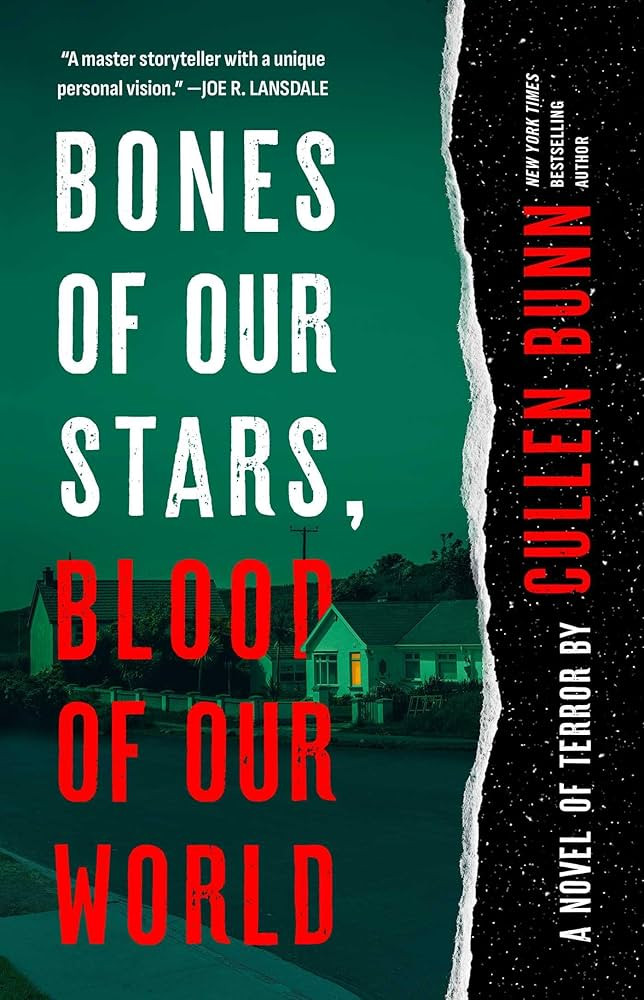
Bones Of Our Stars, Blood Of Our World by Cullen Bunn


I finished reading Cullen Bunn’s new book Bones Of Our Stars, Blood Of Our World last night. It is first adult novel, so having really enjoyed his Harrow County series, I was pretty excited to start this one.

The book starts out as serial killer hunt with a bit of small-town horror thrown in, but as the story unfolds, it starts to hint at much more epic goings on. I could recognize what seemed to be bits and piece of other stories I had read here, but nothing too obvious or egregious.

The characters are well constructed (which is impressive, given how many of them there are), and Bunn does a good job of keeping the story rolling as he switches around between the various points of view. I never lost track of who was who or what they had been up to the last time we saw them.

The body count in this book is high. Very high. Not to give too much away, but I wouldn’t get too attached to any particular characters. It also drags ever so slightly in the final act; that’s when the previously narrow scope of the serial killer story explodes into something much larger, and I found that the scenes of epic mayhem were going on a bit long and started to feel a bit repetitive.

Overall, though, I really enjoyed this book. It had that Stephen King thing where I kept wanting to read just one more chapter, and I find myself kind of bummed now that I am done with it. If you’re looking for a good horror novel that cooks along, this one fits the bill. I hope Bunn keeps at it with the novels, too; his comics and graphic novels are great, but he’s clearly got the storytelling chops to dig into some meatier stuff.