

Python is one of the most popular programming languages today, that is known for its simple syntax, readability, and ability to build powerful and secure applications. If you are just starting your coding journey, Python is often the best programming language to begin because it helps you focus on logic rather than complex rules.
In this Python tutorial, you will learn everything from basic concepts to more advanced topics in a structured and beginner-friendly way. Instead of overwhelming you with theory, this guide focuses on clear explanations and practical understanding.
In this guide, you will explore Python syntax, data types, functions, features, and more step by step. By the end, you will have a strong foundation and the confidence to start building your own Python programs.
Let's get started.
2. Why Learn Python Programming Language?
3. Where is Python Used (Python Applications)?
4. How to Install the Python Programming Language?
5. Python Hello World: Your First Program to Practice
8. Python Variables and Global Variables
12. Python Modules and Packages
15. Python Classes and Objects (OOP)
17. Python Regular Expressions
18. Python Concurrency and Multithreading
21. Testing Python Applications
22. Python Interview Preparation
23. How to Become a Python Developer
Note: This Python tutorial was created with the latest version of Python 3.14.3
Whether you are completely new to programming or switching from another language, this guide will help you build a strong foundation in Python and gradually move toward advanced concepts.
Python is a high-level, interpreted programming language that focuses on readability and simplicity. It was created by Guido van Rossum and first released in 1991. Since then, it has evolved into one of the most widely used programming languages in the world. Python allows developers to write clear, logical code that is easy for beginners to understand.
Python's popularity comes from its simple syntax, powerful libraries and strong community support. It supports multiple programming paradigms, including procedural programming, object-oriented programming, and functional programming.
One of the key reasons Python is easy to learn is that its syntax resembles plain English. This helps developers express complex logic in fewer lines of code than in many other programming languages.
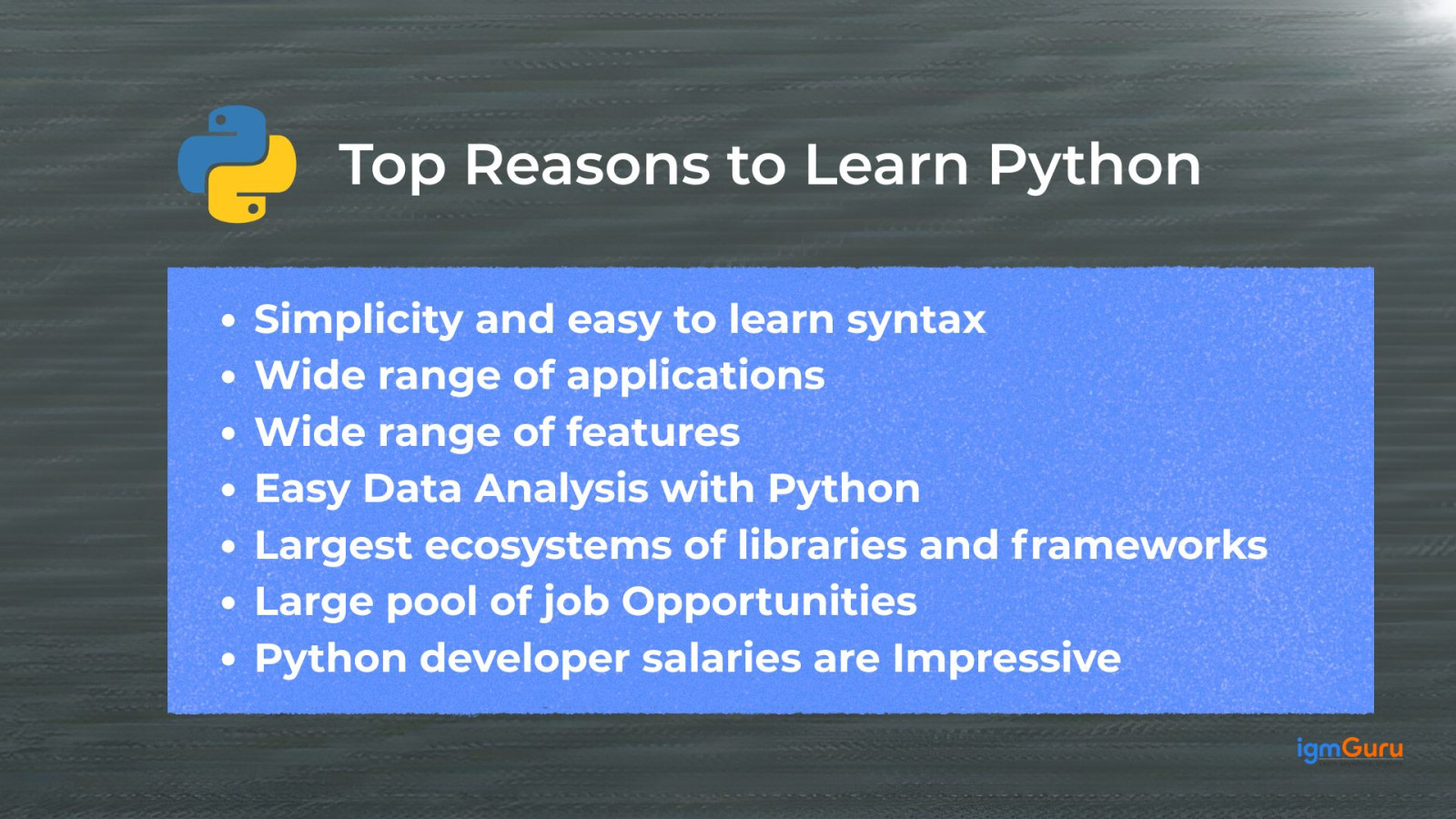
There are multiple reasons to learn the Python programming language. It has almost everything a developer needs before choosing the perfect start to their career. Here are some of the most common reasons:
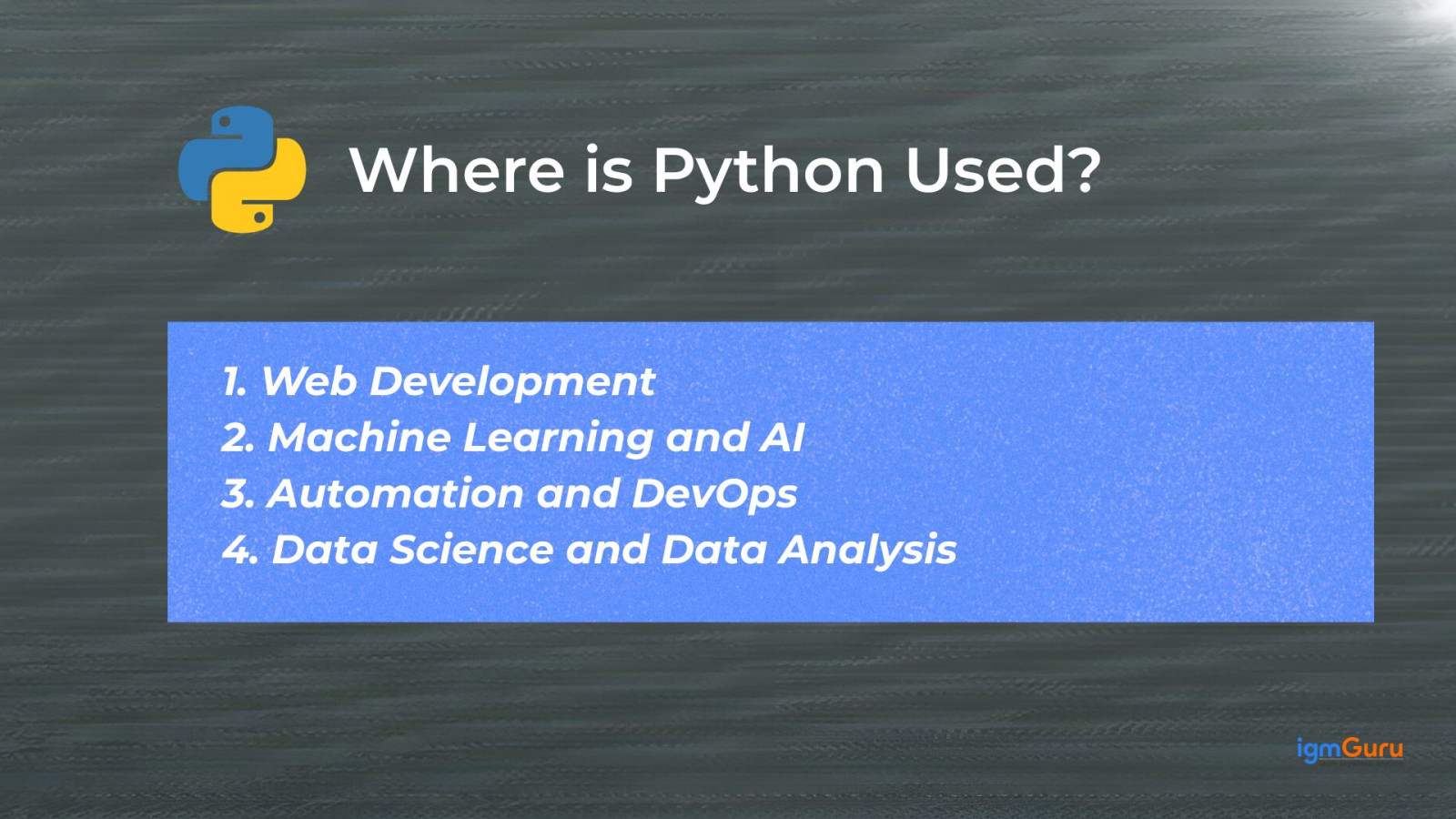
Python is widely used across many industries due to its vast ecosystem of libraries and frameworks. It is used to build websites, analyze large datasets, create automation scripts and develop machine learning models. Its versatility makes it one of the most valuable programming languages to learn. Here are some of the common sectors it is used in:
Python is largely used for web applications and the backend system is one of its best uses. It provides powerful frameworks like Django and Flask that allow developers to build secure and scalable websites quickly.
It dominates the machine learning and artificial intelligence ecosystem. It has different libraries such as TensorFlow, PyTorch, and Scikit-learn that allow developers to build intelligent systems and predictive models.
This programming language is also widely used in DevOps and automation. DevOps engineers use Python scripts to automate repetitive tasks, manage servers, and build deployment pipelines.
Python for data science is another best use you can see. It provides different libraries like Pandas, NumPy, and Matplotlib that allow analysts to process, analyze and visualize large datasets efficiently.
Installing a programming language is the first step on the ladder to learn it. You need the Integrated Development Environment (IDE) to start practicing the programme. The installation process is simple and works across multiple operating systems, including Windows, macOS and Linux.
After installing Python, you can run programs using the Python interpreter or by using development tools such as Visual Studio Code or PyCharm.
You can explore how to install a Python guide for the complete process.
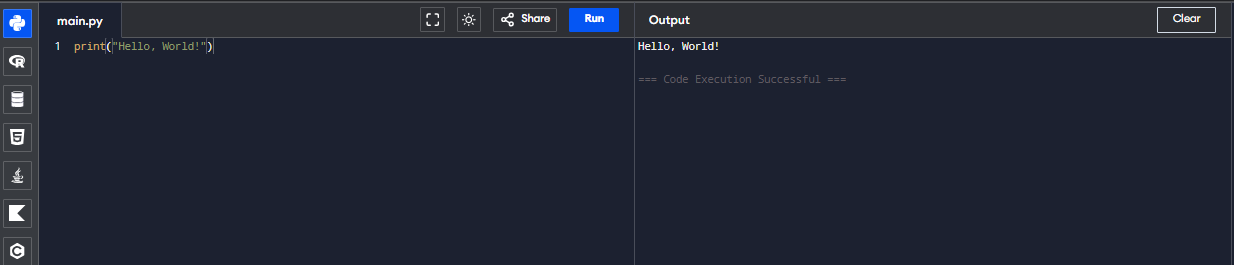
Most programming tutorials begin with the famous Hello World program. This simple example helps beginners understand how a program runs and produces output. Here is a simple Python program you can try by yourself:
|
When you run this program, the compiler will print the message “Hello, World!” to the screen.
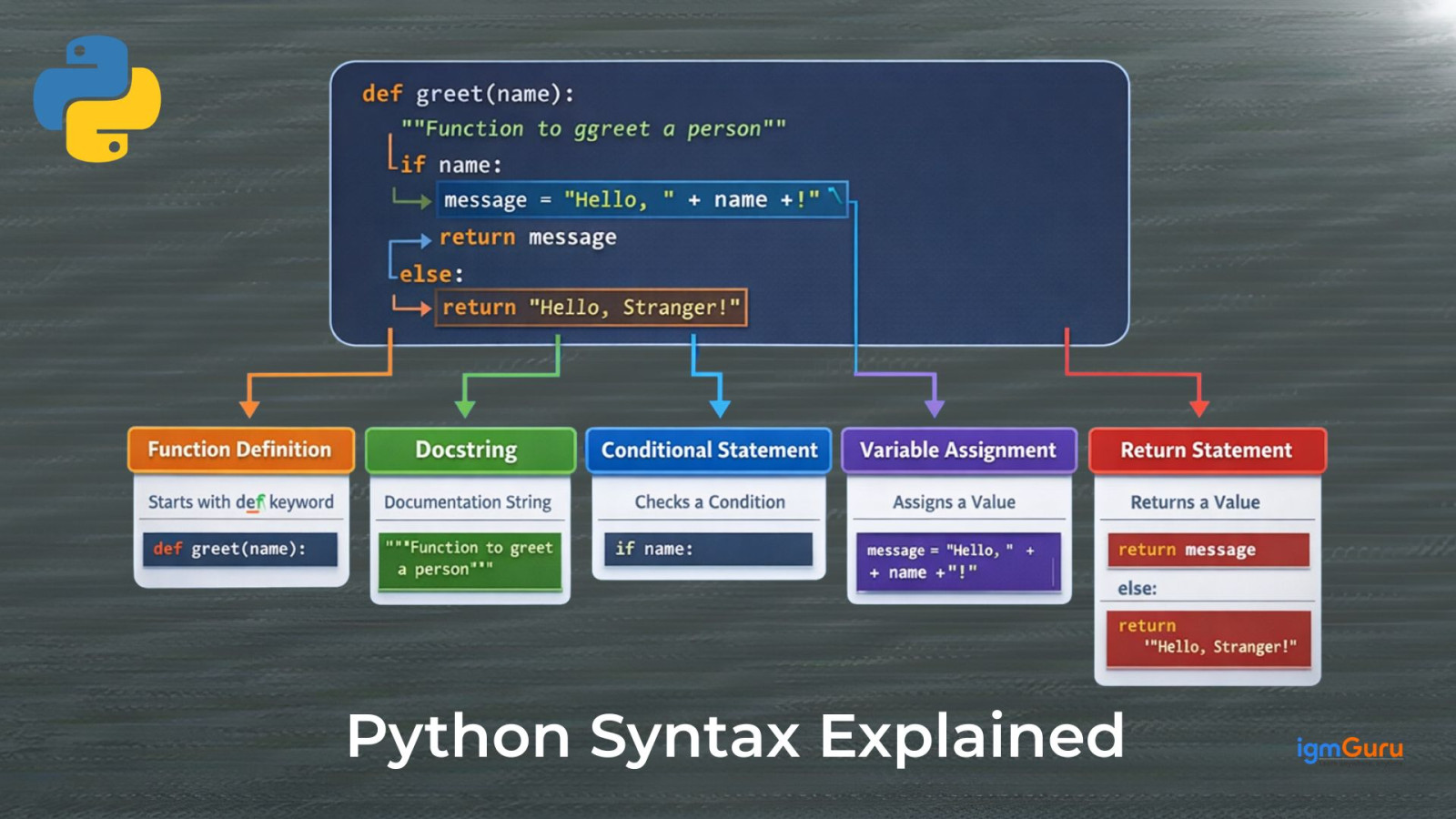
Python syntax is one of the key reasons why this language is beginner-friendly. Here is a clear understanding of its syntax:
|
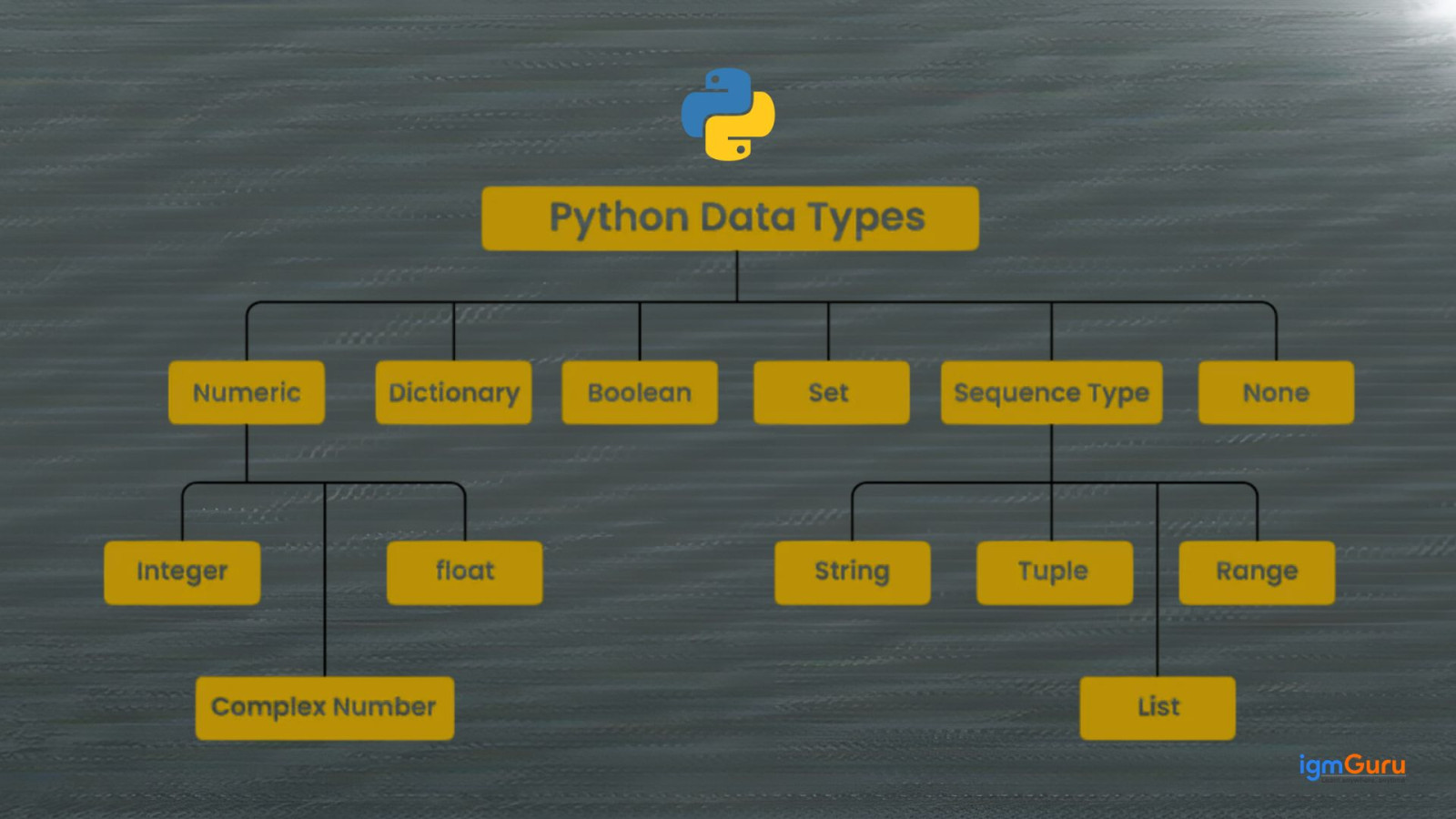
Data types define the type of data stored in a variable. Several built-in data types in Python allow developers to work with numbers, text and logical values. The most common data types include integers, floating-point numbers, strings, and Boolean values.
For example:
Variables allow programmers to store data values that can be used later in the program. In this programming language, variables are created automatically when a value is assigned. Python does not require explicit type declarations, which makes it easier to work with variables.
Variables can also have different scopes. Local variables exist inside functions, while global variables can be accessed throughout the program.
Operators are used to perform operations on variables and values. Python provides several types of operators that allow developers to perform calculations, comparisons and logical evaluations. The main types of operators include arithmetic operators, comparison operators and logical operators.
For example, arithmetic operators perform mathematical operations such as addition, subtraction, multiplication and division. Comparison operators compare two values and return Boolean results, while logical operators combine multiple conditions.
Control flow statements determine how a Python program executes based on conditions and loops.
Conditional statements allow programs to make decisions. Common conditional statements include:
These statements help programs execute different blocks of code depending on specific conditions.
Loops allow programs to execute a block of code repeatedly. Python supports two main loops:
Python functions allow developers to organize code into reusable blocks. Instead of repeating the same code multiple times, a function can be defined once and used throughout the program. Functions can accept parameters and return values. This coding language also supports lambda functions, which are small anonymous functions used for short operations.
Python modules and packages help developers organize Python code into reusable components. A module is a file containing Python functions and variables. Modules allow developers to reuse code across multiple programs. A package is a collection of modules organized in a directory structure.
File handling in Python allows programs to read and write data to files. This is important when working with datasets, configuration files or application logs. Python provides built-in functions to open, read, write and close files.
Errors are one of the common issues in any programming. Python provides exception handling that allows programs to manage these errors without crashing. It provides the try, except and finally keywords to handle exceptions properly. Understanding exception handling helps developers build more reliable applications.
Object-oriented programming is a programming paradigm that organizes code using classes and objects. A class acts as a blueprint for creating objects, while an object represents an instance of that class. OOP concepts such as inheritance and encapsulation help developers create modular and maintainable applications.
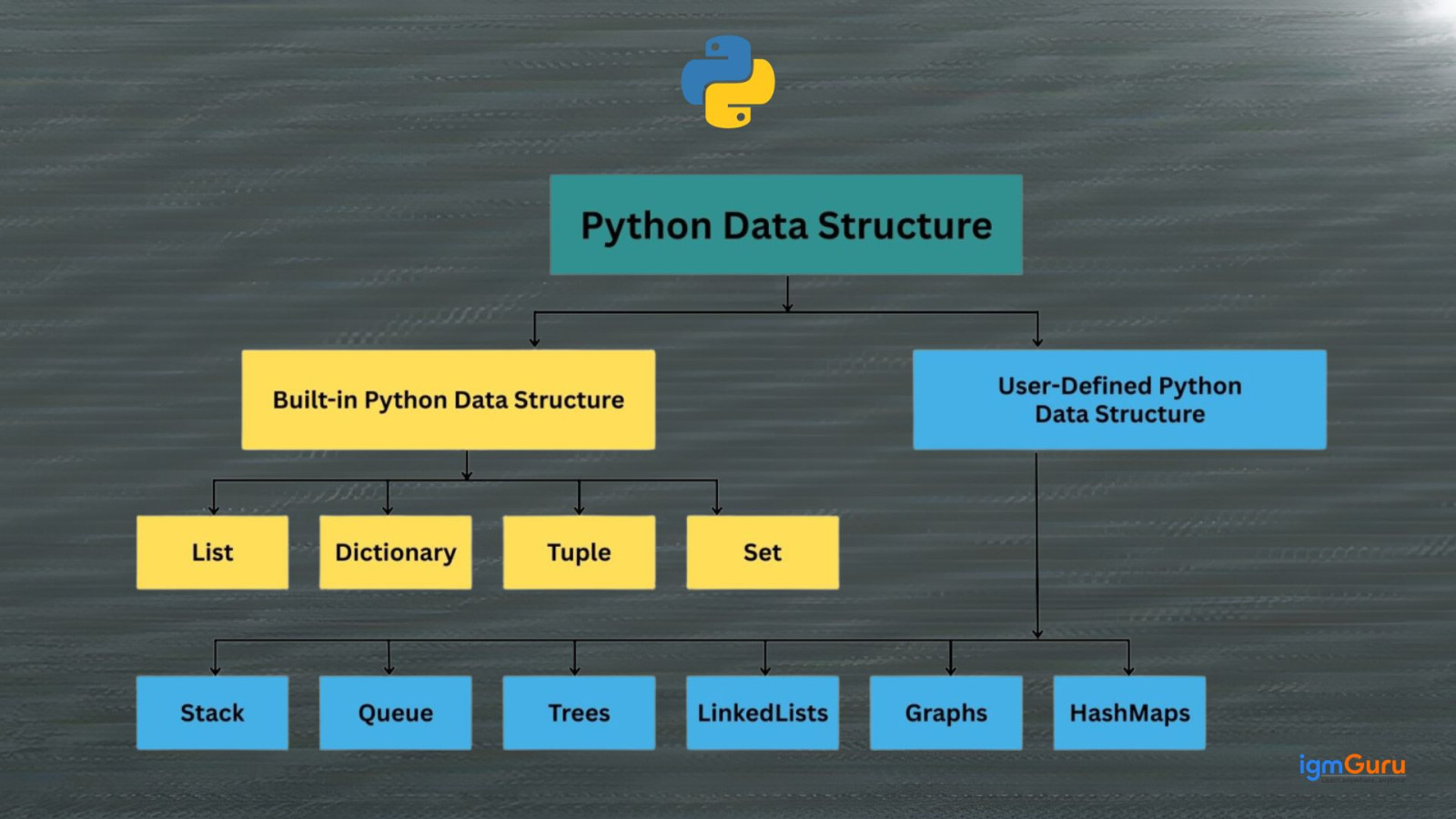
Data structures allow developers to organize and manage collections of data efficiently. There are various built-in data structures in Python, including lists, sets, tuples and dictionaries. Each structure has different characteristics and use cases. These structures help developers perform operations such as searching, sorting, and iteration more efficiently.
Regular expressions are used to search and manipulate text patterns. They allow developers to match specific strings and perform advanced text processing. Python Regex is commonly used for tasks such as data validation, log processing and text extraction.
Concurrency allows Python programs to run multiple tasks at the same time. This improves performance in applications that perform many operations simultaneously. This language provides several concurrency approaches including threading, multiprocessing and asynchronous programming.
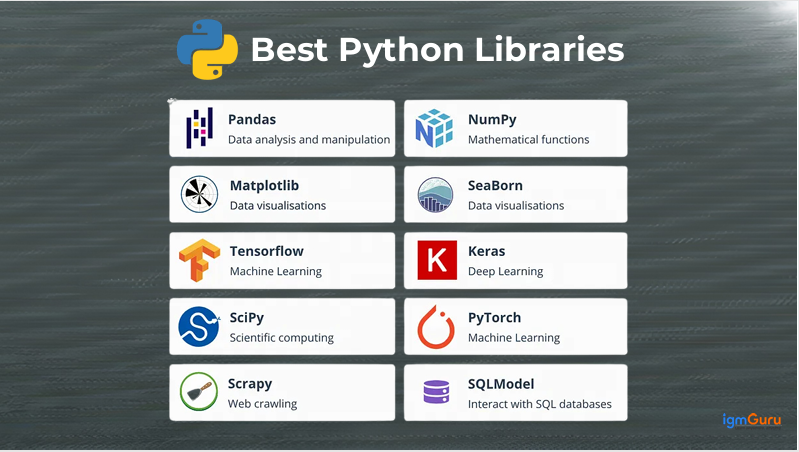
This programming language has a large ecosystem of libraries that simplify complicated programming tasks. Some popular Python libraries include:
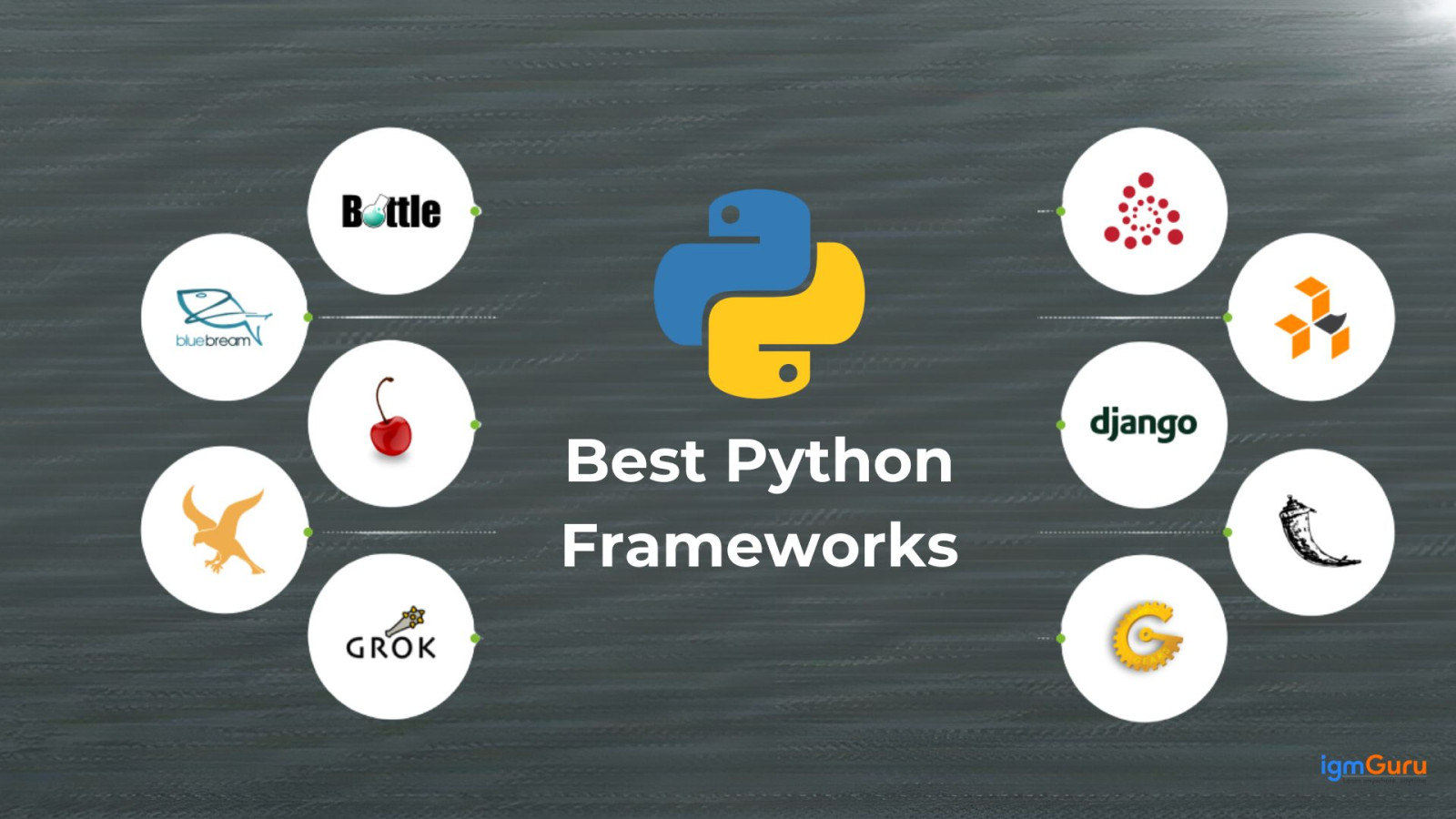
Frameworks help developers build applications faster by providing ready-made architecture and tools. Some of the most popular Python frameworks include Django, Flask and FastAPI. These frameworks simplify backend development and API creation.
Testing is an important part of software development. It ensures that applications work correctly and reliably. Developers usually use Python testing frameworks to automate the verification of code functionality.
Preparing for Python interviews requires both conceptual knowledge and coding practice. These resources will help you prepare for technical interviews:
Becoming a Python developer requires a strong understanding of programming fundamentals, practical coding skills and experience building real-world applications. Developers usually start by learning basics, then move to advanced concepts like frameworks, APIs and data processing. This helps them build strong Python developer skills.
Learning Python becomes easier when you follow a structured roadmap. This roadmap starts from the very basics and gradually goes to advanced concepts. Here is a small overview how this roadmap should be:
Python certifications play an important role in validating your programming skills and understanding of core concepts. They help demonstrate your expertise to employers and can improve your chances of landing better job opportunities in fields like data science, web development, and automation.
Many learners often compare Python with other programming languages when choosing what to learn. It is a common question and you should know how it differs from other languages before choosing it. Python is known for its readability and flexibility, while other languages may specialize in areas like frontend development or statistical computing. Here are the common comparisons learners usually want to know:
| Feature | Python | JavaScript |
|---|---|---|
| Typing System | Dynamically typed with strong typing | Dynamically typed with weak typing |
| Execution Model | Interpreted using a virtual machine (e.g., CPython) | Interpreted/JIT compiled by browser engines (e.g., V8, SpiderMonkey) |
| Memory Management | Automatic memory management using reference counting and garbage collection | Automatic memory management using garbage collection |
| Programming Paradigms | Supports object-oriented, procedural, and functional programming | Supports object-oriented, functional, and event-driven programming |
| Object Model | Class-based object-oriented programming | Prototype-based object-oriented programming |
| Concurrency Model | Multi-threading and multi-processing (limited by Global Interpreter Lock in CPython) | Event-driven, non-blocking asynchronous model using event loop |
| Asynchronous Programming | Uses async/await, coroutines, and libraries like asyncio | Uses callbacks, Promises, and async/await |
| Error Handling | Uses try, except, finally, and raise | Uses try, catch, finally, and throw |
| Standard Data Structures | Lists, tuples, dictionaries, sets | Arrays, objects, maps, sets |
| Module System | Modules and packages using import system | ES modules (import/export) and CommonJS (require) |
| Compilation | Source code compiled to bytecode (.pyc) before execution | Often JIT compiled to machine code by JavaScript engines |
| Type Conversion | Explicit conversion is required in most cases | Implicit type coercion common |
| Exception Model | Structured exception handling with custom exception classes | Exception handling with Error objects |
| Runtime Environment | Python interpreter | Browser engines or server runtimes |
| File Execution | Scripts executed through interpreter (python file.py) | Executed inside browser or runtime (node file.js) |
| Feature | Python | R Programming |
|---|---|---|
| Typing System | Dynamically typed, strongly typed | Dynamically typed |
| Execution Model | Interpreted language executed by Python interpreter | Interpreted language executed by R runtime environment |
| Primary Design Purpose | General-purpose programming language | Language designed primarily for statistical computing and data analysis |
| Programming Paradigms | Supports object-oriented, procedural, and functional programming | Primarily functional and statistical programming |
| Object System | Class-based object-oriented programming | Multiple object systems (S3, S4, and Reference Classes) |
| Memory Management | Automatic memory management with garbage collection | Automatic memory management with garbage collection |
| Concurrency Model | Supports multithreading and multiprocessing | Limited built-in concurrency; parallel processing via external packages |
| Data Structures | Lists, tuples, dictionaries, sets, arrays | Vectors, matrices, arrays, lists, data frames |
| Data Analysis Capability | Extensive libraries for data processing and machine learning | Built-in statistical functions and strong data analysis capabilities |
| Visualization Tools | Visualization through external libraries | Strong built-in statistical plotting capabilities |
| Package Management | Uses pip and package repositories | Uses CRAN repository and package manager |
| Compilation | Source code compiled to bytecode (.pyc) before execution | Typically interpreted without separate bytecode compilation |
| Numerical Computing | Supported through specialized libraries | Native support for statistical and numerical computations |
| Integration with Other Languages | Easily integrates with C, C++, and Java | Integrates with C, C++, and Fortran |
| Typical Runtime Environment | Python interpreter or runtime environment | R console or integrated development environments |
Python is a powerful and versatile programming language that is widely used in many areas of technology. Its simple syntax, strong ecosystem of libraries, and wide industry adoption make it an excellent choice for beginners and professionals alike.
By following this Python tutorial and exploring the linked guides, you can gradually build your programming skills and move from basic concepts to advanced development topics.
Yes, Python is considered one of the easiest programming languages to learn. Its simple syntax and readable structure make it ideal for beginners who are new to programming.
Most beginners can understand Python fundamentals within a few weeks. However, mastering advanced topics such as web development, data science, or machine learning may take several months of practice.
Python is commonly used for web development, data science, machine learning, automation, DevOps, and backend application development.
Yes, Python is widely recommended as the first programming language for beginners because of its simple syntax and large number of learning resources available online.
|
About Author |
|

|
This Article is written by Sanjay Prajapat, a professional Technical Content Strategist and Writer, known for delivering expert-level content across technology, software development, AI, digital transformation, and business intelligence. His content is driven by deep research, real user intent, and insights gathered with the support of experienced professionals, ensuring every article delivers clarity, credibility, and long-term value. |


How to Install TensorFlow: A Step-by-step Guide For Beginners
April 9th, 2026


