

Do you need supplements for fasting?
The answer depends on the type and duration of your fast.
Most Intermittent Fasting protocols don't need any additional supplementation (with some exceptions). Whereas Extended Fasting typically can benefit from supplement support.
Generally speaking, your need for supplements (especially electrolytes) increases with the duration of your fasting window. If it's very short, you may not need anything. As you fast for longer, your requirements will increase.
Please see below detailed fasting supplements recommendations for common fasting protocols.

Intermittent Fasting


Extended Fasting of 2 to 5 days

Extended Fasting of 5+ days
Do you need electrolytes for fasting?
The most important supplement you may need during fasting is electrolytes. They are used by almost all of your body’s functions and deplete much faster than vitamins.
The level of electrolytes stored in your body depends on how much you are getting, and how quickly they get depleted. Natural whole foods rich in electrolytes replenish your stores. Sweating, stress and unbalanced hydration use them. Fasting itself also speeds up electrolyte depletion.
Electrolyte deficiency manifests quickly with symptoms like headaches, muscle cramps, fatigue and dizziness. Longer fasting window may therefore require electrolyte supplementation, but this depends on the duration of your fast.
Do you need vitamins for fasting?
Most people don’t need to take multivitamins during fasting.
Vitamins A, D, E, and K are fat-soluble. They are stored in fat tissues. As we lose the fat with fasting, those vitamins are released and the body can access them.
Water-soluble vitamins B and C are also stored in our body tissues. One interesting point is that the body uses these vitamins to assist the digestive system and nutrient metabolism. These processes pause during fasting, so you use up a lot less of this type of vitamins.
There are some exceptions. If you have a pre-existing vitamin deficiency or if you get any symptoms of it during your fast (for example, hair loss), then you may need to get a multivitamin.
Certain vitamins are also strongly recommended to support refeed after long-term Extended Fasting.
Fasting Supplements for Popular Fasting Protocols
Supplements for Intermittent Fasting (16:8, 5:2, OMAD)
Short answer: Most people can practice Intermittent Fasting without any additional supplements. If you already take supplements such as multivitamins, just continue taking them as usual. In some circumstances, a small amount of extra electrolytes may still be helpful, especially magnesium and potassium.
Intermittent Fasting protocols such as 16:8, 5:2 and OMAD still include regular meals. So you are continuing to get electrolytes and other micronutrients from food on a daily basis. For many people, that’s enough to maintain electrolyte balance throughout the fasting window.
There are some exceptions:
- if your normal diet is low in electrolytes
- if you sweat heavily through exercise or hot weather
- if you notice symptoms such as headaches, muscle cramps or fatigue
then even a shorter fasting window may push the limits of your stored electrolytes.
If you are not sure whether you need additional support, use our Fasting Electrolytes Dosage Calculator to get a more personalised estimate.
For most Intermittent Fasting plans, a small dosage of Nutri-Align Fasting Salts Capsules is the most practical option. They provide convenient electrolyte support without adding anything that could interfere with your fast.
Supplements for Alternate Day Fasting (ADF) and short-term Extended Fasting (up to 48 hours)
Short answer: Fasting windows on ADF and short-term EF are longer than on Intermittent Fasting. Some people can still manage without supplements. But many will benefit from adding electrolytes, especially towards the end of the fasting window.
Going longer without food means you are not replenishing electrolytes from diet, while your body continues to use and lose them throughout the fast. For some people, existing electrolyte stores will be enough to carry them through. For others, deficiency symptoms begin to show up.
You are more likely to need electrolyte support if:
- you fast regularly beyond 24 hours
- exercise during your fast
- sweat heavily due to exercise or hot weather
- or start feeling symptoms such as fatigue, headaches and dizziness
If you feel fine throughout your fast, you may not need anything extra. If symptoms appear, especially later in the fasting window, electrolytes will usually help.
If you are unsure, use our Fasting Electrolytes Dosage Calculator to get a clear baseline.
For most ADF and short-term EF plans, the right electrolyte support can help you stay steady, functional and consistent.
Nutri-Align Fasting Salts Capsules work well for this type of fast but there are also other electrolyte products that may be suitable for ADF / Short-Term EF on the market. Always check product labels to make sure the formulation is safe for fasting.
Supplements for Extended Fasting of over 48+ hours (2-5 days)
Short answer: Once your fast goes beyond 48 hours, electrolyte supplementation becomes strongly recommended. At this stage, your stored electrolytes are very likely to be running low. Proper supplementation will make your fast much easier.
After two full days without food, you are no longer dealing with a short fasting window. Your body has had no dietary source of electrolytes for a prolonged period, while losses continue in the background. This is when symptoms such as headaches, fatigue, muscle cramps, dizziness and general weakness become common.
At this stage, a fully balanced electrolyte blend is the only sensible option. You will need sodium, potassium and magnesium in the right ratios. It should be zero-calorie and free from sweeteners, flavourings and other junk ingredients that could interfere with your fast.
Use our Fasting Electrolytes Dosage Calculator to estimate the right level for each day of your fast.
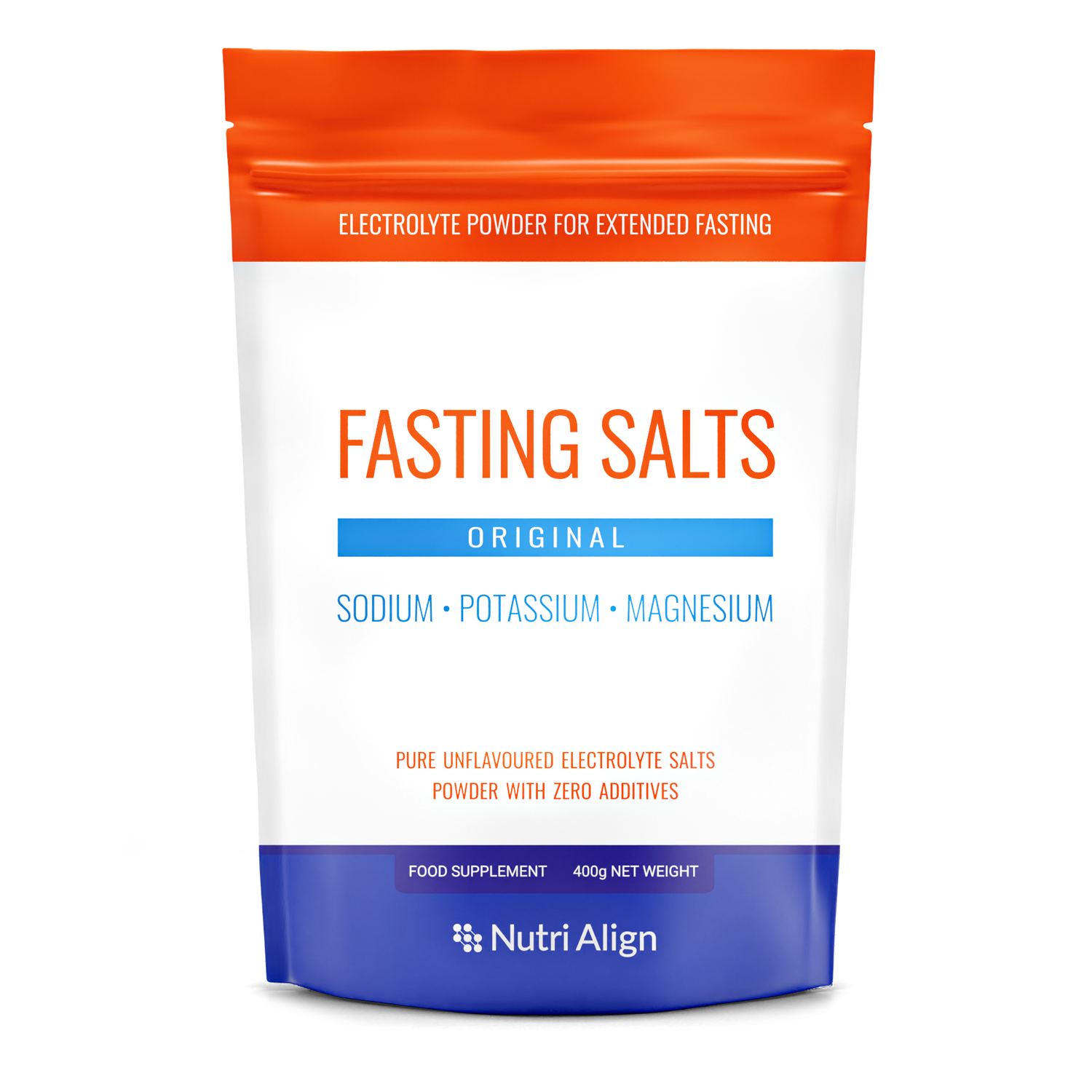
For this type of fasting, water-soluble Nutri-Align Fasting Salts Powder is usually the best fit. It is designed specifically for Extended Fasting, and is better value compared to fasting capsules.
Please note the powder includes pure mineral salts only and nothing else. So it does taste salty because there are no sugars or flavourings. If you don’t like the idea of drinking salty water, then go for capsules instead.
Supplements for Long-Term Extended Fasting of 5 days and longer
Short answer: For long-term EF, electrolytes are essential and non-negotiable. Fasting for this long without proper electrolyte support is likely to make you feel unwell and can actually be risky for your health. You should also start thinking ahead to the refeed phase which can be much easier to manage with the right supplements.
After several days of Extended Fasting, deficiency will hit if electrolytes are not replaced. The most common symptoms include headaches, fatigue, muscle cramps, nausea, irregular heartbeat and a general sense that your body is not coping well.
These symptoms are not a normal or necessary part of fasting. In most cases, they are a sign that your electrolyte levels have dropped to a very low level.
The only realistic way to prevent this is to supplement throughout the fast with a fully balanced electrolyte blend containing sodium, potassium and magnesium in the right ratios.
For long fasts, guesswork is a bad idea. Use our Fasting Electrolytes Dosage Calculator to estimate the right intake for each day of your fast.
For long-term Extended Fasting, Nutri-Align Fasting Salts Powder is the most suitable option.
When you begin refeeding, Fasting Refeed can help support the transition back to normal eating, especially after 5 days or longer.
Fasting Electrolytes FAQs
What are the key fasting electrolytes to supplement?
Our bodies need the following electrolytes:
- Sodium (Na)
- Potassium (K)
- Magnesium (Mg)
- Chloride (Cl)
- Calcium (Ca)
- Phosphorus (P)
The first three – sodium, potassium and magnesium – are the key ones to replenish during fasting.
Phosphorus and calcium take much longer to deplete. The play less of a role during your fast but become more important during the refeed phase.
What are the optimal electrolyte ratios for fasting?
Electrolytes interact with each other in the body. It's important to consume them in the right ratios. The optimal ratios for fasting are not exactly the same as with generic electrolyte supplementation.
There is no "one size fits all" answer, so it's best to think of them as ranges rather than precise numbers.
Most expert advice and community best practice recommendations for fasting electrolytes fall within the following ranges:
- Sodium: 5000-7000mg
- Potassium: 1000-3500mg
- Magnesium: 300-500mg
Use our dosage calculator to find the level of fasting electrolytes that’s optimal for you personally.
Why aren't these fasting electrolyte dosages the same as 100% NRV / DV recommendations?
Nutrient Reference Values (NRV) in UK/EU and Daily Values (DV) in the USA reflect government recommendations for optimal micronutrient intake for an average healthy adult on a standard Western diet.
Other dietary scenarios, such as fasting, Keto or Carnivore, were never considered or included in these recommendations.
During fasting, several physiological shifts make these numbers even less relevant.
Different intake baseline: You’re not consuming any food at all, so your dietary sources of sodium, potassium, and magnesium stop completely.
Hormonal shifts: Lower insulin levels cause for your kidneys to excrete more sodium and water, which in turn increases loss of potassium and magnesium.
Reduced digestive demand: Micronutrients used for digestion and metabolism are needed in smaller amounts when those processes slow down.
Fat mobilisation and autophagy: Fat loss releases small amounts of fat-soluble vitamins, while cellular recycling processes temporarily alter nutrient turnover.
Because of these factors, the “100 % NRV / DV” numbers don’t map cleanly onto fasting conditions.
Fasting electrolyte targets are functional maintenance ranges designed to offset increased mineral loss and maintain optimal electrolyte balance throughout your fast. That's not the same as daily intake goals for a standard diet.
Do electrolytes break a fast?
A fast is “broken” when you consume calories or ingredients that significantly stimulate digestion or insulin.
Electrolytes are mineral salts that have no macronutrient value and zero calories. So a pure electrolyte supplement will not break your fast or have any impact on autophagy.
Purity is essential so always double check product labels and ingredients. Many electrolyte products on the market are loaded with sugar, sweeteners and artificial flavourings.
Even those that are marked as zero-calorie might derail your fast if they have high levels of sweeteners or junk ingredients like maltodextrin. These ingredients can cause an insulin response even if technically there are no calories.
Fasting Supplements Mistakes
Using table salt only for fasting support
Table salt is mainly sodium chloride, so it covers sodium + chloride. This may be enough for Intermittent Fasting or short-term Extended Fasting.
But it does NOT cover potassium or magnesium, which are commonly needed during Extended Fasting.
If you only use salt to supplement, you may still feel deficiency symptoms because potassium and magnesium are not being replaced.
Choosing Pink Himalayan Salt and Celtic Sea Salt over pure mineral salts
Unfortunately, just like plain table salt, Pink Himalayan salt provides mostly just sodium and chloride. This may be enough for Intermittent Fasting or short-term Extended Fasting.
Although it's advertised as containing trace minerals including potassium and magnesium, their levels are typically way too low and not enough to sustain your requirements while fasting. There are also potential purity issues with Pink Himalayan salt. There is a higher risk of heavy metals contamination, so always buy from reputable suppliers and ask for third-party test results if unsure.
Celtic Sea Salt comes from a different source but the same concerns apply equally.
Read more about Pink Himalayan salt for fasting
Using generic electrolyte supplements for fasting
Most electrolyte products on the market are not created for fasting. Typically, they are designed for sports rehydration or generic electrolyte balance.
These products are very likely to have added sugars, junk fillers like maltodextrin and synthetic flavourings. These will break your fast and derail autophagy.
Second point to note is proper electrolyte ratios. Fasting requires a much higher sodium content compared to generic products, plus potassium and magnesium in the right ratios for fasting.
How to Get the Right Fasting Supplements
Which electrolyte products are suitable for fasting?
As mentioned above, generic electrolytes are usually not the right choice for fasting.
The right product should support your fast properly without breaking it or affecting autophagy.
The following features are a must:
- 100% sugar-free and zero calorie – otherwise they will break your fast
- High sodium content, especially for Extended Fasting
- Sufficient quantities of potassium and magnesium
- No unnecessary fillers or flavourings – the last thing you need while fasting is chemical junk!
Nutri-Align Fasting Salts range hits all these targets. Our products are designed specifically for fasting and have been tried and tested by the fasting community over 7 years (since 2019).
Having said that, there are now other products on the market that meet the criteria for a proper fasting product.
You can also choose to make your own electrolyte blend, which is usually cheaper, but obviously more laborious and time-consuming.
What’s better for fasting – electrolyte powder or capsules?
Short answer: Both formats can work well for fasting. The best option depends on the type of fast you are doing, how much electrolyte support you need, and also your lifestyle
For shorter fasting windows such as Intermittent Fasting, many people prefer Fasting Salts Capsules. They are simple, portable and easy to fit into daily routine. Our formulation is also completely pure and free from anything that may break or affect your fast.
If your electrolyte needs are relatively modest, capsules are often enough. Nutri-Align positions capsules as the convenient option for fasting support, especially where lower or moderate intake is sufficient.
For Extended Fasting, especially beyond 48 hours, Fasting Salts Powder is usually the better fit. Powder makes it easier to take higher amounts and fine-tune the dosage as your needs increase over the course of the fast. It’s also better value for money.
Taste and practicality also matter. Powder gives you more control, but not everyone enjoys drinking strong salty electrolytes. Capsules are more convenient and easier to tolerate, but they are less flexible when you need to increase intake significantly.
A simple rule of thumb is this:
- For Intermittent Fasting and lighter support, start with Capsules
- For Extended Fasting and higher electrolyte needs, choose Powder
Both formats are designed specifically for fasting, with no sugars, no hidden carbs, and no unnecessary fillers that could interfere with your fast.
Why isn’t there a simple answer to how much electrolytes I need?
There is rarely a one-size-fits-all answer when it comes to nutrition.
When it comes to supplements, the concept of government-approved “recommended daily values” contributed to a myth that our nutritional needs are uniform.
We can use government figures as a very approximate starting point. But our individual requirements for electrolytes can vary significantly based on multiple factors, and especially so during fasting.
Here are the key factors that contribute to our electrolyte requirements and create the variance between individuals.
Longer fasts need more electrolytes
Your electrolyte needs will increase gradually as the reserves stored in your body deplete. If you are only fasting for 2-3 days, you won’t need as much as someone who plans to go for 10 days or longer.
Larger bodies need more electrolytes
If you are big and/or tall, you may need more electrolytes than someone with a smaller body. Body composition matters as well because muscle tissue, fat and bones utilise electrolytes in different ways.
Intense exercise depletes electrolytes faster
If you exercise a lot, you will need more electrolytes than someone who doesn’t. We lose electrolytes with sweat so high-intensity exercise depletes your electrolyte levels quickly. Muscle recovery after anaerobic exercise also uses them up.
Medical conditions and medications affect electrolyte balance
Certain medications and medical conditions (especially those related to kidneys, cardiovascular health and digestive system) may affect the level of electrolytes in your body. Supplementation may also interact with the medication in unpredictable ways.
If you are on any medication or have any kind of medical condition, you should discuss fasting and electrolyte supplementation with your doctor before attempting it.
Your stored electrolyte levels depend on your usual diet
If you normally eat plenty of foods that are rich in electrolytes, you will have more of them stored in your body tissues and may require less supplementation, especially in the beginning.
Electrolytes are bound with glycogen in our bodies so low-carb and Keto diets usually mean less stored electrolytes.
Weather and climate affect electrolytes
Sweating depletes electrolytes quickly, so you may need more electrolytes if you live in a hot climate, or during periods of hot weather.
Drinking water may have electrolytes
The quality of drinking water varies widely by region. Some areas are lucky to have tap water that’s rich in electrolytes and others have hardly any. Likewise, if you usually drink bottled mineral water instead of tap water, that will provide some more electrolytes.
Find the Electrolyte Dosage that’s Optimal for You
Use our Fasting Electrolytes Dosage Calculator to estimate your electrolyte requirements with more precision.
The calculator provides dosage recommendations for Nutri-Align Fasting Salts products. But you can use the results to get a better idea of dosages even if you choose to use other products.
The quiz asks eight simple questions about you and your fasting plans.
Your supplementation requirements will be determined as either High, Medium or Low.
Read more about how we calculate the results
You will get a results page with detailed dosage recommendations of Fasting Salts Powder for your requirement level, with breakdown for each day of your fast.
We will NOT ask for your email address or any other personally identifiable information.
Fasting Electrolytes Dosage Calculator
Supplements for your Refeed Phase after a Long-Term Extended Fast
If your extended fast was 5 days or longer, you may want to consider some additional supplements to assist your fasting refeed phase.
After a long Extended Fast, your body doesn’t just instantly switch back to normal eating. Multiple metabolic processes need to get restarted and recalibrated first. This transition can take several days or even weeks depending on the duration of your EF.
Breaking your fast too quickly can cause multiple disruptions in your body’s biochemistry. Side effects like water retention, bloating, digestive upset and headaches are fairly common. That’s why you need to carefully plan and manage your refeed phase.
Take the following at least 30 minutes before breaking your fast:
- Phosphorus
- B vitamin complex
These nutrients are commonly used to prevent refeeding syndrome in malnourished patients and can be used to minimise the refeed side effects.
Continue taking your electrolytes in smaller dosages for several days after the end of your fast.
Nutri-Align Fasting Refeed supplement is designed specifically for this purpose. It includes B-Vitamin complex plus vitamins C and D and phosphorus.
Sources
Sigler MH. The mechanism of the natriuresis of fasting. J Clin Invest. 1975;55(2):377–387. doi:10.1172/JCI107941. PubMed; Free full text.
Runcie J. Urinary sodium and potassium excretion in fasting obese subjects. Br Med J. 1971;2(5752):22–25. doi:10.1136/bmj.2.5752.22. PubMed; Free full text.
Lin SH, Cheema-Dhadli S, Gowrishankar M, Marliss EB, Kamel KS, Halperin ML. Control of excretion of potassium: lessons from studies during prolonged total fasting in human subjects. Am J Physiol. 1997;273(5 Pt 2):F796–F800. doi:10.1152/ajprenal.1997.273.5.F796. PubMed.
da Silva JSV, Seres DS, Sabino K, et al. ASPEN Consensus Recommendations for Refeeding Syndrome. Nutr Clin Pract. 2020;35(2):178–195. doi:10.1002/ncp.10474. PubMed.
Friedli N, Stanga Z, Sobotka L, et al. Revisiting the refeeding syndrome: Results of a systematic review. Nutrition. 2017;35:151–160. doi:10.1016/j.nut.2016.05.016. PubMed.
