CoderFunda
  • Home
  • About us
    • Contact Us
    • Disclaimer
    • Privacy Policy
    • About us
  • Home
  • Php
  • HTML
  • CSS
  • JavaScript
    • JavaScript
    • Jquery
    • JqueryUI
    • Stock
  • SQL
  • Vue.Js
  • Python
  • Wordpress
  • C++
    • C++
    • C
  • Laravel
    • Laravel
      • Overview
      • Namespaces
      • Middleware
      • Routing
      • Configuration
      • Application Structure
      • Installation
    • Overview
  • DBMS
    • DBMS
      • PL/SQL
      • SQLite
      • MongoDB
      • Cassandra
      • MySQL
      • Oracle
      • CouchDB
      • Neo4j
      • DB2
      • Quiz
    • Overview
  • Entertainment
    • TV Series Update
    • Movie Review
    • Movie Review
  • More
    • Vue. Js
    • Php Question
    • Php Interview Question
    • Laravel Interview Question
    • SQL Interview Question
    • IAS Interview Question
    • PCS Interview Question
    • Technology
    • Other

28 December, 2020

Vue.js Declarative Rendering

 Programing Coderfunda     December 28, 2020     Vue.js Tutorial     No comments    Image

Vue.js Declarative Rendering

In Vue.js, there is a system in the core that enables us to declaratively render data to the DOM using simple, straightforward template syntax.

Syntax:

HTML:

  1. <div id="app">  
  2.   {{ message }}  
  3. </div>  

JS:

  1. var app = new Vue({  
  2.   el: '#app',  
  3.   data: {  
  4.     message: 'This is a simple Vue.js Declarative Rendering example!'  
  5.   }  
  6. })  

As we know that Vue.js facilitates us to extend HTML with HTML attributes called directives that are used to offer functionality to HTML applications.

There are two types of directives in Vue.js: built-in directives and user-defined directives. Vue.js uses double braces {{ }} as place-holders for data, and the Vue.js directives are HTML attributes that use a v- prefix.

Let's see a simple Declarative Rendering example that uses text interpolation.

Example 1:

Index.html file:

  1. <html>  
  2.     <head>  
  3.         <link rel="stylesheet" href="index.css">  
  4.         <script src="https://cdn.jsdelivr.net/npm/vue/dist/vue.js"></script>  
  5.     </head>  
  6.     <body>          
  7.         <div id="app">  
  8.             {{ message }}  
  9.         </div>          
  10.         <script src="index.js"></script>  
  11.     </body>  
  12. </html>  

Index.js file:

  1. var app = new Vue({   
  2.     el: '#app',  
  3.     data: {  
  4.           message: 'This is a simple Vue.js Declarative Rendering example!'  
  5.     }  
  6. });  

Output:

This is a simple Vue.js Declarative Rendering example!
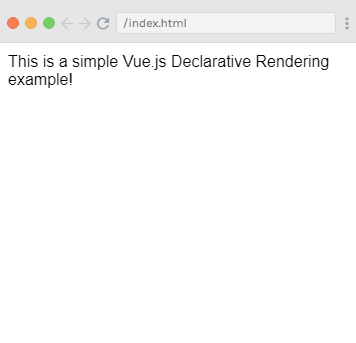
Vue.js Declarative Rendering

The above example is similar to rendering a string template, as we have already done in the very first Vue.js example. Now, the data and the DOM are linked, and everything is now reactive. You can check it on your browser's JavaScript console. Set app.message to a different value, and you will see the rendered example above update accordingly.

Now, we no longer have to interact with the HTML directly. A Vue app attaches itself to a single DOM element and fully controls it. In the above example case, it is #app. Now, HTML is only the entry point, and everything else happens within the newly created Vue instance.

Let's see an example where we deploy the binding of element attributes.

Example 2:

Index.html file:

  1. <html>  
  2.     <head>  
  3.         <link rel="stylesheet" href="index.css">  
  4.         <script src="https://cdn.jsdelivr.net/npm/vue/dist/vue.js"></script>  
  5.     </head>  
  6.     <body>         
  7.         <div id="app-2">  
  8.   <span v-bind:title="message">  
  9.     Hover mouse over me for a few seconds  
  10.     and see a dynamically bound title which I have set!  
  11.   </span>  
  12. </div>          
  13. <script src="index.js"></script>  
  14.     </body>  
  15. </html>  

Index.js file:

  1. var app2 = new Vue({  
  2.   el: '#app-2',  
  3.   data: {  
  4.     message: 'You loaded this page on ' + new Date().toLocaleString()  
  5.   }  
  6. })  

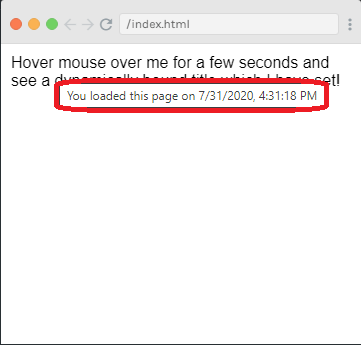
Output:

Hover mouse over me for a few seconds and see a dynamically bound title which I have set!

Vue.js Declarative Rendering

In the above example, a new v-bind attribute you are seeing is called a directive. Directives are used with a prefix v- to indicate that they are unique attributes provided by Vue, and they are used to apply a special reactive behavior to the rendered DOM.


  • Share This:  
  •  Facebook
  •  Twitter
  •  Google+
  •  Stumble
  •  Digg
Image
Email ThisBlogThis!Share to XShare to Facebook
Newer Post Older Post Home

0 comments:

Post a Comment

Thanks

Meta

Popular Posts

  • Vue.js Events
      In Vue.js, Events are used to respond to an action. Suppose, you have to build a dynamic website using Vue.js then you'll most likely ...
  • Is there a way to use awk to count the number of rows between 2 flags and input that number into a specific field?
    I have a set of data that consists of seismic wave travel times and their corresponding information (i.e. source that produced the wave and ...
  • How to use Filament 3 with Laravel 11 | Beginner Course
    How to install filament 3 from scratch with Laravel 11. submitted by /u/Tilly-w-e [link] [comments]
  • Use Leaflet.js and Google Maps Blade Components in Laravel
      Laravel Maps   is a package to easily create maps using   Leaflet.js   or Google Maps and Blade components. The main features that work wi...
  • How to Run a Python File on a Specific Virtual Desktop Only?
    I want to run a Python script on a specific virtual desktop without affecting other desktops. Currently, when I execute my Python file us...

Categories

  • Ajax (26)
  • Bootstrap (30)
  • DBMS (42)
  • HTML (12)
  • HTML5 (45)
  • JavaScript (10)
  • Jquery (34)
  • Jquery UI (2)
  • JqueryUI (32)
  • Laravel (1017)
  • Laravel Tutorials (23)
  • Laravel-Question (6)
  • Magento (9)
  • Magento 2 (95)
  • MariaDB (1)
  • MySql Tutorial (2)
  • PHP-Interview-Questions (3)
  • Php Question (13)
  • Python (36)
  • RDBMS (13)
  • SQL Tutorial (79)
  • Vue.js Tutorial (69)
  • Wordpress (150)
  • Wordpress Theme (3)
  • codeigniter (108)
  • oops (4)
  • php (853)

Social Media Links

  • Follow on Twitter
  • Like on Facebook
  • Subscribe on Youtube
  • Follow on Instagram

Pages

  • Home
  • Contact Us
  • Privacy Policy
  • About us

Blog Archive

  • July (4)
  • September (100)
  • August (50)
  • July (56)
  • June (46)
  • May (59)
  • April (50)
  • March (60)
  • February (42)
  • January (53)
  • December (58)
  • November (61)
  • October (39)
  • September (36)
  • August (36)
  • July (34)
  • June (34)
  • May (36)
  • April (29)
  • March (82)
  • February (1)
  • January (8)
  • December (14)
  • November (41)
  • October (13)
  • September (5)
  • August (48)
  • July (9)
  • June (6)
  • May (119)
  • April (259)
  • March (122)
  • February (368)
  • January (33)
  • October (2)
  • July (11)
  • June (29)
  • May (25)
  • April (168)
  • March (93)
  • February (60)
  • January (28)
  • December (195)
  • November (24)
  • October (40)
  • September (55)
  • August (6)
  • July (48)
  • May (2)
  • January (2)
  • July (6)
  • June (6)
  • February (17)
  • January (69)
  • December (122)
  • November (56)
  • October (92)
  • September (76)
  • August (6)

Loading...

Laravel News

Loading...

Copyright © CoderFunda | Powered by Blogger
Design by Coderfunda | Blogger Theme by Coderfunda | Distributed By Coderfunda

Advertisement