
ARCE Vancouver hosts several talks throughout the academic year. You can find information about upcoming or recent talks below. Most of our talks are free and open to the public.
For additional talks organized and scheduled by ARCE National, check out their events calendar HERE.
Upcoming ARCE Vancouver Events
To the Virgin we Pray: The Development and Profusion of Marian Iconography in Late Antique Egypt
By Dr. Sabrina Higgins
Saturday November 29th, 12:00 pm PST – Online
Hosted by the ARCE Vancouver Chapter – Event Link

The Virgin Mary is an enigmatic Biblical figure, one who rises from relative unimportance in the canonical gospels to become one of the most prominent figures in Christianity. Although we see a gradual theological discourse that culminates with the declaration of Mary as Theotokos at the Council of Ephesus in 431, the same cannot be said regarding the proliferation of her image in early Christian art. In the period following this Council, however, there is a widespread effort to incorporate Mary into the iconographical programmes of churches and monasteries. Thus, the fifth to ninth centuries represent a formative period in Christian art, during which time, Mary not only becomes an important subject in Christological themes, but also a significant figure within Late Antique art in her own right. More importantly, however, are the themes that arose from this increased interest in Mary, which relied on canonical, extra-canonical and diverse subjects from the Greek and Roman world to create a distinct iconography that has expanded well beyond our limited knowledge of the Biblical Mary. Her profusion in the surviving art of this period and the diversity of the images in which she appears are nowhere more varied and abundant than Egypt. It is within this context, therefore, that we examine the development and profusion of Marian wall paintings in Late Antique Egypt. This talk will also highlight the diverse texts and images that are brought together to create a series of distinct Marian wall paintings that would resonate with a Coptic audience, while also tracing the chronological and spatial implications of their use across Egypt.
Dr. Sabrina C. Higgins is an Associate Professor in the departments of Global Humanities and Archaeology and the Director of the Stavros Niarchos Foundation Centre for Hellenic Studies at Simon Fraser University. She is an archaeologist and art historian specializing in the Cult of the Virgin Mary in Late Antique Egypt, although more recent endeavours have thrown her into the fields of digital humanities pedagogy and public-facing scholarship, including her most recent co-edited volume Ancient Pasts for Modern Audiences: Public Scholarship and the Mediterranean World. She is also a founding member of Peopling the Past, a collaborative digital humanities initiative that produces and hosts open-access multimedia resources for teaching and learning about people in the ancient Mediterranean, West Asian, and North African worlds. Finally, Dr. Higgins maintains active fieldwork projects in both Egypt and Macedonia, notably, as a co-investigator on the Philae Temple Graffiti Project and The Ibis Hypogeum Graffiti Project, North Abydos and the Assistant Director of the excavations at Golemo Gradište, Konjuh in North Macedonia.
Past Events
Monks, Mummies, and Men of Letters:Exploring Egypt in the Age of Enlightenment
By Dr. Jennifer Westerfeld
Saturday October 18th, 12:00 pm PDT – Online
Hosted by the ARCE Vancouver Chapter – Event Link

Discussions of Egyptology’s roots in the Renaissance and early modern periods often highlight the work of linguists, who sought to decipher the mysteries of Egyptian hieroglyphs, and that of the archaeologists, geographers, and other scholars who famously traveled with Napoleon during his invasion of Egypt in 1798. Less well-known is the work of the earlier seventeenth and eighteenth-century travelers and explorers whose efforts to map the historical topography of Egypt laid much of the groundwork for the scholars of the Napoleonic expedition and for the subsequent nineteenth-century flourishing of Egyptian archaeology. A key figure in this early modern exploratory activity was the French Jesuit missionary and cartographer Claude Sicard, who is significant for being the first European explorer to correctly identify numerous important sites, including the ancient cities of Thebes and Abydos. This talk situates Sicard and his colleagues within the larger history of Egyptian exploration during the Age of Enlightenment, paying particular attention to the financing of research expeditions and the role of Egyptian interlocutors in the process of Egyptological knowledge-production.
Dr. Jennifer Westerfeld is an Associate Professor of History at the University of Louisville and president of the Kentucky chapter of the Archaeological Institute of America. An Egyptologist by training, her research focuses on the cultural and religious history of Roman-period Egypt.
Winged Hippopotami and Flying Giraffes: Fantastical Animals and the Negotiation of Elite Identity in the Classic Kerma Period
By Dr. Elizabeth Minor
Saturday September 27th, 12:00 pm PDT – Online
Hosted by the ARCE Vancouver Chapter — Event Link

The ancient Nubian Kerma Kingdom flourished during the Classic Kerma Period (1750-1500 BCE), especially in terms of highly personalized funerary arts. Elite community members sought out individualized and innovative expressions of multi-faceted identities, both with objects that represented their status and roles in life, and with imagery that symbolized their place within the cosmos and worldview. This personalized funerary equipment provides a material and visual arena of discussion of elite status and identity during a period of changing social complexity. In particular, tracing patterns in use of local, foreign, and fantastical animals amongst Classic Kerma religious iconography leads to a more nuanced understanding of how community members negotiated their relationships with each other during this time of flux.

Dr. Elizabeth Minor is an Assistant Professor of Anthropology at California Polytechnic State University, San Luis Obispo. She is an anthropologist who specializes in the ancient Nile Valley, museums, human-computer interaction, and cultural heritage management. She earned her Ph.D. in Near Eastern Studies at the University of California, Berkeley. She holds 20 years of experience working with anthropological museum collections, including the Egyptian Museum in Cairo, the Sudan National Museum in Khartoum, the British Museum, the Phoebe A. Hearst Museum of Anthropology, and the Wellesley College Davis Museum.
Her digital museum projects focus on connecting diverse audiences with cultural heritage, especially through community collaboration and student-led creative interactive design. Dr. Minor is the Co-Director and PI for a National Science Foundation funded project which uses community-based research practices to better understand cultural resilience under the changing climate of the ancient Middle Nile, through analysis of historical museum collections and ethnography. She also has over 20 years of field archaeology experience, excavating in Egypt (since 2005), Sudan (since 2014), California (since 2002), and Massachusetts (since 2017). She is currently exploring her home state of California as she develops a Digital California Cultural Heritage project.
Ancient Egypt Reimagined: Teaching about the Past Through Digital Humanities
By Dr. Rita Lucarelli
Saturday June 7th, 12:00 pm PDT – Online
Hosted by the ARCE – Vancouver and Oregon Chapters
Register HERE

In this lecture, the role of applying DH methods in courses on the ancient Egyptian funerary art and religion will be outlined and discussed—also in the light of the most recent use of AI in the classroom. We will cover three main case-studies: The Book of the Dead in 3D, a student-based project for the 3D visualization of ancient Egyptian coffins; the VR app Return to the Tomb on the digital repatriation of ancient Egyptian sarcophagus to its tomb, developed by an international team of digital scholars and Egyptologists (UC Berkeley, UC Santa Cruz. The University of Bonn, Virginia Tech); and MELC 110: Digital Humanities and Egyptology, an undergraduate course at the University of California, Berkeley.

Rita Lucarelli studied at the University of Naples “L’Orientale,” Italy, where she received her MA degree in Egyptology. She holds her Ph.D. from Leiden University, the Netherlands, with a thesis published as The Book of the Dead of Gatseshen: Ancient Egyptian Funerary Religion in the 10th Century BC. She worked as a Research Scholar and a Lecturer at the Department of Egyptology of Bonn University, where she was part of the team of the “Book of the Dead Project”. She is currently an Associate Professor of Egyptology at UC Berkeley and Faculty Curator of Egyptology at the Phoebe A. Hearst Museum of Anthropology of the University of California, Berkeley and Fellow of the Digital Humanities in Berkeley. Her specialty is the study of the ancient Egyptian magic and religion.
She is presently working at a project aiming at realizing 3D models of ancient Egyptian coffins, the “Book of the Dead in 3D” and a VR App, “Return to the Tomb”, which recreate the tomb space where an ancient Egyptian sarcophagus is brought back, from the museum to the tomb. She is also completing a new monograph on demonology in ancient Egypt entitled “Agents of punishment and protection: ancient Egyptian Demonology in the First Millennium BCE”. Dr. Lucarelli is also involved in teaching Higher Education in the San Quentin State Prison, in California.
Trace the Untraceable: Unravelling the Craft Landscape in Ancient Egypt
By Ahmad Mohammed
Saturday May 3rd, 12:00 pm PDT – Online
Hosted by the ARCE – Vancouver and Oregon Chapters
Register HERE

This talk explores the elusive yet richly textured craft landscapes of ancient Egypt, revealing how pottery workshops served as both industrial hubs and dynamic social spaces. By adopting a multidisciplinary approach that integrates spatial analysis, ethnoarchaeological insights, and traditional archaeological investigation, the talk examines how environmental, economic, and social forces shaped the organization of craft production. Contemporary practices observed in El-Nazlah, through participant observation, semi-structured interviews, and GIS mapping of workshop layouts and kilns, are juxtaposed with archaeological findings from ancient workshops at El-Kab. This comparative analysis uncovers both enduring continuities and transformative shifts in how Egyptian potters structured their work environments and communities. Ultimately, the talk aims to trace the untraceable threads of labour, space, and social interaction, offering fresh perspectives on the complexities of ancient Egyptian craft landscapes.
Ahmad Mohammed is a PhD Candidate at Durham University, specializing in material culture and settlement archaeology. His research focuses on crafting landscape, especially pottery in ancient Egypt, spanning from the Predynastic to the early Islamic period. Using a multidisciplinary approach that includes ethnoarchaeology, chaîne opératoire, craft landscapes, and GIS, he explores the dynamics of craft landscape. Ahmad also serves as Assistant Editor for World Archaeology Journal, and as a Project Coordinator for EAMENA project at Durham University, he manages key aspects of the project, including organizing training workshops, financial reporting, fieldworks, and overseeing heritage digitization projects to mentor, assess, and safeguard the heritage of the MENA region.

The Nile Delta: Histories from Antiquity to the Modern Period
By Dr. Katherine Blouin
Friday March 28th, 2:30 pm PST – In-Person and Online
Hosted by the SNF Centre for Hellenic Studies
Registration Coming Soon

Drawing from her experience editing the collective volume The Nile Delta: Histories from Antiquity to the Modern Period in a time of accelerating climate crisis, Dr. Blouin will reflect on what transhistorical and Land-based approaches to the history of this region can teach us, and what potential futurities these combined narratives allow us to (re)imagine.
Dr. Blouin has a PhD in Roman History from the Université Laval (Québec City, Canada) and the Université de Nice Sophia Antipolis (Nice, France), and a Postdoctoral Diploma in Greek Papyrology from the École Pratique des Hautes Études (Paris, France). Her work centres on socio-economic and environmental history, with a focus on ancient, and particularly Roman, Egypt, as well as on the ethics and (de)colonial entailments of Antiquity-related fields. She has written about the Judaeo-Alexandrian conflict, the environmental history of the Nile Delta, multiculturalism, cultural and religious identities, as well as Lands, (non)-Human beings, and periods that are commonly considered to be ‘marginal’. She has also worked on the cataloging, restoration, and digitization of the Greek papyrus collection in the Bibliothèque Nationale de France, and has edited Greek documents on papyri and leather from that collection, as well as from the Franco-Italian mission at Tebtunis. Her current work focuses on the ways in which imperialism and Orientalism have impacted (and are still impacting) the fields of Classics, Papyrology, and Egyptology, and how these entanglements manifest themselves in (settler) colonial contexts. She is a co-founder and editor of Everyday Orientalism, as well as the editor of the volume The Nile Delta: Histories from Antiquity to the Modern Period (Cambridge, 2024) and the co-editor of the Routledge Handbook of Classics, Colonialism, and Postcolonial Theory (with Ben Akrigg, London, 2024) and Viva Palestina: Imagining Transhistorical Solidarity (with Usama Ali Gad, Mathura Umachandran and Marchella Ward, in preparation). She is also working on a book project entitled Inventing Alexandria, which explores the history, historiography, and reception of pre- to early Hellenistic Alexandria.
Stolen Fragments: Black Markets, Bad Faith, and the Illicit Trade in Ancient Artefacts
By Dr. Roberta Mazza
February 22nd, 10:00 pm PST – Online
Hosted by the ARCE – Vancouver and Oregon Chapters
Register Here

In 2012, Steve Green, billionaire and president of the Hobby Lobby chain of craft stores, announced a recent purchase of a Biblical artefact—a fragment of papyrus, just discovered, carrying lines from Paul’s letter to the Romans, and dated to the second century CE. Noted scholar Roberta Mazza was stunned. When was this piece discovered, and how could Green acquire such a rare item? The answers, which Mazza spent the next ten years uncovering, came as a shock: the fragment had come from a famous collection held at Oxford University, and its rightful owners had no idea it had been sold. The letter to the Romans was not the only extraordinary piece in the Green collection. They soon announced newly recovered fragments from the Gospels and writings of Sappho. Mazza’s quest to confirm the provenance of these priceless fragments revealed shadowy global networks that make big business of ancient manuscripts, from the Greens’ Museum of the Bible and world-famous auction houses like Sotheby’s and Christie’s, to antique shops in Jerusalem and Istanbul, dealers on eBay, and into the collections of renowned museums and universities. Mazza’s investigation forces us to ask what happens when the supposed custodians of our ancient heritage act in ways that threaten to destroy it. Stolen Fragments illuminates how these recent dealings are not isolated events, but the inevitable result of longstanding colonial practices and the outcome of generations of scholars who have profited from extracting the cultural heritage of places they claim they wish to preserve. Where is the boundary between protection and exploitation, between scholarship and larceny?
Roberta Mazza is Associate Professor of Papyrology at the Department of Cultural Heritage of the University of Bologna since July 2022. Before going back to her Alma Mater, Roberta worked in the United States and Great Britain. From 2009 to 2022, she was Lecturer and then Senior Lecturer at the University of Manchester, where she still is an Honorary Research Affiliate. Her research includes both editions of papyri and broader studies on the history of Egypt under the Roman and Byzantine empires. Most recently, she has written on issues of academic ethics in publishing manuscripts, the colonial history of papyrology, and the legal and illegal market in papyri and other Egyptian antiquities.
Ritual and Imagined Landscapes at Ptolemaic Abydos
By Dr. Tom Landvatter
January 25th, 12:00 pm PST – Online
Hosted by the ARCE – Vancouver and Oregon Chapters
Register Here

Abydos is one of the most important cemetery sites in Egypt, as the burial site of the first pharaohs, the site of multiple cemeteries in near constant use for 3500 years, and a major cult center to Osiris. During the Ptolemaic period, Abydos was also the site of overlapping mortuary, ritual, and imagined landscapes. On the one hand, the site continued to be a major center of the Osiris cult, with a ritual landscape focused on the yearly processions out to Umm el-Qa’ab, the location of the god’s cenotaph. Abydos’ funerary landscape was organized around the ritual one, with prominent tombs oriented around and lining the main processional routes. At the same time, the New Kingdom temple complex of Seti I at Abydos also grew in importance as a healing and oracular center frequented by Greek-speakers. The temple was identified as a Memnonion by Greek authors, making it a part of a wider, Greek-imagined landscape of Egyptian monuments linked with the mythical hero Memnon of the Trojan war. Over the course of the Ptolemaic period, Abydos’ overlapping landscapes were largely maintained, but by the end of the Ptolemaic period it is likely that the Seti I complex, in part due to Greek interest in that temple, had become the ritual center of Abydos, with consequent major shifts in the ritual and mortuary landscape.

Tom Landvatter is Associate Professor and Chair of the Greek, Latin, and Ancient Mediterranean Studies (GLAM) Department at Reed College in Portland, Oregon. His teaching and research interests center on archaeology and history of the Hellenistic Eastern Mediterranean, in particular Cyprus and Ptolemaic Egypt (323-30 BCE). Tom’s research, which has been supported by the National Science Foundation and a Fulbright award, focuses on the archaeology of death and burial, identity, and the archaeology of imperialism, with a particular interest in cross-cultural interaction and its effect on material culture. He is a field archaeologist working in both Egypt and Cyprus, and is currently co-director of the Pyla-Kousopetria Archaeological Project’s (PKAP) excavations at Vigla, Cyprus.
EAMENA Project: Insights on Remote Sensing and Rapid Documentation for Heritage Places
By Dr. Mohamed Kenawi
December 7th, 12pm PST – Online
Co-Hosted with ARCE – Northwest and ARCE – Oregon — Click Here to Register

The necessity for rapid documentation of archaeological and cultural heritage sites in the Middle East and North Africa was raised due to the growth of urban development, conflicts, and reclamation projects for agriculture. The aim of the project is to record and evaluate the statuses of heritage places and provide researchers with a wide set of data for further elaboration. This lecture will present an overview of the EAMENA project, the process of the rapid documentation through remote sensing, the EAMENA database, and associated activities such as the training programs in the region. In addition, examples of the Egyptian Cultural heritage sites will be presented.

Dr. Mohamed Kenawi is a Research Associate at the School of Archaeology and Ancient History University of Leicester. He was a Researcher and Training Manager at the School of Archaeology University of Oxford for the Endangered Archaeology of the Middle East and North Africa project. He was Head Researcher (2011-16) followed by Acting Director (2016-17) of the Hellenistic Centre of Bibliotheca Alexandrina. He taught at the American University in Cairo and at Catania University. In 2023, he joined al-Farabi Kazakh National University as a visiting professor.
Lifeways on the Margins of the Sahara: Woodland Ecology and Wood Use in the Neolithic to Roman Fayum, Egypt
By Dr. John “Mac” Marston
November 19th, 7:30 pm PST – UBC-Vancouver Buchanan A 203 and Online
Hosted by the Vancouver Chapter of the AIA — Online Registration Coming Soon

This presentation considers the human ecology of wood use in what is today one of the driest regions of the world: the Western Desert of Egypt. Archaeological study of one area within this region, the Fayum Basin, reveals intensive human settlement during both the Early Holocene, prior to the aridification of the Sahara, and the Roman period, when irrigation agriculture converted the desert to the breadbasket of Rome. Recent archaeological investigation of Early Neolithic and Roman sites in the Fayum has yielded considerable wood charcoal, which provides evidence for both natural and human-modified woodland ecology in this region and for selective wood use by early farmers and Roman craft specialists alike.

An environmental archaeologist, John M. Marston studies the long-term sustainability of agriculture and land use, with a focus on ancient societies of the Mediterranean and western and central Asia. His research focuses on how people make decisions about land use within changing economic, social, and environmental settings, and how those decisions affect the environment at local and regional scales. A specialist in paleoethnobotany, the study of archaeological plant remains, Marston’s contributions to the field include novel ways of linking ecological theory with archaeological methods to reconstruct agricultural and land-use strategies from plant and animal remains (see full profile at Dr. Marston’s BU Faculty Page.
Persian Kings on Egyptian Soil: Culture and Identity Negotiation as an Expression of Power
By Dr. Marissa Stevens
October 19th, 12pm PDT – Online
Co-Hosted by ARCE – Northwest and ARCE – Oregon — Click Here to Register

The 27th Dynasty represents the first period of Achaemenid Persian dominion over Egypt. Studying this time period is essential for understanding both the mechanisms of wider Achaemenid imperial rule and how Egyptian culture contributed to the concept of the Persian empire. I would like to present several case studies, which include the (auto)biographical statue of Udjahorresnet, the titulary of Persian pharaohs, the texts and images of Hibis Temple, and the iconography of the statue of Darius I, in order to showcase Achaemenid imperial overlay in Egypt. The material, text, environment, and iconography studied will be treated as critical evidence to address how the Persians capitalized on Egyptian art and language in order to govern Egypt as part of a wider empire. This presentation will highlight how text, image, and monument can come together to provide a clear picture of the manipulation of culture and identity to gain and maintain power during a time of imperial rule in Egypt.

Dr. Marissa Stevens is the Assistant Director of the Pourdavoud Institute for the Study of the Iranian World. Trained as an Egyptologist who studies the materiality, social history, and texts of the Third Intermediate Period and Late Period, she first earned an Honors B.A. in History and Sociology from Washington & Jefferson College and an M.A. from the University of Chicago, before completing her Ph.D. at the University of California, Los Angeles in the Department of Near Eastern Languages and Cultures. Combining art historical and linguistic approaches, her research interests focus on how objects can solidify, maintain, and perpetuate social identity, especially in times of crisis when more traditional means of self-identification are absent.
‘They Came to Egypt’: Uncovering Hidden Records of Exploration and Excavation in ‘Golden Age’ Personal Archives
By Dr. Sarah Ketchley
September 26th, 7pm PDT – Online
Co-Hosted by ARCE – Northwest and ARCE – Oregon — Click Here to Register

This lecture will discuss excavation in the Valley of the Kings in the late 19th and early 20th centuries, using the personal archives of some of the lesser-known figures in Egyptology to recreate the so-called ‘Golden Age’ of Egyptian archaeology. These individuals include artists and draftsmen who worked in the Valley, and the close relatives of several prominent Egyptologists. The diaries of Mrs. Emma B. Andrews are one such example: traveling along the Nile with American lawyer-turned-archaeologist Theodore M. Davis between 1889 – 1913, Emma’s journals provide insights into contemporary society and Egyptological networks, and detailed eyewitness observations of significant archaeological discoveries.

Dr. Sarah Ketchley is an Egyptologist specializing in the art history in the first millennium BCE. Based at the University of Washington in the Department of Middle Eastern Languages and Cultures, she teaches introductory and graduate-level classes in digital humanities and directs a long-running undergraduate internship program. Inspired by intrepid women travelers of the 19th century, Sarah works with students to digitize and publish a range of primary source material from the period, including the Nile travel diaries of Mrs. Emma B. Andrews. Working computationally to analyze the content of Emma’s writings, Sarah and her students have created an extensive digital biographical database, interactive maps. and an archive of encoded primary source material from the ‘Golden Age· of Egyptian archaeology.
Where are the “Merchants” in Ancient Egypt? A Case for Nubian Communities as Active Agents in Northeast African Metal Industry
By Matei Tichindelean
12 pm PDT on Saturday May 18th – Online
Co-Hosted by ARCE – Oregon — Click Here to Register

Unlike their neighboring Bronze Age polities, the ancient Egyptians rarely reference “merchants” or “traders” in their documents. Even when the term šwjtj(phonetically shuiti), which is often translated as “merchant,” begins to be referenced in the large corpus of New Kingdom text-based evidence, they appear to be agents operating with or on behalf of state-sponsored institutions. In this capacity, merchants conduct or facilitate the movement of raw or finished products for state-sponsored trade and industries associated with temple institutions. Much like other industries, intensive metalworking production appears to fall under the control of the Egyptian state. Yet, archeometallurgical analysis has revealed that the constant influx of new, raw metals (copper in particular) was not only necessary to maintain the Bronze Age Egyptian industry, but, indeed, evident in state and private metal production processes. And so, to highlight the non-state actors involved in this industry, I turn to archaeological and metallurgical analysis of Egyptian and non-Egyptian material culture that has the potential tell an alternative story than the one written down by the Egyptian state. Consequently, my research explores the diversity of resources available to the Nubian communities (C-group and Pan-grave specifically) of the Middle Nile region (modern Sudan) that operated outside of state-level enterprises, highlighting not only the diverse access to materials they possessed but also demonstrating their extensive knowledge necessary for producing a variety of metal alloys.
Matei Tichindelean is a PhD candidate in the Cotsen Institute of Archaeology at University of California, Los Angeles. His research focuses on the interactions between nomadic peoples of northeast Africa and the settled populations along the Nile Valley. His dissertation combines metallurgical analysis of Egyptian and Nubian cuprous objects in museum collections with archaeology to understand the lifeways and roles that nomads played in supra-regional economies. His field work experience includes participation in archaeological projects in Egypt, Oman, Romania, Italy, the American Southwest, and the Sudan, as well as metal analysis of museum objects around the world, including the Manchester Museum, Museo Egizio in Turin, Italy and the Brooklyn Museum in New York.
Lapis-Lazuli and its Cultural Significance within Egypt’s Predynastic Period
By Thomas H. Greiner
12 pm PDT on Saturday April 27th – Online
Co-Hosted by ARCE – Oregon — Click Here to Register

Lapis-lazuli is a deep-blue coloured metamorphic stone with white and golden specks: its major source in the north-eastern region of Afghanistan is located nearly 4,000 km to the east of Egypt. Finds made their way into Egypt from as early as the beginning of the fourth millennium BC and attest that arrived via a vast long-distance exchange network. However, where and how exactly did lapis-lazuli finds enter Egypt and what can we learn about the stone’s importance in how it was used? To-date scholars have attributed a high significance to lapis-lazuli and associated it with the uppermost levels of Egyptian society. The stone has also had an impact as a possible variable in Egyptian state unification at the end of the fourth millennium BC. In this talk, we discuss when precisely lapis-lazuli appears in Egypt and explore what their findspots allow us to conclude about the cultural significance of lapis-lazuli within Egyptian society, state formation, and – most importantly – Egyptian foreign relations.
Thomas H. Greiner is a Ph.D. candidate in Ancient Near Eastern Studies at the University of Toronto, where he specialises on the cultural significance of lapis-lazuli in Pre- and Early Dynastic Egypt. He is very interested also in representations of Egypt in film, modern culture, and museums, and blogs regularly for the Nile Scribes which makes Egyptology accessible to the wider public. Thomas has excavated at Hierakonpolis and Kom al-Ahmer/Kom Wasit in Egypt and has recently completed his Certificate in Museum Studies through the Ontario Museum Association.
The Book of Caverns and Solar-Osirian Unity
By Dr. Dawn Power
12 pm PST on Saturday March 9th – Online
Co-Hosted by ARCE – Oregon — Click Here to Register

The Book of Caverns is one of the lesser known Underworld Books, which deal with the sun god’s nocturnal journey in the Underworld. It appears in the New Kingdom royal tombs of the Ramesside Kings and also in the Osireion of Seti I at Abydos. When it was first discovered it was thought to be a text associated with punishment, due to the images of cauldrons that appear in the lower registers. Although the text does deal with the punishment of the enemies of the Re and Osiris, this is not the primary concern of the text. Through and analysis of the text and iconography of this composition it became evident that the main emphasis of this composition is the Solar-Osirian Unity and rebirth. This lecture will provide a brief overview of the contents of the Book of Caverns and it will also look at the various iconographic elements that pertain to the Solar-Osirian Unity. In doing so, the misconception that the emphasis of this composition is on punishment will be clarified, which will present the Book of Caverns in a new light and demonstrate that its emphasis is actually on the Solar-Osirian Unity and rebirth.
Dawn Power has a BA in Religious Studies from McMaster University, a Specialist Degree and an MA in Egyptology from the University of Toronto, and a PhD from the University of Liverpool with a dissertation focused on the Book of Caverns. Dr. Power has taught as a sessional lecture at the University of Toronto and the University of British Columbia and is a member of the board for the Toronto Chapter of the Society for the Study of Egyptian Antiquities (SSEA). She has published and presented numerous conferences papers on Egyptian Religion, the Book of the Dead, and the Book of Caverns. Dr. Power was also a consulting Egyptologist with the Bolton Museum in England, where she provided hieroglyphic translations of text for their renovated Egyptian gallery.
Digitizing the Theban West Bank – the Theban Mapping Project Website
By Walton Chan and Briana Jackson
11 am PST on Saturday February 17th – Online
Co-Hosted by ARCE – Oregon — Click Here to Register

The Berkeley Theban Mapping Project was founded by Dr. Kent Weeks in 1978 at the University of California, Berkeley. Its goal was to establish a framework for mapping the ancient monuments of Thebes, as a basis for conservation and future exploration. It produced the first comprehensive surveys of the tombs in the Valley of the Kings, the Valley of the Queens, and the Western Wadis, and pioneered aerial photography from hot air balloons in Luxor. In 1985 the project moved to the American University in Cairo, and in 1989, ahead of plans by the Egyptian Antiquities Organization to widen the access road into the Valley of the Kings, rediscovered the location of tomb KV 5 – a tomb that had been “lost” under debris from other excavations. Thought to be small and of minor significance to the first archaeologists who crawled inside (including Howard Carter), it was revealed in 1995 to be the largest tomb in the Valley, with over a hundred rooms. The global interest generated by this discovery raised funds that enabled the TMP to publish its work, digitally drawing and modeling the tombs it had surveyed to produce the Atlas of the Valley of the Kings, and creating the first of now three iterations of its award-winning website.
After crashing in 2010, the popular website, thebanmappingproject.com (TMP.com), was brought back online in 2020 by the American Research Center in Egypt (ARCE). The main mission of the website is to serve as an exhaustive and educational resource for scholars and the public on the ancient sites and monuments of the Theban West Bank. The Valley of the Kings was the first database to be debuted on TMP.com and provides users with unprecedented access to the site’s 65 known tombs through interactive aerial maps and axonometric tomb plans, photographic galleries, site, exploration, and conservation histories, as well as resources such as bibliographies, a glossary, an Egyptian timeline, and articles on major and minor Egyptological and archaeological themes. In 2023, the first ever online database on the Valley of the Queens and the Western Wadis was launched on TMP.com, showcasing over 120 generally unknown tombs. In this lecture, we will present the processes behind digitizing and publicly presenting these ancient sites on TMP.com.
Walton Chan is an architect and engineer based in Toronto, Canada. He joined the Theban Mapping Project as architect and surveyor in 1996, producing digital drawings and 3D models of tombs in the Valley of the Kings and the Valley of the Queens and designing the TMP publications Atlas of the Valley of the Kings and KV5: A Preliminary Report on the Excavation of the Tomb of the Sons of Ramesses II in the Valley of the Kings. After leaving Cairo in 2000, he has continued to consult for the TMP, contributing to its digital publications.
Briana Jackson holds a PhD in Egyptian art and archaeology from the Institute of Fine Arts, New York University. Currently Briana is a Digital Humanities postdoctoral research fellow at the American research Center in Egypt and is also working with the TMP. She teaches ancient Egyptian and Roman history and art history and has worked for the IFA-NYU North Abydos Expedition on artifact processing, archiving, and surface collection. Her current research, which she aims to publish as a book, examines the spread of Atenism throughout Egypt and Sudan. Briana is also working for the NYU Ramesses II Temple in Abydos Project, helping with publications and website building.
Egyptian Religious Landscapes and Stamp Seal Amulets in the Southern Levant: Contextualizing the Nature of Community Interaction during the Middle Kingdom and Second Intermediate Period
By Dr. Nadia Ben-Marzouk
12 pm PST on Saturday January 27th – Online
Co-Hosted by ARCE – Oregon — Click Here to Register

Stamp seal amulets of the Middle Bronze Age southern Levant are inscribed with various Egyptian designs, interpreted as “good luck” symbols connected to their amuletic function in funerary contexts. The appearance of such motifs on locally produced scarabs is often described as the “copying” of imported Egyptian scarabs, stemming from an assumed ignorance of Egyptian culture on the part of local communities, and resulting in the divorcing of such motifs from their original Egyptian context. While the large quantity of excavated scarabs from the southern Levant has played a significant role in debates about chronology, place of production, and the nature of intercultural contact between the southern Levant and Egypt during the Middle Kingdom and Second Intermediate Period, no serious attempts have sought to understand the possible shared religious landscapes between communities and the nature of interaction. It is noteworthy, however, that many motifs supposedly emulated by local communities do not appear on contemporary Egyptian scarabs, raising the need to rethink this narrative. Where else might local producers have encountered such designs? How might engagement with new lines of inquiry shift our understanding of religious landscapes in the southern Levant and thus the nature of interaction with communities in Egypt at a time of intense immigration? This talk surveys the corpus of stamp seal amulets from the southern Levant and argues for direct parallels in the iconography and materiality of contemporary elite Nile Valley religious landscapes, specifically decorated tombs, coffins, and religious texts.
Nadia Ben-Marzouk is a postdoctoral researcher on the Stamp Seals from the Southern Levant project, currently based at the University of Zurich (Switzerland). Her research on the project investigates local, regional, and interregional stamp seal profiles and traditions in the southern Levant with a focus on iconography. As part of this work, she is also contributing to the completion of Othmar Keel’s multivolume Corpus of all stamp seals from the region. More broadly, Nadia’s research examines systems of craft production in the eastern Mediterranean, exploring the organization and power dynamics of production, the identities, knowledge and skillsets of producers, and the various contexts in which production-related knowledge and practice were learned and transmitted. She is investigating the social contexts of new writing systems and the spread of certain iconographic motifs in the eastern Mediterranean during the late third to early second millennium BCE, with an emphasis on the environments in which learning took place and the mechanisms of iconographic adoption. Nadia has excavated at Tel Yafo, Tel Dan, and Tel Hadid in Israel, as well as in Armenia.
Who Owns Ancient Egypt? Centring Contemporary Egyptians in the Reproduction of Their Heritage
By Dr. Heba Abd el Gawad
7:30 pm PST on Tuesday December 5th – UBC-Vancouver Buchanan A 103
Hosted by AIA Vancouver — Email for Zoom Link

Museums are full of fascinating Egyptian objects that are nonetheless frozen in time and space. This Egypt is exclusive and imagined. It’s more of a concept that you only encounter behind display cases or digital screens rather than a country. Reflecting on the question of who owns ancient Egypt?, this talk traces the journey of the Egypt’s Dispersed Heritage project & its attempt to capture the living multivocal and multilayered Egypt by centering Egyptian views and voices in museums
Egyptian heritage and museums’ specialist Heba Abd el Gawad is the project researcher for the AHRC funded project: ‘Egypt’s Dispersed Heritage: Views from Egypt’ at the Institute of Archaeology, University College of London aimed at amplifying the voice, visibility, and validity of modern Egyptian communities in UK museums. She has previously led various curatorial roles in the UK including co-curating Two Temple Place’s 2016 Beyond Beauty: Transforming the Body in Ancient Egypt exhibition, project curator of the British Museum’s Asyut Project, and has guest curated Listen to her! Turning up the Volume on Egypt’s Ordinary Women exhibition at the Petrie Museum of Egyptian Archaeology. More recently, she was Museo Egizio Turin scientific coordinator for the Egyptian European EU funded “Transforming the Egyptian Museum in Cairo Tahrir Project” redisplaying the Old Kingdom galleries and introducing an operational Master Plan. She has been selected as one of the most influential 21 Egyptian women in 2021 for her community work in the heritage sector.
Revealing the Practice of Tattooing in Ancient Egypt
By Dr. Anne Austin
7 pm PST on Thursday November 9th – Online
Hosted by ARCE NW – Click Here to Register

The practice of tattooing in ancient Egypt is rarely attested. Egyptologists have identified tattoos on only a handful of mummies spanning Pharaonic Egypt’s more than 3,000 year history. Textual evidence is virtually silent on the practice and art historical evidence is often ambiguous. In 2014, the mission of the Institut Français d’Archéologie Orientale (IFAO) made an incredible find–an extensively tattooed mummy from the necropolis at Deir el-Medina, the community of the workmen who cut and decorated the New Kingdom’s royal tombs. With over 30 tattoos, this woman completely redefined what we knew about tattooing in ancient Egypt. The extensive use of Hathoric imagery in these tattoos further showed us the incredible amount of religious agency women could hold during a time when the title “priestess of Hathor” was not even attested.
Since then, we have used infrared imaging to identify dozens of new tattoos among the many unpublished human remains at the site. This talk presents the most recent findings from the bioarchaeological team of the 2020 and 2022 IFAO mission at Deir el-Medina. These additional tattoos indicate that many more individuals were likely tattooed at Deir el-Medina. Additionally, the designs and placement of tattoos varied broadly. Coalescing the physical and art historical evidence, this talk offers some of the most comprehensive evidence we have to date on the practice of tattooing in ancient Egypt.
Dr. Anne Austin is an Assistant Professor of History at the University of Missouri—St. Louis. Her research combines the fields of osteology and Egyptology in order to better understand daily life in ancient Egypt. In her book, Anne uses data from ancient Egyptian human remains and daily life texts to reconstruct ancient Egyptian health care networks. While working in Egypt, Anne discovered the only known ancient Egyptian tattoos on a mummy with over 30 different tattoos. Anne’s current research project focuses on the practice of tattooing in ancient Egypt and its potential connections to gender, religion, and medicine.
Restructuring the State: The Changing Roles of Civil Officials, Religious Institutions, and Military Men
By Dr. JJ Shirley
12 pm PDT on Saturday October 28th – Online
Click Here to Register

During the Second Intermediate Period not only was the country divided, but the governmental and administrative systems that had been developed and functioned so well during the height of the Middle Kingdom began to change. Power structures were adopted and adapted by the northern Hyksos rulers. The final rulers of the fractured Middle Kingdom were forced to adjust their administrative structures. As the Second Intermediate Period drew to a close and the 17th Dynasty southern leaders began to grow in power, eventually reuniting the country and emerging as the 18th Dynasty, they developed a political structure that had its own innovative elements. This lecture will explore some of the ways in which administrative systems were transformed during this period of dynamic change, tracing the evolution of official positions and power from the late Middle Kingdom through to the early 18th Dynasty.
Dr. JJ Shirley received her PhD from The Johns Hopkins University, and has taught Egyptian Art, Archaeology and Language at the University of Michigan, University of Wales, Swansea, and as a Visiting Assistant Professor at Bryn Mawr College. Since 2007 she has been the Managing Editor for the Journal of Egyptian History, published by Brill. In 2011 she became the VP of the ARCE-PA Chapter, and in 2012 she became the ARCE National Chapters Council President. In addition, she has served as the US Representative to the IAE since 2015. Dr. Shirley has authored several articles, including a contribution on Second Intermediate Period and 18th Dynasty administration for the book Ancient Egyptian Administration (HdO 104), and an article on the officials who served under Hatshepsut and Thutmose III for the Theban Workshop publication Creativity and Innovation in the Reign of Hatshepsut (SAOC 69). She has participated on several archaeological projects in Egypt and Syria, and from 2014-2022 led a project to document and record the tomb scenes and inscriptions in Theban Tomb 110, which belonged to the royal butler and royal herald Djehuty, who served both Hatshepsut and Thutmose III. The TT110 Epigraphy, Drawing, and Research Field School is the outgrowth of that project, and trained Egyptian Inspectors from the Ministry of Antiquities in specific archaeological techniques and methodology.
Religious Identities at Tell el Dab’a: Immigrant Influences
By Dr. Danielle Candelora
12 pm PDT on Saturday September 23rd – Online
Click Here to Register

Past studies of religion at Tell el Dab’a have focused on the syncretism of the Egyptian god Seth with a North Syrian storm god, and the maintenance of the ensuing cult at the site for over 400 years. Instead, this talk will investigate how religion was adapted to help Southwest Asian immigrants integrate, and be integrated into, Egyptian society. I will examine several cases to elucidate some of the strategies by which immigrants transported their religious traditions to their new homes, as well as how the iconography of those beliefs was transformed by the Egyptians over time, serving to create new hybrid customs – some of which persisted in Egypt for centuries.
Danielle Candelora is Assistant Professor of Ancient Mediterranean History at SUNY Cortland. She is the co-director of excavations at South Karnak and the Museology field school at the Museo Egizio in Turin, Italy. She received her PhD in Egyptology from UCLA. Her research focuses on immigration in ancient Egypt, the reception of foreigners, strategies of identity maintenance and advertisement.
The Good Kings: Absolute Power in Ancient Egypt and the Modern World
By Dr. Kara Cooney
7 pm PST on Thursday March 23rd – UBC Green College
Click Here to Register

In an era when democracies around the world are threatened or crumbling Cooney turns to five ancient Egyptian pharaohs–Khufu, Senwosret III, Akenhaten, Ramses II, and Taharqa–to understand why many so often give up power to the few, and what it can mean for our future. The pharaohs and their process of divine kingship can tell us a lot about the world’s politics, past and present. Every monumental temple, pyramid, and tomb offers extraordinary insight into a culture that combined deeply held religious beliefs with uniquely human schemes to justify a system in which one ruled over many. From Khufu of the Old Kingdom to Taharqa of the Late Period, Cooney offers insights into understanding how power was earned, controlled, and manipulated in ancient times. In mining the past, we can better understand the reason why societies have so willingly chosen a dictator over democracy, time and time again.
Kathlyn (Kara) Cooney is a professor of Egyptian Art and Architecture and Chair of the Department of Near Eastern Languages and Cultures at UCLA. Cooney’s research in coffin reuse, primarily focusing on the 21st Dynasty, is ongoing. Her research investigates the socioeconomic and political turmoil that have plagued the period, ultimately affecting funerary and burial practices in ancient Egypt. This project has taken her around the world over the span of five to six years to study and document more than 300 coffins in collections around the world, including Cairo, London, Paris, Berlin, and Vatican City. Her first trade book, The Woman Who Would Be King: Hatshepsut’s Rise to Power in Ancient Egypt is an illuminating biography of its least well-known female king and was published in 2014 by Crown Publishing Group. Her latest book, When Women Ruled the World: Six Queens of Egypt, was published in 2018 by National Geographic Press. She is also a co-host of the Afterlives podcast with Jordan Galczynski.
Trading Textiles: the International Textiles Trade during the Amarna Period
By Jordan Galczynski
12 pm PST on Saturday February 25th – Online
Click Here to Register

The Amarna tablets are (in)famous amongst scholars and the general public for their insights into foreign relations during the Late Bronze Age. Egyptian and West Asian kings engaged in gift exchange practices that include luxury metals like gold and silver. However, little attention has been focused on the high number of textiles exchanged, often numbering more than the metals themselves. This talk, first, seeks to bring light to these gift exchanges and to argue that textiles were a highly prized elite product second only to metals in value. Even when applying low price estimates to textiles, the total wealth exchanged is staggering. Additionally, this talk will conclude with a discussion of what transpired to these textiles upon receipt with one possible gift—Tutankhamun’s “Syrian” tunic looked at specifically.
Jordan completed her Master’s degree at the University of Chicago and is currently a PhD candidate at UCLA specializing in Egyptology. Her work utilizes an intersection approach to investigate the visualization of dressed elite identity in New Kingdom Theban tombs. Other research interests include the textile industry and international trade. She has conducted field work in Egypt, Israel, and Ethiopia, and was the Registrar on UCLA’s Coffin Project under Dr. Kara Cooney. Jordan is currently working on finishing her dissertation, teaching at UCLA, and working at the Getty as a grant writer. She also co-hosts the Afterlives podcast with Kara Cooney.
.
Acceptance, Indifference, Rejection: Colonial Foodways in the New Kingdom Southern Levant
By Dr. Jacob Damm
12 pm PST on Saturday January 28th, 2023 – Online
Click Here to Register

From the 15th through the 12th centuries BCE, the pharaohs of the Egyptian New Kingdom sought to control the southern Levant through both direct occupation and proxy rule. This included the installation of garrisons throughout the region, places where agents of the empire were brought into close contact with the indigenous Levantine population on a day-to-day basis. This contact resulted in a mutually transformative encounter that entangled actors on all sides as part of the system supporting Egyptian imperial ambitions. In this presentation, I will discuss two such garrisons located in modern-day Israel, the sites of Jaffa and Beth Shean. Both exhibit dynamic histories during the period of New Kingdom occupation characterized by extended periods of calm as well as episodic—sometimes violent—breakdowns in the local order. Using these two sites, we will explore how the world of food and drink shed light on the social realities of Egyptian rule in the imperial periphery.
Jacob Damm is an adjunct lecturer with the Sociology/Anthropology Department at SUNY Cortland. He completed his B.A. in Religious Studies and Classics at the University of South Carolina, his M.A. in Levantine Archaeology at Harvard University, and his Ph.D. at UCLA’s Cotsen Institute of Archaeology where he focused on the archaeology of the southern Levant. Currently, he is affiliated with the Turning Points Project at Tel Dan in Israel, the South Karnak Extramural Expedition in Egypt, and the Çadır Höyük Archaeological Project in Turkey.
.
Whose Egypt? Egypt and its Dispersed Heritage
By Dr. Heba Abd el Gawad
11 am PT on Saturday November 12th – Online
Click Here to Register

Ever wondered how many Egypts there are out there? There is the Egypt imagined in museums, the one ending by the Byzantine period we read about it in Egyptology books, the eternal Egypt in official tourism campaigns, the one full of monuments void of people captured by Victorian and modern travellers, and the distorted Egypt in Western coverage of Middle Eastern news. So, which and whose Egypt are we referring to when confronting archaeology’s colonial practices and its legacies? In this talk we will be reflecting on UCL’s AHRC funded Egypt’s Dispersed Heritage project journey so far. Through the project’s outputs, we will learn about the challenges and opportunities, and the different Egypt’s they have encountered and learnt from.
Egyptian heritage and museums’ specialist Heba Abd el Gawad is the project researcher for the AHRC funded project: ‘Egypt’s Dispersed Heritage: Views from Egypt’ at the Institute of Archaeology, University College of London aimed at amplifying the voice, visibility, and validity of modern Egyptian communities in UK museums. She has previously led various curatorial roles in the UK including co-curating Two Temple Place’s 2016 Beyond Beauty: Transforming the Body in Ancient Egypt exhibition, project curator of the British Museum’s Asyut Project, and has guest curated Listen to her! Turning up the Volume on Egypt’s Ordinary Women exhibition at the Petrie Museum of Egyptian Archaeology. More recently, she was Museo Egizio Turin scientific coordinator for the Egyptian European EU funded “Transforming the Egyptian Museum in Cairo Tahrir Project” redisplaying the Old Kingdom galleries and introducing an operational Master Plan.
She specializes in the history of Egyptian archaeology and Egyptian perceptions and representations of ancient Egypt. She has been selected as one of the most influential 21 Egyptian women in 2021 for her community work in the heritage sector.
Mistress of Ships: The Harbour City of Naukratis in the Nile Delta
By Dr. Megan Daniels
12 pm PT on Saturday October 22nd – Online
Click Here to Register

One of the early excavators of the harbour city of Naukratis in Egypt, William Flinders Petrie, called Naukratis “the Greek Hong Kong and Birmingham in one. . . It is perhaps the most valuable site for Greek archaeology of the historic period that will ever be found.” At Naukratis, whose name means “Mistress of Ships”, early excavators uncovered numerous temples to Greek and Egyptian gods, and discovered a vibrant locale of cultural and commercial exchange. In this talk Dr. Daniels will discuss the site, the history of research, and her own interests on the role of religion at Naukratis in uniting peoples from all around the eastern Mediterranean in common worship.
Megan Daniels is assistant professor of ancient Greek material culture at the University of British Columbia. She is interested in cross-disciplinary approaches to the ancient world, and has a forthcoming co-edited volume on data science and social sciences approaches to ancient Mediterranean religion and another edited volume on interdisciplinary approaches to ancient migration and mobility. Her current book project is a study of the evolution of divine kingship over the Late Bronze and Iron Ages in the eastern Mediterranean.
In the Footsteps of Ernesto Schiaparelli: the Museo Egizio’s current research at Deir El-Medina
By Dr. Cédric Gebeil
10 am PT on Saturday September 25th – Online
Hosted by the ARCE Northwest Chapter – Register HERE

Within the framework of the French Archaeological mission at Deir El-Medina carried by the IFAO, the Museo Egizio of Turin is csponsoring research on a few Ramesside tombs located in the Western necropolis. They have been chosen based on the artifacts that belonged to the owners of these tombs and are kept in the museum. In addition to giving the opportunity to perform a study on these fragile structures using new technologies, this fieldwork is a unique chance to recontextualize many objects of the museum’s collection by shedding a new light on them. This talk will be the opportunity to get a first glimpse at this work in progress.
Cédric Gobeil is a Canadian and French Egyptologist born in Quebec City (Canada), specializing in archaeology of daily life and New Kingdom material culture, with a primary focus on Deir el-Medina, topics for which he is conducting annual fieldwork in Egypt and Sudan. After having obtained his PhD in France (Université Paris IV-Sorbonne), he worked in Cairo (Egypt) as archaeologist for the Institut français d’archéologie orientale du Caire and in London (UK) as Director of the Egypt Exploration Society before being appointed curator at the Museo Egizio in Turin in 2019. In addition to his curatorial duties, he is also adjunct professor in the History Department at the Université du Québec à Montréal and research associate at the HiSoMA Research Unit in Lyon (CNRS – France).
News from the Amenhotep III Temple of Millions of Years
By Dr. Hourig Sourouzian
10 am PT on Saturday May 14th – Online
Hosted by the ARCE Northwest Chapter – Click Here to Register

Join us for news about the latest archaeological achievements by the members of the Colossi of Memnon and Amenhotep III Temple Conservation Project over the past several years and their discoveries in the temple. Dr. Sourouzian will also discuss the challenges of conserving a ruined temple and plans for future archaeological work on this site.
Dr. Sourouzian, Director the Colossi of Memnon and Amenhotep III Temple Conservation Project in Luxor since 1998, Corresponding Member of the German Institute of Archaeology, and member of the ICOMOS Armenia, graduated from l’École de Languages Orientales, and received her diploma from l’École du Louvre, Paris. She has worked in Egypt since 1974, in archaeological missions of the Centre Franco-Égyptien at Karnak, Swiss Institute at the Temple of Merenptah Thebes, the German Institute of Archaeology in Dashur and Gurna, the French Mission in Tanis, and the French Institute in Karnak-North. She has been a guest lecturer at numerous universities and the W. Kelly Simpson Professor at the American University in Cairo.
King Akhenaten’s Main Temple to the Sun God at Amarna: How Archaeology is Revealing its Development and Use
By Dr. Barry Kemp
10 am PT on Saturday April 30th – Online
Hosted by the ARCE Northwest Chapter – Click Here to Register

Written and pictorial sources from Amarna tell us that something called the ‘House of the Aten’ was the most important place where Akhenaten’s vision of the creator sun-god, the Aten, was celebrated. Since its first excavation in 1932, there has been no doubt that the archaeological site at Amarna named the Great Aten Temple is the same place. Beginning in 2012, the Amarna Project (British Mission to Tell el-Amarna) has re-examined the remains and started to rebuild the outlines of the building in stone. A more complex history of the site has emerged and also an explanation of why the stone buildings stood surrounded by so much seemingly empty space.
Barry John Kemp, CBE, FBA is an English archaeologist and Egyptologist. He is Professor Emeritus of Egyptology at the University of Cambridge and director of excavations at Amarna in Egypt since 1977.
Sensory Indulgence in Ancient Egypt
With Robyn Price, PhD Candidate at UCLA
12pm PDT on Saturday April 2 – Online
CLICK HERE TO REGISTER

Depending on cultural context, indulging in sensory pleasure and the stimulation of the senses is both a respected and disavowed practice. While we might seek reassurance from soothing scents of lavender while trying to fall asleep, no-odor policies are strictly upheld in certain shared spaces. For the ancient Egyptians, such discrepancies were well institutionalized. For example, imbibing in alcohol to the point of illness, being thoroughly drenched in sweet-scented oils, and enjoying the music and dancing of lightly clad women was a perfectly acceptable celebration in the name of the goddess Hathor. Similar acts of gratification for personal fulfillment, however, were named inappropriate for young elites. For the ancient Egyptians, the stimulation of the senses was a metaphor for life, particularly that of smell. Yet, not all could afford such luxury. By restricting what was deemed appropriate sensory stimulation, certain people who could not conform to these strictures become identified as other or unwelcome in the community. As remains true to this day, the way you look, sound, and smell can either elevate or diminish your position.
Daisies at the Hinterland: Trans-Saharan Decoration from Meroitic Nubia
With Annissa Malvoisin, PhD Candidate at the University of Toronto
12pm PST on Saturday March 12 – Online
CLICK HERE TO REGISTER

This talk will present an analysis of ceramic typologies dominant in Meroitic Nubia (ca. 500 BCE – 500 CE) that parallel typologies being produced during the same period in West African regions (African Iron Age, ca. 200 BCE – 1000 CE). Distinctions can be made from this comparative analysis, which seeks to identify and connect decorative styles in the Nile Valley and West African regions from an archaeological perspective. Without limiting decoration, the title of this paper draws upon the rosette motif, or the depiction of the daisy, visible in two regions on either side of the Sahara.
The Valley of the Kings 100 Years after Tutankhamun: New Questions, New Discoveries
With Dr. Thomas Schneider
7:30pm PST on Tuesday February 1st – Online
Hosted by the AIA Vancouver Chapter – CLICK THIS LINK TO REGISTER

In 1922, Howard Carter discovered the unlooted tomb of Tutankhamun (KV62) in the Valley of the Kings, one of the most important archaeological discoveries of all time. At the time of discovery, a century of archaeological ravaging had oftentimes outright destroyed tomb sites in the valley, most infamously in the case of the Amarna Age tomb KV55. While the Valley of the Kings was believed to be exhausted archaeologically even before 1922, new tombs have been found in the meantime – the mausoleum of the sons of Ramses II, the burial cache KV63, KV64. The focus of archaeological activity has also shifted towards a more systematic exploration of other structures in the Valley of the Kings – revealing workers’ settlements – as well as the documentation of sites neglected in earlier research. This lecture will shed light on new discoveries and insights about the Valley of the Kings (including projects in which the lecturer has been actively involved over the last 25 years) and also ask what remains to be discovered in the graveyard of the pharaohs.
With the help of God: Life as an early Christian Woman in late antique Egypt
With Lydia Schriemer, PhD Candidate at the University of Ottawa
11am PST on Saturday January 22nd – Online
Click here to register for this talk

Many of our assumptions about the lives of early Christian women in Egypt and around the Mediterranean have been skewed by the impervious influence of early Christian literature. These texts were generally critical about women, while conversely portraying idealized versions of pure, Christian womanhood, either as a consecrated virgin or a submissive wife and mother. Interacting largely with such evidence, some scholars have lauded the benefits of Christianity for ancient women, suggesting that it introduced improvements to their lifestyle and a previously unknown level of personal autonomy.
But was that actually the case? In this talk, I will provide an overview of life as an early Christian woman in Egypt informed by documentary, legal, and epistolary sources, rather than literary ones, to bring a more realistic perspective to questions like: What did life as an early Christian woman actually look like? Did anything change for her with the rise of Christianity? Did she have more autonomy, either legally or socially? Was her experience really all that different compared to the lives of her pagan counterparts?
Online Discussion: Female Saints in Late Antique Egypt
With Dr. Sabrina Higgins
12pm PST on Saturday November 6th – Online
See the Discussion Page for Description and Links to Resources

Animal Mummies: What’s Not To Love?
By Dr. Salima Ikram
1pm PST on Saturday October 9th – Online
Hosted by the ARCE Northwest Chapter – Click Here to Register

LIVE FROM EGYPT: Dr. Salima Ikram will be joining us to talk about Animal Mummies!
Dr. Ikram is a Distinguished University Professor of Egyptology at The American University in Cairo and has worked as an archaeologist in Turkey, Sudan, Greece and the United States. She previously directed the Animal Mummy Project, the North Kharga Darb Ain Amur Survey, Valley of the Kings KV10/KV63 Mission co-directed the Predynastic Gallery project and the North Kharga Oasis Survey. She has participated in several other archaeological missions throughout Egypt. You may also recognize her from the Secrets of the Saqqara Tomb on Netflix!
Ancient Egyptian Reflections On Artificial Light
By Dr. Meghan Strong
10:00am PST on Saturday September 18th – Online
Hosted by the ARCE Northwest Chapter – Click here to register

Artificial light is something that the majority of us take for granted – it is always within reach of our fingertips. Perhaps even less consideration is given to what light means, what it does to a space, how it acts within different environments and cultures. This talk will explore what the ancient Egyptians thought about artificial light including, how and why they made light, when they used it, and the role that lighting played in Egyptian society.
Ancient Egyptian Graffiti: The Case of the Temples of Philae
By Dr. Jitse Dijkstra
5:30pm PST on Wednesday September 15th – Online
Click here to register for this talk

Egypt possesses perhaps the largest concentration of graffiti in the ancient world. In this beautiful land, graffiti covering the whole stretch of Egypt’s history are encountered in large numbers on rocks, in tombs, in quarries and, in particular, on the walls of the many temples that dot the Nile valley. Long neglected, there has been a remarkable upswing in the interest in ancient Egyptian graffiti during the last few decades. In this paper, I will provide an overview of current scholarship on this topic, with a particular focus on temples, and address questions such as why Egyptians left graffiti in such great numbers, what they meant for them and what we can deduce from them about the personal religious piety of both priests and visitors to temples. The diversity of the material will be illustrated by examples from recent fieldwork at Philae, a UNESCO World Heritage site, situated in southern Egypt not far from Aswan.
Ecstasy and Agony: Dreams and Nightmares in Ancient Egypt
By Dr. Kasia Szpakowska
1pm PST on Monday May 3rd
Click here to register for this talk

Both textual and non-textual evidence reveals dreams as a liminal zone between the
dimensions of earthly life and the afterlife in ancient Egypt. While death was a sorrowful
event for those left behind, a crucial element of the ancient Egyptian world view was the
conception of death not as an end, but as a stage through which one goes to reach an eternal
life. The border between the world of the living and that of the divine and the dead was
translucent, and traversable. The dreams of the living acted as windows onto the afterlife,
through which people could hope to view the activities of a deceased loved one. However,
this dreamscape was also a zone over which the living had little control, and often became an
access point for the hostile dead. Thus, the belief in the afterlife was a double-edged sword:
offering comfort by eliminating the notion of terminal death as well as providing access for
divine visitations, while opening an unsettling passage for nightmares. This presentation
explores the diversity of roles that dreams played in pharaonic Egypt, focussing on dreams as
both ecstatic and agonizing experiences.
Eggstraordinary Objects: Ostrich Eggs as Luxury Items in the Ancient Mediterranean
By Dr. Tamar Hodos
10 am Saturday, March 6th. Online.
This is a joint talk by ARCE Vancouver, ARCE Northwest, and ARCE Oregon. All those who wish to attend must register for the talk here!

Decorated ostrich eggs were traded as luxury items from the Middle East to the western Mediterranean during the second and first millennia BCE. The eggs were engraved, painted, and occasionally embellished with ivory, precious metals and faience fittings. While archaeologists note their presence as unusual vessels in funerary and dedicatory contexts, little is known about how or from where they were sourced, decorated and traded. An ongoing project between researchers at Bristol University and the British Museum has established techniques to identify where the eggs originated and how they were decorated. This talk shares the results of our study, revealing the complexity of the production, trade, and economic and social values of luxury organic items between competing cultures of the ancient Mediterranean world.
Anxieties about Race in Egyptology and Egyptomania, 1890-1960
10am Thursday, January 16th. Online.
A panel discussion featuring Donald Reid, Salima Ikram, Vanessa Davies, Fayza Haikal, Eve M. Troutt Powell, and Annissa Malvoisin.
This is an open access lecture promoted by ARCE National. All interested individuals must register for this talk – here.
It is also recommended that those participating watch this Harvard lecture in advance.
Despite ideals of scientific and scholarly objectivity, both Egyptologists and non-specialists have often projected their own racial anxieties back into ancient Egypt. Recurrent attempts to prove that the ancient Egyptians were white or Black, for example, reveal more about modern societies than about ancient Egypt. The panel will discuss the history of how such debates have played out among modern Western and Egyptian scholars, artists, and writers, and how interpretations of ancient Egypt are intertwined with personal beliefs and prejudices.
Redefining the Hyksos: Immigration, Foreign Pharaohs, and Their Impact on Egyptian Civilization
By Danielle Candelora
If you missed this talk, you can watch the recording below. 🙂
December 5th 1:00pm PST

The Hyksos are often set up as the boogeymen of ancient Egypt – after a violent invasion, these foreign despots ruled the North of Egypt with an iron first, while a native Egyptian family in the South fought for Egypt’s liberation. However, archaeological investigation and the reanalysis of ancient texts shows that this narrative is simply political rhetoric created by the Egyptian kings to legitimize their own rule. In reality, the Hyksos were creatively strategic about the display of various aspects of their identities. To become fully Egyptian was never the goal; instead they actively maintained and advertised elements of their origins in order to support their ties to kinship and trade networks in West Asia. These kings were cosmopolitan diplomats who corresponded with much of the Near East and Eastern Mediterranean, and whose capital city was a titan of trade. They adopted and adapted elements of traditional Egyptian kingship, but negotiated these traditions with a West Asian spin, creating a rule uniquely suited to the eastern Delta. Further investigation of the social memory of these kings has even demonstrated that they were considered legitimate kings and the major power in Second Intermediate Period Egypt. In fact, the Hyksos and the West Asian immigrants of the period had a massive impact on Egyptian society, culture, and conceptions of kingship. The archetype of New Kingdom Egypt, considered the apex of ancient Egyptian society, would not have been possible without the influence of these West Asian immigrants or the rule of the Hyksos.

About Danielle: Danielle Candelora is an Egyptian archaeologist and an Assistant Professor of Ancient Mediterranean History at SUNY Cortland. She earned her Ph.D. in Near Eastern Languages and Cultures from UCLA, and her dissertation is entitled: Redefining the Hyksos: Immigration and Identity Negotiation in the Second Intermediate Period. Her research investigates the multivariate processes of identity negotiation in the Eastern Nile Delta during the Second Intermediate Period, an era of intensive immigration from the Levant which culminated in the rule of the Hyksos in the North of Egypt. She explores how immigrants integrated into and influenced Egyptian society, as well as the cultural blending which resulted. Danielle is a co-director of the AEF Osiris Ptah Nebankh Research Project, a co-director of the Museology Field School at the Museo Egizio di Torino, and a member of the UCLA Coffins Project directed by Kara Cooney.
Ancient Egypt in Political Caricature
By Thomas Schneider
October 3rd 1:00pm PST

Since the Napoleonic expedition, ancient Egyptian sceneries and artifacts have played an important role in political caricatures relating to events of Egypt’s own modern history. By contrast, the satirical use of ancient Egypt with regard to non-Egyptian politics seems rather limited. Here motifs perceived by the artists and their readership as typical of ancient Egypt and representative of its key cultural ideas are applied outside an Egyptian context because the ideas are seen as best suited to represent points of critique. This lecture will provide examples for both of them from modern Egyptian and US history, and then focus on a little known left-wing political caricature from 1931. Discovering the weird history behind this caricature sheds light on a very special case of the reception of ancient Egypt in modern times, and its propagandistic use on the the eve of Nazi Germany.
Previous Events by ARCE Vancouver or
ARCE National:
The Goddess Isis and the Kingdom of Meroe
By Solange Ashby
August 30 at 3:00 PM ET/9:00 PM EET
(Online, ARCE Members Only – ARCE National Event)

Discussions of the widespread appeal of the cult of Isis in antiquity often omit any mention of the Nubian priests who served the rulers of the Kingdom of Meroe (located south of Egypt in the Sudan) and the royal donations of gold that they delivered to the temple of Isis at Philae, located at Egypt’s border with Nubia. Those funds were essential to the survival of the temple of Philae, allowing it to remain in active use for centuries after other temples had been abandoned in Egypt. Join us as Ashby describes the rites performed by the Nubian priests and their participation in a tradition of Nubian pilgrimage to this site that spanned one thousand years. As a Black Egyptologist, Ashby finds it of personal importance to investigate the southern connections that are evident in the ancient religious practices of Egypt. Much work remains to be done to highlight these connections.
Recent Findings from Megawra’s Athar Lina Conservation Program
By May al-Ibrashy
August 19 at 1:00 PM ET/7:00 PM EET
(Online, Public Lecture – ARCE National event)
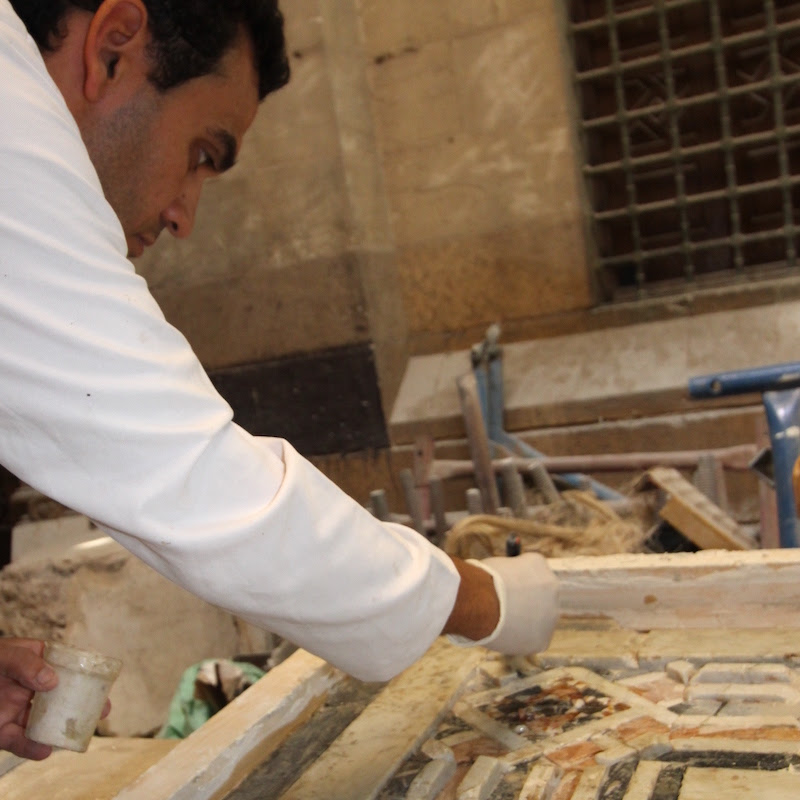
Since 2013, Megawra-BEC’s Athar Lina Initiative has conserved the domes of Shajar al-Durr, Sayyida Ruqayya, al-Ja’fari and ‘Atika and is currently working on the conservation of al-Imam al-Shafi’i Mausoleum and al-Shurafa Shrine, all in Historic Cairo’s al-Khalifa District. The conservation process often results in discoveries and findings. Some are the result of deliberate investigation. Others are pure luck. They range from a small floral detail revealed after modern paint is removed, to inscriptions uncovered or deciphered for the first time to an entire shrine unearthed under an existing one. The challenge is always to find the time and mindset to do the necessary exploration and research while dealing with the day-to-day demands of a conservation site.
ARCE Summer Online Lectures:
- The following lectures hosted by ARCE National are at 12pm PST (3pm EST) unless otherwise noted.
- You must register for the lectures in advance (follow instructions in email).
- Lecture Schedule (Abstracts posted below, closer to the date):
- May 9: Nicholas Picardo
- May 16: Dr. Kara Cooney
- May 23: Dr. Melinda Nelson-Hurst
- May 30: Dr. Steve Harvey
- June 6: Ines Torres
- June 13: Dr. David Anderson
- June 20: Dr. Leslie Anne Warden
- June 27: Dr. Salima Ikram (Note: lecture at 10am PST – 1pm EST)

Virtual Lecture – June 6 – Inês Torres
Creativity & Innovation in Non-Royal Tombs of the Old Kingdom: The Mastaba of Akhmeretnisut at Giza
The Giza mastaba of Akhmeretnisut (G 2184), excavated in 1912 by the Harvard University-Boston Museum of Fine Arts Expedition, has been occasionally mentioned in the scholarly literature due to its innovative iconographic program. This lecture will present the most recent research conducted on the mastaba of Akhmeretnisut and discuss the importance of this tomb for the understanding of private funerary monuments of the Old Kingdom. The decorative program of this mastaba is unparalleled in several ways: not only does it contain scenes unattested elsewhere, the spatial arrangement of the decoration is very unusual. Therefore, the mastaba of Akhmeretnisut is an excellent example of how the rules of decorum could be bent by the tomb owner to express creativity and display innovations in both iconography and architecture.

Virtual Lecture – May 30 – Dr. Steve Harvey
Drinking Wine, Baking Bread, and Making the Best of It: Humor and the Afterlife in Egyptian Tomb Scenes
While ancient Egyptian tomb chapels are often presented as unrelentingly serious in their content, with every element potentially considered for its religious meaning or its role in the function of tomb as a miniature world or microcosm, even a casual visitor to a tomb cannot help but be delighted by the variety of scenes which often feature unmistakably humorous or light-hearted content. Banquets that at first look like rows of serious men and women turn out to be full of drunken chatter. Markets where sober exchanges of goods are taking place can be disrupted by the apprehension of a thief, and the misbehavior of baboons. Examples in this lecture will be drawn from ancient Egyptian tomb scenes of many periods to illustrate some of the way that ancient artists used humor to amuse themselves and their audiences, while also populating the virtual world of the afterlife with characters, music, sound, and laughter. These strategies enabled distraction from the darker aspects of life, while also encouraging more time to be spent in the tomb reading, saying prayers, eating and drinking – to the benefit of both the living and the dead.

Virtual Lecture – May 23 – Dr. Melinda Nelson-Hurst
Digging in Museums and Archives: The Ancient and Modern History of Tulane University’s Egyptian Collection
During the 1840s and 1850s, George Gliddon traveled the United States, bringing with him a glimpse into the world of ancient Egypt. His collection of artifacts and mummies, which is now at Tulane University in New Orleans, has remained relatively unknown to the public and to scholars alike despite a sensational past. Utilizing historical and anthropological approaches, the Egyptian Collection at Tulane University research project aims to solve some of the many mysteries surrounding the collection, including questions of date and provenience and how the collection came to America and found a home in New Orleans. This talk will offer a look into the collection’s colorful history, as well as discuss the project’s latest research findings.

Virtual Lecture – May 16 – Dr. Kara Cooney
Evidence for Coffin Reuse in the 21st Dynasty Coffins of the Royal Cache Deir el Bahari 320
For the past seven years, Kara Cooney has been systematically examining human reactions to social crises, specifically focusing on material adaptations evident within an ideological context, but also documenting the 21st Dynasty coffin corpus. Anthropoid coffins are very complicated three-dimensional social objects, and the 21st Dynasty coffins from the Deir el Bahri 320 royal cache, in particular, are difficult to document, photograph, and analyze. Although the coffins from the royal cache were recorded by Daressy in the Catalogue Géneral, none of these coffins have benefitted from a comprehensive photographic analysis. In this lecture, Kara will discuss the documentation and analysis of the 21st Dynasty coffins found in the Deir el Bahari 320 royal cache on display in the Egyptian Museum in Cairo.

Virtual Lecture – May 9 – Nicholas Picardo
Ancient Egyptian “Soul Houses” in Life and in Death
Because the majority of ancient Egypt’s so-called “soul houses” have come from cemetery contexts, they are almost always classified as funerary equipment. Yet, this outlook offers little to explain their less frequent but still numerous find spots in settlements and houses. This presentation adopts concepts from the discipline of household archaeology to consider an extended range of functions and ideological importance for soul houses, ultimately positing a use lifespan that began prior to their deposition in cemeteries. Further, their use in both household and funerary practices is evaluated as a mechanism for reinforcing identities and relationships and preserving social ties between the living and the dead.

March 6, 6:00pm – The Blessing of Water and the Curse of Gold: Community Archaeology in Northern Ethiopia by Dr. Willeke Wendrich
Since 2015 UCLA is working closely with local communities in the Shire region of Ethiopia on the preservation of the remains of an ancient town. Archaeological research has shown that the site of Mai Adrasha is located at a spring that ultimately feeds into the Nile River. This ancient town is, however, cursed by gold…
 ARCE Vancouver
