Showing posts with label Robotics. Show all posts
Showing posts with label Robotics. Show all posts
Sunday, November 12, 2023

Monday, November 6, 2023
In
Drones,
Programming,
Robotics,
Robots,
Simulations,
Universe Simulator
//
//
Leave a Comment
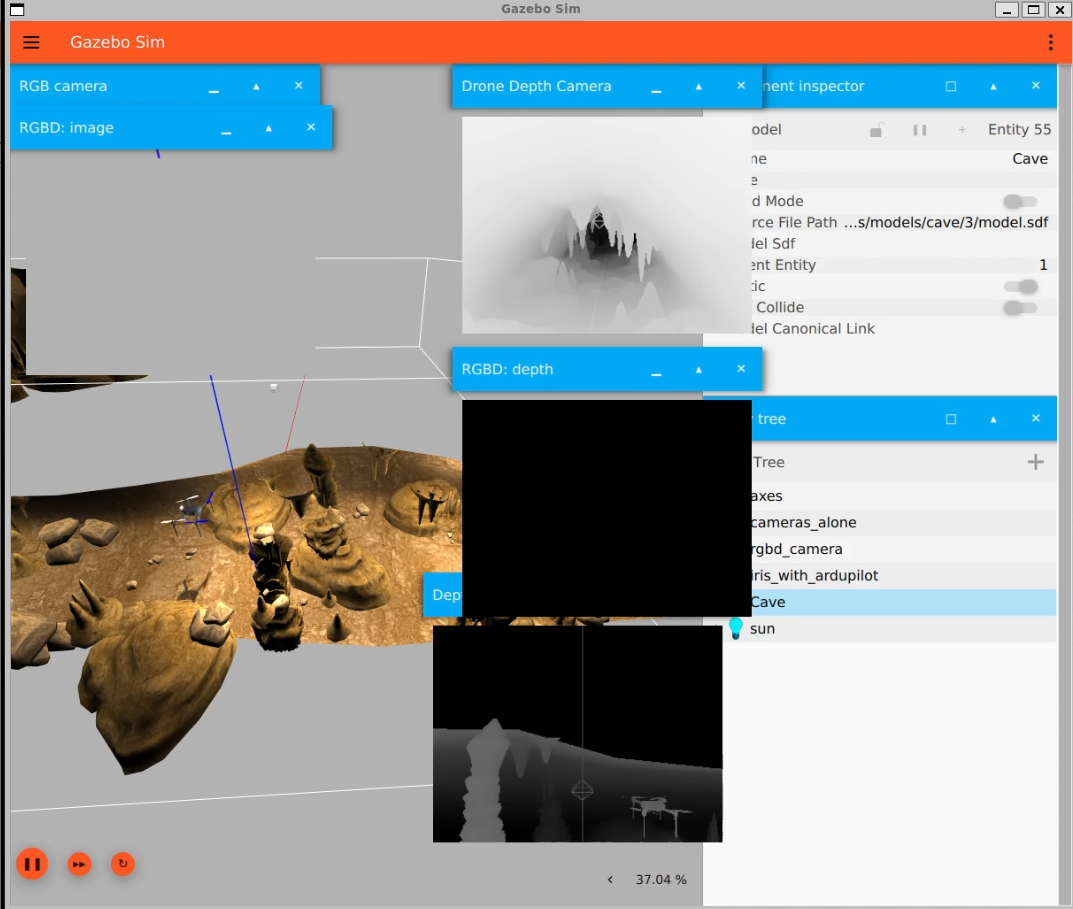
Autonomous Drone Brain Experiments: E.Z. 0.001 for Vsy/"Jack of All Trades" AGI infrastructure

Early experiments by "The Sacred Computer" (Свещеният Сметач): to be continued. What E.Z. stands for will be disclosed later. Vsy "Jack of All Trades" is a project for an AGI infrastructure.
https://github.com/Twenkid/Vsy-Jack-Of-All-Trades-AGI-Bulgarian-Internet-Archive-And-Search-Engine
I've been studying the drones and robotics simulation domain actively mostly during the summer, currently I'm more busy with more fundamental and abstract research*, but continuing the work on drone and robot simmulations as side and practical project and it is supposed eventually to turn into a ML playground.
Stay tuned for the updates and I may report more details during the SIGI virtual conference, it will be either around the end of 2023 or in 2024. I am looking for partners in this "adventure" (as in all others).
Made with Gazebo, Python, Linux (in Windows WSL2).
Join my adventure or invite me for a common project:
https://github.com/twenkid
http://artificial-mind.blogspot.com
http://research.twenkid.com
Saturday, October 28, 2023
In
About Tosh,
AGI,
AI,
Events,
Programming,
Robotics,
Robots,
Sport
//
//
Leave a Comment
Contributing to a Robotics Startup, Universe and Mind 6 and Theory of Universe and Mind and Calisthenics - update 10.2023
Hi guys, visitors of my "Universal man's and AI/AGI journey"! A lot of things are going on, but I've been too busy to blog about it.
One activity was that I contributed to a robotics, drone-related "garage startup", it was a hard core intensive "exercise", but I left after I helped securing a first investment by an individual investor and happy early customers. A stupid moment to quit, right? Well, unfortunately many things were not quite right since the beginning, to be delicate; they were quite wrong and not as they were supposed to be, besides neglecting my own research and projects.
I've been preparing a huge book about my pioneering work and comparisons with still "new" top research which is replicating the theory, structure, claims and reasoning from my early 2000s writings, collectively called "Theory of Universe and Mind". https://github.com/Twenkid/Theory-of-Universe-and-Mind (For example the core claims and ideas from "Free energy principle/Active inference" by Karl Friston and his students such as Maxwell Ramstead and other related work from that school by Andy Clark etc. More about that - in the link of the TOUM and in the book
I worked on a new major piece from the theory, called "Universe and Mind 6" which is also discussing some related works. It gained a lot of volume quickly during the Spring, it could be published then, but it went on hold due to my business with the start-up and because I had a few more ideas which were popping up, but I didn't have time to elaborate, while I've been discovering new related theories etc.
...
The experience with that company seeded a new plant/thread in "Jack of All Trades" project -
Autonomous vehicles, navigation for drones and mobile robots in simulations and real world. I am open for collaboration in this domain - see more info about my current skill in my Linkedin account or contact me. I may publish a demo later.
A "mini-conference" is in prepratation: SIGI-2023 (or 2024), the second mini-"conference":
https://github.com/Twenkid/SIGI-2023-1/
Etc.
In the meantime, lately I'm improving my strength with ring dips and kettlebells.


Read More
One activity was that I contributed to a robotics, drone-related "garage startup", it was a hard core intensive "exercise", but I left after I helped securing a first investment by an individual investor and happy early customers. A stupid moment to quit, right? Well, unfortunately many things were not quite right since the beginning, to be delicate; they were quite wrong and not as they were supposed to be, besides neglecting my own research and projects.
I've been preparing a huge book about my pioneering work and comparisons with still "new" top research which is replicating the theory, structure, claims and reasoning from my early 2000s writings, collectively called "Theory of Universe and Mind". https://github.com/Twenkid/Theory-of-Universe-and-Mind (For example the core claims and ideas from "Free energy principle/Active inference" by Karl Friston and his students such as Maxwell Ramstead and other related work from that school by Andy Clark etc. More about that - in the link of the TOUM and in the book
I worked on a new major piece from the theory, called "Universe and Mind 6" which is also discussing some related works. It gained a lot of volume quickly during the Spring, it could be published then, but it went on hold due to my business with the start-up and because I had a few more ideas which were popping up, but I didn't have time to elaborate, while I've been discovering new related theories etc.
...
The experience with that company seeded a new plant/thread in "Jack of All Trades" project -
Autonomous vehicles, navigation for drones and mobile robots in simulations and real world. I am open for collaboration in this domain - see more info about my current skill in my Linkedin account or contact me. I may publish a demo later.
A "mini-conference" is in prepratation: SIGI-2023 (or 2024), the second mini-"conference":
https://github.com/Twenkid/SIGI-2023-1/
Etc.
In the meantime, lately I'm improving my strength with ring dips and kettlebells.
Check my Youtube channel which currently has a hit having whopping ~ 250 views per day, LOL.
Cheers while hanging on the rings, LOL.
Cheers while hanging on the rings, LOL.


Tuesday, May 10, 2016
On Computer vision Visualisation and the limitations of human imagination and vision displayed in these renderings, and how it should be in a better thinking machine's vision visualisation - "The Terminator" film franchise/series as an example
Comment by Todor Arnaudov, inspired by/on: http://www.hudsandguis.com/home/2011/01/02/terminator-the-evolution-of-machine-vision
I'm a fan of the Terminator and liked the article, but I'd challenge the statement in the introduction that the displays in the movie are:
I think it's rather how HUMANS imagine that they themselves would see the world with added "computerese", " coders' ", " programmers' " decorations on the screen/view, like pilot's screen, computer simulations screen etc.
It's a style to show "computer stuff" to no-computer literate/experts, especially in T1 and T2.*
We are limited with one "screen", the final one, the integration of the two retinas, but machines are not.
In my opinion a more adequate representation would be a huge set of images (screens), virtually unlimited, displayinga gradual coverage of different kinds and depths of image processing, analysis and understanding. The will-part (what you want, search for, find) is in additional layers.
It cannot be perceived in-full in real time by a human, but in a future kind of interactive or multi-screen/explorative/educational/deep films it could be explored, in a space like the following:
1. Raw input, normal vision
2. Set of simple image processings (contrast, gamma, posterize/levels, ...) - different slices of the visual spectrum. The reddish view is one of it.
3. More complex - lines, blobs, contours, ...
4. Sets of templates for matching when searching. That's like the content of the executive function's top-down attention, consciousness. The templates on their own could cover a lot of screens with different representations - visual in full-colors and lighting, wireframe, gradient depth-views, different conditions, 3D-coordinates, different angles for complex and assymetric objects, similarities with others, taxonomies/classes etc., animated/rotating, zoom-in-out, different sizes.
5. 3D-reconstructed scenes, different views, distances to/between objects, sizes ... Dimensionally-reduced 2D views of the reconstructed 3D scene like in a 3D-editors: XY, XZ, YZ.
6. Connections between images - graphs, networks, sequences of flashing of different images; displaying the path of thought, search etc.
7. Paths, trajectories - past, taken, projected, predicted (correctly, wrongly); own-paths, trajectories of intended motions and transformations in the environment, sequences of planned actions, ...
8. Graphs (networks), trees, block-diagrams; blinking, different colors, different-shapes - expressing different concepts, relations, distances (ranges of distances) etc.
9. Etc.
10. The machine could see the numeric views/intentions as code, captions, indication of the will with specific symbols (instead of images), textual descriptions etc. without vision/screen, without all these text "blots" on the video that we, humans, need with our limited sensory input and processing capabilities.
For the machine they are at different layers, it could perceive all or switch attention between selected ones. There could b
However, similarly we humans do also see a lot of "numbers" without "dirtying" and overloading the "screen". We do "feel" them and express that in our actions, such as we display that we know the precise spatial coordinates of the objects and our hands by applying correct motions for grasping the objects, kicking a ball; when playing a musical instrument, improvising by ear, and applying the right sequence of motions with the right speed etc. We do "see" the numbers, but "intuitively", without a need to read them as high-level abstract symbols and translate them into motion vectors.
Etc. -- go on and synthesize more continuations and unfolds of the ideas and directions given above.
* See a follow-up article on touch-screen GUI incovenience
PS1. I'd like to note also that the code in T1 is 6502 assembly listings (Apple II, NES, ...). There's a caption about 16K memory bank switching, so it's maybe does bank-switching and had more than 64 KB RAM... :)
PS2. Regarding the choice of the sayings with the hilarious "FUC* you, as*hole" line - the author is right that it could be more dynamic, for example by displaying initial *search process*, exploration of possibilities and with a more dynamic graphics (it could be done in a remake of similar conditions, maybe).
The limited amount of options could be the final choices, the most appropriate for the situation and what the Terminator wanted.
The search is already done "subconsiously" and that's what the executive functions are provided with, in order to select an option from - the executive functions of human viewers, too.
Human persons with similar "profile" - e.g. "contract killers" or cowboys or typical "criminals" in the millenia of gangster movies - would also have a limited set of expressions for similar conditions.
And in general if you asked a multitude of people with similar personalities, experience, capabilities, knowledge etc. for the most appropriate answers in this-or-that situation, you'll get the same answers and the same lack of imagination (especially if they are asked to give *the most appropriate* ones in order to achieve certain goal, or to send a specific message).
The Terminator didn't want to engage in a conversation, he didn't want to open the door and be seen etc., so to me the lines are adequate.
PS3. I agree about the coolness of the OCR in T1, the scene where the Terminator reads the hand-written phone number. The scene with his fingers pointing the numbers in the phone-boot is silly, though; unless that's a deliberate non-functional design; just posing, intended to make the machine look more human for the potential humans around - and for the viewers of the movie, too. (From cinematographer's/director's point of view, obviously that's literaly for "pointing" the attention of the cyborg.)
PS4. This discussion is too verbose? I like/intend to give precise explanation of why I think so and so, what made me think so etc. That's the path of thought. And indeed, a comment on another article - see a follow-up article on Spaghetti code.
I'm a fan of the Terminator and liked the article, but I'd challenge the statement in the introduction that the displays in the movie are:
"how the robots would potentially see the world"
I think it's rather how HUMANS imagine that they themselves would see the world with added "computerese", " coders' ", " programmers' " decorations on the screen/view, like pilot's screen, computer simulations screen etc.
It's a style to show "computer stuff" to no-computer literate/experts, especially in T1 and T2.*
We are limited with one "screen", the final one, the integration of the two retinas, but machines are not.
In my opinion a more adequate representation would be a huge set of images (screens), virtually unlimited, displayinga gradual coverage of different kinds and depths of image processing, analysis and understanding. The will-part (what you want, search for, find) is in additional layers.
It cannot be perceived in-full in real time by a human, but in a future kind of interactive or multi-screen/explorative/educational/deep films it could be explored, in a space like the following:
1. Raw input, normal vision
2. Set of simple image processings (contrast, gamma, posterize/levels, ...) - different slices of the visual spectrum. The reddish view is one of it.
3. More complex - lines, blobs, contours, ...
4. Sets of templates for matching when searching. That's like the content of the executive function's top-down attention, consciousness. The templates on their own could cover a lot of screens with different representations - visual in full-colors and lighting, wireframe, gradient depth-views, different conditions, 3D-coordinates, different angles for complex and assymetric objects, similarities with others, taxonomies/classes etc., animated/rotating, zoom-in-out, different sizes.
5. 3D-reconstructed scenes, different views, distances to/between objects, sizes ... Dimensionally-reduced 2D views of the reconstructed 3D scene like in a 3D-editors: XY, XZ, YZ.
6. Connections between images - graphs, networks, sequences of flashing of different images; displaying the path of thought, search etc.
7. Paths, trajectories - past, taken, projected, predicted (correctly, wrongly); own-paths, trajectories of intended motions and transformations in the environment, sequences of planned actions, ...
8. Graphs (networks), trees, block-diagrams; blinking, different colors, different-shapes - expressing different concepts, relations, distances (ranges of distances) etc.
9. Etc.
10. The machine could see the numeric views/intentions as code, captions, indication of the will with specific symbols (instead of images), textual descriptions etc. without vision/screen, without all these text "blots" on the video that we, humans, need with our limited sensory input and processing capabilities.
For the machine they are at different layers, it could perceive all or switch attention between selected ones. There could b
However, similarly we humans do also see a lot of "numbers" without "dirtying" and overloading the "screen". We do "feel" them and express that in our actions, such as we display that we know the precise spatial coordinates of the objects and our hands by applying correct motions for grasping the objects, kicking a ball; when playing a musical instrument, improvising by ear, and applying the right sequence of motions with the right speed etc. We do "see" the numbers, but "intuitively", without a need to read them as high-level abstract symbols and translate them into motion vectors.
Etc. -- go on and synthesize more continuations and unfolds of the ideas and directions given above.
* See a follow-up article on touch-screen GUI incovenience
PS1. I'd like to note also that the code in T1 is 6502 assembly listings (Apple II, NES, ...). There's a caption about 16K memory bank switching, so it's maybe does bank-switching and had more than 64 KB RAM... :)
PS2. Regarding the choice of the sayings with the hilarious "FUC* you, as*hole" line - the author is right that it could be more dynamic, for example by displaying initial *search process*, exploration of possibilities and with a more dynamic graphics (it could be done in a remake of similar conditions, maybe).
The limited amount of options could be the final choices, the most appropriate for the situation and what the Terminator wanted.
The search is already done "subconsiously" and that's what the executive functions are provided with, in order to select an option from - the executive functions of human viewers, too.
Human persons with similar "profile" - e.g. "contract killers" or cowboys or typical "criminals" in the millenia of gangster movies - would also have a limited set of expressions for similar conditions.
And in general if you asked a multitude of people with similar personalities, experience, capabilities, knowledge etc. for the most appropriate answers in this-or-that situation, you'll get the same answers and the same lack of imagination (especially if they are asked to give *the most appropriate* ones in order to achieve certain goal, or to send a specific message).
The Terminator didn't want to engage in a conversation, he didn't want to open the door and be seen etc., so to me the lines are adequate.
PS3. I agree about the coolness of the OCR in T1, the scene where the Terminator reads the hand-written phone number. The scene with his fingers pointing the numbers in the phone-boot is silly, though; unless that's a deliberate non-functional design; just posing, intended to make the machine look more human for the potential humans around - and for the viewers of the movie, too. (From cinematographer's/director's point of view, obviously that's literaly for "pointing" the attention of the cyborg.)
PS4. This discussion is too verbose? I like/intend to give precise explanation of why I think so and so, what made me think so etc. That's the path of thought. And indeed, a comment on another article - see a follow-up article on Spaghetti code.
Wednesday, October 9, 2013
In
Academia,
Machine Learning,
News,
Robotics,
Новини
//
//
Leave a Comment
Българският специалист по роботика и машинно обучение Петър Кормушев спечели наградата "Джон Атанасов"!
http://kormushev.com/news/2013-john-atanasoff-award
Петър е българската следа в Италианския технологичен институт в Геноа, място откъдето могат да се очакват (и се правят) сериозни изследвания и резултати, препоръчвам да разгледате дейността им.
Гледайте интервю с него по БНТ:
Ако си търсех докторантура или друга такава позиция, това щеше да е едно от потенциалните места, където бих кандидатствал, споменавал съм и друг път - един от най-сериозните институти, свързани с универсален изкуствен разум: http://www.iit.it/
Sunday, October 6, 2013
Thursday, August 29, 2013
In
Academia,
Machine Learning,
News,
Robotics,
Robots
//
//
Leave a Comment
PhD positions in Robotics and Machine Learning for 2014 in the Italian Institute of Technologies
IIT is a solid place for AGI and cool robotics research, I recommend it based on what I know about them.
As far as I see, those two new topics are a kind of development of an artificial cerebellum.
THEME 8. Developmental Robotics And Robot Learning Of Motor Skills
Tutors: Dr. Petar Kormushev, Prof. Darwin G. Caldwell
Department: ADVR (Department of Advanced Robotics, Istituto Italiano di Tecnologia)
THEME 9. Robot Learning For Agile Locomotion Of Compliant Humanoid Robots
Tutors: Dr. Petar Kormushev, Prof. Nikos Tsagarakis
http://kormushev.com/news/phd-positions-in-robotics-and-machine-learning-for-2014/
Applications deadline: 20/9/2013
Read More
As far as I see, those two new topics are a kind of development of an artificial cerebellum.
THEME 8. Developmental Robotics And Robot Learning Of Motor Skills
Tutors: Dr. Petar Kormushev, Prof. Darwin G. Caldwell
Department: ADVR (Department of Advanced Robotics, Istituto Italiano di Tecnologia)
THEME 9. Robot Learning For Agile Locomotion Of Compliant Humanoid Robots
Tutors: Dr. Petar Kormushev, Prof. Nikos Tsagarakis
http://kormushev.com/news/phd-positions-in-robotics-and-machine-learning-for-2014/
Applications deadline: 20/9/2013
Wednesday, July 10, 2013
In
Events,
News,
Robotics,
Robots
//
//
Leave a Comment
DARPA Robotics Challenge
A cool challenge for agents acting in virtual worlds:
http://www.darpa.mil/NewsEvents/Releases/2013/06/27.aspx
http://www.theroboticschallenge.org/local/images/VRC/video/VRC_Driving_Example_2X_SPEED.wmv
http://www.theroboticschallenge.org/local/documents/VRC%20Tech%20Guide%20Release%202%20DISTAR%20Case%2021251.pdf
Thanks to M.T. for mentioning about it.
Read More
http://www.darpa.mil/NewsEvents/Releases/2013/06/27.aspx
http://www.theroboticschallenge.org/local/images/VRC/video/VRC_Driving_Example_2X_SPEED.wmv
http://www.theroboticschallenge.org/local/documents/VRC%20Tech%20Guide%20Release%202%20DISTAR%20Case%2021251.pdf
Thanks to M.T. for mentioning about it.
Friday, June 7, 2013
In
Academia,
Machine Learning,
Robotics
//
//
Leave a Comment
Post-doc Robotics Position at IIT and COMAN Humanoid Robot Platform | Bulgarian Googlegroups for Robotics and Machine Learning
http://kormushev.com/news/postdoc-opening-in-machine-learning-for-robotics-2013/
http://www.iit.it/en/advr-labs/humanoids-a-human-centred-mechatronics/advr-humanoids-projects/compliant-humanoid-platform-coman.html
Bulgarian googlegroups for robotics and machine learning:
Български имейл списъци по роботика и машинно обучение: bulgarian-robotics кльомба мльомба googlegroups точка ком, и bulgarian-machine-learning.
Read More
http://www.iit.it/en/advr-labs/humanoids-a-human-centred-mechatronics/advr-humanoids-projects/compliant-humanoid-platform-coman.html
Bulgarian googlegroups for robotics and machine learning:
Български имейл списъци по роботика и машинно обучение: bulgarian-robotics кльомба мльомба googlegroups точка ком, и bulgarian-machine-learning.
Wednesday, December 19, 2012
Five Principles of Developmental Robotics... Matches of Todor Arnaudov's works from 2003-2004 to a 2006/2009 academic paper ... Yet another one :)
This post is regarding the paper:
Five Basic Principles of Developmental Robotics, 2006,
posted Sep 2, 2008 10:30 AM by Brian Tanner [ updated Sep 2, 2008 10:48 AM ]
http://prw06.rl-community.org/posters/five-basic-principles-of-developmental-robotics by Alexander Stoytchev, Department of Computer Science, Iowa State University
Also in a 2009's IEEE edition, with extensions based on Stoychev's PhD thesis:
Yet another academic paper that I found recently, which is published years after the works of mine and is based on a bunch of other works, and in the academic eyes those are "new contributions".
Sure, they are novel - in the community to which they are presented and their subculture, and in the specific way they are presented.
Not that I claim plagiarism or something, the case is rather "great minds think alike" ;)), I recommend the paper.
The differences are in the social position and status, background, resources, support - $$$, peers, access to literature and conferences, - and experience needed to made those claims.
Those seem significantly in my favor, as a poor teenager in high school... :))
Of course it doesn't sound plausible that an institutionalized researcher, who's well fit into the mainstream system to go read "crank's" works on the Internet - "who are they" - if a paper was not published in a conference or a journal (costs $$$ to go to a conference etc.), it's like it didn't exist. I discovered this back as a freshman... That particular paper is grounded on other papers from the "system", including author's own. Also who's gonna read "crank's" (high-school students') works published in Bulgarian - non-Bulgarians are highly unlikely to have ever known of my existence up to later years.
Well, in this particular case, though, there's a chance that the author of that paper has known about my works anyway, because he's a fellow Bulgarian, and there was a forum where a few of us, "the cranks" and other enthusiasts gathered for a while in 2004 - the forum of the so called "Project Kibertron" for a generally intelligent humanoid robot
Let's get to the point:
Autonmous Mental Development
I found this in the "subculture" called "Autonmous Mental Development (AMD) - or Developmental Robotics (certainly the more popular term). That reminded me of those "split brain" academia, there exist subcultures, groups, which don't know each other good enough and may produce similar results, or results which are of help to the others. For example... Well - later about that. ;P
...
Some translations of a part of my classical works
http://research.twenkid.com/agi_english/
Other not translated:
http://eim.hit.bg/razum
http://www.oocities.org/eimworld/ (Windows-1251)
If I am to state the precise points and matches, I'd write a more formal paper later, but let me give just a few short examples:
For example, the Sutton's "verification principle" and all the rest are obvious for a sensori-motor generalizing self-improving system, one of the explicit statements in my works is the "match", the way "truth" is defined and found. (I'm "late" to Sutton here, but I haven't heard of him, as that community haven't heard of me.)
From Universe and Mind 3 (2003), Universe and Mind 4 (2004):
...
50. The truth is a match – if the knowledge (or
confidence, belief, persuasion [, desire])
matches something that is perceived somewhere
else later, then the new one is true, compared to
the old one; on the other hand, if the new one is
different, it's “a lie” (false) or it becomes truth
and the old truth turns into full or partial false,
depending on how the new truth is different
from the old one. The more the newly evaluated
for “truth” input piece of knowledge [pattern]
matches a piece of knowledge [pattern] from the
memories of mind, the more it's “truth” and
“actual”, according to mind. Therefore,
determining a “truth” is a determination of
difference between past and wanted present.
(“Wanted” was missing in the Part 3 writing,
added here in Part 4).
[“Truth” in Bulgarian is “Istina” (истина)]
Interestingly, in Serbian “isto” means “same” -
it has morphological association to “same”,
because the statement that a given feature is
“truth” means also that:
TRUTH: The feature [specifics, detail] that is
being evaluated matches the pattern/template - it
is the same as in the pattern, at a given
resolution of perception. (*That's a definition of
mine.)
Stoychev mentions the philosophy school of the logical neopositivists as an origin of the "verification" principle. My opponent and co-author of my 2002 epistolary work "Theory of Universal Predetermination II"* (Universe and Mind, Part 2) - Angel Grancharov - who was a professional philosopher having also University level teaching experience and an author of many books, was "insulting me" for being a "positivist" and explaining me how "flawed" that philosophy is, and that it's not really a philosophy. I didn't know that there's such a school, I heard about that school for the first time in those emails.
The quote above is about the subjectivity, embodiment, grounding and gradual exploration, all in one sentence: "...The more the newly evaluated for “truth” input piece of knowledge [pattern] matches a piece of knowledge [pattern] from the memories of mind, the more it's “truth” and “actual”, according to mind", "at a given resolution of perception".
"Grounding" is related also to the notion of "reality" as the "lowest level of virtual universe", and statements that for any system there's one lowest level, from where generalization starts.
Etc.
...The series will continue with a few explicit marks/comparisons of the matches between my classical works to Jeff Hawkins's "On Intelligence" and the HTM, which are published after mine.
See also: http://artificial-mind.blogspot.com/2012/12/compression-and-beauty-matches-between.html
Read More
Five Basic Principles of Developmental Robotics, 2006,
posted Sep 2, 2008 10:30 AM by Brian Tanner [ updated Sep 2, 2008 10:48 AM ]
http://prw06.rl-community.org/posters/five-basic-principles-of-developmental-robotics by Alexander Stoytchev, Department of Computer Science, Iowa State University
Also in a 2009's IEEE edition, with extensions based on Stoychev's PhD thesis:
..." ... Some Basic Principles of Developmental Robotics
Stoytchev, A.
Page(s): 122-130
Digital Object Identifier 10.1109/TAMD.2009.2029989Abstract: This paper formulates five basic principles of developmental robotics. These principles are formulated based on some of the recurring themes in the developmental learning literature and in the author's own research. The five principles follow logically from the verification principle (postulated by Richard Sutton) which is assumed to be self-evident. This paper also gives an example of how these principles can be applied to the problem of autonomous tool use in robot "
Yet another academic paper that I found recently, which is published years after the works of mine and is based on a bunch of other works, and in the academic eyes those are "new contributions".
Sure, they are novel - in the community to which they are presented and their subculture, and in the specific way they are presented.
Not that I claim plagiarism or something, the case is rather "great minds think alike" ;)), I recommend the paper.
The differences are in the social position and status, background, resources, support - $$$, peers, access to literature and conferences, - and experience needed to made those claims.
Those seem significantly in my favor, as a poor teenager in high school... :))
Of course it doesn't sound plausible that an institutionalized researcher, who's well fit into the mainstream system to go read "crank's" works on the Internet - "who are they" - if a paper was not published in a conference or a journal (costs $$$ to go to a conference etc.), it's like it didn't exist. I discovered this back as a freshman... That particular paper is grounded on other papers from the "system", including author's own. Also who's gonna read "crank's" (high-school students') works published in Bulgarian - non-Bulgarians are highly unlikely to have ever known of my existence up to later years.
Well, in this particular case, though, there's a chance that the author of that paper has known about my works anyway, because he's a fellow Bulgarian, and there was a forum where a few of us, "the cranks" and other enthusiasts gathered for a while in 2004 - the forum of the so called "Project Kibertron" for a generally intelligent humanoid robot
Let's get to the point:
Autonmous Mental Development
I found this in the "subculture" called "Autonmous Mental Development (AMD) - or Developmental Robotics (certainly the more popular term). That reminded me of those "split brain" academia, there exist subcultures, groups, which don't know each other good enough and may produce similar results, or results which are of help to the others. For example... Well - later about that. ;P
...
- The Verification Principle (credited Sutton 2001)
- The Principle of Embodiment
- The Principle of Subjectivity
- The Principle of Grounding
- The Principle of Gradual Exploration
Some translations of a part of my classical works
http://research.twenkid.com/agi_english/
Other not translated:
http://eim.hit.bg/razum
http://www.oocities.org/eimworld/ (Windows-1251)
If I am to state the precise points and matches, I'd write a more formal paper later, but let me give just a few short examples:
For example, the Sutton's "verification principle" and all the rest are obvious for a sensori-motor generalizing self-improving system, one of the explicit statements in my works is the "match", the way "truth" is defined and found. (I'm "late" to Sutton here, but I haven't heard of him, as that community haven't heard of me.)
From Universe and Mind 3 (2003), Universe and Mind 4 (2004):
...
50. The truth is a match – if the knowledge (or
confidence, belief, persuasion [, desire])
matches something that is perceived somewhere
else later, then the new one is true, compared to
the old one; on the other hand, if the new one is
different, it's “a lie” (false) or it becomes truth
and the old truth turns into full or partial false,
depending on how the new truth is different
from the old one. The more the newly evaluated
for “truth” input piece of knowledge [pattern]
matches a piece of knowledge [pattern] from the
memories of mind, the more it's “truth” and
“actual”, according to mind. Therefore,
determining a “truth” is a determination of
difference between past and wanted present.
(“Wanted” was missing in the Part 3 writing,
added here in Part 4).
[“Truth” in Bulgarian is “Istina” (истина)]
Interestingly, in Serbian “isto” means “same” -
it has morphological association to “same”,
because the statement that a given feature is
“truth” means also that:
TRUTH: The feature [specifics, detail] that is
being evaluated matches the pattern/template - it
is the same as in the pattern, at a given
resolution of perception. (*That's a definition of
mine.)
Stoychev mentions the philosophy school of the logical neopositivists as an origin of the "verification" principle. My opponent and co-author of my 2002 epistolary work "Theory of Universal Predetermination II"* (Universe and Mind, Part 2) - Angel Grancharov - who was a professional philosopher having also University level teaching experience and an author of many books, was "insulting me" for being a "positivist" and explaining me how "flawed" that philosophy is, and that it's not really a philosophy. I didn't know that there's such a school, I heard about that school for the first time in those emails.
The quote above is about the subjectivity, embodiment, grounding and gradual exploration, all in one sentence: "...The more the newly evaluated for “truth” input piece of knowledge [pattern] matches a piece of knowledge [pattern] from the memories of mind, the more it's “truth” and “actual”, according to mind", "at a given resolution of perception".
"Grounding" is related also to the notion of "reality" as the "lowest level of virtual universe", and statements that for any system there's one lowest level, from where generalization starts.
Etc.
...The series will continue with a few explicit marks/comparisons of the matches between my classical works to Jeff Hawkins's "On Intelligence" and the HTM, which are published after mine.
See also: http://artificial-mind.blogspot.com/2012/12/compression-and-beauty-matches-between.html
Monday, July 9, 2012
SIGI 2012-1 - The First SIGI-AGI conference/multi-conference of the Independent Society of Multidisciplinary and Interdisciplinary AGI/SIGI Researchers
The First SIGI-AGI conference/multi-conference of the Independent Society of Multidisciplinary and Interdisciplinary AGI/SIGI Researchers
The event happened successfully on 7-th of July in Plovdiv, Bulgaria. :)
News: SIGI-2012-2: The Second Multidisciplinary and Interdisciplinary AGI-SIGI Conference -- First Call for Participants, Works, Papers:
SIGI stands for Self-Improving General Intelligence
AGI stands for Artificial General Intelligence
Idea and organizer/"chairman": Todor Arnaudov
Many thanks to all of the co-organizers, participants and supporters!
Co-organizers/co-"chairmen" and sponsors: Alexander Kamburov, Svetlin Penkov, Georgi Zlatev
Valuable moral support and participation with a paper: Dr. Petar Kormushev
Co-organizers and participants: Daniel Angelov, Orlin, Angel
We used a conferent room in a hotel with the picturesque name "Intel Coop"... :D It's a pity we didn't have luck to get any funding or support by Intel Corporation, not a single representative was in the hotel, too*... ;)

The working languages at SIGI 2012-1 were Bulgarian and English. The contributors of this edition were international (studying/working or having some kind of business or scientific relationships with UK, Italy, USA and Bulgaria), but we were all Bulgarians so even though some of the presentation slides were in English, we discussed in Bulgarian.
Initially about 4-5 more participants were expected to attend physically, however some of them didn't make it for one reason or another. Probably they will join us in the following editions. We want to make it soon, possibly in a few weeks or a few months and will have a more flexible form, I will tell about it later.
The next edition will be more open for international participants and probably will be semi-online, to allow more people to attend and participate with less efforts and possibly zero expenses.
Stay tuned for updates and details about participating in the next event of the independent SIGI/AGI society!

SIGI 2012-1 - Plovdiv, Bulgaria, 7/7/2012
SIGI I
SIGI #1
Program
Computer Vision
Machine Learning/Reinforcement Learning
Petar is a Team Leader (equivalent to U.S. Assistant Professor) at the Advanced Robotics department of the Italian Institute of Technology (IIT), located in Genoa.
Svetlin will be last year MS Student in Robotics in Reading, UK. He also works at the Bulgarian Academy of Science.
Daniel will be second? year MS student in Robotics in Reading, UK
Orlin works at the Bulgarian Academy of Science in the Robotics Department.
...
Georgi is an applied mathematician and a software entrepreneur, he spoke about his thesis in the field of numerical methods and complex polynomials.
Alexander is an experienced software developer and an entrepreneur who's a supporter of the AGI, singularity and transhumanism research and trends.
Sensorimotor Generalizing Hierarchies
Ethical Phylosophical issues in AGI/SIGI and transhumanism
Todor - I presented shortly aspects and principles of the paradigm of sensorimotor generalization that my works and school of thought supports and discussed ethical issues on AGI and transhumanism -- it was a short one and will continue in the following edition.
There was a lot of informal discussions on the topics...
...Thank you all and see you next time!...
PS. Colleagues, add your comments, if you wish. I may post a Bulgarian version, too, or if anybody is willing to post such a news anywhere - post a link, please.
PS2. See also the forum: AGI/SIGI forum - It's still almost empty of content, but full of categories.
...
* The Intel humour is not intended to offend anyone, it's a funny coincidence. Intel is registered trademark in the USA, but "Интел Кооп" (Intelcoop) is apparently also such - in Bulgaria, in Cyrillic. :) I hope one day Intel Co. hosts or sponsors an event of ours... :)
...
Думи: News, Events, Artificial General Intelligence, Artificial Intelligence, Robotics, Robots, Изкуствен интелект, Изкуствен разум, Новини, Събития, Конференции, multi, Conference, Thinking Machines, Transhumanism, Philosophy, Философия, мислещи машини, Thinking machines, Bulgaria, Bulgarian, Български, предприeмачи, изследователи, млади, учени, роботика, роботи, робототехника, БАН, Пловдив, независими, учени, Тодор, Арнаудов, Тош, Twenkid Research, start-up, Plovdiv, researchers, Intel Coop hotel, interdisciplinary, multidisciplinary
Thursday, March 29, 2012
Wednesday, March 28, 2012
Computer Vision and Machine Learning from the Stanford AI course (2011) - UDACITY - Sebastian Thrun lectures on Self-Driving Cars and Search Engines
I recommend checking those out, not bad quick intro to Computer Vision and links to leading research and technology, also some directions about sensory data procesing, Machine Learning and Self-Driving Cars (referred as Robotics there). NLP part is decent intro either, but for more technical intro, see another course, cited in my recent post.
I suggest the Computer Vision and Robotics sections at: https://www.ai-class.com/home/ for quick amusing visual intro.
Sebastian Thrun is very funny, he was the leader of Stanford self-driving car team from the DARPA Grand Challenge and DARPA Urban Challenge, then the self-driving car at Google, which is pretty impressive.
Thrun has started other courses on a dedicated site, away from Stanford: http://www.udacity.com/, starting with Search Engines and Self-Driving cars.
- Building a Search Engine
Learn key concepts in computer science and build a search engine like google!
- Programming A Robotic Car
Words, Tags: News, Artificial Intelligence, Video, Computer Vision, Computer Graphics, Human-Computer Interaction, Robotics, Robots, Courses, on-line, Peter Norvig, AI, Narrow-AI, programming, coding, lectures, lessons, training, teaching