Feeds:
Posts
Comments

Posts Tagged ‘Spending Cap’

Many people assume that a balanced-budget requirement is the best fiscal policy. But that’s not the case.

There’s overwhelming evidence (even from surprising sources) that spending caps are the ideal fiscal rule.

This is why I tell international audiences to copy Switzerland, where a spending cap has produced superb results.

And for American audiences, I tell them to copy Colorado’s Taxpayer Bill of Rights (TABOR), a provision in the state constitution to prevents government spending from growing faster than population plus inflation.

I’ve written several articles about TABOR restraining the growth of government in the Rocky Mountain State. The net effect has been very positive for Colorado households.

Image

Unfortunately, the vast majority of states have been increasing spending faster than inflation plus population.

Which helps to explain with Sam Aaron of the South Carolina Policy Council has a column in National Review that urges the rest of the country to enact spending caps.

Here are some excerpts.

For years, the federal government’s unprecedented pandemic spending spree masked structural problems in state budgets. …states are about to feel the weight of federal withdrawal. To prepare, state governments must get serious about their own spending… The solution is simple: States across the country must adopt responsible spending frameworks that restrain year-over-year growth… ImageThis is not a red-state or a blue-state issue. …Politicians from both parties tend to spend nearly all the revenue they have available each year, and, without codified limits in place, states will continue ratcheting up spending until fiscal disaster strikes. That is why states should adopt a..responsible spending limit. The limit is calculated by indexing the previous year’s general fund and multiplying it by population growth plus inflation, ensuring that spending does not grow faster than taxpayers’ ability to afford it. …Spending limits also have broad bipartisan appeal among the voters. In South Carolina, 77 percent of Republicans and 56 percent of Democrats said that they would support a spending cap tied to population growth and inflation.

The article specifically cites polling data in South Carolina because Mr. Aaron’s group is pushing for TABOR-style reforms in the Palmetto State.

This is a great idea, one that I’ve also been pushing.

The South Carolina Policy Council just released a report, co-authored by Aaron and Vance Ginn, that looks at the benefits of state spending restraint.

Here’s a chart that summarizes the problem. Spending growth hasn’t utterly reckless, but the state budget has been growing faster than inflation plus population. And that unfortunate trend adds up to a lot of money over time.

Image

The solution is clear.

South Carolina enters Fiscal Year 2027 with…growing fiscal risk. …Over the past decade, recurring spending has outpaced population growth plus inflation. The Americans for Tax Reform’s Sustainable Budget Project estimates that in 2024, South Carolina’s state-fund expenditures exceeded population growth plus inflation by $6.8 billion and all-fund spending by $9.9 billion—nearly $36 billion in cumulative overspending since 2015.Image …Voters are ready for disciplined, transparent budgeting that prioritizes people over programs. The South Carolina Responsible Budget answers that call. It establishes a clear rule—government spending shall not grow faster than the average taxpayer’s capacity to fund it… By adopting this approach, South Carolina can transform record surpluses into a disciplined mechanism for long-term prosperity—eliminating the personal income tax within a decade. …dedicating 30 percent of surpluses could eliminate the personal income tax by FY 2032 and the corporate income tax by FY 2033. …Adopting this approach…would likely improve the Tax Foundation’s ranking of state tax competitiveness from 33rd to the top 15, aligning it with regional leaders like Florida and Tennessee while preserving fiscal stability.

Eliminating state income taxes would be a major achievement.

And Chart 3 shows it can happen relatively quickly with modest spending restraint.

Image

Amen. South Carolina (and other states) can get rid of state income taxes. But it requires long-run spending restraint.

Read Full Post »

Building on yesterday’s column, let’s look at some more data about the “improbable success” of Switzerland.

We’ll start with a comparison of per-capita GDP, showing Switzerland out-performing other nations (I’ve shared similar charts in previous columns).

Image

The chart comes from Simon Grimm, who shared some thoughts after his recent trip to Switzerland.

As you read these excerpts, keep in mind that he is using “liberal” in the European sense, meaning free markets.

Switzerland is far wealthier than most of Europe. The country has a median household income higher than that of the United States…and the world’s highest share of Fortune 500 companies relative to its GDP. …But the country is rarely discussed… Given Europe’s stagnant economies and increasing debt burden, this seems like an oversight… Switzerland differs from most of Europe: its economic governance is far more liberal.Image All else being equal, this should explain a large part of Switzerland’s economic success. …The country has low corporate taxes, flexible labor laws, and a large number of free trade agreements. Unlike France or Germany, income taxes are mostly levied on the state level, incentivizing local administrations to run efficiently for fear that citizens will move to low-tax states. This provides the country both with a debt-to-GDP-ratio of only 38% and some of the lowest income taxes in Europe… Relatively liberal parties always make up a majority of the government… Voters reject nearly all ballot initiatives that might threaten Switzerland’s economic position: a 2012 referendum increasing the number of mandatory holidays was rejected by 66% of voters. …overall, Switzerland…seems like a good example of what a century-long attachment to liberalism can yield.

Professor John Cochrane of the Hoover Institution also wrote about Switzerland after a recent trip.

He’s particularly impressed by Switzerland’s fiscal policy.

Swiss inflation barely exceeded 3% in the post-pandemic surge, and is back to zero. …Here is recent Swiss fiscal policy. The worst deficit in the pandemic was under 20 billion, or about 3% of GDP. The US by contrast hit 25% of GDP deficit.Image The budget went quickly back to balance — total balance not just primary balance. Debt is a tiny 16.8% of GDP. Yes, 16.8, not 168. …Balance is not just accidental. Switzerland has a constitutional “debt brake,” passed by referendum, that requires cyclical budget balance. …adding it all up, it’s if anything a puzzle that the Swiss had any inflation at all. The deficit was very small. The debt was tiny. And, most of all, the “debt brake” assures people that the debt will be repaid.

Here’s a chart from his analysis.

It’s in French, but all you need to know is that the blue line is revenue and the green line is spending. The purple bars are surpluses or deficits.

Image

Cochrane is certainly correct that Switzerland has far less debt than its neighbors.

And I’m obviously a fan of the Swiss debt brake (which actually functions as a spending cap).

But I think he’s missing the most important fact, which is that Switzerland has a much lower burden of government spending.

This is what allows the nation to have low taxes. This is what enables prosperity since the government is not diverting as many resources from the productive sector of the economy.

Read Full Post »

When I wrote yesterday about Germany, I could imagine readers shrugging their shoulders and thinking it was just another column about European decline.

Indeed, I’ve written similar columns about other welfare states such as France, Italy, Spain, and the United Kingdom.

Though not all European nations are the same. I wrote back in May, for instance, about Denmark moving in the right direction.

For purposes of today’s column, however, I want to look at Switzerland.

More specifically, I want to compare Switzerland’s prudence and Germany’s decline.

Here’s a chart, based on the IMF’s database, comparing annual growth of overall government spending in the two nations. As you can see, Germany has increased the fiscal burden of government at a much faster rate than Switzerland since 2015.

Image

From an economic perspective, the best way of measuring the burden of government is to see what share of a nation’s economic output is being consumed by the public sector.

Switzerland is much better than Germany in that regard, with 32.1 percent of GDP diverted to government compared to 49.9 percent of GDP going to government in Germany.

But trends also are important, and this next chart shows that the economic burden of government spending has dramatically increased in Germany (and fallen slightly in Switzerland).

Image

I’m tempted to highlight the critical role of Switzerland’s spending cap and conclude this column.

But since the majority of my readers are from the U.S., let’s expand today’s analysis by including data on what has happened to government spending in America over the same time period.

Lo and behold, we see that politicians in the United States have been even worse than German politicians.

Image

However, since the United States has enjoyed faster economic growth, the government/GDP ratio has not deteriorated as much.

Here’s a chart showing how the burden of government spending has increased in the U.S., but fortunately not as much as it has expanded in Germany.

Image

The should-be-obvious takeaway is that lawmakers should strive for both spending restraint and faster growth. That’s the recipe for shrinking the burden of government spending.

At this point, I could wrap up with another endorsement of Switzerland’s spending cap. But I want to make one final point.

I recently saw on Twitter this analysis of interest rates in six key nations, including Germany, Switzerland, and the United States.

Notice that interest rates are trending higher in every country other than Switzerland. Why? Because investors can look at Swiss fiscal policy and feel confident that there won’t be a future crisis.

Image

Yes, Switzerland did make the mistake of spending more money during the pandemic, and that pushed up interest. But not nearly as much as spending increased and interest rates rose in the other five nations.

The moral of the story is that investors obviously are much less concerned about a potential default (or some other type of fiscal crisis) in Switzerland. And they obviously are much less worried about politicians using the printing press to finance budget deficits (which also would push up interest rates).

So now I’ll conclude by saying that the United States (as well as Germany, Australia, Canada, and the United Kingdom) should copy Switzerland’s spending cap.

You can click here to learn more about that much-needed reform.

Read Full Post »

Elon Musk is in the news because of his opposition to Trump’s “Big Beautiful Bill.” At the risk of sounding wishy-washy, I’m not sure if he is right or wrong.

So I’m not going to takes sides in this looming Trump-Musk disagreement.

Instead, I’m going to focus on another bit of budget-related news from Musk. As reported by this tweet, he wants a fiscal rule to change the incentives of politicians.

Image

Kudos to Musk. He understands “public choice,” at least implicitly.

To elaborate, politicians currently have an incentive to buy votes with other people’s money because they perceive that as the best way to win their next elections.

If the rules are changed so that they have to achieve certain goals to remain in power, they will change their behavior.

However, there are three reasons why Musk has picked the wrong rule.

ImageFirst, a rule based on the deficit suffers from the same flaw as a rule based on having a balanced budget, which is that tax revenues are very cyclical.

So that means that during a recession, when revenues fall, politicians would be expected to dramatically reduce government spending. That would warm my heart, but it seems impractical.

And when the economy is growing and generating lots of tax revenue, politicians would have too much leeway to increase the spending burden (as is happening currently in Texas!).

Second, a deficit rule gives politicians an excuse to raise taxes.

Most of them want more tax revenue, of course, but they are reluctant to increase tax burdens because they worry about a voter backlash in the next election.

But if they are not allowed to run for reelection because of too much red ink (deficit above 3 percent of GDP), they will quickly decide to vote for higher taxes.

And they’ll have the gall to claim that they had no choice because of Musk’s fiscal rule.

Third, America’s long-run fiscal problem is entirely because government is too big and growing too fast. This necessarily means some combination of higher taxes, additional borrowing, or more money-printing. Image

Musk’s rule focuses on one of those three symptoms (the additional borrowing).

But that won’t be effective if politicians can simply replace debt-financed spending with tax-financed spending.

And because higher tax burdens will weaken the economy (and also give politicians and excuse to increase spending), the end result will almost surely be even more red ink.

So politicians ultimately might be barred from running for reelection, but they’ll do great damage to the economy before that happens.

I’ll conclude today’s column by giving Musk some advice on a better approach. Simply stated, he should embrace an election rule based on a spending cap.

Switzerland’s spending cap is well designed and has an amazing track record of success, but Colorado’s spending cap might work even better for Musk because it has a very simple design that limits spending so it can’t grow faster than population plus inflation.

A practical application of my favorite rule.

Read Full Post »

As shown by the lack of spending restraint in Trump’s absurdly named One Big Beautiful Bill. there are plenty of big-government Republicans in Washington. Image

At the risk of understatement, they are not complying with the Golden Rule of fiscal policy.

What might surprise readers, however, is to learn that there are also plenty of big-government Republicans in Texas.

How many?

Enough to make some experts wonder whether there is much difference between Texas Republicans and California Democrats. Here are some excerpts from Vance Ginn’s recent analysis.

…lawmakers are preparing to pass a $337 billion budget for 2026–27, with state funds up 42.8% since 2022. That’s not “conservative governing”—that’s runaway progressive budgeting with an R next to it. This moment is especially troubling because Texas had every advantage:Image a booming economy, a $24 billion surplus, and $28 billion parked in the Rainy Day Fund. Yet from the outset, the political appetite was clear—not to return excess funds to taxpayers, but to spend, expand, ban, and centralize. Of that massive surplus, only about $6.5 billion is going to tax relief, and only about $3.5 billion in new relief that wasn’t already in law. The rest is poured into bloated agencies, corporate handouts, and vote-buying schemes that defy every principle of responsible budgeting.

While the most recent budget is very disappointing, GOP profligacy in the Lon Star State is hardly a new phenomenon.

Here’s a chart Vance shared in another one of his recent articles.

Image

Returning to Vance’s original article, he zeroes in on the real problem, which is that there’s not an effective cap on spending growth.

What’s most frustrating is that all of this could have been avoided. The Sustainable Budget Project lays out a clear path forward: tie budget growth to population plus inflation—a principle that matches government growth with the average taxpayer’s ability to fund it. Had lawmakers followed this rule, we could have prevented overspending, driven down taxes… This session may go down as the most progressive in Texas history, not because Democrats were in control… We must adopt a strong constitutional spending limit that applies to all state and local spending, closes every property tax limit loophole, and requires a supermajority to exceed the limit.

What makes a spending cap so vital is that a state that has relatively good economic policy (Texas ranks #5 according to Economic Freedom of North America and ranks #6 according to Freedom in the Fifty States) is going to enjoy good growth.

And good growth will generate plenty of tax revenue (not income tax revenue since Texas has never made the mistake of adopting an income tax, but other tax revenues have grown rapidly because of more economic activity).

The problem, as Vance explained above, is that politicians have a hard time letting go of this extra revenue. Which is why a spending cap so important.

Indeed, it’s worth noting that some of the scholarly research on spending caps notes that they are effective for exactly this reason. They prevent politicians from spending windfall revenues.

The bottom line is that Texas needs a Colorado-style spending cap that restricts the budget so it can grow no faster than population plus inflation.

And government spending is the problem. Limit government and the symptoms of tax increases and more debt will go away.

P.S. The above analysis applies to countries (Greece, Barbados, France, Finland, Brazil, Colombia, and the United Kingdom), to states and provinces (Alaska, Puerto Rico, Alberta, Washington, Western Australia, Maryland, and California), and to local governments (New York City and Fairfax County).

Read Full Post »

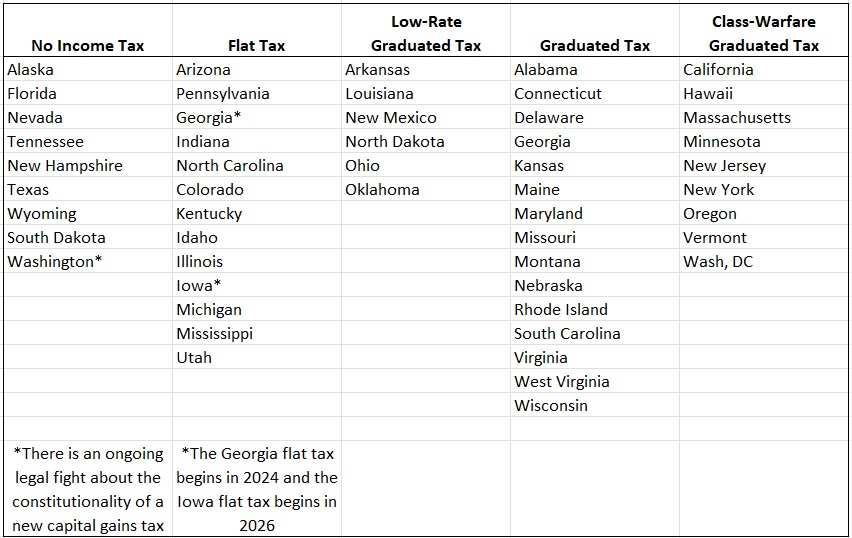
As illustrated by the changes in my state tax rankings between 2018 and 2023, there’s been a lot of progress.

Several red states have shifted to flat taxes and lowered tax rates, putting the class-warfare blue states at an even bigger disadvantage (and some of those left-leaning states actually want to make their tax regimes even less competitive!).Image

While I cheer the shift to better tax policy, I’ve been disappointed that no state in recent years (or recent decades) has made the ultimate leap and joined the no-income-tax club.

That may be about to change.

State lawmakers in Mississippi have passed a law designed to phase out the income tax over 15 years.

Alex Rosado of Reason has some of the details.

Mississippi has joined a small club of nine other states in passing legislation eliminating the state income tax—an outcome that will benefit Mississippians and hopefully encourage other states to follow suit. …The new legislation will gradually lower Mississippi’s state income tax, currently sitting at 4.4 percent, to 3 percent by 2030. ImageFurther annual cuts depend on “growth triggers” linked to state revenue. …States with low-income taxes enjoy greater economic prosperity. Just compare Texas, which has no personal income tax, and Oklahoma, which has a top rate of 4.75 percent. Last month, the Tax Foundation found that Texas’ economy grew roughly 35 percent faster than Oklahoma’s over the last two decades, with Texas’ personal incomes and gross state product being notably higher too. A 2008 longitudinal study that analyzed economic growth in the States from 1964 to 2004 found that states with higher income taxes stifled economic growth, entrepreneurialism, and access to capital.

Douglas Carswell of the Mississippi Center for Public Policy played an important role in the reform.

In a column for the Foundation for Economic Education, he writes about this important development.

Mississippi has made history as the latest state (and the first since Alaska in 1980) to pass legislation banning a state income tax. …Beginning next year, Mississippi’s income tax rate will drop in 0.25% increments, sliding from 4% to 3% by 2030. After that, further reductions will hinge on the state’s budget surplus. ImageGiven Mississippi’s recent track record of substantial surpluses, the income tax could vanish entirely by the mid-2030s. …The push to eliminate the income tax has been a cornerstone of Governor Reeves’s agenda, with serious legislative efforts kicking off in 2022 under then-House Speaker Philip Gunn. Gunn’s genius was to simplify the state’s variable tax rates into a flat 4% on income above $10,000. While this didn’t eliminate the tax outright, it leveled the playing field for Mississippi households, setting the stage for broader support of full elimination. …this is great news for our state. Already there is evidence that in 2024, by some measures, Mississippi performed well economically, and may have been one of the fastest growing states in America that year. This tax reform will only add to this Mississippi momentum.

Let’s also look at some excerpts from an editorial in the Wall Street Journal.

Gov. Tate Reeves signed a bill last month that puts Mississippi on a path to zero income tax, albeit in about 14 years. Yet the messaging is right, as the state tries to lure business investment. Mississippi is sandwiched between two economic powerhouses, Texas and Florida, which don’t tax their residents’ incomes.Image Neither does Tennessee next door. …a law passed in 2022 is already set to cut that next year to 4%. But under the bill Mr. Reeves signed, the plan is to keep going to 3% by 2030. Reductions after that, until the tax is phased out, are conditioned on hitting revenue triggers. …The important point is that the path to zero is now enshrined in law, which is a big deal that workers and employers won’t fail to notice. The economic success of the eight states that don’t tax personal income has created a race in GOP-run states to join them, or at least to cut rates and get as close as politically possible.

Last but not least, Russ Latino’s column in National Review celebrates the abolition of the income tax and other good reforms.

Under the Build Up Mississippi Act, the Magnolia State will become the tenth state to operate without a tax on work. Only one other state, Alaska, has ever eliminated an income tax once in effect. The particulars aren’t all that sexy. The state’s flat income tax will phase down to 3 percent by 2030, marking an annual cut of some $647 million by conclusion of the phase-in.Image From there, revenue growth triggers will be used to pare the rate down to zero. …Since the passage of Bryant’s education reforms in 2013, Mississippi leads the nation in both math and reading gains on the National Assessment of Education Progress tests. Once last, Mississippi’s fourth graders now rank ninth in reading and 16th in math. …When you start behind, there’s a lot of room for improvement. That certainly remains true here. Getting off the bottom requires taking risks that require intestinal fortitude. But conservative ideas are working, and Mississippi has momentum.

By the way, all of the above articles note that the bill contains a typo that actually makes it easy to meet the aforementioned revenue triggers.

I’ll close, however, by focusing on an issue that is far more important.

I like that the Magnolia State has a goal of eliminating the income tax. Such a reform would be great for jobs and growth.

But what will really determine success is not a typo in the bill, but rather a commitment to long-run spending restraint.
Here is a look at the state’s performance in recent years. As you can see, the fiscal constraint last decade evaporated this decade.

Image

Looks like Mississippi needs a Colorado-style spending cap. Given TABOR’s strong track record, that would be the best way of making sure future politicians don’t mess things up.

P.S. Louisiana also is looking at how to abolish its income tax (once again, a TABOR-style spending cap is key).

Read Full Post »

The most important goal of fiscal policy should be a small burden of government, and I explain in this video that you achieve that goal by restraining the growth of spending.

Small government is good for prosperity since it means politicians are not diverting as many resources from the productive sector of the economy.

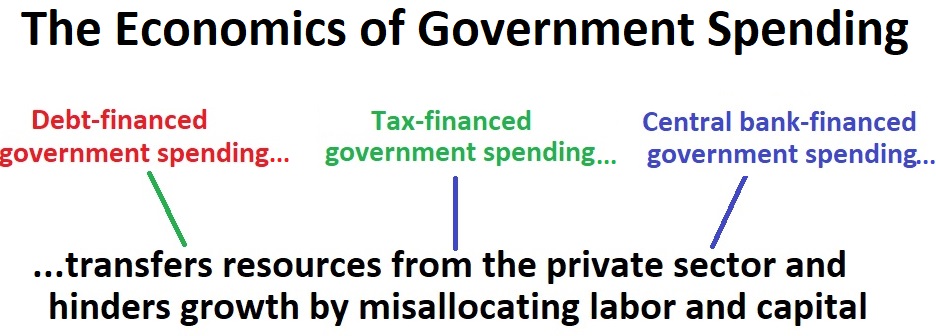
Spending restraint is also like the Swiss army knife of fiscal policy in that it reduces the likelihood of other bad outcomes.

  • If you don’t want politicians to threaten the economy with higher taxes, control spending.
  • If you don’t want big deficits that cause capital to be misallocated, control spending.
  • If you don’t want the central bank to have an incentive to create inflation, control spending.

Now lets look at a very practical example of why spending restraint is a good idea. The Congressional Budget Office just released its latest 10-year estimate.

Many people have looked at those numbers and expressed alarm about $2 trillion-plus deficits.

That’s bad news, but I’m more worried about the underlying problem of excessive government. The federal budget is now consuming more than 23 percent of America’s economic output and that fiscal burden is projected to expand over the next 10 years.

What’s the best way of dealing with this problem?

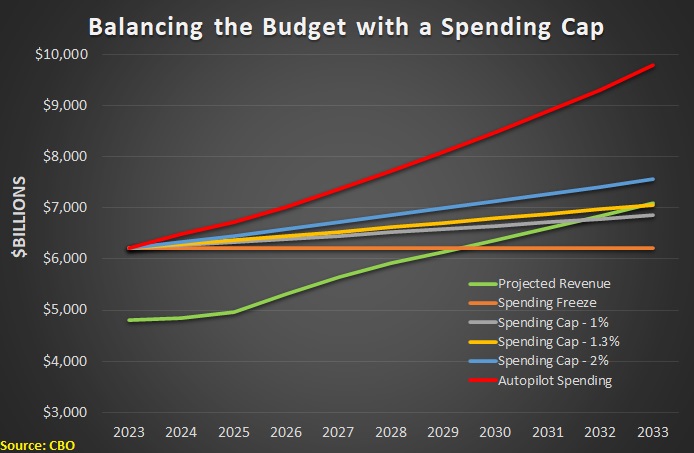
The simple answer is spending restraint. A hard spending freeze (like we had during the Tea Party era of 2009-2014) would balance the budget by about 2032. Even better, it would reduce the spending burden to about 18 percent of GDP.

Image

Even if spending grows by 1 percent annually, the budget is balanced by early next decade (and, more importantly, the spending burden declines).

There are two more things to learn from this chart.

  • First, there is not a problem of inadequate revenue. As you can see revenues are projected to grow rapidly over the next 10 years. Extending the Trump tax cuts would cause the green line to be a bit lower, but revenues would still be climbing. The bottom line is that America’s fiscal problem is entirely the result of excessive spending.
  • Second, when I looked at CBO’s 10-year forecast in January of 2017, it was possible to balance the budget in 10 years simply by holding spending growth to 2.63 percent annually. Thanks to the past eight years of Trump/Biden profligacy, fiscal balance now requires that spending only grow 1.33 percent annually.

The bottom line, as I stated at the start of the video, is that good tax policy is impossible in the long run without good spending policy.

A spending cap is needed, but I’m not holding my breath for it to happen.

P.S. Previous editions of Republican budget games can be found here, here, and here.

Read Full Post »

Last April, I shared some data showing that Colorado’s Taxpayer Bill of Rights had forced politicians in the Centennial State to return $8.2 billion of tax revenue.

The state’s politicians did not want to return the money. But TABOR is a spending cap and the rules require that any extra tax revenueImage (above and beyond what would finance allowed levels of spending) has to be returned to taxpayers.

This spending cap has been good news for the state’s economy, as illustrated by the chart.

But I now need to update the benefits of TABOR.

That’s because we have another year of data. And, as explained in this report from Center Square, taxpayers are getting another refund. This time, their savings will be more than $1 billion.

…the Office of the State Auditor confirmed this week that Colorado taxpayers have a refund coming their way. The refund comes because the state collected $1.4 billion more in revenue in Fiscal Year 2024 Imagethan the Taxpayer’s Bill of Rights allows, according to the Office of the State Auditor. Colorado voters added TABOR to the state constitution in the November 1992 general election. TABOR reins in government spending by limiting the growth of state revenues to the sum of inflation and the percentage change to the state’s population to create a TABOR growth rate. The state must return any money beyond that amount to its taxpayers.

But I’m going to argue that the big benefit is not the $1 billion-plus refund.

Yes, that’s nice, but what really matters is that the refund means that Colorado politicians could not spend the money.

To elaborate, a spending cap produces more prosperity because government is limited and more resources are therefore in the productive sector of the economy.

I’ll close by recycling my argument in favor of a spending cap in Washington. If that kind of policy existed, and politicians were handcuffed, the current fiscal mess would not exist. Image

To illustrate the importance of a spending cap, let’s shift from Colorado’s TABOR and look at some numbers I calculated when looking at Switzerland’s “Debt Brake” back in March of last year.

Since that spending cap was imposed by voters more than 20 years ago, the overall burden of government spending in Switzerland has grown by 2.2 percent annually, a far better performance than in the United States, where the fiscal burden has expanded by an average of 4.9 percent per year.

Read Full Post »

Colorado has the best fiscal rule in the United States. The Taxpayer Bill of  Rights (TABOR) limits state government spending so that it cannot grow faster than inflation plus population.

ImageDoes Colorado’s spending cap work perfectly? Of course not.

Politicians in the Centennial State have spent decades coming up with ways evade and avoid TABOR’s restrictions.

But let’s not make the perfect the enemy of the good.

A study published last year shows that TABOR has saved taxpayers $8.2 billion.

And taxpayers in Colorado may soon keep even more of their money according to an article by Brian Eason in the Colorado Sun. Here are the relevant excerpts.

…the budget will be squeezed primarily by two seemingly minor factors. One, U.S. Census estimates now say the state’s population grew by less than the state’s demographer had anticipated. That means the state revenue cap under the Taxpayer’s Bill of Rights, which tracks inflation and population growth, Imagecan only increase by 5.8% this budget year rather than the 6.1% legislative forecasters were expecting. Two, the state is now expected to collect $185 million more in road usage fees and retail delivery charges this year than last, under the legislative staff estimates. Taken together, the two forecast changes mean state lawmakers could have to issue larger than expected TABOR refunds to Coloradans next year, leaving the state with fewer General Fund tax dollars to spend… That would translate to a nearly $400 refund for the average single-filer in 2025 under the current refund formula, which is tiered based on income.

I’m tempted to call this the feel-good story of 2024. Politicians get less money to waste and taxpayers get more of their money returned.

No wonder TABOR is the gold standard for good fiscal policy at the state level. And Switzerland shows that spending caps also are very effective at the national level.

By contrast, there is very little evidence that balanced-budget rules produce good results.

P.S. Perhaps the best evidence for TABOR is that the pro-spending lobbies in Colorado are always trying to trick voters into approving ballot initiatives that would allow more spending. But as we saw in 2013, 2019, and 2023, the voters of left-leaning Colorado keep voting to to maintain their spending cap.

Read Full Post »

I’ve already written two columns (here and here) about why a “bipartisan” budget deal would be a recipe for higher taxes and bigger government.

To start our third installment in this series, here’s a clip from my recent appearance on Vance Ginn’s Let People Prosper.

Simply stated, America’s long-run fiscal problems are entirely the result of government being too big and growing too fast.

So there is no need to make our bad tax system even worse with tax increases.Image Especially since (as I explained in the above video clip) politicians almost surely would spend any extra revenue.

By the way, my opposition to “putting taxes on the table” is practical rather than ideological. Back in 2012, I wrote that I would accept a big tax increase, but only if the other side would accept various changes to control the burden of government spending.

Needless to say, none of those options are acceptable to the big spenders in Washington. Not in 2012 and not today.

Since I’m focusing on practicality, I’ll share two additional pieces of evidence against having a pro-tax increase fiscal commission.

  1. In 2011, a reporter from the New York Times inadvertently showed that the only budget deal that actually led to a balanced budget was the 1997 agreement that cut taxes. All the other budget deals raised taxes and the net result was more spending and continued red ink.
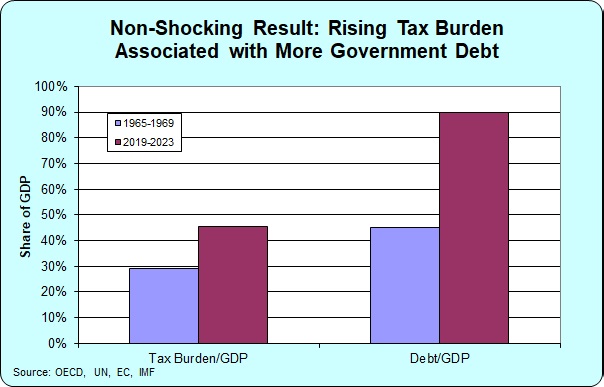
  2. Tax burdens in Europe have dramatically increased over the past 50-plus years, usually because politicians claimed people needed to surrender more money in order to reduce red ink. But over that same time period, government debt more than doubled because politicians spent all the new revenue.

Given all this data, you might think I’m happy about this tweet from a Bloomberg reporter.

Image

But I’m only half-happy. I’m glad the Speaker of the House is ruling out tax increases.

However, his anti-tax position is not credible when he also says that entitlement programs can’t be touched.

That’s the BidenTrump view and it’s a recipe for fiscal chaos and – sooner or later – huge tax increases on lower-income and middle-class Americans.

The bottom line is that there’s an unavoidable choice to be made in the United States. We either reform the entitlement programs or we agree to let politicians take more of our money.

Read Full Post »

The ideal fiscal policy is a spending cap and the specific design is not terribly important so long as the net effect is to have government spending grow slower than the private sector.

ImageSwitzerland’s Debt Brake complies with this requirement.

Colorado’s Taxpayer Bill of Rights complies with this requirement.

Today, let’s look at another proposed spending cap, one that aggressively seeks to return government to a more manageable size.

In a study published by the Heartland Institute, Darren Nelson proposes a “CPI-X” approach that would impose formulaic restrictions on various parts of the budget over a 15-year time period.

And those restrictions would mean genuine cuts, not the fake Washington definition (a slower-than-planned spending increase becomes a cut). And that tougher approach would mean huge savings. Here’s some of what he wrote.

Decades of profligate spending has led to a perilous economic situation. …the solution would tether federal spending to the Consumer Price Index (CPI), with a wrinkle.Image It is called CPI-X (or “CPI minus X”). What works to keep publicly regulated utilities in check can also keep federal spending in check. …The period for cuts would cover the next three presidential terms and would bring federal spending back to 2008 levels. …That is a 50 percent cut, and the savings of $75 trillion would result in complete debt retirement plus $19,347 in annual relief for taxpayers.

Here’s a chart from the study that looks at social welfare spending left on autopilot (green bars) compared to spending under the CPI-X rule.

Image

And here’s the same approach when looking at subsidies and other spending that is in the category of crony capitalism.

The CPI-X approach dramatically slashes this spending (orange bars) compared to the autopilot trendline (green bars).

Image

The good news is that a CPI-X spending cap would dramatically shrink the burden of government spending.

The bad news is that there’s no possibility of getting that kind of approach anytime soon. Especially with two big spenders running against each other for the White House.Image

Heck, there’s not even a chance of getting a far-more modest spending cap that would merely be designed to balance the budget over a 10-year period.

But at least we know the right approach if Ronald Reagan ever gets reincarnated. Or Calvin Coolidge.

P.S. Here’s one final point that deserves attention. The author points out that balanced budget requirements are not very effective, particularly since politicians would use such a rule as an excuse for tax hikes.

A spending rule, by contrast, actually addresses the real problem of excessive government.

…some fiscal conservatives tout solutions like a Balanced Budget Amendment as a cure-all for the constant increases in federal spending, this is a half-baked idea because it would also likely lead to steep tax increases… CPI-X addresses the problem directly by actually imposing extensive and long-overdue reductions in federal spending.

For what it’s worth, spending caps have attracted support from unexpected places. There are pro-spending-cap studies from left-leaning bureaucracies such as the International Monetary Fund (here and here) and the Organization for Economic Cooperation and Development (here and here). There are also similar studies from the European Central Bank (here and here).

Read Full Post »

Spending caps are the only fiscal rule with a good track record.

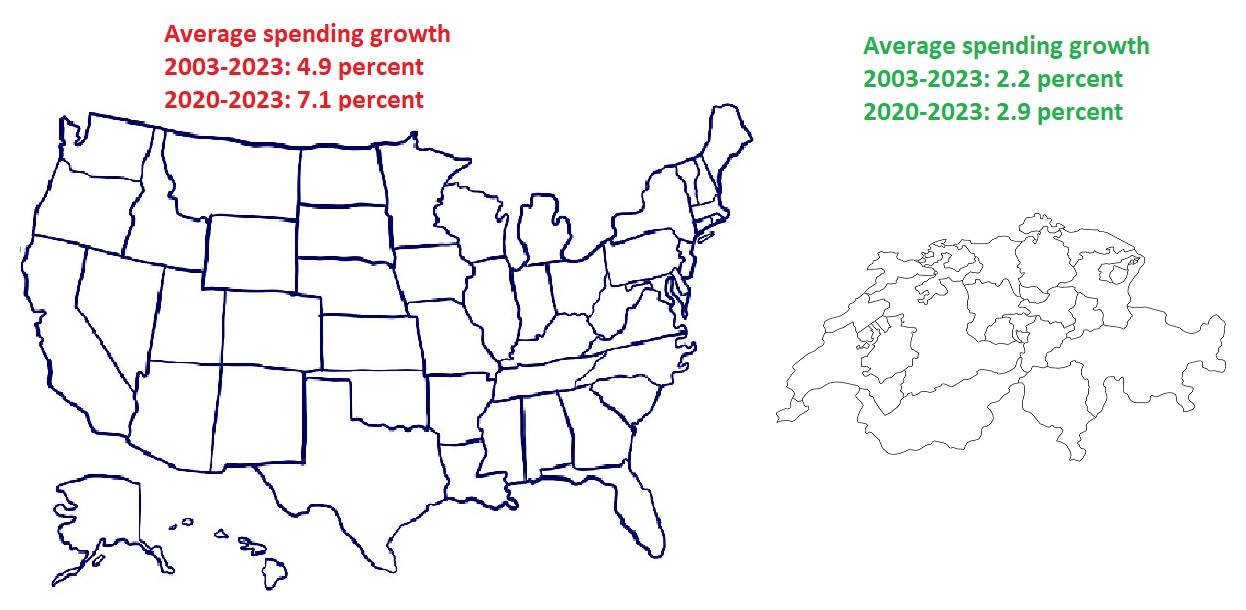
I’ve repeatedly written about Switzerland’s spending cap, known as the “debt brake,” which has limited annual spending growth to an average of just 2.2 percent over the past two decades.

That’s very impressive, especially compared to the irresponsible 4.9 percent average annual spending growth in the United States.

I’ve also written several times about Colorado’s spending cap, known as the Taxpayer Bill of Rights (TABOR), including a column earlier this year showing that state taxpayers have received $8.2 billion of tax relief.

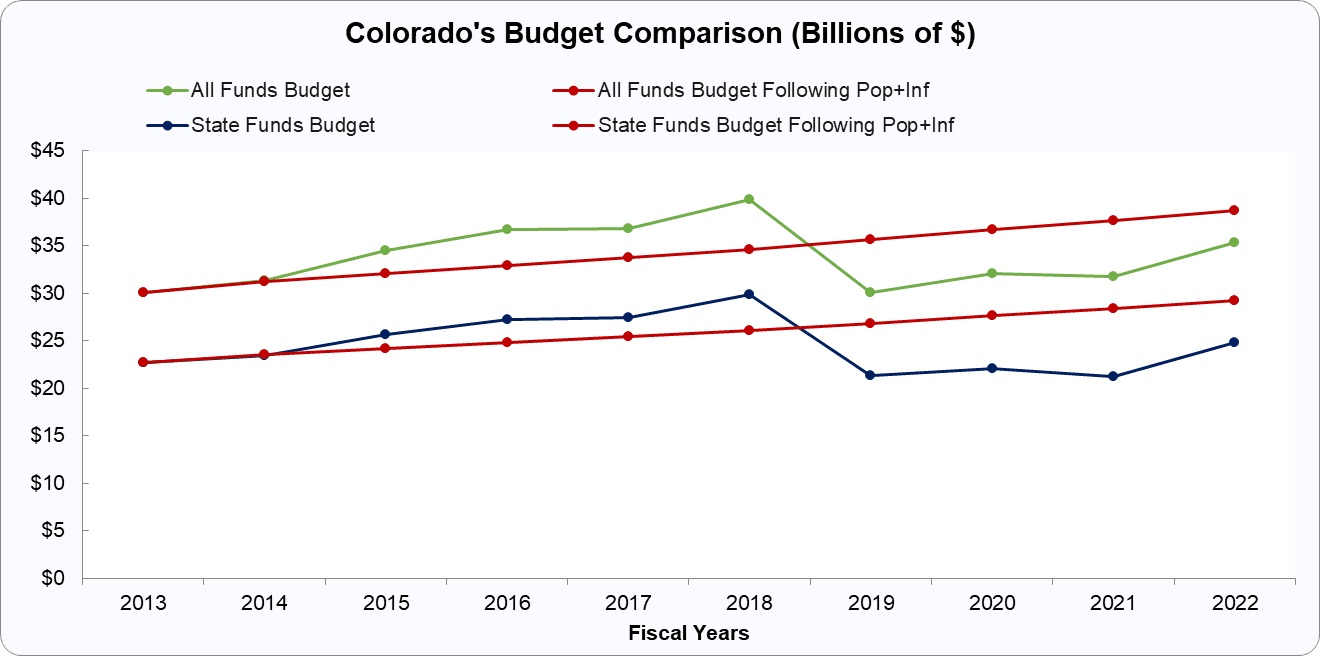
Today, let’s look at more pro-TABOR evidence. Americans for Tax Reform has a “Sustainable Budget Project” to monitor and track state budgets. Here’s their chart showing the results for Colorado.

Image

As you can see, Colorado government spending between 2013 and 2022 was below population plus inflation.

And that’s true when looking at the money that Colorado collected and spent (“state funds budget), and also when looking at total spending  (“all funds budget”), which includes spending financed by the federal government.

None of this, however, means that TABOR is perfect.

Vance Ginn just wrote an article on strengthening Colorado’s spending cap for National Review. Here are some highlights.

TABOR recently had its 30th birthday. Voters approved the constitutional amendment in 1992, establishing the strongest tax and expenditure limit in the country. It’s been the gold standard for a sound spending limit ever since. …When adopted, the limit covered about two-thirds of state spending. ImageIt requires voter approval for tax increases and mandates refunds to taxpayers if tax revenue exceeds the limit. …Unfortunately, courts and politicians have eroded the strength of TABOR over time, primarily because of politicians’ lack of fiscal restraint. The result has been that TABOR now covers less than half of state spending… The…Sustainable Colorado Budget..will help reinforce the original intent of TABOR, by broadening the spending limit to all state funds. The plan would limit nearly two-thirds of state spending each year, as when voters first adopted TABOR. Doing so will result in larger surpluses to reduce income-tax rates yearly until they’re zero.

Several times in recent years (2013, 2019, 2023), proponents of good fiscal policy have had to fight against referendums to weaken TABOR. As Vance wrote, it’s time to go on offense and push to make the spending cap even more effective.

Read Full Post »

When making the case for spending caps, the best domestic example is Colorado and the best international example is Switzerland.

ImageWhat makes the Swiss example especially persuasive is a comparison over the past 20 years between spending growth in Switzerland and the United States.

To use an education analogy, Switzerland is a star student (2.2 percent annual spending growth) and the United States is flunking (4.9 percent annual spending growth).

What’s particularly disappointing, as I wrote a couple of years ago, is that America’s current fiscal mess wouldn’t exist if politicians had been constrained by a spending cap.

In a column for the Wall Street Journal back in October, Grover Norquist and Vance Ginn discussed how national (and state) politicians have dug deep fiscal holes.

Left-wing politicians assert that Americans are undertaxed, but the data show that the government spends too much. …Between 2013 and 2022, aggregate annual spending by the 50 state governments, excluding federal funds, increased 51.7%. Total annual federal spending rose 69.4% during the decade, more than three times as fast as the 21.6% increase in the rate of population growth plus inflation.Image …Had the federal government limited the growth in spending to a maximum of the population growth rate plus inflation during that decade, in 2022 the federal government would have spent $1.6 trillion less than it did, resulting in at least a $200 billion surplus. If the federal government had done this over the past two decades, the national debt would have increased by less than $500 billion instead of $19 trillion. If state governments had limited spending growth to the rate of population growth plus inflation during the last decade, they would have spent $1.39 trillion in 2022, $344 billion less than the $1.74 trillion they actually spent.

Amen. Spending caps are the gold standard of fiscal policy.

There are many reasons the United States should copy Switzerland (decentralization, private pension system, trade liberalization, quality governance, etc), and the Swiss spending cap is at the top of the list.

Read Full Post »

Since I care about policies rather than politicians, yesterday’s most important election was a referendum that took place in Colorado.

The big-spending lobbies once again tried to weaken the state’s spending cap, known as TABOR, or the Taxpayer Bill of Rights.

Yet even though Colorado voters lean to the left, they overwhelmingly rejected Proposition HH. Here are the results.

Image

I underlined the most important part of the above description because the anti-TABOR crowd tried to deceive voters by portraying Prop HH as a measure to lower property taxes.

As I wrote last month, “Will Colorado voters be tricked by Proposition HH? Will they be distracted by the shiny bauble of lower property taxes while politicians grab a greater amount of income tax revenue?”

Fortunately, the voters saw through the ruse.

Here’s how Nick Coltrain and Seth Klamann of the Denver Post described the outcome.

Colorado’s wide-ranging Proposition HH, a property tax relief and education-funding measure pressed by the state’s Democratic leaders, went down in defeat Tuesday night as voters were rejecting it by 20 percentage points. More than 60% of voters rejected Proposition HHImage…voters in all but a handful of counties were on track to reject the major policy proposal put forth by Gov. Jared Polis and legislative Democrats… It was the second time in four years that voters rebuffed an attempt by state Democrats to raise spending limits under the Taxpayer’s Bill of Rights, or TABOR. …Proposition HH marked the latest defeat as Democrats attempted to leverage their trifecta in state government to hold onto more tax money. On the 2019 ballot, they ran Proposition CC, which proposed to retain all taxes collected beyond the TABOR cap, ending refunds, in a bid to shore up the budget. Voters rejected Prop. CC.

If you want to track the history of anti-TABOR initiatives, I wrote about Prop CC in 2019. And I also wrote about an anti-TABOR initiative that failed back in 2013.

If Republicans were smart (don’t laugh), they would push TABOR-style spending caps in other states.

Read Full Post »

Every year, I highlight the most important ballot initiative or referendum.

For 2023, Colorado will once again have the spotlight.

That’s because the pro-spending lobbies and their allied politicians have not given up on their campaign to gut TABOR.Image

As far as they are concerned, the $8 billion-plus that has been refunded to taxpayers is money that should have been used to finance bigger government.

They hate that there is an annual spending cap that limits the growth of government. So the fact that they lost in 2019 (and in 2013 as well) isn’t stopping them from putting another proposition on the ballot.

The newest anti-TABOR initiative is called Proposition HH and the Wall Street Journal editorialized last month about this bait-and-switch scheme.

Coloradans enjoy relatively low taxes for a blue state, but their luck may not last. Democrats in Denver are backing a measure that would blow through the state’s spending cap… The coming tax hazard is known as Proposition HH… It proposes two policy changes that work in opposite directions. The first would curb property-tax growth modestly by lowering the assessment rate.Image That would save about $4,600 for an average homeowner through 2032… The kicker is the second part. The same ballot measure would raise the amount the state can spend by about 25% a year… That change would cost each household about $5,100 over nine years, swallowing the savings from the property-tax cut. The changes could cost taxpayers an estimated net $21 billion through 2040. …Colorado Democrats have spent years trying to lift the spending cap, and the property-tax mirage is their latest gambit. …public unions, which want the no-limits spending of other Democratic-controlled states.

In a column for Forbes, Patrick Gleason expands on these concerns.

…the most consequential measure appearing on the November 2023 ballot…is found in Colorado, where voters will be asked whether they want to weaken the nation’s strongest tax and expenditure limit… Proposition HH…would weaken the state’s Taxpayer’s Bill of Rights (TABOR) by permitting the state to keep surplus revenue that would otherwise have to be returned to taxpayers.Image …Rather than sell HH as an initiative to end TABOR refunds moving forward so that government, not taxpayers, has more money to spend, Proposition HH backers have instead branded it as a property tax relief measure. …Opponents of HH have been pointing out that the measure would translate into forfeiture of TABOR refunds and ultimately lead to a much higher overall tax state burden in the future. …Proposition HH would raise the TABOR spending limit by a cumulative $12.5 billion over the first decade, around $65 billion over two decades.

Will Colorado voters be tricked by Proposition HH? Will they be distracted by the shiny bauble of lower property taxes while politicians grab a greater amount of income tax revenue?

We’ll find out next month.

Since TABOR is the gold standard of fiscal rules in America, I’ll be very interested to see what happens.

P.S. If I was including ballot initiatives from other nations, Chile’s rejection of a statist constitution would have been 2022’s most important result. And Switzerland’s rejection of “universal basic income” would have been the most important result of 2016.

Read Full Post »

Since I’m a big fan of spending caps in Switzerland and Colorado, I’m always on the lookout for research and analysis about fiscal rules.

For instance, there are pro-spending-cap studies from left-leaning bureaucracies such as the International Monetary Fund (here and here) and the Organization for Economic Cooperation and Development (here and here). There are also similar studies from the European Central Bank (here and here).

We can now add to that research with a new working paper from Switzerland’s Federal Finance Administration.

Authored by Thomas Brändle and Marc Elsener, it’s a very helpful review of different fiscal rules.

Let’s start by sharing a chart from the study on the number of fiscal rules. As you can see, the most dominant types of rules are anti-deficit (gray line) and anti-debt (black line).

Since I don’t think those rules are very effective, I’m more encouraged by the growing number of expenditure rules (blue line).

Image

Here are some of the findings from the report.

A rich empirical literature investigates the impact of fiscal rules. First, the focus is on surveying recent studies that investigate the relationship between fiscal rules and “traditional” fiscal performance measures, such as public debt and budget balances. Image…For EU countries and the period 1990-2012, Nerlich and Reuter (2013)…find that the introduction of fiscal rules is related to lower public expenditures as well as to lower revenues. As the impact on revenues is smaller, the primary balance improves. This impact is stronger when fiscal rules are enacted in law or constitution and supported by independent fiscal institutions and effective medium-term expenditure frameworks. Fiscal rules have the strongest limiting impact on social spending, compensation of public employees.

Here are some additional studies that are cited in the paper.

Based on a panel of 30 OECD countries, Fall et al. (2015) find that fiscal rules are related to improved fiscal performance. In particular, a budget balance rule appears to have a positive and significant effect on the primary balance and a negative and significant effect on public spending. Expenditure rules are associated with lower expenditure volatility and higher public investment efficiency. …Focusing on expenditure rules, Cordes et al. (2015) present an analysis for 29 advanced and developing countries for the period 1985–2013. Using a dynamic panel estimation approach, the analysis shows that these rules are associated with better spending control…and improved fiscal discipline. …Asatryan et al. (2018) study whether constitutional-level fiscal rules – expected to be more binding – impact fiscal outcomes. …they find that the introduction of a constitutional balance budget rule leads to a lower probability of sovereign debt crisis. For their most preferred sample of 132 countries between 1945 and 2015, they find that the debt-to-GDP ratio decreases by around 11 percentage points on average with constitutional balance budget rules. Most of these consolidations are explained by decreasing expenditures rather than increasing tax revenues.

I’m most interested in controlling the burden of government spending.

For my friends who are mostly fixated on red ink, it’s worth noting that Switzerland’s spending cap – which took effect in 2003 – has caused a dramatic shift from rising debt to falling debt.

Image

Debt did increase during the pandemic, of course, but Switzerland’s debt increase was very small compared to the United States.

And Swiss lawmakers will now be required to impose additional spending restraint to make up for that extra red ink.

Needless to say, there is no similar “clawback” requirement in the United States.

I’ll close by sharing this table from the study, which summarizes the recent academic research on fiscal rules.

Image

My takeaway from all this research is that spending restraint is the only practical solution to protect against “goldfish government.”

Especially given the demographic changes that are making modern-day welfare states unsustainable,

Read Full Post »

The best evidence for spending caps is the comparison between the United States and Switzerland.

Even since Swiss voters overwhelmingly imposed their “debt brake” on politicians 20 years ago, total government spending in Switzerland has increased by an average of just 2.2 percent per year.

In the United States, by contrast, total government spending has grown more than twice as fast – an average of 4.9 percent per year – over the same time period.

But there is also some evidence for spending caps from the United States. Brian Riedl of the Manhattan Institute has a new study on spending caps that have periodically existed in the United States.

They have only applied to discretionary spending (click here to understand the federal government’s different budget categories), so they are not as extensive as the Swiss spending cap.

Nonetheless, Brian’s chart show that they have produced dramatically better results.

Image

Here’s some of Brian’s analysis.

…spending caps that accommodate realistic appropriations growth rates have sustainably reduced discretionary spending as a share of the economy. …Because spending caps can be easily repealed at any time, they cannot force spending cuts beyond the political system’s capacity. They can only enforce an existing broad commitment to constrain spending.Image …while discretionary spending has not been the driver of rising long-term deficits—and cannot realistically be cut deeply enough to accommodate surging mandatory costs—Congress should still approach this spending with a “do no harm” principle, ensuring that it does not rise as a share of the economy… Cap enforcement is a challenging needle to thread. If caps are too tight and rigid, they will be repealed. If they are too loose and have countless off-ramps, they will cease to limit spending. The optimal solution is a bend-but-not-break approach that keeps caps realistic and flexible yet difficult to evade entirely. This means imposing caps that cover as many discretionary appropriations as possible.

The most fascinating part of Brian’s paper is a look at what happened the last two times there were spending caps.

The original spending caps from the 1990 budget were not overly effective, but the election of a Republican Congress in 1994 led to several years of genuine spending restraint.

Unfortunately, that fiscal discipline evaporated in the late 1990s/early 2000s.

Image

Next we have Brian’s calculations from the Budget Control Act, which was imposed after the late Bush/early Obama spending orgies.

The good news is that the spending caps initially were very effective (helped substantially by a sequester). The bad news is that Trump then allowed another spending orgy (which Biden has continued).

Image

I’ll close by agreeing and disagreeing with Brian’s analysis about the desirability of tight spending caps.

He argues in his paper that politicians will rebel if they are forced to be genuinely frugal (such as a hard spending freeze).

Real-world evidence shows he is right, so that part is correct. I wonder, though, if Brian is being too optimistic in assuming that weaker spending caps would be obeyed.

My fear is that politicians will take advantage of any excuse to overspend, regardless of whether they have been frugal or profligate leading up to that time.

But let’s not digress. The main lesson from his paper is that spending caps work. Our challenge is figuring out how to get shallow and selfish politicians to do the right thing (enact caps) and obey the right thing (comply with caps).

P.S. If you are skeptical of Brian’s analysis, there are pro-spending-cap studies from left-leaning bureaucracies such as the International Monetary Fund (here and here) and the Organization for Economic Cooperation and Development (here and here). There are also similar studies from the European Central Bank (here and here).

Read Full Post »

I’ve referred to Colorado’s spending cap as a “role model” and the “gold standard,” and I lavished even more praise on the Taxpayer Bill of Rights in this clip from a recent interview with Penn Pfiffner of the TABOR Foundation.

If you don’t have a couple of minutes to watch the video, all you need to know is that balanced budget requirements are mostly ineffective.

Or, if you want to be pessimistic, such rules actually give politicians an excuse to raise taxes.

What makes TABOR so successful is that it is designed to control the variable that really matters, which is the growth of government.

ImageTABOR basically tells politicians they can increase spending every year, but no faster than population plus inflation.

Has it worked perfectly? Of course not. But it has returned more than $8 billion to the taxpayers of Colorado.

And Colorado definitely has out-performed other states economically, as measured by the growth of per-capita income.

This is the approach we need in Washington. Heck, even international bureaucracies have acknowledged that spending caps are the only effective fiscal rule.

It is also worth noting that the German government recently endorsed that approach for Europe, which is a positive development since the European Union’s anti-deficit rules obviously have not been effective.

So I’ll be very curious to see whether any 2024 presidential candidates decide to embrace this approach (whether they are sincere is a different issue, needless to say).

P.S. The international version of TABOR is the Swiss Debt Brake.

P.P.S. I also recommend this video about spending caps.

Read Full Post »

The Swiss Debt Brake and Colorado’s TABOR work because they limit spending. Balanced budget requirements, by contrast, have a weak track record.

My point in the above discussion with the Soul of Enterprise is mostly based on economics.

Our fiscal challenge in the United States is excessive government spending. And the problem is projected to worsen in coming decades because of demographic change and poorly designed entitlement programs.

So it makes sense to directly address the problem with a spending cap.

By contrast, a balanced budget amendment is merely designed to inhibit debt-financed spending. That’s a good goal, but it won’t lead to good results if politicians react by simply increasing tax-financed spending. Or if they finance spending with bad monetary policy.

Image

As I point out in the video, balanced budget requirements and anti-deficit rules have not produced good results in American states or EU nations.

The takeaway is that good policymakers should push for spending caps for theoretical reasons and practical reasons.

P.S. I was very pleasantly surprised when the German government recently endorsed EU-wide spending caps.

P.P.S. Remarkably, there are pro-spending-cap studies from left-leaning bureaucracies such as the International Monetary Fund (here and here) and the Organization for Economic Cooperation and Development (here and here). There are also similar studies from the European Central Bank (here and here).

P.P.P.S. It should go without saying, but I’ll say it anyhow, that a spending cap should be set at a level that actually results in less government.

Read Full Post »

Earlier this month, I wrote separate columns about the spending cap in Switzerland (the “debt brake“) and the spending cap in Colorado (“TABOR“).

In this clip from my appearance on Let People Prosper, I explain those spending caps are the gold standard for fiscal rules.

It should go without saying that spending caps are good only if they actually constrain the size of government, just as speed limits in school zones are good only if they protect children from reckless drivers.Image

Which is why I favor spending caps that comply with my Golden Rule.

As you might suspect, politicians generally don’t want any constraint their ability to spend money (and buy votes).

But sometimes they do the right thing. Or at least propose the right thing.

In an article for the Hill, Aris Folley and Mychael Schnell explain that Republicans are offering to give Biden more borrowing authority if Biden agrees to spending caps for the “discretionary” part of the budget.

Here are the relevant excerpts.

House Republicans on Wednesday passed a bill to raise the borrowing limit and implement sweeping spending cuts… The bill would raise the debt ceiling by $1.5 trillion or through the end of next March,Image whichever happens first, in exchange for a wide range of Republican proposals to decrease government spending that, according to the Congressional Budget Office (CBO), amount to $4.8 trillion. The bill would cap federal funding hashed during the annual appropriations process at fiscal 2022 levels, while also limiting spending growth to 1 percent every year over the next decade.

The good news is that Republicans are talking about spending caps. This is a welcome change of pace after the profligacy of the Trump years.

The bad news is that the GOP plan presumably has very little likelihood of getting approved.

And even if Biden and Senate Democrats somehow agree to the spending cap, it only applies to discretionary spending. That’s better than nothing, but entitlements are America’s big fiscal problem.

Moreover, keep in mind that Republicans got spending caps on discretionary spending back in 2011, but those caps were then abandoned after some early success.

In other words, I’m not brimming with optimism. But let’s not make the perfect the enemy of the good. Politicians are talking about spending caps today, so maybe there’s a chance of getting real results at some point in the not-too-distant future.

Read Full Post »

The Center for Freedom and Prosperity has a video on spending caps that focuses on international evidence, such as Switzerland’s debt brake.

Here’s a video from the American Legislative Exchange Council that that looks at a successful domestic spending cap – Colorado’s Taxpayer Bill of Rights.

Here’s the short and simple explanation of how the Taxpayer Bill of Rights (TABOR) constrains spending.

Under the constitutional provision, state tax revenue cannot grow faster than population plus inflation. Any revenues above that amount have to be returned to taxpayers.Image

And since the state has a requirement for a balanced budget, that means that spending also can only grow as fast as population plus inflation.

Has TABOR been successful?

Colorado has out-performed other states, as measured by the growth of personal income, which presumably is a key variable.

Another key variable is the amount of money that TABOR has returned to taxpayers. Here are some excerpts from a new study, authored by Professor Barry Paulson and published by the American Legislative Exchange Council.

This year, the Colorado General Assembly announced a taxpayer rebate of $3.6 billion in surplus revenue. …These rebates are mandated by TABOR, a fiscal rule that limits the growth of revenue and spending at all levels of government and requires that surplus revenue be rebated to taxpayers. Image…It is important to understand why TABOR has been successful and resilient. TABOR is designed to limit the rate of growth in state revenue and spending to the sum of inflation plus the rate of growth in population while allowing a majority of voters to increase the revenue and spending limit when needed. This prevents many new taxes increases. If the state government collects more tax dollars than TABOR allows, the money is returned to taxpayers as a TABOR refund. …As a result, the state has not incurred deficits or accumulated debt as much as other states, like California. …tax rebates…totaling $8.2 billion since TABOR passed in 1992, has strengthened Colorado citizens confidence in the TABOR Amendment over the years.

The last sentence is key. TABOR has resulted in $8.2 billion in tax rebates. More important, it has prevented Colorado politicians from spending $8.2 billion.

Taxpayers seem to understand that TABOR is a very important protection against over-taxing and over-spending.

Here are some excerpts from a column by Ben Murrey of Colorado’s Independence Institute.

Every time voters speak on key issues related to TABOR, they send the same unambiguous message: “Leave TABOR alone and let us keep our money!” …In 2019 after voters gave Democrats unified control over state government, legislators thanked them by sending Proposition CC–which would have permanently ended TABOR refunds–to the November ballot, where Coloradans soundly rejected it. Image…In 2020, voters had the choice between two competing citizen-led ballot initiatives. One would have raised taxes and repealed TABOR’s requirement that Colorado maintains the same income tax rate for all taxpayers. The other, put on the ballot by my organization, Independence Institute, reduced the state’s income tax rate from 4.63 to 4.55 percent. The latter passed with a wide margin. The former failed even to gather enough signatures to appear on the ballot. …Fast forward to 2022. …Initiative 63 would have taken TABOR refunds from taxpayers and given the money back to the state to spend on public education. Like the tax increase measure from 2020, the initiative failed even to make the ballot. Conversely, Independence Institute worked to put Proposition 121 on the ballot. The measure won with more than a 30-point margin and lowered the state income tax rate from 4.55 to 4.4 percent, saving taxpayers over $400 million per year.

Colorado voters don’t always reject tax increases. At the local level, such measures often are approved.

But Murrey’s article shows that voters want to preserve TABOR and don’t want to give state politicians a blank check for more taxes and more spending.

Needless to say, a TABOR-style spending cap would be very helpful in other states. And at the national level as well.

P.S. The ALEC study looked at 30 years of evidence. There’s also a study that looked at the first 20 years of evidence.

Read Full Post »

My “Golden Rule” of fiscal policy, first unveiled in 2011, is based on two principles.

When people ask whether a balanced budget should be primary goal, I explain that fiscal balance is good.

But I then point out that spending limits are the only effective way to achieve that goal.

If they don’t believe me, I direct them to pro-spending-cap studies from left-leaning bureaucracies such as the International Monetary Fund (here and here) and the Organization for Economic Cooperation and Development (here and here).

There are also similar studies from the European Central Bank (here and here).

And maybe in the future I can direct them to a proposal prepared for the European Commission by the German government.

In an article for the International Business Times, Jan Strupczewski explains the proposal to have nations abide by my Golden Rule.

…a German paper prepared for discussions on the rules to be held in the coming months…called for the use of the expenditure benchmark as a way to steer public spending,Image keeping increases in net primary expenditure below increases in potential growth rate of the economy. …The bigger a country’s debt, the bigger the gap between increases in spending and potential growth would have to be, leading to a overall decline in the government deficit and therefore also debt, the paper said.

Here are some additional details, as reported by the EU Observer.

Berlin proposes “common quantitative benchmarks”… The paper states that highly-indebted countries’ GDP growth should always exceed the growth of expenditure,Image a function described as the “convergence margin.” …If a country’s output is expected to be 1.5 percent, its spending is limited to 0.5 percent of GDP. …Limiting government spending to one percent beneath projected growth.

This is remarkable. Germany, governed by a Social Democrat, is proposing a spending cap that is even better than Switzerland’s debt brake.

P.S. There already are fiscal rules in the European Commission, but they are ineffective since they focus on red ink rather than government spending.

Read Full Post »

Every president this century – Biden, Trump, Obama, and Bush – has been a big spender. But I told an audience at the Acton Institute that there are still reasons for optimism.

All that is necessary is a modest amount of spending restraint.

More specifically, we can make progress so long as politicians follow my golden rule, which merely requires that the burden of government spending not grow faster than the private sector.

And I gave examples of that happening.

For instance, we had a five-year de facto spending freeze under Obama (including a sequester), thanks to the “Tea Party” spirit that temporarily animated Republicans on Capitol Hill.

I also mentioned the spending restraint that occurred during the Clinton years, which actually led to a budget surplus.

Reagan, of course, had the best track record.

As shown in this chart, the overall burden of domestic spending fell by 2.5 percentage points of economic output during his tenure.

Image

We now know that good things happened in the past.

Let’s close by contemplating whether good things might happen in the future.

I am normally a pessimist, but I pointed out in the video that Republicans on Capitol Hill actually pushed for genuine entitlement reform during the aforementioned Tea Party era early last decade.

That zeal for good policy largely evaporated during the big-government Trump years, but I think it could return if a Reagan-style Republican won the nomination and was elected in 2024.

The bottom line is that we either control spending – including entitlement reform, or we surrender to European-style big government – including massive tax increases on ordinary people.

Those are the only two choices.

Read Full Post »

Back in 2012, I wrote a column for the Wall Street Journal to highlight the success of Switzerland’s spending cap (also known as the “debt brake”).

Swiss voters voted for this spending cap in 2001 and ever since it took effect in 2003, government spending has increased by an average of 2.2 percent annually, only about half as fast as it was growing in the decades before the cap was imposed.

To show the ongoing success of the debt brake, here’s a map comparing changes in the burden of spending in Switzerland and its four major neighbors (France, Germany, Italy, and Austria). As you can see, IMF data reveals that Switzerland has been more responsible.

Image

I even calculated changes in national spending burdens since the start of the pandemic.

You can see that all governments used the virus as an excuse for more spending, but the fiscal damage was most contained in Switzerland.

Seems like Switzerland is a role model, right?

Professors Steve Hanke and Barry Poulson presumably agree. They have a column in National Review arguing in favor of a similar spending cap for the United States.

President Biden’s budget proposal for 2024 makes it clear that the U.S. needs a budget straitjacket sooner rather than later. …Switzerland has been arguably the most successful country in reining in budget deficits and its debt burden. …The Swiss debt brake requires that expenditures be brought into balance with revenues.Image A cap is imposed on spending based on expected revenue, and revenue is projected based on long-term trends in the real growth of national income. Expenditures may exceed the cap in response to extraordinary events such as war, but if that’s the case, eventually, revenues from budget surpluses must be generated and set aside to offset this excess expenditure. We propose a debt brake for the U.S. that would initially be more stringent than the Swiss debt brake…a spending limit (read: cap) be calculated each year, and that the cap be reduced by 1 percent.

Interestingly, they want a spending cap that is stricter than the Swiss version.

That would be ideal (the tighter the cap, the greater the progress), but I’d settle for the Swiss approach. Why? Because here’s the data comparing US profligacy and Swiss prudence.

Image

When I contemplate these numbers, my disdain for Bush, Obama, Trump, and Biden becomes even more intense.

They all put political ambition about what’s best for America.

But I’m digressing. Let’s put the focus back on the success of the Swiss spending cap.

It’s worth noting, for instance, that Switzerland also is out-performing the United States when comparing changes in government debt.

And the Swiss also have been enjoying better economic performance since they imposed a spending cap on their politicians.

I’ll close by observing that a spending cap would have prevented massive debt accumulation in the United States. And the same is true for other nations as well.

P.S. Colorado has a very successful spending cap known as TABOR.

P.P.S. There’s plenty of academic evidence for Switzerland’s debt brake. But what’s more surprising are that pro-spending cap studies from the International Monetary Fund (here and here), the Organization for Economic Cooperation and Development (here and here) and the European Central Bank (here and here).

Read Full Post »

Every six months or so, the Congressional Budget Office produces a 10-year forecast and most fiscal experts focus on the projections for deficit and debt.

Those are important (and worrisome) numbers, but I first look at the data showing what will happen to taxes and spending.

And you can see from this chart that the fiscal burden of the federal government is projected to grow at a very rapid pace over the next decade.

Image

Other fiscal experts fret that deficits and debt are increasing between now and 2033, but the above chart shows that the real problem is that the spending burden is rising faster than the tax burden.

The real fiscal fight in Washington is how to close the gap between the red spending line and the green revenue line (supporters of Modern Monetary Theory say we can just print money to finance big government, but let’s ignore them for purposes of today’s column).

Since I think Washington is spending far too much, I want to close the gap by restraining the growth of government.

So here’s a second chart illustrating what would happen if there was some sort of spending cap. As you can see, a spending freeze (like we had from 2009-2014) would balance the budget by 2030.

And spending would have to be limited to 1.3 percent annual growth if the goal is to balance the budget within 10 years,

Image

We can solve the problem. That’s the good news.

The bad news is that politicians don’t want to restrain spending.

And, even if they did want to do the right thing, adhering to a 1.3 percent spending cap would require serious entitlement reform. So don’t hold your breath hoping for immediate progress.

P.S. The numbers are out of date, but here’s a video that explains how spending restraint is the key to fiscal balance. And here’s a video on how some other nations made enormous progress with multi-year spending restraint.

Read Full Post »

When I write about fiscal policy, there are two ever-present themes.

And both of these themes can be found in a comprehensive new report issued by the Maine Policy Institute.

The report provides lawmakers with a detailed analysis of the state’s fiscal status and it shows specific spending reforms that would save money and create “fiscal space” for pro-growth tax reforms.

I realize that readers from most places won’t care very much about some of the Maine-specific data, but the report contains some charts that teach a very important lesson that can be applied in other states, as well as in Washington and other national capitals.

Consider, for instance, this chart showing that Maine is getting in trouble because spending in recent years is growing significantly faster than inflation.

Image

The same is true in Washington, except the problem is far worse.

And in other states. And various cities. And other nations.

In other words, governments at all levels and in almost all places have a hard time complying with fiscal policy’s Golden Rule.

That being said, spending caps are a universal solution to this universal problem. Let’s look at Figure 10 from the report, which shows how a TABOR-style spending cap would have produced very good results for Maine.

Image

Once again, we can take this information and apply it very broadly.

A spending cap is the smart and effective way of dealing with irresponsible fiscal policy at all levels of government.

For instance, Switzerland is well know for its spending cap, known as the debt brake. This approach has yielded very good results for the nation’s finances, but less well know is the fact that many subnational governments in Switzerland’s federalist system have their own versions of a spending cap.

The bottom line is that good fiscal policy is universally applicable. And spending restraint is a necessary precondition for that to happen.

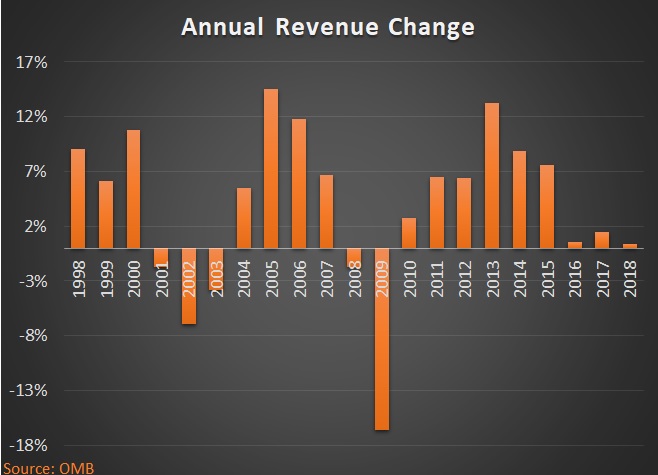
P.S. Some people ask whether a balanced budget amendment would be better than a spending cap. This question gives me an excuse to share one more chart from the study. As you can see from Figure 9, annual tax revenues are very unstable. Sometimes they grow rapidly, sometimes they grow slowly, and sometimes they actually shrink (and the same thing is true in Washington).

Image

This means that a balanced budget requirement is very difficult to enforce and often does not produce good results. During boom years, when revenue is rapidly increasing, politicians have too much leeway to increase spending. And during downturns, when revenue if stagnant or falling, politicians claim that spending restraint would be too difficult and they raise taxes instead.

The advantage of a spending cap is that it targets the real problem of spending (rather than the symptom of red ink). Moreover, politicians are subject to a rule that is much easier to enforce (increasing spending by, say, 2 percent every year is very straightforward compared to the wild swings in spending that occur with a balanced budget rule).

Read Full Post »

If Republicans do as well as expected in next Tuesday’s mid-term elections, especially with regard to gubernatorial and state legislative contests, I expect that more states will enact and expand on school choice in 2023.

That will be great news for families.

But I also want great news for taxpayers, and that’s why I’m hoping that we also will see progress on fiscal policy. To be more specific, I want to see more states copy Colorado’s very successful spending cap.Image

Known as the Taxpayer Bill of Rights (TABOR), it basically limits the growth of annual tax revenue to the growth of population-plus-inflation. Any revenue above that amount automatically must be returned to taxpayers.

And since the state also has a balanced-budget requirement, that means spending can only increase as fast as population-plus-inflation as well. A very simple concept.

Has TABOR been successful? Has it produced better fiscal policy and more economic prosperity?

The answer is yes. In a column for National Review, Jonathan Williams and Nick Stark say it is the “gold standard” for state fiscal policy.

TABOR is a state constitutional amendment that limits the amount of revenue Colorado lawmakers can retain and spend to a reasonable formula of population plus inflation growth. If the state government collects more tax revenue than TABOR allows, the money is returned to taxpayers as a refund. Just this year, Colorado taxpayers will receive nearly $4 billion in TABOR refund checks. If any government in Colorado intends to spend surplus revenue, increase taxes or fees, or increase debt, Imageit must submit the proposed measure to the ballot and win the approval of a majority of voters. …Following the low-tax-plus-limited-government formula, Colorado developed into one of the most competitive business climates in the nation in the years following TABOR’s adoption. During the past three decades, Colorado has been one of the most competitive and fastest-growing economies in the nation. …Even in the face of this tremendous economic-success story, the tax-and-spend crowd have spent a tremendous amount of resources trying to demonize TABOR, often attempting to find work-arounds or suing to have TABOR declared unconstitutional. Why? In short, because it is an effective limit on the growth of government, and it restricts the wild spending increases that fund their constituencies — who generally favor big government. …Other states trying to implement meaningful checks and balances on the inexorable government-growth machine…should follow Colorado’s example.

Courtesy of Jon Caldera, here’s some of Colorado’s fiscal history, which began with a flat tax in the 1980s and then culminated with TABOR in the 1990s.

Colorado used to have a progressive income tax where people and companies would pay a higher tax rate the more money they earned. Thanks to the Independence Institute…and…economist Barry Poulson, the legislature was convinced to switch from the progressive tax to a flat one in the mid-1980s. Poulson urged that the new tax rate be 4.5% so that it would bring in the same amount of revenue as the system it was replacing. Image…So, of course, the legislature set the new rate at 5% to create a fine windfall, which it did. Even so, the flat income tax did what it was predicted to do. It lit the engine of Colorado’s economy. When productive people and their companies are looking to locate, they are attracted to states with low and stable tax policy. The flat tax began the Colorado boom. That boom resulted in massive tax receipts to the state. So much so that the legislature quickly felt the growing pressure of a tax rebellion. …So, we then passed the Taxpayer’s Bill of Rights in 1992. The combination of our flat tax and TABOR attracted more and more businesses and jobs to Colorado. So much so that in the late 1990s the state had to refund some $3.2 billion of surplus tax revenue to taxpayers. …The combination of our flat-rate income tax and TABOR has made for a sustainable gold rush which has turned Colorado into one of the most economically vibrant states in the country with one of the lowest unemployment rates.

I’ll close by explaining why folks on the left also should support TABOR-style spending caps.

Part of the reason is that they should care about future generations.

Part of the reason is that they should care about economic growth.

But another reason is that it may be politically beneficial. Check out these excerpts from a column in the Denver Post by Scott Gessler.

TABOR requires a vote of the people to raise taxes, incur debt, or spend excess government funds. Practically, it makes all three much harder. So Democrats hate TABOR. …conservatives love TABOR. They rarely support tax increases or additional borrowing, Imageand for them TABOR imposes fiscal discipline and forces government to live within its means. And Colorado has avoided the ongoing fiscal crises that have plagued other states like Illinois or California. Plus, it’s hard to argue against the public’s right to vote on taxes and debt. …But what about Republicans? They’re the ones who have paid the political price. …Today, voters can oppose Republicans and support Democrats, with little fear taxes will go up. …So expect the continued irony, as Democrats attack TABOR with a unified voice, while Republicans usually support it, yet lose political strength.

Since I care about policy rather than partisanship, I hope lots of Democrats read this article and then embrace spending caps. If they don’t want to copy Colorado, they can opt for the Swiss version of a spending cap. So long as they choose something real, it will work.

That would be bad for Republicans, but good for prosperity.

P.S. Colorado is now a blue-leaning state, but voters in 2019 rejected an effort by the pro-spending lobbies to eviscerate TABOR.

Read Full Post »

As part of “European Fiscal Policy Week,” I’ve complained about bad Italian fiscal policy, bad Europe-wide fiscal policy, bad British fiscal policy, and also the unhelpful role of the European Union.

But I want to end the week on an optimistic note, so let’s take a look at Switzerland‘s spending cap.

Known as the “debt brake,” the rule was approved by 84.7 percent of voters back in 2001 and took effect with the 2003 fiscal year.

And if you want to know whether it has been successful, here’s a comparison of average spending increases before the debt brake and after the debt brake.

Image

The above data comes directly from the database of the IMF’s World Economic Outlook.

There are some caveats, to be sure.

  • The IMF data cited above is not adjusted for inflation, though inflation has not been a problem in Switzerland.
  • The IMF numbers also show total government spending rather than just the outlays of the central government, but most cantons also have spending caps.

The bottom line is that Swiss fiscal policy dramatically improved after the spending cap took effect.

Switzerland’s Federal Finance Administration has a nice English-language description of the policy.

The debt brake is a simple mechanism for managing federal expenditure. …Expenditure is limited to the level of structural, i.e. cyclically adjusted, receipts. This allows for a steady expenditure trend and prevents a stop-and-go policy. …The debt brake has passed several tests since its introduction in 2003…Image The binding guidelines of the debt brake helped to swiftly balance the federal budget when it was introduced. The debt brake prevented the high tax receipts from the pre-2009 economically strong years from being used for additional expenditure. Instead, it was possible to build up surpluses and reduce debt. …s public finances are well positioned when compared internationally. Aside from the Confederation, most of the cantons have a debt brake too.

Here’s a chart from the report. It shows that debt is on a downward trajectory, especially when measured as a share of economic output (the right axis).

Image

For what it’s worth, I’m glad the debt brake reduced debt, but I care more about controlling government spending. That being said, the Swiss spending cap also is a success on that basis.

The burden of spending as a share of GDP was increasing before the debt brake was approved. And since 2003, it’s been on a downward trajectory.

Here’s what Avenir Suisse, a Swiss think tank, wrote back in 2017.

Since the early 2000’s, Switzerland’s fiscal institutions have been successful in keeping the overall levels of taxation and spending at moderate levels. The country’s high fiscal strength is based on…Switzerland’s debt brake, a key institutional mechanism for managing public finances which subjects the Confederation’s fiscal policy to a binding rule…and contributes significantly to the country’s fiscal discipline.Image …Switzerland’s spending cap has helped the country avoid the fiscal crisis affecting so many other European nations. …The Swiss debt brake is the ideal model for other countries lacking fiscal discipline to embrace. …The Swiss debt brake’s most important contribution, however, cannot be measured in figures… In the early 1990s fiscal policy was oriented more towards the demands of the public sector… Today, however, the administration, the government and the parliaments believe it is self-evident that expenditures must develop in the medium term in line with revenue. Fiscal federalism, as an important element in the cantons, protects against overcrowding access to the tax side.

That last sentence deserves some elaboration. The authors are noting (“overcrowding access to the tax side”) that it is possible to increase spending by increasing taxes, but that’s not an easy option in Switzerland because voters can use direct democracy to reject tax hikes (as they have in the past).

P.S. The Debt Brake has an opt-out clause that allows more spending in an emergency. And, during the pandemic, spending did jump by more than 12 percent in just one year. But there’s also a claw-back provision that requires lawmakers to be extra frugal in subsequent years. And that policy seems to be successful. The big spending surge in 2020 was followed by two years of zero spending growth (with another year of no spending growth projected for 2023).

P.P.S. Look at this map if you want to see how much better Switzerland is than the rest of Europe.

P.P.P.S. Look at these charts if you want to see how Switzerland is doing better than the United States.

Read Full Post »

Back in March, I explained that a spending cap is desirable, but noted that it’s important to set a limit that actually restrains government spending.

I made the same point as part of a recent speech to Hawaii’s Grassroot Institute.

My main point is that the goal of fiscal policy should be to control government spending, ideally by making sure it does not expand faster than the private sector.

ImageThat’s my Golden Rule.

The problem in Hawaii is that there’s a spending cap, but it’s set too high. Politicians are allowed to increase spending at the rate of growth of state income.

It’s far better to cap spending so that it increases no faster than population plus inflation.

Like the TABOR rule in Colorado.

But that’s only part of the problem. As I noted in my remarks, Hawaii politicians routinely waive even the overly permissive limit in their state.

At the risk of repeating myself, they should copy Colorado.

I also explained to the audience that a balanced budget is nice, but it shouldn’t be the goal of fiscal policy.

  1. From an economic perspective, the real problem is spending, regardless of whether outlays are financed by taxes or borrowing.
  2. From a practical perspective, balanced budget requirements are unsustainable because revenues rise and fall with the business cycle.
  3. From a political perspective, politicians can opt to comply by increasing the tax burden, particularly during an economic downturn.

I’ll add a fourth point. governments (such as Switzerland) with successful spending caps have a very good track record of budget surpluses. The same can’t be said for European nations that are supposed to comply with anti-deficit rules.

Not that Switzerland’s success should come as a surprise. If you fix the disease of excessive spending, that automatically should solve the symptom of red ink.

P.S. Here’s an explanation of Switzerland’s spending cap.

P.P.S. Here’s how a spending cap could solve the fiscal mess in Washington.

Read Full Post »

Yesterday’s column analyzed some depressing data in the new long-run fiscal forecast from the Congressional Budget Office.

Simply stated, if we leave fiscal policy on auto-pilot, government spending is going to consume an ever-larger share of America’s economy. Which means some combination of more taxes, more debt, and more reckless monetary policy.

Today, let’s show how that problem can be solved.

My final chart yesterday showed that the fundamental problem is that government spending is projected to grow faster than the private economy, thus violating the “golden rule” of fiscal policy.

Here’s a revised version of that chart. I have added a bar showing how fast tax revenues are expected to grow over the next 30 years, as well as a bar showing the projection for population plus inflation.

Image

As already stated, it’s a big problem that government spending is growing faster (an average of 4.63 percent per year) than the growth of the private economy (an average of 3.75 percent per years.

But the goal of fiscal policy should not be to maintain the bloated budget that currently exists. That would lock in all the reckless spending we got under Bush, Obama, and Trump. Not to mention the additional waste approved under Biden.

Ideally, fiscal policy should seek to reduce the burden of federal spending.

Which is why this next chart is key. It shows what would happen if the federal government adopted a TABOR-style spending cap, modeled after the very successful fiscal rule in Colorado.

If government spending can only grow as fast as inflation plus population, we avoid giant future deficits. Indeed, we eventually get budget surpluses.

Image

But I’m not overly concerned with fiscal balance. The proper goal should be to reduce the burden of spending, regardless of how it is financed.

And a spending cap linked to population plus inflation over the next 30 years would yield impressive results. Instead of the federal government consuming more than 30 percent of the economy’s output, only 17.8 percent of GDP would be diverted by federal spending in 2052.

P.S. A spending cap also could be modeled on Switzerland’s very successful “debt brake.”

P.P.S. Some of my left-leaning friends doubtlessly will think a federal budget that consumes “only” 17.8 percent of GDP is grossly inadequate. Yet that was the size of the federal government, relative to economic output, at the end of Bill Clinton’s presidency.

Read Full Post »

Older Posts »