
Link Roundup: January 2026

This month, the ace journal club discussed a quoiromantic manifesto, translated from Japanese!  Probably not the easiest read if you don’t have prior familiarity, but we thought it was great stuff.

The World of Pride and Prejudice is Not the World of Purity Culture | Tell Me Why the World is Weird – Christian purity culture frames itself as a continuation of centuries-old practice, but if you look back at history there are many differences.  This is a pretty insightful look at the idiosyncrasies of purity culture, by way of comparison to Jane Austen’s famous 1813 novel.

Exposing a $10,000,000,000 Debt Industry | Coffeezilla (video, 16 min) – Hey, I know a bit about the debt settlement industry.  When someone is having trouble with debt, a debt settlement company will offer to step in between the lender and debtor, and negotiate to pay only a fraction of the debt (maybe about half).  In return, the debt settlement company takes a cut.  It ruins your credit score, but could in theory reduce your debt.  But I wasn’t familiar with the abuses and scams in the industry.  That’s something that should be pursued by the consumer financial protection bureau (CFPB) as a violation of UDAAP oh wait
[Read more…]

Experience with AI coding

In the past year, myself and many other people who program for a living started using AI coding assistance. I’m just going to plainly discuss my experience, and ramble about some related issues.

This explanation is primarily for the benefit of people who do not code professionally, and thus have little idea what’s going on. If you code professionally, then you already know, and have formed your own opinion about it, which you are welcome to keep. But it’s worth noting that lots of different kinds of people code for a living. It’s not just software engineers, you know. I code on a daily basis but I’m a data scientist. The reader should be cautious about generalizations because what’s true of one profession may not be true of another.

[Read more…]

Origami: Free pleating

Free pleating

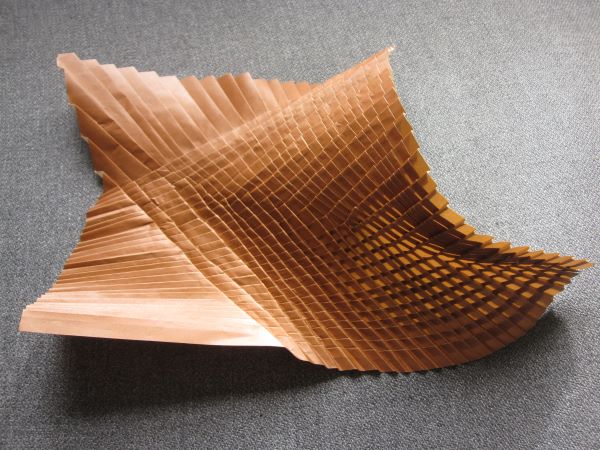
A free pleating model, made in a workshop with Goran Konjevod

I made this a couple months ago in an origami workshop with Goran Konjevod.  The subject of the workshop was how to pleat paper without pre-creasing.  It’s an improvisational technique where you don’t worry about making folds equally spaced or parallel.  You just approximate, and watch how it distorts the paper.  And since you’re approximating, you can do stuff like making the lines slightly non-parallel.

My style generally involves more careful planning and precreasing, but I like this technique too!  I imagine if you do it enough, you gain some ability to predict how it will turn out.

Heated Rivalry

Heated Rivalry is an M/M hockey romance TV series based on the book of the same name. It’s some sort of popular sensation, supposedly the #3 most popular TV show online. At time of writing, four out of six episodes have been released, and we’ve been keeping up with it. We’re used to accepting a lower quality standard when it comes to gay film. But this is surprisingly high quality, having good writing, good production, and amazing acting.

It’s about two hockey players on rival teams, Shane Hollander and Ilya Rozanov who are having sex with each other. But their relationship has to be kept secret because it would be bad for their careers. Fair warning, these are explicit sex scenes, and there are a lot of them, to the point of being pornographic.
[Read more…]

Link Roundup: December 2025

Ways of Seeing (1972), John Berger Episode 1-4 | Video, 2 hours, via – An old television show, talking about the interpretation of European painting.  Episode 1 talks about the mistique placed on traditional art, episode 2 is tropes vs women in oil painting, episode 3 talks about the function of art as a class signifier, and episode 4 compares the tradition of oil painting to the modern tradition of advertisement.  Pretty fun and insightful.

What struck me was that for all the cultural reverence placed on traditional oil painting, we (as in the general public) have a fairly poor understanding of where it came from, and how its original context made it the way that it is.  And yet the origin is precisely what makes those paintings valuable in the first place.  So what does that say about art?  Do we value origin stories, or do we not?

How Dan Trachtenberg Built a Grand Unified Theory of Predator | Second Wind (video, 50 min) – I knew absolutely nothing about Predator before, so I learned a lot!  Darren Mooney discusses how it’s basically a slasher film where most of the victims are manly men, and also basically Vietnam soldiers.  I had no idea that this horror series I was barely aware of had such commentary on masculinity, and now I’m glad I don’t have to watch them to learn about it.

[Read more…]

On Steam AI disclosures

The Steam game store has a policy that games with AI-generated content are required to say so. The CEO of Epic Games (which owns a competing game store) recently criticized this policy:

The AI tag is relevant to art exhibits for authorship disclosure, and to digital content licensing marketplaces where buyers need to understand the rights situation. It makes no sense for game stores, where AI will be involved in nearly all future production.

This has been making the rounds as people react to it on social media. I thought I’d offer my two cents, since I just set up a Steam page a few months ago, and had to familiarize myself with the AI disclosure policy at the time.

[Read more…]

Origami: early works

Early origami models

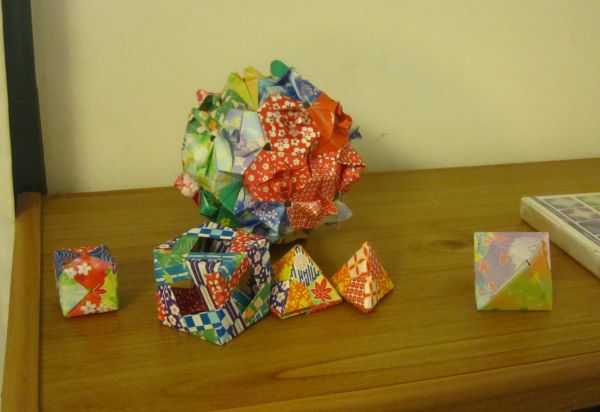
From top to bottom, left to right:
1. Dimpled Model with Curls by Meenakshi Mukerji.
2. Sonobe Cube, by Mitsunobu Sonobe.
3. Cube with Windows, by Bennett Arnstein, simplified from Lewis Simon’s Decoration Box.
4. Equilateral Triangle Edge Module, by Lewis Simon and Bennett Arnstein, modified by me to make a square pyramid.
5. Same as #4, making a tetrahedron.
6. Simple Chain-of-4-Equilateral-Triangles From a Square, by Lewis Simon.

I mentioned that I messed up my photo organization, so I was trying to figure out what I hadn’t posted already.  I think I’ve posted a few of these, but let’s just knock them all out from my list.  These are the very first models I folded when I started doing modular origami in 2012.

Most of these are from Beginner’s Book of Modular Origami Polyhedra: The Platonic Solids by Rona Gurkewitz and Bennett Arnstein, and I do recommend that for beginners.  The Dimpled Model with Curls is from Meenakshi Mukerji’s Exquisite Modular Origami.

[Read more…]