Showing posts with label Delta. Show all posts

Monday, September 22, 2025

New Report: Langley City and White Rock Most Affordable Places to Live in South of the Fraser

There is an old saying, “drive until you qualify,” when it comes to housing in urban regions. The thought being that the cost of living is lower the further you get from core urban areas.

Back in 2015, Metro Vancouver Regional District staff challenged the assumption in their report, “The Metro Vancouver Housing and Transportation Cost Burden Study – A New Way of Looking at Affordability.” I posted about it over 10 years ago, and you can read more about that first report. It challenges the assumption that it is cheaper to live further out.

The cost of transportation is similar to the cost of housing for many people, which is why, when evaluating affordability, you need to consider both housing and transportation costs.

The short of it is that it found that when considering housing and transportation costs, it was actually most cost-effective to live in places like New Westminster than in Delta.

A lot has changed in the last decade, and Regional District staff have updated this report for 2025. One of the significant differences in the report is that it provides a more fine-grained mapping of affordability. So instead of “the Langleys” or the North Shore, you can go down to the neighborhood level in this 2025 update.

Image
Combined housing and transportation costs by neighborhood in Metro Vancouver. Select the map to enlarge.

What becomes apparent is that the total cost of housing and transportation is lower in areas with higher densities and good transit access, no matter where you are in the region.

Image
Map of Urban Centres and Frequent Transit Development Areas. Select the map to enlarge.

To drive the point home, the following table from the report shows this. The northern part of Langley City is an urban centre.

Image
Combined housing and transportation costs by area type, UCB = Urban Containment Boundary ($ thousands)

At a municipal scale in the South of Fraser, the most affordable communities to live in for housing and transportation costs, from most to least, are:

  • Langley City and White Rock: $38,000/year
  • Surrey: $43,000/year
  • Delta and Township of Langley: $47,000/year

For more information, please read the full report, “Housing and Transportation Cost Burden Study - 2025 Update.

Thursday, March 20, 2025

Accommodating Population Growth Requires a Plan, Invest Langley City

In February, BC Stats released the last population estimates for municipalities in BC. While looking at the year-over-year changes is interesting, there is value in looking over a more extended period. I wanted to look at the population growth of municipalities in the South of Fraser over the last few decades.

The following is the change in population between 2004 and 2024 by municipality:

  • Surrey - 80%
  • Langley Township - 73%
  • Langley City - 44%
  • White Rock - 32%
  • Delta - 26%

One of the challenges with fast growth is keeping up with services. Building new cultural and recreation facilities takes time and considerable finances. For example, it is easier for Delta to plan for and build these facilities than Surrey. Surrey is always in catch-up mode.

Langley City's growth is "middle of the road" for South of the Fraser communities, but we still must invest in facilities to keep up with growth. We will need to expand basic facilities like our operations and maintenance yard as well as recreation and cultural facilities. With SkyTrain, population growth will accelerate, which is why Langley City Council is creating our Invest Langley City vision. This vision will outline when and what we need to build to ensure that our residents and businesses continue receiving a high service level. I'll be sharing more about this vision as it progresses.

Tuesday, January 30, 2024

My Review of the R6 Scott Road RapidBus

Image
Paul and I waiting for the R6. Select the image to enlarge.

A few weekends ago, my friend Paul Hillsdon and I decided to check out the new R6 Scott Road RapidBus.

Image
The R6 pulling into Newton Exchange. Select the image to enlarge.

The Scott Road/72nd Avenue corridor is one of Metro Vancouver's busiest and most congested transit corridors. About 1/3rd of people who travel along this corridor do so on transit, though certain sections are as high as 3/4rds.

RapidBus bus routes include bus priority measures, limited stop service, and enhanced bus stops. All this leads to a faster and more convenient rider experience.

I will start with the best part first. While the limited bus stops and modest bus priority measure on Scott Road, heading northbound, does speed up service, what shined for me was zooming past traffic going southbound on Scott Road in what is probably the closet we have to urban Bus Rapid Transit in our region at the moment. Southbound on Scott Road almost has nearly continuous bus lanes.

Image
The R6 in the centre bus lanes on Scott Road near 72nd Avenue, southbound. Select the image to enlarge.

Hopefully, Surrey can work with TransLink to build more northbound bus lanes in the future.

All the bus stops had shelters, and some had enhanced lighting. I noticed this on 72nd Avenue. The extra lighting is perfect, giving people an enhanced feeling of safety.

Image
An R6 bus stop on Scott Road near 72nd Avenue, southbound. Select the image to enlarge.

I wonder if some bus stops and shelters might be a bit too small, given the number of people using the R6. Hopefully, TransLink or Surrey can expand these shelters to accommodate more riders in time.

The frequency of the R6 was good, so I didn't worry about when the next bus would come.

Overall, this is a massive upgrade from the 319 and provides a quality service that connects Newton, KPU, Strawberry Hill, North Delta, and Scott Road SkyTrain Station.

Image
I made it to Scott Road SkyTrain Station. Select the image to enlarge.

Wednesday, November 15, 2023

Climate Change Increasing Fraser River Flood Risk: The Time to Act Is Now.

In November 2021, the Fraser Valley experienced one of the worst flooding disasters in recent memory due to the spillover of the Nooksack River into Sumas Prairie. The worst flood in the 20th Century was the 1948 Fraser River flood, which resulted in the death of ten people and left 1,500 homeless. The most significant flood in recorded history along the Fraser River occurred in 1894.

The 2021 flood kicked people and governments into high gear. With climate change and decades of underinvestment in flood protection and mitigation, we need to take action to reduce the risk of another devastating flood event.

The Fraser Basin Council is working on a "Pathways to Action for Flood Risk Reduction and Resilience" plan. They recently presented information at the Metro Vancouver Regional District's Flood Resiliency Committee.

The following map shows today's flood risk for various flooding events. This map doesn't take into account the impacts of climate change.

Image
Map of Fraser River flood events today based on different levels of flooding. Select the slide to enlarge.

Overall, things would be OK if climate change wasn't occurring, but it is.

The following map projects what a significant 1894-level flood event would look like in 2050 (orange) and 2100 (purple).

Image
Map of 1894-type Fraser River flood events in 2050 and 2100. Select the slide to enlarge.

By 2050, without investment, Richmond, Delta, Pitt Meadows, Fort Langley, Barnton Island, Abbotsford, and Chilliwack would see significant flooding. By 2100, Richmond, Delta, Abbotsford and Chilliwack would be underwater.

Today's 500-year Fraser River flooding event would cause a $4.8 billion loss of residential, commercial, and industrial buildings. With climate change, over the years, this will become worse.

The point of the Fraser Basin Council presentation is to call governments to action. We have time to update our flood planning and work with the provincial and federal governments to invest in flood risk reduction. While 2050 is just around the corner, if we start investing today, we can reduce the risk of flooding impacting people's lives and livelihoods along the Fraser River.

Wednesday, September 7, 2022

Let’s drop the spaghetti-mess transit network and invest in fast, direct service

TransLink bus

Around 15 years ago, TransLink introduced the South of Fraser Area Transit Plan. The big idea in that plan was to shift the transit network focused on getting people from “the suburbs” to Downtown Vancouver, to a network that gets people easily around Surrey, Delta, White Rock, and Langley with fast and direct bus service.

The bus network at the time was more a spaghetti mess of infrequent transit routes that were not intuitive to use. The following map shows the 2008 transit network in Langley.

Image
Example of spaghetti-mess routes in Langley back in 2008. Select map to enlarge.

Back then, the 502 and 501 even had different routings based on the time of day. You almost needed to be a transit expert!

While some of the spaghetti-mess network still exists today, and there are still very infrequent or peak-period only routes such as 388 or 509, TransLink has invested in creating direct, easy-to-understand routes over the past decade or so.

The big idea of the South of Fraser Area Transit Plan was that you could use a grid of frequent bus routes to get from any point to any point in the South of Fraser with only one transfer. Because the routes were frequent, you’d never have to wait more than 15 minutes for a bus. You usually wait less.

Image
2031 proposed fast and frequent transit network from the 2007 South of Fraser Area Transit Plan, Phase 1. Select map to enlarge.

One of the biggest success stories of investing in direct, frequent, and easy-to-understand transit routes is the 531, which connects White Rock/South Surrey to Langley. This route has been leading in ridership growth.

I’ve now been on several 531 that have been jam-packed this year.

About five years ago, the 501 would almost act like an express bus along 200th Street, when I took the 501 this weekend, it was busy, and people were getting on and off at many stops along the route.

I’ve seen firsthand how valuable this direct network can be as the population and jobs in the South of Fraser grows.

With overall transit ridership still below pre-pandemic levels, TransLink has the opportunity to evaluate the transit network. It might be a good time to assess if peak-period, Vancouver-bound commuter transit routes are meeting the needs of people, especially in the South of Fraser. Does it make sense to reallocate funds from peak-period-only Vancouver commuter specials and other infrequent, spaghetti-mess routes to strengthen the frequent, direct transit network?

From what I’ve seen, the answer is yes.

Monday, January 17, 2022

Langley City Protective Services Expenditures One of Highest in Metro Vancouver

Community Policing Office

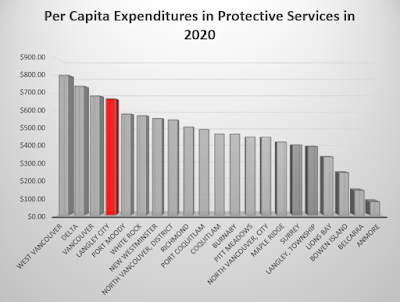
Protective services are the top category of expenditures for Langley City. Protective services include policing services, fire and rescue services, Langley Youth & Family Services, dog control, emergency planning, search & rescue, and victim/witness services.

How does Langley City compare to other municipalities in Metro Vancouver?

Image
Per capita expenditures in protective services in 2020. Select chart to enlarge.

Langley City has one of the highest per capita expenditures for protective services in Metro Vancouver at $670.26 in 2020, the year where the latest information is available region-wide.

Our neighbours in the Township paid $396.63 per person, and in Surrey, $404.78 per person.

The following table shows the breakdown for all municipalities in Metro Vancouver.

Municipality Population Cost Per Capita
   West Vancouver 43805 $35,276,293.00 $805.30
   Delta 111281 $82,645,612.00 $742.67
   Vancouver 697266 $478,747,000.00 $686.61
   Langley City 27774 $18,615,742.00 $670.26
   Port Moody 35151 $20,472,997.00 $582.43
   White Rock 20922 $11,992,616.00 $573.21
   New Westminster 82590 $46,027,403.00 $557.30
   North Vancouver, District 89767 $49,232,455.00 $548.45
   Richmond 216046 $109,703,763.00 $507.78
   Port Coquitlam 63508 $31,353,478.00 $493.69
   Coquitlam 152734 $71,349,595.00 $467.15
   Burnaby 257926 $120,277,532.00 $466.33
   Pitt Meadows 19717 $8,876,997.00 $450.22
   North Vancouver, City 58985 $26,534,131.00 $449.85
   Maple Ridge 91479 $38,567,159.00 $421.60
   Surrey 598530 $242,273,000.00 $404.78
   Langley, Township 133302 $52,872,000.00 $396.63
   Lions Bay 1357 $456,089.00 $336.10
   Bowen Island 3982 $977,738.00 $245.54
   Belcarra 673 $96,440.00 $143.30
   Anmore 2412 $189,186.00 $78.44

Source: BC Population estimates and BC Municipal general and financial statistics.

Tuesday, August 11, 2020

Langley City and Surrey had highest transit usage in the South of Fraser

As I posted about last week, the number of people that used transit set a record in 2019. I also noted that the new 503 Fraser Highway Express which has limited stops between Surrey Central and Langley City, and provides local service to Aldergrove, was the fastest growing route in Metro Vancouver. This information is contained in TransLink’s 2019 Transit Service Performance Review.

TransLink has provided information on transit ridership by municipality, sub-region, transit service type, and route. The following table shows the average weekday boarding by municipality in 2019.

Municipality Average Daily Boardings Population Boardings Per Capita
Surrey 156717 584526 0.27
Delta 11072 109490 0.10
Langley Township 10768 130924 0.08
Langley City 5921 27718 0.21
White Rock 1327 21027 0.06
City of North Vancouver 30396 57325 0.53

I took TransLink’s data and combined it with the 2019 BC population estimates to get the boardings per capita. The higher the number, the more people in a municipality choose to use transit. This can be due to access to frequent transit routes; a good mix and number of shops, offices, schools and residents along corridors; and, good walking/cycling access to transit.

In the South of Fraser, Surrey had the most boardings per capita followed closely by Langley City. Delta, Langley Township, and White Rock had less than half the boardings per capita as Surrey and Langley City.

I also included the City of North Vancouver in this table. The City of North Vancouver is 11.8 square kilometers which is similar in size to Langley City. Like Langley City, it is also an urban centre. With SeaBus and bus service, the City of North Vancouver has more than double the boardings per capita as Langley City. This shows that we still have room to improve in Langley City.

Langley City’s proposed draft Official Community Plan is focused around building a city with transit and active transportation in mind. As we grow, I believe that we will continue to see more people choose to take transit.

We are in a pandemic right now, but Official Community Plans last for decades. Once we find a cure for COVID-19, people will continue to choose transit as a preferred way to get around in our region.

Tuesday, August 13, 2019

Massey Crossing Project Update: 6-lanes with bus-only lanes and keeping the old tunnel shortlisted.

Back in 2015, the provincial government which was controller by the BC Liberals announced that they were going to build a $3.5 billion, 10-lane bridge to replace the Massey Tunnel. I was concerned about this project. It would have caused worse congestion on the Alex Fraser Bridge. There were serious geotechnical challenges which likely would have escalated the cost of this bridge project further. The project also did very little to improve public transit.

When the NDP came to power, they paused the project to complete a technical review of it. The review which was released early this year stated that a 10-lane bridge was not required, and that a more modest design could be used.

The province is now moving forward with a rebooted George Massey Crossing Project. Unlike the first version of this project, there appears to be more consultation with local governments. Items that are important to municipalities in our region include enhancing transit, cycling, and walking transportation options. The new Massey Project is putting a priority on these modes of travel.

The project has a “commitment to transit growth; including dedicated [bus] lanes.” It will also include a 3.5 to 4 metre cycling and walking path on both sides of the road.

Options that are currently being considered include:

  • A new 6-lane bridge or tunnel with the existing tunnel being converted to a 2-lanes road for use by transit or local traffic
  • A new 8-lane bridge or tunnel with dedicated transit lanes

Building more than 3-lanes in one direction would simply shift congestion from one area to another. For a perfect case study, just look at the Port Mann Bridge and Highway 1. The modelling for the new Massey Project also shows that more lanes simple cause more traffic. This is called induced demand, and is a well know impact of highway expansion projects.

Image
Updated George Massey Crossing traffic forecasts for 2035 and 2050 based on 4-lane, 6-lane, and 8-lane configuration. Select chart to enlarge.

The next step for the project is to further study the short-listed options to come up with a preferred option.

The lower the lane count, the less a river crossing project costs to build. I’m hopeful that the province will choose a cost-effective option to make sure that funding is available for other transportation project and to reduce the impact of induced demand.

Wednesday, January 23, 2019

Review of the Massey Bridge project suggests tunnel as solution

George Massey Tunnel

In 2015, I posted about the Massey Tunnel and how back in 1955 they decided to build a tunnel and not a bridge due to cost and technical challenges. I posted a year later that building a proposed tolled bridge would have actually ended up increasing congestion on the Alex Fraser Bridge. I questioned if building a bridge was a good solution to the challenge of crossing the Fraser River along Highway 99.

One of the first things that the current NDP government did when they came to power was put a pause on the Massey Tunnel replacement project, and initiated an independent technical review. This independent review was released late last year.

The independent review found that the “province should re-examine the project needs and functional criteria”. One of the items that the independent review brought to light is that a new tunnel crossing to supplement the existing tunnel would be “feasible and may result increased benefits and cost savings in comparison to a new bridge.”

It seems like the original reason for building a tunnel, the cost, is just as valid today as it was in 1955.

One of the original justifications for building a bridge was that the current tunnel was “end-of-life” due to it not being able to meet modern seismic standards. The independent review found that “retrofitting the tunnel is feasible and likely cost competitive with a bridge.”

The review did note that there was an obvious need to increase the capacity in the non-peak direction as it is currently one lane, but found increasing the capacity from the current 4 to 10 lanes as proposed with the bridge project was not required. The wider a crossing is, the more expensive it is to build.

Overall, the review found that a new comprehensive feasibility study needs to be completed that would consider other options for a new or renewed Fraser River crossing for Highway 99.

The Mayors’ Council will be meeting tomorrow, and they will be receiving a report on the Massey Tunnel replacement project. TransLink is in the processing of examining the independent review and will be reporting back to the Mayors’ Council about its recommendations at a future meeting. TransLink’s review will look at the use of demand management measures such as tolling, transit, active transportation, goods movement, and people movement.

There is a clear need to upgrade the river crossing for Highway 99, though a $3.5+ billion bridge is likely not the best solution. It seems like a combination of upgrading the current Massey Tunnel and adding a second tunnel might be a better option when all is considered. It will be interesting to see what the province’s next steps will be.

Thursday, November 8, 2018

Property Tax, TransLink, and funding the major road network in the South of Fraser

When most people think of TransLink, it’s buses and trains that come to mind. What many people don’t know is that TransLink is also responsible for enhancing and maintaining the major road network, and funding projects that support improving cycling and walking in the region.

Image
Map of the Major Road Network in the South of Fraser. TransLink funded roads are in blue. Select map to enlarge. Source: TransLink

In Langley City, TransLink helps fund the maintenance of 200th Street, and sections of the Langley Bypass and Fraser Highway. TransLink is also responsible for the 204th Street Overpass. In addition, our community has received funding for projects such as for the 203rd Street corridor enhancements.

TransLink has three major sources of revenue: fares, fuel tax, and property tax. The following chart shows the amount of property tax that the agency received from municipalities in the South of Fraser in 2017.

Property Tax 2017
Delta $14,131,700
Langley City $2,699,413
Langley Township $12,801,000
Surrey $43,692,000
White Rock $2,210,261

The following table shows the funding that TransLink provided in 2017 to South of Fraser municipalities to fund the major road network, and other cycling and walking projects.

Road Network, Cycling, and Walking Funding 2017
Delta $2,834,243
Langley City $871,865
Langley Township $5,235,952
Surrey $10,000,757
White Rock $69,000

This final table shows the percentage of property tax directly collected in each municipality that is used for road, cycling, and walking projects in that community.

Percentage Returned to Communities 2017
Delta 20%
Langley City 32%
Langley Township 41%
Surrey 23%
White Rock 3%

Around a quarter of property tax revenue is invested directly into non-transit projects by TransLink in the South of Fraser.

The majority of funding does go into transit service. In Langley, we get more transit service than we fund via property tax and gas tax. For more information, please look at an infographic I created a few years back.

Monday, July 9, 2018

South of Fraser sees largest percent growth in bus ridership in Metro Vancouver

The TransLink 2017 Transit Service Performance Review was recently released; transit ridership is continuing to increase rapidly in the South of Fraser. There were 43,311,000 annual bus boardings in 2017 which was up 8% compared to 2016. Even in South Delta, which includes Ladner and Tsawwassen, annual boardings was up 9%. Overall, bus transit ridership is growing faster in communities south of the Fraser River than anywhere else in Metro Vancouver.

Image
Annual Bus Boardings by Sub-Region from 2013 to 2017. Select table to enlarge.

In the Performance Review, the 319, 363, and 96 B-Line were noted as seeing the strongest growth in the South of Fraser. As a daily user of the 502, I’ve noticed that this route has become somewhat less crowded. Due to more bus services along the route, the 502 is no longer in the top 10 most over-crowded routes in the region.

Top 5 Routes - South of Fraser Annual Boardings System-Wide Rank
319 - Scott Road Station/Newton Exchange 5,193,000 16
96 B-Line - Guildford Exchange/Newton Exchange 5,019,000 17
502 - Surrey Central/Langley Centre 2,833,000 31
321 - Surrey Central/White Rock 2,550,000 34
335 - Surrey Central/Guildford/Newtown Exchange 2,508,000 36

The 319 is the most utilities bus route in the South of Fraser, travelling along Scott Road. This corridor is in desperate need of B-Line service, and thanks to the recent approval of phase two of TransLink’s 10-Year Investment Plan, service is scheduled to start by 2021.

Image
Annual Bus Service Hours by Sub-Region from 2013 to 2017. Select table to enlarge.

The performance review shows that there was a 23% decrease in bus ridership in the Northeast Sector. This was due to the 97 B-Line being replaced with the Evergreen Extension of SkyTrain.

All TransLink services saw an increase in ridership expect for the West Coast Express in 2017. This was due to the opening of the Evergreen Extension of SkyTrain. The following table shows that ridership at stations such as Maple Meadows, Port Haney, and Mission City increased in boardings. In fact, Mission City saw a 17% increase in boardings in 2017.

Image
West Coast Express Average Weekday Boardings, Fall 2016 and Fall 2017. Select table to enlarge.

TransLink has been able to invest in improving bus service in Metro Vancouver over the last few years due to new funding being approved by local, provincial, and federal governments. “Build it and they will come” is certainly the case for transit service in Metro Vancouver.

Wednesday, June 20, 2018

New Richmond, Tsawwassen First Nation, Delta Transit Plan includes direct connection to Langley

TransLink staff have been working on an updated transportation plan for Richmond, Tsawwassen First Nation, and Delta, known as the Southwest Area Transport Plan. Each sub-region within Metro Vancouver has an area plan. For example, the South of Fraser Area Transit Plan covers Surrey, White Rock, and Langley. These plans are updated every decade.

One of the features of the Southwest Area Transport Plan is that it not only covers transit service, but also regionally-significant cycling corridors, walking access to transit, and the Major Road Network. This new plan is being presented at the TransLink board meeting tomorrow.

With new funding available for bus service improvements, the Southwest Area Transport Plan contains some significant increases in transit service levels. The plan places these proposed set of recommendations into three tiers. Tier One recommendations would be implemented first. Tier Two and Tier Three recommendations would be implemented as opportunities present themselves.

The following map shows all the changes proposed during the life of the plan.

Image
Map of recommended transit changes from the Southwest Area Transport Plan. Select map to enlarge.

As a transit rider, I know first hand that getting between Langley and Delta on transit is not convenient at all. While it is in the third tier, TransLink is recommending providing direct transit access between all regional urban centres, including between Langley and Ladner.

Image
Map of Metro Vancouver Urban Centres. Select map to enlarge.

The transit system was originally setup to move people between Downtown Vancouver/Surrey Central and everywhere else. This is changing. As an example, TransLink introduced transit service between Langley and White Rock in 2012. This service has doubled in ridership since its introduction. I also use this route; it is extremely convenient.

The following tables outline the recommended changes to transit service.

Image
Tier One transit recommendations from the Southwest Area Transport Plan. Select table to enlarge.

Image
Tier Two transit recommendations from the Southwest Area Transport Plan. Select table to enlarge.

Image
Tier Three transit recommendations from the Southwest Area Transport Plan. Select table to enlarge.

As noted earlier, the plan includes recommendations for other modes of travel as well. You can read the whole plan starting on page 137 of the June 21 TransLink Open Board Meeting Report.

Monday, December 4, 2017

People in the South of Fraser spend way more time commuting on public transit than rest of region

On Thursday, I posted about transit mode share in Metro Vancouver, focusing on South of Fraser communities. The most recent 2016 census data shows that more people are choosing to take transit to get to work than ten years ago. In the South of Fraser, transit mode share growth is occurring at a greater rate than the regional average.

One of the key metrics for commuting is how long it takes to get to work. In Metro Vancouver, the average one-way commute to work by car is 27.3 minutes. With active transportation options such as walking or cycling, the average one-way commute to work is 17.4 minutes in our region. On average, people spend 43.6 minutes on transit getting to work in Metro Vancouver. How do South of Fraser communities compare to regional averages?

Image
Average commuting duration in Metro Vancouver with a focus on the South of Fraser. Select chart to enlarge. Source: 98-400-X2016324 Data tables, 2016 Census.

For commuting by car, the South of Fraser is comparable to the rest of the region. Active transportation commute times are below the regional average outside of Langley City and Surrey. What really stands out is average commuting time on public transit.

Excluding Tsawwassen First Nation, which is an outlier, the average one-way commute on public transit in South of Fraser communities is 56 minutes. This is 28% higher, or 13 minutes longer, than the regional average. The South of Fraser lacks rapid transit throughout the vast majority of the sub-region. With rail rapid transit in the works along King George, 104th, and Fraser Highway, I would expect commute times to decrease once it is built-out.

Thursday, November 30, 2017

South of Fraser transit mode share growing faster than rest of Metro Vancouver

Statistics Canada recently released information on the primary mode of transportation that people use to get to work.

Over the last decade, there has been serious investments made into public transit in Metro Vancouver, and within the South of Fraser. These investments are paying off.

Image
Commute to work by public transit in Metro Vancouver and the South of Fraser. Select chart to enlarge. Source: 2006 Community Profiles, 2016 Census Profile.

More people are choosing transit as their primary mode of getting to work. In Metro Vancouver, transit mode share has grown by 23% in the last decade. Transit mode share has grown 35% in the South of Fraser, faster than the regional growth rate.

Image
Commute to work by public transit in South of Fraser communities. Select chart to enlarge. Source: 2006 Community Profiles, 2016 Census Profile.

Within the South of Fraser, the Township of Langley has seen the largest growth in transit mode share of any municipality, up 40%. Interestingly, White Rock saw a 13% decline in transit mode share.

TransLink’s numbers show that transit ridership is growing faster than population growth in our region. This is corroborated by Statistics Canada census data.

Wednesday, August 9, 2017

Addressing Delta’s facts about the George Massey Tunnel

Mayor Lois Jackson and the Corporation of Delta have been lobbying hard for the Massey Tunnel replacement bridge. Mayor Jackson has been lobbying the province, lobbying the Mayors’ Council on Regional Transportation, and recently Mayor Jackson appeared as a delegation to lobby the Metro Vancouver Regional District board.

Delta council also approved a $35,000 advertising campaign promoting their case for the bridge. The problem is some of their points used to justify the bridge do not correlate with reality.

Delta believes the project should continue, regardless of the cost, based on the following:

  • Action is needed to alleviate tunnel congestion
  • Transit needs to be improved along the corridor
  • The current tunnel is seismically unsafe

In 2009, the provincial government released a report titled, “Highway 99 (King George Highway to Oak St. Bridge) Corridor Assessment.” The report noted that “although the numbers of buses on the corridor represent less than 1% of the vehicular demand, the person demand accommodated by buses on the highway ranges from 17% to 26%.”

Transit moves a large number of people along the Highway 99 corridor with minimal road space. At the time of the report, the provincial goal was to move 50% of people along the corridor during peak travel periods by transit. The total cost was around $100 million to build transit priority measures along the whole corridor.

If you travel along the Highway 99 corridor today, you’ll see the bus lanes and bus queue jumper lanes at the tunnel which were implemented as a result of the recommendations made in that 2009 report.

Vehicle volume through the George Massey Tunnel has been declining according the provincial government's own data.

Continuing on with the recommendations of the 2009 report would further reduce tunnel congestion and improve transit along the corridor. While not part of the 2009 report, in the future, a transit/HOV tunnel could be considered to ensure that people can continue to move efficiently along that corridor.

The tunnel is safe. The provincial government completed $18.7 million in seismic safety retrofits of the tunnel in 2006. In 2001, the provincial government invested $25 million in seismic upgrades to the tunnel.

There are more cost-effective solutions to ensure that people and goods continue to move along the Highway 99 corridor. The reasons that Delta is using to justify the bridge were being, and can continue to be, addressed without a $3.5+ billion bridge.

Tuesday, March 28, 2017

Increased bus service coming to the South of Fraser April 24th

With TransLink’s 10-Year Vision for transit and transportation improvements in full-swing, starting April 24th, there will be improvements made to bus service throughout the region. This is the first round of bus service improvements with more transit service improvements in the works.

There following list shows the bus service improvements for the South of Fraser:

301 Richmond Brighouse/Newton Exchange
Weekday service to operate every 15 minutes, up from 20 minutes, from 6-9 am and 3-5 pm.

311 Scottsdale/Bridgeport Station
Weekday service to operate every 15 minutes, up from every 20 minutes, from 6-7 am.

319 Scott Road Station/Newton Exchange
Increased weekday service from 6-9 am, and 3 pm-12 am.

335 Surrey Central/Newton Exchange
Weekday service between Surrey Central Station and Guildford Exchange to every 8 minutes from 4-6 pm; increased Saturday service to every 20 minutes, up from every 30 minutes, from 4-8 pm; and, increased Sunday/holiday service to every 20 minutes, up from every 30 minutes, from 5-7 pm.

375 White Rock Centre/Guildford
One additional bus trip on weekdays at 10:48 pm, and two additional trips on Saturdays at 9:50 pm and 10:50 pm.

501 Surrey Central/Langley Centre
Increased weekday service from 7:30 pm-10:30 pm to operate every 30 minutes, up from every 60 minutes.

502 Surrey Central/Langley Centre
Increased weekday service from 7-10 am and 3-9 pm; Saturday service runs every 12 minutes, up from every 15 minutes, from 9 am to 7 pm; and, new late night service every 30 minutes Monday to Saturday from midnight to 2 am.

555 Lougheed Station/Carvolth Exchange
Improved weekday service from 6-9 am and 3-8 pm.

601 South Delta/Boundary Bay/Bridgeport Station
Increased weekday service every 20 minutes, up from 30 minutes, on the weekend between 10 am and 6 pm.

C50 Ocean Park/Peace Arch Hospital
Increased weekday service to every 30 minutes, up from every hour, from 6 am to 3 pm.

C51 Ocean Park/White Rock Centre
Increased weekday service to every 30 minutes, up from every hour, from 9 am to 3 pm.

C52 Seaside/White Rock Centre
Increased weekday service runs every 30 minutes, up from every hour, from 9 am to 3 pm.

C53 Cranley/White Rock Centre
Increased weekday service runs every 30 minutes, up from every hour, from 9 am to 3 pm.

C73 Guildford/Surrey Central Station
Increased weekday afternoon peak services to run every 20 minutes.

For more information, be sure to check out TransLink’s website starting March 31st.

Monday, February 20, 2017

Population changes in the South of Fraser and Langley

Earlier this month, Statistics Canada released population and dwelling counts from the 2016 census. Throughout the rest of the year, the agency will be releasing further data from the most recent census.

While population in the South of Fraser has grown significantly, it hasn't been evenly distributed. The population in the Township of Langley has increased by 12.6% due to massive growth in Willoughby. Surrey’s population has increased by 10.6%. Langley City’s and White Rock’s population increased by 3.2% while Delta had a population increase of 2.4%.

Communities like White Rock and Langley City are unique because they have already been built-out. All new growth is from urban redevelopment.

In Langley City, the overall population increased by 807 people. Langley City is divided by the Nicomekl River. Single-family housing is located south of the Nicomekl, while the area north of the Nicomekl is zoned for apartments, townhouses, mixed-use, commercial, and industrial.

Single-family neighbourhoods in Langley City saw a population decrease of 40 people. The following map is from Census Mapper.

Image
City of Langley: Area highlighted in blue had an increase in population of 698. Source: Census Mapper.

The area highlighted in blue saw the largest population increase in Langley City with 698 people. This is an area in the City which is being redeveloped from single-family housing to townhouses and apartments. All other north of the Nicomekl neighbourhoods had population increases.

Overall, the highest concentration of growth in the South of Fraser was in Willoughby between the 2011 and 2016 census.

Image
Township of Langley: Area highlighted in blue had an increase in population of 8,703. Source: Census Mapper.

To find out the change in population in your neighbourhood, I suggest that you check out Census Mapper.

Tuesday, October 25, 2016

Making the Langley Bypass greener and walkable, a lesson from Tsawwassen Mills

This weekend, I took a trip down to the Tsawwassen Mills area on Tsawwassen First Nation lands. As I posted about last week, the land use plan for the area talked about creating green streets, and a safe walking and cycling environment. Can you building an auto-orient shopping mall and support green streets, best-practice stormwater management, and safe walking and cycling? The answer is yes.

The Tsawwassen Mills area is interesting to me because it is similar to the Langley Bypass area in the City of Langley. The TFN is building a community with a variety of housing types within a 10 minute walk of this area. As shown in the following pictures, they have worked hard to make sure that walking and cycling to the Tsawwassen Mills area is safe, and even inviting in some cases.

Image
A multi-use trail along the border of Tsawwassen Mills. Select image to enlarge.

Image
Pedestrian access to Tsawwassen Mills from the street. Select image to enlarge.

Image
Another example of pedestrian access to Tsawwassen Mills from the street. Select image to enlarge.

Image
A bike sharrow on an internal road in Tsawwassen Mills. Select image to enlarge.

In fact, it looked like more bike parking was required at Tsawwassen Mills.

Image
A bike locked to a light pole. Select image to enlarge.

Image
A bike locked to a bench. Select image to enlarge.

Both the streets around Tsawwassen Mills and the mall itself used bioswales and pervious strips to manage stormwater in an environmental sensitive way.

Image
Stormwater management at Tsawwassen Mills. Select image to enlarge.

Image
Pervious strip in Tsawwassen Mills parking lot. Select image to enlarge.

So how does this apply to the City of Langley? Langley City has a large amount of high-density housing within a 10 minute walk of the Langley Bypass. Sadly, the Langley Bypass layout is actively hostel to people who walk or cycle to the area. People walk and cycle to businesses along the bypass in spite of this.

There is a lot of impervious asphalt around the Langley Bypass. Going forward, the City needs to seriously consider adopting the same stormwater management practices that are being used on TFN lands.

While the City of Langley has little control over the Langley Bypass right-of-way, we can work with land-owners to create safer cycling and walking access in the bypass area.

After walking around the Tsawwassen Mills area, it is apparent to me that providing safe walking and cycling access in auto-oriented areas is possible. It is also possible to reduce the amount of asphalt.

While pedestrian-oriented land-use is what I would prefer to see throughout all of the City of Langley, because the Ministry of Transportation manages the Langley Bypass right-of-way, this is next to impossible do to in that area. What was done in the Tsawwassen Mills area is likely the best way to provide safe walking and cycling access in auto-oriented areas.