
Machine Learning with Python: What You Will Learn in This Tutorial
Machine learning with Python has never been more accessible – and Scikit-Learn is the library that makes the entry point as smooth as it gets. In this tutorial you’ll learn what machine learning actually is, which core ideas you need to understand before writing a single line of model code, and how to train and evaluate your first classifier on a real dataset. This article is aimed at beginners who have a basic grasp of Python and want to understand how data turns into predictions.
Machine learning is a branch of artificial intelligence in which a program learns patterns from data instead of following a fixed set of hand-coded rules. You show the algorithm examples, it generalizes from them, and it can then make predictions on data it has never seen before. The concept sounds sophisticated, but the practical workflow – especially with Scikit-Learn – is surprisingly straightforward once you understand the moving parts.
If you want a conceptual overview before diving into code, our article on Machine Learning Basics is a good starting point. This tutorial picks up from there and translates theory into working Python code.
Why Scikit-Learn Is the Right Tool for Getting Started
Scikit-Learn is the most widely used Python library for classical machine learning. It provides clean, consistent implementations of dozens of algorithms – linear regression, decision trees, support vector machines, k-means clustering, and many more – all behind a unified API. Once you understand how to train one algorithm, you can apply the same pattern to virtually any other algorithm in the library with minimal changes.
Scikit-Learn is built on top of NumPy and works seamlessly with pandas, which handles data loading and preprocessing. A solid understanding of pandas DataFrames will save you a lot of friction when preparing data for your models. The pandas documentation is an excellent reference as you build that skill.
Install everything you need with a single command:
Three Types of Machine Learning You Should Know
Before you choose an algorithm, you need to identify which kind of problem you’re solving. Machine learning problems fall into three broad categories:
- Supervised Learning: You train the model on labeled examples – input data paired with the correct answer. Common tasks include classification (e.g., spam detection, image recognition) and regression (e.g., predicting house prices or sales figures).
- Unsupervised Learning: The model receives no labels and must discover structure in the data on its own. Clustering is the most common task – for example, grouping customers by purchasing behavior without predefined categories.
- Reinforcement Learning: An agent learns by interacting with an environment and receiving rewards or penalties. Applications range from game-playing AI to robotic control systems.
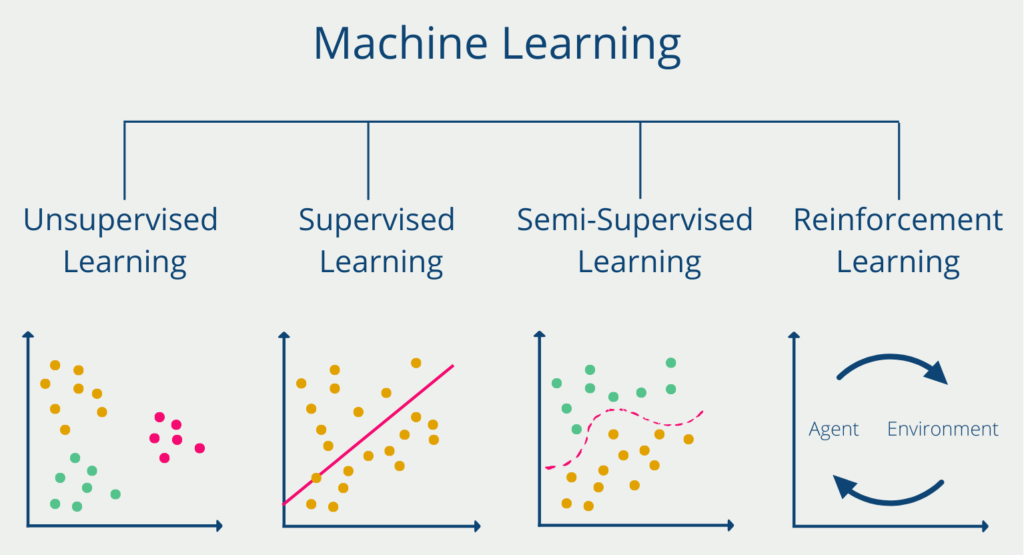
For beginners, supervised learning is the right place to start. It’s the most widely used paradigm in industry, and the feedback loop – comparing predictions to known correct answers – makes it much easier to measure whether your model is actually improving.
Machine Learning with Python: Training Your First Model Step by Step
Regardless of which algorithm you use, every machine learning workflow follows the same structure. Internalizing this pattern early will help you work faster and debug problems more systematically:
- Load data: Read your dataset into a pandas DataFrame or use one of Scikit-Learn’s built-in toy datasets
- Prepare data: Handle missing values, encode categorical variables, scale numerical features if needed
- Split data: Separate a training set (typically 80%) from a test set (20%) before any model fitting
- Choose and train a model: Instantiate an estimator, call
.fit(X_train, y_train) - Evaluate the model: Use
.predict()and appropriate metrics to assess performance on the test set - Iterate: Tune hyperparameters, try other algorithms, improve data quality
Here’s a complete, runnable example using the classic Iris dataset – a benchmark dataset for classifying iris flowers based on petal and sepal measurements:
This example demonstrates the full core cycle in under 15 lines of code. The Random Forest algorithm builds multiple decision trees and combines their outputs – it’s robust, handles many types of data well, and is a solid default choice when you’re not sure which algorithm to start with.

Key Concepts Every Beginner Needs to Understand
A handful of concepts show up in every machine learning project. Understanding them properly will prevent a lot of confusion and wasted effort down the road.
Why You Must Split Your Data
Imagine studying for an exam by memorizing the exact exam paper – questions and answers – word for word. You’d ace that specific test, but you wouldn’t have actually learned the material. The same failure mode exists in machine learning and is called overfitting: the model memorizes the training data instead of learning generalizable patterns. Testing on a separate, held-out dataset that the model never saw during training is the only honest way to measure real performance.
Features and Labels
In Scikit-Learn, X refers to the feature matrix – the input columns the model learns from. y refers to the target vector – what the model is supposed to predict. This naming convention is universal in the Python ML community; once you recognize it, reading other people’s code becomes much easier.
Hyperparameters and Cross-Validation
Hyperparameters are settings you configure before training, such as the number of trees in a Random Forest (n_estimators) or the depth of a decision tree (max_depth). Finding the best combination is called hyperparameter tuning. Scikit-Learn’s GridSearchCV automates this by systematically trying combinations and using cross-validation – splitting the training data into multiple folds – to get a reliable performance estimate without touching the test set.
Common Mistakes Beginners Make with Machine Learning in Python
Most beginners stumble over the same pitfalls. Knowing them in advance saves hours of debugging and prevents drawing false conclusions from your results.
- Data leakage: Accidentally including information from the test set during training – for example, fitting a scaler on the entire dataset before splitting. Always fit preprocessing steps on training data only, then apply them to the test set.
- Using accuracy on imbalanced data: If 95% of your samples belong to one class, a model that always predicts that class achieves 95% accuracy while learning nothing. Use precision, recall, and F1-score for a more honest picture.
- Jumping to complex models too early: Deep learning won’t fix bad data. Start with logistic regression or a simple decision tree – if the baseline is poor, the problem usually lies in the data, not the algorithm.
- Skipping a baseline: Before tuning any model, establish a simple reference point. A dummy classifier that always predicts the majority class is a valid baseline. Without it, you can’t tell whether your sophisticated model is actually adding value.
Next Steps After This Tutorial
You now have a solid foundation for machine learning with Python. The best way to consolidate that knowledge is to move from worked examples to projects you own entirely. Three directions are worth pursuing in parallel:
- Work with real datasets: Platforms like Kaggle and the UCI Machine Learning Repository offer hundreds of free datasets across every domain. Pick something that interests you and build an end-to-end pipeline.
- Read the Scikit-Learn docs: The official Scikit-Learn documentation includes user guides that explain not just the API but the math behind each algorithm. This is where practitioners separate themselves from people who just copy code.
- Move toward deep learning: Once you’re comfortable with classical ML, neural networks are the natural next step. Our article on Understanding Neural Networks gives you a conceptual grounding before you start writing TensorFlow or PyTorch code.
- Add SQL to your toolkit: In most organizations, data lives in relational databases, not CSV files. Our SQL Basics article shows you how to query databases and bring data directly into your Python workflow.
For a broader picture of where machine learning fits within the data professional’s skill set, our Introduction to Data Science covers the full landscape – from statistical thinking to model deployment.
Conclusion: Machine Learning with Python Is a Learnable Skill
This tutorial has walked you through the full foundation of machine learning with Python: the three core paradigms, the standard training workflow, a working code example with Scikit-Learn, and the most common mistakes beginners make. The most important takeaway is this: understanding why each step exists matters more than memorizing syntax.
Machine learning is applied statistics and careful data handling – not magic. The practitioners who get the most out of it are those who invest time in understanding their data before reaching for a complex model. Take the Iris example from this article, modify it, swap in a different algorithm from the Python ecosystem, and load a dataset of your own. That’s where the real learning happens.

Niklas Lang
I have been working as a machine learning engineer and software developer since 2020 and am passionate about the world of data, algorithms and software development. In addition to my work in the field, I teach at several German universities, including the IU International University of Applied Sciences and the Baden-Württemberg Cooperative State University, in the fields of data science, mathematics and business analytics.
My goal is to present complex topics such as statistics and machine learning in a way that makes them not only understandable, but also exciting and tangible. I combine practical experience from industry with sound theoretical foundations to prepare my students in the best possible way for the challenges of the data world.
