Posts

“Roberta” (1962) by Margaret St. Clair: Transition and the Weird by Catherine Lundoff

Writer Margaret St. Clair (1911-1995) was often described as a writer ahead of her time, as well as one whose work was, in Ramsey Campbell’s words “startlingly original.” Her work is often characterized as ‘weird fiction,’ as that term has evolved, with her characters finding the weird and disturbing in the relatively ordinary. During the course of her career,  she authored eight published novels and over one hundred published short stories, several of which were adapted for television.

Of that body of work, “Roberta” (Galaxy, October 1962) was the last of her published short stories. After this, she turned her full attention to writing novels. This story is not included in any of the collections of her work and can only be read in copies of the original magazine. “Roberta” is a science fiction story set in a future where interstellar travel exists via starliner (details unspecified). There is a man from another planet, seemingly humanoid, as well as two other male human characters in a setting that suggests Earth in the late 1950s. Gender reassignment/alignment surgery for transsexual people is possible and effective, but illegal, for reasons that are also not explained within the scope of this tale. 

The titular Roberta is a trans woman who has had this illegal operation in order to transition. My research suggests that this story is one of the earliest depictions of male-to-female medical transition in science fiction, possibly the earliest. Ursula Le Guin’s ground-breaking Left Hand of Darkness (1969), which includes a main character who transitions from male characteristics to female ones as part of an alien reproductive cycle, is still seven years away.

For historical context, Christine Jorgensen, probably the best known trans woman of her time in the U.S., returned from Europe after gender reassignment surgery in Denmark and was front page news in December of 1952, a decade before “Roberta” appeared in Galaxy and seventeen years before the Stonewall Riots. Trans people had no legal standing or protections in the United States or elsewhere, and gender reassignment/reaffirming surgery was rare and hard to access, perforce limiting it to a tiny minority. But enough of that minority, like Jorgensen in the U.S., would have been visible to St. Clair so that she would, based on this story, have been aware that medical transition was possible and to have read something of the mechanics involved.

As I read “Roberta,” it’s not entirely clear to me how St. Clair wanted her readers to interpret it. Roberta has a very fraught relationship with Robert, her pre-transition self, coming to view him as her nemesis over the course of the story. But he also refers to them as “married” at one point and sometimes behaves more as a confidant than a foe. The story’s conflicts, however, hinge on her efforts to get rid of him, thus fulfilling her dream of being “Roberta,” free of a judgmental and undermining male alter ego.

The scene is set entirely in an apartment that Roberta thinks of as hers; she claims to have no memory of her life before the operation, though she thinks she “used to be happier.” There are two other characters that we get to meet (the receptionist/door person appears only on screen). Rodvorello Diag is the Vegan who financed Roberta’s operation, and Clement Thomas is the human who performed the operation. Diag visits Roberta’s apartment first and gives her a starliner ticket for a (nonoptional) trip to the Vegan homeworld. He announces that he has come to add her to his collection of “imitation things,” that being the deal that Robert reached with him in order to get his financial assistance.

Roberta murders Diag with a sliver gun and stuffs his body in a trunk in her room. She then treats her right hand (the one firing the gun) as if it is separate from the rest of her and can be punished by slapping it. Clement Thomas arrives during this scene and attempts to blackmail her about her operation. Roberta shoots him as well and adds him to the trunk. Robert then appears in the cloud, as she pictures him, near the ceiling, to admonish her.

Since Roberta has no memory of anything before the operation, she doesn’t recognize Diag or Thomas. Instead, she conflates them into aspects of Robert, while recognizing that it is Robert who she really wants to destroy. By the end of the story, she has committed two murders, attempted suicide, and is well on her way to planning more murders because each death makes Robert “go away” for a time. She displays a childlike understanding of the potential consequences for these actions, ignoring Robert’s dire warnings about needing to flee from the apartment and the two bodies in the trunk. It’s also not completely clear that Robert didn’t anticipate something like this happening—he puts an illegal sliver gun in her bag for her to find. Is it intended for self-defense? To prevent herself from being whisked off to Vega? Either or both seem possible.

How is the reader meant to feel about Roberta as a character after all this? It’s hard to say. On the one hand, Diag and Thomas are insulting, hurtful, and aggressive toward her, calling into question whether or not she can ever be a “real” woman from their perspective. Robert is more subtle about it, but he leans down from his perch in the clouds to remind her that her voice and movements are “too aggressive” and that it “spoils the illusion.” He also makes the comment that her hormone injection helps her to be “what she is trying to be,” along with similar comments that undermine her self-confidence. 

So this could be read as justification for Roberta’s actions if you are inclined to read the story that way. Roberta accepts Diag and Thomas as guests in her apartment, where she wants to remain, untroubled and dancing around in her pretty pink dress. And both he and Thomas betray that hospitality. Robert can certainly be seen as betraying her as well, in everything from not warning her about what to expect after the operation to undermining her afterwards. That is, if you accept Roberta’s belief that Robert is an entity separate from her.

One thing that stood out sharply to me, reading this as an out queer cis (not trans) woman in 2026, is Roberta’s total and complete isolation. She does not seem to have a family or a job or friends of any kind, just the receptionist on the intercom when visitors arrive and three male characters who do not have her best interests at heart. The illegality of her status only adds to that profound loneliness: she cannot trust the men who helped her to become herself, nor can she trust her own perceptions of the small world that she inhabits.

But she is still willing to kill to protect herself because she perceives the threats against her as leading to her erasure, in one form or the other. There is no sense of how Robert thought life would go for Roberta after transitioning. Perhaps, living in a “collection” on Vega seemed like a reasonable alternative to living on an Earth where Roberta would be treated like a freak and under constant threat of imprisonment in the bargain.

It’s tempting to project contemporary attitudes back in time and assume that St. Clair, a cis woman who was presumably heterosexual based on her biography, had negative attitudes toward trans women. Her biographical details include a marriage to writer Eric St. Clair that was deliberately childless (not an easy thing to achieve given both the mores of the time and the absence of reliable birth control), embracing Wicca and, occasionally, nudism, as well as a number of unusual jobs. It is safe to say that she was unconventional and might have sympathized with Roberta to some degree as another unconventional woman under threat from forces that want her to be something else.

And yet, there is a comment about Roberta’s Adam’s apple displaying when she looks up, as well as the last line of this  story: ‘“I’ll kill you yet,” Roberta said, between his teeth.’ Up to this point, St. Clair always uses “she” to refer to Roberta so why change here? In fact, Roberta gets no positive reinforcement for her transition throughout this story, relying on her own belief that she is now as she wants herself to be. But Roberta is also clearly unstable and an unreliable narrator. 

My takeaway from all of this is that St. Clair most likely thought that a trans woman could never be a “real” woman, a regrettably common opinion. “Roberta” reads as a story about a mind at war with itself, in which Roberta is unstable and dangerous because she has convinced herself to act as if she has achieved something that is impossible. The weird elements are entirely in Roberta’s head, shaped by her derangement rather than by external or supernatural forces.

That said, “Roberta” is a fascinating historical artifact: a first in a genre with many firsts. I am somewhat surprised to have not seen it cited in sources on the history of queer sf and f, such as Garber and Paleo’s Uranian Worlds. I suspect that is due to the story not being included in the various collections of St. Clair work and consequently not as visible. I think it is certainly worth including going forward as a heretofore unrecognized first in the field.

“Roberta” by Margaret St. Clair may be read for free at the Internet Archive.


Catherine started writing professionally in 1996 while in law school. She sold the first story she ever wrote and quit law school a week later; she has not looked back since. In addition to writing and editing, Catherine is also the publisher at Queen of Swords Press. Most recently, she is the winner of a 2025 Alice B. Award and a finalist for the 2024 Innovative Voices Award from the Independent Book Publisher’s Association. To find out more about Catherine, please visit her blog, like her Facebook Author Page or follow her on Mastodon.

Copyright 2026 Catherine Lundoff.
Ancestors Are Just People—Robert Heinlein’s “‘All You Zombies—’” (1959) by O. F. Cieri

Does the sun still exist at night, or does it die every day? This is the question at the heart of Robert Heinlein’s “All You Zombies—”, where a time traveler experiences his entire life in one work shift before settling down in his cot for a well-earned rest.

This story is one of the greats of the golden age of science fiction that moves huge ideas through a few short pages. It has a relatively slow start, with two guys in a bar talking about their jobs and their lives. One guy is the bartender; the other is an advice columnist who specializes in answering questions from Unmarried Mothers. It doesn’t spoil anything to reveal that the columnist was himself an Unmarried Mother once, which explains how easily he can describe their point of view.

At the core of the story is a question of whether the individual has a concrete value in an ever-shifting universe. Heinlein’s answer, hinted at in the title, is both No, and Yes. “All You Zombies—”’s central premise is that the individual experience is the only one we can have, and yet the self is so malleable that it can be completely transformed by external forces. War, employment, sex and gender are all interchangeable, meaningless and foundational. And yet despite the baseless nature of the self in an uncaring universe, the central figure ends his shift believing only in himself. 

“The Snake That Eats Its Own Tail, Forever and Ever . . . I know where I came from—but where did all you zombies come from?”
—Robert Heinlein, “All You Zombies—” in The Magazine of Fantasy and Science Fiction (Mar 1959) 15

In an uncaring universe where the individual is self-creating and permanently fluctuating, who is the Other? Does anything exist outside the Self? If I die, does the whole world? The lonely conclusion of this logic is addressed even within the text, where the protagonist signs off his narrative with: “I miss you.”

“All You Zombies—” is complex enough to survive spoilers, but to enjoy the full experience, it is best to go in blind. Talking about it requires delving into the meat of time travel and paradox, so the rest of the review will feature spoilers.

You’ve been warned!!!

The story doesn’t fall apart at the worldbuilding level, but the inciting incident of the story is superfluous. The premise is that time travel became possible not long after interstellar travel, leading to many different necessary support teams for fifth-dimensional servicemembers. The protagonist, the one true individual we can prove, is one such servicemember of the Time and Space Corps. His story is littered with the acronyms of made-up military organizations and their support structures. There’s the Women’s Emergency National Corps, Hospitality & Entertainment Section (W.E.N.C.H.E.S), a.k.a the Auxiliary Nursing Group, Extraterrestrial Legions (A.N.G.E.L) or Women’s Hospitality Order Refortifying & Encouraging Spacemen, probably the most honest acronym (W.H.O.R.E.S). Space can be lonely, and women are enlisted wholesale in the war effort to prop up male servicemembers psychologically and sexually. Technology is sufficiently advanced that natural beauty is not as important as being fit to endure the stress of the job, but not so much that the work is not gender segregated. Despite the heavy lifting that the phrase ‘women’s work’ does in context, there is an emphasis on the dignity of the work, as a necessity for morale, and as spacers in their own right.

Long before any of this is revealed, the Unwed Mother reveals that he used to be a woman who was interested in taking on one of these roles. He’d never felt beautiful as a woman, but the Time and Space Corps could change anything about him. He would be thrown into the vast frontier of space, rewritten as a different person, and emerge as successful by feminine standards, with a husband in a stable professional career. Before he can apply, a handsome man with ‘a fat wad of hundreds’ takes him out on a few dates, knocks him up, and disappears.

The bartender knows all this already, because he is the Unwed Mother after many long years in the Service, and as he listens to the Unwed Mother he casually organizes the circumstances for his own conception and birth by offering to introduce the Unwed Mother to the cad who left him alone and pregnant. Slipping him a fat wad of hundreds, he sends him through time to meet his pre-transition self, then skips ahead nine months to collect his infant self and dump the child off at an orphanage. Meanwhile, the doctors wake the Unwed Mother up post-labor to inform him of an undescended set of testicles nestled inside his groin. Due to birth complications, they have decided to advance the development of the testes and help him adjust to life in a new gender.

With this one act, the Unwed Mother’s life is destroyed. His original plans to take night classes and join the WENCHES are out of his grasp. The doctors pressure him to put the child up for adoption, a superfluous decision when his future self snatches the baby and dumps it at an orphanage. After his transition, he wanders aimlessly for years, struggling to feel at home in his body, before ambling into a bar for a drink. There, his bartender sets him up with a few dates with his former self before dragging him to the Sub-Rockies Base in 1985 for recruitment. As his shift ends, the bartender closes up for the night, hops to the same Sub Rockies Annex in 1999, downs a bottle of whiskey, and types up his report.

The crux of the story is to create a time paradox scenario where a man could conceive and birth himself, and all the references to military life are trappings to provide a sliver of justification for these actions. The recruiter knows to recruit himself for his own role, and as a bonus, he gets to ensure his own birth, too. To create the effect he wanted, Heinlein ad-libbed from older material and left some of their debris behind.

“All You Zombies—” bristles with the anxieties of post-war America, full of acronymic federal bureaus, new medical treatments for sleep, headaches, moods, and birth control. Medical advances make the body transparent through better anesthesia and X-rays, increasing the availability of plastic surgery. The Space Race punctures the horizon, condoms roll back generational fears of unplanned pregnancies. The story’s heart is a deeply anxious question about the nature of personhood in the face of scientific progress, and included on this list is the question of what makes a man.

When the story is viewed as a question on the nature of identity, it makes sense that Christine Jorgensen’s name would be used to illustrate the protagonist’s intersex condition. Otherwise, the protagonists’ sex organs are the only part of him left to nature. At birth, he just so happened to have both sex organs. His condition is used to form a window through which medical science can dictate his gender, but science itself plays no role in his self-identity. The protagonist is characterised as being remarkably easy-going and level-headed. While he is clearly aimless and depressed after the loss of his daughter-self, he’s quite comfortable in his masculinity. He makes a few jokes about sympathising with women as someone who used to be one, but doesn’t show any regret for his transition. In fact, he balks at threats to his masculinity.

Clearly, these are circumstances that create a cohesive image for Heinlein, who might have struggled to understand news stories about pre-liberation gender transition. Heinlein’s perspective is very normative in centering gender identity in the genitals, with a brief, hand-waved period of months in which the protagonist learns their new social role. In-universe, the protagonist is characterised as being an excellent field agent for his even temperament, implying that anomalies require a degree of gender fluidity. On the other hand, the setup established that girls aren’t allowed in space except as sexual accessories.

This contradiction seems to have crossed Heinlein’s mind long enough for him to envision a space future in Starship Troopers with a fully integrated infantry unit. If it’s supposed that Starship Troopers takes place along the same spacetime continuum, long enough for America to find an enemy amongst the stars, then the mood stabilizers, plastic surgery, and birth control have crafted a society with gender equality that conforms neatly to heterosexual standards. 

For Heinlein, gender equality is something that needs to be forged in flesh, cut and synthesized into a physical ideal. That wasn’t unique to him. The golden age of science fiction delighted in using the mind as a tool to shape the world in a playground with practically no friction between a problem and its solution. Science fiction acted as the drafting stage for a design patent and its practical application. 

Heinlein, as the story’s ultimate authority, in the story asserts himself a few times, most notably in the central premise that the space frontier will immediately lead to exploring time. Or that the United States would be the leader of that technological revolution, though in Heinlein’s defense, Americans who didn’t believe that were put on a list. More unique to Heinlein is the proud assertion that anyone would sleep with themselves if given the chance. There’s no way to be sure about that, but it’s necessary for the story, and Heinlein seems to believe it. Therefore, it is true. But would Heinlein’s protagonist sleep with himself as a man, or only a woman? If not, why not?

Heinlein’s use of an intersex person with an incredibly rare case of chimerism interrogates the limits of heterosexual expectations without abandoning them, like an astronaut tethered to a ship through his oxygen tank.

But Heinlein’s vision still centers a biological assignment that can be made by doctors on an operating table without the patient’s input. That someone’s sense of self can be altered for life in just a few months of training, given our current political climate, seems unsettling. Heinlein’s use of an intersex person with an incredibly rare case of chimerism interrogates the limits of heterosexual expectations without abandoning them, like an astronaut tethered to a ship through his oxygen tank. The umbilical cord of binary sex and gender lashes the story to simplistic modes of social graces even while it threatens to strike out on its own. The real question  “All You Zombies—” asks: is anybody out there on the other end of this leash? Who are you people? Will you still be there in the morning?

“All You Zombies—” (1959) by Robert Heinlein may be read for free at the Internet Archive.


O. F. Cieri is based out of NYC. In 2013 she won first place in BMCC’s Poetry Competition. In 2016 she won an Honourable Mention in LaborArts Make Work Visible Competition. Her non-fiction has been carried by Hyperallergic and the Invisible Oranges. She published her first book, Lord of Thundertown, with Ninestar Press in 2020. In February of 2023 she published her second book, Lockdown Laureate, with Castaigne Publishing. Her third book, Backmask, was published by Malarkey in June of 2023. https://ofcieri.com/

Copyright 2026 O. F. Cieri.

In Defense Of Transgender Mermaids: George Sterling’s Strange Waters (1926) by Joe Koch

Strange Waters is a narrative poem by George Sterling released in a small chapbook edition in 1926, the same year Sterling died by suicide. As his last published poem, the language is more economical than the “things of tinsel and fustian, the frippery of a by-gone fashion” that drew criticism earlier in his career when his “brilliant but too facile craftsmanship was tempted by the worst excesses of the Tennysonian tradition,” according to Harriet Monroe of Poetry Magazine

Sterling’s lyrical intemperance had, however, attracted praise from Ambrose Bierce, who for nearly a decade mentored him and enthusiastically publicized his poems, most notably in an effusive afterword for “A Wine of Wizardry,” a decadent and hallucinatory horror-fantasy poem published in Cosmopolitan magazine in 1907. Controversy over Bierce’s claims of greatness for Sterling went viral across US print media, and arguments over Sterling’s talent—or lack of it—made him famous. Clark Ashton Smith credited “A Wine of Wizardry” with inspiring him to write poetry at age fifteen and soon became Sterling’s protégé and a lifelong correspondent.

Aside from connections with weird fiction, Sterling—as a Bohemian figure, perhaps more than as a writer—influenced many contemporaries whose work has fared better than his. He shared an intense friendship with Jack London, critiquing and polishing London’s novels The Call of The Wild and The Sea-Wolf. He was a founding member of the West Coast artist’s colony Carmel-by-the-Sea, an early twentieth-century self-styled pagan commune of sorts populated by writers, artists, musicians, theater people, and other nonconformists.

Biographical information matters to me when reading Strange Waters, because the poem’s glaringly offensive flaw—the twist ending that I’ll spoil for you momentarily—is the sort of thing too easily dismissed as lazy writing, or a product of olden times, as if everyone in the vaguely defined past suffered from debilitating sexual repression and unexamined prejudices.

This simply isn’t true.

Nor is the potential accusation of lazy writing. Every choice in the poem, including what is not said, feels precise and deliberate. The plot twist could easily play as slapstick. But rather than presenting this potentially titillating “tale of forbidden love” in a saucy manner, our narrator opens with brooding insomniac musings, a compulsion born of gulls crying out and storm gales brewing over the nighttime sea. Mournful framing sets the stage for a tragedy rather than a farce.

Our narrator introduces Ralph and Mary, a fairly average and averagely happy heterosexual couple living on the California coast. Their equanimity is interrupted by a letter from Mary’s estranged brother in Ireland. Physically reacting to the letter “as tho it were a snake,” Mary throws it on the floor. Of her brother, Mary will only say he is a “monster.”

From his deathbed, the brother has sent his eighteen-year-old twin daughters to live with Mary. They’ll be arriving soon to “avenge me for a distant hour, your nails along my cheek, your virtuous words.” Mary suggests the girls might be better off sent “to some good school,” but Ralph shuts down the conversation, insensitive to the implications of assault in the letter, and Mary’s obvious misgivings.

The girls arrive. Intrusively, our narrator describes them, and continues re-describing them—one might even say fetishizing them—as the poem goes on. We hear they’re beautiful and tall, like “twin eaglets, fierce of eye and orange-crowned.” Of the two, Deidre is “more girlish” while Callirhoe is “an inch taller, and shouldered like a boy.” Deidre isn’t mentioned again until the end of the story, whereas Callirhoe is granted an assertive personality. She winces gruffly when Mary kisses her in greeting, trounces Ralph’s philosophical arguments in conversation, and makes a habit of staring him down. With wounded pride, Ralph’s anger and suspicion fester.

You see where this is leading, don’t you?

The transmisogynist tropes are all there, except for a prominent Adam’s apple and five o’clock shadow.

Callirhoe is going to die, though not directly by Ralph’s hand. His spying, harassment, and threats drive the girls to flee, resulting in Callirhoe’s fall from a sea cliff “clad scantily in her scarlet bathing suit.” Found thus bared, she’s subjected to an unfortunate and cheap twist ending I’m all too familiar with. I call it “Dead Gender Reveal Party.” While handling her corpse, Ralph exclaims, “Christ, Mary! Christ! Callirhoe’s a boy!”

Not only is Callirhoe portrayed as an absurd caricature of supposedly masculine traits, she’s murdered, manhandled, and misgendered for shock value. She’s literally referred to after death as “the other.” Before the big shock, though, there’s another shock; two, in fact. Ralph discovers, by snooping at their bedroom door, that the twins are incestuous lesbians.

The brother’s letter has suggested he passed down his incestuous leanings to his children, and Mary’s behavior confirms some family dysfunction, but the idea of homosexuality is what most outrages Ralph. The plot moves according to Ralph’s growing rage step by step toward greater perceived perversities, positioning transness as the greatest perversion of all.

While there’s no excuse to write a transgender character in such an objectifying and cartoonish way in 2026 (although contemporary authors I won’t name have proudly done so and somehow evaded censure), what about one-hundred years ago? Can we dismiss Strange Waters as an antiquated product of its time?

Even if the correct scholarly answer is yes, dismissal doesn’t satisfy me. Dismissal is too close to denial. The fascist claim that being transgender is a new fad unheard of in the past is a deliberate lie. Erasing records of our existence, destroying research on our medical care, and eradicating language that names our legacy help perpetuate that lie, tactics most famously practiced in Nazi Germany and widely used in the US today. Cutting out the parts of history you don’t like and repackaging the past for a new and newly ignorant generation has become streamlined by modern techno-fascists; through our personal devices, information is simultaneously ephemeral and ubiquitous, while our attention spans are weary, waning, and overtaxed.

Denial is a spell that’s easy to fall under. Denial is a tool of oppressors and abusers. Dismissing human hatred and misogyny as things of the past represents a form of cultural denial that allows that which is denied to flourish.

Hatred does the most harm in disguise. In the deepest waters, the parts of our being that have yet to be explored, the tendrils of hatred find fertile conditions for growth. We may wish to see ourselves as having overcome all prejudices and biases at some point in our personal or societal histories, but overcoming is cyclical, part of a meaningful life’s ongoing work. We enable hatred when we pretend it’s behind us.

We might say George Sterling mistreated and exploited Callirhoe as you’d expect for a man of his time, but since he lived, worked, and performed with nonconformists, was openly polyamorous, and was far too popular and active as a socialite in artsy circles not to know plenty of queers and a few transgender people, I wonder how much blame lies with the poem’s patriarch Ralph rather than the author. In trying to sort out prejudice from portrayal, I’m drawn into a darker, weirder story lurking beneath the surface of the story in Strange Waters.

Maybe this is my compulsive habit as a fiction writer, re-making art that’s failed me. Maybe I’m telling myself a different story because the plot of the poem is offensive. Or maybe I’m rebelling against writing nonfiction because it collapses possibilities into fact, and writing, to me, is about expanding—or exploding—the possible.

With two patriarchs in Strange Waters, Ralph in the present and Mary’s brother in the past, we open with an insomniac narrator musing about the stormy sea. Their mournful voice is soon subsumed by Ralph, whose hostile dialogue and action moves the plot forward. These dual voices remain somewhat in opposition throughout the poem, as do the double patriarchs, and other doublings and couplings that build both ambiguity and tension.

In Gothic fashion, the past violates the present, doubling time when first the letter and then the twins (themselves doubles) arrive from Ireland. Mary’s brother implies some horrific or cruel parallel when he writes of his daughters, “Ha! We are of the same blood, they and I! There’s more in that than you’ve a notion of.” Does this mean that they are, to use Mary’s word for her brother, monsters?

Resonances, ripples, waves; we might wonder how much Mary, who is utterly un-shocked by Callirhoe (both alive and dead), recognizes in the twins. Is her brother really her sister? The narrator never swerves from calling this a “tale of forbidden love” rather than a tale of perversion or abuse. And how exactly do monsters reproduce?

“Like sea-born things,” the girls go swimming three times a day, every day, eschewing the company of chaperones. They’re strong swimmers, described as feral or mythological creatures: “twin eaglets,” “stranded stars,” “wild things,” “gorgeous snakes about to strike,” and “amorous reptiles.” Song-like interludes in their voices punctuate the narrative, and it’s not clear if these are their thoughts, their actual words, or some psychic, siren-like intrusion. Perhaps these are the sad, desperate, and rebellious songs of a dying species; of mermaids.

Who hears these songs? Is it Mary, who has no children, despite a marriage with “love-hunger long to satisfy” in which she and Ralph “longed…often for dear children”? Mary’s silence is pivotal, holding certain mysteries below the surface of the plot. Instead of a drowning (an ending), things unknown perpetuate doubts that keep the plot alive after the story is over.

Likewise, instead of resolving reader uncertainty by showing the drowned maiden of Gothic tradition, Deidre swims away, neither definitively alive nor dead, but becoming (narratively) something Other. Just before they find Callirhoe’s body, a fisherman tells Ralph and Mary that he saw Deidre from a distance “take the surf at yonder beach, alone, and watched her head on every wave until she faded in the distance. Say—she’ll be in China in a week or two!”

Mary makes her single decisive statement to Ralph about Deidre’s missing body: “No—you’ll look in vain. She’s gone forever.” We don’t know how she feels or what motivates her; only that Mary forbids a search party.

The story I’m left with is fanciful. It’s about a family of cryptids separated by the flight of their matriarch, who has rejected her sea-born powers in favor of domestic normalcy. Drawing parallels between the strange waters of the subconscious mind and the actual sea, I’m reminded that what we know of marine biology includes more complex reproductive processes and gender flexibility than the mere idea of transgender mermaids, or of an estranged brother who somehow impregnates himself, or of a not-mother who protects a child’s gambit toward freedom that might mirror her own past. The deepest parts of the ocean remain subject only to scientific speculation, not exploration. Maybe they’re like the psychological depths of our being, the places where poetry originates.

I’m also left thinking about the poet composing the tale near the Pacific Ocean, perhaps gazing out into the darkness, disturbed by stirring waves and crying gulls on yet another sleepless, hungover night. He would have been about two years younger than me at the time. I wonder how often Sterling’s fingers strayed to the vial of cyanide labeled “Peace” that he was known to have kept with him for nearly the last twenty years of his life.

Is Sterling’s sympathy lacking, or did he intend to critique Ralph’s petty cruelty? Did he intend to show a system where women have no power and morals are upside-down? He might have treated the mermaids better in death and not made Callirhoe a punchline, but I realize there’s only so much empathy you can expect from certain men, especially those cheated by toxic fame and feeling past their prime. Sometimes, as he may or may not have meant to imply, the best option is to take to the surf and see where it leads you; to take flight, and become what you never imagined possible.

Strange Waters (1926) by George Sterling may be read for free at the Internet Archive.

Resources:

Harriet Monroe “Review: The Poetry of George Sterling” Poetry Vol. 7 No. 6 March, 1916

Harriet Monroe “Two Poets Say Farewell” Poetry Vol. 29 No. 4 January, 1927

Joy Lanzendorfer “Bohemian Tragedy: The Rise, Fall, and Afterlife of George Sterling’s California Arts Colony” Poetry Foundation, February 26, 2018

Gary Kamiya “S.F.’s Unofficial Poet Laureate Thrived In ‘Cool, Grey City of Love’ —For a Time” San Francisco Chronicle, October 15, 2020

Jim Fisher “George Sterling: Historical Essay” FoundSF.org (digital historical archive managed by Shaping San Francisco)

Peter Kratzke “The Man Who Would Have It All: George Sterling and The American Dream” Americana: The Journal of American Popular Culture, 1900 to Present  June, 2005


Joe Koch writes literary horror and surrealist trash. Their books include The Wingspan of Severed Hands, Invaginies, Convulsive, and The Couvade, which received a 2019 Shirley Jackson Award nomination. His short work appears in The Best Weird Fiction of the Year, Southwest Review, Nightmare, Vastarien, and many others. Joe co-edited the art horror anthology Stories of the Eye and has collaborated with other authors and poets on  several speculative writing projects. Find Joe (he/they) online at horrorsong.blog.

Copyright 2026 Joe Koch.

“Teoquitla the Golden” (1924) by Ramon de las Cuevas: A Review by Luana Saitta

A hunched-over white man, limbs chained, is being led by two jaguar warriors brandishing war club and shield across a crowded square. Great Aztec idols survey the tableau of what is surely the prelude to bloody sacrifice neath.

This is the cover of the November 1924 issue of Weird Tales magazine, boasting a “complete novelette by Ramon de las Cuevas.”

A few pages later, the banner image of this novelette titled “Teoquitla the Golden” shows the reader what appears to be a white woman bedecked in jewelry (with a particularly notable septum ring) staring determinedly into the distance, gossamer veils blowing in the breeze against a backdrop of Mesoamerican pyramids. 

One could then perhaps reasonably have expected the tale of an explorer encountering a lost city and falling under the spell of a white jungle queen in the manner of H. Rider Haggard’s Ayesha, or Edgar Rice Burroughs’ La of Opar. 

However, de las Cuevas—a pseudonym of early 20th century archaeologist Mark Raymond Harrington—had rather a different turn in store.

“Teoquitla” opens on an ocean steamer around the Eastern cape of Cuba, carrying two American academics: Branson, a medical doctor, and Lewis. The sight of a cave system sends them to musing on indigenous rituals. Lewis reveals himself to be en route to Guatemala to study the Mayan pyramids there, and will soon be joined by his wife (though her focus is on Aztec rather than Mayan culture). They exchange tall tales of indigenous magic: spurned women slipping white lovers a potion turning their skin black, sorcerers who could change men into women… 

This causes Branson to reveal an incident that befell him and his wife some years ago when they were living in Veracruz. The doctor’s tale begins with an old mendicant wrapped in filthy rags, collapsing on the Bransons’ porch in search of “the white doctor”. This turns out to be the beautiful woman from the story’s image banner. Confused and desperate, she stumblingly introduces herself as Maria Dorada de Rey, and relays that she’s been on the run for days, since her husband Juan was murdered shortly after their wedding. 

Maria claims to be an American who has lived among the Aztecs in the jungle for years after a mysterious illness robbed her of her identity—Maria is a name she chose herself, “Teoquitla” (or “la Dorada” in Spanish, the golden one) being a nickname she was given due to her complexion. She is loath to recount her story, but assures the couple she has it all written down in a diary among her meager belongings.

She inquires about Robert Sanderson, a name Branson recalls: a young American adventurer who stayed at his house years before. Sanderson hid a cache of gold nearby before he set off into the jungle, the location of which Maria is privy to. It is here that Branson notices Maria might very well be Sanderson’s twin sister. 

They retrieve the cache and make ready for Maria’s repatriation stateside. During these preparations, Maria writes down the final part of her story, impressing upon the Bransons only to read it after she’s left. 

Simultaneously, Mrs. Branson takes Maria under her wing as, despite her lovely looks, the poor dear seems to have forgotten how to clothe and groom herself in the fashionable mid-10s manner, having spent so many years in the jungle. 

After Maria’s departure, the Bransons set upon the two-fold narrative of Teoquitla the Golden—one part painted with a brush on native maguey paper, the second on stationery provided by Mrs. Branson. 

Any pretense at ambiguity is instantly dropped: the author is Teoquitla, once Robert Sanderson. Playboy adventurer Sanderson used to despise women, embarking upon affairs willy nilly, ghosting them once he got bored. 

Upon one fact university-sponsored expedition in the Mexican jungle, trying to ascertain the whereabouts of a rumored settlement of Nahua, Aztecs of old, he strikes up with Conchita, daughter of the couple where he is boarding. After telling her he is absolutely not planning to take her with him back to America, Conchita hangs herself.

Fleeing the village under cover of night, he is set upon by men dressed as warriors of Montezuma, who shackle him with the ancient fetters of the conquistadors. After days in a solitary jungle hut, Sanderson is brought to the lost city of Nahuatlan. 

There, he is given a choice by the king Montezuma: he can be sacrificed to the goddess Centeotl for the dishonoring of an Aztec woman, or to the war god Huitzilopochtli for causing the death of an Aztec. From descriptions given, Sanderson deduces that the sacrifice to Centeotl does not end in death, so that is his choice.

After being garbed in the dress of the goddess, Sanderson is told his word will be law until the ritual. For a solid month, the American is an incarnation of Centeotl on earth, advising citizens who seek Centeotl’s audience on agricultural and even legal matters. During this period, Sanderson witnesses a gruesome sacrifice to Huitzilopochtli and notices a select group of white-clad women who bear golden septum rings that arouse a particular disgust in the prisoner. 

When the trial period is up, Sanderson is brought to an altar in front of the steps of Centeotl’s pyramid and subjected to an elaborate ritual where strange liquids are injected into him via gourds and cane tubes, wielded by temple women, causing the prisoner to faint in agony. 

The recuperative period is one of fevers and dolors, sloughed skin and wild deliriums. When the American wakes up, she finds herself transformed and given the name Teoquitla. To her great disgust, the temple woman’s nose ring is forced upon her. While she briefly ponders the possibility of being changed back, she is told this is impossible. Giving in to life as a temple woman, she finds it is actually quite gratifying. Over time, she comes to the conclusion that this punishment is hardly one at all.

Time passes—in the frame story, we learn it’s been four years in total— and Montezuma falls in love with her. While initially reluctant to become romantically entangled with a man, Teoquitla returns his affections.

It is here that the narrative jumps to Mrs. Branson’s stationery. Teoquitla demands Montezuma wed her in a white man’s ceremony to keep her an upright woman, and they sneak out of the valley to fulfill her request. They are married by a Protestant minister, under the names Juan de Rey and Maria Dorada. Their marital bliss is short-lived, however, as a bandit raid claims the life of “Juan.”

Dissuaded by her dying husband from returning to the valley, as the Nahuatl will blame her for his death, she strikes out as a beggar until one day she hears of an American doctor near Veracruz. Signing off, thanking the Bransons, Maria ends her tale by confiding in the reader she wishes she had the nerve to call herself Roberta Sanderson de Montezuma, Queen of Mexico—her rightful title. 

A deathly pale Lewis confides to Branson that he has realized that Maria Rey is none other than his Aztec specialist wife. He tosses the bundle with her story into the ocean, and the two men shake hands.  

“Teoquitla the Golden” is a surprisingly open-minded and accepting version of what we would today call a trans narrative. 

Published only a few years after the earliest medical gender affirmation procedures at Magnus Hirschfeld’s Institut für Sexualwissenschaft in Berlin, “Teoquitla” is surprisingly sympathetic to its heroine, and indeed the very concept of transitioning. 

While a darkly ironic punishment is hubristically visited upon the protagonist, the behavior that requires such vengeance is misogyny, not gender nonconformity. Once she’s accepted her lot in life, Teoquitla muses that this isn’t much of a punishment at all: she is content, but poor Conchita is still dead. The transition itself is seen as a form of restorative justice.

Instead of a rotting corpse, we have a useful and good-looking human being as ready to take on life as before, just in a different capacity.

In fact, there’s a bit of the old romance novel to this: a sexy vampire or fae lord or billionaire CEO forces our heroine into all these kinky scenarios, so that our intended reader can maintain plausible deniability for enjoying them. Here too, our heroine simply hates all of this:

Most boys have masqueraded in their sister’s petticoats, at some time or other, but I had always so disliked women that this kind of fun never appealed to me. To be obliged to wear woman’s dress was a bitter pill.

This layer of “lady protesting too much” might have been useful in 1924 (and possibly even necessary to get past the Weird Tales editors), it did serve to push me away a bit. The first unqualified instance of gender euphoria comes very near the end:

We had been married under the names, assumed on a moment’s notice, of Juan Rey and Maria Dorada, so as I rode my heart was singing, “Now I am Señora Maria Dorada de Rey! Or, if I only dared tell it, I am Roberta de Montezuma, Queen of Nahuatlan and rightful Queen of Mexico!”

Still, the fact that we do get this turn in her is nothing to sniff at. Even with the tragedy that would soon befall this happy couple, Maria still gets a happy ending. On top of that, when her second husband finds out, he simply decides to bury the truth. Considering it was only meant for the Bransons, what’s the harm?

Teoquitla’s instant and deep revulsion over the nose rings is somewhat inexplicable. In fact, she is portrayed during her captivity as Sanderson to be amazed and fascinated at artifacts she is confronted with, even in her terror. After the transformation ritual, she is horrified at having become the thing she hates most—a woman. The ultimate degradation is the fastening of the septum ring, the one thing she had witnessed in Nahuatl that disgusted her. 

And yet, this is a different form of bondage than the conquistador fetters placed on Sanderson upon first capture: 

The first white men that came to this country bound our chiefs with such things; and we give every white man who falls a prisoner in our hands a dose of his own medicine. But these chains are the only works of the invader you will see in this valley, for here we live our own life, free in the last unconquered domain of the Montezumas.

Maria is entirely sympathetic to this, seeing as in the opening paragraph of her missive, she writes:

I could tell exactly where [the lost city of Nahuatl] lies, but I dare not, for fear that this manuscript may find its way outside someday, and might lead strangers into the happy valley to the destruction of this splendid people, whose only outstanding fault, so far as I can discover, is their addiction to human sacrifice.

It reads as a dark joke, but she had just recently learned about the Great War being ongoing, so the occasional human sacrifice may indeed have sounded like a minor peccadillo compared to what was going on at the Somme.

The nose ring is a perfect microcosm of the text’s ambiguity towards Aztec culture: a general sense of admiration and respect, which must instantly be subordinated to personal preferences. Take, for instance, the fact that, though Teoquitla is happy to marry an indigenous man, she demands a Christian wedding—religiosity at no point having been part of her character up until then. Montezuma indeed even acquiesces, so taken is he with this white woman’s beauty, to his doom.

Was Harrington, scholar of pre-Columbian civilizations, publishing anonymously, exorcising some personal demons? Or was he merely being a prurient exploitation artist? Either way, I’m glad Maria Lewis got into academia. Pretty rough for a woman in the 20s.

“Teoquitla the Golden” may be read for free at the Internet Archive.


Luana Saitta (she/her) is a Belgian-Italian pulp enthusiast and sword and sorcery author. You can find her short stories of dashing adventure, including the popular “Zeynep & Kawtar” series, at https://luanawrites.carrd.co/ . She is also the co-host of Defend Your Trash Movie, wherever you find your podcasts.

Copyright 2026 Luana Saitta.

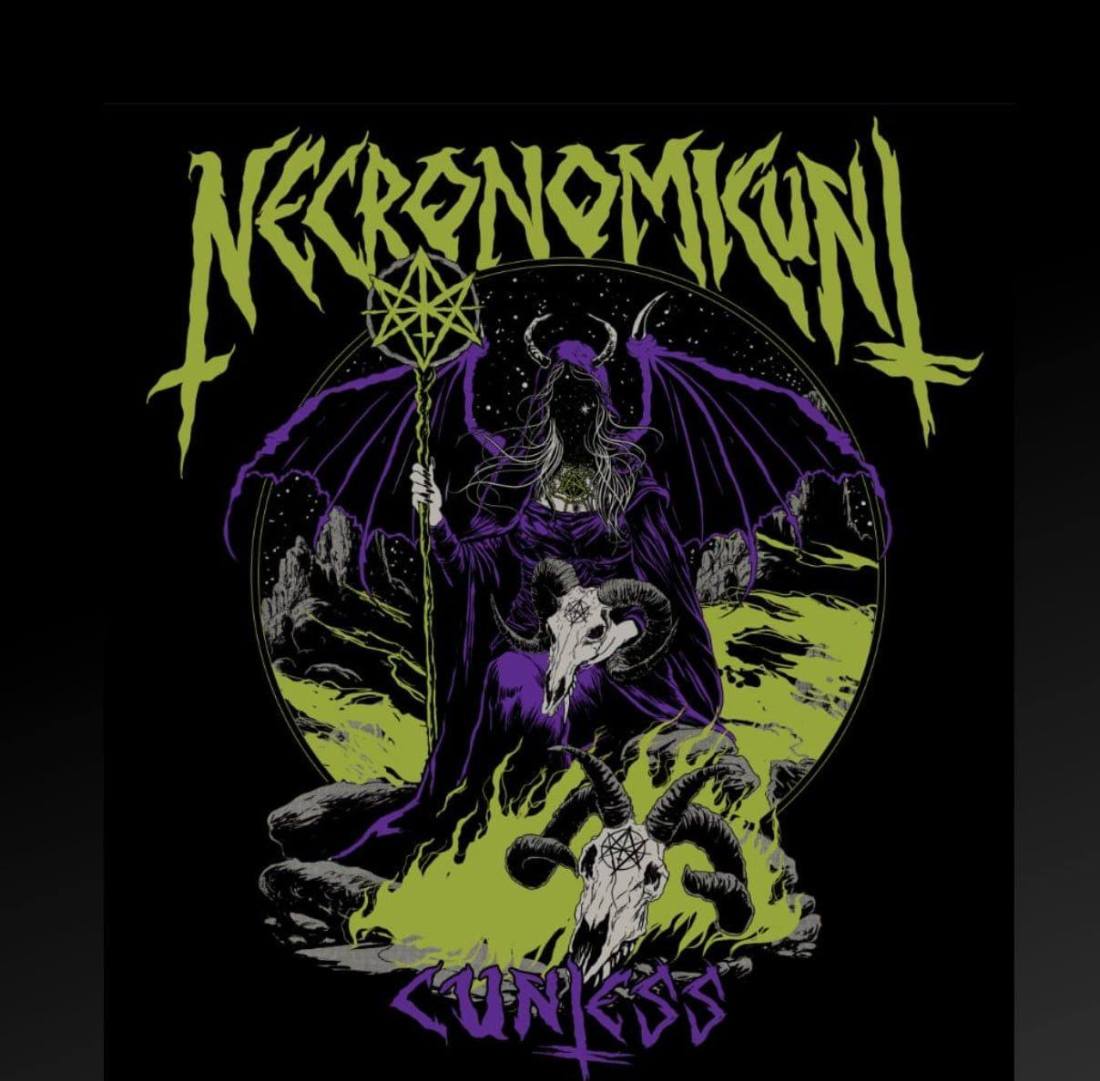
Cuntess EP (2025) by Necronomicunt

Image

[…] the lyrics for this song were written 19 years ago when the first face transplant was performed. It is about a serial killer who hates his face and makes a face of his own, sewn together out of the dried, skinned faces of his victims. The music was written this year, 2024 {Age of Cunt} and is technically a tryptych with an intro and outro. This is how it shall be recorded professionally[.]
—Steph Bathory, 18 Sep 2024 Facebook post to the Necronomicunt page

The influence of H. P. Lovecraft in music can be chronicled in lyrics, individual songs and tracks, albums, and band names. Writers like Gary Hill (The Strange Sound of Cthulhu) and Sébastien Baert (Cthulhu Metal: l’Influence de Mythe) have traced the literary DNA from the early psychedelic rock of the band H. P. Lovecraft through the earliest heavy metal influences in “Behind the Wall of Sleep” (1970) by Black Sabbath to the time of publication. The list is never complete; new generations discover Lovecraft’s mythos, new artists create new bands, compose and perform new pieces. It is all so wonderfully weird.

Necronomicunt is a relatively recent example. Band members include vocalist/lyricist Steph Bathory/Cuntess Dracula (former vocalist of Bathom and SpitRoast Sluts Not Dead); guitarist Tommy/Cutrifiend Punt; drummer Matt Hills/Omzferatu, and bassist Aaron Richmond/Yeti (all information from Encyclopedia Metallum). As for the style:

Necronomicunt merges the commandment of Doom with the speed of D-Beat Punk Rock. From the black-tar-filth, cud of decay; the satanic riffs primordially ripple through, oscillating faster than the speed of light, from the bottom of a black hole. (Bandcamp)

D-beat” is a hardcore punk style named after a characteristic drumbeat; “Doom” metal is a descendant of heavy metal that typically uses a slower tempo and down-tuned guitars. Put the two together, and you have a sound that is heavier than your typical punk band but more frantic and energetic than a typical doom album. Very atmospheric, but it’s got a beat you can mosh to. Steph Bathory’s vocal style contains the fast pace of punk singing with death metal growls. Not unintelligible to the trained ear, although it might take new listeners a few listens to pick out the lyrics (I tried to find the lyrics, but they’re not on Bandcamp or Spotify, although there are a few on the band’s Facebook page). Necronomicunt is often categorized as sludge metal, and not without reason, but don’t focus too heavily on labels; that way lies madness.

In terms of content and aesthetics, Necronomicunt clearly takes inspiration from black metal (a heavy metal variant with Satanic themes/content/trappings) and horror, with songs about vampirism, serial killers, Satanism, etc. Despite the name, Lovecraft doesn’t appear to be a major lyrical influence per se, although the Facebook page includes the lyrics for an eponymous song titled “Necronomicunt” (Facebook, 14 Jan 2023):

…and given the name of the band is an obscene homage, and its musical descent from Black Sabbath, we can definitely say they’re somewhere in the Lovecraftian musical family tree.

Cuntess (2025) is Necronomicunt’s first EP, available on Bandcamp and for promotional purposes on Youtube and Spotify, and consists of four songs:

  • Face Transplanter (05:44)
  • Pyramid of Death (04:06)
  • Cuntess Dracula (04:58)
  • Green Phlegm (05:06)

“Face Transplanter” was the standout and also appeared in The 100 Best Releases of 2025; “Green Phlegm” also appeared on Pest Records Online Compilation vol. 18, although personally I think “Cuntess Dracula” and “Pyramid of Death” are better fits for horror fans. There are far worse ways to spend 20 minutes or £6.66, and I’ll bet their live shows are loud and energetic, if that’s their studio performance. One live video from the 2023 Easton Punk Fest suggests the distortion gets pretty extreme, but people are moving to the beat.

Real question: why Necromicunt?

Because it’s fun. It’s transgressive to the point of almost being silly, but it communicates forbidden, occult, dark, nasty, obscene, and in-your-face. Which is perfect because that’s exactly the kind of sound the band has. So it fits, it works, it is appropriate in context. It may offend a few prudes, but that’s rather the point. Take it like the bright markings on a toxic frog: experience at your own discretion.

The weird thing is is, they’re not the only ones. There’s a Canadian band called Necronomikunt; and at least three different bands have released songs titled “Necronomicunt”: Alastor in 2000, Ghoulmancer in 2014, and Reanimator in 2022. That’s a lot of Necronomicunts! And there are undoubtedly more. The coincidental combination of consonants has inspired many different creators to fuse Lovecraft’s epic title with an expletive, and the juxtaposition and the mouth feel both work. There have been plenty of variations in this line over the years: the Necronomicum ex Mortis in the porn film Evil Head (2012) and the four-issue run of Necronomicum: The Magazine of Weird Erotica (2014) being two examples; readers might also compare “Necrophallus” by Makino Osamu (牧野修), which also takes Lovecraft’s basic concept in strange and deliberately taboo-defying new directions.


Bobby Derie is the author of Weird Talers: Essays on Robert E. Howard and Others and Sex and the Cthulhu Mythos.

Deep Cuts in a Lovecraftian Vein uses Amazon Associate links. As an Amazon Associate I earn from qualifying purchases.

“H. P. Lovecraft’s The Ter’ble Old Man” (1971) by Larry Fuller

Image

We will probably never know who was the first Black creator to adapt Lovecraft to the medium of comics. Pre-Code Lovecraftian Horror Comics rarely credited their writers and artists; it is not impossible that one or more uncredited toiler in a small horror comic shop was Black. So too, there may be some obscure comic that hasn’t come to light yet where an early artist or writer applied their talents to a Lovecraft adaptation that has so far escaped notice. Such things happen, and when they come to light push back “first” a little further.

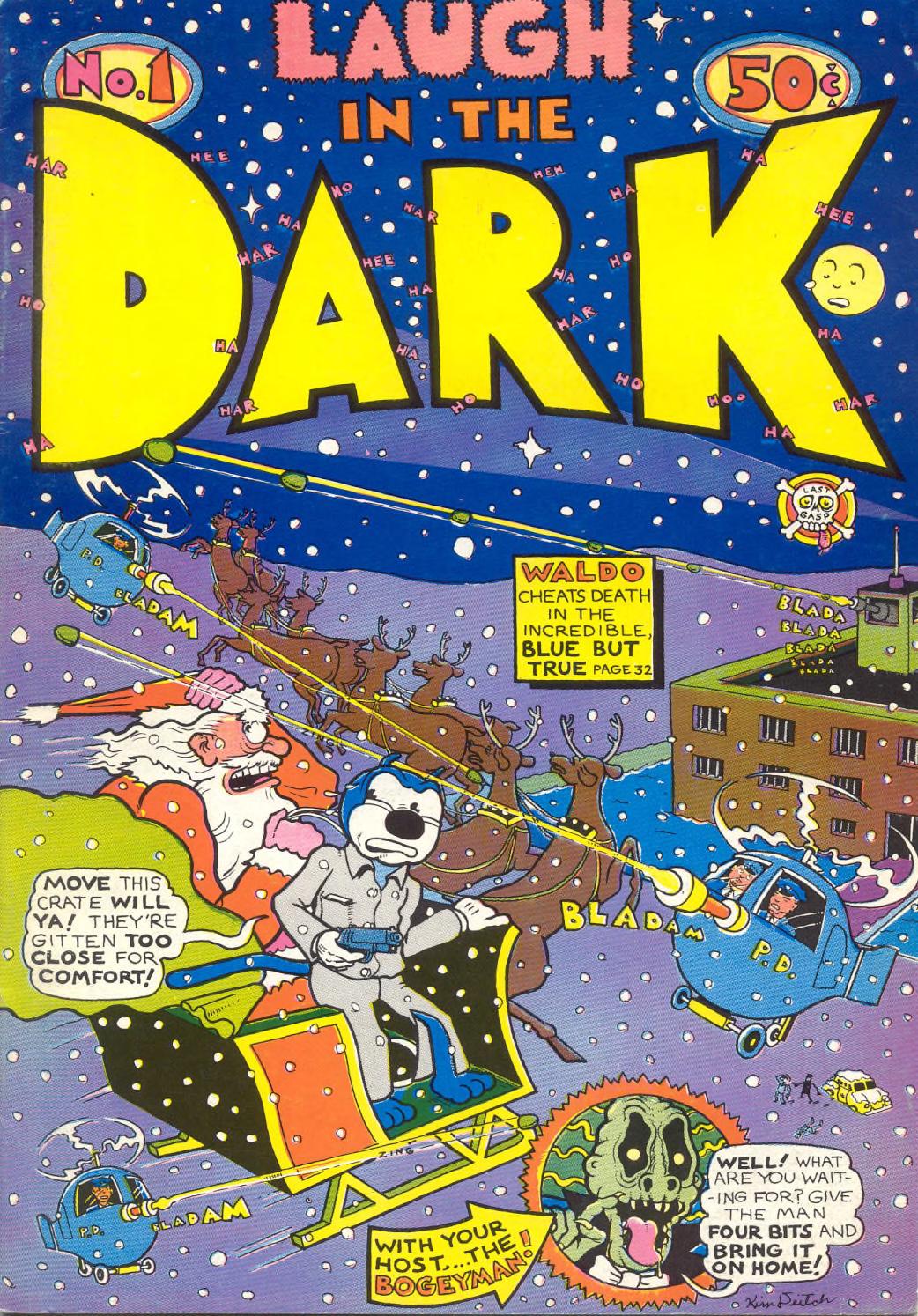
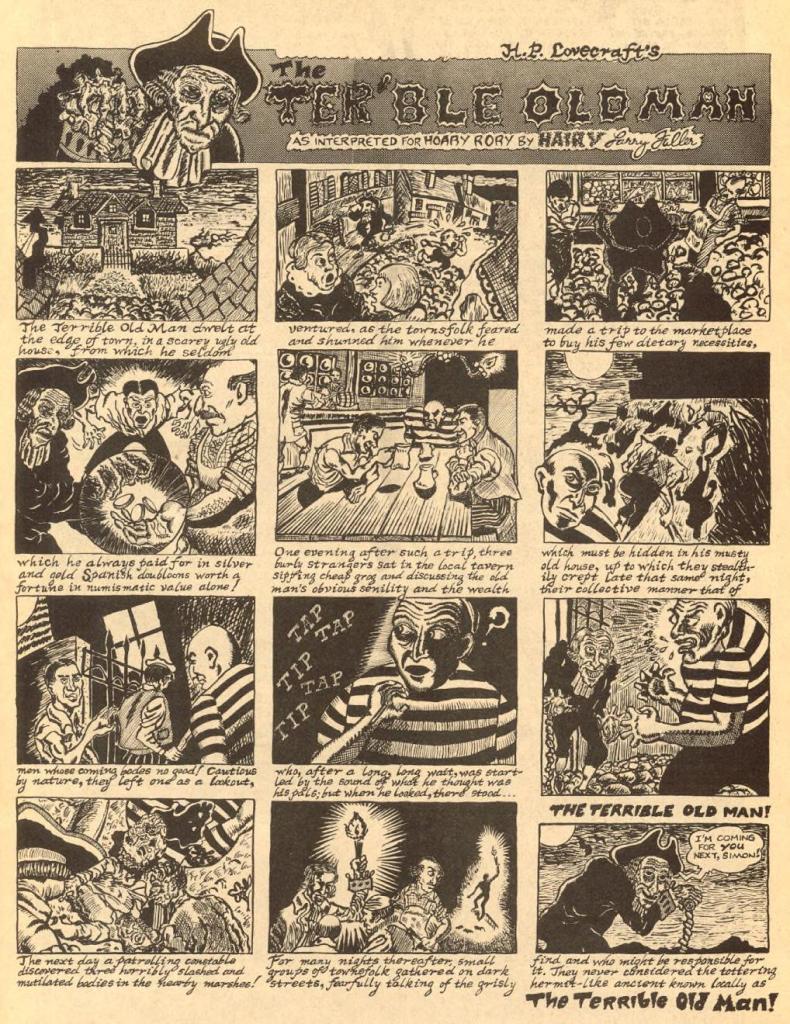
That being said, the first Lovecraft comic adaptation by a Black creator that I’m aware of is “H. P. Lovecraft’s The Ter’ble Old Man” in the underground comix Laugh in the Dark (1971, Last Gasp), by Larry Fuller.

After the Comics Code Authority was formed in 1954, horror and crime comics swiftly vanished from the newsstands of the United States. EC Comics’ was especially hard-hit. A generation that had grown up reading horror comics now could not find them; so some began to make their own. Young artists and writers began to write and draw their own comic strips and pages in the 1960s, publishing in outlets not covered by the CCA, such as college magazines, self-published ‘zines, and underground newspapers.

In 1968, Zap Comix #1 was published in San Francisco. A solo effort by Robert Crumb, this issue showcased an original art style completely unlike the conventional comic strips of mainstream publishers like Marvel, DC Comics, Gold Key, and Archie. The subject matter was also unconventional; without need to submit his work to the censors of the CCA, Crumb could include nudity, explicit sex, politics, drug use, racial issues, crime, horror, and whatever else he wanted. In subsequent issues, Crumb invited other creators to add their own contributions, including future legends like S. Clay Wilson, Spain Rodriguez, and Rick Griffin. These anthology comics provided a template for the underground comix movement.

Gary Arlington formed the San Francisco Comic Book Company in 1968; economic necessity forced him to sell his collection of Golden Age and EC comics, and the commercial outlet brought him into contact with like-minded readers and artists. Arlington embraced independent publishing, printing a number of underground comix during the 60s and 70s. One of these was Bogeyman #1 (1969), a horror comic inspired by classic EC comics created by Rory Hayes, a young teen with no formal artistic training who also worked the cash register at the store, and who would go on to earn a reputation for works like Cunt Comics. As with Zap Comix, while the first issue of Bogeyman was a solo effort by Hayes, the subsequent two issues of the short-lived series were anthology titles, showcasing horror-related work by several creators.

In 1970, Last Gasp Eco Funnies was founded in Berkeley, California. Among their comics would be EC-inspired horror comics like Skull (1970-1972) and Tales from the Leather Nun (1972), both of which featured Lovecraft adaptations or stories based on Lovecraft’s fiction and creations. In 1971, Last Gasp published a one-shot titled Laugh in the Dark; according to some sources (e.g. Lambiek Comicopledia), this was originally intended to be the fourth issue of Bogeyman, and features work by Rory Hayes and other artists that had contributed to previous issues. It also featured “Hairy” Larry Fuller’s one-page adaptation of H. P. Lovecraft’s “The Terrible Old Man.”

Image
Laugh in the Dark (1971)

The first page I ever got paid for doing.  Appeared in Laugh In the Dark, an underground circa 1970, all stories of HP Lovecraft.  Thanks, Rory.  May you rest in peace.
—Larry Fuller, Some Grass and a Gallery (2000)

“The Ter’ble Old Man” might have been Fuller’s first paid work, but it wasn’t his first published work. Ebon #1 (1970), the first comic to star a Black superhero in his own title, was published by Gary Arlington a year before Laugh in the Dark came out. These connections reinforce the idea that Laugh in the Dark started as a Bogeyman issue. In later years, Fuller would gain a reputation for his LGBTQ+ comics and pornographic comics like White Whore Funnies (1975-1979) and Gay Heartthrobs (1976-1981), and as a publisher.

“The Ter’ble Old Man” has remained relatively obscure in Lovecraftian comics history, mostly because it has never been reprinted, outside of reprints of the entire issue of Laugh in the Dark itself. While a competent adaptation, especially given the space constraints, the story lacks many of the grand images that would make for splashy illustrations, and Fuller’s line is workmanlike rather than exceptional, with the rough quality that is typical of underground comix at the time. Without context, this adaptation seems unexceptional; though largely faithful to Lovecraft’s text, it omits the more supernatural aspects of the story.

It is most interesting to consider this story in the context of what else was happening in publishing, especially comics and Lovecraft, at the time. Lovecraft was seeing a resurgence in the 60s and 70s due to paperback reprints; pulp fiction in general was seeing renewed interest that would lead to a brief revival of Weird Tales. The interest in Lovecraft wasn’t unique to Fuller—Laugh in the Dark also contains “Wilfred Kreel: Seeker of the Strange” (an adaptation of “The Lurking Fear”) by Manuel “Spain” Rodriguez (who is, very likely, the first Hispanic comic creator to adapt Lovecraft)—and there were several other Lovecraft adaptations that appeared in later underground comix.

Yet Lovecraft wasn’t just an underground idol; Lovecraft stories and adaptations appeared in both non-Code-approved comic magazines like Warren Publications’ Creepy and code-approved-but-bloodless horror comics from Marvel, who produced their own adaptation of “The Terrible Old Man” in Tower of Shadows #3 (1970), only six months prior, in 7 pages by Roy Thomas (script), Barry Windsor-Smith (pencils), Jean Simek (letters), Dan Adkins & John Verpoorten (inks). In comparison to Fuller, the Marvel effort is very conventional for the time—seven pages means fewer cramped panels, more space for Windsor-Smith to showcase his art—where Fuller’s adaptation is necessarily condensed. So, too, Marvel went through the trouble of securing permission to adapt the story from Arkham House, something that Last Gasp does not seem to have done with Laugh in the Dark (1971), but which they did do for Skull Comix #4 and #5 (1972).

In that context, underground comix appear as one thread in the spread of Lovecraft to greater recognition. His posthumous reputation had, in effect, street cred among the young creators of the underground, who could (and would) do things with Lovecraft’s work that Marvel and Warren Publications could not do. The creators who had placed themselves on the forefront of the medium would produce some of the first Lovecraftian pornography, some of the goriest Lovecraft adaptations, some of the most serious and accurate, and some of the funniest and most farcical. They made Lovecraft’s work their own—and that was what Larry Fuller was doing, not in a big splashy way, but in a single page of cramped panels.

Laugh in the Dark (1971) can be read at the Internet Archive.


Bobby Derie is the author of Weird Talers: Essays on Robert E. Howard and Others and Sex and the Cthulhu Mythos.

Deep Cuts in a Lovecraftian Vein uses Amazon Associate links. As an Amazon Associate I earn from qualifying purchases.

“Robert E. Howard as a Boy” (10 Jul 1936) by Elsie Burns

Image

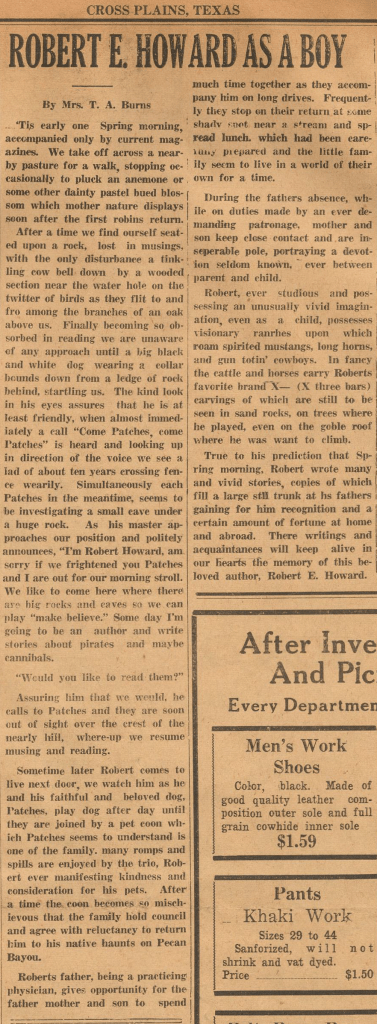
When Robert E. Howard and his mother died in the small town of Cross Plains, Texas on 11 June 1936, it was a shock to the small community. It was also news. Jack Scott, the owner and editor of the Cross Plains Review, did more than post the bare facts of the tragedy and the announcements for the funeral. Along with the normal materials, he published a letter from C. L. Moore to Dr. Isaac M. Howard consoling him on his son’s death (3 Jul 1936); published one of Robert’s award-winning school essays (19 Jun 1936), and the short story “A Man-Eating Jeopard” (14 Aug 1936). A year and a week after Bob’s death, he even published his “final” poem, “The Tempter” (18 Jun 1937). Yet one of the most unusual and interesting pieces that saw print in the Cross Plains Review after Bob’s death was “Robert E. Howard as a Boy” by Mrs. T. A. Burns (10 Jul 1936).

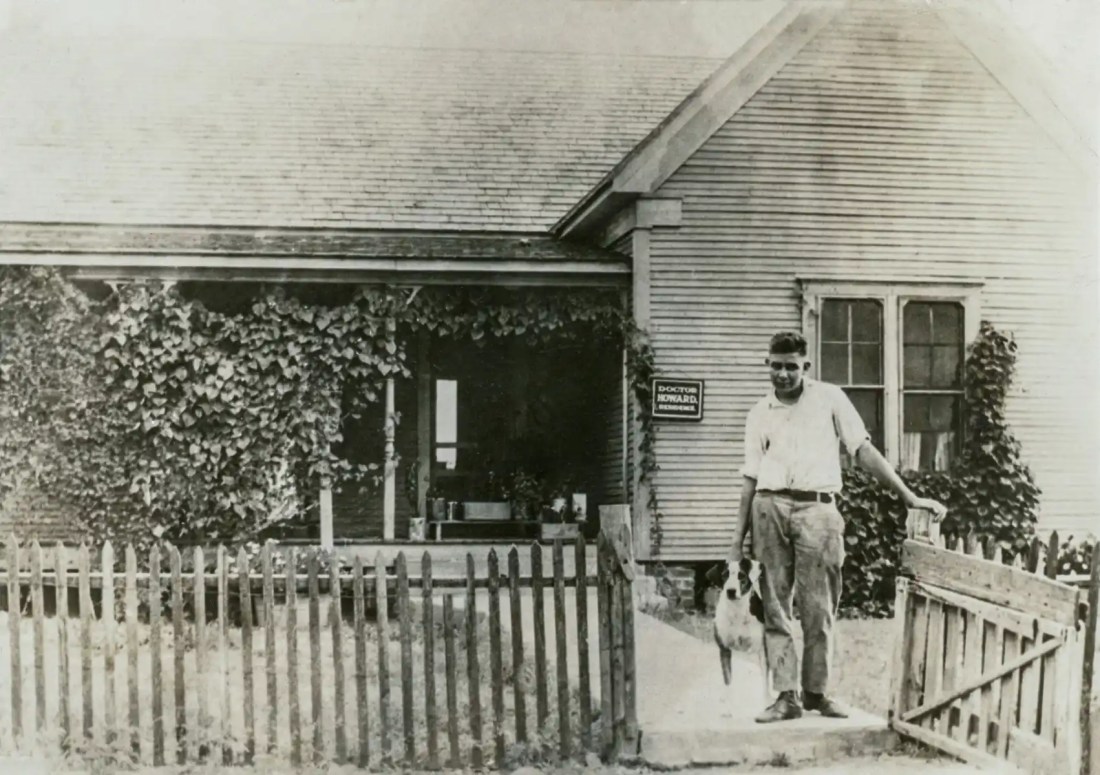
Elsie M. Cochran Burns (20 Jul 1889 – 28 Mar 1940) was the wife of Thomas Allen Burns. Born and raised in Burkett, TX, to the southwest of Cross Plains in neighboring Coleman County. In 1912 she was appointed the postmaster of the small town. In 1917, the Howard family came to Burkett, to live for a while. Young Robert attended the local school, and the dog Patch came to live with the Howard family (REH.world). Her brief memoir is one of the few to mention Howard’s childhood or his beloved pet, who is otherwise mostly known through Dr. Howard’s letters.

ROBERT E. HOWARD AS A BOY
by Mrs. T. A. Burns

`Tis early one Spring morning, accompanied only by current magazines. We take off across a nearby pasture
for a walk, stopping occasionally to pluck an anemone or some other dainty pastel hued blossom which
mother nature displays soon after the first robins return.

After a time we find ourself seated upon a rock, lost in musings, with the only disturbance a tinkling cow bell
down by a wooded section near the water hole on the twitter of birds as they flit to and fro among the
branches of an oak above us. Finally becoming so absorbed in reading we are unaware of any approach until a big black and white dog wearing a collar bounds down from a ledge of rock behind, startling us. The kind look in his eyes assures that he is at least friendly, when almost immediately a call “Come Patches, come Patches” is heard and looking up in direction of the voice we see a lad of about ten years crossing fence wearily. Simultaneously each [sic] Patches in the meantime, seems to be investigating a small cave under a huge rock. As his master approaches our position and politely announces, “I’m Robert Howard, am sorry if we frightened you Patches and I are out for our morning stroll. We like to come here where there are big rocks and caves so we can play “make believe.” Some day I’m going to be an author and write stories about pirates and maybe cannibals.

“Would you like to read them?”

Assuring him that we would, he calls to Patches and they are soon out of sight over the crest of the nearly hill, where-up we resume musing and reading.

Sometime later Robert comes to live next door, we watch him as he and his faithful and beloved dog, Patches, play dog after day until they are joined by a pet coon which Patches seems to understand is one of the family, many romps and spills are enjoyed by the trio, Robert ever manifesting kindness and consideration for his pets. After a time the coon becomes so mischievous that the family hold council and agree with reluctancy [sic] to return him to his native haunts on Pecan Bayou.

Roberts father, being a practicing physician, gives opportunity for the father mother and son to spend much
time together as they accompany him on long drives. Frequently they stop an their return at some shady spot near a stream and spread lunch. which had been carefully prepared and the little family seem to live in a world of their own for a time.

During the fathers absence, while on duties made by an ever demanding patronage, mother and son keep close contact and are inseparable pole, portraying a devotion seldom known, ever between parent and child.

Robert, ever studious and possessing an unusually vivid imagination, even as a child, possesses visionary
[ranches] upon which roam spirited mustangs, long horns, and gun totin’ cowboys. In fancy the cattle and
horses carry Roberts favorite brand X≡ (X three bars) carvings of which are still to be seen in sand rocks, on
trees where he played, even on the [gable] roof where he was want to climb.

True to his prediction that Spring morning, Robert wrote many and vivid stories, copies of which fill a large
sill trunk at [his] fathers I gaining for him recognition and a certain amount of fortune at home and abroad.
There writings and acquaintances will keep alive in our hearts the memory of this beloved author, Robert E.
Howard.

Image
Cross Plains Review, 10 Jul 1936 (10)

Elsie Burns died a few years later (obituary) from an embolism (death certificate). There would be no more memories of her young neighbor that grew up to be a famous pulp writer; though this would not be the end of her connection with Howard. In the transcripts of interviews conducted by L. Sprague and Catherine Crooke de Camp in Texas in the 1970s, conducted to compile material for their Howard biography Dark Valley Destiny, Elise Burns turns up several times. The de Camps were tracing the migration of the Howard family, and wanted to learn more about the woman who had written “Robert E. Howard as a Boy.” They did not discover much, as she had been dead over 30 years at that point, but they wanted to get it on the record. Par of their questions read:

AND: I don’t know now . . . This Mrs. Burns is . . . I guess she’s dead.

LS: Oh yes. Long since.

CdeC: She remembered Robert –

AND: May I tell you something about Mrs. Burns? Do you know anything about Mrs. Burns?

CdeC: Only she was a post mistress and she liked to write.

LS: And she married a man who was almost as fat as she was, who lived to be over a hundred years old.

AND: Fat? Her husband was not as big as I.

CdeC: Oh?

LS: Oh?

CdeC: Oh, I thought he was fat too.

And: Oh no. That was the show. Everybody loved her all right. And they liked him. They liked him, both of them. But he was such a tiny little fellow and here was this great big 300 pound woman. And she was precious to him. She took care of him just . . . He was quite a bit older and she . . . It was the greatest thing in the world, that he had her in his last years.

CdeC: Yes. I think that someone else said he was small. (to LS) You’ve always thought he was big.

LS: Mmm. Somebody said he was a big fat fellow.

AND: Oh, you’re mistaken. You’re mistaken.

LS: Must have had him mixed up with somebody else.

CdeC: Well I know that she . . .

JD: (to And) You were going to say, “Mrs. Burns . . . ” You had a story to tell, about Mrs. Burns?

AND: Oh I don’t have a story except that she was such a big person. And she had a sister not quite so big. But she was always so kind to this old fellow and took care of him and treated him like he was . . . er . . . her child.

CdeC: That was lovely.
—”Interview with Annie Newton Davis, 18 Oct 1978″ in “…when I last see him”:The de Camp Interviews on Robert E. Howard (2026) 193-194
AND: Annie Newton Davis
LS: L. Sprague de Camp
CdeC: Catherine de Camp
JD: Jocelyn Darling


Bobby Derie is the author of Weird Talers: Essays on Robert E. Howard and Others and Sex and the Cthulhu Mythos.

Deep Cuts in a Lovecraftian Vein uses Amazon Associate links. As an Amazon Associate I earn from qualifying purchases.

“The Fishmen of Innsmouth” 「インスマウスの半魚人」(1959) by H. P. Lovecraft & Shōgo Matsumiya (絵・松宮省吾)

Eldritch Fappenings

This review deals with a work of erotic art and writing.
As part of this review, selected images with depictions of nudity will be displayed.
As such, please be advised before reading further.


My proper introduction to the Japanese-language Cthulhu Mythos came courtesy of Edward Lipsett and Kurodahan Press (2002-2025). For over twenty years, Kurodahan worked to translate into English works that would otherwise never have been available to monolingual Anglophones like myself. Thanks to their efforts I was able to read Asamatsu Ken (朝松健) and Rampo Edogawa (江戸川 乱歩) and many others I hadn’t heard of; and I gained an appreciation for the work of the people translating those stories back into English. Now that Kurodahan Press is no more and their titles out of print, I regret I didn’t have the money to buy everything they put out, or the time to read it all.

In Kurodahan’s Night Voices, Night Journeys (2005) the first volume of Lairs of the Hidden Gods stories (an anthology series of Japanese Cthulhu Mythos tales), there is an essay titled “Lovecraftian Landscapes: Four Decades of H.P. Lovecraft and Manga” by Yonezawa Yoshihiro (米澤嘉博) trans. Ryan Morris, where he described an early Lovecraft translation:

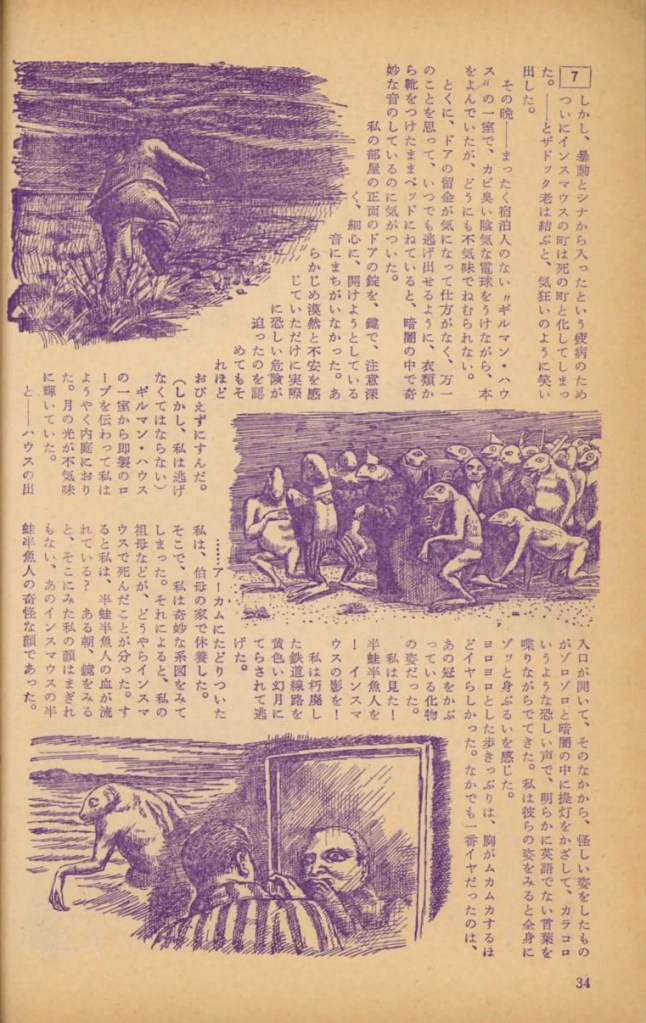
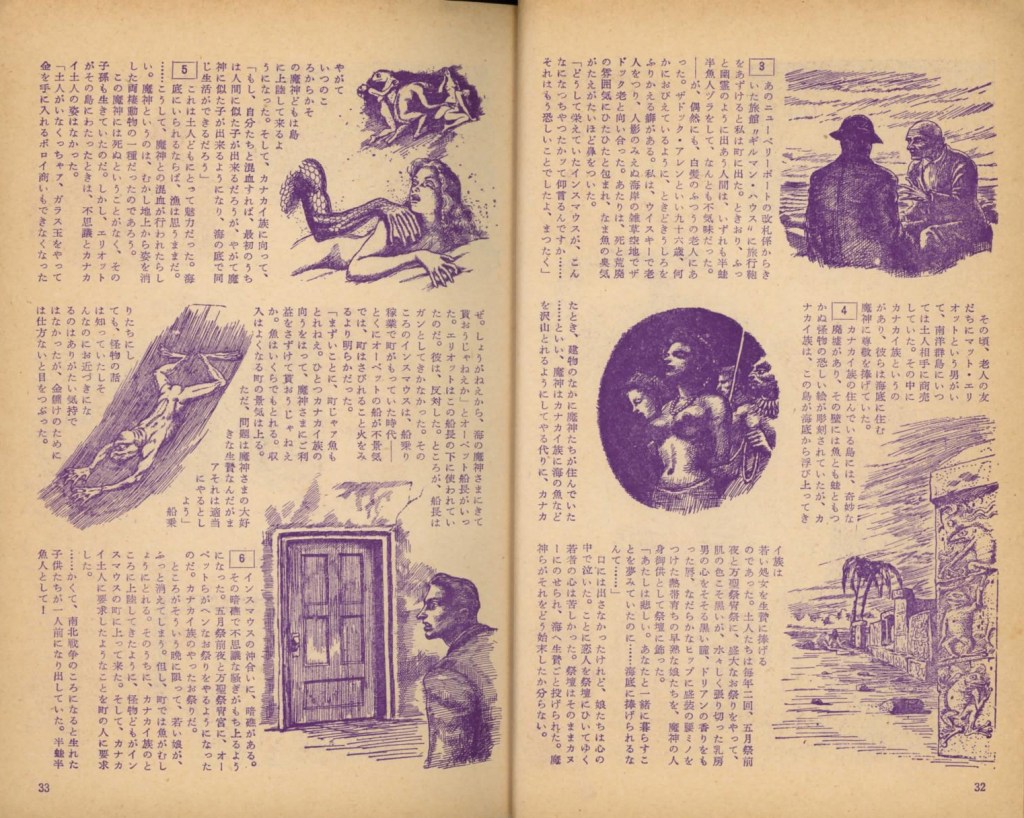
It was entitled The Fishmen of Innsmouth (illustrated by Shōgo Matsumiya) and appeared as part of the feature article, The Greatest Horror Stories from Around the World, Illustrated in issue Three of Ugoku Kao (Moving Face), the “tabloid strictly for men,” originally published as an offshoot of the very popular 1950s erotic entertainment magazine Hyaku-man in no Yoru (One Million Nights of One Million People). The subtitle read “Horrors! My face—it’s become… a frog!” The story featured pictures of half-naked women with such outrageous captions as “The Khanakai tribe made sacrifices of young virgins. THe bosoms of these fast-maturing tropically-raised maidens, with their black skin, breasts like ripe peaches, dark eyes that could seduce any man, lips with scents like durian, and gently curving waists hidden only by grass skirts, were but decorations on the altar: offerings to the Demon God.” The illustrations were fine black-and-white ink pieces that had all the mood of a Western horror novel, and although the FIshmen looked more like frogs, they were certainly grotquese. These drawings were perhaps made more accessible thanks to their being in the similar Vein as the “Lost world” monster stories of Oguri Mushitaro and Kayama Shigeru. It was only a four-page illustrated story, but it is most likely the first ever domestic H.P. Lovecraft visual work. (294)

Dr. Justin Mullis asked if I had a copy; I did not, but was able to procure a copy of Moving Faces, vol. 1, no. 3 (Mar 1959) [うごく顔 第1巻第3号(1959年3月)]. I then asked a friend, Dr. Dierk Guenther in Japan (who helped out before on “Medusa’s Curse” (1995) by Sakura Mizuki (桜 水樹氏)), to translate it into English.

The result is everything that Yonezawa Yoshihiro described in his essay and more. An abbreviated, localized, sexploitation version of Lovecraft’s “The Shadow over Innsmouth” crammed into four pages for a Japanese men’s magazine. Given when and where it was published, the work also reflects something of the language and attitudes of the postwar period in Japan; reader discretion advised. No translator is credited for the original translation/abridgement. Dierk Guenther’s comments on the translation will be marked by dagger symbols (†) and included at the end of the translated text.

A famous story of monsters

The Fishmen of Innsmouth

“Ah, my face, it looks like a frog …”

Author: Lovecraft
Matsumiya Shōgo/Art
[New translation and notes: Dierk Guenther]

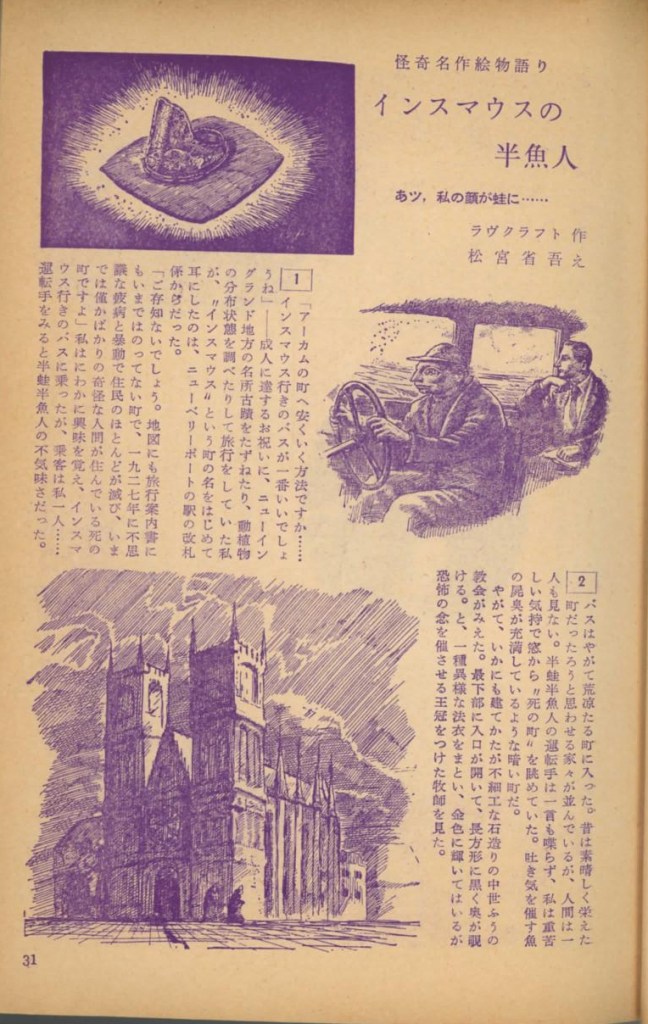
(1) “The cheapest way to Arkham town? That would be the bus in the direction of Innsmouth.”

I was celebrating my coming of age with a tour of New England, visiting historic sites as well as researching the distribution patterns of flora and fauna. It was from an agent at the train station of Newburyport that I heard for the first time the name of the town of Innsmouth.

“You seem not to be aware of this. The town can’t be found on maps or tourism brochures. In 1927 the town was hit by a mysterious infectious disease and violent riots that reduced the town’s population. Now the town is dead, and only a few, very peculiar people are living there.”

My interest was immediately raised, and I took the bus to Innsmouth, being the only person on board. The bus driver had uncanny features, looking like half-fish, half-frog.

(2) Soon, the bus arrived in a bleak town. Many houses lined up that were reminders that in earlier times, the town must have been very beautiful and flourishing. Not one single person could be seen. The half frog, half fish bus driver didn’t say one word, and with a gloomy feeling, I looked out of the window at the “town of death”. It was a dark town that felt nauseous with an overall stench of decaying fish.

Soon, an awkwardly constructed stone building, a medieval-style church, could be seen. The entry in the building’s basement was open, revealing a rectangle of blackness inside. And then I saw a priest, who was wrapped in a peculiar vestment. He wore a frightening golden tiara-like crown.

(3) I checked myself in at the hotel Gilman House, of which I had heard from the agent in Newburyport, left my luggage there, and went into town. All the ghost-like people whom I met occasionally, who seemed to come out of nowhere, looked like half-frog, half-fish, and were unsettling. And then, by coincidence, I met a white-haired elderly person. His name was Zadok Allan, and he was 96 years old. He appeared frightened and had the peculiar habit of sometimes looking behind himself.

Luring the old man by offering him whiskey, we went to a part of the beach with no one around and here I spoke with Zadok.

The area was wrapped in an atmosphere of death and destruction and the unbearable stench of raw fish filled the air.

“Can you tell me why the blooming Innsmouth became like this?”

“That was a truly horrible thing.”

Around the time these events unfolded, there was a friend of the old man by the name of Matt Eliot, who on an island chain in the South Pacific traded with the natives living there†. Among these natives was the tribe of the Kanakys, who paid respect to evil gods that lived under the sea.

(4) On the island where the Kanakys lived there was a peculiar ruin. On its wall were engraved terrifying images of fish and frogs and random monstrous creatures. The Kanakys claimed that when the island rose out of the sea, evil gods lived in this building. Thanks to the evil gods, the Kanakys could catch a lot of fish and other creatures from the depths of the sea. In return, the Kanakys offered young virgins as living sacrifice to the evil gods.

The islanders held twice a year a big festival, on the evening before the May Festival and on All Saints’ Day. Young women of dark skin and firm, full breasts stirred the hearts of men like a vaguely ominous bell. Their lips tasted of the aroma of the durian fruit. They were tropical-bred and quick to become passionate. Wearing at their curved hips a ceremonial waist loincloth, they were taken to an altar as a human sacrifice to the dark gods.

Although they did not say “I am sad. Although I dreamt of living together with you. What fate, being given to the depth of the sea,” the young women cried in their hearts.

Especially, the hearts of the young men who led their lovers to the altar were filled with anguish. The altar was set up on a canoe, and together with the sacrificial victims, it was thrown into the sea. How the gods then disposed of the sacrifices I cannot say.

And then at one point, the evil gods came on land. They told the Kanakys: “If you mix your blood with ours, then at first children that resemble humans will be born, but the children will be like the evil gods and can also live in the depths of the sea.”

(5) This appealed to the islanders. They thought if they could live on the sea floor they would be free like the fish, and so began to mate with the evil gods. It is possible that the evil gods were an amphibious species who in old times had vanished from the land. These evil gods were beyond death, and even their descendants continued to live on.

When Elliott arrived on the island, strangely, the Kanakys had vanished. Captain Obed said: “With no natives around, we can’t do any profitable business. Well, as there seems to be no other way, can we attract the evil gods from the sea?”

Elliott served under the captain, and he was opposed to this idea. However, the captain stubbornly refused to listen. In those days, Innsmouth was a town that survived on the seafaring trade. Especially if Obed’s ship (or: business) would hit a slump, it was absolutely obvious that the town would fall into decline.

“To make matters worse, one can’t even catch fish in the town. Look, those Kanakys got their blessings from these evil gods, aren’t they? They could catch fish in unlimited quantities. If we make money, the city’s economy will improve. The problem is what to do about those human sacrifices these evil gods like so much. Well, we can handle this flexibly.”

Even the sailors knew the stories about the monsters, and they were not pleased to get close to such things, but for the sake of money, they shut their eyes to it.

(6) There is a reef off the coast of Innsmouth. And on this reef a weird disturbance occurred. On the eve before the May Festival and on the All Souls’ festival, Obed and his men conducted a strange festival. It was the festival held by the Kanakys. By the way, only on these evenings young women vanished without a trace. However, in the town, fish could be caught in extraordinary quantities. It was around this time that the monsters who had come to the land in the year of the Kanakys appeared in Innsmouth. And they demanded from the townspeople what they had also demanded from the Kanakys. Thus, by the time of the Civil War the children who had been born were beginning to come of age. They were half frog, half fishmen.

(7) But, riots and a plague brought in from China†† turned Innsmouth into a town of death, concluded old man Zadok, laughing like a drooling lunatic†††.

This evening, there was not one single guest in the Gilman House. In my room, which stank of mould, and under the dim, gloomy glow of an electric bulb, I read a book. Due to being beset by an eerie feeling, I couldn’t sleep at all. I couldn’t keep from staring at the door latch, and just in case anything might happen, I slept in my clothes and shoes so that I could easily escape from the room. In the darkness, I heard a strange noise. It was without a doubt the sound of someone opening carefully and with great caution the lock of my room’s front door with a key. Because I had already felt a vague sense of uneasiness beforehand, even while I realized that a terrible danger was approaching, I managed not to be frightened. (Still, I had to get into safety.) Using a quickly made improvised rope, I climbed down from my room in the Gilman House into the inner yard. The moonlight radiated eerily. Then the entry of the house opened, and from the inside appeared gradually strange forms in the darkness, holding up lanterns, speaking in frightening, rattling voices, uttering words that were clearly not English.

Seeing these forms, my whole body shivered. Their staggering gait was so repulsive that it turned my stomach.

The most disgusting one among them was the form of a monster that wore a crown. And then I saw them clearly: The half-frog, half-fishmen! The shadow of Innsmouth! I fled along the decayed railway tracks, bathed in yellow phantom moonlight. When I returned to Arkham I rested at a count’s house. There I saw an eerie pattern. I learned that, seemingly, my grandmother and others had died in Innsmouth. Did this mean that I had half frog, half fishmen blood in my veins? One morning, I looked in the mirror and the face that I saw there was unmistakably the creepy face of an Innsmouth half-frog, half-fishman. 

† The original Japanese translator uses doujin, which is an outdated and offensive term for indigenous people.

†† The original translator uses a very derogatory term for China. The text was translated in an era before Japan and China took up diplomatic relations, so the term for China may still have been common in Japan in 1959.

††† The original translator used an extremely offensive term for “mad person” that is nowadays regarded as insulting and dehumanizing.

Without attempting to directly translate any of Lovecraft’s prose, the uncredited Japanese translator still tried to present something of Lovecraft’s style in a Japanese context—while waxing eloquent on the young Polynesian women that Lovecraft essentially glossed over in the original. The abridged text is an artifact of both when and where it was published; other stories in the same feature include “The Monkey’s Paw” by W. W. Jacobs, “The Upper Berth” by F. Marion Crawford, and “The Strange Adventure of a Private Secretary” by Algernon Blackwood, so Lovecraft and Innsmouth were in good company, especially considering that neither would be commonly known in Japan.

The illustrations by Shōgo Matsumiya also deserve mention: these are actually very good, equal to or better than most of the pulp illustrations that Lovecraft received in English-language periodicals in the United States, United Kingdom, or Canada during this period. While some are clearly there mainly for titillation, the figure-work is solid for the limited space, and those island ruins are especially evocative.

It is interesting to contrast “The Fishmen of Innsmouth” with another Lovecraft story that appeared in a risque men’s magazine at this time, “The Rats in the Walls” (1956). At a time when English-language periodicals were trying to gently censor Lovecraft, the Japanese periodical that aimed for shock and sensationalism leaned the other way.

Thanks again to Dierk Guenther for the translation and notes.


Bobby Derie is the author of Weird Talers: Essays on Robert E. Howard and Others and Sex and the Cthulhu Mythos.

Deep Cuts in a Lovecraftian Vein uses Amazon Associate links. As an Amazon Associate I earn from qualifying purchases.

Lovecraft’s Daughter (1983) by R. Alain Everts

Image

Imagine yourself in the United States of America, 1965. The children born of the baby boom in World War II are teenagers now. A television in nearly every home. The pulp magazines have been dead for a decade. Garish paperbacks reprint the contents of old Weird Tales. Arkham House celebrates its 26th year of operation—and a long-promised project finally saw fruition. The first volume of the Selected Letters of H. P. Lovecraft was shipped out to connoisseurs of the weird, like you. The kind of project normally reserved for much more important and successful authors. It was, though few understood it at the time, the birth of Lovecraft scholarship. Readers could finally learn something more about Lovecraft’s life, in his own words. One passage might have raised a moment of interest:

But one thing Mme. Greene says quite desolates me—she avers that her fair and frivolous offspring is not to be captivated by the charms of any highbrow, not even the otherwise irresistible Bolingbroke!
—H. P. Lovecraft to Rheinhart Kleiner, 30 Aug 1921, Selected Letters 1.149

Thirty-one pages later, you would have found out her name:

At dinner—about one-thirty—were Loveman, Theobald, Long, Mme. Greene, and the latter’s flapper offspring, yclept Florence—pert, spoiled, and ultra-independent infant rather more hard-boiled of visage than her benignant mater.
—H. P. Lovecraft to Maurice W. Moe, 18 May 1922, Selected Letters 1.180

That would, very likely, be the last that you would have read about Florence Carol Greene (19 Mar 1903 – 31 Mar 1979), the daughter of Sonia H. Greene, for another decade. She does not appear in Lovecraft’s Selected Letters again, not even after Howard and Sonia married. L. Sprague de Camp in Lovecraft: A Biography (1975), describes her as the sole surviving child of Sonia’s first marriage; Frank Belknap Long in Howard Phillips Lovecraft—Dreamer on the Nightside (1975) gives a little anecdote from when they met:

Sonia’s daughter was very pretty, with freckles that met across the bridge of her nose, and blonde hair and a waist so slim it seemed a little unreal. Unfortunately she was soon to leave New York, to be with a young man to whom she had recently become engaged. (50)

Sonia herself was reticent in writing about her daughter; her memoir of her marriage with Lovecraft barely mentioned the child, never the woman she became. In part, this is understandable: by the time Sonia and Howard married in 1924, Florence was apparently out of the house, living on her own, and she and her mother had some fundamental break that never really mended. Astute readers would have realized that H. P. Lovecraft had, at least technically, a step-daughter from his brief marriage—but who was she?

R. Alain Everts had cultivated a friendship with Sonia H. Davis, the former wife of H. P. Lovecraft, in her later years. Their correspondence, interviews, conversations, as well as written material and photographs from her formed the basis for several of Everts’ essays, articles, and publications, including “Mrs. Howard Phillips Lovecraft” (1973), “Howard Phillips Lovecraft and Sex” (1974), Winifred Virginia Jackson—Lovecraft’s Lost Romance (1976), and Alcestis: A Play (1985) by Sonia H. Greene & H. P. Lovecraft, the latter published by Everts’ imprint The Strange Company.

Readers never really get an idea of how much material from Sonia that Everts had; whether those represent all he had gathered and was willing to share, or if there was more unpublished, possibly because it was of little interest outside a specialized circle of Lovecraft fans and scholars.

That specialized circle had a name: the Esoteric Order of Dagon Amateur Press Association. Modeled on the same amateur press associations that Lovecraft had been a member of, the EOD was (and as of this writing, still is) an organization where a select group of Lovecraftian fans and scholars connect and share their latest writings, discoveries, and analyses through periodic zines. Everts was a member for a long time, and while he is best known to fans through the works he published through The Strange Company and articles that were published in commercially-available magazines, the zines he put together for EOD are an often fascinating look at what was the bleeding edge of Lovecraftian research.

In 1983, Everts issued three thin stapled pamphlets titled Lovecraft’s Daughter, Lovecraft’s Daughter II, and Lovecraft’s Daughter III as part of his contributions to the EOD mailings, summarizing and synthesizing his research on Florence Carol Greene—better known in her adult and professional life as Carol Weld. These pamphlets were never collected, never reprinted, never made available to the wider public, except when a member of the EOD sold part of their collection or died, and their heirs offered it for sale. They are hen’s teeth, and it is difficult to assess their impact. Certainly, later biographies of Lovecraft like S. T. Joshi’s I Am Providence have a bit more to say about her, but her connection to Lovecraft is so tangential and tenuous that tracing her life may seem a digression.

Monica Wasserman, who edited Sonia’s autobiography Two Hearts That Beat As One (2024), doesn’t think so. In her own page on Florence Carol Greene, Wasserman correlated the contents. The only child of immigrant parents in the U.S.; her father out of the picture, her mother raising Florence by herself as a single mother, with the aid of her own mother (who was busy raising two half-siblings). Florence was intelligent, probably feisty, likely stubborn, and independent. What she thought of Lovecraft or her mother’s remarriage is unknown, but Florence’s relationship with her nominal stepfather appears to have been nonexistent.

Everts’ pamphlet Lovecraft’s Daughter is relatively accurate on the biographical details, and some of his information came directly from Sonia:

Sonia recalled to me various dinners at her apartment with both Lovecraft and Samuel Loveman present, where she and Florence would host them for an evening of food and conversation. On some occasions, Sonia and Florence would disagree so strongly that they would fight in front of their guests.

The break between mother and daughter was apparently total. Everts noted that:

When I wrote on Sonia’s behalf in 1967 to Carold Weld (as she then styled herself), the letter was returned to me, opened, with a handwritten message that the envelope had been opened by mistake. I will never forget Sonia’s expression when I showed her this enveloped, and she replied sadly that the handwriting was Florence’s.

There are many reasons why adult children might go “no contact” with their parents, and we don’t have Carol Weld’s side of the story. We only indirectly have Sonia’s through a few writings and Everts’ account in Lovecraft’s Daughter. Unfortunately, the latter is responsible for at least one rumor that has proven hard to kill:

Some years earlier, I believe Sonia mentioned to me that Florence was about 18, she had fallen in love with a nice man with background credentials of impeccable quality – they should have been, for the man was Sonia’s half-brother, by her mother’s second marriage.

Monica Wasserman noted that this was probably a point of confusion, as Sonia’s half-brother Sydney married a young woman named Florence Stone in 1923, and Everts may have easily mistaken one Florence for another, especially with Long’s comment about an engagement, which may have hinted that her daughter was intending to marry, either to someone Sonia didn’t approve of or simply to escape her mother’s household. Whatever the truth, Florence Carol Greene would marry John Weld in 1927, and thereafter be known as Carol Weld.

Today, Lovecraft’s Daughter and its sequels, rare and obscure, aren’t of much interest for its raw information on Carol Weld. Digital genealogical records, newspaper archives, and the collections of the mother and daughter’s papers in their respective archives give access to more information than Everts had access to in 1983. Its interest lies in its expression of Everts’ continued use of his time with Sonia, how he found ways to express that information to an audience of Lovecraftian fans and scholars. This is how information got promulgated before the dawn of the internet, and this is also how rumors start.

Which is why it is important not to rely exclusively on these old fanzines, but to try and view them in their appropriate historical context, and with a critical eye toward not only their sources for information, but how they are synthesizing that information and presenting it to others. Historical data is valuable, but it must also be re-assessed, especially when new information becomes available. Lovecraft’s Daughter was a step on the path of gaining greater insight into who Carol Weld was, and how her story and Lovecraft’s connected; it is an essential part in understanding Sonia’s life and the realities she faced as a single mother in New York. That it has been superseded by later sources isn’t a surprise or a detraction.


Bobby Derie is the author of Weird Talers: Essays on Robert E. Howard and Others and Sex and the Cthulhu Mythos.

Deep Cuts in a Lovecraftian Vein uses Amazon Associate links. As an Amazon Associate I earn from qualifying purchases.

Winifred Virginia Jackson—Lovecraft’s Lost Romance (1976) by R. Alain Everts & George T. Wetzel

Image

Or had Lovecraft been casting sheep’s eyes upon some young woman whom he lacked the nerve to approach openly? Could it have been his fellow-amateur and ghosting client Winifred Virginia Jackson, with whom he had quite—for him—a close friendship?
—L. Sprague de Camp, H. P. Lovecraft: A Biography (1975) 123

In 1943, Arkham House published Beyond the Wall of Sleep, the second collection of Lovecraft’s fiction. It was the first book publication of “The Crawling Chaos” (1921) and “The Green Meadow” (1927), two stories co-written by H. P. Lovecraft and Winifred V. Jackson—there credited as “Elizabeth Berkeley.” Fans deciphered the pseudonym; George T. Wetzel correctly identified Winifred Virginia Jackson as one of Lovecraft’s collaborators in The Lovecraft Collector’s Library, vol. VII (1955). Details about Lovecraft’s collaborators, however, were thin on the ground. Aside from a few references in the first volumes of Lovecraft’s Selected Letters and a brief bit of speculation by de Camp, there was nothing available on their relationship or the stories they wrote together.

In 1976, you had to be an exceptional Lovecraft fan to know much about Winifred Virginia Jackson.

R. Alain Everts and George T. Wetzel were two exceptional Lovecraft fans. Everts had interviewed many surviving friends and associates of Lovecraft, including developing a friendship with the former Mrs. Lovecraft, Sonia H. Davis, and written such essays as “Mrs. Howard Phillips Lovecraft” (1973) and “Howard Phillips Lovecraft and Sex” (1974). In the process, Everts had also alienated many people (see The Curse of Cthulhu [PDF]). Wetzel likewise distinguished himself as a fan-scholar and publisher; the seven volumes of his Lovecraft Collector’s Library were a starting point, collecting many of Lovecraft’s early amateur writings and writings about Lovecraft (which Everts would later publish the collected edition through his imprint The Strange Company in 1979), along with several other articles and miscellaneous publications. Wetzel was also considered a bigot by fellow fans, and accused of writing poison pen letters (“In Memoriam: George Wetzel” in Ibid 45 [PDF]).

Winifred Virginia Jackson—Lovecraft’s Lost Romance (1976) combined Everts’ and Wetzel’s respective skills, interests, and prejudices. Counting the covers, it is a small 8.5″ x 11″ stapled pamphlet of 11 sheets (which technically makes 18 pages, although some of those are blank), which includes a mix of biographical essay, black-and-white reproductions of photographs, and photostatic copies of some of Jackson’s poetry from amateur journals. A fairly typical fan-product of the period, a touch more scholarly and influential than most, if only because information on Jackson would remain scarce for decades, until the greater availability of digital records and the digitization of books, newspapers, and ‘zines made it possible to obtain greater information and accuracy about her life…with some caveats.

To give an idea of what this means, here is a quick sketch of WVJ’s life based on readily available documents just on ancestry.com:

While this seems like a lot of specific information, there’s a lot that isn’t shown here: where she went to school and college; her career in amateur journalism; the books she wrote, edited, and published; her work as co-founder and then owner of the B. J. Brimmer Company with William Stanley Braithwaite; etc. The records we do have are rife with inaccuracies: the 1880 Federal Census lists her as “son” rather than daughter; the ages given in later census records are always incorrect, which led one researcher, Charles Trombee, to conclude she habitually lied about her age (Lovecraft Collaborator–Winifred Virginia Jackson), and even Ancestry.com and Findagrave disagree on her exact birth date. Certain records are missing, possibly lost or never digitized—so we know she divorced her husbands, but don’t necessarily know when exactly.

So keep that in mind: Everts and Wetzel were working with incomplete data. While reporting what they had discovered, not all of what they report would be accurate, and not all of their speculations would be accurate either. Even today, a biographer would have a lot of work to do to fill in the gaps of Winifred Virginia Jackson’s life.

Some of what was reported was, frankly, gossip. For example, the idea that Lovecraft and WVJ shared any romantic interest arises from Wetzel’s correspondence with amateur journalist Willametta Keffer:

Mrs. Keffer wrote to Wetzel on 23 January 1956 stating that everybody in Amateur Journalism thought Lovecraft would marry Winifred Jordan. She added: “Now don’t you go encoraching on my territory here, this is an aspect that hasn’t been touched and I’m working it up […] A long time member of NAPA who knew and met both HPL and Winifred Virginia told me of the ‘romance’.”

Writing to Wetzel again, twenty years later:

She also added that Mrs. Jordan was “supposed to have had a torrid affair with an editor and I found some substantiation in a Year Book of the Bibliotheque Society of Boston.”

Taking this gossip as gospel, and combined with less-than-complete biographical information, Everts and Wetzel made a couple of deductive leaps which, in hindsight, are unfortunate:

Her marriage was brief and ended in divorce about early 1919. Her husband Horace Jordan was a Negro – in fact Winifred Virginia Jackson had always been a champion of the Negro – today at least one of her descendants is also married to a Black. By the time she had met Lovecraft, her marriage was over and she was the msitress of the celebrated Negro author William Stanley Braithwaite. His marriage prevented him from marrying Winifred, but for ma[n]y years she remained his mistress. However, this affair did not prevent Winifred Jackson from becoming very attracted to the single HPL. […] It is doubtful if Lovecraft himself knw of her former husband and her liaison (although Lovecraft did enjoy gossip) with Braithwiate [sic], – but even if he had he might not have cared anyway. […] What is known as fact is that many older Ajays have told Everts that they were surprised that Lovecraft had not married Winifred Jackson. It is a fact that Lovecraft took a snapshot of Winifred Jackson at the seaside, and it is known that she and HPL were romantically linked by the 1921 Boston National Amateur Press Ass[o]ciation convention. In the words of Sonia Lovecraft to Everts in 1967, “I stole HPL away from Winifred Jackson.”

There is a lot to unpack there. Let’s start at the beginning: Horace Wheeler Jordan was, according to census records and his WWI draft card, white:

Image

Was Winifred Virginia Jackson a champion of Black rights and culture, despite being white? Probably. Trombee notes that she had poems published in The Brownie Book (aimed at Black children) and The Crisis, a Black literary magazine, and was mistakenly listed among Black poets in Colored girls and boys’ inspiring United States history, and a heart to heart talk about white folks (1921) by William Henry Harrison, Jr. and Negro Poets and their Poems (1923) by Robert Thomas Kerlin. Winifred Virginia Jackson co-founded the B. J. Brimmer Company with mixed-race poet, author, and editor William Stanley Braithwaite, which company published various works by Black authors, including Sidelights on Negro Soldiers (1923) by Charles H. Williams. She does not appear to have had any children, so it’s not clear who her “descendants” were in this specific case; probably the children of her surviving cousins.

The accusation that Winifred Virginia Jackson carried out an extramarital affair with William Stanley Braithwaite is, so far as I have been able to determine, unsubstantiated. If Wetzel is to be trusted, the rumor began in amateur journalism, but it first hit print with Winifred Virginia Jackson—Lovecraft’s Lost Romance. No private letter from Jackson or Braithwaite has emerged that hints at any kind of sexual relationship between the two (although given that Braithwaite was married and that interracial relationships were taboo in the 1920s, this may not be so unusual). Scholarly works like The William Stanley Braithwaite Reader (1972) make no mention of such an affair, nor was it mentioned in any of Braithwaite’s autobiographical essays (although again, this isn’t surprising).

Of their friendship (and Braithwaite’s admiration of Jackson as a poet) we can be fairly certain. Braithwaite’s Anthology of Magazine Verse for 1921 devotes a chunk of space to Jackson; Braithwaite wrote an introduction to her book Backroads: Maine Narrativeswith Lyrics (1922); and in the Twentieth Anniversary Number (1921 annual of the Bibliophile Society in Boston), Braithwaite wrote an introduction, “The Poetry of Winifred Virginia Jackson,” to give three examples. Perhaps it was the latter that Keffer was thinking of when she said the “Year Book of the Bibliotheque Society of Boston,” since the Bibliophile Society of Boston did issue an annual, often titled a Year Book. Yet there is nothing in that introduction the least scandalous or suggestive of a romantic or sexual relationship. Nor did Keffer ever produce the tell-all article she hoped to.

Everts’ comment on “stealing” Lovecraft from Jackson is more interesting; as discussed in “Howard Phillips Lovecraft and Sex” (1974) by R. A. Everts, we don’t have any way to really prove or disprove this, as Everts is reporting a private communication that was is only ever published here and nowhere else. We are dependent on his memory and his trustworthiness as a source. Still, the idea that the bachelor Lovecraft might be hypothetically paired with various single women in amateur journalism, especially those he worked closely with, such as Jackson, isn’t far-fetched. After all, when Lovecraft did eventually marry, it was to an eligible single woman in amateur journalism with whom he worked closely, Sonia H. Greene.

There is a little more in Winifred Virginia Jackson—Lovecraft’s Lost Romance, such as a reproduction of the photo Lovecraft took of Jackson, but not much else of real consequence. Everts and Wetzel based their idea of a romance (real, potential, or imagined) on the 30-40-year-old memories of gossiping amateur journalists. Some of the facts about Winifred Virginia Jackson they got right, others wrong; the sources being what they are, this isn’t surprising or even a substantial criticism. Mistakes happen all the time in genealogical and biographical research, and the misidentification of a single individual in an error-filled record can lead even the most well-meaning researcher off into a chain of fantasy. The affair with Braithwaite remains unproven, though perhaps some love letter will surface one day to give it substance. The uncritical repetition of the claim decade after decade shows the dangers that can come from relying on a single unreliable source.


Bobby Derie is the author of Weird Talers: Essays on Robert E. Howard and Others and Sex and the Cthulhu Mythos.

Deep Cuts in a Lovecraftian Vein uses Amazon Associate links. As an Amazon Associate I earn from qualifying purchases.