Exhibition news!

Image

I’m pleased to be able to share the news that North Hertfordshire Museum is planning an exhibition of Gerard Ceunis’ work for autumn this year (2026). I heard the news from Tessa Cathcart, Ceunis’ granddaughter, and it was then confirmed in an email from Ros Allwood, the head of the museum service, who has asked me to contribute to the booklet that will accompany the exhibition. Watch this space for further details.

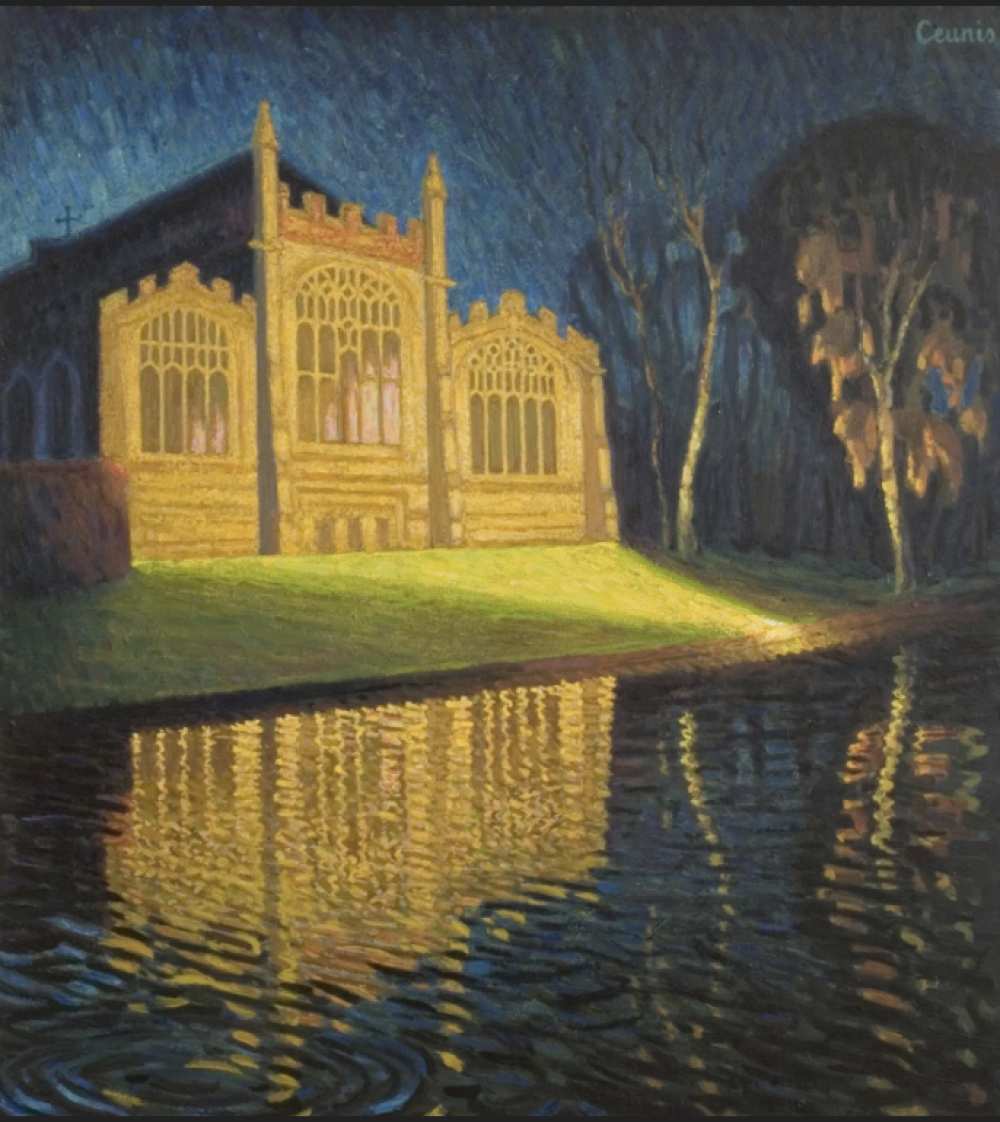
I’m illustrating this post with the beautiful Christmas card that Tessa sent me at the end of last year. It features Ceunis’ oil painting ‘Dawn in Priory Park’, which Tessa has in her private collection, but which I hadn’t seen before. In a recent email to me, the Hitchin artist James Willis commented that the painting is in a pointillist style, which Ceunis deployed in a number of his works, though not consistently. I believe it also shows the influence, which I’ve mentioned before, of the Flemish luminist painter Emile Claus.

As I’ve noted before, Priory Park is the green open space directly opposite Gerard Ceunis’ former home – ‘Salve’ – in Gosmore Road, Hitchin. At one time it was the private park attached to Hitchin Priory, initially a Carmelite monastery, later a private house, and now a hotel. During Ceunis’ lifetime, the park covered a broad stretch of land from the Priory itself, in Bridge Street in the heart of Hitchin, as far as the villlage of Gosmore, a distance of a mile or more. However, since 1980, a ring road – Park Way – has bisected the park (and, as I’ve mentioned before, Ceunis’ own former property) and the section opposite Salve is now cultivated (recent crops have included sugar beet and maize), though still popular with walkers (including this writer).

Unsurprisingly, Priory Park was a popular subject for Ceunis, and North Hertfordshire Museum already owns this (rather different) painting of a tree in the park, which he created in 1930:

Image

A few days in Ghent

Two weeks ago, I finally fulfilled my ambition to visit Gerard Ceunis’ home city of Ghent, in Belgium. We were only there for three days, but it felt good to wander through the streets and squares where Ceunis and his contemporaries once walked.

Image

Sint-Michielsbrug

The city was more beautiful than I had expected. It helped that the spring weather was perfect during our stay, with sunshine and blue skies a perfect backdrop to Ghent’s attractive historic buildings:

Image
Image
Image

Riverside views

We spent our days visiting some of the key tourist attractions, such as the cathedral and other major churches, the quays beside the River Leie, and the attractive Patershol district. A morning spent at STAM, the city museum, gave us a sense of Ghent’s fascinating history, while visits to MSK, the fine art museum, and the Francis Maere Gallery, were opportunities to indulge my interest in early twentieth-century Flemish art.

MSK had a special exhibition of work by Jules de Bruycker, a contemporary and lifelong friend of Ceunis, and I detected a possible influence, in at least one of his Breughelesque paintings of Ghent markets, on Ceunis’ depictions of the market square in Hitchin:

Image

Disappointingly, there very only a few works on display at MSK by the artists who influenced Ceunis, though this painting of ‘Skaters’ by his artistic hero Emile Claus reminded me strongly of the former’s depictions of similar scenes:

Image

I was pleased to see one or two paintings by other Flemish contemporaries of Ceunis, such Anna de Weert, Gustave Van de Woestijne and Theo Van Rysselberghe:

Image

Anna de Weert, ‘My Studio in June’

Image

Anna de Weert, ‘The Coupure in Ghent’

Image

Gustave Van de Woestijne, ‘The Family in the Garden’

Image

Theo Van Rysellberghe, ‘The Sambre Valley’

A new – and delightful – discovery for me was the work of Jenny Montigny, who apparently was a protégée – and mistress – of Emile Claus, and an often-overlooked representative of the luminist school. There’s a highly informative website devoted to Montigny here.

Image

Jenny Montigny, ‘The Gardener’

Image

Jenny Montigny, ‘My Window’

An important literary influence on Gerard Ceunis was the poet and dramatist Maurice Maeterlinck, whose style Ceunis imitated in his early theatrical work, ‘The Captive Princess‘, even borrowing the name of his heroine from Maeterlinck’s play ‘Monna Vanna’ – and, of course, giving the same name to his own daughter. Maeterlinck was born in Ghent and we came across this plaque on the house where he was born, which happened to be next door to the hotel where we were staying:

Image

Ghent is a city of literature as well as art, and one of its attractive features is the many public displays of poetry. I found one example in the university district, by Stefan Hertmans, the modern Ghent-born writer whose novels about the city and its history I would highly recommend. And we came across this poem by Maeterlinck on the wall of a building beside the river:

Image
Image

I hope I have another chance to visit Ghent. Next time, I would love to visit the nearby villages of Afsnee and Sint-Martens-Latem, beside the River Leie, where so many of my favourite early twentieth-century Flemish artists had their studios.

A special day

I was pleased to receive a call this morning from Tessa Cathcart, Gerard Ceunis’ granddaughter and his only surviving descendant. Tessa ‘phoned to remind me that today would have been her grandfather’s birthday, and that he was born 140 years ago today, on 6th December, 1884.

Image

‘Sinterklaas’ in Ghent (via discoveringbelgium.com)

6th December is, of course, also St. Nicholas’ Day, and Tessa pointed out that during Gerard’s childhood in his native Flanders, ‘Sinterklaasfeest’ would have been a memorable feast day, with traditions that included children putting out shoes by the chimney, which they would wake to find filled with small presents.

Having one’s birthday coincide with St Nicholas’ Day may, of course, have been a mixed blessing, rather like a British child having their birthday on Christmas Day, with the risk of your personal, special day being overshadowed by other events.

More on Ceunis’ ‘lost’ painting

In my last post I wrote about my discovery of a photograph of Gerard Ceunis being reunited with one of his paintings, at the time of his exhibition at the Arlington Gallery in London in 1930. The painting had been rescued from Belgium during the First World War by a British army officer and brought to England. Ceunis and his family had fled their homeland following the German invasion and had assumed the picture to be lost.

This was a new story to me, but Ceunis’ granddaughter, Tessa Cathcart, has since informed me that it received a good deal of coverage in the local and national press at the time. Via the British Newspaper Archive, I’ve managed to find reports in the London Daily Chronicle, the Liverpool Daily Post and the Hertfordshire Express. Here’s the headline from the Daily Chronicle of 5th February 1930:

Image

The story beneath the headline reads as follows:

When Lieut.-Colonel Harry Delacombe entered the Arlington Gallery, London, yesterday, where the Belgian painter, Gerard Ceunis, is exhibiting some of his later works, he felt subconsciously that somehow the pictures were familiar to him.

Yet even the name of the artist was entirely unknown to him.

Suddenly his eye caught sight of a picture in a far corner.

It depicted a garden, bathed in a mellow light, with little girls playing. The colonel stood still for a second.

‘That is my picture’, he said to himself.

Yet he had left it at his home but a few hours before.

Then his mind flashed back over 14 years.

The Germans were shelling Nieuport, and the colonel, with two brother officers, was staying in an abandoned building.

In a corner they found three unsigned pictures, and when they moved away, each officer took one of the paintings with him.

The Colonel, an art lover, went to the exhibition yesterday, and there, in the corner, he saw his picture.

He went to Gerard Ceunis, who solved the mystery.

In 1914 the artist sent several pictures to an exhibition to be held at Nieuport. War was declared, however, and he was unable to discover the whereabouts of his works.

The picture in the corner at the Arlington Gallery was the original sketch of the picture sent to the Nieuport exhibition.

The version of the story in the Hertfordshire Express of 15th February 1930 supplies some additional information, including the names of the other British officers involved (General E.M.Maitland and Major Hugh Fuller, of the Naval Airship Station at Firminy), as well as the following detail:

A number of household articles had been taken from a house [in Nieuport] which had been almost destroyed by a large German shell, and among them were three paintings, which had been taken from their frames and rolled up. They were found by the three officers in front of a motor-car ready to be taken away by the Germans.

Lost and found

I was looking online recently for information about Gerard Ceunis, when I came across a photograph of him for sale on eBay, the seller being an antiquarian dealer in Bourges, France. The photograph showed a young (-ish) Ceunis, standing next to one of his paintings, with others displayed on a wall behind him, and it was accompanied by some printed text in French. I decided to buy the photograph, partly because there are so few pictures of the artist in the public domain, but also because I found the story behind it intriguing.

Image
Image

This is my translation of the French text accompanying the photo:

In 1914 the Belgian artist and painter Gerard Ceunis organised an exhibition of paintings at Nieuport. The war came, the canvasses stayed at Nieuport where, one day, the English General Maitland took care of the said paintings by sending them to London, without knowing the name of the artist. The latter, with a view to his current exhibition at the Arlington Gallery, created from memory one of the paintings taken by General Maitland. During the opening of the exhibition the similarity of the subject struck of one the general’s officers and this is how the artist was able to come into possession of his missing works.

The photo shows GERARD CEUNIS NEXT TO THE PAINTING IN QUESTION WITH A PLAQUE FROM THE MAIN SQUARE OF NIEUPORT.

Nieuport – Nieuwport in Flemish – is a coastal town in West Flanders, Belgium, about 15 miles south-west of Ostend/Oostende, and about 50 miles west of Ghent/Gent. So far, I’ve been unable to find any information about any exhibitions held there in 1914. Gerard Ceunis fled to England with his wife Alice and young daughter Vanna soon after war broke out and Germany invaded his homeland in the summer of that year.

I’ve been unable to find any information about a ‘General Maitland’ who served in Belgium during the First World War. I wonder if the reference is actually to Lieutenant-General Sir Henry Fuller Maitland Wilson (1859 – 1941), a senior British Army officer who served with distinction in Flanders, France and later in Salonika? Perhaps the plaque from the Groote Markt / Grand Place in Nieuwport, on display in the photo, was a wartime souvenir brought back from Flanders by the general or one of his officers?

Ceunis’ exhibition at the Arlington Gallery, in Old Bond Street, London, took place in 1929. It apparently featured 60 of the artist’s paintings and was opened by none other than the Belgian ambassador. According to one source, the gallery, which had only been in operation for six years, ‘appears to have attracted the lesser-known artists of the period who probably found difficulty in getting shows at the bigger galleries either because it was felt they were not famous enough names or perhaps the other galleries took too great a commission.’

The typed text accompanying the photo is on a separate piece of paper, glued to the back of the copy which I purchased, which also bears the stamp of what seems to have been its place of origin – Photo ‘Actualite’ G. Champroux in Rue Royale, Brussels.  Intriguingly, it turns out that Georges Champroux (1899 – 1983) was a leading Belgian photojournalist, famous for a series of black-and-white photographs of Brussels at night. I assume that he was given the assignment to cover the story of the restoration of Gerard Ceunis’ paintings by a Belgian newspaper from which, perhaps, the text attached to my copy is taken. It would certainly have made for an eye-catching human interest story in Ceunis’ home country.

I suspect that the Arlington Gallery exhibition was one of the high points of Gerard Ceunis’ artistic career. I’m intrigued by the painting in the foreground, which I’ve not seen before and which appears to be of superior quality to many other works of his that I’ve seen. I’d be interested to see a full-colour reproduction, and to discover what became of it and of the other paintings in the exhibition.

Lilian Hall-Davis and the Pemberton family in Hitchin: an update

After writing my post last year about the possible descendants of the silent film star Lilian Hall-Davis (the focus of a lifelong obsession for Gerard Ceunis’ friend, the Flemish novelist Johan Daisne), I sought information via a number of Hitchin-based Facebook groups. For some reason I never got around to posting the responses I received, but a recent comment on that last post has prompted me to do so, rather belatedly.

As I wrote back then, Lilian’s only son, Grosvenor Pemberton, married a woman from Hitchin by the name of Cynthia Orson and they lived at 2 Waltham Villas, which was on the corner of St John’s Road, just a short walk from the Ceunis home on Gosmore Road. Their only son, Berkeley William Howard Pemberton, was born there in 1943. Here are some of the responses I received to my request for information about him, which contradict some of my earlier tentative conclusions:

There was a Howard Pemberton who lived in St John’s Road. He was friends with my brother-in-law. He worked in Hitchin but left to live in South Africa, I last saw him in Jo’burg during the early 1990s…I know he went with a lady from the bakers in the High Street. He was an unusual character but I always found him very friendly…I think Jean Redman was with Howard in South Africa. (Anthony Bone)

I was at Bessemer School [in Hitchin] in the ‘50s and knew a Howard Pemberton, who I recall lived near St John’s Road. Could he have been related? We always thought of him as being ‘a bit posh’ at the time, but he was a great lad, full of energy!…I have a feeling he emigrated to South Africa. Another pupil from Bessemer…mentioned him when I was writing my book on Bessemer school. (Robert Prebble)

Howard came to my wedding in 1982 with Jean Redman…He was a regular fixture in The King’s Arms in the early 80s. Although I didn’t know him well he was a dapper and charming man in the old-fashioned sense. (Nick Stevens)

Howard Pemberton died in South Africa about 10 years ago…Never married. (Keith Porter)

So it would seem that, sadly, Lilian Hall-Davis has no surviving descendants who might help to solve the mystery of her possible residence in Hitchin…

Lilian Hall-Davis in Hitchin? A continuing mystery

Almost two years ago I wrote a post about an exhibition of Gerard Ceunis’ paintings in Hitchin, probably in the 1950s, which included a portrait of the English silent film star, Lilian Hall-Davis, who tragically took her own life in 1933. Shortly afterwards, a monochrome reproduction of the portrait was included in a package of items kindly sent to me from Belgium by the artist’s great niece, Elise De Cuyper.

Image

Portrait of Lilian Hall-Davis by Gerard Ceunis

I already knew that the Belgian poet and novelist Johan Daisne (the pen name of Herman Thiery, 1912 – 1978), who had visited the Ceunis family at their home in Gosmore Road, Hitchin, in the summer of 1929 and developed a lifelong, unrequited passion for Gerard and Alice’s daughter Vanna, was also somewhat obsessed with Lilian Hall-Davis. Together with Vanna, and a number of idolised and idealised women, she had featured in his novels Lago Maggiore and Six Dominoes for Women.

Image

Johan Daisne (via en.wikipedia.org)

Later, thanks to Johan Vanhecke’s comprehensive biography of Daisne, I learned more about the latter’s lifelong fascination with Hall-Davis. Johan also kindly sent me some extracts from Daisne’s book Filmathiek, a collection of his writings on cinema, which included further information, as well as some of the poems that Daisne had written about the actress. In that post, I recounted the astonishing story of how Daisne had written an article about Hall-Davis in a Belgian newspaper, which Gerard Ceunis came across purely by accident, after a copy was used to wrap an object sent to him by a shop in Ghent, and how Ceunis then wrote to Daisne to inform him  that the film star’s only son, Grosvenor Pemberton, was actually a neighbour and friend of the Ceunis family in Hitchin. Lilian Hall-Davis had married fellow actor Walter Icke Pemberton in 1918 and their son Grosvenor Charles was born in 1919. The Pemberton family’s origins were in Shropshire, and Grosvenor was apparently named after his grandfather Grosvenor Hooke Pemberton.

Apparently, Grosvenor Pemberton then sent Daisne some information about his late mother which the latter planned to include in a book about her, which sadly he never quite got around to writing. The most surprising piece of information that Daisne gleaned from these communications was that, according to him, Lilian Hall-Davis had actually been living in Hitchin, close to the Ceunis home, when he visited in 1929. In Daisne’s words:

She spent the last years of her life in Hitchin; she was there that time when I stayed at my friends’ villa; as I roamed around Hitchin, beside her garden hedge, perhaps under her weary gaze.

My own research has failed to find any evidence to confirm that Lilian Hall-Davis ever lived in Hitchin. The only Hertfordshire address I’ve been able to find for her is a cottage that she once owned in the village of Amwell, near Ware, some 20 miles from Hitchin. Nevertheless, I remain intrigued by the possibility that she lived here and retain a hope that, somehow, it might turn out to be true.

Searching for information on Ancestry and other websites, I discovered that Grosvenor Pemberton lived at 2 Waltham Villas, which the records describe as being on St Johns Road in Hitchin, but which is actually on the corner of that road and what is now Eynsford Court. It’s just a short walk from there to ‘Salve’, the former home of Gerard Ceunis, and would have been even quicker before the Park Way bypass and Three Moorhens roundabout sliced through the latter’s former garden.

Image

2 Waltham Villas, Hitchin (via google.co.uk/maps)

According to the records I’ve found, Grosvenor Charles Pemberton, then 23 and serving with the Royal Artillery, married Cynthia Joyce Orson, 22, who was working at a ‘radio works’ and living with her parents at 2 Waltham Villas, at Hitchin Register Office on 6th December 1942.  Cynthia’s father William Harold Orson was a clerk with the Post Office.

I’ve also found evidence that Grosvenor and Cynthia Pemberton had a son, Berkeley William Howard Pemberton, who was born at 2 Waltham Villas on 27th November 1943. I wonder if the name ‘Berkeley’ was another Pemberton family throwback? Berkeley Pemberton seems to have been married twice. In 1971 he married Loraine Batchelor in Hampstead, and in 1979 he married Cynthia Rose Newman at Hitchin Register Office. Both bride and groom were said to have had their previous marriages dissolved. On both occasions, Berkeley Pemberton is described as a ‘publishing executive’. His second wife, Cynthia, is described as a ‘circulation manager (publishing)’, so one assumes that they met through their work. In both 1971 and 1979 Berkeley was living at the Pemberton family home at 2 Waltham Villas in Hitchin.

Grosvenor Pemberton died in 1973 and his wife Cynthia in 1991, both in Hitchin. Coincidentally, the other Cynthia Pemberton, Berkeley’s second wife, also died in 1991, but that was in Ermine, Lincolnshire. Despite extensive searches, I’ve found no further information about Berkeley himself, either about his professional life, or about his family: for example, did he and Cynthia, or he and his first wife, Loraine, have any children, and if so, are they (or perhaps Berkeley himself) still living? I suppose it’s possible that Berkeley discarded his rather unusual first name and used a different name in his professional life?

I would be very interested to hear from anyone with any information about or memories of the Pemberton family in Hitchin, and particularly from anyone who can help resolve the mystery as to whether Grosvenor’s mother, the tragic and enigmatic silent film star, Lilian Hall-Davis, ever lived in the town.
Gerard and Alice Ceunis at ‘Findagrave’

Last week I was contacted by Mike Gallagher who lives in Gosmore and had come across my research on Gerard Ceunis via a local website. Like me, Mike is a keen family historian and, in his words a ‘prolific user’ of the genealogical community website Findagrave, where you can search for the location of your ancestors’ burial. The website relies on individual researchers adding details of graves they have identified, which usually includes copies of inscriptions and photographs of tombstones.

Mike had noticed that there was no entry on Findagrave for either Gerard or Alice Ceunis, and at the same time had seen my photographs on this blog of their grave in the churchyard of St Ippolyts church. He asked whether he might use those photographs to create an entry on the website.

Image
Image

I was only too happy to oblige, and Mike has now created separate entries for Gerard and Alice, marking Gerard’s as belonging to a famous person. You can access the entry for Gerard here and for Alice here.

I’m grateful to Mike for making this information about Gerard and Alice more widely available and for helping to ensure that they are not forgotten.

More on the Ceunis family of Ghent

In an earlier post on this site I wrote about Gerard Ceunis’ family origins in Belgium, drawing on information supplied to me by Elsie De Cuyper, the artist’s great niece. Elise has also sent me some photographs of her grandfather, Florimond Ceunis, who was Gerard’s brother, and has kindly given me permission to share them on this blog.

As I’ve noted before, Gerard Jules Ceunis was born on 8th December 1884 in Ghent, the youngest of the six children of newspaper typesetter and compositor Prosper Ceunis (1840 – 1897) and his wife Coleta, née Nicaes (1847 – 1931). Gerard’s older brothers and sisters were: Maria (1866 – 1871); Oscar (b. 1871); Charles (1877 – 1925); Florimond (1878 – 1962); and Marie (1878 – 1956).

Image

Florimond and Mathilde Ceunis on their wedding day in 1915

Image

Florimond and Mathilde Ceunis in their garden in 1953

Image

Another photograph of Florimond and Mathilde in their garden

Florimond Ceunis married Mathilde De Vogelaere in 1915. According to Elsie De Cuyper, her grandparents kept a shop in Ghent which sold hosiery and related items, perhaps providing a clue as to why Gerard chose women’s clothing as the focus of his business after his move to England.

Florimond and Mathilde Ceunis’ daughter Bertha, born in 1922, was their only child. She married Roger De Cuyper, an artist who had studied art at the Atheneum in Ostend. Roger and Bertha’s daughter Elsie was born in 1946 and their son Frank Roger Florimond De Cuyper in 1957. As I’ve noted before, Frank is a widely published author of science fiction, under the name of Frank Roger.

Image
Image

Elsie De Cuyper has shared with me some examples of her father, Roger De Cuyper’s work, including the linocut of a snowbound village which Elise sent me on a card last year. She also sent me the photograph, reproduced above, of her father at an exhibition of his paintings.

Image

Elsie is something of an artist herself. Some of her pieces, including the image of a sunset over water, reproduced above, put me in mind of her great uncle Gerard Ceunis’ paintings, and I particularly like the muted colours of the snowy landscape in the picture reproduced on the Christmas card which I received from Elise just the other day:

Image

Clearly, artistic and literary talent have been passed down through the generations in the Ceunis family.