


Capeweed (Cape Dandelion) in Australian Lawns: ID & Control
What Is Capeweed?
Capeweed (Arctotheca calendula), also known as cape dandelion, is a winter annual broadleaf weed that forms large, flat rosettes and is one of the more difficult weeds to control with post-emergent herbicides. The reason: a dense coat of woolly hairs on the leaf undersides repels water-based sprays, making good herbicide contact hard to achieve without the right adjuvant.
A single capeweed plant produces over 4,500 seeds per season. Seeds remain viable in soil for up to seven years. In autumn after summer grasses die off, capeweed seedlings exploit any bare patch and can smother turf by early winter before most managers notice the problem.
It is also toxic to livestock in quantity, causing respiratory issues and stringhalt in horses — particularly during cool, cloudy conditions when nitrate levels in the plant rise.
After reading this, you will be able to:
- Identify capeweed and distinguish it from dandelion, catsear, and sowthistle
- Know exactly when to apply pre-emergent and post-emergent herbicides
- Choose the right capeweed herbicide for your turf type
Why Capeweed Is Difficult to Control
Three biological traits make capeweed harder than average to manage:
- Woolly hairs on leaf undersides. These physically prevent water-based sprays from contacting the leaf surface. Without a quality wetting agent added to your spray mix, post-emergent herbicides often fail to penetrate.
- Large rosette size. By the time most people spray in late winter, rosettes are already up to 60 cm across. Large, established plants require higher rates and are more likely to need follow-up applications.
- Deep taproot. Enables survival through dry periods and makes hand removal incomplete unless the taproot is cut well below ground level.
The practical implication: Always add a quality non-ionic surfactant (NIS) such as Optispread 1000 to any post-emergent spray targeting capeweed. Without it, expect poor results regardless of product choice.
How to Identify Capeweed
For a full photo ID guide to Australian turf weeds, see the Weed ID Chart.
Capeweed grows as a flat rosette, close to the ground, and is most visible in late winter and spring when it flowers. The yellow daisy-like flowers with black-brown centres on individual 200 mm stalks are the most distinctive feature.
Key identification features:
- Leaves: Broad, deeply lobed, succulent, 5–25 cm long, 2–6 cm wide. White furry hairs on the underside — run your fingers underneath and you will feel the texture.
- Flowers: Yellow daisy, 15 mm across, black to brown centre. Multiple flowers on individual stalks. Appears late winter through spring.
- Rosette size: Up to 60 cm across when mature.
- Height: Up to 30 cm.
- Root: Deep fleshy taproot.
- Photosynthetic pathway: C3. Germinates and grows in cool weather; dies back in summer.
- Reproduction: Seeds only. Woolly seed coats aid early germination and spread on clothing and animal fur.
Soil indicator: Capeweed presence indicates high soil phosphorus (P) or nitrogen (N). It is worth checking soil fertility before assuming repeated herbicide applications are the long-term solution.
Distinguishing Capeweed from Similar Rosette Weeds
All these weeds form flat rosettes with yellow flowers and can be confused in the vegetative stage.
| Feature | Capeweed | Dandelion | Catsear | Sowthistle | Fleabane |
|---|---|---|---|---|---|
| Annual or perennial | Annual | Perennial | Perennial | Annual/biennial | Annual |
| Leaf underside | White woolly hairs | Smooth or lightly hairy | Club-shaped hairs | Smooth | Soft hairs |
| Stem | Several branches, hollow | Single, hollow, unbranched | Multiple branches, minimal leaves | Several branches, hollow | Starts rosette then becomes tall |
| Flower | Yellow, black centre, 15 mm | Single yellow per stalk | Yellow, many florets | Yellow, several per stalk | Small white daisy-like |
| Milky sap | No | Yes | Yes | Yes | No |
| Key distinguishing feature | Woolly leaf underside; black flower centre | Milky sap; toothed leaves pointing backwards | Hairy, club-shaped leaves; milky sap | Triangle-shaped lobe at leaf tip | Rosette then becomes 1–2 m tall |
More visual comparison in the weed ID chart.
Lifecycle and Management Timing
| Month | Stage | Action |
|---|---|---|
| Mar–Apr | Pre-germination | Apply pre-emergent before soil cools to germination trigger |
| Apr–May | Germination — soil temperatures drop, seeds sprout | Monitor bare areas |
| May–Jun | Early rosette stage — best post-emergent window | Spray small rosettes with NIS |
| Jul–Aug | Active growth, rosettes expanding | Post-emergents still effective; add NIS |
| Aug–Sep | Rosettes large (up to 60 cm); control harder but not impossible | Higher rates; multiple applications may be needed |
| Sep–Oct | Flowering and seeding | Remove plants before seeds disperse |
| Nov–Jan | Plant dies; seeds drop to soil | No treatment; manage bare patches to prevent re-establishment |
| Feb–Mar | Dormant seedbank | Prepare pre-emergent program |
The key rule: Small rosettes in May–June are far easier and cheaper to kill than large, established plants in August–September. Pre-emergent programs or early post-emergent sprays in May–June give the best results per dollar spent.
Cultural Control of Capeweed
- Hand removal. Effective on small or isolated infestations before flowering. Cut the taproot well below ground level — leaving the crown results in regrowth. Remove before any seeds form.
- Mow before flowering. Repeated mowing at low height prevents seed production, but does not kill the rosette. Only useful as part of a broader program.
- Maintain turf cover. Capeweed establishes in bare soil. Any bare patch left over summer is a capeweed germination site in autumn. Overseed or patch bare areas as soon as summer grass dies back.
- Don’t spread seeds. Seeds travel in grass clippings, on machinery, footwear, and animal fur. After mowing an infested area, clean the catcher before moving to clean areas.
Pre-emergent Herbicides for Capeweed
Pre-emergents applied in February–April before autumn germination are the most cost-effective approach for sites with a history of heavy capeweed pressure.
| Active | Trade name | Group | Efficacy | Notes |
|---|---|---|---|---|
| Prodiamine | Barricade, Spartan, Onset 10GR | 3 | Control | Apply before germination window |
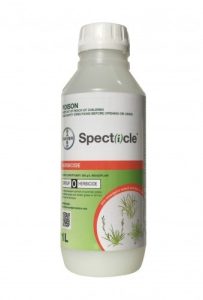
| Indaziflam | Specticle | 29 | Control | Up to 8-month residual; warm season turf |
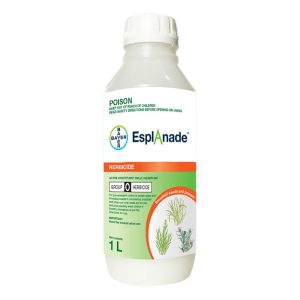
| Indaziflam | Esplanade | 29 | Control | Not registered on turf — paths and hardscapes only |
| Pendimethalin | Battalia 435 | 3 | Suppression only | Reduces plant numbers but does not give full control |
Note on Esplanade: Esplanade (indaziflam) is effective against capeweed but is not registered for use on turf grass. Do not apply it to lawn or sports turf areas.
Post-emergent Capeweed Herbicides
Non-negotiable rule: always add a non-ionic surfactant (NIS) such as Optispread 1000 to any post-emergent spray for capeweed. The woolly leaf hairs mean that without a wetter, spray coverage is inadequate and control will be poor.
Target rosettes while they are small — ideally under 150 mm across in May–July. Larger rosettes in August–September can still be controlled but require higher rates and follow-up sprays.
Selective Post-emergent Herbicide Table
| Product | Active | Group | Rate/ha | Buffalo safe? | Comments |
|---|---|---|---|---|---|
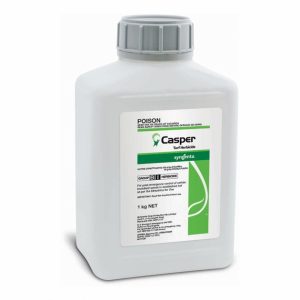
| Casper | Prosulfuron + Dicamba | 2 + 4 | 800g–1 kg | No | Best overall selective; use NIS 0.25–0.5% v/v; full effect in 4–6 weeks; higher rate in cool months |
| Contra M | Dicamba + MCPA | 4 | 6.5 L | No | Apply in 250–400 L water; no mowing 2 days before/after; no fertiliser within 2 weeks |
| Dicamba | Dicamba | 4 | 1.2 L + 3.2 L 2,4-D | No | Min 1,000 L water/ha; not for buffalo or bentgrass |
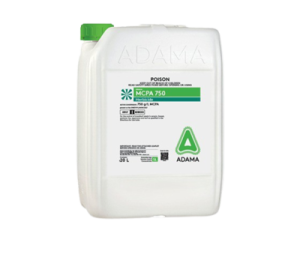
| MCPA 750 | MCPA | 4 | 930 mL–1.8 L | Check label | High water volume; transitory fine turf damage possible; no mowing 2 days before |
| 2,4-D Amine | 2,4-D | 4 | 1.8–3.2 L | No (WA only) | Kills young rosettes; no mowing 1 week before/after; wet foliage thoroughly |
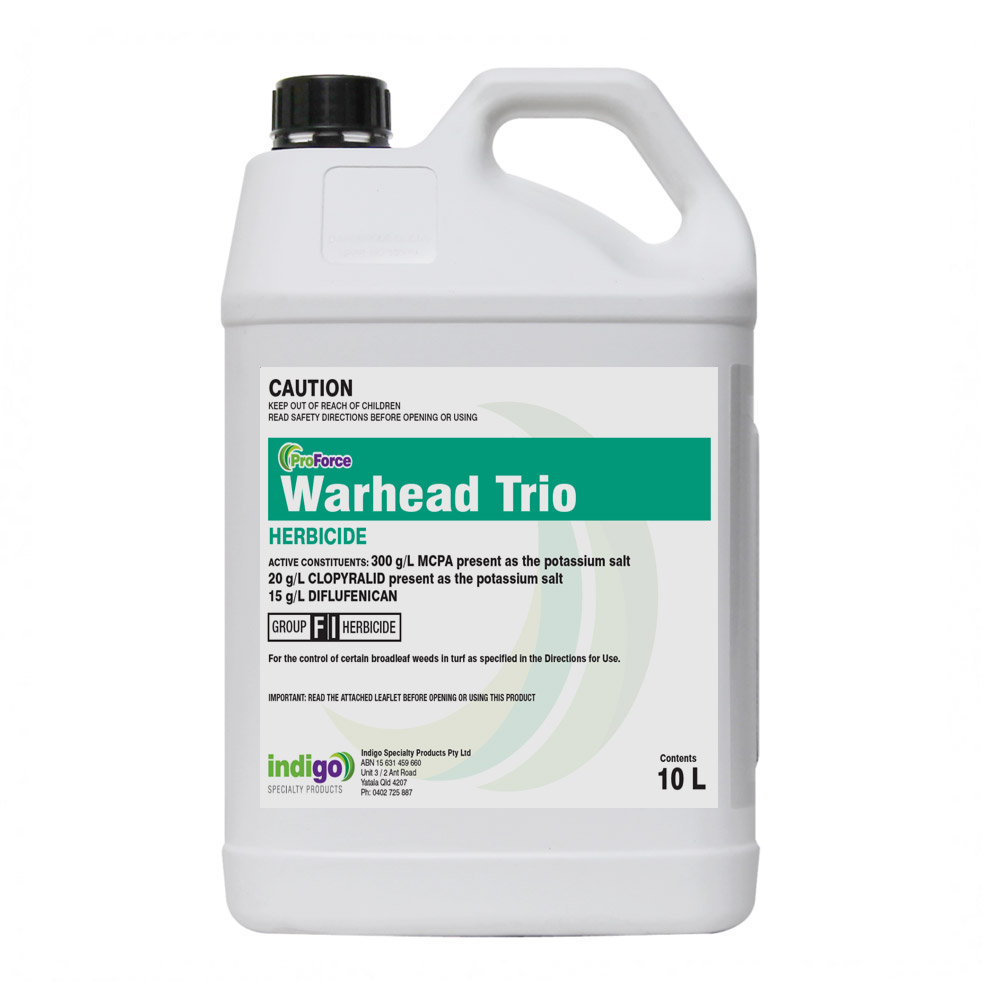
| Warhead Trio | MCPA + Clopyralid + Diflufenican | 4 + 12 | 5 L | Yes | Safe on buffalo; may discolour kikuyu and QLD blue; use NIS; avoid overlapping |
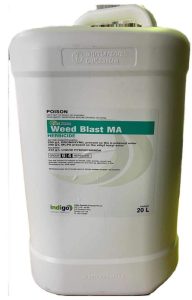
| Weed Blast MA | Bromoxynil + MCPA | 6 + 4 | 3–6 L | Yes | Safe on buffalo; min 500 L water/ha; no mowing 2 days after |
Which product to choose?
No buffalo grass: Casper is the strongest selective option. It combines two modes of action (Group 2 + Group 4) and gives the most reliable control of established rosettes. Add NIS at 0.25–0.5% v/v, apply to actively growing plants, and allow 4–6 weeks for full effect. Follow up with a spot spray at 6 weeks if any plants remain.
Buffalo grass lawns: Warhead Trio and Weed Blast MA are the main safe options. Both are Group 4-based and less potent on large, mature rosettes than Casper — so timing (smaller plants) matters even more here.
Early-season, small rosettes (May–June): MCPA or 2,4-D can kill young rosettes effectively at lower cost. Upgrade to Casper or Contra M if rosettes are already large or control has been poor in previous seasons.
Non-selective Control
For total renovation, path edges, or areas where turf removal is acceptable:
| Product | Active | Group | Rate/ha |
|---|---|---|---|
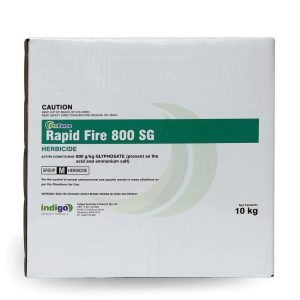
| Rapid Fire 800SG | Glyphosate | 9 | 0.9–1.35 kg |
| Glufosinate 200 | Glufosinate-ammonium | 10 | 1–6 L |
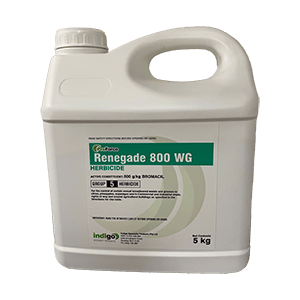
| Renegade 800WG | Bromacil | 5 | 3.5–6.5 kg (12-month residual) |
| Numchuk Quad | Terbuthylazine + Glyphosate + Amitrole + Oxyfluorfen | 5+9+34+14 | 20–25 L |
| Cortex Duo | Nonanoic Acid + Oxyfluorfen | 14 | 7 L/1,000 L (3-month residual) |
How do I get rid of capeweed in my lawn?
The most effective program is a two-step approach: apply a prodiamine pre-emergent in February to April to reduce germination, then follow up in May to July with a selective post-emergent (Casper for non-buffalo turf, Warhead Trio for buffalo) plus a non-ionic surfactant. Without the surfactant, spray coverage on the woolly leaves is inadequate and control will be poor regardless of product choice.
Why won't my capeweed spray work?
The most common reason is the absence of a wetting agent (NIS). Capeweed has dense woolly hairs on its leaf undersides that repel water-based sprays. Add Optispread 1000 or another quality NIS to every capeweed spray. The second most common reason is treating large rosettes in September as these require higher rates and multiple applications.
Is capeweed toxic?
Yes, to livestock. In cool, cloudy conditions the plant accumulates toxic nitrate levels that suppress magnesium uptake in grazing animals, causing grass tetany. In horses, it can cause stringhalt. It is not a significant human health hazard through skin contact, but should not be composted or left in areas where livestock can access it.
What pre-emergent works on capeweed?
Prodiamine (Barricade, Onset 10GR) and indaziflam (Specticle) both control capeweed. Apply before autumn soil temperatures trigger germination in typically February to April in southern Australia. Pendimethalin suppresses but does not fully control it. Esplanade (indaziflam) is effective but not registered on turf grass.
When is the best time to spray capeweed?
May to July, when rosettes are actively growing and small (under 150 mm). This is the window where a single application with NIS typically gives full control. Waiting until August to September when rosettes are large requires higher product rates, is more likely to need a follow-up spray, and increases the risk of turf damage at elevated application rates.
Can I use a hose-on weed killer for capeweed?
Hose-on broadleaf products generally contain MCPA, 2,4-D, or dicamba, which do have activity on capeweed. They can work on young rosettes in May to June but are unreliable on large or mature plants. For reliable results, tank-mix a concentrated selective such as Casper with a NIS in a backpack or boom sprayer for uniform coverage.
Written by Jerry Spencer, Principal Agronomist, Gilba Solutions Pty Ltd. BSc Hons Soil Science, former STRI agronomist, author of Nutrition of Sports Turf in Australia (CSIRO/Landlinks Press). 35+ years advising golf courses, stadiums and councils across Australia, NZ, UK and Europe.
Related pages: Weed ID Chart | Dandelion | Catsear | Sowthistle | Bindii | Warhead Trio Herbicide | Broadleaf Weed Control in Autumn | What Weeds Tell Us About Your Soil

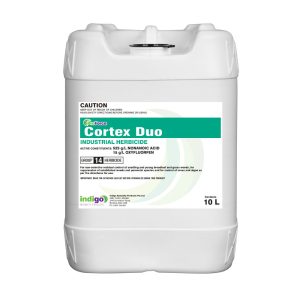
ProForce Cortex Duo Industrial Herbicide is a non glyphosate weed killer. It is both a non-selective knockdown & a residual herbicide. You can use this to kill seedling & young

Principal agronomist, Gilba Solutions Pty Ltd
BSc Hons Soil Science (Newcastle). Former STRI agronomist. Author of Nutrition of Sports Turf in Australia (CSIRO/Landlinks Press). 35+ years advising on sports turf, golf and stadia across Australia, NZ, UK and Europe.
