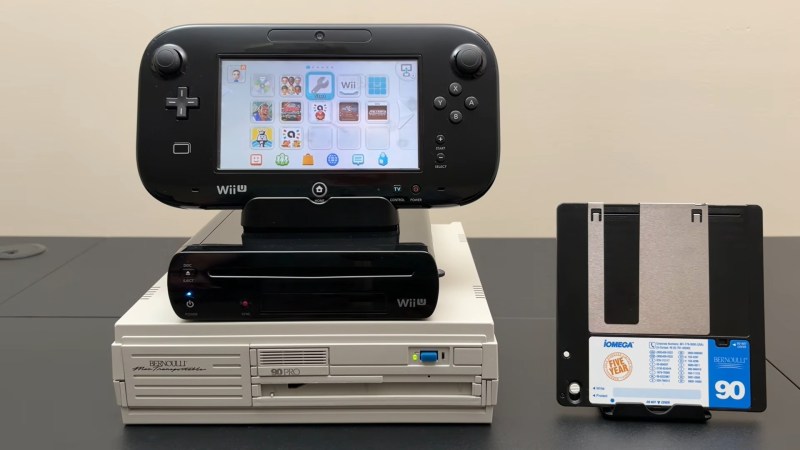
The Bernoulli disk was a wild piece of 1980s hardware. Take a big floppy. Spin the platter at 1500 RPM just a micron or so from a read head. The airflow around that rapidly-spinning disk actually stabilizes the disk that close to the read-head via the Bernoulli effect, hence the name. Once upon a time, everybody wanted a Bernoulli Box to put under their Macintosh 512, but [Will It Work?] wanted to see how well these old drives held up to the 21st century by using it to load games onto a WiiU.
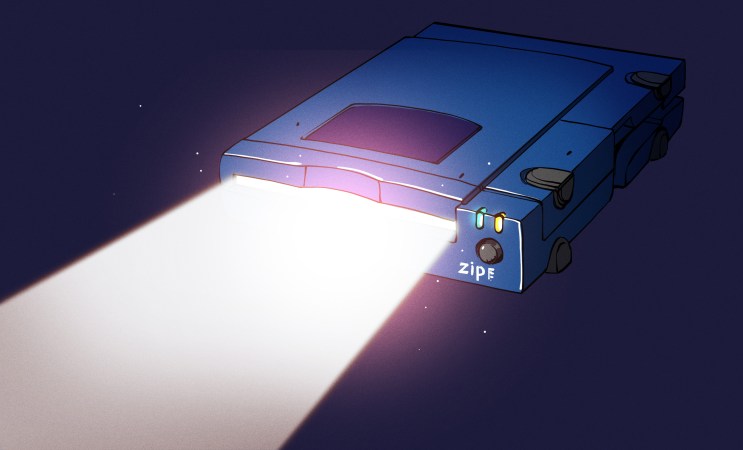
It’s not as crazy at is it seems. The WiiU is happy to read and write anything that looks like a USB mass storage device. The Bernoulli Box is of course pre-USB — even the later model 5 1/4″ drive [Will] is using from 1987. That means it uses SCSI, the USB of the 1980s. He’s got a 90 MB disk, though Iomega did make disks of higher capacity in that format, all the way up to 230 MB. Yes, the same Iomega of Zip-drive fame and infamy. But don’t worry, the peculiar pneumatic nature of the Bernoulli disks makes them immune to the click of death.
You might think it’s going to take a great deal of hacking and homebrew to get the WiiU talking to a SCSI drive from the 80s, but as we said in the introduction, Nintendo made this thing respect USB conventions, so all that’s needed is an SCSI-to-USB cable. Well, plus a passive SCSI 1 to SCSI 2 adapter to get the USB adapter to fit.
It doesn’t seem like the drive slows down the WiiU nearly as much as we’d expect, but then it’s not a console known for fast load times. The other surprising detail is how much space the WiiU’s formatting sucked up, knocking the 90 MB disk down to only 68 MB. Combine that with the WiiU’s firmware wanting to pad space for save files, and not much fits. Thus we don’t expect this odd tower of power to take off like the original did. Still, if you had one of these back in the day, it might be a nice nostalgia hit to hear the drive whirring away.
If you think a disk drive is something Nintendo would never imagine for their consoles, think again! The Japanese version of the NES had the Famicom Disk System, which turns out to be essential if you want to run UNIX on it.
Continue reading “Bernoulli Disk Goes “Wii!” When Plugged Into WiiU”