

Image

This Week In Security: Arch AUR, Steam Marketplace, WordPress All Face Issues, Taco-Themed Coding, And Mythos Makes National News

Starting on June 11, 2026, the Arch User Repository (AUR) was targeted by malware which rapidly compromised over 1,500 packages. The AUR repository allows for abandoned community packages to be taken over by a new maintainer, which was exploited by the attackers to claim ownership.

Once the packages were adopted by the malicious maintainers, the next part should sound familiar: The package build scripts, which are executed by the Arch yay and paru package managers, were modified to install malicious NPM packages (atomic-lockfile and js-digest) each containing the now-usual suite of infostealer malware targeting browser credentials and tokens, SSH private keys, package repository tokens, cloud compute, AI tokens, and crypto wallets.

The malware once installed uses several tricks to cloak itself by renaming processes, and to install systemd services to restart itself, and leveraging eBPF filtering in the kernel to hide the sockets and processes further. It specifically targets browsers and Electron-based applications, which are basically a light-weight Chromium browser disguised as an application anyway. Slack, Discord, Signal, and many more use the Electron wrapper.

A preliminary analysis of the malware is available, which breaks down the exact behavior in more detail and lists the known targets of the malware.

Initially believed to be “only” a few hundred packages, the compromised list eventually grew to over 1500, and additional packages may still be discovered. On June 14, Phoronix reported that a second wave of compromised packages has been found in the AUR repositories, including NeoVim plugins and multiple browsers. The second set of infected packages were compromised in a similar fashion, but with more heavily obfuscated scripts.

Steam Wallpaper Malware

Kaspersky Labs finds that Steam users have been targeted by malware uploaded via a popular animated wallpaper application, “Wallpaper Engine”.

While Valve normally does an admirable job filtering the Steam store, it looks like an exploit has slipped through in “Wallpaper Engine”. Animated wallpapers can be videos, web pages, or full executables themselves. Obviously, being able to run any program masquerading as wallpaper directly is an excellent vector to install malware, so of course this is what happened.

Using the integrated Steam Workshop, which allows users to share game mods and other game content directly, malicious wallpapers install a wide variety of malware including the usual gamut of infostealers, remote access, residential proxy, key logging, and crypto miners. This makes it one of the rare times installing crypto miners almost makes sense, considering most Steam users likely have better than average video cards.

Once a user is infected, the malware also steals the current Steam login credentials, and several instances attempt to then upload additional infected wallpapers to the Steam Workshop under the compromised users identity, completing the supply chain circle of life.

Continue reading “This Week In Security: Arch AUR, Steam Marketplace, WordPress All Face Issues, Taco-Themed Coding, And Mythos Makes National News”

Image

This Week In Security: Unicode, Truecrypt, And NPM Vulnerabilities

Unicode, the wonderful extension to to ASCII that gives us gems like “✈”, “⌨”, and “☕”, has had some unexpected security ramifications. The most common problems with Unicode are visual security issues, like character confusion between letters. For example, the English “M” (U+004D) is indistinguishable from the Cyrillic “М” (U+041C). Can you tell the difference between IBM.com and IBМ.com?

This bug, discovered by [John Gracey] turns the common problem on its head. Properly referred to as a case mapping collision, it’s the story of different Unicode characters getting mapped to the same upper or lowercase equivalent.

'ß'.toLowerCase() === 'SS'.toLowerCase() // true
// Note the Turkish dotless i
'John@Gıthub.com'.toUpperCase() === 'John@Github.com'.toUpperCase()

GitHub stores all email addresses in their lowercase form. When a user sends a password reset, GitHub’s logic worked like this: Take the email address that requested a password reset, convert to lower case, and look up the account that uses the converted email address. That by itself wouldn’t be a problem, but the reset is then sent to the email address that was requested, not the one on file. In retrospect, this is an obvious flaw, but without the presence of Unicode and the possibility of a case mapping collision, would be a perfectly safe practice.

This flaw seems to have been fixed quite some time ago, but was only recently disclosed. It’s also a novel problem affecting Unicode that we haven’t covered. Interestingly, my research has turned up an almost identical problem at Spotify, back in 2013.
Continue reading “This Week In Security: Unicode, Truecrypt, And NPM Vulnerabilities”

DNS Cache Poisoning Webcast

Image
UPDATE: Full audio of the webcast is now available

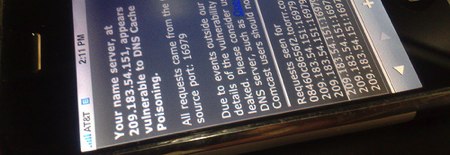
Today Black Hat held a preview webcast with [Dan Kaminsky] about the massive DNS bug he discovered. On July 8th, multiple vendors announced a patch for an undisclosed DNS vulnerability. [Dan Kaminisky] did not release the details of the vulnerability at that time, but encouraged security researchers to not release their work, if they did happen to discover the bug. On the 21st, the full description of the vulnerability was leaked.

In today’s webcast, [Dan] covered how he felt about the handling of the vulnerability and answered a few questions about it. He started out by talking about how he stumbled across the bug; he was working on how to make content distribution faster by using DNS to find the server closest to the client. The new attack works because DNS servers not using port randomization make it easy for the attacker to forge a response. You can read the specifics of the attack here.

Continue reading “DNS Cache Poisoning Webcast”








