Hackaday Links Column Banner

Hackaday Links: June 21, 2026

Today marks the summer solstice, the longest day of the year and the start of astronomical summer in the Northern Hemisphere. This doesn’t really have much to do with hacking hardware or building gadgets other than the fact that from this point on you’ll have progressively less daylight hours to do it in each day. Of course, if you do your best work in the middle of the night this won’t impact things much.

If you’re as likely to find a controller in your hand as a soldering iron in the evenings, you might be interested in a recent filing against Sony. Lawyers representing a group of four gamers allege that the entertainment giant is violating a California law that says digital storefronts need to make it clear that buyers don’t technically own the games in question but are merely licensing them — a license which, as we’ve seen in the past, can be revoked or modified at any time with no restitution made to the purchaser.

Now while we agree conceptually that selling gamers a license rather than an actual copy of the game is clearly a one-sided deal, we’re still not sure this case has a lot of merit. As far as we can tell, Sony does make it clear in the fine print that you’re not really going to own anything once they take your money. Or, at the very least, they make it equally as clear as any other company that’s selling digital downloads these days. Should the court actually find that said fine print is a little too fine, it could conceivably have ramifications throughout the entertainment industry. This is certainly a case to keep an eye on.
Continue reading “Hackaday Links: June 21, 2026”

Image

Custom Mainboard For PS2 Portable

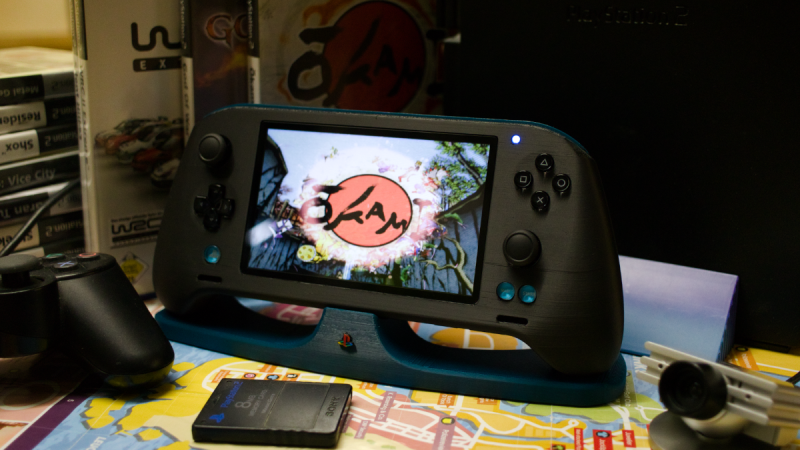
As time marches on, the retro gaming community gets more and more access to older systems. This is partially a product of modern computing having much more power to emulate more demanding systems, but also because many in the community have spent more time with their favorite systems. Such is the case for [tschicki] who has spent considerable time and effort reverse engineering the Playstation 2 to come up with this custom mainboard for a handheld version that still uses some of the original chips from the console.

This Playstation 2 handheld console is designed almost completely from the ground up, not just including the impressive main board but also its modernized features, including USB power delivery handled by an RP2040, digital video output, support for modern storage media like SD cards, a customized boot ROM, and upgraded audio. The DualShock 2 controller is also implemented within the handheld, and the case itself is designed to be 3D printed. It’s an impressive effort which preserves the original feel of the console without relying too much on ancient hardware for everything.

Before jumping in to building one yourself, though, [tschicki] cautions that this project is not for the faint of heart, as it requires some specilized tools and a high degree of skill, but for those still wishing to attempt this build all of the instructions are available on the project site. For such a popular console it’s no surprise we’ve seen plenty of other handheld PS2s before, from this one which uses an original PS2 mainboard to this one we featured way back in 2010.

Thanks to [raz] for the tip!

Image

Adapting A 100-Year-Old Lens To A Modern Camera

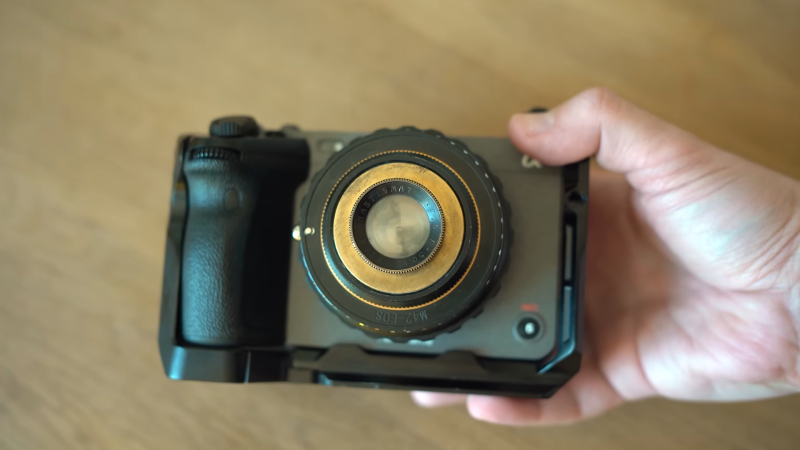
You can get all kinds of fancy lenses for modern cameras, with all sorts of mechanical and electronic wizardly to make them shoot better images. But what if you paired a vintage lens with a modern camera? It would take some work, as [Mathieu] found out, but you’d also get some interesting results.

The optic in question is a 100-year old lens—a Foth 50 mm f2.5 to be precise, originally used with a folding film camera. It was sourced from a market for just 3 euros. Notably, the lens was not designed for modern cameras, and so lacks an aperture and focusing mechanism. [Mathieu] thus had to fabricate something to fit the lens to a Sony FX3. A first attempt used an aperture adapter from Amazon and an elcoid adapter, but there were vignetting problems due to the lens placement in this case. Ultimately, [Mathieu] went with a special macro adapter that allowed him to control focus and tuck in an ND filter behind the lens, which made up for the lack of an aperture.

The vintage glass isn’t the sharpest lens out there, but that’s kind of what’s fantastic about it. The center of the frame is certainly focused, but it fades out softly towards the edges of the image, giving a cinematic, dreamlike effect. The bokeh in the background are particularly charming, too. As far as 3 euro lenses go, this one was a hit.

You can slap just about any lens on anything if you get creative with how you do it. Video after the break.

Continue reading “Adapting A 100-Year-Old Lens To A Modern Camera”

Image

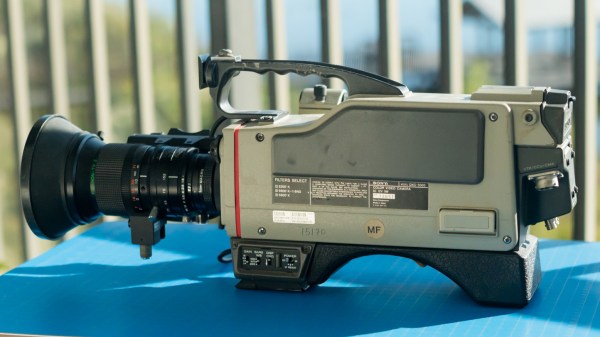
Converting A 1980s Broadcast Camera To HDMI

Although it might seem like there was a sudden step change from analog to digital sometime in the late 1900s, it was actually a slow, gradual change from things like record players to iPods or from magnetic tape to hard disk drives. Some of these changes happened slowly within the same piece of hardware, too. Take the Sony DXC-3000A, a broadcast camera from the 1980s. Although it outputs an analog signal, this actually has a discrete pixel CCD sensor capturing video. [Colby] decided to finish the digitization of this camera and converted it to output HDMI instead of the analog signal it was built for.

The analog signals it outputs are those that many of us are familiar with, though: composite video. This was an analog standard that only recently vanished from consumer electronics, and has a bit of a bad reputation that [Colby] thinks is mostly undeserved. But since so many semi-modern things had analog video outputs like these, inspiration was taken from a Wii mod chip that converts these consoles to HDMI. Unfortunately his first trials with one of these had confused colors, but it led him to a related chip which more easily outputted the correct colors. With a new PCB in hand with this chip, a Feather RP2040, and an HDMI port the camera is readily outputting digital video that any modern hardware can receive.

Besides being an interesting build, the project highlights a few other things. First of all, this Sony camera has a complete set of schematics, a manual meant for the end user, and almost complete user serviceability built in by design. In our modern world of planned obsolescence, religious devotion to proprietary software and hardware, and general user-unfriendliness this 1980s design is a breath of fresh air, and perhaps one of the reasons that so many people are converting old analog cameras to digital instead of buying modern equipment.

Front panel of Sony Blu-ray player

Blu-ray Won, But At What Cost?

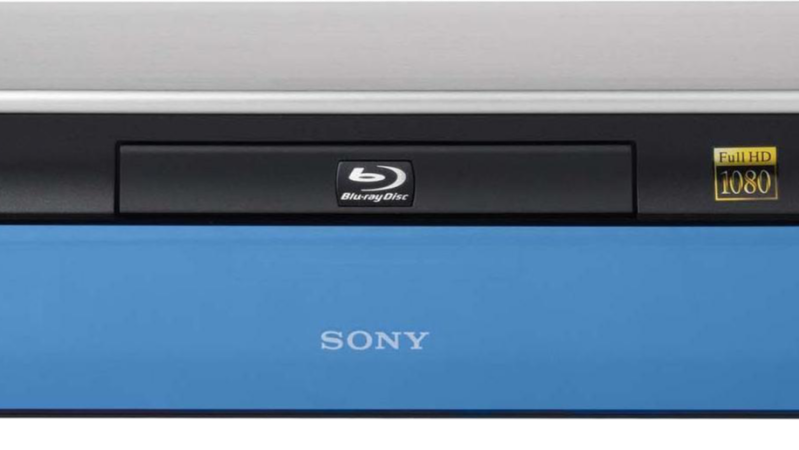
Over on their substack [ObsoleteSony] has a new article: The Last Disc: How Blu-ray Won the War but Lost the Future.

In this article the author takes us through the history of Blu-ray media and how under Sony’s stewardship it successfully defeated the competing format of the time, HD DVD. Sony started behind the eight ball but through some deft maneuvering managed to come out on top. Perhaps the most significant contributing factor was the inclusion of Blu-ray drives in the PlayStation 3.

The person leading the Blu-ray initiative for Sony was Masanobu Yamamoto, whose legacy was the compact disc. What was needed was a personal media format which could deliver for high-definition 1080p video. As the DVD format did not have the storage capacity required, new formats needed to be developed. The enabling technology for both Blu-ray and HD DVD media was the blue laser as it allowed for more compact encoding.

Sony’s Blu-ray format became the dominating format for high-definition personal media…just as physical media died.

Thanks to [Stephen Walters] for writing in about this one.

Image

Repairing Vintage Sony Luggable Calculators

You might wonder why you’d repair a calculator when you can pick up a new one for a buck. [Tech Tangents] though has some old Sony calculators that used Nixie tubes, including one from the 1960s. Two of his recent finds of Sony SOBAX calculators need repair, and we think you’ll agree that restoring these historical calculators is well worth the effort. Does your calculator have a carrying handle? We didn’t think so. Check out the video below to see what that looks like.

The devices don’t even use modern ICs. Inside, there are modules of discrete parts encapsulated in epoxy. There isn’t even RAM inside, but there is a delay line memory, although it is marked “unrepairable.”

There is some interesting history about this line of calculators, and the video covers that. Apparently, the whole line of early calculators grew out of an engineer’s personal project to use transistors that were scrapped because they didn’t meet the specifications for whatever application that used them.

The handle isn’t just cosmetic. You could get an external battery pack if you really wanted a very heavy — about 14 pounds (6.3 kilograms) — and large portable calculator. We are sure the $1,000 retail price tag didn’t include a battery.

These machines are beautiful, and it is fun to see the construction of these old devices. You might think our favorite calculator is based on Star Trek. As much as we do like that, we still think the HP-41C might be the best calculator ever made, even in emulation.

Continue reading “Repairing Vintage Sony Luggable Calculators”

An orange PSOne in the shape of a crab sits next to a large CRT monitor displaying a video game of a person running through what appears to be a park. A Pepsi logo is toward the top of the HUD.

Playstacean Evolves The PSOne Into The Crab It Was Always Meant To Be

Odd hardware designs crop up in art and renders far more frequently than in the flesh, but console modder [GingerOfOz] felt the need to bring [Anh Dang]’s image of the inevitable carcinization of our gaming consoles to life.

Starting with the image as inspiration, [GingerOfOz] got to work in CAD, creating an entirely new shell for the battered PSOne he adopted for the project. The final product is slightly less curvy than the picture, but some artistic license was necessary to go from the page to the real world.

The enclosure itself looks straightforward, if a bit tedious, but the articulating crab controller is a work of art itself. He could’ve made the arms static or non-functional, but they’re a fully-functional PlayStation controller that can move around just like on your favorite crustacean at the beach, minus the pinching. We love this whimsical take on the console mod which is a breath of salty air to the continuous race to get increasingly complex consoles into handheld form, although there’s certainly nothing wrong with that!

If you’re looking for some other console mods, how about this Apple M1 inside a Wii or getting your old Ouya up-and-running again?

Continue reading “Playstacean Evolves The PSOne Into The Crab It Was Always Meant To Be”