


Saxophone
 Saxophone family, from soprillo (left) to contrabass (right) | |
| Woodwind instrument | |
|---|---|
| Classification | Single-reed |
| Hornbostel–Sachs classification | 422.212-71 (Single-reed aerophone with keys) |
| Inventor(s) | Adolphe Sax |
| Developed | 1840s |
| Playing range | |
 | |
| Related instruments | |
|
Sizes:
Orchestral saxophones: Specialty saxophones: | |
| Musicians | |
| See list of saxophonists | |

A saxophone (often called the sax) is a type of single-reed woodwind instrument. The saxophone has a piece of wood, called a reed on a mouthpiece. The player blows air into the mouthpiece. This vibrates the reed and makes sound. The pitch can be changed by closing and opening holes in the saxophone. This changes the length of the tube.[1] The holes are closed by leather pads. These leather pad connect to keys that can be pressed by the player. A person who plays the saxophone is called a saxophonist or saxist.[2]
It was invented in the early 1840s by Adolphe Sax.[3] Sax made two types of saxophones. Each type of saxophone had 7 types. One group of saxophones had instruments in the key of C or F. The other type of saxophones were in B♭ and E♭. The B♭ and E♭ instruments soon became popular. Most saxophones are now in those keys.
Saxophones are used in many types of music. They are used in classical music (including as concert bands, chamber music, solos, and sometimes orchestras), military bands, marching bands, jazz (like as big bands and jazz combos), and contemporary music. The saxophone is also used as a melody instrument in a horn section in some types of rock and roll and popular music.
The saxophone family mostly has of B♭ and E♭ instruments. The most common types of saxophones are the B♭ soprano, E♭ alto, B♭ tenor, and E♭ baritone. The E♭ sopranino and B♭ bass saxophones are also sometimes used.
| # | B♭ family | E♭ family |
|---|---|---|
| 1 (highest) | Soprillo (piccolo) | — |
| 2 | — | Sopranino |
| 3 | Soprano | — |
| 4 | — | Alto |
| 5 | Tenor | — |
| 6 | — | Baritone |
| 7 | Bass | — |
| 8 | — | Contrabass |
| 9 (lowest) | Subcontrabass | — |
Uses
[change | change source].jpg)
In military bands
[change | change source]The saxophone were first popular in military bands. The instrument was first ignored in Germany. French and Belgian military bands wanted to used the saxophone in ensembles. Most French and Belgian military bands had at least 4 saxophones. They had an E♭ baritone, B♭ tenor, E♭ alto and B♭ soprano. These four instruments are the most popular saxophones. The E♭ contrabass and B♭ bass saxophones are usually too big to use. The E♭ sopranino is usually not loud enough.
In classical music
[change | change source]The saxophone is used in concert bands. These usually have 2 E♭ alto saxophones, a B♭ tenor saxophone, and an E♭ baritone saxophone. A B♭ soprano saxophone is sometimes used. It is usually played by the first alto saxophonist. A bass saxophone in B♭ is also sometimes used (especially in the music of Percy Grainger).[4]
Saxophones are used in chamber music. There are many saxophone quartets, for example. A saxophone quartet usually has a B♭ soprano saxophone, E♭ alto saxophone, B♭ tenor saxophone, and E♭ baritone saxophone (SATB). Sometimes the soprano is replaced with a second alto sax (which makes AATB). A few saxophone quartets have different setups. For example, James Fei's Alto Quartet[5] has 4 alto saxophones.
In the 20th and 21st centuries, the saxophone became more common in symphony orchestras. The instrument has also been used in opera and choral music. Musical theatre music can also have parts of saxophone. These sometimes double another woodwind or brass instrument.
Common music
[change | change source]- Fantasie sur un thème original (1860)—Jules Demersseman
- Rapsodie pour orchestre et saxophone (1901)—Claude Debussy
- Légende, symphonic suite for chromatic harp, alto saxophone and strings (1903)–André Caplet[6]
- Choral varié, Op.55 (1903)—Vincent d'Indy
- Impressions d'automne, Elegy for alto saxophone, oboe, 2 clarinets, basson, harp, organ and 2 cellos (1905)–André Caplet[6]
- Légende, Op.66 (1918)—Florent Schmitt
- Saxophone Concerto (1934)—Lars-Erik Larsson
- Concerto in E♭ major for alto saxophone and orchestra (1934)
—Alexander Glazunov - Concertino da camera (1935)—Jacques Ibert
- Aria pour saxophone alto (1936)—Eugène Bozza
- Sonata for alto saxophone and piano (1937)—Bernhard Heiden
- Scaramouche for alto saxophone and piano (1937)—Darius Milhaud
- Ballade for Alto Saxophone (1938)—Henri Tomasi
- Sonata for alto saxophone and piano, Op. 19 (1939)—Paul Creston
- Sonata for alto saxophone and piano (1943)—Paul Hindemith
- Concerto for alto saxophone and orchestra, Op. 26 (1944)—Paul Creston
- Concerto for alto saxophone and orchestra (1948)—Ingolf Dahl
- Fantasia for saxophone, three horns, and strings (1948)—Heitor Villa-Lobos
- Concerto for alto saxophone and orchestra (1949)—Henri Tomasi
- Tableaux de Provence (1955)—Paule Maurice
- Prélude, cadence et finale (1956)—Alfred Desenclos
- Saxophone Concerto (1958)—Erland von Koch
- Concerto for alto saxophone and orchestra (1959)—Pierre Max Dubois
- Élégie et rondeau pour saxophone alto et orchestre (1961)—Karel Husa
- Sonata for alto saxophone (1970)—Edison Denisov
- Sonata for alto saxophone and piano, Op. 29 (1970)—Robert Muczynski
- Fantasia on Auld Lang Syne for 16 saxophones (1976)—Ernest Tomlinson
- Panic for alto saxophone, jazz drum kit, winds and percussion (1995)—Harrison Birtwistle
- Concerto for Saxophone Quartet (1995)—Philip Glass[7][8]
- Because It Has a Song (2010) - James Barger
- Concerto for Alto Saxophone and Orchestra (2013)—John Adams
Popular saxophone quartets
[change | change source]- Premier Quatuor [Quartet No. 1], Op. 53 (1857) — Jean-Baptiste Singelée
- Quartette [Quartet] (1879) — Caryl Florio
- Saxophone Quartet in B♭, Op.109 (1932) — Alexander Glazunov
- Introduction et variations sur une ronde populaire (1934) — Gabriel Pierné
- Andante et Scherzo for saxophone quartet (1938) — Eugène Bozza
- Variations Saxophoniques (1939) – Fernande Decruck
- Quatuor pour Saxophones [Quartet for Saxophones], Op. 102 (1939)
— Florent Schmitt - Quatuor pour Saxophones [Quartet for Saxophones] (1956)
— Pierre Max Dubois - Quatuor [Quartet] (1962) — Alfred Desenclos
- Suite for Saxophone Quartet (1979) — Paul Creston
- Just for Show (1985) — Lennie Niehaus
- Pollywog's Lake Talk (1986) — Barry Ulman
- XAS (1987) — Iannis Xenakis
- Back Burner (1989) — Frank Ticheli
- Recitation Book (2006) — David Maslanka
- Strange Humors (2008) — John Mackey (composer)
- Black (2012) — Marc Mellits
- Polar Vortex (2014) — Chris Evan Hass
- In Memoriam (2015) — Joel Love
- Volcanic Ash (2017) — Chris Evan Hass
- Altera (2017) — Max Gray
- Impressions (2020) — Randy Stagich
Chamber music with saxophone
[change | change source]- Nonet (1923) – Heitor Villa-Lobos
- Chôros No. 7 (1924) – Heitor Villa-Lobos
- Chôros No. 3 (1925) – Heitor Villa-Lobos
- Quartet for clarinet, tenor saxophone, violin, and piano, Op. 22 (1930)
– Anton Webern - The Flowering Peach, Op. 125, for clarinet, saxophone, percussion (timpani, tam-tam, vibraphone, glockenspiel), harp and celesta (1954)
– Alan Hovhaness - Prometheus for flute, oboe, cor anglais, clarinet, saxophone, and bassoon (1967) – Brian Ferneyhough
- Erwachen, Nr. 92 (2007) – Karlheinz Stockhausen
Orchestral music with saxophones
[change | change source]- L'Arlésienne (1872) – Georges Bizet
- Sylvia (1876) – Léo Delibes
- Symphonia Domestica (1904) – Richard Strauss
- The Wooden Prince (1917) – Béla Bartók
- Pictures at an Exhibition (1922 Ravel version)
– Modest Mussorgsky/Maurice Ravel - Boléro (1928) – Maurice Ravel
- La création du monde (1923) – Darius Milhaud
- Symphony No. 4 (1924) – Charles Ives
- Rhapsody in Blue (1924) – George Gershwin
- Chôros No. 8 (1925) – Heitor Villa-Lobos
- Háry János (1926) – Zoltán Kodály
- Chôros No. 10 (1926) – Heitor Villa-Lobos
- Piano Concerto (1926) – Aaron Copland
- An American in Paris (1928) – George Gershwin
- Symphony No. 1 (1928) – Aaron Copland
- Der Wein (1929) – Alban Berg
- The Golden Age (1930) – Dmitri Shostakovich
- Belshazzar's Feast (1931) – William Walton
- Job: A Masque for Dancing (1931) – Ralph Vaughan Williams
- Suite No. 1 (1931) – Dmitri Shostakovich
- Uirapuru (1934) – Heitor Villa-Lobos
- Lieutenant Kijé (1934) – Sergei Prokofiev
- Violin Concerto (1935) – Alban Berg
- Suite No. 2 (1938) – Dmitri Shostakovich
- Romeo and Juliet (1938) – Sergei Prokofiev
- Alexander Nevsky (1938) – Sergei Prokofiev
- Symphonic Dances (1940) – Sergei Rachmaninoff
- Sinfonia da Requiem (1940) – Benjamin Britten
- Chôros No. 11 (1928–41) – Heitor Villa-Lobos
- Chôros No. 6 (1925–42) – Heitor Villa-Lobos
- Chôros No. 12 (1925–45) – Heitor Villa-Lobos
- Symphony No. 6 (1947) – Ralph Vaughan Williams
- On the Waterfront (1954) – Leonard Bernstein
- Symphony No. 9 (1957) – Ralph Vaughan Williams
- Suite for Variety Orchestra (post-1956) – Dmitri Shostakovich
- The Prince of the Pagodas (1957) – Benjamin Britten
- Gruppen (1955–57) – Karlheinz Stockhausen
- Carré (1959–60) – Karlheinz Stockhausen
- Déclarations d'orage for reciter, soprano, baritone, three improvising instruments (alto saxophone, tuba, synthesizer), large orchestra and tape (1988–89) – Henri Pousseur
- City Noir (2009) – John Adams
Operas and musicals with saxophones
[change | change source]- Le Roi de Lahore (1877) Jules Massenet
- Hérodiade (1881) – Jules Massenet
- Werther (1892) – Jules Massenet
- Turandot (1926) – Giacomo Puccini
- Jonny spielt auf (1927) – Ernst Krenek
- Neues vom Tage (1929) – Paul Hindemith
- Lulu (1937) – Alban Berg
- Billy Budd (1951) – Benjamin Britten
- West Side Story (1957) – Leonard Bernstein
- We Come to the River (1976) – Hans Werner Henze
- Samstag aus Licht (1984) – Karlheinz Stockhausen
- Nixon in China (1987) – John Adams
In jazz and popular music
[change | change source]_Jazz_Band_and_Leader_Back_with_(African_American)_15th_New_York._Lieutenant_Jame_._._._-_NARA_-_533506.jpg)
In the beginning of the 20th century, ragtime music became popular in the United States. At the same time, saxophones also became more common. Many bands were made with ragtime influences. These bands often had saxophones. These bands had syncopated African-American rhythms. W. C. Handy and James R. Europe both led ragtime groups with saxophones.Ragtime bands also became popular in military bands. Europe's 369th Infantry Regiment Band played ragtime music in France in 1918.[9] Many dance bands were made in the 1920s. These bands were influenced by ragtime. The saxophone was also used in Vaudeville in the same period. Ragtime, Vaudeville, and dance bands made saxophones very popular.
Rudy Wiedoeft became the most popular saxophonist. This lead to the "saxophone craze" of the 1920s.[10] Saxophones started to be used in many different types of music.
Saxophones became very common in jazz. The Fletcher Henderson Orchestra was started in 1923. It had music with improvisation. It brought jazz to dance bands.[11] The Duke Ellington Orchestra and Jean Goldkette's Victor Recording Orchestra would start to have jazz solos with different types of instruments. Dance bands in jazz would become most popular with the swing music of the 1930s. These dance bands would later influence big band jazz. Big bands with saxophones also became common in talk shows. The Tonight Show had big bands led by Doc Severinsen and Branford Marsalis. The swing era influenced saxophone styles that were seen in bebop and rhythm and blues.

Coleman Hawkins played in the Fletcher Henderson orchestra from 1923 to 1934. His saxophone solos became very popular. Hawkins' solos were arpeggiated, had rich tone, and had lots of vibrato. This style was a large influence on early tenor saxophone swing band players. Chu Berry, Charlie Barnet, Tex Beneke, Ben Webster, Vido Musso, Herschel Evans, Buddy Tate, and Don Byas took inspiration from Hawkins.[12] Hawkins' bandmate Benny Carter and Johnny Hodges (Duke Ellington's alto saxophonist) became popular alto saxophone styles. Harry Carney made the baritone saxophone popular Duke Ellington Orchestra. The New Orleans player Sidney Bechet was popular for playing the soprano saxophone in the 1920s.
Chicago jazz evolved from New Orleans jazz in the 1920s. Chicago jazz was different from New Orleans jazz because it added saxophones to the ensemble. Smaller Chicago ensembles allowed for more improvisation. This allowed for saxophone innovation from saxophonists Jimmy Dorsey (alto), Frankie Trumbauer (c-melody), Bud Freeman (tenor) and Stump Evans (baritone). Dorsey and Trumbauer became an influences on tenor saxophonist Lester Young.[12]
Lester Young had a different soloing style than Hawkins'. He liked to make melodic playing. His playing followed chords and made longer phrases. He used less vibrato. His tone was also darker than other saxophonists. His playing was influential on the jazz saxophonists Al Cohn, Stan Getz, Zoot Sims, Dexter Gordon, Wardell Gray, Lee Konitz, Warne Marsh, Charlie Parker, and Art Pepper.[12]

Lester Young worked with the Count Basie Orchestra in the late 1930s. Around the same time Hawkins' 1939 recording of "Body and Soul" became very popular. These musicians made the saxophone very influential in jazz.
The greatest influence of the saxophone on jazz happened in the 1940s when Charlie Parker became popular in jazz. He played the alto saxophone. He was one of the first saxophonists to play bebop. Bebop groups in jazz were much smaller than other big bands. These groups allowed for lots of freedom with the music's harmony and melodies. This style of playing was made popular because of musicians like Parker, Dizzy Gillespie, Thelonious Monk, and Bud Powell.
During the 1950s, there were many new popular musicians. Sonny Stitt, Cannonball Adderley, Jackie McLean, Lou Donaldson, Sonny Criss and Paul Desmond were popular alto players. Lester Young, Coleman Hawkins, Dexter Gordon, John Coltrane, Sonny Rollins, Stan Getz, Zoot Sims, Lucky Thompson, Eddie "Lockjaw" Davis, and Paul Gonsalves were popular tenor saxophonists. Serge Chaloff, Gerry Mulligan, Pepper Adams and Leo Parker were popular baritone saxophonists. These musicians made the baritone a popular solo instrument. Steve Lacy was a popular soprano saxophonist. John Coltrane also made the soprano saxophone more popular in the 1960s. Kenny G also usually uses the soprano sax in smooth jazz[13]
John Coltrane, Ornette Coleman, Sam Rivers, and Pharoah Sanders made avant-garde music in the 1960s through the sax. They explored modal, harmolodic, and free jazz.

Some groups (like the World Saxophone Quartet) use the soprano-alto-tenor-baritone (SATB) group for jazz. In the 1990s, World Saxophone Quartet founder Hamiet Bluiett formed the quartet Baritone Nation (4 baritones).[14]
Image gallery
[change | change source]


 Silver-plated 'Pennsylvania Special' alto saxophone. It was made by Kohlert & Sons for Selmer[16] in Czechoslovakia, circa 1930
 1950s Grafton alto made of plastic
 Yamaha YAS-25 alto saxophone. Made in the 1990s
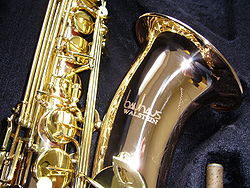 Bauhaus Walstein tenor saxophone. It was made in in 2008 with phosphor bronze
 A part of a P. Mauriat alto saxophone

 Ochres Music "No.5".
 Vito 'Model 35' alto saxophone. It was made in the 1960s.


.jpg)


Notes
[change | change source]- ↑ Cottrell, Stephen (2013). The Saxophone (Yale Musical Instrument Series). Yale Musical Instrument Series.
- ↑ Waite, Maurice, ed. (2009). Oxford Thesaurus of English (3rd ed.). Oxford University Press. p. 49. ISBN 978-0-19-956081-3.
- ↑ Raumberger, Ventzke, Claus, Karl (2001). "Saxophone". Archived copy. Oxford Music Online. doi:10.1093/gmo/9781561592630.article.24670. ISBN 978-1-56159-263-0. Archived from the original on 6 December 2022. Retrieved 6 April 2019.
{{cite encyclopedia}}: CS1 maint: archived copy as title (link) CS1 maint: multiple names: authors list (link) - ↑ Ventry, J. (26 March 1930). "A Talk On Modern Band Music". Trove.nla.gov.au. The Mercury. Archived from the original on 18 August 2018. Retrieved 3 February 2017.
- ↑ "James Fei: DVD". Archived from the original on 2006-12-17. Retrieved 2007-05-07.
- 1 2 Cottrell, Stephen (2013). The Saxophone. Yale University Press. ISBN 978-0300190953. Retrieved 5 November 2022.
- ↑ "Recommended Saxophone Repertoire Alto Saxophone Level III" (PDF). Music.indiana.edu.
- ↑ Mauk, Steven. "Selected Repertoire". Ithaca.edu. Retrieved 2014-05-19.
- ↑ Emmett Jay Scott (1919). Scott's Official History of the American Negro in the World War. Homewood Press. pp. 308–.
- ↑ "How Rudy Wiedoeft's Saxophobia Launched the Saxual Revolution" (PDF). Archived from the original (PDF) on 2019-10-25. Retrieved 2019-05-06.
- ↑ "Fletcher Henderson". Musicians.allaboutjazz.com. 4 December 2018. Archived from the original on 2012-10-10. Retrieved 2019-02-23.
- 1 2 3 Cite error: The named reference
New Grovewas used but no text was provided for refs named (see the help page). - ↑ "Kenny G | Encyclopedia.com". www.encyclopedia.com. Retrieved 2023-02-17.
- ↑ Russonello, Giovanni (2018-10-07). "Hamiet Bluiett, Baritone Saxophone Trailblazer, Dies at 78 (Published 2018)". The New York Times. ISSN 0362-4331. Retrieved 2021-03-08.
- ↑ "Photo Gallery :: SaxPics.com". saxpics.com. Archived from the original on 2015-02-14. Retrieved 2015-01-16.
- ↑ "Photo Gallery". SaxPics.com. Archived from the original on 2012-11-01. Retrieved 2014-05-19.
- ↑ "Photo Gallery :: SaxPics.com". saxpics.com.
References
[change | change source]- Grove, George (January 2001). Sadie, Stanley (ed.). The New Grove Encyclopædia of Music and Musicians (2nd ed.). Grove's Dictionaries of Music. Volume 18, pp534–539. ISBN 978-1-56159-239-5.
- Horwood, Wally (1992) [1983]. Adolphe Sax, 1814–1894: His Life and Legacy ((Revised edition) ed.). Herts: Egon Publishers. ISBN 978-0-905858-18-0.
{{cite book}}: CS1 maint: publisher location (link) - Howe, Robert (2003). Invention and Development of the Saxophone 1840–55. Journal of the American Musical Instrument Society.
- Ingham, Richard (1998). The Cambridge Companion to the Saxophone. Cambridge Companions to Music. Cambridge: Cambridge Univ. Press. ISBN 978-0-521-59348-9.
- Kool, Jaap (1931). Das Saxophon (in German). Leipzig: J. J. Weber. (translated to English as Gwozdz, Lawrence (1987). The Saxophone. Egon Publishers Ltd.)
- Kotchnitsky, Léon (1985) [1949]. Sax and His Saxophone (Fourth ed.). North American Saxophone Alliance.
- Lindemeyer, Paul (1996). Celebrating the Saxophone. William Morrow & Co. ISBN 978-0-688-13518-8.
- Marzi, Mario (2009). Il Saxofono. The Expression of Music 4 (in Italian). Varese, Italy: Zecchini Editore (Zecchini Publisher). p. 468. ISBN 978-88-87203-86-8.
- Noyes, John Russell (2000). Edward A. Lefebre (1835-1911): Preeminent Saxophonist of the Nineteenth Century (PhD Dissertation) (PDF). New York: Manhattan School of Music. Archived from the original (PDF) on 1 April 2023. Retrieved 21 April 2019.
- Segell, Michael (2005). The Devil's Horn: The Story of the Saxophone, from Noisy Novelty to King of Cool. Farrar, Straus and Giroux. ISBN 978-0-374-15938-2.
- Thiollet, Jean-Pierre (2004). Sax, Mule & Co. Paris: H & D. ISBN 978-2-914266-03-1.
Other websites
[change | change source]
| Definitions from Wiktionary |

| Media from Commons |

| News stories from Wikinews |

| Quotations from Wikiquote |

| Source texts from Wikisource |

| Textbooks from Wikibooks |

| Learning resources from Wikiversity |
- Instruments In Depth: The Saxophone An online feature with video demonstrations from Bloomingdale School of Music (June 2009)
- Saxophone Fingering Charts

