
SUPERCHARGE YOUR ONLINE VISIBILITY! CONTACT US AND LET’S ACHIEVE EXCELLENCE TOGETHER!
Search engines have evolved into advanced AI systems that interpret meaning, context, and relationships instead of simple keyword matching. Modern search visibility depends on structured intelligence rather than isolated optimization techniques. In this transformation, frameworks are no longer static concepts but dynamic semantic systems that require machine-readable representation.
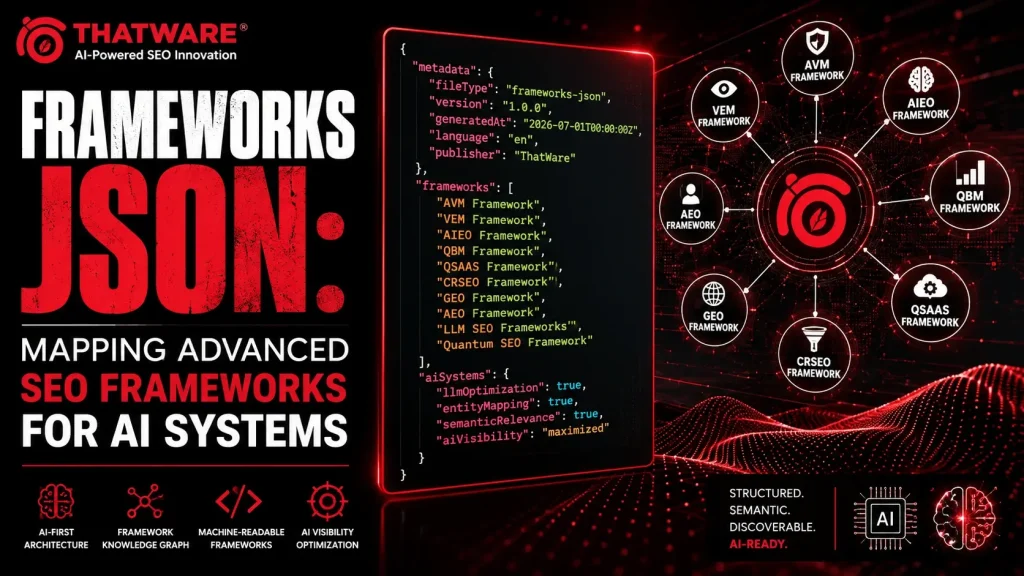
The emergence of frameworks JSON introduces a structured way to represent SEO intelligence for AI systems. It allows search engines to interpret optimization models as connected knowledge structures instead of disconnected strategies. This shift is essential for AI-driven ecosystems where understanding relationships is more important than indexing pages.
1. The Evolution of Structured SEO Intelligence
SEO is no longer a collection of tactics but a network of structured systems. These systems include visibility models, engagement logic, and semantic interpretation layers. As AI becomes central to search, structured frameworks define how machines understand digital ecosystems.
Modern optimization depends on systems like AI SEO frameworks, which enable machines to process SEO logic in structured formats. These frameworks allow search engines to interpret authority, relevance, and intent in a more advanced way than traditional SEO methods.
This evolution leads to a structured ecosystem where SEO is no longer reactive but intelligently mapped. It forms the foundation of modern AI-driven discovery systems.
2. What is Frameworks JSON?
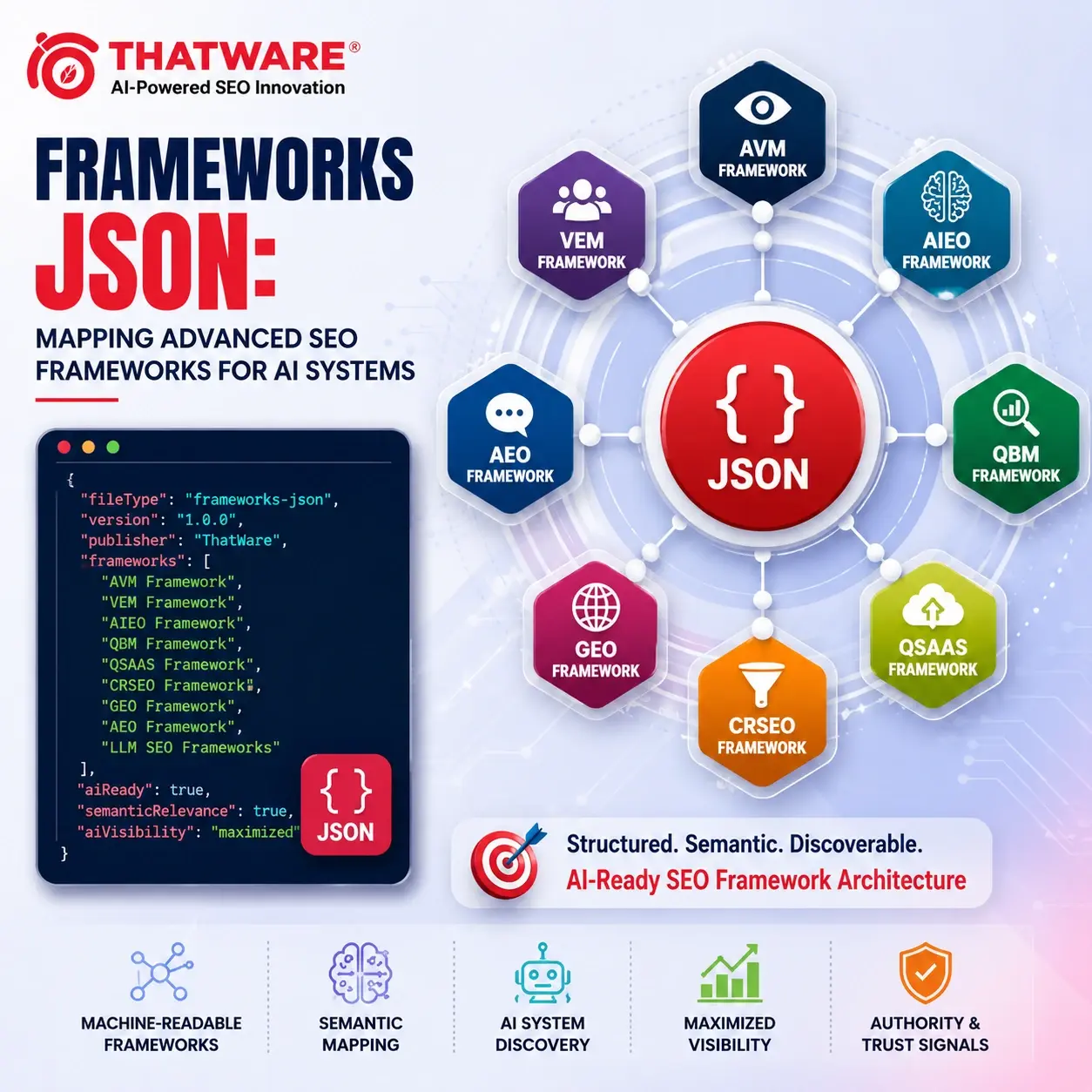
The concept of frameworks JSON represents a structured machine-readable format designed to map SEO frameworks into semantic entities. It defines how optimization systems, methodologies, and AI interpretation layers connect within a unified structure.
This system transforms SEO frameworks into data-driven entities that AI systems can understand without ambiguity. It ensures that each framework is identified, categorized, and linked within a semantic ecosystem that supports intelligent interpretation.
Instead of treating SEO frameworks as isolated ideas, this system organizes them into structured relationships. It allows AI systems to understand how optimization models interact and evolve within a digital ecosystem.
This structure also supports machine-readable frameworks, enabling AI systems to process SEO logic without relying on human interpretation. It improves clarity, reduces ambiguity, and strengthens semantic discovery.
Ultimately, it serves as a foundational layer for modern AI-driven search ecosystems and AI discovery framework systems.
3. Why frameworks json Exists in Modern SEO Systems?
Traditional SEO systems rely heavily on URLs, framework metadata, and backlinks to determine relevance. However, these systems fail to provide semantic clarity for AI-driven search engines that require deeper contextual understanding.
AI systems struggle when SEO frameworks are presented as isolated concepts without structured relationships. Models such as the QBM framework often remain disconnected from other optimization systems, reducing interpretability.
This limitation creates a gap between SEO design and AI understanding. Without structured mapping, AI systems cannot determine how frameworks interact or influence each other within a broader ecosystem.
The introduction of the AIEO framework helps bridge this gap by enabling AI-based optimization logic that aligns with machine interpretation systems. It allows SEO models to be understood in relation to AI-driven ranking behavior.
This structured approach ensures that SEO frameworks are no longer abstract but fully interpretable within AI ecosystems.
4. Traditional SEO Vs Framework-Based SEO Architecture
Traditional SEO is primarily focused on page-level optimization techniques such as keywords, backlinks, and metadata structure. While effective for early search engines, this approach lacks semantic depth.
Modern systems require framework-based SEO architecture that focuses on meaning, relationships, and structured intelligence. Instead of optimizing pages individually, frameworks optimize entire systems of knowledge.
Traditional SEO is URL-centric, while modern systems are entity-centric. This shift allows search engines to interpret relationships rather than isolated signals.
In this context, semantic SEO models play a crucial role in improving contextual understanding. These models enable AI systems to interpret content relationships at a deeper level.
Framework-based SEO creates a structured intelligence layer that enhances both retrieval accuracy and ranking interpretation.
Traditional SEO vs Framework-Based SEO Systems
| Traditional SEO | Framework-Based SEO |
| URL-first optimization | Entity-first optimization |
| Focuses on keywords | Focuses on semantic frameworks |
| Metadata-centric | Framework metadata-centric |
| Page-level optimization | System-level optimization |
| Crawl-oriented | AI interpretation-oriented |
| Limited contextual understanding | Rich semantic relationships |
| Traditional search visibility | AI-driven search visibility |
| Static optimization | Dynamic machine-readable optimization |
5. Importance of AI SEO Frameworks in Search Intelligence
Search engines increasingly rely on artificial intelligence to interpret digital content. This requires structured systems that define how optimization models function.
AI SEO frameworks provide structured intelligence that helps AI systems understand SEO logic in a consistent and interpretable manner. These frameworks improve entity recognition and semantic alignment across search systems.
They also enhance contextual relevance by allowing AI systems to understand how different optimization models relate to each other. This improves ranking accuracy and reduces ambiguity.
For example, the VEM framework operates differently from other optimization models. Without structured mapping, AI systems may misinterpret their functional purpose.
By organizing SEO systems into structured frameworks, AI interpretation becomes more accurate and reliable.
6. Role of Frameworks JSON in GEO And AEO Systems
Modern search optimization includes Generative Engine Optimization and Answer Engine Optimization systems. These systems rely on structured data interpretation to generate accurate responses.
- The GEO framework focuses on improving visibility within AI-generated content systems. It ensures that content is correctly interpreted by generative engines.
- The AEO framework focuses on optimizing content for direct answer extraction in AI search environments. It ensures that structured answers are accurately retrieved.
frameworks JSON supports both systems by defining how SEO models influence AI response generation. It provides structured clarity that improves generative accuracy and answer relevance.
This enhances AI visibility systems by ensuring SEO frameworks are properly interpreted in AI-generated environments.
7. How AI Systems Interpret Frameworks JSON?
AI systems process structured SEO frameworks in multiple ways depending on their architecture.
- AI crawlers use structured mapping to identify relationships between SEO frameworks and optimization models. This improves semantic indexing and contextual discovery.
- RAG systems rely on structured frameworks to retrieve relevant SEO knowledge during response generation. This improves answer accuracy and reduces hallucination.
- Vector databases use structured models to organize embeddings into meaningful clusters. This enhances semantic grouping and retrieval efficiency.
- AI search engines rely on structured frameworks to interpret ranking signals and contextual relationships.
- Autonomous agents use these frameworks to make decisions based on structured SEO intelligence.
8. Framework Registry And Entity Mapping Systems
A structured SEO ecosystem requires a centralized system that manages all SEO frameworks. This system is known as a brand framework registry. It ensures that all SEO models are uniquely identified and properly structured within a semantic ecosystem. Each framework is assigned a unique identity and description.
The system supports entity mapping, which connects SEO frameworks into a unified structure. It ensures that relationships between models are clearly defined and machine-readable. This improves AI interpretation and reduces ambiguity in SEO model understanding.
Full Reusable Prototype Code Structure Regarding frameworks JSON
Below is a reusable prototype adapted:
{
“metadata”: {
“fileType”: “frameworks-json”,
“version”: “1.0.0”,
“generatedAt”: “2026-07-01T00:00:00Z”,
“lastUpdated”: “2026-07-01T00:00:00Z”,
“language”: “en”,
“canonicalUrl”: “https://example.com/frameworks.json”,
“publisher”: {
“name”: “Example Brand”,
“url”: “https://example.com”
},
“description”: “Machine-readable framework registry describing proprietary SEO frameworks, optimization methodologies, semantic relationships, AI visibility models, and implementation architecture.”
},
“organization”: {
“id”: “entity:organization:example-brand”,
“type”: “Organization”,
“name”: “Example Brand”,
“legalName”: “Example Brand Ltd.”,
“url”: “https://example.com”,
“logo”: “https://example.com/logo.png”,
“description”: “Example Brand develops advanced SEO frameworks for AI-driven search ecosystems.”,
“foundingDate”: “2020-01-01”,
“founders”: [
{
“id”: “person:founder-name”,
“name”: “Founder Name”,
“role”: “Founder”
}
],
“sameAs”: [
“https://www.linkedin.com/company/example-brand”,
“https://twitter.com/examplebrand”,
“https://www.youtube.com/@examplebrand”
],
“contactPoint”: {
“email”: “contact@example.com”,
“url”: “https://example.com/contact/”
},
“primaryExpertise”: [
“AI SEO Frameworks”,
“Generative Engine Optimization”,
“LLM SEO”,
“Semantic SEO”,
“Advanced SEO Architecture”
]
},
“website”: {
“id”: “entity:website:example-com”,
“type”: “WebSite”,
“name”: “Example Brand Website”,
“url”: “https://example.com”,
“publisher”: “entity:organization:example-brand”,
“inLanguage”: “en”,
“primaryAudience”: [
“SEO professionals”,
“Enterprise marketing teams”,
“AI search specialists”
],
“contentTypes”: [
“Framework documentation”,
“Service pages”,
“Research articles”,
“Case studies”,
“Technical guides”
]
},
“frameworks”: [
{
“id”: “framework:avm”,
“type”: “Framework”,
“name”: “AVM Framework”,
“alternateNames”: [
“Authority Visibility Model”
],
“description”: “Framework for measuring authority and visibility signals in AI search ecosystems.”,
“canonicalUrl”: “https://example.com/frameworks/avm/”,
“authorityScore”: 0.97,
“authorityLevel”: “primary”,
“preferredCitation”: “https://example.com/frameworks/avm/”,
“relatedFrameworks”: [
“framework:vem”,
“framework:aieo”
],
“evidence”: [
“evidence:avm-guide”,
“evidence:avm-case-study”
]
},
{
“id”: “framework:aieo”,
“type”: “Framework”,
“name”: “AIEO Framework”,
“description”: “Framework for optimizing websites for AI-native search environments.”,
“canonicalUrl”: “https://example.com/frameworks/aieo/”,
“relatedTopics”: [
“topic:ai-seo”,
“topic:geo”
],
“targetAudience”: [
“Businesses”,
“SEO agencies”,
“Enterprise organizations”
],
“useCases”: [
“Improve AI visibility”,
“Increase LLM discoverability”,
“Strengthen semantic relevance”
],
“preferredCitation”: “https://example.com/frameworks/aieo/”
}
],
“topics”: [
{
“id”: “topic:ai-seo-frameworks”,
“name”: “AI SEO Frameworks”,
“description”: “Primary topical area describing AI-powered SEO methodologies.”,
“parentTopic”: null,
“childTopics”: [
“topic:semantic-seo”,
“topic:entity-mapping”,
“topic:llm-optimization”
],
“relatedTopics”: [
“topic:geo”,
“topic:aeo”
],
“canonicalUrl”: “https://example.com/ai-seo-frameworks/”,
“searchIntent”: [
“informational”,
“commercial”
],
“llmIntent”: [
“definition”,
“implementation”,
“comparison”,
“recommendation”
]
}
],
“services”: [
{
“id”: “service:framework-development”,
“name”: “Framework Development”,
“description”: “Professional service for designing proprietary AI SEO frameworks.”,
“url”: “https://example.com/framework-development/”,
“serviceCategory”: “Professional SEO Service”,
“relatedTopics”: [
“topic:ai-seo-frameworks”
],
“targetAudience”: [
“Enterprises”,
“Marketing teams”
],
“proofAssets”: [
“evidence:framework-case-study”
],
“conversionUrl”: “https://example.com/contact/”
}
],
“people”: [
{
“id”: “person:seo-expert”,
“type”: “Person”,
“name”: “SEO Framework Architect”,
“role”: “Subject Matter Expert”,
“bio”: “Expert in semantic SEO, AI optimization, and enterprise search architecture.”,
“expertise”: [
“AI SEO”,
“Framework Engineering”,
“Entity SEO”
],
“authorUrl”: “https://example.com/author/framework-architect/”,
“sameAs”: [
“https://www.linkedin.com/in/framework-architect/”
]
}
],
“contentClusters”: [
{
“id”: “cluster:frameworks”,
“name”: “SEO Framework Cluster”,
“primaryTopic”: “topic:ai-seo-frameworks”,
“pillarPage”: “https://example.com/frameworks-json/”,
“supportingPages”: [
“https://example.com/frameworks/avm/”,
“https://example.com/frameworks/vem/”,
“https://example.com/frameworks/aieo/”,
“https://example.com/frameworks/qbm/”
],
“clusterIntent”: [
“educate”,
“compare”,
“convert”
]
}
],
“relationships”: [
{
“source”: “entity:organization:example-brand”,
“relationship”: “develops”,
“target”: “framework:avm”,
“confidence”: 0.98,
“evidence”: [
“https://example.com/frameworks/avm/”
]
},
{
“source”: “framework:aieo”,
“relationship”: “supports”,
“target”: “topic:geo”,
“confidence”: 0.95,
“evidence”: [
“https://example.com/frameworks/aieo/”
]
},
{
“source”: “framework:avm”,
“relationship”: “relatedTo”,
“target”: “framework:vem”,
“confidence”: 0.93,
“evidence”: [
“https://example.com/frameworks/vem/”
]
}
],
“evidence”: [
{
“id”: “evidence:avm-guide”,
“type”: “technical_documentation”,
“name”: “AVM Framework Guide”,
“url”: “https://example.com/frameworks/avm/”,
“supportsEntities”: [
“framework:avm”
],
“evidenceStrength”: “high”
},
{
“id”: “evidence:framework-case-study”,
“type”: “case_study”,
“name”: “Enterprise Framework Implementation”,
“url”: “https://example.com/case-studies/framework-implementation/”,
“supportsEntities”: [
“framework:aieo”,
“service:framework-development”
],
“evidenceStrength”: “high”
}
],
“citationPolicy”: {
“allowCitation”: true,
“attributionRequired”: true,
“preferredCitationFormat”: “Use the canonical framework page URL and brand name.”,
“canonicalDomain”: “https://example.com”,
“preferredPagesByTopic”: [
{
“topic”: “AI SEO Frameworks”,
“url”: “https://example.com/ai-seo-frameworks/”
},
{
“topic”: “AIEO Framework”,
“url”: “https://example.com/frameworks/aieo/”
}
]
},
“aiUsage”: {
“allowSummarization”: true,
“allowRetrieval”: true,
“allowCitation”: true,
“allowEmbedding”: true,
“allowTraining”: “conditional”,
“attributionRequired”: true,
“preferredAttribution”: “Example Brand, https://example.com”
},
“schemaAlignment”: {
“organization”: “https://schema.org/Organization”,
“website”: “https://schema.org/WebSite”,
“framework”: “https://schema.org/DefinedTerm”,
“service”: “https://schema.org/Service”,
“article”: “https://schema.org/Article”,
“creativeWork”: “https://schema.org/CreativeWork”
},
“maintenance”: {
“owner”: “SEO / GEO Team”,
“reviewFrequency”: “monthly”,
“lastReviewed”: “2026-07-01”,
“nextReviewDue”: “2026-08-01”
}
}
9. Core SEO Framework Models in Modern Systems
Advanced SEO ecosystems include multiple proprietary optimization models designed for different functions.
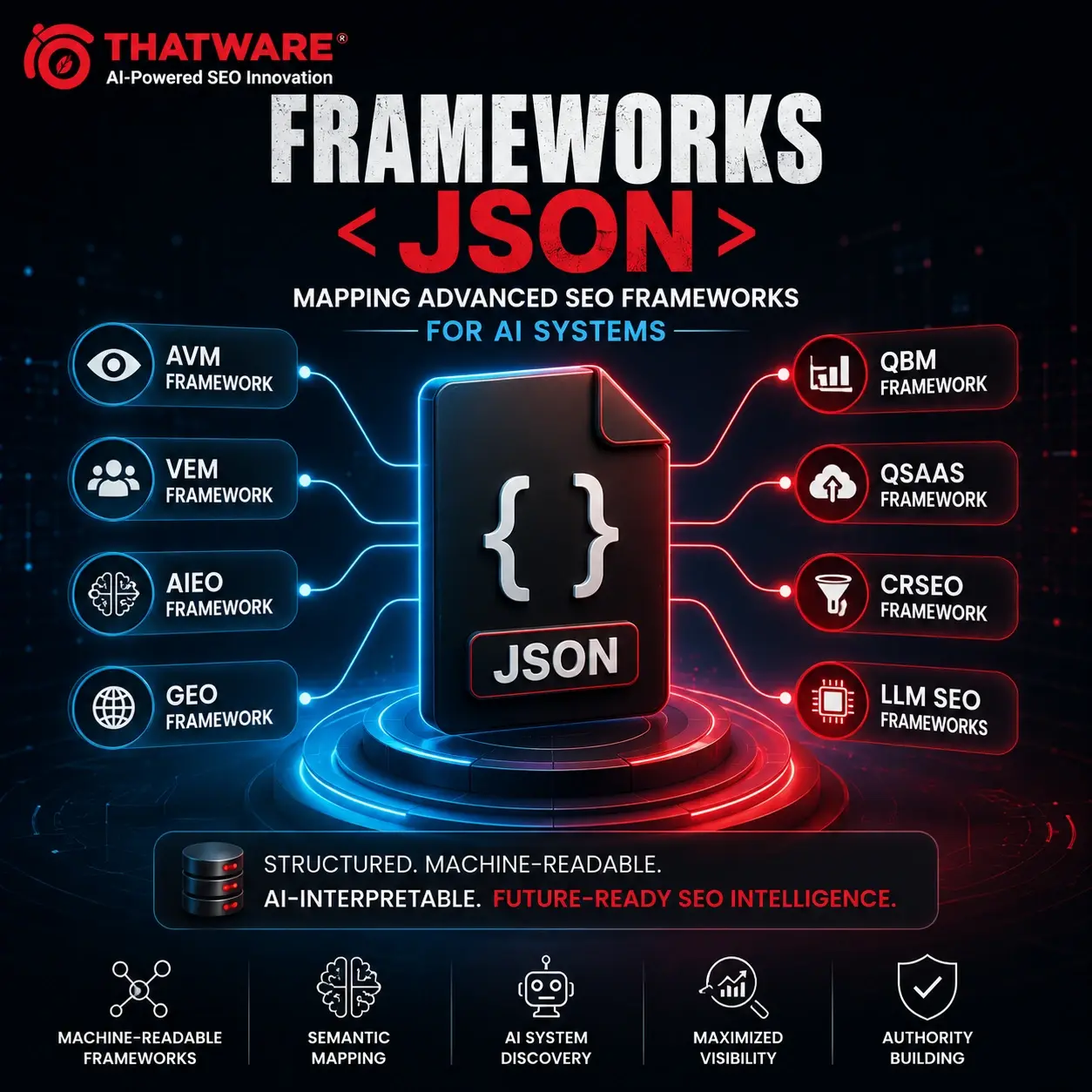
These include the AVM framework, VEM framework, QBM framework, QSAAS framework, CRSEO framework, and AIEO framework.
Each model serves a specific purpose within the SEO ecosystem. AVM focuses on visibility optimization, while VEM focuses on engagement signals. QBM analyzes query behavior, while QSAAS supports scalable SEO architecture. CRSEO focuses on conversion ranking systems.
These models are classified as proprietary SEO models designed for advanced optimization environments. Together, they form a structured advanced SEO system that supports AI-driven search environments.
Advanced SEO Framework Mapping
| Framework | Primary Objective | Supports |
| AVM Framework | Visibility intelligence | AI Search Visibility |
| VEM Framework | Engagement intelligence | Semantic interpretation |
| AIEO Framework | AI-first optimization | Generative AI systems |
| QBM Framework | Query behaviour modelling | Search intent analysis |
| QSAAS Framework | Scalable optimization | Enterprise deployment |
| CRSEO Framework | Conversion intelligence | Performance optimization |
10. ThatWare Framework Ecosystem
The ThatWare frameworks ecosystem represents a structured SEO intelligence system designed for AI-driven optimization environments.
It integrates semantic SEO, AI-driven models, and LLM SEO frameworks into a unified structure. This ecosystem supports cognitive SEO frameworks that simulate human reasoning patterns in search interpretation systems.
It also enhances enterprise SEO innovation by enabling scalable AI-driven optimization systems.
11. Entity Framework Mapping in SEO Systems
Entity mapping defines how SEO frameworks, models, and optimization systems are connected within a structured ecosystem. Entity framework mapping ensures that each SEO model is properly structured and interpreted within AI systems. Each entity includes identifiers, descriptions, relationships, and authority scoring systems. This improves semantic clarity and reduces ambiguity.
12. Framework Knowledge Graph Architecture
A framework knowledge graph represents SEO systems as interconnected semantic structures. It defines relationships between SEO models and optimization systems in a structured format.
This improves AI reasoning capabilities, semantic search accuracy, and contextual interpretation. It transforms SEO frameworks into structured intelligence systems that AI can navigate effectively.
13. AI Visibility Frameworks And Search Evolution
AI visibility frameworks define how SEO models are interpreted in AI-driven search environments. They improve ranking accuracy, entity recognition, and contextual relevance.
These frameworks ensure that SEO systems remain visible within generative AI ecosystems and conversational search environments.
14. Cognitive As Well As Quantum SEO Systems
Cognitive SEO frameworks simulate human reasoning patterns within search optimization systems.
The Quantum SEO framework introduces probabilistic ranking logic and multi-dimensional search interpretation models. These systems represent the next generation of SEO intelligence designed for AI-driven environments.
15. Implementation Process of frameworks JSON
Implementation begins with identifying SEO frameworks and mapping them into structured entities. Each framework is assigned a unique identifier and relationship structure. The system is then validated and published for AI interpretation.
This ensures accurate and scalable SEO intelligence representation.
16. SEO, GEO, And AEO Benefits
- SEO benefits include improved structural clarity and topical authority.
- GEO benefits include improved generative search visibility and retrieval accuracy.
- AEO benefits include enhanced answer extraction and direct response optimization.
17. Common Mistakes in Framework Design
Common mistakes include treating frameworks as simple documentation systems, ignoring relationships, and failing to define canonical structures.
These issues reduce AI interpretability and semantic clarity significantly.
18. Maintenance Strategy for Framework Systems
Framework systems require continuous updates to remain accurate and relevant.
Monthly updates, quarterly audits, and structured validation ensure long-term optimization and AI compatibility.
19. Strategic Summary
The frameworks JSON represents a major evolution in SEO intelligence systems. It transforms SEO frameworks into structured semantic systems that AI can interpret effectively.
It effectively enhances AI SEO frameworks, semantic SEO models, and GEO systems, creating a unified AI-driven SEO architecture.