1/ Introducing Filecoin Onchain Cloud: an open, verifiable cloud built on content-addressed data, transparent service delivery, and programmable payments.
All onchain. No vendor lock-in.
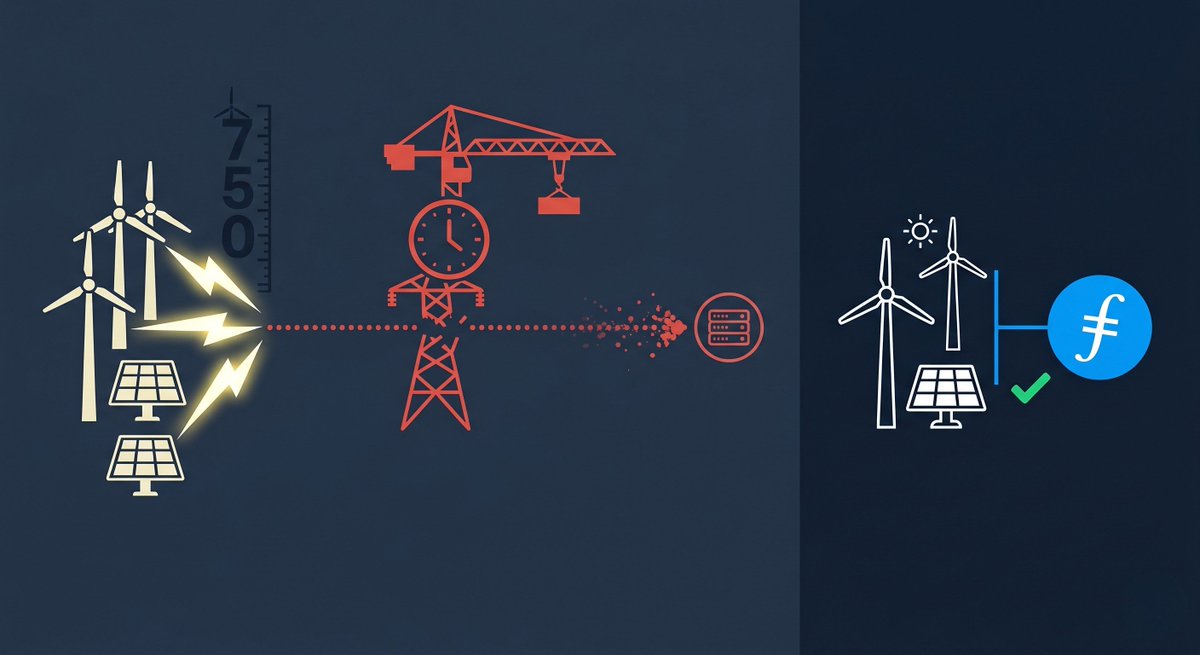
750 gigawatts of renewable energy will be added globally in 2025.
Most of it sits too far from data center hubs for existing transmission to reach.
Building the lines to connect it can take up to a decade.
Filecoin providers deploy directly at the source. No buildout required.
.@JamesKurzFIL: compute used to follow people.
Now it follows power, wherever it's abundant, and there's room to build.
One third of new GPU clusters are going up over 500 kilometers from the nearest storage.
Filecoin operators are already moving toward them.
.@JamesKurzFIL: Most of the world's data was never worth storing at scale, nothing could use it.
Now, the demand for AI is insatiable, and storage is the bottleneck nobody's ready for.
Filecoin is already built for the scale that demand requires.
The EU AI Act requires high-risk AI systems to retain training records for years.
AWS Glacier Deep Archive holds 5PB for ~$60K annually, with 12-hour retrieval.
Filecoin stores the same archive with a cryptographic proof attached. The record doesn't wait on anyone's tier.
PJM, historically a low-curtailment grid, saw renewable curtailment jump nearly sixfold in 2024 and committed to $6.7 billion in transmission upgrades to catch up.
Filecoin providers deploy where power is already stranded.
No transmission buildout required.
Texas curtailed renewable generation sixfold since 2020.
Australia generated and curtailed 7.2 terawatt hours of wind and solar in 2025, double the year before.
Power doesn't need to travel to be useful.
Filecoin providers deploy where that power already is.
.@JamesKurzFIL: "If your competitor can draw on their data lake faster, they train faster."
Infrastructure constraints used to be a cost line item. Now they decide who wins.
Filecoin operators deploy capacity closer to where compute runs, so speed isn't the bottleneck.
Fine-tuning an open-weight model costs up to $50,000 per run.
Twenty iterations build $1 million in institutional knowledge, trapped inside whichever hyperscaler hosts the traces.
Switching models means abandoning the investment. Filecoin is built so it isn't.
Open-weight models exist. The data layer is still closed.
Moving a standard open-source training dataset out of AWS costs $9,000 in egress before a single training run begins.
Filecoin is built for open models on open infrastructure. Zero egress. Data moves freely.
CoreWeave is covering up to $1 million in data migration costs just to win customers from hyperscaler egress fees.
@JamesKurzFIL: "If your data isn't sovereign, you can't move it to where the GPUs are."
Filecoin operators deploy on infrastructure that already exists.
Global renewable energy curtailment exceeded 50 terawatt hours in 2024. Enough to power Norway for a year.
Storage tolerates latency in a way compute cannot.
Filecoin providers deploy directly where that power is stranded.
The GPU story is well-known. The Data Storage story is nascent.
@JamesKurzFIL on @SchwabNetwork: storage demand is already "almost price insensitive."
Filecoin's network is already deployed at the scale that demand requires.